
Scope 1 · Stationary Combustion
Scope 1 Stationary Combustion Calculator | GHG Protocol & AR6 Aligned
Audit-grade CO₂e emissions from on-site fuel combustion. Choose DEFRA 2026 (UK) or IPCC 2006 (global) factor source; choose Regulatory (AR5 inherited) or Engineering (AR6 reweighted) GWP disclosure. Scope 3 Category 3 (well-to-tank) companion always computed where DEFRA WTT data available.
Regulatory mode (DEFRA factor as-published, AR5 GWP-100 inherited):
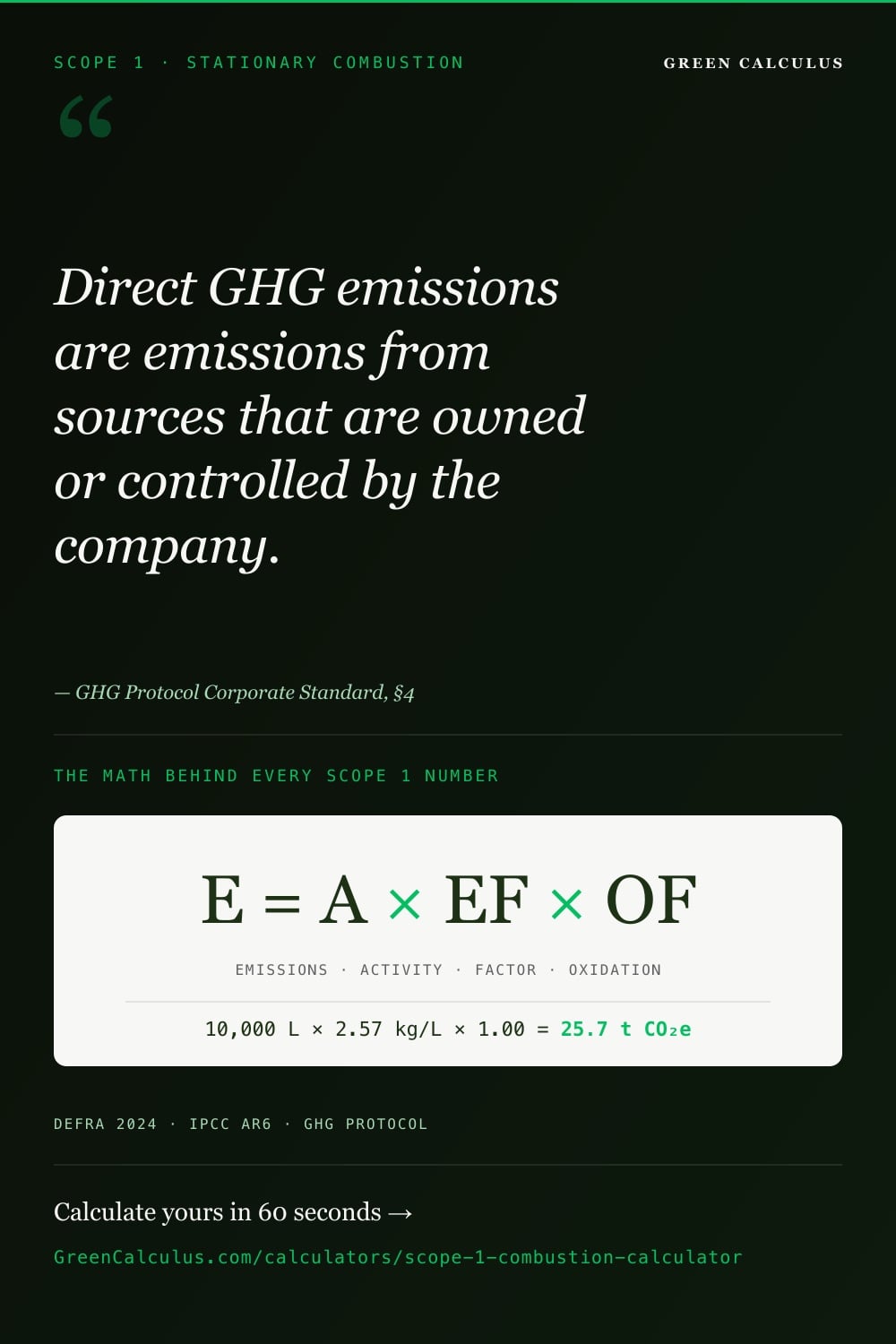
Emissions (tCO₂e) = [Quantity × DEFRA factor (kg CO₂e/unit) × Oxidation factor] ÷ 1,000
DEFRA’s factor table is constructed at AR5 GWP-100 and published as a single CO₂e value per unit. GWP is not re-applied — the factor is consumed as-is. This is the SECR / ESOS / NEA-aligned path.
Engineering mode (DEFRA components reweighted at AR6 GWP-100, gas-by-gas):
Step 1: Decompose DEFRA factor into CO₂, CH₄, and N₂O components (each already CO₂e-weighted at AR5).
Step 2: Derive raw gas masses by dividing each component by its AR5 GWP (CH₄ ÷ 28; N₂O ÷ 265; CO₂ unchanged).
Step 3: Apply AR6 GWP-100 (CH₄ × 27.0, the non-fossil value the GHG Protocol uses for combustion; N₂O × 273; CO₂ × 1) and sum.
For natural gas the drift between modes is about −0.004%; for fuels with a higher N₂O share (coal, fuel oil) it is larger. This is the SBTi / CDP / GHG Protocol voluntary-reporting path.
Global IPCC factor source:
IPCC 2006 Guidelines for National Greenhouse Gas Inventories, Vol. 2 (Energy) publishes per-gas emission factors in kg of gas per TJ on a net calorific basis. The calculator converts your fuel to net GJ, then multiplies by the per-gas EF and AR6 GWP gas-by-gas. There is no AR5/AR6 distinction here — IPCC factors are gas-mass and are weighted at AR6 directly. Use this path for non-UK reporting.
The HHV/LHV toggle changes only the GJ figure displayed for intensity; it never changes a total. DEFRA factors are unit-locked (per kWh / m³ / litre / tonne), and the IPCC path always works in net GJ to match its factors. Energy-unit inputs (kWh, GJ, MMBtu, therms) are taken as gross, as UK and US bills are. Oxidation factor defaults to 1.0 (complete combustion) per GHG Protocol §3.2.
Scope boundary: Scope 1 stationary combustion (CO₂, CH₄, N₂O from on-site fuel combustion). The calculator additionally produces a parallel Scope 3 Category 3 (well-to-tank, upstream fuel) figure when DEFRA WTT data is available — reported as a separate inventory line per GHG Protocol Scope 3 Standard. Excluded: fugitive emissions, mobile combustion, biogenic CO₂, process emissions.
Unit options update automatically for the selected fuel.
Changes only the GJ shown. UK and US energy bills are gross (HHV).
Pick the publisher your reporting is made under. A national source that does not publish a given fuel falls back to IPCC global, and the result says so on the line. Two sources are listed but unavailable — the reason is on the option.
Regulatory: DEFRA factor as-published. Engineering: components reweighted at AR6.
Source: utility bills, meter readings, or fuel delivery records.
Please enter a valid positive number.
Annualised: result × (12 ÷ period months).
GHG Protocol §3.2 default = 1.0 (complete combustion assumed).
For audit trail only — does not affect calculation.
Included in the audit trail and JSON export.
Audit mode exposes the full calculation chain for verification.
Enter fuel quantity above to calculate
Results appear instantly. Audit trail and Scope 3 Cat 3 (WTT) companion available after calculation.
Results are estimates based on standardised emission factors and GHG Protocol methodology. Site-specific combustion conditions, fuel composition variability, and equipment type may cause actual emissions to differ from calculated values. For regulatory submissions, verify factors against national inventory guidance (Tier 2/3 methods where available). Full methodology notes.
Stationary combustion — boilers, furnaces, turbines, generators — is the primary Scope 1 source for most industrial and commercial organisations, and the first line auditors interrogate in any GHG verification. Getting it wrong means a qualified opinion, a restated inventory, or in regulated markets like Singapore, a direct tax liability.
This calculator applies the GHG Protocol Corporate Standard methodology with full provenance: DEFRA 2026 factors for UK regulatory reporting (AR5 GWP-100, as published) or the IPCC 2006 default factors for global voluntary reporting. Both factor sources support a parallel Engineering mode that decomposes the published factor and reweights at AR6 GWP-100 — producing the figure auditors expect for science-based target work — alongside the as-published Regulatory mode figure for SECR / ESOS / NEA submission.
We do not hide our math. Read the complete methodology — including the full dual-mode AR5/AR6 architecture, factor provenance from MasterBrain v2026.284, and the well-to-tank companion calculation — to prepare for your GHG inventory audit.
Read Full Methodology Whitepaper →Related Calculators
What Is Stationary Combustion? Scope, Boundary, and Asset Coverage
Stationary combustion is the single largest Scope 1 emissions source for most industrial, manufacturing, and commercial organisations. It covers the direct burning of fossil fuels in fixed equipment — equipment that does not move as part of its primary function. The GHG Protocol Corporate Standard defines it as combustion in stationary equipment such as boilers, furnaces, burners, turbines, heaters, incinerators, engines, flares, etc.
Equipment in Scope
Common in-scope assets include industrial boilers producing steam for process heat or space heating; gas-fired furnaces and kilns in manufacturing; diesel or gas-fired emergency generators; combined heat and power (CHP) turbines (allocated in the CHP cogeneration calculator); process heaters in refineries and chemical plants; and incinerators for waste disposal where the reporting entity owns or controls the equipment.
Under the GHG Protocol, direct GHG emissions are those from sources that are owned or controlled by the company. A natural gas boiler leased to you under a finance lease almost certainly falls within your boundary. A steam supply you purchase from a third-party utility does not — that is a Scope 2 emission from purchased heat.
What Stationary Combustion Is Not — The Mobile Combustion Boundary
The single most common misallocation in corporate GHG inventories is the placement of diesel fuel for company vehicles inside stationary combustion. The GHG Protocol draws a hard line: mobile combustion covers fuel burned in transportation devices such as automobiles, trucks, buses, trains, airplanes, boats, ships, barges, vessels, etc. A diesel-powered forklift operating inside a warehouse is mobile combustion. A diesel generator standing next to that warehouse is stationary combustion.
Mobile combustion factors from EPA AP-42 and DEFRA account for varying engine load cycles, cold starts, and drivetrain losses that are irrelevant to stationary boilers. Use the Scope 1 Mobile Combustion Calculator for fleet and transport fuel.
Included vs. Excluded Emissions
| Included in this calculator | Excluded — report separately |
|---|---|
| CO₂ from fossil fuel combustion in fixed equipment | Biogenic CO₂ (e.g., burning wood, biogas, biomass) — report separately per GHG Protocol Chapter 9 |
| CH₄ from incomplete combustion | Fugitive methane from gas pipelines, storage, or equipment leaks — separate Scope 1 category |
| N₂O from combustion at temperature | Mobile combustion (company vehicles, vessels, aircraft) |
| Scope 3 Category 3 well-to-tank companion (computed in parallel) | Process emissions (e.g., CO₂ from calcination in cement — separate calculation required) |
| On-site electricity generation from fossil fuel combustion (CHP, standby generators) | Tank-to-wheel emissions for fuel that left site (delivery / transit) — Scope 3 if material |

The Calculation Methodology — Dual-Mode AR5/AR6 Architecture
Two Orthogonal Choices: Factor Source and GWP Disclosure Mode
This calculator separates two questions that are often conflated. Where does the emission factor come from? (DEFRA 2026 for UK reporting, or IPCC 2006 defaults for global). How is the global warming potential disclosed? (Regulatory mode = factor as-published; Engineering mode = decomposed and reweighted at AR6). The answers are independent.
Regulatory Mode — DEFRA Factor as Published (AR5 Inherited)
DEFRA’s published factor table is constructed at AR5 GWP-100 (CH₄ = 28; N₂O = 265). The published value is a single CO₂e number per unit (per kWh, per m³, per litre, per tonne) — already pre-aggregated. Regulatory mode consumes this number as-is. GWP is not re-applied. This is the path used for UK SECR, ESOS, and Singapore NEA submissions.
Engineering Mode — DEFRA Components Reweighted at AR6
Step 2: Recover gas masses: CH₄_mass = CH₄_component ÷ 28; N₂O_mass = N₂O_component ÷ 265
Step 3: Apply AR6 GWP-100: AR6_factor = CO₂_component + (CH₄_mass × 27.0) + (N₂O_mass × 273)
Step 4: Total Scope 1 (tCO₂e) = [Quantity × AR6_factor × Oxidation] ÷ 1,000
For natural gas the drift between Regulatory and Engineering modes is about −0.004%; for fuels with a higher N₂O share (coal, fuel oil) the drift is larger but typically still under 0.1%. Engineering mode is the path for voluntary reporting on the AR6 basis, which the GHG Protocol and CDP recommend.
Global IPCC Factor Source
tCO₂e_CO₂ = GJ × EF_CO₂ × Oxidation × 1 ÷ 1,000
tCO₂e_CH₄ = GJ × EF_CH₄ × Oxidation × 27.0 ÷ 1,000
tCO₂e_N₂O = GJ × EF_N₂O × Oxidation × 273 ÷ 1,000
Total = sum
IPCC 2006 Guidelines for National Greenhouse Gas Inventories, Vol. 2 (Energy), Chapter 2, publishes per-gas emission factors in kg of gas per TJ on a net calorific basis (Tables 2.2 to 2.5). The calculator converts the activity to net GJ and multiplies by the per-gas EF and AR6 GWP. Because IPCC factors are gas-mass (not pre-aggregated CO₂e), there is no Regulatory/Engineering distinction in the IPCC path — both modes produce the same result. Use IPCC for non-UK reporting or where regulator-specific factors are not mandated.
DEFRA publishes one CO₂e number per fuel — but that number is built using GWP values from the IPCC’s Fifth Assessment Report (AR5). Most science-based target frameworks now expect the Sixth Assessment (AR6) GWP values, which are slightly higher for methane and nitrous oxide. Regulatory mode reports DEFRA’s number unchanged — the right choice for UK regulatory submissions. Engineering mode pulls DEFRA’s number apart, reweights the methane and nitrous oxide components at AR6, and reassembles — the right choice for an inventory kept on AR6. The drift is tiny for natural gas (about −0.004%) and for coal (about +0.01%). Both numbers are defensible; which one you cite depends on who is reading.
The Oxidation Factor — What It Is and When to Change It
The default value is 1.0, meaning complete combustion is assumed. For most modern industrial boilers and furnaces burning natural gas, diesel, or LPG, this assumption is appropriate. The oxidation factor becomes material when combustion is demonstrably incomplete — for example, older coal-fired boilers with unburned carbon in ash. Reducing the factor requires documented justification. If you do not have site-specific data, leave it at 1.0. The oxidation factor does not apply to the WTT companion — upstream emissions occur regardless of combustion completeness.
HHV vs. LHV — Which Heating Value Standard to Use
HHV (Higher Heating Value, also called Gross Calorific Value or GCV) includes the latent heat recovered from water vapour condensation in combustion products. LHV (Lower Heating Value, also called Net Calorific Value or NCV) excludes it. For natural gas, the difference is approximately 10%. DEFRA publishes each fuel on both bases, and its methodology makes gross the default for natural gas in kWh; the IPCC 2006 default factors are on a net basis. See calorific value for the conversion ratios.
| Data source | Typical basis | Notes |
|---|---|---|
| UK gas utility bills | HHV (gross CV) | UK billing is gross CV. Use DEFRA’s gross-CV kWh factor, which is DEFRA’s default for gas. |
| US / Canadian gas utility bills | HHV | HHV is standard across North American gas billing. |
| European gas metering (non-UK) | LHV | Continental European national inventories typically use LHV. Verify with your utility supplier. |
| DEFRA 2026 conversion factors | Both (gross and net) | Derived on a net basis from the UK inventory and published per kWh on both bases. DEFRA’s methodology makes gross the default for natural gas in kWh unless your supplier states net. |
| IPCC 2006 default factors | LHV (net CV) | Tables 2.2 to 2.5 are per TJ on a net calorific basis. The calculator converts your fuel to net GJ for this path. |
| Fuel delivery records (diesel, LPG) | Volume (litres/gallons) | The DEFRA path uses volumetric factors directly. The IPCC path converts to GJ first. |
Think of HHV as the energy content on the label — the theoretical maximum. LHV is what you actually get out of it in practice, because some energy escapes as steam. UK gas bills use the label (HHV/gross), and DEFRA’s default gas factor matches it. IPCC factors and most European process engineers work with what you actually get (LHV/net). Either is valid — match your data to the factor’s basis. In this calculator the toggle only changes the GJ shown; the IPCC path always converts to net GJ to match its factors.
Worked Example — Natural Gas, 4,847 kWh, Both Modes Side-by-Side
This example mirrors Example 1 of the Natural Gas Combustion methodology exactly. The user can reproduce the result in either page and verify the calculator against the methodology. Numbers are an audit snapshot taken against MasterBrain v2026.182 on 2026-09-05.
Why All Three Gases Must Be Reported — CO₂, CH₄, and N₂O
The GHG Protocol Corporate Standard is explicit in Chapter 9: companies must report emissions data for all six Kyoto-covered GHGs separately. Reporting only CO₂ is a compliance deficiency, not a conservative choice.
The GWP Weighting Effect — Why Small Gas Quantities Matter
For natural gas combustion the methane component contributes a small share of total CO₂e — but not zero. At AR6 GWP-100 (27.0 for combustion methane) a building consuming 1,939 GJ of gas (roughly 538,500 kWh) emits enough CH₄ to register as approximately 0.15 tCO₂e — small in proportion (about 0.15% of the natural-gas total) but not nil. Across a large industrial portfolio consuming 100,000+ GJ annually, the methane contribution accumulates to a few tCO₂e per year. Across a ten-year baseline this adds up to dozens of tCO₂e, all of which must be reported and any of which an auditor can ask to see.
N₂O matters more per kilogram. At AR6 GWP-100 (273) the gas contributes proportionally more for fuels with elevated nitrogen content or higher combustion temperatures. For a coal-fired facility consuming 50,000 GJ annually (about 1,800 tonnes of industrial coal), N₂O contributes approximately 23 tCO₂e per year on its own — an order of magnitude larger than for an equivalent gas facility.
Reporting Format Requirements Under GHG Protocol
Your sustainability report should show a breakdown table, not just a total. The calculator’s gas-by-gas display and JSON export provide exactly this breakdown. In Regulatory mode, the gas split is shown for transparency at AR5 weights (matching the published DEFRA factor); in Engineering mode it’s shown at AR6 weights.
Audit Checklist — What Gets Flagged in a Third-Party Verification
Third-party verification of GHG inventories — whether under ISO 14064-3, ISAE 3410, or a voluntary verification protocol — follows a systematic process of tracing each material emission source from raw activity data through to the reported tCO₂e figure.
Fuel-Specific Guidance — Carbon Intensity, Use Cases, and Common Mistakes
Natural Gas
Natural gas has the lowest carbon combustion intensity of the fossil fuels in this calculator. Per MasterBrain v2026.284, the DEFRA 2026 factor is 0.18231 kg CO₂e/kWh (gross CV) or equivalently 2.02633 kg CO₂e/m³. The IPCC 2006 global path uses 56.1 kg CO₂/GJ on a net calorific basis. Converted to the same gross kWh, the two agree within about 1%; the remaining gap reflects UK grid gas composition (DEFRA) against the IPCC international default.
Natural gas carries a Scope 3 liability: upstream methane leakage during extraction, processing, and transmission is classified under Scope 3, Category 3. The calculator computes this WTT companion automatically (DEFRA WTT-Fuels: 0.03021 kg CO₂e/kWh) and reports it as a separate Scope 3 line.
Common reporting mistake: confusing kWh and m³ on a UK gas bill. UK bills typically show kWh as the headline figure with m³ in finer print. Match the calculator unit to your billing unit precisely.
Most on-site diesel equipment in the UK runs on gas oil (red diesel), not forecourt road diesel — if in doubt, check whether the fuel is dyed red and select “Gas oil (red diesel)”. The two are separate DEFRA fuels with different factors; picking the wrong one mis-states Scope 1 by about 7%.
Diesel (road / B7 blend)
The DEFRA 2026 factor for road diesel is 2.58354 kg CO₂e/litre (per MasterBrain v2026.284). This is standard UK forecourt diesel (EN 590), which by law contains up to 7% biodiesel (FAME) — DEFRA names it “Diesel (average biofuel blend)”. The IPCC 2006 global factor for gas/diesel oil is 74.1 kg CO₂/GJ on a net calorific basis. For UK SECR reporting, the DEFRA factor source is the regulator-specified path; for global reporting, the IPCC 2006 defaults are the international convention. Road diesel WTT companion: 0.61101 kg CO₂e/litre — about 24% of the Scope 1 figure.
Common reporting mistake: barrel vs. litre confusion. One US barrel equals 158.987 litres. One US gallon equals 3.785 litres. The calculator includes unit conversion for these but the source document should be checked.
Gas oil (red diesel)
The DEFRA 2026 factor for gas oil is 2.75541 kg CO₂e/litre (per MasterBrain v2026.284, gross CV, AR5 GWP-100) — about 7.2% higher than road diesel, because gas oil is pure fossil distillate with no biofuel blend. DEFRA names it “Gas oil”; it is dyed red and carries rebated duty. This is the default fuel for most stationary diesel assets: standby and emergency generators, agricultural and construction plant (permitted sectors post-2022), industrial process heaters, and CHP back-up. Gas oil WTT companion: 0.62665 kg CO₂e/litre.
Common reporting mistake: selecting “Diesel (road / B7 blend)” instead of “Gas oil (red diesel)” for a red-diesel generator under-reports emissions by approximately 7%. If the fuel is dyed red, select gas oil.
Coal — Bituminous, Sub-bituminous, and Lignite
The DEFRA 2026 industrial coal factor (used as the bituminous proxy in this calculator) is 2,415.04 kg CO₂e/tonne (current MasterBrain v2026.284, up from 2,395.29 in the DEFRA 2025 edition, itself reconciled from an earlier approximate 2,340.3 in prior published material). The IPCC global per-GJ values are 94.67 (bituminous), 96.61 (sub-bituminous), and 101.00 kg CO₂/GJ (lignite) — lignite is approximately 7% higher carbon intensity per GJ than bituminous because of its lower energy density.
Lignite (brown coal) is younger geologically — it contains more moisture and less carbon. Bituminous coal is older, denser, and more carbon-rich. Because you need more lignite to generate the same amount of heat, the intensity (emissions per GJ) ends up being higher for lignite. That’s why coal grade matters.
For UK reporting, DEFRA publishes industrial coal as a single CO₂e factor (used here for the bituminous category). DEFRA does not separately publish sub-bituminous or lignite — for those grades the calculator falls back to the IPCC global factor source automatically and surfaces this in the audit trail. Common reporting mistake: using a single “coal” emission factor without specifying the grade.
Geographic and Regulatory Context — Global, UK, and Singapore
Global Baseline — IPCC 2006 Defaults
The global emission factor set — IPCC 2006 Guidelines, Vol. 2 (Energy), Chapter 2 Tables 2.2 and 2.4, for CO₂, CH₄ and N₂O on a net calorific basis — is appropriate for most voluntary sustainability reporting (CDP, GRI, TCFD-aligned disclosures), science-based target setting (SBTi), and GHG Protocol-aligned corporate inventories where regulator-specific factors are not mandated. The IPCC factor source applies AR6 GWP-100 gas-by-gas; there is no AR5/AR6 distinction in the IPCC path.
UK Reporting — DEFRA 2026 and SECR / ESOS Obligations
Large UK companies subject to SECR normally use DEFRA’s conversion factors for their mandatory energy and carbon disclosures: the regulations do not name a factor set, but these are the government’s published default. DEFRA factors, published by the Department for Energy Security and Net Zero (DESNZ, formerly BEIS), are published per kWh on both gross and net calorific bases (gross is DEFRA’s default for natural gas in kWh, because UK suppliers bill on gross) and are updated annually each June. The current applied values are carried by MasterBrain v2026.284 (DEFRA 2026, June 2026 release).
For SECR-aligned reporting: select DEFRA (UK) as the factor source and Regulatory · AR5 as the GWP mode. This produces the result in the form and with the GWP basis that matches DEFRA’s published methodology. If you are simultaneously preparing a CDP submission or SBTi inventory at AR6, switch the GWP mode toggle to Engineering · AR6 — the same factor source, reweighted. The drift is rounding-level for natural gas; document it in your methodology notes regardless.
ESOS Phase 3 requires energy consumption reporting by source, including on-site fuel combustion. The activity data (GJ of fuel consumed) is the primary metric required for ESOS compliance and is shown in the calculator’s energy reference row.
Singapore — Carbon Tax and Precision Reporting
Singapore’s Carbon Pricing Act, administered by the NEA, applies a carbon tax to large direct emitters with annual emissions at or above 25,000 tCO₂e. The IPCC 2006 default factors used in this calculator’s global path are consistent with NEA MRV framework requirements for most fuel types, though practitioners should verify against the specific NEA-approved factor tables for their reporting year. The calculator’s JSON export and audit trail are specifically designed to support NEA submission documentation.
Data Sources, Factor Versioning, and Update Transparency
Emission Factor Provenance
DEFRA 2026 GHG Conversion Factors (DESNZ, June 2026) are the primary source for the UK path. The factors are pre-aggregated CO₂e values constructed at AR5 GWP-100. MasterBrain v2026.284 stores both the published factor and the underlying CO₂/CH₄/N₂O components — the calculator reads the published factor for Regulatory mode and the components for Engineering mode reweighting.
IPCC 2006 Guidelines, Vol. 2 (Energy), Chapter 2 provides the CO₂, CH₄ and N₂O emission factors for the global path, in kg per TJ on a net calorific basis (Table 2.2 for diesel and gas oil, Table 2.4 for the other fuels). Each default comes with a lower and upper bound: for natural gas CO₂ the range is 54,300 to 58,300 kg/TJ around the 56,100 default. The CH₄ and N₂O defaults are far less certain; their bounds run to roughly a third and three times the default.
GWP Version and the AR5 → AR6 Transition
The transition from IPCC AR5 (2013) to IPCC AR6 (2021) GWP values changed the weighting for both non-CO₂ gases relevant to stationary combustion. For combustion methane, which the GHG Protocol weights with the non-fossil value, CH₄ fell from 28 (AR5) to 27.0 (AR6), about 4% lower. (The fossil value, 29.8, is for leaks from oil, gas and coal and for fossil industrial processes.) N₂O increased from 265 (AR5) to 273 (AR6), approximately a 3% increase. Note that the AR4 (2007) values often still seen in legacy spreadsheets — CH₄ = 25; N₂O = 298 — are obsolete and should not be cited as either AR5 or AR6.
DEFRA’s published factor table inherits AR5 GWP-100 (CH₄ = 28; N₂O = 265). For natural gas, the Engineering-mode reweight at AR6 produces a drift of approximately −0.004% — well within rounding for most reporting purposes but auditable in a science-based-target inventory. For coal, the drift is approximately +0.01%; for diesel approximately +0.04%. The drift is always small but always non-zero.
If your corporate inventory was established using AR5 GWPs and you are transitioning to AR6, you will need to recalculate your base year emissions using the new GWPs. Presenting a time series with AR5 for historical years and AR6 for the current year without restating prior years is a consistency finding. Engineering mode is designed to make this transition mechanical: same factor source, same components, different GWP weights.
Factor Uncertainty — What ±30% on CH₄ Actually Means
A ±30% uncertainty on CH₄ means that for a facility emitting 10 tCO₂e from CH₄ combustion, the true value could plausibly range from 7 to 13 tCO₂e. For most organisations, CH₄ and N₂O together represent less than 1% of total combustion CO₂e from natural gas, so the absolute uncertainty is manageable. For coal-fired facilities, the uncertainty is more material because the CH₄/N₂O share of total combustion CO₂e is several times higher.
Version History and Update Schedule
This calculator’s emission factor data is sourced from the live MasterBrain (MasterBrain v2026.284 · updated 6 Nov 2026). DEFRA conversion factors are updated annually each June; this calculator updates within 30 days of each DEFRA release via MasterBrain. IPCC factors are updated with each Assessment Report cycle; the current AR6 factors will remain current until AR7 is published (~2028). The data version badge in the calculator footer always reflects the live MasterBrain version in use.
What’s Next? Completing Your Scope 1 Inventory
You have completed Scope 1 stationary combustion (and Scope 3 Cat 3 well-to-tank for fuels with DEFRA WTT data) — typically representing 25–60% of total Scope 1 emissions for manufacturing, industrial, and commercial organisations with on-site fuel combustion.
The GHG Protocol requires Scope 1 and Scope 2 to be reported as a minimum. Scope 3 (including the Category 3 WTT companion this calculator already produces) is strongly encouraged.
Quick converters: fuel carbon content to CO₂, g CO₂/MJ to g CO₂/kWh and t CO₂/TJ to kg CO₂/GJ.
Frequently Asked Questions
No — and this is a deliberate design decision. The GHG Protocol requires that direct CO₂ emissions from biomass combustion be reported separately from the scopes, not included in the Scope 1 tCO₂e total. The emission factors in this calculator are sourced from DEFRA 2026 and the IPCC 2006 default tables for fossil fuels only.
Legitimate differences arise from four sources: different emission factor values (DEFRA 2026 vs DEFRA 2025 vs IPCC vs EPA), different GWP versions (AR5 with CH₄ = 28, N₂O = 265 vs AR6 with CH₄ = 27.0, N₂O = 273), different heating value bases (HHV vs LHV conversion factors), and whether all three gases are included or just CO₂.
Export the JSON from this calculator, which includes every factor value used and the MasterBrain version, and compare against the other tool’s stated methodology. Differences greater than 5% usually indicate a GWP version mismatch, factor-source mismatch, or HHV/LHV basis discrepancy.
Match the basis of your data source. For UK organisations: your gas utility bill is on a gross calorific value (HHV/GCV) basis, and DEFRA’s default gas factor is gross to match it. For European facilities whose energy balances are expressed in NCV (LHV) — use LHV. The practical difference for natural gas is approximately 10%.
In this calculator the HHV/LHV toggle never changes the total. DEFRA factors are unit-locked (per kWh / m³ / litre / tonne), and the IPCC path always converts to net GJ because its factors are net-basis. The toggle only changes the GJ display used for intensity.
The oxidation factor represents the fraction of the fuel’s carbon content that is fully oxidised to CO₂ during combustion. The GHG Protocol §3.2 specifies a default of 1.0. You should only deviate from 1.0 if you have site-specific evidence of incomplete combustion from continuous emission monitoring or stack testing. Any deviation requires documented justification. The oxidation factor is not applied to the WTT companion calculation — upstream emissions occur regardless of how completely the fuel is burned at the point of use.
In proportional terms, no — for natural gas combustion, CO₂ accounts for approximately 99.7% of total tCO₂e, with CH₄ and N₂O making up the remaining 0.3%. However, “not significant in proportion” does not mean “omit.” The GHG Protocol requires all three gases to be reported. For coal-fired facilities, the share is materially higher — N₂O alone can contribute 0.5–1% of the Scope 1 total. The calculator’s gas-by-gas breakdown surfaces these contributions transparently in both Regulatory and Engineering modes.
Regulatory mode uses the DEFRA factor as published. DEFRA constructs its CO₂e factors using AR5 GWP-100 (CH₄ = 28; N₂O = 265). The published factor is consumed as a single number; GWP is not re-applied. This is the path for UK SECR, ESOS, and Singapore NEA submissions where the regulator specifies the factor source.
Engineering mode takes the same DEFRA factor, decomposes it into CO₂/CH₄/N₂O components, recovers the underlying gas masses (by dividing each component by its AR5 GWP), and re-aggregates using AR6 GWP-100 (CH₄ = 27.0; N₂O = 273). For natural gas the resulting drift is approximately −0.004% — within rounding for most purposes but auditable. This is the path for any voluntary inventory framed at AR6 GWP.
For the Global IPCC factor source, the two modes produce identical results — IPCC factors are gas-mass values weighted at AR6 directly, so there is nothing to reweight.
Both are legitimate, and for natural gas they agree closely. For 4,847 kWh, the DEFRA 2026 path (UK regulatory) gives 0.884 tCO₂e in either mode and the IPCC 2006 global path gives about 0.889 tCO₂e, about 0.5% higher. The small gap reflects UK grid gas composition (DEFRA) against the IPCC international default, and AR5 against AR6 weighting of the methane and nitrous oxide. Before 5 October 2026 the IPCC path applied its net-basis factors to gross energy and showed about 0.98 tCO₂e; that was a calculator error, now corrected.
Choose the factor source that matches your reporting context. UK regulatory submissions: DEFRA. Non-UK or voluntary global reporting: IPCC. Do not mix sources within a single inventory year — the audit trail will flag this as a consistency issue.
Yes. A diesel generator that is physically fixed to a location is stationary combustion under the GHG Protocol definition. A generator mounted on a truck chassis and driven to sites is mobile combustion. A generator bolted to a concrete pad outside your building is stationary combustion, even if it is only operated occasionally.
Note that most generators run on gas oil (red diesel), not road diesel — select “Gas oil (red diesel)” (DEFRA 2.75541 kg CO₂e/litre), not “Diesel (road / B7 blend)” (2.58354). The two differ by about 7%, so the wrong selection materially mis-states your Scope 1.
The calculator’s global IPCC 2006 path is aligned with the methodology that the NEA MRV framework specifies as the default approach for stationary combustion. The JSON export provides the factor source citations and full calculation chain that NEA requires in facility-level submissions. For formal regulatory submissions, verify that the specific emission factors match the NEA-approved factor tables for your reporting year before finalising.
The calculator currently covers natural gas, diesel (road / B7 blend), gas oil (red diesel), LPG (propane), and three grades of coal. For other fuel types — heavy fuel oil, kerosene, refinery gas, waste-derived fuel — source the appropriate emission factors from MasterBrain (extending coverage is on the development roadmap) or from the IPCC 2006 Guidelines, Vol. 2, Chapter 2. Additional fuels are scheduled in upcoming MasterBrain updates.
Methodology Notes and Limitations
Factor averaging. All emission factors are averages across equipment types and operating conditions. For facilities where emissions from CH₄ and N₂O are material, Tier 2 or Tier 3 measurement approaches are preferable.
Fossil fuels only. Biogenic CO₂ from combustion must be reported separately from the Scope 1 total per GHG Protocol Chapter 9 requirements. Do not use fossil fuel emission factors for biogenic fuels.
Stationary combustion boundary. The practitioner is responsible for confirming that entered fuel consumption relates to fixed equipment only.
WTT companion is illustrative for some fuels. Where MasterBrain has DEFRA WTT data the calculator computes a parallel Scope 3 Category 3 figure. For fuels without DEFRA WTT data (e.g. coal grades), the WTT companion is suppressed and a Scope 3 Cat 3 figure should be sourced separately if material.
No site-specific verification. For regulatory submissions where site-specific accuracy is required, independent verification against facility-specific measurement data is required. This calculator is a calculation aid, not a measurement system.