
How Much Water Does AI Use?

Published figures for the water used by one AI prompt run from 0.12 millilitres to 45, a gap of more than 300 times. Most of that gap is not about water at all: the estimates assume different amounts of energy per prompt and count different things. This page puts every published figure side by side, says what each one counts, and lets you calculate a like-for-like number for any grid.
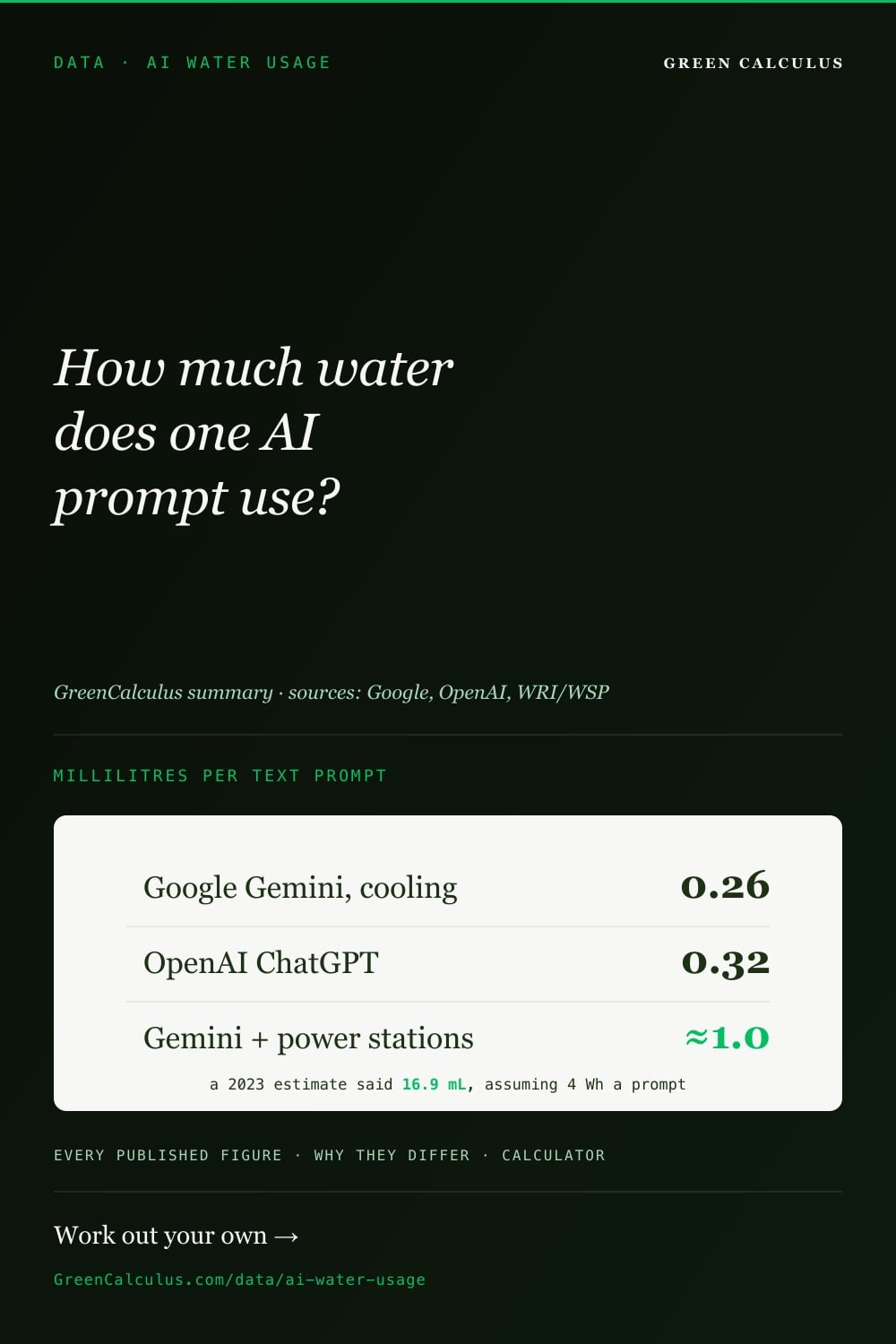
A typical AI text prompt uses well under a teaspoon of water. Google measured 0.26 millilitres for a median Gemini text prompt in May 2025, about five drops, and OpenAI says an average ChatGPT query uses 0.32 mL. Those figures count cooling water at the data center. Add the water power stations use to generate the electricity and, on an average US grid, a Gemini prompt comes to about 1 mL. Older estimates of a 500 mL bottle for every 10 to 50 responses assumed GPT-3 needed about 4 Wh per response, more than ten times what Google and OpenAI now report.
AI water calculator
Pick an energy figure, the data center’s cooling water (WUE) and the electricity grid. The calculator splits the water per prompt into cooling water and power station water, places your result next to every published estimate, and totals it for the prompts you send a day.
Pick an energy figure above to calculate the water per prompt
Results split cooling water from power station water, compare your figure with every published estimate, and total it per day and per year.
Indicative estimate of the water used per AI text prompt, in two parts. Cooling water = the prompt’s IT energy × WUE (litres per kWh of IT energy); the presets are operators’ published fleet averages, not the data center that served any particular prompt. Power station water = the prompt’s total energy × the grid-average water consumed per kWh, from the World Resources Institute and WSP (2020, CC BY 4.0, 2016 generation mixes, including evaporation from hydropower reservoirs). The energy presets are the developers’ own figures (Google, OpenAI) or a published research assumption (Li et al.); OpenAI has not published its method. Not included: model training, networking, your own device, water embodied in chips and servers, and local water stress. Image, video and long reasoning prompts can use many times more energy than a text prompt; no developer has published figures for them.
Water per prompt: every published figure
Four organisations have published a water figure for a single AI prompt or response. They are not measuring the same thing, so the scope column matters as much as the number.
| Source | What it covers | Energy per prompt | Water |
|---|---|---|---|
| Google, Gemini Apps (May 2025) | Median text prompt; data center cooling only | 0.24 Wh | 0.26 mL |
| Google, same prompt, narrow method | AI chips only, no idle machines or overhead; cooling only | 0.10 Wh | 0.12 mL |
| OpenAI, ChatGPT (2025) | Average query; scope and method not published | 0.34 Wh | 0.32 mL |
| Li et al., GPT-3 (estimate) | Medium-length response, Microsoft US average; cooling plus power stations | 4 Wh (servers) | 16.9 mL |
| Mistral AI, Le Chat (2025) | 400-token response; full life cycle, including making the servers | not published | 45 mL |
Google’s paper is the most detailed: it counts the AI chips, the host machines, capacity kept idle for traffic peaks and the data center’s overhead, and multiplies the energy that reaches the servers by its fleet WUE of 1.15 litres per kWh. OpenAI’s figure comes from a blog post by its chief executive with no method attached. Mistral’s was produced with the consultancy Carbone 4 and the French ecological transition agency ADEME, and peer-reviewed. Li et al. is an academic estimate built from GPT-3-era assumptions; its location table runs from 7.1 mL (Ireland) to 47.5 mL (Washington state), the source of the widely quoted “10 to 50 responses per bottle”.
Why the estimates differ so much
Water per prompt is energy per prompt multiplied by water per unit of energy. Three choices move the answer:
- Energy per prompt. Li et al. assumed 4 Wh of server energy per GPT-3 response. Google measured 0.24 Wh for a median Gemini prompt in 2025, and OpenAI reports 0.34 Wh. That one assumption explains most of the gap between 16.9 mL and 0.26 mL.
- What water is counted. Google counts cooling water at the data center. Li et al. add the water consumed by the power stations that make the electricity, which on most grids is larger. Mistral counts a full life cycle, including manufacturing the servers.
- Where the prompt runs. Cooling water ranges from about zero at air-cooled sites to over 2 litres per kWh in hot, humid regions, and power station water from 1.1 litres per kWh (Malta) to 18.6 (Brazil, where hydropower reservoirs dominate), depending on the grid.
Take Google’s median Gemini prompt: 0.24 Wh. At Google’s fleet PUE of 1.09, 0.22 Wh reaches the servers, and at its WUE of 1.15 L/kWh that is 0.25 mL of cooling water, matching Google’s 0.26. On the average US grid, generating 0.24 Wh consumes 3.13 L/kWh × 0.24 Wh = 0.75 mL at the power stations. The total is about 1.0 mL, and three-quarters of it is outside the data center.
Google buys large amounts of clean electricity, and wind and solar use almost no water to generate, so its real power station water may be lower than the US average. The grid average is the fair comparison when the actual supply is not published.
Why does AI use water?
AI runs on chips in data centers, and the chips turn almost all of their electricity into heat. Many data centers remove that heat with evaporative cooling: water evaporates in cooling towers and carries the heat away. Evaporated water does not come back, which is why it counts as water consumed. Evaporative cooling uses less electricity than air cooling, so operators trade water against energy.
The second route is the electricity itself. Thermal power stations evaporate water in their cooling systems, and hydropower reservoirs lose water to evaporation. The World Resources Institute and WSP estimate 3.13 litres consumed per kWh of electricity on the average US grid.
Making the chips and servers also uses water. Of the published per-prompt figures, only Mistral’s life-cycle figure includes it. For how much water data centers use in total and by site, see data center water usage.
How much water AI uses per day
No developer publishes a daily water total, but the published figures allow an estimate. OpenAI told Axios in July 2025 that ChatGPT receives about 2.5 billion prompts a day. At OpenAI’s own 0.000085 gallons a query, that is about 212,000 US gallons (800,000 litres) a day, roughly the home water use of 700 US families.
That figure leaves out the power stations. Counting them at the US-average grid, OpenAI’s 0.34 Wh a query adds 1.06 mL, and the daily total rises to about 914,000 gallons (3.5 million litres), about 3,000 families. This assumes OpenAI’s energy figure includes data center overhead and that the electricity matches the US average; OpenAI publishes neither.
For scale, Google’s data centers, which run all of Google’s services, consumed 10,523 million gallons in 2025, about 28.8 million gallons a day. ChatGPT’s on-site figure above is under 1% of that.
Your own AI water use
At about 1 mL per prompt including power stations, 20 prompts a day comes to 20 mL a day, or about 7.3 litres a year. A US family uses more than 300 gallons of water a day at home, according to the EPA, which matches about 1.1 million prompts at that rate. Individual text prompts are a small share of a household’s water; the concern about AI water is local, where large data centers draw on stressed supplies, and in the speed at which total AI use is growing.
Training a model
Training uses water once, before anyone sends a prompt. Li et al. estimate that training GPT-3 in Microsoft’s US data centers consumed 5.4 million litres: 0.7 million on site and 4.7 million at the power stations. The actual training location is not public. Mistral reports 281,000 cubic metres (281 million litres) for Mistral Large 2 over its training and first 18 months of use, on a life-cycle basis; training and use are reported together. No other major developer has published a training water figure.
What nobody has published
- Images, video and reasoning. Every per-prompt figure above is for text. Generating images or video, or answers from reasoning models that work through many steps, can take far more energy per request, and no developer has published water or energy figures for them.
- Per-prompt figures from most developers. As of October 2026 we found no water-per-prompt figure from Anthropic, Meta or xAI. Meta does publish its data center water use (a WUE of 0.19 L/kWh in 2024), just not per prompt.
- Where prompts are served. The same prompt uses very different amounts of water in Ireland and in Arizona. Providers do not say which data center served a request.
Provenance and data access
| Figures | Source |
|---|---|
| Gemini energy, water and WUE | Elsworth et al. (Google), Measuring the environmental impact of delivering AI at Google Scale, arXiv:2508.15734 (21 August 2025), Table 2. The text gives 0.15 mL for the narrow method; the table gives 0.12, used here. |
| ChatGPT energy and water | Sam Altman, The Gentle Singularity (10 June 2025): “about 0.34 watt-hours” and “about 0.000085 gallons of water”. |
| ChatGPT prompts per day | OpenAI to Axios, reported by TechCrunch (21 July 2025). |
| Le Chat and Mistral Large 2 | Mistral AI, Our contribution to a global environmental standard for AI (22 July 2025). |
| GPT-3 per response and training | Li, Yang, Islam and Ren, Making AI Less Thirsty, arXiv:2304.03271 v5 (26 March 2025), Table 1. |
| Power station water | Reig, Luo, Christensen and Sinistore (2020), Guidance for Calculating Water Use Embedded in Purchased Electricity, World Resources Institute and WSP. CC BY 4.0. 2016 generation mixes. In MasterBrain as section water. |
| Google data center water, 2025 | Google 2026 Environmental Report; see data center water usage. |
| Household comparison | US EPA WaterSense: “The average American family uses more than 300 gallons of water per day at home.” |
All eight AI figures are in the open dataset Data Center Water Benchmarks (version 2026.10.12.1, CSV and JSON, CC BY 4.0, DOI 10.5281/zenodo.23307400; source on GitHub), alongside 77 data center figures, with a water_scope column saying what each one counts. The power station water factors are served by the open factor API:
/wp-json/greencalculus/v1/factors?key_prefix=water.electricity.— 49 countries and 26 US eGRID subregions
For how much electricity data centers and AI use in total, see data center energy consumption. For the energy and carbon side of AI, see the carbon footprint of AI and the AI search carbon calculator.
Frequently asked questions
Google measured 0.26 millilitres of cooling water for a median Gemini text prompt in May 2025, about five drops, and OpenAI says an average ChatGPT query uses 0.32 mL. Adding the water power stations use to make the electricity brings a Gemini prompt to about 1 mL on an average US grid.
Yes. Data centers evaporate water to cool the chips that run AI, and power stations consume water to generate the electricity. The amount per text prompt is small, under a millilitre at the data center, but it adds up across billions of prompts a day and is concentrated where large data centers are built.
AI chips turn their electricity into heat, and many data centers remove that heat with evaporative cooling towers, where water evaporates and is not returned. Power stations that supply the electricity also evaporate water for cooling, and hydropower reservoirs lose water to evaporation.
OpenAI’s chief executive wrote in June 2025 that an average ChatGPT query uses about 0.000085 gallons of water, roughly one fifteenth of a teaspoon (0.32 mL), and about 0.34 Wh of electricity. OpenAI has not published how that water figure was calculated or what it includes.
No developer publishes a daily total. ChatGPT alone receives about 2.5 billion prompts a day (OpenAI, July 2025); at OpenAI’s 0.000085 gallons a query that is about 212,000 US gallons a day. Counting power station water on an average US grid raises it to about 914,000 gallons.
That figure comes from a 2023 estimate that GPT-3 consumed a 500 mL bottle for every 10 to 50 medium-length responses, counting power station water and assuming about 4 Wh per response. Google and OpenAI now report 0.24 to 0.34 Wh per prompt, which puts a bottle at several hundred prompts or more.
Version history
- 1.1 (12 October 2026): correction. Version 1.0 said Meta publishes no data center water figures; it publishes annual WUE and water use, though not per prompt.
- 1.0 (12 October 2026): first published.