
IPCC AR6 Global Warming Potential Values

Global Warming Potential (GWP) values are the conversion factors that translate raw greenhouse gas emissions into a single carbon dioxide equivalent (CO₂e) figure. Every Scope 1 disclosure, every Scope 2 calculation, every Scope 3 line item depends on which Assessment Report the GWP basis is drawn from and which time horizon is applied. A 6.4% upward revision in the methane GWP from AR5 to AR6 propagates directly into every gas-bearing inventory total.
This page publishes the complete IPCC Sixth Assessment Report (AR6) GWP dataset, sourced cell-by-cell from Working Group I Supplementary Material Table 7.SM.7 (Forster et al., 2021). These are the exact values implemented in the GreenCalculus MasterBrain v2026.203 — the data layer that powers every calculator on this platform.
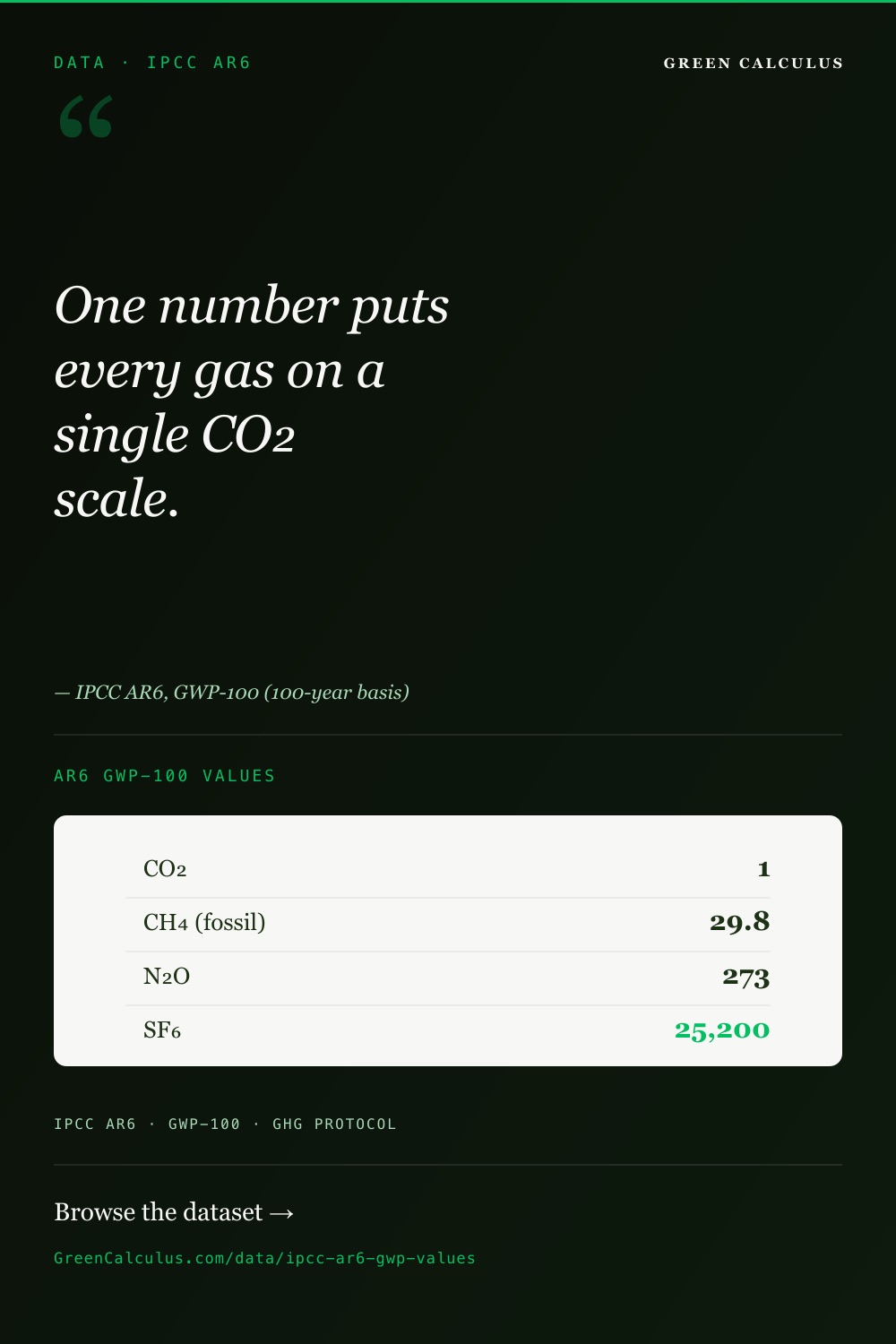
Under IPCC AR6, the GWP-100 values without carbon-cycle feedbacks — the basis corporate reporting requires — are CO₂ 1, fossil CH₄ 29.8, biogenic CH₄ 27.0, N₂O 273, SF₆ 25,200, NF₃ 17,400, HFC-134a 1,530.
What Global Warming Potential measures
Global Warming Potential is the time-integrated radiative forcing of one mass unit of a greenhouse gas relative to one mass unit of carbon dioxide, evaluated over a specified time horizon. CO₂ is the reference: GWP(CO₂) = 1 by definition at every horizon. Every other greenhouse gas is expressed as a multiple. Methane at GWP-100 of 29.8 means one tonne of methane (fossil origin) traps 29.8 times more cumulative energy in the atmosphere than one tonne of CO₂ over a 100-year window.
The time horizon is not a precision setting — it is a policy choice with material consequences. GWP-20 weights short-term warming heavily; GWP-100 weights long-term cumulative forcing; GWP-500 captures multi-century persistence. For methane, with an atmospheric lifetime of approximately 11.8 years, the GWP-20 value (82.5) is roughly 2.8 times the GWP-100 value (29.8) because at 20 years most of the methane molecule’s warming capacity is still being expressed. By the 100-year mark, most has oxidised to CO₂ and water vapour, so the time-integrated impact per unit emission is proportionally smaller.
GWP-100 is the time horizon required by every major corporate GHG reporting framework: the GHG Protocol Corporate Standard, the EU’s ESRS E1 Climate Change standard, the CDP climate questionnaire, and the SBTi Corporate Net-Zero Standard. UNFCCC national inventory reporting under the Paris Agreement also uses GWP-100. Unless a reporting framework specifies otherwise, or the analysis is explicitly modelling short-lived climate pollutants for near-term mitigation policy, the correct horizon is GWP-100.
Feedback vs no-feedback — the AR6 distinction that matters
IPCC AR6 introduced a refinement that earlier assessments did not present consistently: the explicit distinction between GWP values calculated with and without climate-carbon cycle feedbacks. This distinction has practical consequences for every CO₂e calculation downstream.
Climate-carbon feedbacks are secondary effects triggered by the warming caused by a greenhouse gas. Warming weakens the ocean and terrestrial carbon sinks, accelerates permafrost thaw, and modifies the residence time of CO₂ itself in the atmosphere. These secondary effects amplify the radiative forcing attributable to a unit emission. Including them produces slightly higher GWP values; excluding them produces the conventional values.
For corporate GHG reporting, the convention — established under AR5 and continued under AR6 — is to use GWP values without climate-carbon feedbacks for non-CO₂ gases. This maintains methodological consistency with how CO₂ itself is treated in the inventory. The values with feedbacks are published for scientific completeness and are appropriate for some climate-policy analysis contexts, but they are not the values you use in a Scope 1, Scope 2, or Scope 3 inventory.
| Gas | GWP-100 no feedbacks |
GWP-100 with feedbacks |
Difference | Use for corporate inventory? |
|---|---|---|---|---|
| CO₂ | 1 | 1 | — | No-feedback baseline |
| CH₄ (fossil) | 29.8 | 32.8 | +10.1% | No-feedback (29.8) |
| CH₄ (biogenic) | 27.0 | 30.8 | +14.1% | No-feedback (27.0) |
| N₂O | 273 | 296 | +8.4% | No-feedback (273) |
| SF₆ | 25,200 | 25,200 | — | Either (no difference) |
For long-lived halogenated species (HFCs, PFCs, SF₆, NF₃), the feedback distinction is negligible because their direct warming effect dwarfs any indirect carbon-cycle response. For CH₄ and N₂O, the distinction is material — selecting the wrong column produces an 8–10% systematic bias in the inventory total for those gases.
Complete AR6 dataset — all gases, all time horizons
Source: IPCC AR6 Working Group I, Chapter 7 Supplementary Material, Table 7.SM.7. All values relative to CO₂ = 1. GWP-20, GWP-100, and GWP-500 are time-integrated horizons. The “GC Implementation” column indicates which gases are exposed via the MasterBrain runtime data layer for use in live calculators.
| Gas | Formula | CAS No. | Lifetime (years) |
GWP-20 | GWP-100 no feedback |
GWP-100 with feedback |
GWP-500 | GC MasterBrain |
|---|---|---|---|---|---|---|---|---|
| Carbon dioxide | CO₂ | 124-38-9 | variable | 1 | 1 | 1 | 1 | Live proof |
| Methane (fossil) | CH₄ | 74-82-8 | 11.8 | 82.5 | 29.8 | 32.8 | 10.0 | Live proof |
| Methane (biogenic) | CH₄ | 74-82-8 | 11.8 | 79.7 | 27.0 | 30.8 | 7.2 | Live proof |
| Nitrous oxide | N₂O | 10024-97-2 | 109 | 273 | 273 | 296 | 130 | Live proof |
| HFC-134a | CH₂FCF₃ | 811-97-2 | 14.0 | 4,140 | 1,530 | 1,526 | 436 | Live proof |
| HFC-32 | CH₂F₂ | 75-10-5 | 5.4 | 2,690 | 771 | 771 | 220 | Live proof |
| HFC-404A (blend) | R-125 / R-143a / R-134a | — | — | 7,208 | 4,728 | — | 1,515 | Live proof |
| HFC-410A (blend) | R-32 / R-125 | — | — | 4,715 | 2,256 | — | 665 | Live proof |
| HFO-1234yf (R-1234yf) | CH₂=CFCF₃ | 754-12-1 | 0.03 | 1.81 | 0.501 | 0.501 | — | Live proof |
| Sulphur hexafluoride | SF₆ | 2551-62-4 | 3,200 | 18,300 | 25,200 | 25,200 | 34,100 | Live proof |
| Perfluoromethane (PFC-14) | CF₄ | 75-73-0 | 50,000 | 5,300 | 7,380 | 7,380 | 10,600 | Live proof |
| Nitrogen trifluoride | NF₃ | 7783-54-2 | 569 | 13,400 | 17,400 | 17,400 | 18,200 | Live proof |
Every row is checkable. proof opens that factor’s provenance page on verify.greencalculus.com — the value MasterBrain holds right now, the exact source cell it was read from, the retrieval date, the licence and the data version. The pages are public, keyless and carry no tracking. If a figure in this table ever drifts from the one the proof page shows, the proof page is the one to believe.
Bold green column (GWP-100, no feedbacks) = the values to use for corporate GHG reporting under the GHG Protocol, ESRS E1, CDP, SBTi, ISO 14064-1, and UNFCCC Paris Agreement reporting. Live = exposed in window.gcMasterBrain at runtime; Reference = published here for completeness, not yet wired into a calculator pathway. SF₆ GWP-500 reflects the IPCC AR6 published value (34,100); see methodology notes.
Every gas, every basis — the full 44-gas matrix
The table above is the curated 12-gas reference set. This is the complete canonical matrix: all 44 gases the corpus carries — including every ANSI/ASHRAE refrigerant blend — across five bases: AR6 at 20, 100 and 500 years, and the AR5 and AR4 100-year values that older reporting regimes still require. Each figure is generated from the same canonical rows the open API serves; an em-dash means the assessment report does not publish that gas (a blank is a fact here, not a gap — HFOs, for instance, postdate AR4).
44 gases, alphabetical — click a column header to sort.
| Carbon dioxide (CO2) | 1 | 1 | 1 | 1 | 1 |
|---|---|---|---|---|---|
| Hexafluoroethane PFC-116 (C2F6) | 8,940 | 12,400 | 17,500 | 11,100 | 12,200 |
| HFC-125 (C2HF5) | 6,740 | 3,740 | 1,110 | 3,170 | 3,500 |
| HFC-134 (1,1,2,2-tetrafluoroethane, CHF2CHF2) | 3,900 | 1,260 | 361 | 1,120 | — |
| HFC-134a (CH2FCF3) | 4,140 | 1,530 | 436 | 1,300 | 1,430 |
| HFC-143 (1,1,2-trifluoroethane, CH2FCHF2) | 1,300 | 364 | 104 | 328 | — |
| HFC-143a (C2H3F3) | 7,840 | 5,810 | 1,940 | 4,800 | 4,470 |
| HFC-152a (C2H4F2) | 591 | 164 | 46.8 | 138 | 124 |
| HFC-227ea (C3HF7) | 5,850 | 3,600 | 1,100 | 3,350 | 3,220 |
| HFC-236fa (C3H2F6) | 7,450 | 8,690 | 6,040 | 8,060 | 9,810 |
| HFC-245fa (1,1,1,3,3-pentafluoropropane, CHF2CH2CF3) | 3,170 | 962 | 274 | 858 | 1,030 |
| HFC-32 (CH2F2) | 2,690 | 771 | 220 | 677 | 675 |
| HFC-365mfc (1,1,1,3,3-pentafluorobutane, CF3CH2CF2CH3) | 2,920 | 914 | 261 | 804 | 794 |
| HFC-404A blend | 7,208 | 4,728 | 1,515 | 3,943 | 3,922 |
| HFC-407A blend | 4,890 | 2,262 | 662 | 1,923 | 2,107 |
| HFC-407C blend | 4,457 | 1,908 | 555 | 1,624 | 1,774 |
| HFC-407F blend | 4,485 | 1,965 | 573 | 1,674 | 1,825 |
| HFC-41 (fluoromethane, CH3F) | 485 | 135 | 38.6 | 116 | — |
| HFC-410A blend | 4,715 | 2,256 | 665 | 1,923 | 2,088 |
| HFC-422D blend | 5,692 | 2,917 | 860 | 2,473 | 2,729 |
| HFC-43-10mee (decafluoropentane, CF3CHFCHFCF2CF3) | 3,960 | 1,600 | 458 | 1,650 | 1,640 |
| HFC-507A blend | 7,290 | 4,775 | 1,525 | 3,985 | 3,985 |
| HFO-1234yf (R-1234yf) | 1.81 | 0.501 | 0.143 | — | — |
| HFO-1234ze(E) (R-1234ze) | 4.94 | 1.37 | 0.391 | — | — |
| Methane biogenic (CH4) | 79.7 | 27 | 7.2 | 28 | 25 |
| Methane fossil (CH4) | 82.5 | 29.8 | 10 | 28 | 25 |
| Nitrogen trifluoride (NF3) | 13,400 | 17,400 | 18,200 | 16,100 | 17,200 |
| Nitrous oxide (N2O) | 273 | 273 | 130 | 265 | 298 |
| Octafluoropropane PFC-218 (C3F8) | 6,770 | 9,290 | 12,400 | 8,900 | 8,830 |
| Perfluorobutane PFC-3-1-10 (n-C4F10) | 7,300 | 10,000 | 13,400 | 9,200 | 8,860 |
| Perfluorocyclobutane PFC-318 (c-C4F8) | 7,400 | 10,200 | 13,800 | 9,540 | 10,300 |
| Perfluorohexane PFC-5-1-14 (n-C6F14) | 6,260 | 8,620 | 11,600 | 7,910 | 9,300 |
| Perfluoromethane PFC-14 (CF4) | 5,300 | 7,380 | 10,600 | 6,630 | 7,390 |
| Perfluoropentane PFC-4-1-12 (n-C5F12) | 6,680 | 9,220 | 12,700 | 8,550 | 9,160 |
| R-290 (propane, HC) | 0.072 | 0.02 | 0.006 | — | — |
| R-448A (HFC/HFO blend) | 3,322 | 1,494 | 437 | — | — |
| R-449A (HFC/HFO blend) | 3,383 | 1,504 | 440 | — | — |
| R-450A (HFC/HFO blend) | 1,742 | 643 | 183 | — | — |
| R-452A (HFC/HFO blend) | 4,273 | 2,292 | 679 | — | — |
| R-454B (HFC/HFO blend) | 1,854 | 531 | 152 | — | — |
| R-513A (HFC/HFO blend) | 1,823 | 673 | 192 | — | — |
| Sulfuryl fluoride (SO2F2) | 7,510 | 4,630 | 1,410 | 4,090 | — |
| Sulphur hexafluoride (SF6) | 18,300 | 25,200 | 34,100 | 23,500 | 22,800 |
| Trifluoromethane HFC-23 (CHF3) | 12,400 | 14,600 | 10,500 | 12,400 | 14,800 |
Every row is addressable — link to a gas with #gwp-<key>, e.g. #gwp-hfc-410a. Blends are mass-weighted from their constituents per ANSI/ASHRAE Std 34, with the arithmetic recorded in each canonical row’s source reference; the seven blends with an AR4 identity reproduce the EU F-Gas nameplate GWPs exactly. A single value can be pinned to a past edition through the API’s as_of parameter, so a converted figure cited today stays checkable after AR7.
Methane has four GWP-100 values in AR6 — choosing correctly
One of the more confusing aspects of AR6 for practitioners is that methane is associated with four distinct GWP-100 values, used in different contexts — and two of them, 27.0 and 27.9, are close enough that documents citing either look interchangeable when they are not. Choosing the wrong one is one of the most common methodology errors flagged in third-party verification.
| Value | IPCC AR6 label | Use for | What it includes |
|---|---|---|---|
| 27.0 | “CH₄-non fossil” — Table 7.15 | Biogenic CH₄: landfill gas, livestock enteric fermentation, manure management, rice cultivation, anaerobic digestion. This is the value GreenCalculus calculators apply for biogenic methane. | The IPCC’s published value for methane of non-fossil origin: the oxidation CO₂ is not counted as a net atmospheric addition, because the carbon was recently drawn down from the atmosphere. |
| 27.9 | “Methane” — Table 7.SM.7, origin-agnostic | Only when the methane’s origin is genuinely unknown, or to match a tool that adopts the supplement value (the USEEIO supply-chain factors and Ember’s grid intensities both do). Not a substitute for 27.0 or 29.8 when the origin is known. | The supplement table’s single generic methane value, which does not separate fossil from non-fossil origin. Documents quoting “27.9 for methane” are quoting this row. |
| 29.8 | “Methane (fossil)” — fossil and fugitive process | Fossil CH₄: stationary combustion fugitives, oil & gas upstream/midstream/downstream fugitives, coal mine methane, natural gas distribution leaks | Direct radiative forcing plus the indirect forcing from CO₂ produced when fossil-origin CH₄ oxidises in the atmosphere. About 75% of the carbon in CH₄ converts to atmospheric CO₂; the remaining 25% deposits as formaldehyde. |
| 32.8 | Methane (fossil) — with climate-carbon feedbacks | Scientific analysis only — not for corporate GHG inventory | Direct + oxidation CO₂ + climate-carbon cycle feedback amplification. The +10% uplift versus 29.8 reflects the modelled response of carbon sinks to additional warming. |
If the methane comes from burning a fossil fuel, fugitive emission from oil/gas/coal infrastructure, or the venting/flaring of a fossil source, use 29.8. If the methane comes from a biological process where the carbon was recently part of the active carbon cycle — landfill, livestock, rice paddies, biogas, sewage treatment — use 27.0. Never use 32.8 in a corporate GHG inventory; it is a scientific value for climate-policy modelling.
Cross-assessment comparison — AR4, AR5, AR6
If your inventory was compiled before 2023, it almost certainly used AR5 GWP values. The shift to AR6 has a quantifiable, gas-specific impact on reported emissions totals. This is not a methodological abstraction — it changes the numbers your assurance provider will check, and in some cases it triggers a base year restatement under the GHG Protocol Corporate Standard.
| Gas | AR4 GWP-100 |
AR5 GWP-100 |
AR6 GWP-100 |
AR5 → AR6 | Sectors most affected |
|---|---|---|---|---|---|
| CO₂ | 1 | 1 | 1 | — no change | Universal baseline |
| CH₄ (fossil) | 25 * | 28 | 29.8 | +1.8 (+6.4%) | Energy, oil & gas, transport (natural gas) |
| CH₄ (biogenic) | 25 * | 28 * | 27.0 | −1.0 (−3.6%) | Agriculture, waste, wastewater |
| N₂O | 298 | 265 | 273 | +8 (+3.0%) | Agriculture, fertiliser, wastewater treatment |
| HFC-134a | 1,430 | 1,430 † | 1,530 | +96 (+6.7%) | Refrigeration, mobile air conditioning |
| HFC-32 | 675 | 677 | 771 | +94 (+13.9%) | Air conditioning |
| SF₆ | 22,800 | 23,500 | 25,200 | +1,700 (+7.2%) | Electrical utilities, semiconductor fabrication |
| CF₄ (PFC-14) | 7,390 | 6,630 | 7,380 | +750 (+11.3%) | Aluminium smelting, semiconductor fabrication |
| NF₃ | 17,200 | 18,200 | 17,400 | +1,300 (+8.1%) | Semiconductor manufacture, flat-panel displays |
* AR4 and AR5 did not separately publish fossil and biogenic methane GWP values; both used a single value (25 in AR4, 28 in AR5). AR6 introduced the fossil/biogenic distinction. † 1,430 is the AR4 figure for HFC-134a, not an AR5 one — several HFCs fell from AR4 to AR5 as radiative efficiencies were refined. The AR5 GWP-100 is 1,300, which is the value the GHG Protocol carries in Global Warming Potential Values v2.0 (August 2024) and the one to use; an “AR5” table showing 1,430 is almost certainly an unconverted AR4 table. Per UNFCCC Paris Agreement decisions, parties were required to use AR5 GWP values (without feedbacks) by no later than December 2024.
The GHG Protocol Corporate Standard requires base year recalculation when a methodology change produces a significant impact on the inventory total — typically defined as a threshold in the range of 5%. For organisations whose Scope 1 is dominated by natural gas combustion, the AR5→AR6 shift on methane and N₂O is unlikely to exceed this threshold on its own. For organisations with material refrigerant leakage, electrical SF₆ exposure, or significant N₂O sources, the combined uplift can cross the threshold and require base year restatement. Document the GWP basis used in every reporting year. Mixing AR5 in 2020 and AR6 in 2024 without disclosure and without base year recalculation is a methodology inconsistency finding under ISO 14064-3 verification.
Field note: when the label is wrong — the EPA supply-chain factors
Which assessment report a dataset uses is usually taken from its documentation. Sometimes the documentation is wrong, and the only way to know is to solve for it. A worked example from our own corpus:
The EPA-lineage US supply-chain emission factors ship as pre-aggregated CO₂e. The PDF bundled with the v1.3.0 release documents AR4 — but it describes v1.2, two data vintages earlier. Trusting it, our own database carried those 1,106 rows labelled AR6 for ten weeks before the discrepancy was caught and corrected. The basis has moved with every release of that series: v1.2 was AR4, v1.3 AR5, and v1.4.0’s published sheet is AR6 with methane at 27.9 — the origin-agnostic value from the table above.
When a CO₂e dataset also publishes per-gas masses, the GWP set is solvable rather than assumable: recombine the per-gas sheet under each candidate set and see which reproduces the published CO₂e. For EPA v1.3.0 the answer is unambiguous — the implied multipliers come out at 27.9 for CH₄ and 265.0 for N₂O, and 265 is AR5’s N₂O value (AR4 says 298, AR6 says 273 — N₂O is the sharpest discriminator because the three reports disagree on it most). The same method settled v1.4.0 as AR6 with non-fossil methane, to a 0.185% median fit.
The practical lesson for anyone consuming CO₂e data: a stated GWP basis is a claim, not a property. If the per-gas decomposition is published, verify the claim; if it is not, treat the basis as unverified and say so. Every CO₂e row in the GreenCalculus corpus records its GWP set per row — and where we solved for it rather than read it, the row’s note says that too.
Application — formulas, time horizons, mixing rules
The base conversion formula
Time horizon selection
GWP-100 is the corporate reporting default. Use it for every Scope 1, Scope 2, and Scope 3 inventory unless the reporting framework specifies otherwise.
GWP-20 has two legitimate corporate-reporting use cases. First, where a national policy framework explicitly mandates GWP-20 — New York State’s Climate Leadership and Community Protection Act is the most-cited example, requiring GWP-20 for all GHG accounting under the Act. Second, when communicating short-term mitigation potential of methane-reduction projects (oil and gas leakage abatement, landfill gas capture), GWP-20 better represents the near-term climate benefit and is increasingly seen in voluntary disclosures alongside the GWP-100 figure. GWP-20 is never substituted for GWP-100 in a standard corporate inventory; the two are reported in parallel where both are relevant.
GWP-500 is rare in corporate reporting and primarily appears in long-horizon climate risk modelling.
Applying GWP-100 to CO₂ and N₂O while applying GWP-20 to CH₄ within the same total is methodologically indefensible. The inconsistency cannot be disclosed away. If both horizons are needed for stakeholder communication, report two separate inventories — one labelled GWP-100, one labelled GWP-20 — and never combine them into a hybrid total.
Live implementation in GreenCalculus calculators
The Scope 1 Stationary Combustion Calculator applies AR6 GWP-100 of 29.8 for fossil CH₄ and 273 for N₂O whenever the calculator is run in Engineering mode. The Regulatory mode reads pre-aggregated DEFRA 2025 CO₂e factors which embed AR5 GWP values (DEFRA’s stated basis, per the DEFRA 2025 Introduction tab, Row 35). The audit trail panel below every result discloses which mode was used and which GWP basis was applied. Both modes are correct disclosures of distinct methodologies — the difference between them is the AR5→AR6 shift in the GWP basis itself.
Framework requirements — which AR version each standard mandates
The transition from AR5 to AR6 is not uniformly mandated across all reporting frameworks. The picture is nuanced: some frameworks have moved to AR6, some preserve AR5 as the legacy default, and some allow either. The table below documents the position as of May 2026, verified against each framework’s current published guidance.
| Framework | Current GWP basis | Status | Notes |
|---|---|---|---|
| GHG Protocol Corporate Standard | AR4 default; AR5 and AR6 accepted | Transitioning | The current 2004/2015 Corporate Standard text references AR4. The August 2024 GHG Protocol “Required Gases and GWP Values” supplemental guidance accepts AR4, AR5, or AR6 with disclosure. Draft guidance for the next revision is expected in 2026; final standards in 2027; effective from 2028 or later. Full reference → |
| UNFCCC / Paris Agreement | AR5 (without feedbacks) | Required | Parties were required to apply AR5 GWP-100 values (without climate-carbon feedbacks) for national inventory reporting under the Paris Agreement Enhanced Transparency Framework no later than December 2024. |
| CDP Climate Questionnaire | AR6 | Required | CDP moved to AR6 GWP values starting with the 2023 questionnaire cycle. Reports submitted with AR4 or AR5 values must explicitly disclose the basis. |
| CSRD / ESRS E1 | AR6 (latest IPCC assessment) | Required | ESRS E1 references “the latest IPCC assessment.” That is AR6 (2021) for any sustainability statement prepared today. The GWP basis must be explicitly disclosed in the sustainability statement. CSRD detail → |
| SBTi Corporate Net-Zero Standard | AR6 | Required | SBTi Corporate Net-Zero Standard v1.x specifies AR6 GWP-100 values. Version 2 (in development through 2026, public consultation closed December 2025) preserves the AR6 basis. |
| ISO 14064-1:2018 | “Latest IPCC values” | Flexible | The standard requires use of “the latest IPCC assessment values” without specifying an AR version. Currently AR6. ISO 14064-1 detail → |
| UK SECR / DEFRA 2025 | AR5 | Required | The DEFRA 2025 conversion factor workbook (DESNZ, June 2025) embeds AR5 GWP-100 values in its pre-aggregated CO₂e factors. DEFRA’s Introduction tab, Row 35, states explicitly: “The GWPs used in the calculation of CO₂e are based on IPCC Fifth Assessment Report (AR5) over a 100-year period.” DEFRA detail → |
| US EPA GHG Reporting Program | AR4 (default); AR5 for some gases | Transitioning | 40 CFR Part 98 generally uses AR4 GWP values. EPA voluntary methane reduction programmes use AR5 for consistency with the U.S. national inventory. Federal climate disclosure rulemaking will dictate any future shift. |
| IFRS S2 (ISSB) | AR6 | Required | IFRS S2 mandates use of the GHG Protocol Corporate Standard, with the latest GWP values from the most recent IPCC assessment. Effective for jurisdictions that have adopted IFRS Sustainability Disclosure Standards. |
Common reporting errors
DEFRA, EPA, and most national inventory factor sets publish pre-aggregated CO₂e factors with GWP already applied internally. Multiplying a DEFRA CO₂e factor by GWP-100 again produces a result roughly 30% too high for natural gas. GreenCalculus calculators guard against this with explicit factor type validation; manual spreadsheet workflows often do not. Always verify whether a factor is reported as kg CO₂ (apply GWP) or kg CO₂e (do not apply GWP).
CDP moved to AR6 with the 2023 questionnaire cycle. SBTi adopted AR6 in Corporate Net-Zero Standard v1.1. ESRS E1 effectively requires AR6 from FY2024. Organisations that copied GWP values from legacy spreadsheets without updating are reporting CH₄ at 28 instead of 29.8 — a systematic 6.4% understatement on all methane-bearing Scope 1 emissions. Auditors and CDP reviewers flag this as a methodology inconsistency.
“GWP values from IPCC” is insufficient disclosure under the GHG Protocol and ISO 14064-1. Specify the Assessment Report version (AR4, AR5, or AR6), the time horizon (GWP-100), and whether feedbacks are included. The required disclosure form is: “GWP values from IPCC AR6 (2021), WGI Table 7.SM.7, 100-year time horizon, without climate-carbon cycle feedbacks.” Undisclosed GWP versions are a completeness finding under ISO 14064-3 verification.
Reporting 2020–2022 at AR5 and 2023 onwards at AR6 without restating the base year creates an artificial discontinuity. The GHG Protocol requires base year recalculation when methodology changes are material — typically defined at a 5% threshold on the inventory total. For natural-gas-heavy organisations this threshold is rarely crossed by GWP changes alone; for refrigerant-heavy or SF₆-exposed organisations it often is. Apply the threshold test deliberately and document the result.
AR6 publishes separate values for fossil CH₄ (29.8) and biogenic CH₄ (27.0). The distinction matters because biogenic methane comes from biological processes where the carbon was recently part of the active carbon cycle and the oxidation product (CO₂) does not constitute a net atmospheric addition. Use 29.8 for combustion and oil/gas/coal fugitive emissions; use 27.0 for landfill gas, livestock enteric fermentation, manure management, rice cultivation, and biogas digestion.
AR6 publishes both “with” and “without” climate-carbon feedback values. The corporate reporting convention — preserved from AR5 and codified in GHG Protocol guidance — is to use values without feedbacks, for methodological consistency with how CO₂ itself is treated. Selecting CH₄ = 32.8 instead of 29.8 inflates methane CO₂e by approximately 10% relative to peers and produces a non-comparable disclosure.
Methane’s GWP-20 (82.5) is approximately 2.8× its GWP-100 (29.8). These are not different precision levels of the same number; they answer fundamentally different questions about climate impact over different time windows. Substituting GWP-20 in a GWP-100 reporting context overstates methane emissions by a factor of nearly three. Aside from explicit jurisdictional mandates (New York State CLCPA), GWP-100 is the corporate reporting horizon.
HFC-404A, HFC-410A, R-507A, and other refrigerant blends are not assigned IPCC GWP values directly — IPCC publishes GWP values for individual halocarbons (HFC-32, HFC-125, HFC-134a, HFC-143a, etc.). Blend GWPs are calculated as mass-weighted averages of the component HFC values, typically by industry bodies (AIRAH, ASHRAE, EU F-Gas Regulation Annex IV). When citing a blend GWP, cite the calculation source, not “IPCC AR6” directly. The blend values published in this dataset use the AR6 component values applied to standard blend compositions.
Methodology, boundaries, and uncertainty
Primary source and rounding policy
This dataset reproduces the GWP values exactly as published in IPCC AR6 WGI Chapter 7 Supplementary Material, Table 7.SM.7 (Forster et al., 2021). Where IPCC publishes integer values (CO₂ = 1, N₂O = 273), integers are stored. Where IPCC publishes decimal values (CH₄ fossil = 29.8), decimals are preserved. We do not round 29.8 to 30 — the 0.2 unit difference compounds across large inventories with significant methane exposure. Trailing zeroes shown in tables (for example “1,526.0” displayed as “1,526”) are the published values; no rounding has been applied.
Why GWP values vary across published sources
Practitioners encounter methane GWP-100 values ranging from approximately 25 to 32 across different sources. This variation is not noise — it reflects four distinct technical choices:
- Assessment Report version. AR4 (2007) value was 25; AR5 (2013) was 28; AR6 (2021) is 29.8 for fossil and 27.0 for biogenic.
- Climate-carbon feedback inclusion. AR6 fossil CH₄ is 29.8 without feedbacks, 32.8 with feedbacks. Earlier assessments did not consistently distinguish.
- Fossil vs biogenic distinction. Introduced in AR6. Earlier assessments used a single value regardless of origin.
- Indirect effect inclusion. CH₄ produces ozone and stratospheric water vapour as oxidation products; both are themselves greenhouse gases. AR6 incorporates these indirect effects.
The values on this page are AR6 GWP-100 without climate-carbon cycle feedbacks, fossil and biogenic distinguished, which is the correct combination for corporate GHG reporting under the GHG Protocol family of standards.
Scope applicability — which GWP applies to which inventory line
| Gas | Scope | Typical activity | Calculation approach |
|---|---|---|---|
| CO₂ | 1, 2, 3 | Stationary & mobile combustion, electricity, value chain | Activity × emission factor; pre-aggregated CO₂e factors typical |
| CH₄ (fossil) | 1, 3 | Stationary & mobile combustion, oil/gas fugitives, coal mine methane | Activity × CH₄ emission factor × 29.8 |
| CH₄ (biogenic) | 1, 3 | Landfill gas, livestock enteric fermentation, manure management, rice cultivation, anaerobic digestion | Activity × CH₄ emission factor × 27.0 |
| N₂O | 1, 3 | Combustion (small amounts), agricultural soils, fertiliser application, wastewater treatment | Activity × N₂O emission factor × 273 |
| HFCs | 1 | Refrigerant fugitive losses (refrigeration, AC, heat pumps, MAC) | Refrigerant mass leaked × refrigerant-specific GWP-100 |
| SF₆ | 1 | Electrical switchgear, semiconductor etching, magnesium foundries | SF₆ mass leaked × 25,200 |
| PFCs (CF₄, C₂F₆) | 1 | Aluminium smelting (anode effects), semiconductor manufacture | PFC mass × PFC-specific GWP-100 |
| NF₃ | 1 | Semiconductor cleaning, flat-panel display manufacture | NF₃ mass × 17,400 |
Uncertainty
IPCC AR6 reports GWP-100 uncertainty ranges of approximately ±20% for CO₂, ±30% for CH₄ and N₂O, and ±10% to ±20% for halogenated species at 90% confidence (per WGI Chapter 7 Supplementary Material). For corporate reporting, point values are used; uncertainty propagates into the inventory total but is not the dominant source of inventory uncertainty in most practical cases. Activity data uncertainty (the mass or volume of the gas emitted) is usually the larger contributor, particularly for fugitive emissions and leak-rate-driven sources.
Geographic applicability
GWP values are global by construction. The Earth’s atmosphere mixes greenhouse gases on timescales much shorter than their residence times, so a tonne of methane emitted in Singapore has the same global warming potential as a tonne emitted in Norway. The geographic adjustment in corporate GHG inventories applies to emission factors (grid intensity, fuel composition, cooking practices) — never to the GWP values themselves.
Implementation and provenance chain
Transparency in factor sourcing is a foundational design principle of GreenCalculus. Every GWP value on this page is directly traceable to a cell in a published IPCC table. This section documents how those values flow from the source document into the calculator outputs.
IPCC Sixth Assessment Report, Working Group I — The Physical Science Basis (2021). Chapter 7: The Earth’s Energy Budget, Climate Feedbacks and Climate Sensitivity. Supplementary Material, Table 7.SM.7. This table is the definitive publication of AR6 GWP values.
Each GWP value is hardcoded in gc-master-brain.php under the gwp section with explicit source attribution. The file carries a version string (currently v2026.203) and an updated date (2026-09-22). Every gas entry includes a source field citing IPCC_AR6, a note field stating the recommended use case, and where applicable a comment marking corrections from prior versions.
The public /wp-json/greencalculus/v1/gwp-values endpoint maintains its own copy of the GWP dataset, independent of the MasterBrain runtime layer. Per editorial standards, the Data Library never reads from the MasterBrain — both are updated separately and deliberately on each AR-cycle release. This isolation prevents silent API changes when the MasterBrain is updated for calculator behaviour reasons.
The MasterBrain is injected into window.gcMasterBrain on every calculator page load. Calculator engines read GWP values from window.gcMasterBrain.gwp.CH4_fossil.ar6_100 at runtime — never from hardcoded local variables in the calculator code. This ensures a single MasterBrain update propagates to every calculator simultaneously without per-calculator deployment.
Every calculation result includes a gwp_basis declaration in the JSON export: for example "IPCC AR6 GWP-100 without feedbacks (CO₂=1, CH₄=29.8, N₂O=273, source: WGI Table 7.SM.7)". The MasterBrain version and update date are also included. This creates a complete, auditable chain from the IPCC primary source citation to the tCO₂e result — exactly what an ISO 14064-3 verifier requires.
IPCC AR7 publication is currently expected in the 2028–2029 window per the IPCC AR7 work programme. GreenCalculus will update GWP values in the MasterBrain within 30 days of AR7 publication. The version string will increment to mark the update; every calculator will automatically use the new values; the Data Library API will receive a parallel deliberate update with a new schema_version; this page’s text will be revised under a Major version bump.
Open the Scope 1 Stationary Combustion Calculator, enter any quantity of natural gas, click Calculate, then expand “View calculation detail and audit trail.” The step-by-step formula shows: [GJ × EFCH₄ × oxidation factor × 29.8 GWP ÷ 1000]. The GWP value is named, sourced, dated, and never hidden inside an aggregate factor.
Data access — REST API and CSV
The IPCC AR6 GWP values on this page are available as a machine-readable REST API endpoint and as a flat CSV download. Both surface the same dataset shown in the table above, sourced from WGI Table 7.SM.7, versioned, and citable.
The /wp-json/greencalculus/v1/gwp-values endpoint exposes the IPCC AR6 GWP dataset only. These are IPCC values, © IPCC: the AR6 report is open access at Cambridge University Press under CC BY-NC-ND 4.0, so we publish them in machine-readable form as cited reference values, each with its table and page, and the API marks them as not redistributable. The full factor corpus, including fuels, grid electricity, transport, refrigerants and agriculture, is served by the GreenCalculus API; each row carries its own licence and whether it may be republished.
Cache-Control: max-age=86400. X-GC-Version header signals dataset updates./wp-json/greencalculus/v1/gwp-values
Click to generate ↓
Citation guidance
If you use this dataset in a published tool, report, or academic work, please cite the IPCC primary source. The GreenCalculus implementation reference is optional but appreciated.
Forster, P., T. Storelvmo, K. Armour, W. Collins, J.-L. Dufresne, D. Frame, D. J. Lunt, T. Mauritsen, M. D. Palmer, M. Watanabe, M. Wild, and H. Zhang, 2021: The Earth’s Energy Budget, Climate Feedbacks and Climate Sensitivity Supplementary Material. In Climate Change 2021: The Physical Science Basis. Contribution of Working Group I to the Sixth Assessment Report of the Intergovernmental Panel on Climate Change. Cambridge University Press, Table 7.SM.7.
IPCC AR6 WGI primary citation
Cite this dataset (GreenCalculus compilation). A versioned, machine-readable snapshot of this table is permanently archived on Zenodo with a citable DOI:
Say, Jeremiah (2026). GreenCalculus — IPCC AR6 Global Warming Potential (GWP) values (machine-readable). GreenCalculus. Zenodo. https://doi.org/10.5281/zenodo.20612456
GreenCalculus dataset DOI (concept — always the latest edition)
Frozen editions: v2026.186 (198 rows, five bases: AR6 20/100/500 + AR5/AR4 100, deposited 7 Sep 2026) · v2025.69 (original 12-gas reference table, deposited 9 Jun 2026).
Related GreenCalculus resources
Frequently asked questions
The IPCC AR6 GWP-100 value for fossil methane is 29.8 (without climate-carbon cycle feedbacks), sourced from WGI Table 7.SM.7 (Forster et al., 2021). For biogenic methane — landfill gas, livestock enteric fermentation, manure management, rice cultivation, anaerobic digestion — the AR6 GWP-100 value is 27.0. AR6 also publishes a “with feedbacks” fossil value of 32.8, but this is for scientific analysis only and is not used in corporate GHG inventories. The previous AR5 (2013) value was 28 with no fossil/biogenic distinction; AR4 (2007) was 25.
ESRS E1, the climate disclosure standard under CSRD, references “the latest IPCC assessment” as the GWP source. The latest assessment is AR6 (2021), so AR6 is the appropriate basis for CSRD sustainability statements. The GWP basis must be explicitly disclosed in the methodology section of the sustainability statement. Use of AR5 with explicit disclosure is technically defensible for organisations with a complex base year transition history, but new inventories started today should use AR6. See the CSRD / ESRS E1 standards page for detailed disclosure requirements.
IPCC AR7 is currently scheduled for publication in the 2028–2029 window per the IPCC AR7 work programme. Until then, the AR6 values on this page remain the current standard. GreenCalculus will update the MasterBrain within 30 days of AR7 publication; the Data Library API will receive a parallel deliberate update; this page will be republished under a Major version bump. AR6 GWP values are stable — they will not be retroactively revised before AR7. Organisations should not delay GWP basis decisions in anticipation of AR7; the framework requirement is to use the latest published values.
Methane has an atmospheric lifetime of approximately 11.8 years. Over a 20-year time horizon, its warming effect (GWP-20 = 82.5) is approximately 2.8 times its 100-year effect (GWP-100 = 29.8) because at the 20-year mark most of the methane molecule’s warming capacity is still being expressed. By the 100-year mark, most has oxidised to CO₂ and water vapour, so the time-integrated effect per unit emitted is proportionally smaller. CO₂, by contrast, has GWP-20 = GWP-100 = 1 because it is the reference gas and persists in the atmosphere for centuries. For long-lived gases like SF₆ (lifetime 3,200 years), the GWP-20 is actually lower than the GWP-100 because the cumulative integral hasn’t had time to accumulate over a 20-year window.
The current GHG Protocol Corporate Standard (2004 edition, 2015 revisions) text references AR4 GWP values. The August 2024 GHG Protocol “Required Gases and GWP Values” supplemental guidance accepts AR4, AR5, or AR6 with explicit disclosure of the basis used. The GHG Protocol is currently revising its corporate suite of standards: draft guidance is expected in 2026, final standards in 2027, with adoption from 2028 or later. In the interim, organisations choose between AR4, AR5, and AR6 based on which downstream framework imposes the strictest requirement — for most international filers, that is AR6 (driven by CDP, CSRD, SBTi, ISSB). See the GHG Protocol standards page for the current position.
Climate-carbon cycle feedbacks are secondary warming effects triggered by the primary warming from greenhouse gases. Warming weakens the ocean and terrestrial carbon sinks, accelerates permafrost thaw, and modifies the residence time of CO₂ itself. AR6 explicitly calculated GWP values both with and without these feedback effects. For methane, GWP-100 without feedbacks is 29.8; with feedbacks it is 32.8 — a ~10% uplift. For corporate GHG reporting under the GHG Protocol family of standards, values without feedbacks are used, consistent with the convention established under AR5. The with-feedback values are published for scientific completeness and are appropriate for some climate-policy modelling contexts, but they are not the values you use in a Scope 1, 2, or 3 inventory.
DEFRA (DESNZ) publishes pre-aggregated CO₂e emission factors in its annual UK Government GHG Conversion Factor workbook. The DEFRA 2025 release (June 2025) uses AR5 GWP-100 values as its stated basis (DEFRA 2025 Introduction tab, Row 35). DEFRA’s choice reflects UNFCCC Paris Agreement reporting requirements — parties were required to apply AR5 for national inventory reporting no later than December 2024. Organisations using DEFRA factors for UK SECR or ESOS reporting are correctly applying AR5. Organisations using DEFRA factors for CSRD reporting should disclose this and consider whether the AR5/AR6 difference is material to the inventory total. GreenCalculus calculators offer an Engineering mode that recalculates DEFRA’s underlying CO₂, CH₄, and N₂O components using AR6 GWP, alongside the Regulatory mode that uses DEFRA’s pre-aggregated AR5 factors directly.
Refrigerant blends are not assigned IPCC GWP values directly — IPCC publishes GWP values for individual halocarbons (HFC-32, HFC-125, HFC-134a, HFC-143a, etc.). Blend GWPs are calculated as mass-weighted averages of the component HFCs. R-410A is a 50/50 blend of HFC-32 and HFC-125 with an AR6 GWP-100 of approximately 2,256 (the AR4 figure, which the EU F-Gas Regulation still mandates, is 2,088). R-404A is a blend of HFC-125, HFC-143a, and HFC-134a with an AR6 GWP-100 of approximately 4,728 (AR4: 3,922). R-507A is a 50/50 blend of HFC-125 and HFC-143a with an AR6 GWP-100 of approximately 4,775 (AR4: 3,985). When citing a blend GWP in an inventory or sustainability statement, cite the calculation source (typically the EU F-Gas Regulation Annex IV, AIRAH, or ASHRAE), not “IPCC AR6” directly. The blend values stored in the GreenCalculus MasterBrain use the AR6 component values applied to standard blend compositions.
Version history
| Version | Date | MasterBrain | Summary |
|---|---|---|---|
| 4.2 | 2026-09-14 | v2026.192 | CORRECTION — the footnote to the cross-assessment matrix stated that “AR5 published 1,430 (without climate-carbon feedbacks) and 1,300 (with feedbacks) for HFC-134a; the GHG Protocol convention is to use the no-feedback value.” That was wrong, and it pointed the reader at the AR4 figure. 1,430 is AR4; the AR5 GWP-100 is 1,300, which is what the GHG Protocol carries in Global Warming Potential Values v2.0 (August 2024) and what MasterBrain serves. Several HFCs genuinely fell from AR4 to AR5 as radiative efficiencies were refined, so an “AR5” table showing 1,430 is almost always an unconverted AR4 table. The footnote is replaced with that reading. It is recorded here because this page is the reference the rest of the site cites, and the same 1,430-as-AR5 error was found on nine other pages the same day — corrected in the same pass. |
| 4.1 | 2026-09-14 | v2026.192 | CORRECTION, follow-on to 4.0 — HFC-134a AR6 GWP-100 1,526 → 1,530 in the cross-assessment matrix and the embedded CSV. 1,526 does not appear anywhere in IPCC AR6 WGI Table 7.SM.7; the published GWP-100 is 1,530, which is also the value the GHG Protocol carries in Global Warming Potential Values v2.0 (August 2024) and the value MasterBrain has served throughout. The CSV’s GWP_100_with_feedback cell for HFC-134a is now blank rather than 1,526: Table 7.SM.7 publishes a single GWP-100 per halocarbon and has no feedback columns, so the with/without pair is real only for CH₄ and N₂O, which take theirs from Chapter 7 Table 7.15. The HFO-1234yf CSV row was also brought into line with the matrix above it — renamed from “HFC-1234yf” (it is an HFO), GWP-20 1.5 → 1.81 and GWP-500 — → 0.143 — and footnote [3], which said that GWP-500 was absent from the AR6 publication, is retired: it is published, and MasterBrain serves it. |
| 4.0 | 2026-09-13 | v2026.192 | CORRECTION — three refrigerant-blend GWP-100 values were AR4 figures presented as AR6. R-410A 2,088 → 2,256, R-404A 3,922 → 4,728, R-507A 3,985 → 4,775. Blend GWPs are mass-weighted averages of the component halocarbons, so the assessment report the components are taken from decides the answer: R-410A is 50/50 HFC-32 / HFC-125 by mass, and AR4 components (675, 3,500) give 2,088 where AR6 components (771, 3,740) give 2,256. Corrected in the AR6 table, the FAQ and the embedded CSV. MasterBrain was never wrong — it has held gwp.HFC_410A.ar6_100 = 2256 throughout, which is why the live 44-gas matrix on this page already showed 2,256 while the table above it did not; the API, the calculators and the MCP server were unaffected. The AR4 figures are retained and labelled, because the EU F-Gas Regulation still mandates them. Both blends also gained the AR6 GWP-20 and GWP-500 values, previously blank though MasterBrain held them. |
| 3.0 | 2026-09-07 | v2026.186 | Cross-assessment rebuild. NEW: the full 44-gas matrix (#full-matrix) across five bases — AR6 20/100/500-year plus AR5 and AR4 100-year — generated from the canonical rows added in MasterBrain v2026.184–185, with filter, per-column sort and per-gas anchors; and a field note (#epa-gwp-mislabel) on solving for a dataset’s GWP basis empirically. RULING APPLIED: biogenic methane now reads 27.0 (Table 7.15 CH4-non fossil) at every point of use — twelve prose and table sites, the worked formula, the embedded CSV and the FAQ — matching the value every GreenCalculus calculator applies; 27.9 remains documented as the origin-agnostic Table 7.SM.7 value, now in a four-value methane table that says exactly when each applies. Biogenic GWP-500 in the remaining table corrected 9.8 → 7.2; the feedback-comparison delta recomputed accordingly. |
| 2.1 | 2026-09-07 | v2026.186 | Nine numeric corrections, verified against the canonical GWP rows added in MasterBrain v2026.184–186 and the published IPCC tables: fossil methane GWP-20 80.8 → 82.5 (Table 7.15; the 2.7× ratio prose becomes 2.8×); NF₃ GWP-500 16,100 → 18,200 (the old figure was its AR5 GWP-100, transposed); HFC-134a GWP-20 4,144 → 4,140, GWP-100 1,526 → 1,530, GWP-500 435 → 436 and AR5 GWP-100 1,430 → 1,300 (the old AR5 figure was its AR4 value); HFC-32 GWP-20 2,693 → 2,690; HFO-1234yf GWP-20 1.5 → 1.81. The long-standing SF₆ engineering note is closed: MasterBrain now derives GWP-500 from canonical rows and serves 34,100. The biogenic-methane presentation (27.9 vs the corpus’s 27.0) is under editorial review and deliberately unchanged in this revision. |
| 2.0 | 2026-05-07 | v2025.3 | Full institutional rewrite. Corrected SF₆ GWP-500 to IPCC published value (34,100). Corrected DEFRA GWP basis to AR5 (was incorrectly stated as AR6). Corrected GHG Protocol revision timeline (2026 draft, 2027 final, 2028+ effective). Added “three CH₄ values” section. Expanded common errors to 8. Added citation guidance and dataset version history. Adopted new gc-meta page header. |
| 1.0 | 2026-05-01 | v2025.1 | Initial publication. Complete AR6 GWP table, AR5/AR6 delta, framework mapping, 6-item FAQ. |
Apply AR6 GWP values to your inventory
Every GreenCalculus calculator runs on the dataset on this page. Audit-grade outputs include the GWP basis declaration, source citation, and MasterBrain version — exactly what an ISO 14064-3 verifier or CSRD assurance practitioner requires.