
Emission Factor

Nobody measures carbon dioxide directly. A company reads its electricity meter, totals its fuel invoices, weighs its waste — and then, to turn any of it into tonnes of CO₂, reaches for a published conversion rate. That rate carries an enormous amount of hidden work: atmospheric chemistry, national grid mixes, fuel properties, and policy choices about which greenhouse gases count and by how much. Choose the wrong one, or use it out of context, and a perfectly accurate meter reading still produces a wrong answer.
An emission factor is that conversion rate — the greenhouse gas emissions released per unit of an activity — the number that turns measured activity into reported carbon.
An emission factor converts a unit of activity into greenhouse gas emissions — for example 0.131 kg CO₂e for each kWh of UK grid electricity. Multiplied by activity data it gives emissions in CO₂e. Its value depends on source, region, year and GWP basis.
Definition — Emissions per Unit of Activity
An emission factor is a coefficient that quantifies the greenhouse gas emissions released per unit of a given activity. It is the bridge between a physical activity and its climate impact: multiply the amount of activity by its emission factor and you get emissions, conventionally expressed in CO₂e. DEFRA calls them “conversion factors”; the IPCC calls them emission factors or coefficients; practitioners shorten it to EF. All name the same thing — a rate of emissions per unit of activity.
It is the other half of the most fundamental relationship in greenhouse gas accounting. The first half is activity data — how much of the activity happened, in physical units. The emission factor supplies the missing piece: how much CO₂e each of those units releases. Neither produces an emissions figure alone.
Unlike activity data, which an organisation measures for itself, an emission factor is almost always looked up from a published dataset. That makes choosing the right one — for the correct source, region, year, and greenhouse-gas basis — the main skill in applying them. A single kilowatt-hour of electricity does not have one emission factor; it has a different one in every country, every year, and under every accounting convention.
Definition at a glance
| Also known as | Emissions factor · conversion factor (the DEFRA term) · EF |
|---|---|
| Expressed as | Emissions per unit of activity — e.g. kg CO₂e/kWh, kg CO₂e/litre, kg CO₂e/km |
| Role | The conversion half of Emissions = activity data × emission factor |
| Depends on | Source · region · vintage year · GWP basis (AR5 / AR6) |
| Published by | DEFRA/DESNZ · IPCC · US EPA · Ember/IEA · ecoinvent |
| Not to be confused with | Activity data · the emissions themselves |
The GHG Protocol Corporate Standard defines it in its glossary as “a factor allowing GHG emissions to be estimated from a unit of available activity data (e.g. tonnes of fuel consumed, tonnes of product produced) and absolute GHG emissions.”
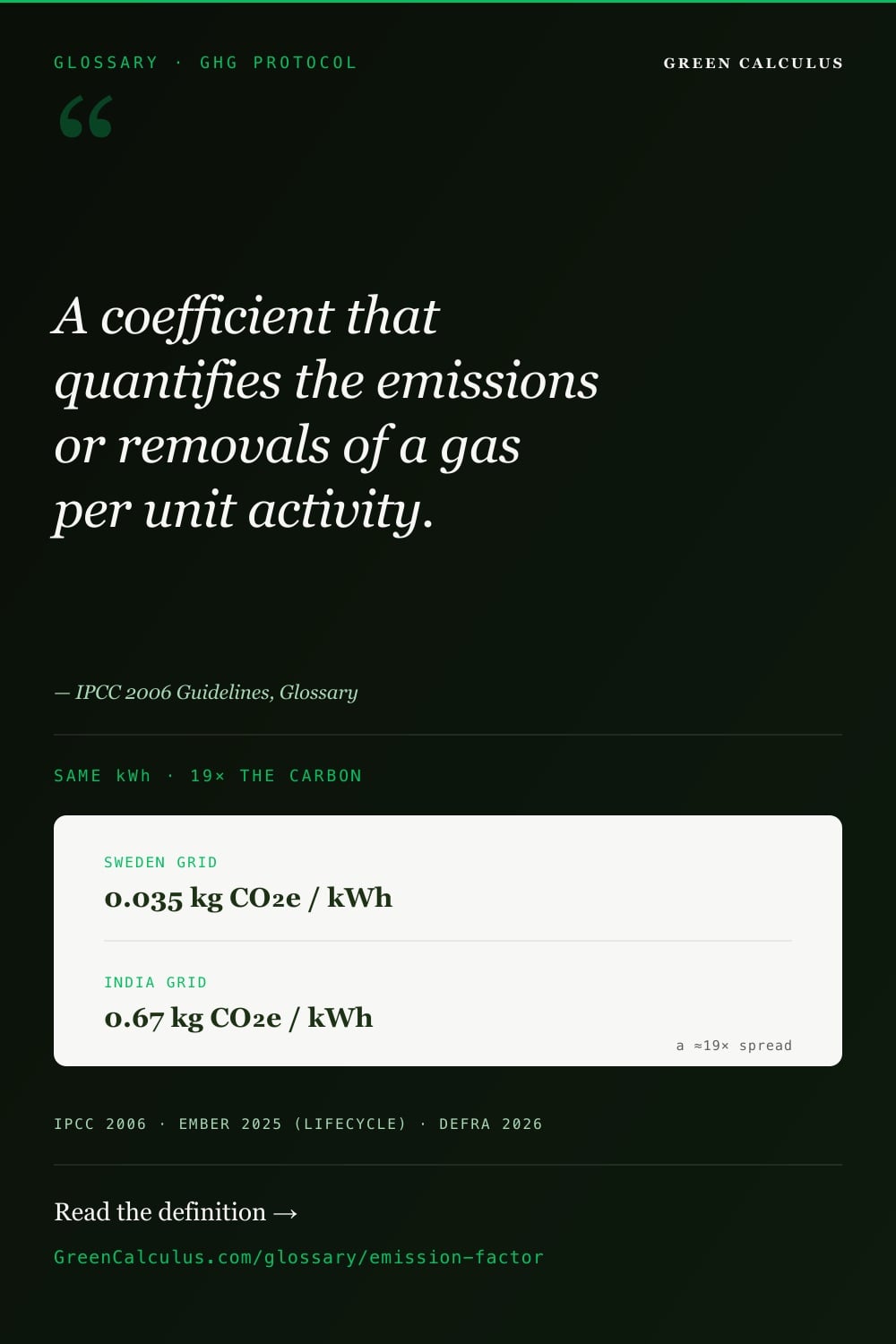
The IPCC 2006 Guidelines define an emission factor as “a coefficient that quantifies the emissions or removals of a gas per unit activity,” adding that emission factors are often based on a sample of measurement data, averaged to give a representative rate for a given activity level and operating conditions.
The Equation: Activity Data × Emission Factor
The emission factor never acts alone. It is one term in the master equation of greenhouse gas accounting — the same relationship the activity data entry describes from the other side:
Emissions (kg CO₂e) = activity data × emission factor
The activity data carries the physical units (kWh, litres, km); the emission factor carries CO₂e per those units; the product is emissions in CO₂e. Where an activity releases several gases, the factor already blends them into one CO₂e figure using each gas’s global warming potential — so a fuel’s combustion factor bundles its CO₂, methane (at 27 [GreenCalculus gwp.CH4_biogenic.ar6_100 · IPCC AR6 · v2026.272] times CO₂ over 100 years, the non-fossil value used for combustion) and nitrous oxide (at 273 [GreenCalculus gwp.N2O.ar6_100 · IPCC AR6 WGI Ch 7 Table 7.SM.7 (2021) — AR6 GWP-100] times) into a single number.
10,000 kWh of UK grid electricity, at the current emission factor of about 0.131 kg CO₂e/kWh (location-based, DEFRA 2026), gives 10,000 × 0.131 = 1,310 kg CO₂e, roughly 1.31 tonnes. Swap in France’s location-based factor (0.035, ADEME 2026) and the identical 10,000 kWh becomes just 350 kg CO₂e. The activity is the same; only the factor changed — which is the whole point.
How an Emission Factor Is Calculated
Every emission factor is, at root, a ratio: emission factor = emissions ÷ activity. What differs is how the publisher arrives at the two numbers.
Fuels: from carbon content. For combustion CO₂ the IPCC 2006 Guidelines (Volume 2, Table 1.4) build the factor from the fuel’s chemistry: CO₂ factor (kg/TJ) = carbon content (kg C/GJ) × oxidation factor × 44/12 × 1,000. The 44/12 converts a mass of carbon into the mass of CO₂ it becomes (the molecular masses of CO₂ and carbon). The oxidation factor is the share of the carbon that actually burns, and the IPCC default is 1.
IPCC default carbon content of natural gas: 15.3 kg C/GJ. 15.3 × 1 × 44/12 × 1,000 = 56,100 kg CO₂/TJ, or 56.1 kg CO₂/GJ, the IPCC default. Divided by 277.78 kWh per GJ, that is 0.2020 kg CO₂/kWh on a net calorific basis, almost exactly DEFRA’s net-basis UK factor of 0.20199 kg CO₂e/kWh [GreenCalculus fuels.gbr.natural_gas.kwh_ncv · DEFRA 2026 'Fuels'!D41] (which also counts a little methane and nitrous oxide). The IPCC figures are per unit of net calorific value, so they must be applied to net energy.
Electricity: from a whole grid. A grid factor divides the emissions of every power station feeding the grid in a year by the electricity they supplied. DEFRA’s UK factor, for example, adds imports and is rebuilt every year from national energy statistics, which is why it moves as the generation mix changes.
Materials, products and spend. Factors for steel, cement or a purchased service come from life-cycle assessment or environmentally-extended input-output (EEIO) models, which trace emissions through supply chains. The ratio is the same, emissions per tonne or per dollar, but the boundary is far wider and the uncertainty larger.
Where an activity releases more than one gas, each gas gets its own factor and is weighted by its global warming potential before the factors are summed into a single CO₂e figure.
What’s Inside an Emission Factor
A single published number hides several choices, and two factors that look interchangeable can rest on different conventions. The dimensions that matter most:
| Dimension | Options | Why it matters |
|---|---|---|
| Gases included | CO₂ only · CO₂ + CH₄ + N₂O (as CO₂e) | Determines whether it is a full CO₂e factor or carbon dioxide alone |
| GWP basis | AR5 · AR6 (100-year) | Same gas, different multiplier — never mix two bases in one total |
| Energy basis (fuels) | Gross (GCV) · Net (NCV) | The activity data must use the same calorific basis as the factor |
| Boundary | Combustion only · well-to-tank · lifecycle | Direct emissions vs also counting upstream extraction, refining and transport |
This is why a factor should always travel with its metadata. “2.02 kg CO₂e” means nothing on its own; “2.02633 kg CO₂e [GreenCalculus fuels.gbr.natural_gas.m3 · DEFRA 2026 'Fuels'!D40] per m³ of natural gas, gross calorific value, AR5 basis, DEFRA 2026″ is a usable factor. Corporate reporting increasingly standardises on the AR6 100-year basis, though DEFRA-sourced fuel and UK grid factors carry AR5 internally by design.
Why the Same Activity Has Different Factors
An emission factor is only meaningful with its context attached — source, region, year, and basis. The clearest illustration is electricity. A kilowatt-hour is a kilowatt-hour anywhere, but the emissions behind it depend entirely on how the local grid generates power:
Emission factor for 1 kWh of electricity, by country
Lifecycle carbon intensity of one kilowatt-hour of grid electricity, in kg CO₂e/kWh (Ember 2025, 2024 data). The same activity — using 1 kWh — carries roughly nineteen times more CO₂e in India than in Sweden, purely because of how each grid is generated (coal-heavy versus hydro and nuclear). Lifecycle figures also count emissions from building and fuelling the power stations, so they are higher than the location-based factors used for Scope 2: the UK’s is 0.217 here, against 0.131 in DEFRA 2026.
Region is only one axis. Even within one country, the same kWh has two legitimate factors: a location-based factor (the physical grid average) and a market-based factor (reflecting the electricity a company has contractually purchased through tariffs or certificates). They answer different questions and are reported side by side, not interchangeably.
Factors also move over time as grids decarbonise and datasets are revised. The UK grid factor has fallen from 0.2556 kg CO₂e/kWh in DEFRA 2019 to 0.131 [GreenCalculus grid.gbr.electricity.location_based · DEFRA 2026 'UK electricity'!E25] in DEFRA 2026 — almost half. That is why every factor carries a vintage year, and why an inventory must use the factor set published for its reporting year rather than an older one.
An emission factor without its source, region, year, and basis is just a number — and usually the wrong one.
Where Emission Factors Come From
Because factors are looked up rather than measured, knowing the authoritative sources — and applying them consistently — is central to a credible inventory. The main published sets:
- DEFRA / DESNZ — the UK government conversion factors for fuels, electricity, travel, and waste; updated annually.
- IPCC — default (Tier 1) factors for national inventories, used where country-specific values are unavailable.
- US EPA — US factors, including the eGRID subregional grid factors and the USEEIO spend-based set.
- Ember — lifecycle carbon intensity of electricity by country (the basis for the chart above). The IEA also publishes country grid factors, under a paid licence.
- ecoinvent and input-output (EEIO) databases — lifecycle and spend-based factors for materials, goods, and services.
The values below render live from the current datasets — a snapshot of real emission factors in use today:
| Activity | Emission factor (current) | Basis / source |
|---|---|---|
| UK grid electricity | 0.131 kg CO₂e/kWh | Location-based · DEFRA 2026 |
| Natural gas (combustion) | 2.02633 kg CO₂e/m³ | Gross CV · DEFRA 2026 |
| Diesel (combustion) | 2.58354 kg CO₂e/litre | Average biofuel blend · DEFRA 2026 |
| Methane (fossil leaks), GWP-100 | 29.8 × CO₂ | IPCC AR6 |
| Nitrous oxide, GWP-100 | 273 × CO₂ | IPCC AR6 |
For the full country grid set see the grid electricity emission factors dataset; for the UK conversion factors, the DEFRA emission factors reference. Converting an activity-data unit to match a factor’s denominator is covered in the fuel, distance and energy conversion methodology.
Common Confusions
- Using the wrong vintage. Factors are revised every year; a reporting year must use that year’s factor set, not a stale one carried over from a template.
- Mixing GWP bases. An AR5 factor and an AR6 factor for different gases in the same total are inconsistent — pick one basis and apply it throughout.
- Unit mismatch. A per-kWh factor applied to cubic metres, or a per-litre factor to kilograms, silently corrupts the result. The factor’s denominator must match the activity-data unit.
- Confusing location-based and market-based. The physical grid average and the contractual factor answer different questions; don’t substitute one for the other.
- Ignoring the boundary. A combustion-only factor omits upstream emissions; where a lifecycle or well-to-tank figure is required, a direct factor understates the total.
- Treating a spend-based factor as a physical one. A factor expressed per unit of currency is an economic proxy, not a physical rate — coarser and price-sensitive.
- Confusing the factor with the emissions. The emission factor is the rate; the emissions are the result after multiplying by activity data.
Convert an emission factor’s units: g CO₂/MJ to g CO₂/kWh, t CO₂/TJ to kg CO₂/GJ, kg CO₂e/tonne to per short ton and g CO₂e/kg to kg CO₂e/tonne.
Frequently Asked Questions
They are the two halves of the same equation. Activity data is how much of an activity happened, in physical units (for example 10,000 kWh of electricity). The emission factor is how much CO₂e is released per unit of that activity (for example 0.131 kg CO₂e per kWh) [GreenCalculus grid.gbr.electricity.location_based]. Multiplying them gives the emissions in CO₂e. Activity data is measured by the organisation; the emission factor is looked up from a published source.
Because the emissions behind an activity depend on its context. One kilowatt-hour of electricity carries a lifecycle intensity of about 0.035 kg CO₂e in Sweden but 0.67 in India, because each grid is generated differently. Factors also change with the vintage year (grids decarbonise), the accounting basis (AR5 versus AR6 global warming potentials), the boundary (combustion only versus lifecycle), and, for electricity, whether a location-based or market-based factor is used. This is why an emission factor is only meaningful with its source, region, year, and basis attached.
From published datasets maintained by governments and research bodies. In the UK, DEFRA/DESNZ publishes annual conversion factors for fuels, electricity, travel, and waste. The IPCC provides default (Tier 1) factors for national inventories; the US EPA publishes US factors including the eGRID grid set; Ember and the IEA publish international grid factors; and databases such as ecoinvent and environmentally-extended input-output (EEIO) models provide lifecycle and spend-based factors. An organisation selects the source that matches its reporting scope, region, and required data quality.
Both apply to purchased electricity but answer different questions. A location-based factor is the average carbon intensity of the physical grid the site draws from — the emissions actually flowing through the wires. A market-based factor reflects the electricity a company has contractually chosen, through tariffs, renewable certificates, or power purchase agreements, and can be much lower if clean power is procured. The GHG Protocol requires both to be reported for Scope 2. They are compared in detail on the location-based versus market-based page.
By dividing emissions by activity. For fuels the IPCC builds the CO₂ factor from the fuel’s carbon content: carbon content (kg C/GJ) × oxidation factor × 44/12 × 1,000 gives kg CO₂ per TJ. For natural gas that is 15.3 × 1 × 44/12 × 1,000 = 56,100 kg CO₂/TJ, or about 0.202 kg CO₂ per kWh on a net calorific basis. Grid electricity factors divide a year’s power-station emissions by the electricity supplied, and factors for materials and purchased goods come from life-cycle assessment or input-output models. Methane and nitrous oxide are converted to CO₂e with their global warming potentials before being added.
An emission factor is a coefficient that converts a unit of activity into greenhouse gas emissions — for example, kilograms of CO₂e per kilowatt-hour of electricity, or per litre of fuel. It is one of the two numbers every emissions calculation multiplies together: emissions equal activity data times an emission factor. Unlike activity data, which an organisation measures itself, an emission factor is looked up from a published dataset such as DEFRA, the IPCC, or Ember. DEFRA refers to these as “conversion factors”; both terms mean the same thing.
Need someone who does this? 6 carbon accounting & inventory providers in our directory →