
Stationary Combustion

The gas boiler in a building’s basement, the furnace in a factory, the turbine in an on-site power plant — all of them do the same fundamental thing: they burn fuel where they stand to make heat or power. None of them moves, and every one of them sends carbon dioxide up a flue. For most organisations, this fixed, on-site burning is the single most visible source of the emissions they directly control.
That is stationary combustion — the burning of fuel in fixed, non-moving equipment to produce heat, steam, or power on site.
Stationary combustion is the burning of fuel in fixed equipment — boilers, furnaces, kilns, heaters, turbines, generators — to produce heat, steam or power. Because the equipment is owned or controlled, it is a primary source of Scope 1 emissions.
Definition — Burning Fuel in Fixed Equipment
Stationary combustion is the controlled burning of fuel in equipment that stays in one place, to generate heat, steam, electricity, or mechanical power on site. The defining word is stationary: the equipment is fixed, which sets it apart from mobile combustion, where the same chemical process happens inside a moving vehicle. Typical stationary combustion equipment includes:
- Boilers — heating water or raising steam for space heating and processes;
- Furnaces, ovens, and kilns — high-temperature heat for manufacturing;
- Heaters and dryers — direct-fired process and space heating;
- Turbines and stationary engines — on-site power and combined heat and power (CHP);
- Generators — standby and prime power;
- Flares and incinerators — controlled burning of waste gases or materials.
Because the reporting company owns or controls this equipment, the emissions it produces are direct emissions and fall into Scope 1. They are almost entirely carbon dioxide, with small quantities of methane (from incomplete combustion) and nitrous oxide, all added together as CO₂-equivalent.
Definition at a glance
| What it is | Burning fuel in fixed equipment to make heat, steam, or power on site |
|---|---|
| Equipment | Boilers, furnaces, ovens, kilns, heaters, turbines, stationary generators |
| Scope | Scope 1 — direct emissions from owned/controlled sources |
| Gases | Mostly CO₂, plus small CH₄ and N₂O |
| Calculated as | Fuel burned × emission factor |
| Distinct from | Mobile combustion (same burning, but in vehicles) |
How the Emissions Are Calculated
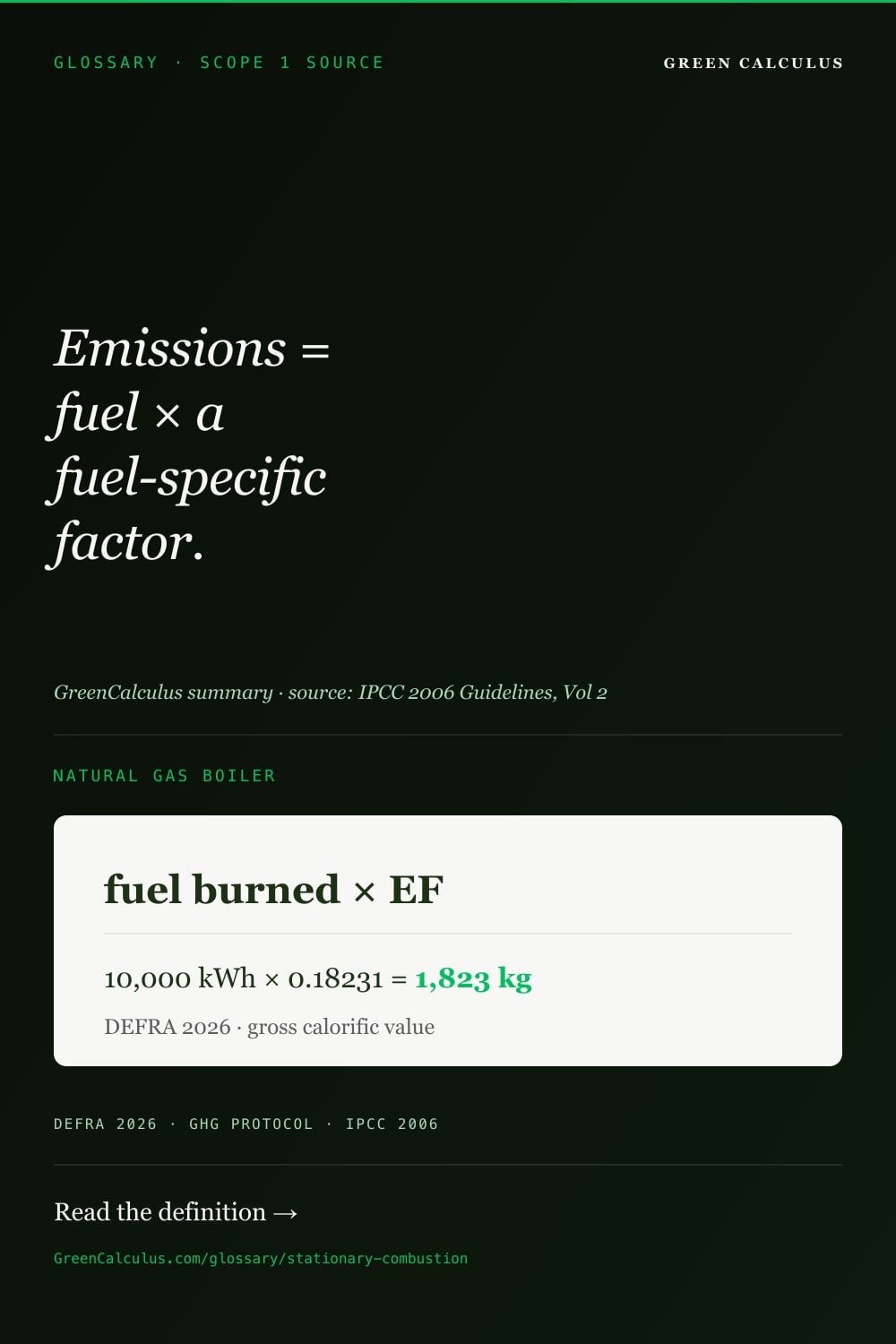
The arithmetic is the standard emissions equation: measure how much fuel was burned (the activity data), and multiply it by an emission factor for that fuel. The activity data comes from meter readings, delivery records, or invoices — cubic metres or kilowatt-hours of gas, litres of oil, tonnes of coal — and the emission factor converts it into kilograms of CO₂-equivalent.
The table below shows live UK DEFRA factors for common stationary-combustion fuels, on a comparable energy basis of kilograms of CO₂e per kilowatt-hour (gross calorific value):
| Fuel | Emission factor (live, kg CO₂e / kWh, gross CV) |
|---|---|
| Natural gas | 0.18231 |
| LPG (liquefied petroleum gas) | 0.2145 |
| Gas oil (heating oil) | 0.2565 |
| Coal (industrial) | 0.32512 |
The GHG Protocol’s guidance on Scope 1 stationary combustion and the IPCC 2006 Guidelines (Volume 2, Energy) both define the method the same way: emissions equal fuel consumption multiplied by a fuel-specific factor, summed across CO₂, CH₄, and N₂O. Two details matter for consistency. First, factors are quoted per unit of fuel — per litre, per tonne, per cubic metre, or per kWh — so the activity data must be in the matching unit. Second, energy-based factors depend on whether they use gross (higher) or net (lower) calorific value; UK DEFRA factors use gross CV, while IPCC and EU figures typically use net, and the two are not interchangeable.
Comparing Fuels: Not All Are Equal
The choice of fuel is the largest lever on stationary-combustion emissions, because the carbon intensity of fuels varies widely. Per unit of useful energy, natural gas is the cleanest of the common fossil fuels and coal is the dirtiest — the live factors below make the gap concrete:
Live UK DEFRA factors, kg CO₂e per kWh (gross calorific value). Coal emits roughly 80% more CO₂e per unit of energy than natural gas (green), which is why switching a coal or oil boiler to gas — and ultimately to electric heat — is one of the highest-impact moves in a Scope 1 inventory. In their natural units, a litre of gas oil is 2.75541 kg CO₂e [GreenCalculus fuels.gbr.gas_oil.litre · DEFRA 2026 'Fuels'!D84 · v2026.284] and a tonne of industrial coal is 2415.03994 kg CO₂e [GreenCalculus fuels.gbr.coal_industrial.tonne · DEFRA 2026 'Fuels'!D131].
Same boiler, same heat delivered — swap coal for natural gas and the carbon per kilowatt-hour falls by nearly half. The fuel you burn matters more than almost anything else you can change.
Stationary vs Mobile Combustion
Stationary combustion has a twin: mobile combustion, the burning of fuel in vehicles and other transport a company owns — cars, vans, trucks, forklifts, ships, and aircraft. Both are Scope 1 because the company controls the equipment; the difference is simply whether that equipment stays put or moves. The distinction matters because they are usually reported as separate categories, use different activity data, and sometimes different emission factors.
| Stationary combustion | Mobile combustion | |
|---|---|---|
| Equipment | Fixed — boilers, furnaces, turbines | Moving — cars, vans, trucks, ships |
| Typical fuels | Natural gas, LPG, heating oil, coal | Petrol, diesel, jet fuel |
| Activity data | Fuel metered or delivered on site | Fuel used or distance travelled |
| Scope | Both are Scope 1 direct emissions | |
In practice, a company estimates its stationary combustion with a stationary combustion calculator and its fleet with a mobile combustion calculator, then reports them as distinct lines within the same Scope 1 total.
Common Confusions
- Confusing stationary combustion with purchased energy. Burning gas in your own boiler is Scope 1; buying electricity or district heat generated elsewhere is Scope 2. The dividing line is whether you burn the fuel.
- Mixing up gross and net calorific value. Energy-based factors differ depending on whether they use gross (higher) or net (lower) CV. UK factors are gross; IPCC and EU are usually net — match the factor to your energy data.
- Forgetting methane and nitrous oxide. They are small next to CO₂ but standards require all three gases; a CO₂-only figure slightly understates the total.
- Treating stationary and mobile combustion as one line. Both are Scope 1, but they are reported as separate categories with different activity data.
- Using the wrong unit factor. A per-litre factor applied to a kWh figure (or vice versa) produces nonsense — the activity data and the emission factor must share a unit.
Frequently Asked Questions
Stationary combustion is the burning of fuel in fixed, non-moving equipment — boilers, furnaces, ovens, kilns, heaters, turbines, and stationary generators — to produce heat, steam, or power on site. Because the company owns or controls the equipment, the emissions are direct emissions and fall into Scope 1. They are calculated by multiplying the amount of fuel burned by a fuel-specific emission factor, and consist mostly of carbon dioxide with small amounts of methane and nitrous oxide. The word “stationary” distinguishes it from mobile combustion, which is the same burning but in vehicles.
Scope 1. Stationary combustion is a direct emission because the company burns the fuel in equipment it owns or controls, so it sits in Scope 1 alongside mobile combustion, process emissions, and fugitive leaks. The common confusion is with Scope 2: if you buy electricity, heat, or steam generated somewhere else, that is Scope 2, because someone else burned the fuel. The test is simple — if the combustion happens in your own equipment, it is Scope 1 stationary combustion; if you are buying the resulting energy, it is Scope 2.
By multiplying the quantity of fuel burned by a fuel-specific emission factor. The fuel quantity — the activity data — comes from meters, delivery records, or invoices, in units such as kilowatt-hours of gas, litres of oil, or tonnes of coal. The emission factor converts that into CO₂-equivalent and covers CO₂, CH₄, and N₂O. For example, UK DEFRA factors on a gross-calorific-value basis are about 0.18231 kg CO₂e per kWh [GreenCalculus fuels.gbr.natural_gas.kwh_gcv · DEFRA 2026 'Fuels'!D42] for natural gas and 0.32512 [GreenCalculus fuels.gbr.coal_industrial.kwh_gcv · DEFRA 2026 'Fuels'!D133] for coal. The activity data and the factor must share the same unit, or the result is meaningless.
The difference is whether the equipment moves. Stationary combustion burns fuel in fixed equipment — boilers, furnaces, turbines — while mobile combustion burns it in vehicles and transport such as cars, vans, trucks, ships, and aircraft. Both are Scope 1 direct emissions because the company controls the equipment, but they are reported as separate categories, use different activity data (fuel metered on site versus fuel used or distance travelled), and sometimes different fuels — natural gas and heating oil for stationary sources, petrol and diesel for mobile ones. Companies typically estimate them with separate stationary and mobile combustion calculators.
Among the common fossil fuels, natural gas has the lowest emissions per unit of energy and coal the highest. On a gross-calorific-value basis, UK DEFRA factors put natural gas at about 0.18231 kg CO₂e per kWh [GreenCalculus fuels.gbr.natural_gas.kwh_gcv], LPG at 0.2145 [GreenCalculus fuels.gbr.lpg.kwh_gcv · DEFRA 2026 'Fuels'!D38], gas oil at 0.2565 [GreenCalculus fuels.gbr.gas_oil.kwh_gcv · DEFRA 2026 'Fuels'!D86], and coal at 0.32512 [GreenCalculus fuels.gbr.coal_industrial.kwh_gcv] — so coal emits roughly 80% more per kilowatt-hour than natural gas. That is why switching from coal or oil to gas, and ultimately to electric heat drawn from a decarbonising grid, is one of the most effective ways to cut Scope 1 emissions. Lower-carbon still are heat pumps and genuinely renewable heat.
Need someone who does this? 6 carbon accounting & inventory providers in our directory →