
Science-Based Targets (SBTi) — Definition and GHG Accounting Context

A company can promise to cut its emissions by any number it likes. What makes the promise credible is whether the number is tied to something outside the company’s own ambition — a global carbon budget, a temperature limit, a decarbonisation curve that physics rather than marketing sets. A science-based target is exactly that: a reduction goal calibrated to the pace climate science says the world must move to hold warming to 1.5°C.
It is the difference between a target a company chose and a target the climate chose for it.
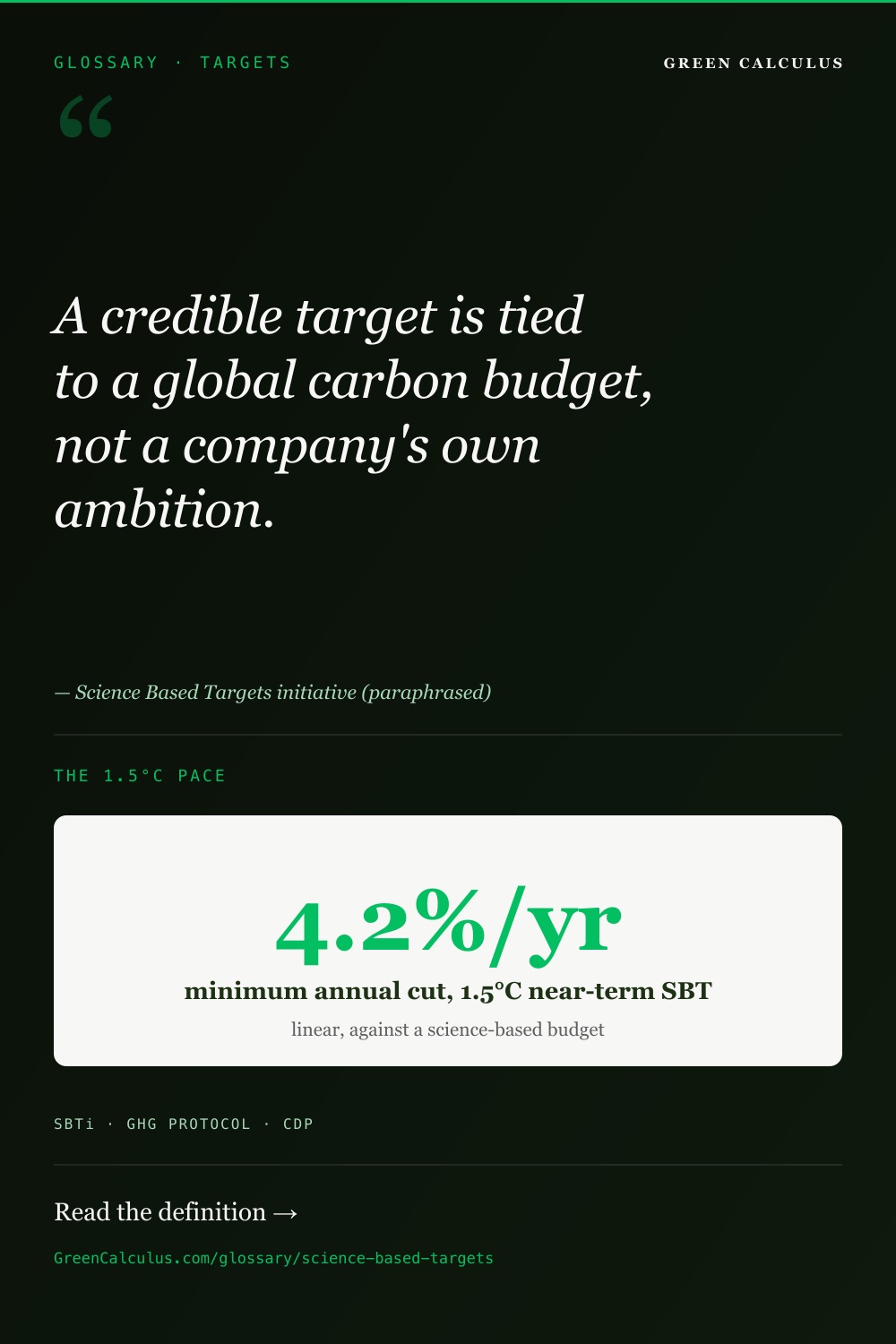
Science-based targets are corporate emission-reduction targets aligned with what climate science requires to limit warming to 1.5°C. The Science Based Targets initiative (SBTi) sets the criteria and independently validates them. A 1.5°C near-term target needs roughly a 4.2% absolute cut per year across Scopes 1 and 2, a Scope 3 target where material, and a long-term net-zero target. Offsets do not count.
Definition — What Makes a Target “Science-Based”
A target is science-based when the rate and scope of the emission reduction it commits to are consistent with a global decarbonisation pathway that keeps warming within the goals of the Paris Agreement — in current practice, 1.5°C above pre-industrial levels. The “science” is the carbon budget: the finite quantity of greenhouse gas the world can still emit and stay under the temperature limit. A company’s fair share of the cuts needed to live within that budget, expressed as a dated reduction target, is its science-based target.
This is what separates a science-based target from an ordinary corporate goal. An arbitrary “cut 30% by 2035” pledge is anchored to nothing outside the company. A science-based target is anchored to the 1.5°C pathway, which fixes both how fast emissions must fall and how deep the cut must go, and it is checked against published criteria rather than self-declared.
Two things must be distinguished, because the name blurs them. A science-based target is the reduction goal a company sets. The Science Based Targets initiative (SBTi) is the organisation that writes the criteria and validates the goal. A company “sets a science-based target” and “has it approved by the SBTi” — the target is the thing, the initiative is the referee.
The Initiative Behind the Standard
The Science Based Targets initiative is a partnership of CDP, the United Nations Global Compact, the World Resources Institute, and WWF, launched in 2015. It has become the de facto global standard-setter for corporate climate targets: it publishes the criteria a target must meet, the sector guidance and methods used to set one, and it runs the independent validation process that approves — or rejects — a company’s submitted targets. Companies typically disclose progress annually, often through the CDP Climate Change questionnaire.
Because SBTi validation has become the benchmark investors and disclosure frameworks look for, “having a science-based target” in corporate usage almost always means a target validated against SBTi criteria — including the flagship SBTi Corporate Net-Zero Standard and sector guidance such as SBTi FLAG for forest, land, and agriculture. Whether your company is ready to submit can be checked with the SBTi Readiness Checklist.
Near-Term and Long-Term Targets
The SBTi framework requires two targets, not one. A near-term target drives the cuts that must happen this decade; a long-term target commits the company to net zero. Both are mandatory under the Corporate Net-Zero Standard — a 2050 pledge with no near-term step is not a valid science-based target.
Near-term target
A 5–10 year target that cuts emissions in line with 1.5°C — roughly a 4.2% absolute reduction per year, about 42% by 2030 for Scope 1 and 2. Modelled in the SBTi Near-Term Target Calculator.
Long-term net-zero target
A commitment to reduce emissions ~90% by 2050 and neutralise the residual with permanent removals — the net-zero end state. Modelled in the SBTi Net-Zero Target Calculator.
Target-Setting Methods — ACA vs SDA
SBTi provides more than one method to translate the 1.5°C pathway into a company target. The two principal ones differ in how they allocate the required cuts.
| Dimension | Absolute Contraction (ACA) | Sectoral Decarbonization (SDA) |
|---|---|---|
| Basis | Same linear % cut for every company | Emissions intensity converges within a sector |
| 1.5°C near-term rate | ~4.2% absolute reduction per year | Sector pathway to a 2050 intensity target |
| Best suited to | Most companies; diverse activities | Homogeneous sectors — power, cement, steel, aviation |
| Metric | Absolute tonnes CO₂e | Intensity (e.g. tCO₂e per tonne product or MWh) |
| Guards against | Any absolute rise | Falling intensity while output — and absolute emissions — climb |
The Absolute Contraction Approach is the default and the most widely used. Intensity methods such as the SDA are reserved for sectors where a physical output denominator is meaningful and comparable across companies.
Scope Coverage and the Scope 3 Threshold
A science-based target must cover Scope 1 and Scope 2 in full. Scope 3 — the value-chain emissions accounted for under the GHG Protocol Corporate Standard and its Scope 3 guidance — becomes mandatory once it is material:
If a company’s Scope 3 emissions are 40% or more of its total Scope 1 + 2 + 3 footprint, an SBTi-validated Scope 3 target is required. For most companies — retailers, manufacturers, financial institutions, technology firms — Scope 3 clears that threshold easily and dominates the target, which is why a credible science-based target is rarely just an operational-emissions goal.
How Science-Based Targets Fit GHG Accounting
A science-based target is set and tracked against the greenhouse gas inventory. The base-year footprint — gross Scopes 1, 2, and 3, measured under the GHG Protocol — is the reference the target reduces from, and progress is the fall in that gross figure over time. Targets are denominated in tonnes of CO₂e, which aggregates each gas by its global warming potential — methane at 29.8 and nitrous oxide at 273 times CO₂ over 100 years.
SBTi progress is measured only by real reductions inside the value chain — carbon credits and offsets do not count toward a science-based target. Buying credits cannot substitute for cutting emissions, and it never reduces the gross inventory the target is tracked against. The only role for carbon removals is neutralising the residual at the net-zero year, and even then it is removals — not avoidance credits — that qualify. This is the same reductions-first, no-netting principle that governs the inventory itself.
Worked Micro-Example
A company’s base-year Scope 1 + 2 emissions are 50,000 tCO₂e (base year 2022). It sets a 1.5°C near-term target using the Absolute Contraction Approach, to 2030.
Base-year Scope 1 + 2 = 50,000 tCO₂e
1.5°C near-term reduction to 2030 ≈ 42% (≈ 4.2% per year)
Target 2030 Scope 1 + 2 = 50,000 × (1 − 0.42) = 29,000 tCO₂e
Long-term net-zero (~90% by 2050) → residual ≈ 5,000 tCO₂e, neutralised by removals
If Scope 3 ≥ 40% of the total footprint, a separate Scope 3 target is also required.
The 42% near-term cut is the commitment that must be delivered by 2030; the ~90% long-term cut takes the company to its net-zero year. Size a full target in the SBTi Near-Term and Net-Zero Target calculators, model the trajectory between them in the Net-Zero Pathway Calculator, and set a land-sector target with the FLAG Emissions Calculator.
Common Confusions
- Confusing the target with the initiative. A “science-based target” is the goal; the “SBTi” is the body that validates it. They are not interchangeable.
- Assuming offsets count. SBTi progress is real reductions only — credits and offsets do not count toward a science-based target.
- Omitting Scope 3. When Scope 3 is ≥40% of the footprint, a Scope 3 target is required — and it usually dominates.
- Using an outdated ambition. Near-term Scope 1 and 2 targets must be 1.5°C-aligned; the older “well-below 2°C” ambition no longer qualifies for them.
- Setting only one target. A near-term target without a long-term net-zero target — or vice versa — is not a valid SBTi commitment.
- Intensity that masks growth. An intensity target can fall while absolute emissions rise; SBTi methods are designed to prevent that.
Frequently Asked Questions
A science-based target is a corporate greenhouse gas reduction target whose rate and depth are aligned with what climate science requires to limit warming to 1.5°C — anchored to the global carbon budget rather than to a company’s own ambition. A 1.5°C near-term target needs roughly a 4.2% absolute cut per year across Scopes 1 and 2, a Scope 3 target where Scope 3 is material, and a long-term net-zero target. The Science Based Targets initiative sets the criteria and validates the target.
The Science Based Targets initiative (SBTi) is a partnership of CDP, the UN Global Compact, the World Resources Institute, and WWF, launched in 2015. It publishes the criteria a target must meet, the methods used to set one, and runs the independent validation process that approves company targets. It has become the de facto global standard for corporate climate targets — “having a science-based target” almost always means one validated against SBTi criteria. The target is the goal; the SBTi is the body that checks it.
A near-term science-based target is a 5–10 year target that cuts emissions in line with 1.5°C — roughly 42% for Scope 1 and 2 by 2030. A long-term target commits the company to net zero — about a 90% reduction by 2050, with the residual neutralised by permanent removals. Under the SBTi Corporate Net-Zero Standard both are required: the near-term target drives this decade’s cuts, and the long-term target sets the end state. You can model each in the near-term and net-zero calculators.
No. SBTi progress is measured only by real emission reductions inside the value chain; carbon credits and offsets do not count toward a science-based target and never reduce the gross inventory the target is tracked against. Buying credits cannot substitute for cutting emissions. The only role for carbon removals is neutralising the residual at the net-zero year — and even there it must be permanent removals, not avoidance credits.
The Absolute Contraction Approach (ACA) applies the same linear percentage cut — about 4.2% per year for a 1.5°C near-term target — to every company’s absolute emissions, and is the default. The Sectoral Decarbonization Approach (SDA) instead has companies in a sector converge to a common emissions intensity by 2050, and suits homogeneous sectors such as power, cement, steel, and aviation where a physical output denominator is comparable. ACA guards against any absolute rise; SDA guards against intensity falling while absolute emissions climb.