
SECR Reporting: Who Must Report, What to Disclose and How

About 21,200 UK companies and LLPs are quoted or meet SECR’s size test, and about 12,800 of them report in their own right (the rest are covered by a parent’s group report or are low energy users), according to the Government’s January 2026 evaluation. Every year they put their energy use and carbon emissions into the same document as their profit and loss — the Directors’ Report filed at Companies House.
SECR took carbon reporting out of a specialist sustainability silo and wired it directly into statutory accounts, where auditors, investors, and Companies House all see it.
SECR is the UK's mandatory energy and carbon disclosure framework, in force since 1 April 2019. Quoted companies, and large unquoted companies and LLPs, must report energy use, Scope 1 and 2 emissions, an intensity ratio and efficiency actions.
Executive Summary
Streamlined Energy and Carbon Reporting (SECR) is the UK’s mandatory framework for disclosing corporate energy use and greenhouse-gas emissions. It came into force for financial years beginning on or after 1 April 2019 under the Companies (Directors’ Report) and Limited Liability Partnerships (Energy and Carbon Report) Regulations 2018 (SI 2018/1155), replacing the Carbon Reduction Commitment (CRC) Energy Efficiency Scheme and extending mandatory carbon reporting from quoted companies alone to a far wider population of large businesses.
The framework applies to three categories of organisation: all UK quoted companies regardless of size, large unquoted companies, and large LLPs. Those in scope must disclose, within their annual Directors’ Report (or an equivalent Energy and Carbon Report for LLPs), their energy consumption, their Scope 1 and Scope 2 greenhouse-gas emissions, at least one emissions intensity ratio, a narrative of the energy-efficiency actions taken during the year, and the methodology used — with prior-year comparatives from the second reporting year onward.
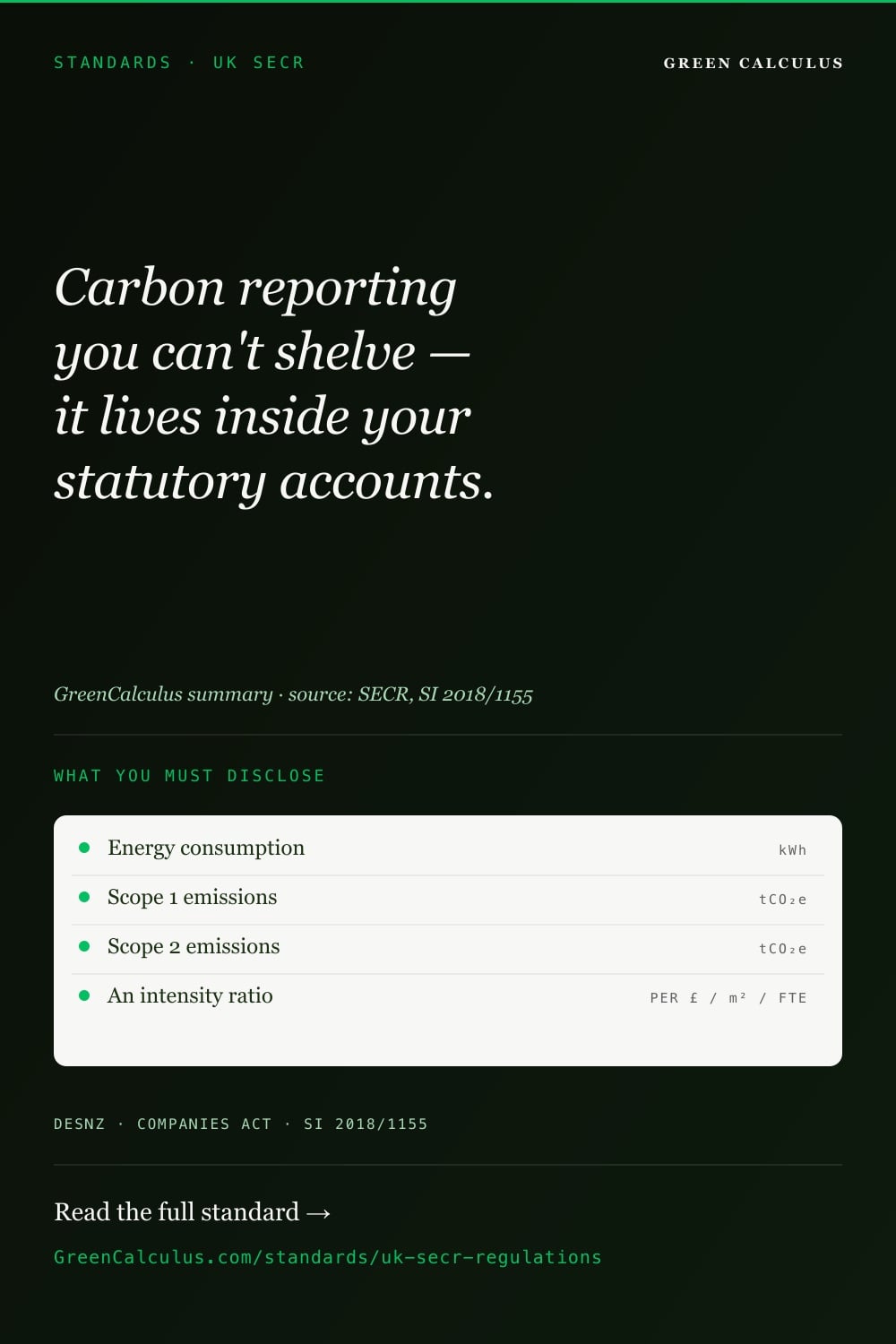
SECR’s distinguishing feature is that it lives inside statutory accounts. The disclosures sit in the Directors’ Report filed at Companies House, subject to the same filing deadlines and the same auditor consistency checks as the financial statements. Carbon reporting is not a separate sustainability document a company can quietly shelve — it is part of the annual report, seen by every user of the accounts.
SECR remains fully in force in 2026, even as the UK develops its ISSB-aligned UK Sustainability Reporting Standards (UK SRS). The two regimes currently coexist: SECR is rule-based, backward-looking energy and emissions disclosure for a broad population; UK SRS is judgement-based, forward-looking climate disclosure aimed initially at listed companies. The Government has committed to review how the two interact to reduce duplication, but has not announced a phase-out.
Provider directory
Need help reporting this to a regulator?
See who does this work. Every listing names the standards it works to, and paid placements are labelled. Including ESG PRO and SCS Consulting Services.
Browse 4 regulatory reporting providers →Do this work? A listing is US$390 a year. Get listed →
What Is SECR?
SECR is a disclosure regime, not an emissions-calculation method or a reduction target. It does not tell a company how much to emit or by when; it tells a defined set of companies what energy and carbon information they must publish, where, and in what form. The calculation itself follows established methods — principally the GHG Protocol and the UK Government’s annually-updated conversion factors — which SECR references rather than replaces.
The framework does three things. First, it defines scope: which organisations must report, using company-law size tests. Second, it specifies content: the mandatory data points — energy use, Scope 1 and 2 emissions, an intensity ratio, an efficiency narrative, and methodology. Third, it fixes location and cadence: the disclosures go in the Directors’ Report, annually, filed with the statutory accounts. By binding all three to company law, SECR gives carbon reporting the same legal standing and the same audience as financial reporting.
The name is deliberate. “Streamlined” signals the policy intent — to consolidate a fragmented set of earlier obligations into a single, lower-burden framework attached to existing reporting, rather than a standalone scheme with its own registration, allowances, and administration like the CRC it replaced.
Why SECR Exists
SECR replaced the Carbon Reduction Commitment (CRC) Energy Efficiency Scheme, a cap-and-report scheme widely criticised as complex and costly, with its own registration, allowance purchasing, and league tables. When the CRC was abolished, the Government needed a mechanism to preserve — and widen — the transparency benefits of carbon reporting without the CRC’s administrative overhead. SECR was that mechanism.
The policy goals are twofold. The first is transparency: making energy and carbon information visible to investors, lenders, and other users of accounts, consistent with the direction the G20 Financial Stability Board’s Task Force on Climate-related Financial Disclosures (TCFD) was setting internationally. The second is behaviour change: the requirement to report energy use and, crucially, to narrate energy-efficiency actions taken, is intended to prompt companies to find and act on efficiency opportunities — cutting both cost and carbon.
The mandatory narrative of efficiency actions is the part of SECR most directly aimed at changing behaviour rather than merely disclosing. A company that must publicly describe what it did — or state that it did nothing — faces a mild but real pressure to act. The Financial Reporting Council has signalled it expects specific, non-boilerplate narratives rather than generic statements of intent.
Legal Basis and Governance
SECR is created by secondary legislation: the Companies (Directors’ Report) and Limited Liability Partnerships (Energy and Carbon Report) Regulations 2018 (SI 2018/1155), which amended the Companies Act 2006 to insert the energy-and-carbon disclosure requirements into the Directors’ Report regime and created a parallel Energy and Carbon Report for LLPs. The obligation is therefore a company-law obligation, discharged through the same reporting machinery as the rest of the annual report.
Three bodies shape the framework in practice. Policy and guidance responsibility sits with the Department for Energy Security and Net Zero (DESNZ), which inherited it from the former BEIS; DESNZ maintains the Environmental Reporting Guidelines, the Government’s detailed interpretation of how to discharge the statutory duty. The guidelines are not themselves legally binding, but they are the primary reference for compliance. Enforcement runs through the ordinary company-law machinery: Companies House may refuse accounts that do not meet the Companies Act and charges late-filing penalties, and the Financial Reporting Council’s Conduct Committee reviews annual reports and can apply to the court for an order requiring revised reports.
Because SECR is embedded in the Companies Act framework, the definitions it relies on — “quoted company,” “large,” turnover, balance-sheet total — are Companies Act definitions, and the disclosures are located and audited within the existing Directors’ Report structure under sections 415 to 419 of the Act.
Who Must Report
SECR applies to three distinct categories of organisation, each qualifying by a different route.
Quoted companies
Every UK-incorporated quoted company is in scope, regardless of size. A quoted company is one whose equity share capital is officially listed on the Main Market of the London Stock Exchange, an EEA-regulated market, or admitted to trading on the New York Stock Exchange or NASDAQ. There is no size threshold — even a small quoted company must comply.
Large unquoted companies
UK-incorporated companies that are not quoted but meet the Companies Act “large” test qualify. This is the population SECR newly brought into mandatory reporting in 2019. It includes charitable companies and companies regulated by the FCA where they meet the size test.
Large LLPs
Limited liability partnerships meeting the same “large” size test must prepare and file an Energy and Carbon Report — the LLP equivalent of the Directors’ Report disclosure, introduced specifically by the 2018 Regulations.
Public bodies are outside SECR at the organisational level, though many face parallel carbon-reporting duties such as the Greening Government Commitments. Not-for-profits and organisations undertaking public activities — companies owned by universities, academies, or NHS trusts, for example — must nonetheless check whether they meet the “large” company test, because meeting it brings them into scope.
The Size Thresholds
A company or LLP is “large” for SECR if it meets at least two of three thresholds. This two-of-three logic is the single most consequential mechanism in the framework, because it determines the entire unquoted population’s obligation.
| Threshold | Value | Basis |
|---|---|---|
| Annual turnover | More than £36 million | Companies Act 2006 definition of turnover |
| Balance-sheet total | More than £18 million | Aggregate of assets before deduction of liabilities |
| Employees | More than 250 | Average number over the year |
An unquoted company or LLP is in scope if it meets any two of these three in the relevant financial year. Quoted companies, by contrast, are in scope irrespective of these numbers.
In April 2025 the UK raised the general Companies Act “large” company thresholds (to £54 million turnover and £27 million balance sheet). The SECR thresholds did not move — they remain £36m / £18m / 250. This creates a deliberate divergence: a company now classed as “medium-sized” for general accounting purposes can still be caught by SECR. Assuming the new higher accounting thresholds govern SECR eligibility is a live, current error.
Exemptions and the Low-Energy User
SECR contains a narrow de minimis exemption for low energy users. An organisation that consumes 40 MWh (40,000 kWh) or less of energy over the reporting period is not required to make the full disclosures — but it is not silent: it must include a statement in its report confirming that it is a low energy user. The exemption removes the reporting burden, not the acknowledgement.
The energy scope of the 40 MWh test tracks the reporting scope. For quoted companies the threshold is assessed against global energy use; for large unquoted companies and LLPs it is assessed against UK energy use. In a group report, the low-energy-user threshold applies to the combined consumption of the parent and its subsidiaries, not to each entity separately.
SECR also carries a comply-or-explain mechanism. Where it is not practical to obtain some of the required information, a company may omit it, provided it states what has been omitted and why. The clause exists to accommodate genuine data-availability problems — not to excuse incomplete reporting — and companies are expected to close such gaps over time.
A common misconception is that falling under 40 MWh means nothing needs to appear in the report. In fact a low-energy-user statement is still required. Omitting even that statement is a compliance failure, because the reader of the accounts is entitled to know that the absence of energy figures is deliberate and rule-based, not an oversight.
What Must Be Reported
Within the relevant geographic boundary, an in-scope organisation must disclose a defined set of data points. The core mandatory content is:
- Energy consumption for the financial year, in kWh — for unquoted companies and LLPs, covering at least purchased electricity, gas and transport fuel (a separate figure for each is optional).
- Greenhouse-gas emissions in tonnes of CO₂ equivalent (tCO₂e), reporting Scope 1 (direct) and Scope 2 (purchased electricity and other energy) emissions, plus — for large unquoted companies and LLPs — business travel in rental cars or employees’ own vehicles where the company buys the fuel, which is Scope 3 in GHG Protocol terms.
- At least one intensity ratio expressing emissions relative to a business activity metric (for example tCO₂e per £ million turnover, per employee, or per unit of output).
- An energy-efficiency narrative describing the principal measures taken during the year to improve efficiency — or a clear statement if none were taken.
- The methodology used to calculate the figures, referencing the standard applied (such as the GHG Protocol) and the emission factors used.
- Prior-year comparatives for energy, emissions, and the intensity ratio, from the second reporting year onward.
Scope 3 emissions — the value-chain emissions covered by the GHG Protocol Scope 3 Standard — are mostly voluntary under SECR, with one exception. Large unquoted companies and LLPs must include the energy and emissions of transport where they are responsible for purchasing the fuel, and the Government’s guidance spells out that this covers business travel in rental cars and employee-owned vehicles — Scope 3 under the GHG Protocol. All other Scope 3 is voluntary, though strongly encouraged where material; for quoted companies all Scope 3 is voluntary.
Quoted versus Unquoted: The Two Regimes
SECR is really two disclosure regimes under one name. Quoted companies carry an enhanced, global obligation; large unquoted companies and LLPs carry a lighter, UK-only obligation. Conflating the two is one of the most common scoping errors.
| Requirement | Quoted companies | Large unquoted companies & LLPs |
|---|---|---|
| Geographic boundary | Global | UK only (incl. offshore UK) |
| Emissions | Global Scope 1 + 2 (all seven Kyoto gases) | UK Scope 1 + 2, plus business travel in rental or employee-owned cars where the company buys the fuel |
| Energy use | Global energy consumption; UK/offshore split disclosed | UK energy: electricity, gas, transport fuel |
| Intensity ratio | ≥ 1 | ≥ 1 |
| Energy-efficiency narrative | Mandatory | Mandatory |
| Methodology statement | Required | Required |
| Prior-year comparatives | Required (from year 2) | Required (from year 2) |
The reason for the split is proportionality. Quoted companies were already subject to mandatory greenhouse-gas reporting before SECR (the 2013 Mandatory Carbon Reporting regulations), so SECR retained and enhanced their global obligation. Unquoted companies and LLPs were new to mandatory reporting, so their obligation was scoped to UK operations and the three energy categories most companies can readily measure.
Scope 2: Location-Based and Market-Based
Scope 2 — emissions from purchased electricity, heat, steam, and cooling — carries a specific SECR rule that trips up many reporters. The regulations do not name a method, but the Government’s guidance does: organisations “are encouraged to use location-based grid average emission factors”, and its example report marks location-based Scope 2 as mandatory. That is energy consumed multiplied by the UK grid-average emission factor published annually by the Government. Every organisation on the grid uses the same factor, so location-based figures are comparable across companies.
The market-based method — which reflects the emissions of the electricity a company has actually contracted for, through green tariffs backed by Renewable Energy Guarantees of Origin (REGOs), power purchase agreements, or the residual mix — is permitted as a supplementary disclosure, and the guidance recommends presenting it alongside the location-based figure, stating whether the renewable supply is additional. Reporting only a near-zero market-based figure, and omitting the location-based one, departs from the guidance and misleads readers.
The UK grid-average factor has fallen steadily for over a decade as coal left the system and renewables grew. So a company’s location-based Scope 2 drops year on year even with identical electricity use. In the SECR narrative, separate “the grid decarbonised” from “we used less” — letting a grid-driven fall read as your own achievement is exactly the kind of claim the FRC and sceptical investors will challenge.
The mechanics of the two methods, and when each applies, are set out in the GHG Protocol Scope 2 Guidance and compared directly on the GreenCalculus location-based versus market-based comparison.
The Intensity Ratio
Every SECR report must include at least one intensity ratio — emissions normalised to a measure of business activity — so that performance can be tracked year on year and, loosely, compared between companies. The choice of ratio is the company’s, but it must be appropriate to the business and applied consistently.
Common financial ratios express emissions per £ million of turnover; common physical ratios express emissions per employee, per square metre of floor space, or per unit of product. Financial ratios are simple but can mislead when revenue moves without a corresponding change in physical activity — a revenue spike can make emissions intensity fall even as absolute emissions rise. Physical ratios (per tonne of product, per m²) are more robust where a meaningful physical denominator exists.
The most useful intensity ratio connects emissions to their actual driver. For a manufacturer, per tonne of product; for an office-based business, per employee or per m²; a per-£m-revenue ratio alongside a physical one gives readers both the financial and the operational picture. Switching the ratio year on year destroys comparability and draws auditor scrutiny — choose one and hold it.
Methodology and Emission Factors
SECR does not prescribe a single calculation method, but it requires the methodology to be disclosed, and the Government’s guidance points to recognised standards. In practice, two references dominate UK SECR reporting.
The GHG Protocol Corporate Standard is the near-universal methodological basis for defining boundaries and categorising emissions into scopes; ISO 14064-1 is an accepted alternative. The GHG Protocol Corporate Standard reference page covers the accounting rules SECR reporting rests on.
The UK Government GHG Conversion Factors, published annually (typically in June) and commonly still referred to as the DEFRA factors, are the expected source for converting activity data — kWh of electricity, litres of fuel — into tonnes of CO₂e. The formula is the standard one: activity data × emission factor = emissions. Because the factors update every year, a company’s reported emissions can move even when its consumption is flat, which is why methodology notes and factor-year disclosure matter. The GreenCalculus UK DEFRA emission factors reference and the grid electricity emission factors data page document the factor sets SECR calculations draw on.
Apply the conversion factors for the year that covers most of the reporting period, and state which vintage was used. Silently changing factor years, or mixing vintages within one report, breaks year-on-year comparability. When a factor update materially moves the numbers, disclose that in the narrative so the change is not mistaken for a real performance shift.
For the underlying calculations — combustion emissions and purchased-electricity emissions — the GreenCalculus Scope 1 combustion calculator and Scope 2 electricity calculator apply these factors directly, and the UK SECR calculator assembles a full SECR-format energy-and-emissions disclosure.
Group Reporting and Subsidiaries
Where a parent company prepares group accounts, SECR is reported at group level: the Directors’ Report must include the energy and carbon information for the parent and the subsidiaries included in the consolidation. But the framework offers a specific flexibility that differs from earlier schemes.
A group may exclude the energy and carbon information of a subsidiary that would not itself be required to report under SECR if it stood alone — for example a small subsidiary below the size thresholds. Subsidiaries that would qualify in their own right must be included. And a UK subsidiary whose information is included in a qualifying UK parent’s group SECR report generally does not need to report separately in its own accounts.
A UK subsidiary that is large enough to be in SECR scope cannot rely on an overseas parent’s disclosures to discharge its obligation. If the parent is based outside the UK and does not file SECR-compliant accounts capturing the subsidiary, the UK entity must report in its own right. Group structures with foreign parents are a frequent source of missed obligations.
Where and When to Report
SECR disclosures are made in the annual Directors’ Report for companies, or the equivalent Energy and Carbon Report for LLPs, and filed at Companies House as part of the statutory accounts. There is no separate SECR submission, no separate regulator to file with, and no separate deadline — the SECR content rides on the accounts-filing timetable.
That timetable is the ordinary Companies House deadline under the Companies Act: broadly nine months after the accounting reference date for private companies and six months for public companies. A private company with a 31 December year-end, for instance, files its SECR-bearing accounts by the following 30 September. Because the deadline is the accounts deadline, missing it is a late-filing failure with the ordinary consequences, not a separate carbon-reporting penalty.
Crossing the thresholds once does not by itself bring a company into scope. SECR uses the Companies Act “two-year rule”: an established company changes size class only after meeting (or failing) two of the three tests in two consecutive years, so a company can be in scope in a year it misses the tests, or out of scope in a year it meets them. A newly incorporated company is in scope if it meets two of the tests in its first financial year. Prior-year comparatives are not required in the first year of reporting.
Assurance and Enforcement
SECR does not require independent third-party assurance of the energy and carbon figures. What it does require is that the disclosures appear in the Directors’ Report, where the statutory auditor’s duty applies: the auditor must confirm that the required information is present and that it is not materially inconsistent with the financial statements and their knowledge of the company. This is a consistency check, not a substantive audit of the emissions calculations.
Many companies nonetheless obtain voluntary limited assurance over their SECR figures, for credibility with investors and to prepare for the tighter assurance expectations emerging under other regimes. It is good practice rather than a legal requirement.
Enforcement operates on two tracks. Companies House may refuse accounts that do not meet the Companies Act, and accounts delivered late attract the standard late-filing civil penalty under section 453, on a tiered scale from the low hundreds of pounds to several thousand. The Financial Reporting Council’s Conduct Committee monitors annual reports, including SECR disclosures, and can apply to the court under section 456 for an order requiring the directors to prepare a revised report; in practice it works by agreement with companies. The Government’s January 2026 evaluation estimated that between 10% and 34% of companies in scope were not complying, with its business survey pointing to 14–23%.
The direct financial penalties for SECR non-compliance are modest by corporate standards. The material risks are reputational and audit-related: a rejected set of accounts, a public FRC censure, and the scrutiny that a visibly incomplete or boilerplate disclosure invites from investors and lenders. Regulators have signalled that carbon reporting is no longer treated as a soft obligation.
SECR versus ESOS
SECR is routinely confused with ESOS — the Energy Savings Opportunity Scheme — because both are UK energy schemes for large organisations. They are distinct instruments with different mechanics, and understanding the difference is essential to running both efficiently.
| Attribute | SECR | ESOS |
|---|---|---|
| What it is | Annual energy & carbon disclosure | Periodic energy audit |
| Frequency | Every year | Every four years (per compliance phase) |
| Output | Public disclosure in the Directors’ Report | Private audit + notification to the Environment Agency |
| Focus | Reporting energy use and emissions | Identifying cost-effective efficiency measures |
| Public? | Yes — filed with accounts | No — records held internally |
| Regulator | Companies House / FRC | Environment Agency |
The two are complementary. An ESOS audit identifies efficiency opportunities; SECR is the annual lens through which a company reports the energy, emissions, and efficiency actions — including the delivery of measures an ESOS audit surfaced. Leading organisations run them from a single data foundation rather than as separate exercises, using the ESOS findings to populate the SECR efficiency narrative.
SECR and the UK Sustainability Reporting Standards
The most important forward-looking question about SECR is its relationship with the emerging UK Sustainability Reporting Standards (UK SRS) — the UK’s endorsement of the ISSB’s IFRS S1 and IFRS S2. The Government published UK SRS 1 and UK SRS 2 in February 2026 for voluntary use. Making the climate standard mandatory is happening through the FCA’s listing rules: consultation CP26/5 proposes that listed companies report against UK SRS S2 for accounting periods beginning on or after 1 January 2027, with final rules expected in autumn 2026.
The two regimes are different in kind. SECR is rule-based, backward-looking disclosure of historical energy and emissions in the Directors’ Report, applying to a broad population of large companies and LLPs. UK SRS is judgement-based, forward-looking sustainability disclosure — governance, strategy, risk management, and metrics and targets — initially aimed at listed companies. An entity subject to both will have to comply with both.
Two Government processes now bear on SECR. The Modernising Corporate Reporting consultation (7 September 2026) proposes removing the Directors’ Report from the annual report; SECR disclosures would move with it, and companies would be free to place them anywhere in the first half of the annual report. Separately, DESNZ says it will consult on SECR and ESOS later in 2026 to “explore longer-term options to reform SECR”, building on its January 2026 evaluation. Neither is a phase-out. For the great majority of SECR-scope organisations — large unquoted companies and LLPs — UK SRS is not a direct obligation, and SECR remains the active mandatory framework in 2026. Treating SECR as already superseded is premature.
The practical implication is directional: UK corporate climate reporting is tightening and converging on the ISSB architecture, and companies preparing SECR today should build the data governance, boundary discipline, and voluntary Scope 3 capability that UK SRS will later require. The IFRS S2 and UK mandatory TCFD-aligned disclosure reference pages cover the forward-looking regimes SECR increasingly sits alongside.
The Annual Compliance Workflow
A repeatable SECR cycle runs roughly as follows, aligned to the financial year and the accounts-filing timetable.
- Confirm scope and eligibility. Determine whether the entity is quoted, a large unquoted company, or a large LLP — applying the £36m / £18m / 250 two-of-three test (not the higher April-2025 general accounting thresholds).
- Define boundaries. Fix the reporting boundary (global for quoted; UK for unquoted/LLP), the group consolidation, and which subsidiaries are in or out.
- Build the site and meter register. Capture every significant energy source — electricity, gas, transport fuel — with half-hourly and smart-meter data where available, plus landlord/tenant flows.
- Collect activity data. Assemble kWh and fuel data from invoices, meter exports, and fleet records for the financial year.
- Apply the right factors. Convert activity data using the correct-year UK Government conversion factors; compute location-based Scope 2 (mandatory) and, if claimed, market-based (supplementary).
- Compute emissions and intensity. Total Scope 1 and Scope 2 in tCO₂e and calculate the chosen intensity ratio, held consistent with prior years.
- Write the efficiency narrative. Describe specific measures taken (or state none), ideally drawing on ESOS findings; keep it concrete, not boilerplate.
- Document methodology. State the standard (GHG Protocol / ISO 14064-1), the factor vintage, boundaries, and any material changes (acquisitions, disposals, factor updates).
- Place in the Directors’ Report and file. Insert the disclosures, obtain the statutory auditor’s consistency confirmation, and file with the accounts at Companies House by the ordinary deadline.
Common Misinterpretations
Scope 1 and Scope 2 are mandatory, and so, for large unquoted companies and LLPs, is one slice of Scope 3: business travel in rental or employee-owned cars where the company buys the fuel. Other value-chain emissions are voluntary — strongly encouraged, and increasingly expected by investors. Omitting a grey-fleet mileage claim from the transport figure is a common gap.
The April 2025 uplift of the general “large” company thresholds to £54m / £27m did not change SECR’s £36m / £18m / 250 test. A company reclassified as medium-sized for general accounting can still be in SECR scope.
The Government’s guidance expects the location-based figure (grid-average factor). A REGO-backed tariff produces a low market-based figure that may be disclosed in addition, presented alongside the location-based number. Publishing only the near-zero market-based figure departs from the guidance and misleads readers.
The grid-average factor falls yearly as the grid decarbonises, so location-based Scope 2 drops even with flat consumption. Presenting that fall as the company’s own efficiency gain, without separating grid effects from genuine reductions, misleads readers and invites challenge.
An organisation under 40 MWh is exempt from full disclosure but must still include a statement confirming it is a low energy user. The exemption removes the figures, not the acknowledgement.
UK SRS is arriving for listed companies from 2027, and the Government will review SECR–UK SRS duplication, but SECR remains the active mandatory framework for large companies and LLPs in 2026. It has not been phased out.
Common Reporting Errors
- Applying the wrong size test. Using the April-2025 general accounting thresholds (£54m / £27m) instead of the unchanged SECR thresholds (£36m / £18m / 250).
- Reporting only a market-based Scope 2. Omitting the location-based figure the guidance expects when a renewable claim is made.
- Leaving out grey-fleet travel. Large unquoted companies and LLPs must include business mileage in rental and employee-owned cars where they pay for the fuel.
- Applying UK factors to overseas electricity. A quoted company reporting global emissions must use location-appropriate grid factors for each country, not UK factors applied worldwide.
- Mixing or silently changing factor vintages. Using a different conversion-factor year without disclosure, breaking year-on-year comparability.
- A boilerplate efficiency narrative. Generic statements of intent rather than specific measures taken — a target of FRC scrutiny.
- Switching intensity ratios year on year. Changing the denominator, or picking a revenue ratio that swings with turnover rather than activity, undermining comparability.
- Relying on an overseas parent. A UK subsidiary in scope in its own right failing to report because a foreign parent published something that does not discharge the UK obligation.
- Omitting the low-energy-user statement. Falling under 40 MWh and saying nothing at all, rather than including the required confirming statement.
Criticisms and Limitations
SECR is widely regarded as a proportionate, low-burden framework, and it attracts correspondingly measured criticism.
Scope 1 and 2 only understates the footprint
By mandating only Scope 1 and 2, SECR omits the value-chain emissions that dominate the footprint of many businesses. For a retailer or a service firm, the reported figure can be a small fraction of the true total, which limits SECR’s usefulness as a measure of real climate impact and can flatter light-operations, heavy-supply-chain businesses.
No mandatory assurance
The absence of a third-party assurance requirement means data quality varies widely. The statutory auditor’s consistency check is not a substantive verification of the emissions calculations, so errors in factor application or boundary definition can pass through unchallenged.
Weak, back-loaded enforcement
Penalties are modest and tied to accounts filing rather than to the quality of the carbon content, so the direct deterrent against thin or boilerplate disclosure is limited. Enforcement leans on reputational risk and FRC scrutiny rather than hard sanctions.
Intensity-ratio gaming and grid effects
The free choice of intensity metric, combined with the steadily falling grid factor, lets companies present improving-looking numbers that reflect neither efficiency nor decarbonisation effort. A revenue-based ratio in a good sales year, over a decarbonising grid, can show progress that is largely arithmetic.
Duplication and the coming transition
As UK SRS arrives, entities subject to both face duplicative reporting until the Government resolves the interaction. The overlap is a recognised burden that the promised review is intended to address.
SECR was designed as a streamlined, proportionate successor to a heavier scheme, and it succeeds on those terms: it put mandatory carbon disclosure into the statutory accounts of thousands of companies at low cost. Its limitations — Scope 1 and 2 only, no assurance, soft enforcement — are the price of that proportionality, and they are precisely the gaps the forward-looking UK SRS regime is designed to close. SECR is a floor, not a ceiling.
Future Evolution
Three developments will shape SECR over the next few years.
Reform and relocation. If the September 2026 proposals go ahead, SECR leaves the Directors’ Report and can sit anywhere in the front half of the annual report. DESNZ’s SECR and ESOS consultation, due later in 2026, will look at longer-term reform. Meanwhile UK SRS S2 is proposed for listed companies from 2027 through the FCA’s listing rules, so listed companies will report under both regimes until the overlap is resolved.
Rising quality expectations. Independent of any rule change, the FRC’s push for specific, non-boilerplate narratives, well-defined boundaries, and consistent methodology is raising the effective bar for a compliant SECR report — and the annual conversion-factor updates keep methodology discipline in focus.
Convergence of the reporting stack. Leading organisations are consolidating SECR, ESOS, TCFD/UK SRS, and voluntary Scope 3 onto a single data foundation. The direction of travel is away from SECR as a standalone annual exercise and toward it as one output of an integrated climate-reporting system.
Frequently Asked Questions
SECR — Streamlined Energy and Carbon Reporting — is the UK’s mandatory framework requiring large companies and LLPs, and all quoted companies, to disclose their energy use and greenhouse-gas emissions in their annual Directors’ Report. In force since 1 April 2019 under SI 2018/1155, it replaced the CRC scheme and put carbon reporting directly into statutory accounts filed at Companies House.
Three groups: all UK quoted companies regardless of size; large unquoted UK companies; and large LLPs. “Large” means meeting at least two of three tests — turnover of more than £36 million, a balance-sheet total of more than £18 million, or more than 250 employees, applied with the Companies Act two-year rule. Quoted companies are in scope with no size test. The Government’s 2026 evaluation counted about 21,200 companies and LLPs meeting the criteria, about 12,800 of which report in their own right.
Energy consumption in kWh; Scope 1 and Scope 2 greenhouse-gas emissions in tCO₂e; at least one intensity ratio; a narrative of energy-efficiency actions taken during the year; the methodology used; and prior-year comparatives from the second year onward. Quoted companies report globally; large unquoted companies and LLPs report UK energy (electricity, gas, transport fuel). Scope 3 is voluntary except that unquoted companies and LLPs must include business travel in rental or employee-owned cars where they buy the fuel.
Mostly not. SECR mandates Scope 1 and Scope 2, and for large unquoted companies and LLPs one slice of Scope 3: business travel in rental cars or employee-owned vehicles where the company is responsible for buying the fuel. Other Scope 3 emissions are voluntary — the Government strongly encourages disclosure of material Scope 3, but it is not a legal requirement.
No. The April 2025 uplift of the general Companies Act “large” thresholds (to £54 million turnover and £27 million balance sheet) did not change the SECR thresholds, which remain £36m turnover / £18m balance sheet / 250 employees. A company now classed as medium-sized for general accounting purposes can still be in SECR scope — a common current source of error.
No. The Government’s guidance expects the location-based figure — your consumption times the UK grid-average factor. A REGO-backed green tariff gives you a low market-based figure that you may disclose in addition, presented alongside the location-based number. Reporting only the near-zero market-based figure departs from the guidance and misleads readers.
In the annual Directors’ Report (or an Energy and Carbon Report for LLPs), filed at Companies House with the statutory accounts. There is no separate submission or deadline — the SECR content follows the ordinary accounts-filing timetable, broadly nine months after year-end for private companies and six months for public companies.
No third-party assurance is mandatory. The statutory auditor must confirm the required information is present and not materially inconsistent with the financial statements, but that is a consistency check, not a substantive audit of the emissions figures. Many companies obtain voluntary limited assurance for credibility, but it is good practice rather than a legal requirement.
SECR is annual public disclosure of energy use and emissions in the Directors’ Report, regulated by Companies House and the FRC. ESOS (the Energy Savings Opportunity Scheme) is a private energy audit conducted every four years, notified to the Environment Agency, aimed at identifying cost-effective efficiency measures. They are complementary: ESOS findings can populate the SECR efficiency narrative.
Not yet. UK SRS (the UK’s ISSB-aligned standards, published February 2026) is proposed to become mandatory for listed companies through FCA listing rules, for accounting periods beginning on or after 1 January 2027. SECR continues for the broader population of large companies and LLPs. A September 2026 Government consultation proposes moving SECR out of the Directors’ Report, and DESNZ plans to consult on longer-term SECR reform later in 2026, but no phase-out has been announced.
Sources and References
Every requirement and threshold on this page reconciles to the primary UK legislation and Government guidance below. Where the regulation or guidance is definitive, it is cited directly; secondary commentary is used only for interpretation, and all values are tied to their dated source.
Primary legal and Government sources
- The Companies (Directors’ Report) and Limited Liability Partnerships (Energy and Carbon Report) Regulations 2018 (SI 2018/1155) — the instrument creating SECR; in force for financial years starting on or after 1 April 2019.
- Companies Act 2006 — definitions of “quoted company” (s.385), the “large” company size tests, and the Directors’ Report requirements (ss.415–419) into which SECR is inserted.
- UK Government (DESNZ, formerly BEIS), Environmental Reporting Guidelines: Including Streamlined Energy and Carbon Reporting guidance — the primary interpretive reference for SECR compliance.
- DESNZ, Streamlined Energy and Carbon Reporting (SECR) regulations: evaluation, 29 January 2026 — population in scope, compliance estimates and the two-year rule.
- Department for Business and Trade, Modernising Corporate Reporting to support long-term economic growth, consultation, 7 September 2026 — paragraphs 149–150 on SECR’s location and DESNZ’s planned SECR/ESOS consultation.
- Financial Conduct Authority, CP26/5 Aligning listed issuers’ sustainability disclosures with international standards — proposed UK SRS S2 reporting for listed companies.
- UK Government GHG Conversion Factors for Company Reporting (published annually, typically June) — the expected emission-factor source, commonly known as the DEFRA factors.
Methodological references
- GHG Protocol Corporate Accounting and Reporting Standard — the accounting basis for scopes and boundaries.
- GHG Protocol Scope 2 Guidance — the location-based and market-based methods.
- ISO 14064-1:2018 — an accepted alternative accounting basis.
Related and adjacent regimes
- Carbon Reduction Commitment (CRC) Energy Efficiency Scheme — the scheme SECR replaced.
- Energy Savings Opportunity Scheme (ESOS) — the four-yearly energy-audit scheme regulated by the Environment Agency.
- UK Sustainability Reporting Standards (UK SRS S1 & S2), Department for Business and Trade, published February 2026 — the UK’s ISSB-aligned forward-looking climate-disclosure standards.
- Task Force on Climate-related Financial Disclosures (TCFD) recommendations — the international direction SECR was aligned with.
Related GreenCalculus reference pages
- GHG Protocol Corporate Standard
- GHG Protocol Scope 2 Guidance
- GHG Protocol Scope 3 Standard
- UK DEFRA emission factors
- IFRS S2 — Climate-related Disclosures
- UK Mandatory Climate Disclosures (TCFD)
- Scope 2: location-based vs market-based
- UK SECR calculator
- Scope 1 combustion calculator
- Scope 2 electricity calculator
Editorial scope and methodology
Editorial scope. This page documents SECR as it stands on the date in the header above, including its coexistence with the emerging UK SRS. UK climate reporting is evolving; the primary regulation and Government guidance should be consulted for any time-sensitive application. GreenCalculus is independent of the UK Government and provides this reference for informational and educational purposes.
Methodology. Every threshold and requirement is taken from the SECR regulations, the Companies Act 2006, or the Government’s Environmental Reporting Guidelines. These figures do not update automatically. When the regulations or guidance change — including any resolution of the SECR–UK SRS interaction — this page is reviewed and revised through the GreenCalculus changelog process at /changelog/.