
Base Year — Definition and GHG Accounting Context
Every climate target is a comparison in disguise. “Cut emissions 42% by 2030”, “halve our footprint”, “reduce 25% against a 2019 level” — each is a percentage, and every percentage needs something to be a percentage of. That something is a single year of history, frozen in place, that all future years are measured against. Move it, mislabel it, or choose it carelessly, and every reduction figure built on top of it inherits the distortion.
The base year is that frozen reference — the fixed historical year a company tracks its emissions and targets against, and the anchor that gives every reduction claim its meaning.
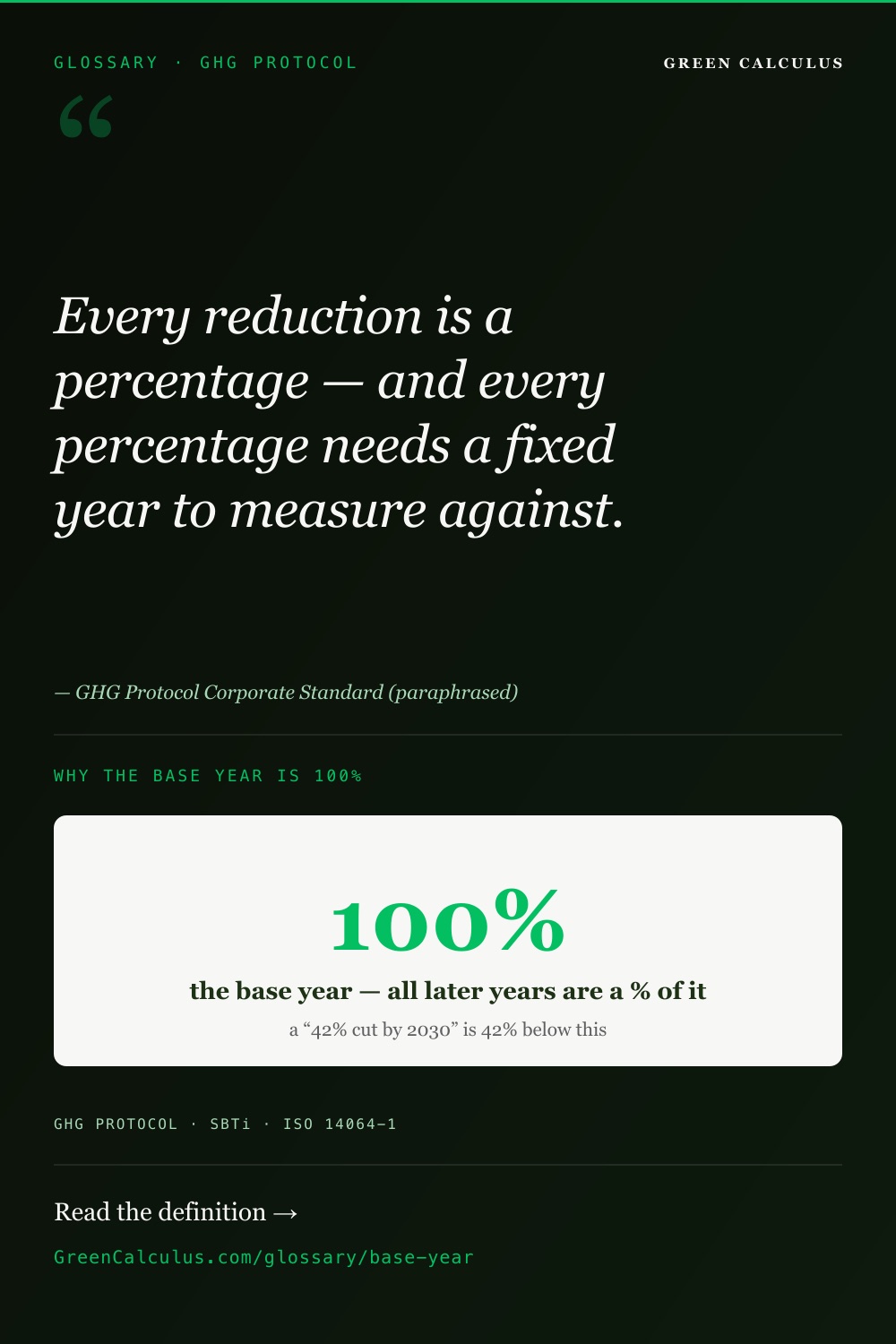
A base year is the fixed historical year a company uses as the reference for tracking its greenhouse gas emissions and setting reduction targets. A “42% cut by 2030” is always a cut relative to the base year. It must be a real, measured year with verifiable data covering the same scopes and boundary as today’s inventory — and it is recalculated after major structural changes to keep comparisons honest.
Definition — The Fixed Reference Year
A base year is a specific historical year against which a company tracks its greenhouse gas emissions over time. It is the reference point for reduction targets and for measuring progress: emissions in any later year are compared with the base year to show whether, and by how much, they have fallen. Because it is the yardstick, it is held fixed — the same base year is used year after year, so that changes in the numbers reflect real changes in emissions rather than a moving reference.
Crucially, a base year is a real, measured year — an actual GHG inventory from a year that happened, not a projection or a hypothetical. It must cover the same scopes and the same organisational boundary as the current inventory, or the comparison is meaningless: you cannot measure a reduction between two years that counted different things.
Almost every corporate climate commitment rests on one. A science-based target, a net-zero pathway, a regulatory disclosure of progress — all express reductions relative to a base year, which is why choosing and maintaining it correctly is foundational rather than administrative.
Definition at a glance
| Also known as | Base-year · reference year |
|---|---|
| What it is | A fixed historical year used as the reference for tracking emissions and targets |
| Used for | Reduction targets · progress tracking · disclosure |
| Chosen for | Verifiable, complete, representative data — the same scopes and boundary as today |
| Kept | Fixed — but recalculated after significant structural change |
| Not to be confused with | A crediting baseline (a hypothetical counterfactual, not a real year) |
The GHG Protocol Corporate Standard requires that “companies shall choose and report a base year for which verifiable emissions data are available and specify their reasons for choosing that particular year.” Most choose a single year, though an average of several consecutive years is also permitted.
The SBTi requires targets to be set from a recent base year with good-quality data across all scopes; ISO 14064-1 likewise has organisations establish and maintain a base year for tracking emissions over time.
Why the Base Year Matters
The base year does quiet but decisive work: it converts an absolute pile of tonnes into a trend. On its own, “83,000 tCO₂e this year” says nothing about progress. Set against a base year of 100,000 tCO₂e, it becomes “17% below base year” — a statement about direction and pace. Every target, every year-on-year comparison, every progress claim runs through it.
| Point | % of base year |
|---|---|
| 2020 | 100.0 % of base year |
| 2021 | 96.0 % of base year |
| 2022 | 93.0 % of base year |
| 2023 | 88.0 % of base year |
| 2024 | 85.0 % of base year |
Because everything is expressed relative to it, the base year is also where a target can be quietly gamed. Choose an unusually high-emitting year and a given absolute level looks like a large percentage cut; choose an unusually low one and real reductions look small. This is why the standards constrain the choice and require the base year to be disclosed and justified.
How to Choose a Base Year
The base year should be the earliest year for which reliable, complete, and representative data exist — early enough to capture a meaningful trend, but not so early that the data are patchy or the year was atypical. The main considerations:
- Data quality. The GHG Protocol requires verifiable emissions data; a base year is only as good as the inventory behind it. This usually rules out very early years with incomplete Scope 3 coverage.
- Representativeness. Avoid a year distorted by an unusual event — a plant outage, a demand spike, an acquisition mid-year — that would make the reference misleading.
- Standard requirements. Frameworks add their own rules: the SBTi, for instance, requires a recent base year with data across all scopes so that targets start from a current, complete picture.
- Boundary and scope match. The base year must cover the same scopes and organisational boundary as the current inventory, so like is compared with like.
Keeping It Honest: Base-Year Recalculation
A base year is fixed, but not untouchable. When a company’s structure changes in a way that would otherwise distort the comparison — a significant acquisition, divestment, merger, or a change in calculation methodology — its base-year emissions are recalculated so the historical figure reflects the same organisation being reported today.
Without it, a company could appear to cut emissions simply by selling a high-emitting business, or appear to grow them by buying one — changes in the company, not in its performance. The GHG Protocol requires a base-year recalculation policy and, per its guidance, retroactive recalculation to ensure a “meaningful and accurate comparison of emissions data over time.” Each policy sets a significance threshold that triggers a recalculation, and any recalculation must be disclosed. (Base-year recalculation is a distinct process with its own detailed rules.)
Base Year vs Baseline
“Base year” and “baseline” are often used interchangeably, but in carbon accounting they are distinct, and the difference matters:
| Base year | Baseline (crediting) | |
|---|---|---|
| What it is | A real, measured historical year | A hypothetical “what would have happened” scenario |
| Used for | Corporate and national reduction targets | Carbon credits and offset projects |
| Nature | An actual figure from history | An estimate of a counterfactual that never occurs |
| Reduction measured as | Change from the base-year total | Baseline − actual (project) emissions |
A base year is a photograph of a year that happened; a crediting baseline is a painting of a year that didn’t.
Common Confusions
- Confusing a base year with a crediting baseline. A base year is a real, measured year for targets; a crediting baseline is a hypothetical counterfactual for carbon credits.
- Choosing an atypical base year. An unusually high-emitting year makes later reductions look large; an unusually low one makes real cuts look small.
- Not recalculating after a structural change. An acquisition or divestment can make emissions appear to move for reasons that have nothing to do with performance.
- Changing the base year without disclosure. Silently shifting the reference breaks comparability and undermines every reduction claim.
- Base year and current inventory covering different things. If the scopes or boundary differ, the comparison is invalid.
- Confusing the base year with the reporting year. The base year is the fixed reference; the reporting year is the current year being measured against it.
Frequently Asked Questions
A base year is the fixed historical year a company uses as the reference for tracking its greenhouse gas emissions over time and for setting reduction targets. A target like “42% below 2020 by 2030” measures the reduction against the base-year emissions. It must be a real, measured year with verifiable data covering the same scopes and organisational boundary as the current inventory, and it is held fixed year to year so that changes in the numbers reflect real changes in emissions rather than a moving reference.
A base year is a real, measured year of history used as the reference for a corporate or national reduction target. A crediting baseline is a hypothetical counterfactual — an estimate of the emissions that would have occurred without a project — used to calculate carbon credits. The base year is an actual figure you can verify; the baseline is an estimate of something that never happens. They are often used interchangeably in everyday language, but in carbon accounting only the base year is a real year, and only the crediting baseline is a counterfactual.
Choose the earliest year with reliable, complete, and representative data — early enough to show a meaningful trend, but not so early that the data are patchy or the year was atypical. The GHG Protocol requires companies to select a base year with verifiable emissions data and to state why they chose it. Avoid years distorted by unusual events such as an outage or a mid-year acquisition, ensure the base year covers the same scopes and boundary as the current inventory, and check any framework-specific rules — the SBTi, for example, requires a recent base year with good-quality data across all scopes.
When a structural change would otherwise distort the year-on-year comparison — most commonly a significant acquisition, divestment, or merger, or a change in calculation methodology or emission factors. In those cases the base-year emissions are retroactively recalculated so the historical figure reflects the same organisation reported today, which the GHG Protocol requires to ensure a meaningful and accurate comparison of emissions over time. Companies set a significance threshold that triggers recalculation and must disclose any recalculation they make. Ordinary changes in actual emissions — a plant running more or less — do not trigger it.
The SBTi requires targets to be set from a recent base year with good-quality data covering all relevant scopes, including Scope 3 where it is significant. The emphasis is on the base year being current and complete, so that a target starts from an accurate, up-to-date picture of the company’s emissions rather than an old or partial one. As with the GHG Protocol, the base year must be maintained consistently and recalculated after significant structural changes so the target remains valid over its lifetime.