
Well-to-Tank (WTT) — Definition and GHG Accounting Context

Every litre of fuel a company buys arrives carrying emissions it did not produce on site. Before the diesel reaches the tank, it has been drilled, shipped, refined, and trucked — each stage releasing greenhouse gases that never appear in the combustion factor. A Scope 1 inventory that stops at the exhaust pipe misses roughly a fifth of the fuel’s true climate impact.
Well-to-Tank is the upstream emissions every fuel inventory carries but most stop short of counting — and under CSRD it is no longer optional.
Well-to-Tank (WTT) emissions are the upstream greenhouse gases from extracting, refining, and distributing a fuel before combustion. They are reported under Scope 3 Category 3a — always Scope 3, even when the combustion is Scope 1. For UK diesel, WTT adds about 0.611 kg CO₂e/L, roughly 19% of the Well-to-Wheel total.
Definition and Scope Placement
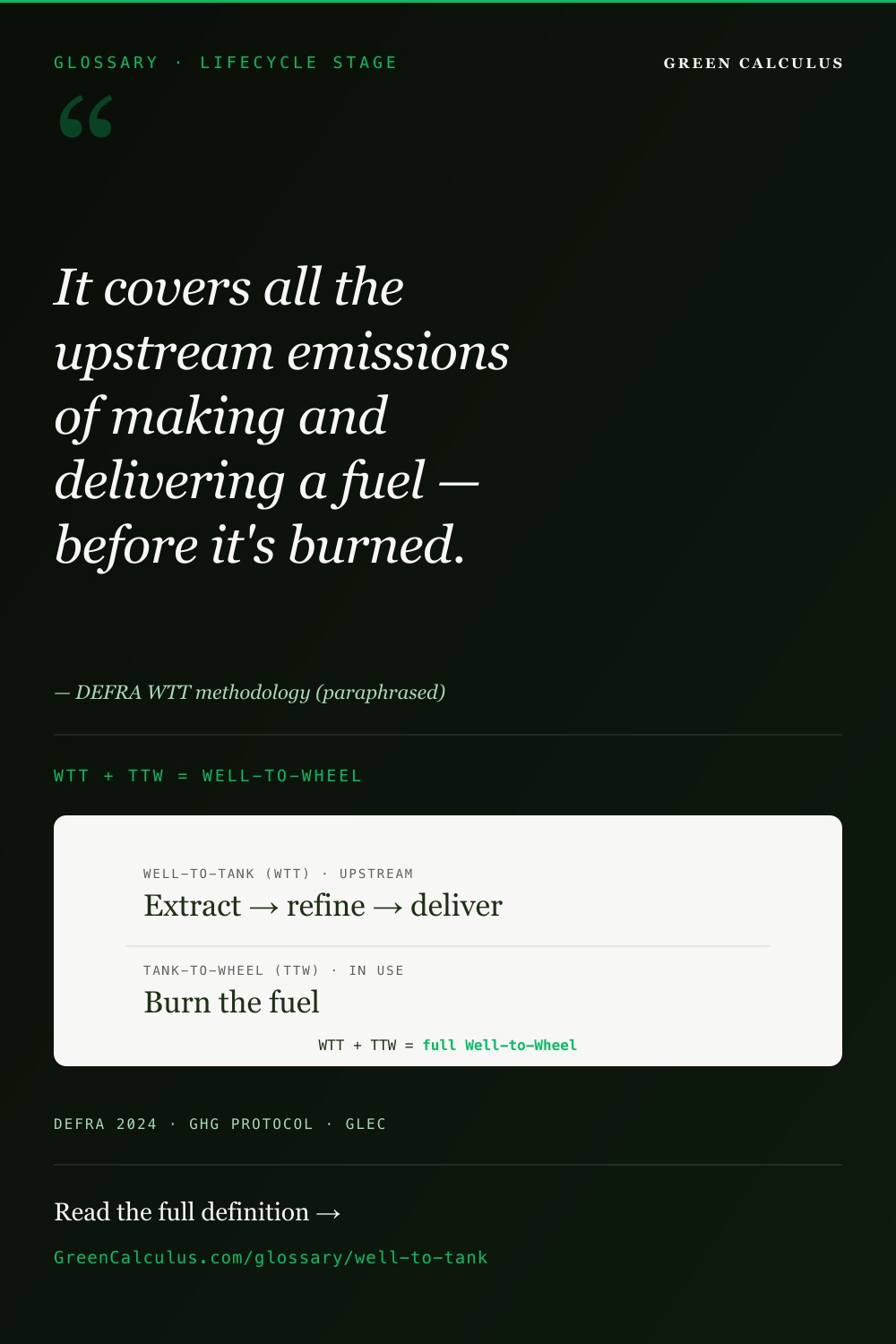
Well-to-Tank (WTT) emissions are the greenhouse gases released across the upstream supply chain of a fuel — from resource extraction (“well”) to the point the fuel enters the combustion asset (“tank”). For a petroleum fuel this covers crude extraction, transport to the refinery, refining, and onward distribution to the point of use. WTT explicitly excludes the emissions from burning the fuel, which are accounted separately as combustion (Tank-to-Wheel) emissions.
Under the GHG Protocol Corporate Value Chain (Scope 3) Standard, WTT is reported in Category 3a — fuel- and energy-related activities, upstream. The defining rule is that WTT is always Scope 3, regardless of where the combustion it precedes is reported. A company that burns diesel in its own fleet reports the combustion as Scope 1 and the WTT of that same diesel as Scope 3 Cat 3a. The two figures describe the same litre of fuel at different lifecycle stages, and they are never bundled into a single number.
WTT factors aggregate the upstream contributions of the three relevant Kyoto gases — CO₂, CH₄, and N₂O — into a single CO₂e value at GWP-100. For fossil fuels the methane share of WTT is proportionally larger than in the combustion factor, because upstream extraction and gas processing release fugitive methane that combustion does not.
WTT is defined by lifecycle stage, not by who controls the asset. The combustion of a fuel can be Scope 1, 2, or 3 depending on operational control — but the upstream WTT of that fuel is invariably Scope 3 Category 3a. This is the single most important structural fact about WTT: it is the upstream companion to every fuel and energy line in the inventory, not a standalone fuel type.
The Boundary Triad — WTT, TTW, and WTW
WTT is one of three lifecycle boundaries that together describe a fuel’s full emissions. Confusing them is the most common source of double-counting and under-reporting in fuel inventories, so the relationship is worth fixing precisely.
Where each boundary sits
Well-to-Tank (WTT) is the upstream stage — everything that happens to the fuel before it reaches the combustion asset. It is Scope 3 Category 3a.
Tank-to-Wheel (TTW) is the combustion stage — the emissions released when the fuel is burnt. This is the “combustion factor” most inventories start with, and its scope depends on operational control: Scope 1 for owned or operated assets, Scope 3 for fuel burnt by third parties on the company’s behalf.
Well-to-Wheel (WTW) is the arithmetic sum of WTT and TTW — the fuel’s full lifecycle emissions from extraction to combustion. WTW is published as a convenience figure for distance-based logistics calculations, but it is not a reporting line: a compliant inventory splits WTW back into its TTW (Scope 1) and WTT (Scope 3 Cat 3a) components.
The Well-to-Wheel value (for UK road diesel, 3.182 kg CO₂e/L) bundles upstream and combustion emissions. Using it as a Scope 1 combustion factor inflates Scope 1 by the full WTT share — about 24% for diesel. WTW belongs in distance-based Scope 3 logistics calculations (Cat 4, Cat 6) where the upstream and combustion stages are reported together against a third party’s activity, never against a company’s own Scope 1.
WTT vs T&D Losses — Cat 3a Is Not Cat 3b
Category 3 (fuel- and energy-related activities) has two sub-categories that are routinely conflated. Both are upstream energy emissions, but they cover different physical processes and use different factor sets.
| Category 3a — Well-to-Tank | Category 3b — T&D losses | |
|---|---|---|
| Covers | Upstream extraction, refining, and distribution of purchased fuels | Grid transmission & distribution losses for purchased electricity |
| Applies to | Combusted fuels (diesel, gas, LPG, etc.) and the WTT of purchased electricity | Electricity lost between generation and the meter |
| Factor basis | kg CO₂e per litre / kWh / tonne of fuel | Grid loss rate (%) × grid factor, or DEFRA combined kg CO₂e/kWh |
| MasterBrain section | fuels_wtt | transmission_distribution |
| This page covers | Yes — Cat 3a is the subject here | No — see the T&D losses methodology |
A complete Category 3 figure for a company that buys both fuel and electricity includes the WTT of the fuel (Cat 3a), the WTT of the electricity (Cat 3a), and the grid T&D losses on the delivered electricity (Cat 3b). The mechanics of the electricity loss calculation are covered in the T&D losses methodology; the upstream-fuel side is the Well-to-Tank methodology.
Reference Table — WTT Factors by Fuel
The table below lists the Well-to-Tank companion factor alongside the combustion factor for the most commonly inventoried fuels, with the combined Well-to-Wheel total. Values read live from MasterBrain — combustion via —, WTT via the V3 — path — and update on each DEFRA release.
| Fuel | Combustion TTW | WTT (Cat 3a) | Combined WTW | Unit |
|---|---|---|---|---|
| Diesel (avg biofuel blend, B7) | 2.58354 | — | 3.18183 | kg CO₂e/L |
| Petrol (avg biofuel blend) | 2.075 | — | — | kg CO₂e/L |
| Gas oil (red diesel) | 2.75541 | 0.62665 | 3.38206 | kg CO₂e/L |
| LPG | 1.55713 | 0.18551 | — | kg CO₂e/L |
| Natural gas | 2.02633 | 0.03021 | — | kg CO₂e/kWh GCV |
| Aviation turbine fuel | 2.54269 | — | — | kg CO₂e/L |
Combustion values read live via —; WTT values via — (MasterBrain V3 path). The combined WTW column is shown only where the arithmetic sum is verified against the DEFRA full-set workbook (diesel, gas oil); other WTW cells are left blank rather than computed from unverified components — see the data note in the engineering change summary.
WTT as a Share of Lifecycle Emissions
The WTT share of a fuel’s Well-to-Wheel total varies by fuel chemistry and supply chain. The share is highest for fuels with energy-intensive extraction or processing, and for gaseous fuels where upstream fugitive methane is significant relative to the combustion CO₂.
For UK road diesel, WTT is about 23.8% of the combustion factor and 19% of the Well-to-Wheel total. Natural gas typically carries a higher WTT share because upstream methane leakage across extraction, processing, and pipeline transport adds proportionally more to a fuel whose combustion factor is already low per unit energy. The practical consequence is that fuel-switching decisions evaluated on combustion factors alone can understate the upstream penalty of a switch — the WTW comparison is the one that holds at verification.
When comparing fuels for a switching decision, compare on a Well-to-Wheel, per-energy basis (kg CO₂e/kWh including WTT), not on combustion factors per litre. A per-litre combustion comparison ignores both the energy density difference between fuels and the upstream emissions that Cat 3a captures — two corrections that frequently move the ranking.
How WTT Factors Are Built
A WTT factor aggregates the emissions of every upstream stage between resource and tank. For a petroleum fuel the chain is broadly extraction, crude transport, refining, and product distribution; for gaseous fuels it adds processing and pipeline or liquefaction stages.
The upstream sub-stages
The extraction and production stage covers drilling, primary processing, and associated venting or flaring. The refining stage — typically the largest single contributor for refined petroleum products — covers the energy used to convert crude into finished product. The distribution stage covers transport from refinery to point of use, including pipeline, marine, rail, and road movements. Each stage is assembled by the publishing authority (DEFRA for the UK) from lifecycle inventory data and expressed per unit of finished fuel delivered.
Why WTT factors are not interchangeable across denominators
As with combustion factors, the same WTT emissions can be expressed per litre, per tonne, or per kWh, and the values are interchangeable only after unit conversion using the fuel’s published density and calorific value. The MasterBrain stores WTT on the same denominators as the combustion row for each fuel, which is why the V3 key carries the same <unit> segment as the combustion factor (fuels.gbr.diesel.wtt.litre mirrors fuels.gbr.diesel.litre). Applying a per-litre WTT factor to a kWh-metered consumption record produces the same order-of-magnitude error that afflicts combustion factors.
Biofuel WTT is feedstock-specific
For biofuels, the combustion factor captures only trace CH₄ and N₂O, with the biogenic CO₂ reported outside of scopes. The WTT, by contrast, is substantial and feedstock-specific — cultivation, harvesting, and processing emissions differ markedly between used cooking oil, tallow, and virgin crop feedstocks. A biofuel reported as low-combustion but with its feedstock WTT omitted is a materially incomplete Cat 3a figure. The feedstock-resolved WTT factors live in the MasterBrain bioenergy WTT section and are addressed in the dedicated methodology page rather than enumerated here.
Worked Example — Diesel Scope 1 and Cat 3a Split
The WTT calculation uses the same multiplication as combustion, applied with the WTT factor and routed to Scope 3 Category 3a.
tCO₂e = litres × WTT factor (kg CO₂e/L) ÷ 1,000
Reported in Scope 3 Cat 3a, separately from the Scope 1 combustion figure.
| Component | Factor | Scope | Calculation | Result (tCO₂e) |
|---|---|---|---|---|
| Combustion (TTW) | 2.57082 | Scope 1 | 50,000 × 2.57082 / 1,000 | 128.54 |
| Well-to-Tank (WTT) | 0.61101 | Scope 3 Cat 3a | 50,000 × 0.61101 / 1,000 | 30.55 |
| Well-to-Wheel total | 3.18183 | S1 + S3 Cat 3a | 50,000 × 3.18183 / 1,000 | 159.09 |
50,000 L of UK road diesel in an owned fleet produces 128.54 tCO₂e of Scope 1 combustion emissions and a separate 30.55 tCO₂e of Scope 3 Category 3a Well-to-Tank emissions. The two are reported on different inventory lines and never summed into a single 159.09 tCO₂e figure — that combined Well-to-Wheel total exists only for cross-checking against distance-based logistics factors. The worked-example values are hardcoded per the worked-example discipline; the diesel WTT factor of 0.61101 is verified against the DEFRA 2025 full-set workbook.
Split combustion from Well-to-Tank automatically, with full DEFRA 2025 provenance.
The Scope 3 Cat 3 Well-to-Tank calculator applies the correct WTT factor per fuel, keeps the Scope 1 combustion figure and the Scope 3 Cat 3a upstream figure on separate lines, and produces CSRD-E1-6-ready output.
Five Common Mistakes
- WTT grossed into Scope 1. The most damaging WTT error is adding the upstream factor to the combustion factor and reporting the combined Well-to-Wheel value as Scope 1. For diesel this inflates Scope 1 by about 24%. WTT for purchased fuel belongs in Scope 3 Cat 3a, calculated separately as litres × WTT factor and reported on its own line.
- WTT omitted entirely. An inventory that reports only combustion (Scope 1 and the location of consumption) and skips Cat 3a is incomplete. Under CSRD/ESRS E1, datapoint E1-6 requires Scope 3 disclosure, and fuel- and energy-related upstream emissions are a standard Cat 3 component. Omission is a completeness finding at assurance, not a conservative simplification.
- Cat 3a confused with Cat 3b. WTT of fuels (Cat 3a) and grid T&D losses on electricity (Cat 3b) are different processes with different factor sets. A company that buys both fuel and electricity needs all three: fuel WTT, electricity WTT, and electricity T&D losses. Treating “Category 3” as a single number collapses two distinct calculations.
- Wrong denominator. WTT factors are published per litre, per tonne, and per kWh. Applying a per-litre WTT factor to a kWh-metered consumption record breaks the result by orders of magnitude, exactly as with combustion factors. Confirm the WTT factor’s unit matches the measured input before multiplying.
- Biofuel WTT dropped. Because biofuel combustion factors are very low (biogenic CO₂ sits outside of scopes), it is tempting to treat biofuels as near-zero. But the feedstock-specific WTT — cultivation, processing, distribution — is substantial and must be reported in Cat 3a. A biofuel with omitted feedstock WTT is materially under-reported.
Regulatory Context
WTT disclosure obligations follow from the Scope 3 requirements of each framework. The factor source and GWP basis must match the reporting requirement.
| Framework | WTT requirement | GWP basis | Reference |
|---|---|---|---|
| GHG Protocol Scope 3 Standard | Category 3a (upstream fuel) and 3b (T&D losses) for purchased energy | Latest IPCC | View standard → |
| CSRD / ESRS E1 | Datapoint E1-6 — Scope 3 disclosed separately; fuel- and energy-related activities are a standard Cat 3 component | AR6 GWP-100 | View standard → |
| UK DEFRA Conversion Factors | WTT-fuels factor set published alongside combustion factors; annual June release | AR5 GWP-100 | View standard → |
DEFRA 2025 publishes its WTT-fuels factors on IPCC AR5 GWP-100, while CSRD/ESRS E1 mandates the latest IPCC basis (currently AR6). The numerical difference on most fuel WTT factors is small because CO₂ dominates, but for methane-heavy upstream chains (natural gas WTT) the AR5/AR6 gap on the methane component is more visible. Multinational reporters using DEFRA WTT factors alongside AR6-basis sources should disclose the basis boundary in the methodology footnote.
Frequently Asked Questions
Well-to-Tank (WTT) is the upstream greenhouse gas emissions from extracting, refining, and distributing a fuel before it is combusted — everything that happens between the “well” and the “tank”. It is reported under GHG Protocol Scope 3 Category 3a. WTT is always Scope 3, even when the combustion of the same fuel is Scope 1. For UK road diesel, WTT adds about 0.611 kg CO₂e/L on top of the 2.571 kg CO₂e/L combustion factor.
Always Scope 3, specifically Category 3a. This is true regardless of where the combustion is reported. If a company burns diesel in its own fleet, the combustion is Scope 1 and the WTT of that diesel is Scope 3 Cat 3a — the same litre of fuel split across two scopes by lifecycle stage. WTT is never reported as Scope 1.
Well-to-Tank (WTT) is the upstream supply-chain stage; Tank-to-Wheel (TTW) is the combustion stage; Well-to-Wheel (WTW) is the sum of the two — the full lifecycle from extraction to combustion. For UK road diesel, WTT is 0.611 kg CO₂e/L, TTW (combustion) is 2.571 kg CO₂e/L, and WTW is 3.182 kg CO₂e/L. A compliant inventory splits WTW back into its TTW component (Scope 1) and WTT component (Scope 3 Cat 3a) — WTW itself is a cross-check figure, not a reporting line.
No. Both sit in GHG Protocol Category 3 (fuel- and energy-related activities), but they cover different processes. WTT (Cat 3a) is the upstream extraction, refining, and distribution of fuels. Transmission & distribution losses (Cat 3b) are the electricity lost between generation and the meter. A company buying both fuel and electricity reports fuel WTT, electricity WTT, and electricity T&D losses. The electricity-loss side is covered in the T&D losses methodology.
CSRD/ESRS E1 datapoint E1-6 requires Scope 3 emissions to be disclosed, and fuel- and energy-related upstream activities are a standard Scope 3 Category 3 component. WTT therefore falls within the disclosure obligation for in-scope companies. ESRS E1 also mandates the latest IPCC GWP basis (AR6), so reporters using DEFRA WTT factors (published on AR5) should disclose the basis difference in the methodology footnote. See CSRD/ESRS E1 for the full datapoint requirements.