
Net Zero — Definition and GHG Accounting Context

Almost every large company now has a net-zero target, and almost as many misunderstand what it commits them to. The phrase sounds like a balance sheet — emit some carbon here, cancel it with a credit there, and call the account settled. That is not what net zero means. Under the science-based definition, the account is settled only after a company has cut its own emissions to the bone and neutralised the small remainder with carbon it permanently removes from the atmosphere.
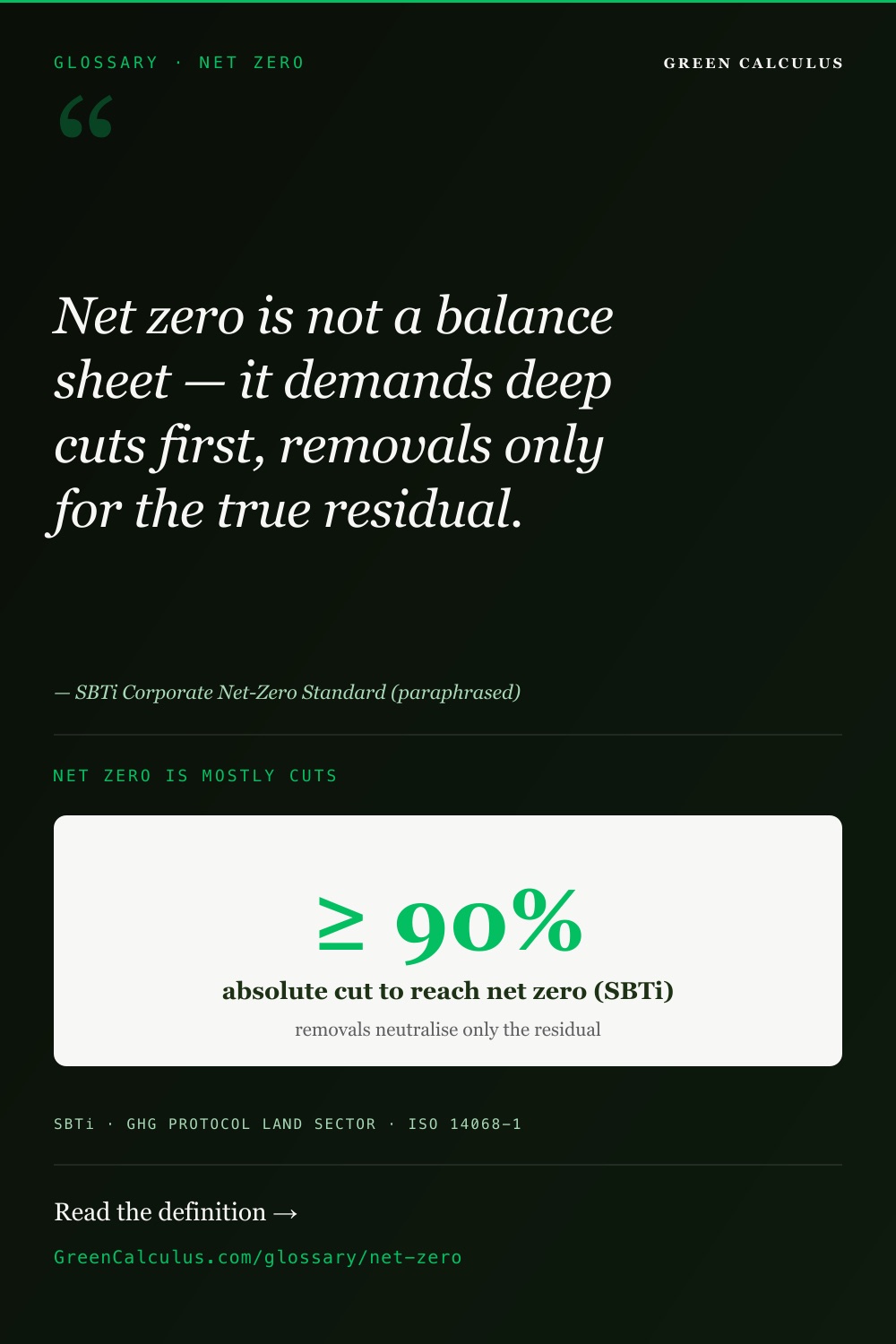
Net zero is decarbonisation first and offsetting almost never — the opposite of the shortcut it is often mistaken for.
Net zero is the state where the greenhouse gases an entity emits are balanced by an equal quantity of permanent removals, over a defined period. Reaching it requires deep cuts first — typically a 90%+ absolute reduction across Scopes 1, 2, and 3 — with only the residual neutralised by removals. It is a stricter bar than carbon neutrality, and offsets are never netted against gross emissions.
Definition — Emissions Balanced by Removals
Net zero — often written net-zero emissions — is the state in which the anthropogenic greenhouse gases released into the atmosphere over a period are balanced by an equal quantity of anthropogenic removals of those gases from the atmosphere. The “net” is the balance of two flows: the gross emissions an entity puts up, and the removals it takes back down. When the two are equal, the entity’s net contribution to atmospheric concentrations is zero.
Crucially, that balance is not achieved by removals alone. The SBTi Corporate Net-Zero Standard — the most widely used corporate definition — requires an entity to first reduce its own emissions as far as science demands, typically at least 90% in absolute terms across the whole value chain, on a trajectory consistent with limiting warming to 1.5°C. Only the small hard-to-abate residual that remains at the target year may be neutralised, and only with permanent carbon removals. Removing carbon is what closes the last gap; it is not a substitute for cutting emissions in the first place.
Net zero has two non-negotiable halves: a deep absolute reduction of gross emissions (the ~90%), and neutralisation of the residual with permanent removals (the ~10%). A target that skips the first half and reaches “net zero” by buying credits is not net zero as the science-based standards define it — it is offsetting wearing the label.
Net Zero vs Carbon Neutral
The two terms are used interchangeably in marketing and mean quite different things in accounting. Carbon neutrality — governed by ISO 14068-1 and the older PAS 2060 — can be claimed for a product, a site, or an organisation by compensating for its footprint with carbon credits, and it does not mandate any particular reduction trajectory. Net zero sets a far higher bar: deep, science-aligned cuts across the full value chain, with removals reserved for the residual.
| Dimension | Net Zero | Carbon Neutral |
|---|---|---|
| Typical standard | SBTi Corporate Net-Zero Standard | ISO 14068-1 · PAS 2060 |
| Reduction required | ~90%+ absolute, 1.5°C-aligned | No mandated trajectory |
| Boundary | Full value chain incl. Scope 3 | Can be a product, site, or entity |
| Role of credits | Permanent removals, residual only | Compensation is central; avoidance allowed |
| What “net” balances | Residual emissions vs removals | Total footprint vs purchased credits |
| Time horizon | Long-term (by 2050) + near-term interim | Often an annual claim |
A company can be carbon neutral today by buying credits and still be nowhere near net zero. The reverse is not true: reaching net zero necessarily satisfies, and far exceeds, the intent of a neutrality claim.
The Reductions-First Hierarchy
Every credible net-zero framework orders action the same way. Abatement of the entity’s own emissions always comes first; removals close the residual; anything done outside the value chain is additional and is never counted toward the target.
1. Decarbonise
Cut absolute emissions across Scopes 1, 2, and 3 — energy, processes, supply chain, products — as far as the 1.5°C pathway requires. This is where roughly 90% of the work happens, and no removal or credit can stand in for it.
2. Neutralise the residual
At the target year, balance the small residual of hard-to-abate emissions with permanent carbon removals that physically take CO₂ out of the atmosphere and store it durably.
3. Beyond value chain (extra)
Investing in mitigation outside your own footprint — high-quality credits, nature finance — is encouraged, but it sits alongside the target as additional action, never as a substitute for cuts.
Removals, Not Avoidance
The single most consequential technical rule of net zero is what may neutralise the residual. It must be a removal — an activity that draws CO₂ out of the atmosphere and stores it — not an avoidance credit that merely prevents emissions somewhere else. Avoided emissions and reduction credits keep carbon out of the air; only removals take carbon that is already there back out. At net zero, the account must balance like for like: residual emissions against genuine removals.
A tonne emitted and a tonne “avoided” elsewhere do not cancel. If a company emits a residual 8,000 tonnes and buys 8,000 tonnes of avoidance credits, its net atmospheric contribution is still positive — nothing was removed. Neutralisation under the net-zero definition requires removals, and increasingly durable ones. The accounting for those removals follows standards such as the GHG Protocol Land Sector and Removals Guidance.
Scopes, Timelines, and CO₂ vs GHG
Three further distinctions separate a rigorous net-zero target from a slogan.
All scopes. Net zero covers Scope 3 — the value-chain emissions that are usually the majority of a company’s footprint. A target that quietly excludes Scope 3 addresses a fraction of the real impact.
Near-term and long-term. A 2050 pledge is not credible on its own. Science-based frameworks require a near-term target — roughly halving emissions by 2030 — alongside the long-term net-zero target, so progress is measurable this decade. Both are modelled in the SBTi near-term and net-zero target calculators.
CO₂ vs all gases. Net-zero targets are expressed in tonnes of CO₂e, which aggregates every gas by its global warming potential — methane at 29.8 and nitrous oxide at 273 times CO₂ over 100 years. But reaching net-zero CO₂ is what actually halts global warming, because warming tracks cumulative CO₂; net-zero GHG across all gases is a later, stricter milestone. The IPCC finds that holding warming to 1.5°C requires global net-zero CO₂ around 2050, which is why corporate 2050 targets are anchored to that date.
How Net Zero Fits GHG Accounting
Net zero is a target state defined against the greenhouse gas inventory, not an adjustment inside it. The gross figure — Scopes 1, 2, and 3, measured under the GHG Protocol — is what the target commits a company to reduce. Removals and any credits are tracked in a separate account and reported transparently; they are never subtracted from the gross inventory to manufacture a lower headline number.
Report gross emissions and removals separately. Progress toward net zero is measured by the fall in gross emissions over time — not by the volume of credits or removals purchased. Only at the target year, once gross emissions have been cut ~90%, do like-for-like permanent removals neutralise the residual to reach a net of zero. Collapsing the two accounts before that point is the error every disclosure framework — from CSRD/ESRS E1 to the ISSB baseline — is written to prevent.
Worked Micro-Example
A manufacturer’s base-year footprint is 100,000 tCO₂e across Scopes 1, 2, and 3. Its science-based pathway commits it to a 92% absolute cut by its 2050 net-zero year.
Base-year gross emissions = 100,000 tCO₂e
Required reduction by 2050 = 92% → gross emissions cut to 8,000 tCO₂e
Residual to neutralise = 8,000 tCO₂e of permanent removals per year
Net position at target year = 8,000 − 8,000 = net zero
Buying 8,000 tonnes of avoidance credits instead would not qualify — the residual must be neutralised with removals.
The 92% is where almost all the effort and cost sit; the 8,000-tonne removal is the final closing entry. Model the reduction trajectory in the Net-Zero Pathway Calculator, size the residual-removal requirement in the Carbon Removal (CDR) Calculator, and price any beyond-value-chain mitigation in the Carbon Offset Cost Calculator.
Common Confusions
- Treating net zero as carbon neutral. Neutrality can be bought with credits; net zero demands ~90%+ absolute cuts first. Different bar, different standard.
- Reaching “net zero” with avoidance offsets. The residual must be neutralised with permanent removals, not reduction or avoidance credits.
- Excluding Scope 3. Value-chain emissions are usually the majority of the footprint; a net-zero target that omits them is not credible.
- Netting credits against gross emissions. Gross and removals are two separate accounts; progress is the fall in gross, not the volume of credits held.
- A 2050 target with no interim step. Without a near-term (≈2030) halving, a long-dated pledge has no accountability this decade.
- Confusing net-zero CO₂ with net-zero GHG. Net-zero CO₂ halts warming; net-zero across all gases is a later, stricter goal.
Frequently Asked Questions
Net zero is the state in which the greenhouse gases an entity emits into the atmosphere are balanced by an equal quantity of permanent removals, over a defined period. Reaching it requires deep decarbonisation first — under the SBTi Corporate Net-Zero Standard, typically a 90%+ absolute cut across Scopes 1, 2, and 3 on a 1.5°C-aligned pathway — with only the small residual neutralised by permanent carbon removals. It is decarbonisation first and offsetting almost never.
Carbon neutrality — under ISO 14068-1 or the older PAS 2060 — can be claimed by compensating for a footprint with carbon credits, with no mandated reduction trajectory, and can cover just a product or site. Net zero requires deep, science-aligned absolute cuts (~90%+) across the full value chain, and neutralises only the residual, and only with permanent removals. A company can be carbon neutral today by buying credits and still be nowhere near net zero.
No. Net zero is reached by cutting your own emissions ~90% first, then neutralising the residual with permanent carbon removals — activities that take CO₂ back out of the atmosphere. Avoidance or reduction offsets, which prevent emissions elsewhere, do not qualify to neutralise the residual, and no credit substitutes for the deep absolute cuts. Beyond-value-chain mitigation with high-quality credits is encouraged as additional action, but it is tracked separately and never netted against gross emissions.
Yes. A credible net-zero target covers the full value chain, including Scope 3 — the upstream and downstream emissions that are usually the majority of a company’s footprint. Excluding Scope 3 addresses only a fraction of the real impact, which is why science-based frameworks require it. Targets are set in tonnes of CO₂e across all greenhouse gases.
Net-zero CO₂ balances carbon-dioxide emissions and removals alone; net-zero GHG balances all greenhouse gases, expressed as CO₂e. The distinction matters because warming tracks cumulative CO₂, so reaching net-zero CO₂ is what halts global temperature rise — the IPCC places global net-zero CO₂ around 2050 for a 1.5°C pathway. Net-zero across all gases, including methane and nitrous oxide, is a later and stricter milestone.