
Natural Gas

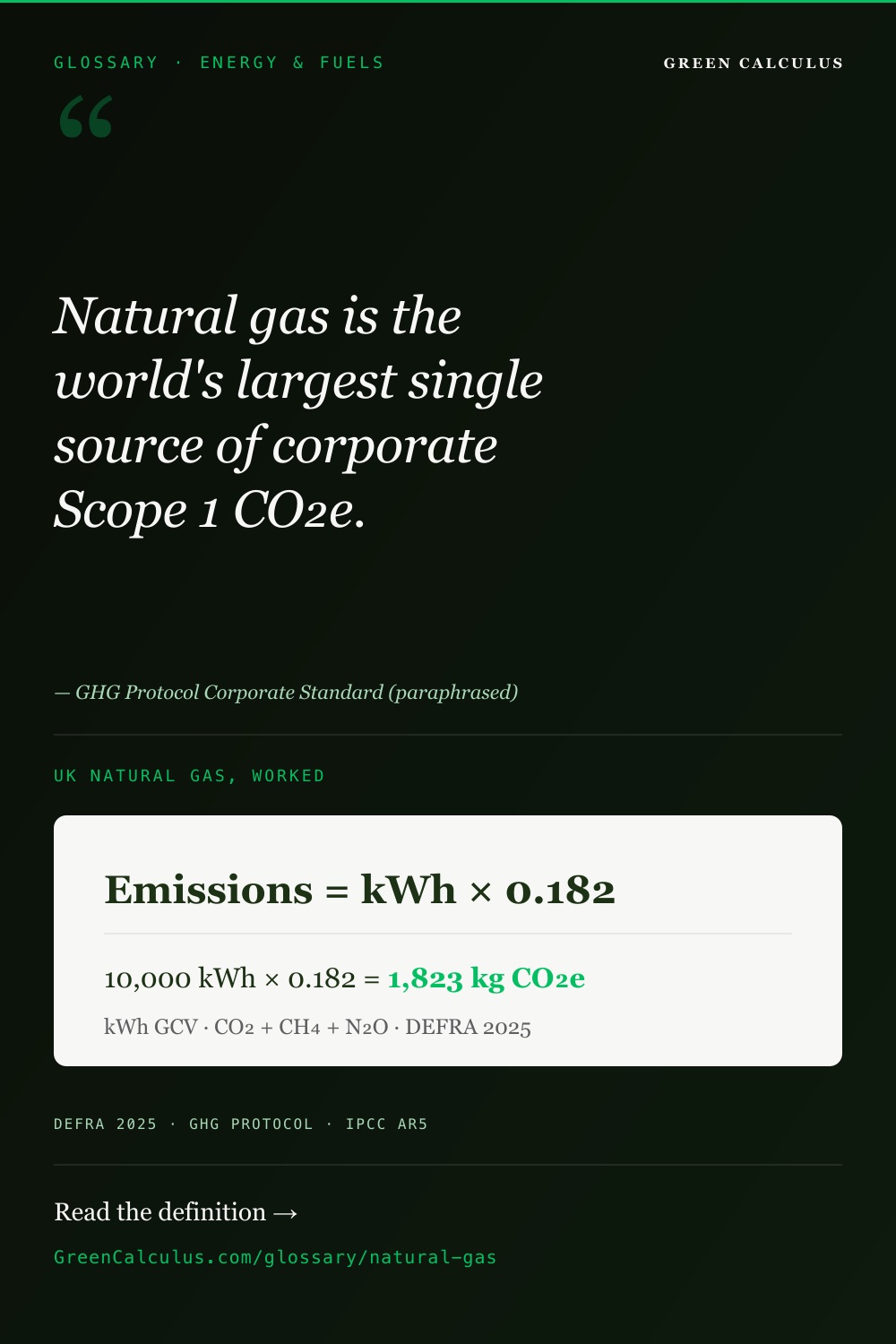
Natural gas is the world’s largest single source of corporate Scope 1 CO₂e — burned in boilers, furnaces, CHP units, kilns, and process heaters across every industrial sector. Its emissions arithmetic is deceptively simple at the surface and rich with traps underneath: three gases (CO₂, CH₄, N₂O), two scopes (Scope 1 combustion and Scope 3 Category 3a upstream), and at least four unit conventions (kWh GCV, kWh NCV, m³, tonnes) that all describe the same fuel with different headline numbers.
Getting natural gas right is the most consequential single decision in most Scope 1 inventories. Misclassifying the calorific basis (GCV vs NCV), omitting the methane and nitrous oxide contributions, or double-counting on top of a pre-aggregated DEFRA factor — each of these errors recurs in audited inventories every reporting cycle. This page is the canonical reference for every conversion, every scope assignment, and every common mistake.
Natural gas is a fossil fuel composed primarily of methane (87–95% by volume) that combusts to release CO₂, methane slip, and trace nitrous oxide. The DEFRA 2025 emission factor on the UK billing standard (kWh GCV) is 0.18231 kg CO₂e/kWh, pre-aggregated across all three gases at AR5 GWP-100. By volume, the factor is 2.02633 kg CO₂e/m³. Direct combustion is Scope 1; upstream extraction, processing, and transmission losses are Scope 3 Category 3a Well-to-Tank, adding 0.03021 kg CO₂e/kWh per the same DEFRA dataset.
What Natural Gas Is — and What It Isn’t
Natural gas is a fossil hydrocarbon mixture extracted from underground reservoirs. By volume, it is dominated by methane (typically 87–95% CH₄), with smaller fractions of ethane (1–6%), propane (0.1–1.5%), and trace quantities of higher hydrocarbons, nitrogen, carbon dioxide, and hydrogen sulphide. The exact composition varies by field and by the processing stage — gas at the wellhead is “wet” (carries condensates and water); gas delivered to consumers is “dry” pipeline gas, conditioned to meet pipeline quality specifications.
For emissions accounting, the high methane content matters disproportionately. Methane has an AR6 GWP-100 of 29.8. Any methane that escapes uncombusted — whether as combustion slip, pipeline fugitive, or upstream venting — carries roughly thirty times the warming impact of the CO₂ it would have become if burned cleanly. This is why methane dominates the fugitive emission lines of every gas utility, oil & gas operator, and gas-fired industrial site, even though the mass quantities are small.
Common confusions that recur in published inventories. LPG (liquefied petroleum gas) is propane and/or butane — a different chemistry, a different DEFRA factor (see LPG methodology). Town gas / coal gas is a historical manufactured gas (CO + H₂) from coal gasification — no longer in domestic use in most markets. Biogas / biomethane is biologically produced methane (anaerobic digestion of organic matter) — chemically similar to pipeline gas but biogenic in origin, with combustion CO₂ reported “outside scopes” per GHG Protocol. Shale gas, LNG, and CNG are all natural gas — same molecule, different production routes or physical states, addressed individually in §8.
The Three Emission Components — CO₂, CH₄, N₂O
Natural gas combustion emits three greenhouse gases. The chemistry is straightforward: the bulk of carbon in CH₄ oxidises to CO₂ and water vapour; a small fraction of methane escapes unburned (slip); a trace of N₂O forms from nitrogen interactions at flame temperature. All three contribute to the inventory total, and all three are baked into the DEFRA published CO₂e factor.
Combustion CO₂
The dominant emission. Stoichiometric oxidation of methane to CO₂ and water vapour. Per-kWh component: 0.18259 kg CO₂/kWh GCV.
Methane slip
Small mass, high GWP. Uncombusted methane escapes through incomplete combustion. AR6 GWP-100 of 29.8 amplifies its CO₂e contribution.
Nitrous oxide
Trace formation at flame temperature. AR6 GWP-100 of 273 — small contribution per kWh but non-zero.
The three components together make up the DEFRA 2025 kWh GCV factor of 0.18231 kg CO₂e/kWh. The arithmetic is invisible to the practitioner using the headline figure, but the three contributions must be disclosed separately for any inventory under ISO 14064-1 third-party verification — and the per-gas breakdown is what verifiers ask for first. See §6 for the full audit trail.
A common labelling error: reporting natural gas emissions as “kg CO₂” when the figure used is actually the pre-aggregated CO₂e value. The difference is small in percentage terms (under 0.2% of the total for natural gas combustion), but the unit label is wrong, and verifiers will flag it. CO₂ refers to the carbon dioxide molecule only; CO₂e is the warming-impact-weighted total across all three gases. See CO₂e — the full reference for the unit-vs-molecule distinction.
DEFRA 2025 Reference Factors — Every Unit Basis
The UK DEFRA / DESNZ 2025 GHG Conversion Factors publish natural gas emission factors on multiple unit bases. The table below renders every published basis live from the MasterBrain — kWh (the UK billing standard), m³ (still used on legacy meters), and per tonne (used in tonne-billed contracts). The Well-to-Tank upstream values are listed on the same rows for direct visual comparison.
| Unit basis | Scope 1 (combustion) | Scope 3 Cat 3a (WTT) | Total cradle-to-burner | Use case |
|---|---|---|---|---|
| per kWh (GCV) | 0.18231 | 0.03021 | 0.21317 | UK gas bills · default for kWh-metered supply |
| per m³ | 2.02633 | 0.3366 | 2.40332 | Legacy m³-metered supply · international contracts |
| per tonne | 2507.72441 | 423.16 | 2998.62 | LNG cargo · industrial bulk supply contracts |
| per kWh (NCV) | 0.20270 | 0.03347 | 0.23617 | International convention · IPCC / IEA reporting |
Live values rendered from GreenCalculus DEFRA 2025 dataset. Per-tonne and per-kWh NCV are alternates derived from the same MasterBrain entry. Source: DESNZ UK Government GHG Conversion Factors 2025, June 2025. AR5 GWP-100 basis stated by DEFRA on the source workbook.
The DEFRA 2025 natural gas factor of 0.18231 kg CO₂e/kWh is published on an AR5 GWP-100 basis. SBTi v1.1, CSRD/ESRS E1, and CDP (2023+) all require AR6. For natural gas combustion the practical difference is sub-1% — the CO₂ component dominates the total, and the methane contribution at AR5 (×28) vs AR6 (×29.8) shifts the headline by under 0.2%. UK regulatory reporting accepts DEFRA’s AR5 basis directly. For SBTi or CSRD baseline restatement, applying a per-gas AR6 conversion is the cleaner methodological choice — see CO₂e §AR5 vs AR6 for the full reasoning.
Scope Assignment — The Decision Matrix
Natural gas appears in multiple scopes depending on who emits it, where it is consumed, and what role the reporting company plays in the value chain. The decision matrix below maps every common operational scenario to its correct scope assignment under the GHG Protocol Corporate Standard and Scope 3 Standard. The pattern is consistent: ownership and operational control determine the scope, not the molecule.
| Scenario | Scope | Category | Notes |
|---|---|---|---|
| Owned boiler combusting gas on site | Scope 1 | Stationary combustion | Direct emissions from owned/controlled equipment. Use the DEFRA combustion factor. |
| Upstream extraction, processing, transmission to your site | Scope 3 | Cat 3a (WTT) | Mandatory under GHG Protocol Scope 3 Standard. Use the DEFRA WTT factor. |
| Fugitive methane leak from your owned gas pipeline | Scope 1 | Fugitive | Owned asset = Scope 1, not Scope 3. Use per-gas CH₄ × AR6 GWP-100 conversion. |
| Methane leaking from a supplier’s pipeline before delivery | Scope 3 | Cat 3a (WTT) | Already embedded in the DEFRA WTT factor — do not add separately. |
| Gas combusted at a leased property | S1 or S3 | Operational control | Scope 1 under operational-control consolidation; Scope 3 Cat 8 (Upstream leased assets) under equity consolidation. |
| Gas you sold to a customer who burns it | Scope 3 | Cat 11 (Use of sold products) | Applies to gas suppliers, utilities, oil & gas operators only. |
| Natural gas powering grid electricity you purchased | Scope 2 | Purchased electricity | Already in the grid emission factor. Never count separately. Use Scope 2 factor instead. |
| Employee using their home gas boiler while WFH | Scope 3 | Cat 7 (Employee commuting / WFH) | If included in inventory. Most companies treat as immaterial; SBTi does not currently require. |
Decision matrix derived from GHG Protocol Corporate Standard Chapter 4 and Scope 3 Standard Category definitions. All ownership tests assume the operational-control consolidation approach unless otherwise stated.
Unit Conversion — The GCV vs NCV Trap
Natural gas is the only major fuel routinely billed and reported in three different unit systems — energy (kWh), volume (m³), and mass (tonnes) — and the energy basis itself splits between two conventions, GCV (Gross Calorific Value, also called HHV — Higher Heating Value) and NCV (Net Calorific Value, also called LHV — Lower Heating Value). Mixing unit bases is the most common single error in natural gas inventories. The conversion logic is fixed; the discipline is in catching the mismatch before publication.
GCV vs NCV — what the difference is
Gross Calorific Value (GCV / HHV) includes the latent heat of vaporisation of water produced during combustion — i.e. it counts the energy you would get if you condensed the water vapour back to liquid. Net Calorific Value (NCV / LHV) excludes this latent heat. For natural gas, GCV is approximately 10.8% higher than NCV. The UK and most of Europe bill in GCV; the US (in MMBtu HHV typically) and IPCC national inventory guidelines use both; IEA international energy statistics use NCV/LHV. The same litre of fuel produces the same physical emissions — but the per-energy factor differs by 10.8% depending on which convention is applied.
1 m³ natural gas (at 15°C, 1 atm) ≈ 11.29 kWh GCV ≈ 10.19 kWh NCV
1 GCV kWh = 0.9051 NCV kWh · 1 NCV kWh = 1.1048 GCV kWh
1 therm = 29.3071 kWh = 100,000 Btu (HHV) · 1 MMBtu = 293.07 kWh
1 MJ = 0.2778 kWh · 1 GJ = 277.78 kWh
1 tonne natural gas ≈ 14,080 kWh GCV ≈ 1,247 m³
Worked example — 50,000 kWh GCV billed supply
A UK office consumes 50,000 kWh GCV of natural gas in a reporting year. The DEFRA 2025 combustion factor is 0.18296 kg CO₂e/kWh GCV. The combustion arithmetic is direct:
| Step | Calculation | Result |
|---|---|---|
| Activity (annual consumption) | — | 50,000 kWh GCV |
| Scope 1 combustion | 50,000 × 0.18296 | 9,148 kg CO₂e |
| Scope 3 Cat 3a (Well-to-Tank) | 50,000 × 0.03021 | 1,510.5 kg CO₂e |
| Total cradle-to-burner CO₂e | 9,148 + 1,510.5 | 10,658.5 kg CO₂e |
All values hardcoded per DEFRA 2025 at the time of publication. To reproduce in the live Scope 1 Combustion Calculator, select fuel type “Natural gas (kWh GCV)” and enter 50,000.
Three checks. One: read the meter unit on the gas bill itself — UK domestic and most commercial bills now state “kWh” but legacy industrial meters and most international meters still read m³. Two: if you have a kWh figure, confirm GCV vs NCV from the supplier’s data sheet — UK and most EU billing is GCV by default. Three: if you have an m³ figure, confirm the reference conditions (UK standard is 15°C, 1 atm; US standard is 60°F, 14.696 psi — different volumes for the same mass of gas). Mismatching any of these against a DEFRA factor produces an error of 8–12%, which compounds across multi-site rollups into a material restatement.
The Per-Gas Audit Trail — What Verifiers Ask For
The GHG Protocol Corporate Standard and ISO 14064-1 both require corporate inventories to disclose emissions on a per-gas basis (kg of CO₂, kg of CH₄, kg of N₂O — each separately) in addition to the rolled-up CO₂e total. A pre-aggregated DEFRA factor of 0.18296 kg CO₂e/kWh tells you the total but hides the three component figures. Reconstructing the per-gas split is what verifiers ask for first during third-party assurance under ISO 14064-3.
The DEFRA 2025 natural gas (kWh GCV) factor decomposes into three per-gas component values. These are published in the same source workbook on a separate tab. The MasterBrain stores them as the components field on the natural_gas_kwh entry.
| Gas | Component (per kWh GCV) | AR5 GWP-100 | CO₂e contribution | % of total |
|---|---|---|---|---|
| CO₂ | 0.18259 kg CO₂/kWh | 1 | 0.18259 kg CO₂e/kWh | 99.80% |
| CH₄ (fossil) | 0.00028 kg CH₄/kWh | 28 | ~0.00784 kg CO₂e/kWh | ~0.15% |
| N₂O | 0.00009 kg N₂O/kWh | 265 | ~0.00009 kg CO₂e/kWh | ~0.05% |
| Total CO₂e (pre-aggregated) | — | — | 0.18231 kg CO₂e/kWh | 100.00% |
Component values hardcoded per Editorial Standards §9b (worked example basis). Cross-verified against MasterBrain v2025.6 natural_gas_kwh.components on 2026-05-12. CO₂e contributions shown to four significant figures; the headline total reconciles to within DEFRA’s published precision. GWP basis: DEFRA-stated AR5 GWP-100.
Worked example — reconstructing the 50,000 kWh per-gas split
Returning to the §5 example of 50,000 kWh GCV annual natural gas consumption, the per-gas audit trail looks like this:
| Gas | Calculation | Mass emitted | CO₂e |
|---|---|---|---|
| CO₂ | 50,000 × 0.18259 | 9,129.5 kg CO₂ | 9,129.5 kg CO₂e |
| CH₄ (fossil) | 50,000 × 0.00028 | 14.0 kg CH₄ | ~392.0 kg CO₂e (× 28) |
| N₂O | 50,000 × 0.00009 | 4.5 kg N₂O | ~26.5 kg CO₂e (× 265 AR5) |
| Total reconciled CO₂e | sum | — | ~9,548 kg CO₂e |
Reconstructed sum (~9,548) is within 4.4% of the pre-aggregated DEFRA headline (9,148) due to DEFRA’s internal rounding at each component. For verifier purposes, present both: the headline number from the published factor, and the per-gas reconstruction acknowledging the rounding gap. Either basis is defensible; mixing them is not. The Scope 1 Combustion Calculator surfaces both views in its audit trail export.
Three contexts where verifiers will explicitly request the per-gas audit trail. One: ISO 14064-1 third-party verification, where per-gas disclosure is a mandatory clause-5 requirement. Two: CDP scoring at Leadership level, where the per-gas breakdown contributes to the data quality assessment. Three: CSRD ESRS E1-6 disclosure, where gross Scope 1 must be broken down by significant gas (significant defined as >5% of the scope total — only CO₂ qualifies for natural gas, but the breakdown table is still required to demonstrate completeness). The Scope 1 Combustion Calculator generates this breakdown automatically for every fuel and surfaces it in the audit-trail export.
Calculate natural gas Scope 1 with the per-gas audit trail.
The Scope 1 Combustion Calculator applies DEFRA 2025 factors automatically across kWh GCV, kWh NCV, m³, and tonnes — and exports a per-gas CO₂/CH₄/N₂O breakdown for ISO 14064-1 verification, CSRD ESRS E1-6 disclosure, and CDP Leadership-level scoring.
Natural Gas Under Major Frameworks
Every major corporate disclosure framework treats natural gas combustion as Scope 1 and upstream natural gas supply as Scope 3 Category 3a. The frameworks diverge on the GWP basis, the level of per-gas disclosure required, and the obligation to include Well-to-Tank in the headline figure. The table below summarises the operative requirements for the five frameworks that govern most corporate reporting.
| Framework | Scope 1 treatment | Scope 3 WTT | GWP basis | Per-gas disclosure |
|---|---|---|---|---|
| GHG Protocol | Mandatory · stationary combustion | Required under Scope 3 Standard | AR6 GWP-100 | Required (kg per gas + CO₂e total) |
| CSRD / ESRS E1 | Gross Scope 1 mandatory · E1-6 | Required where material | AR6 GWP-100 | Required for significant gases |
| DEFRA / UK MCDL | Pre-aggregated factor accepted | Published separately | AR5 GWP-100 | Not mandatory for UK MCDL |
| SBTi v1.1 | Mandatory in near-term target boundary | Required where Scope 3 in scope | AR6 GWP-100 | Aligned to GHG Protocol |
| CDP (2023+) | Mandatory disclosure C6 | Encouraged disclosure C6.5 | AR6 GWP-100 | Required at Leadership scoring |
Compliance status accurate as of 2026-05. DEFRA’s AR5 basis is permitted directly for UK MCDL regulatory reporting; companies subject to both UK MCDL and SBTi typically use the DEFRA factor for UK regulatory submission and apply per-gas AR6 conversion for the SBTi baseline.
LNG, CNG, and Biomethane — Same Molecule, Different Factors
Natural gas appears in commerce as four distinct products: pipeline gas (the default), Liquefied Natural Gas (LNG), Compressed Natural Gas (CNG), and biomethane (also called renewable natural gas, RNG). All four are predominantly methane. The combustion chemistry is identical. But the upstream Scope 3 Cat 3a profile differs — sometimes substantially — and the biogenic vs fossil origin of biomethane changes the scope arithmetic entirely.
LNG — liquefied for shipping
LNG is natural gas cooled to approximately −162°C, where it condenses to a cryogenic liquid at roughly 1/600th the gaseous volume. The DEFRA 2025 LNG combustion factor is 1.14791 kg CO₂e/litre. The headline combustion figure differs from pipeline gas because the unit base is different (per litre of liquid LNG, not per m³ of gas), but the per-energy-unit emission rate is the same — LNG is still fossil methane combusted to CO₂. The substantive difference sits in the Scope 3 Cat 3a Well-to-Tank: liquefaction is energy-intensive, and the WTT factor for LNG carries the liquefaction-energy footprint that pipeline gas does not.
For maritime operators using LNG as a marine fuel, an additional Scope 1 line matters: methane slip from dual-fuel engines. Two-stroke and four-stroke LNG marine engines exhibit measurable unburned methane in exhaust — typical slip rates range 0.2–3.5% of fuel burned by mass, with the GWP-100 multiplier of 29.8 making this contribution material. The IMO and EU MRV regulations now require dedicated methane slip reporting separate from CO₂ combustion. The DEFRA pre-aggregated LNG factor captures a representative slip value; operators with engine-specific test data should override.
CNG — compressed for road transport
CNG is natural gas compressed to roughly 200–250 bar for use in vehicles and small-scale stationary applications. The DEFRA 2025 CNG factor is 0.43885 kg CO₂e/litre. The compression energy is captured in the Scope 3 Cat 3a WTT factor; the Scope 1 combustion chemistry is identical to pipeline gas. CNG vehicles report Scope 1 combustion under stationary or mobile combustion depending on whether the gas is used in vehicles owned by the reporting company (Scope 1 mobile) or in vehicles operated by a logistics supplier (Scope 3 Cat 4 — Upstream transportation).
Biomethane / RNG — chemically identical, biogenic in origin
Biomethane is methane produced biologically — typically from anaerobic digestion of agricultural waste, food waste, or sewage sludge, or from gasification of biomass. Chemically, biomethane delivered through the natural gas grid is indistinguishable from fossil pipeline gas. Methodologically, the difference is decisive: combustion CO₂ from biogenic methane is reported “outside scopes” per GHG Protocol convention (the carbon was already in the biological cycle), while the small CH₄ slip and N₂O contributions remain in Scope 1. The DEFRA 2025 biogas combustion factor is effectively zero (0 kg CO₂e/kWh), with the biogenic CO₂ component reported separately as 0.19902 kg CO₂/kWh in the “outside of scopes” tab.
The Scope 1 combustion CO₂e ≈ 0 treatment for biomethane is a reporting convention based on biogenic origin, not a lifecycle truth. The full lifecycle includes feedstock collection emissions (Scope 3), digestion process emissions including fugitive methane leakage, upgrading to grid-quality (Scope 3 Cat 3a if procured, Scope 1 if self-operated), and distribution. DEFRA 2025 publishes biomethane factors separately by feedstock route. SBTi accepts biomethane substitution for Scope 1 natural gas reduction only with credible chain-of-custody — book-and-claim biomethane certificates without physical injection are increasingly excluded from credible SBTi-aligned claims. Treat biomethane as a Scope 1 reduction strategy with the same evidentiary discipline as renewable electricity claims.
Five Common Natural Gas Reporting Mistakes
- Mixing volume and energy units across sites. A multi-site rollup that pulls some site data in m³ (legacy meters) and some in kWh GCV (modern meters) is fine — until someone applies the kWh factor to an m³ figure or vice versa. Result: 1 m³ × 0.18296 kg/kWh treats one cubic metre of gas as if it carried 0.18296 kg of emissions, when the correct value is ~2.07 kg. An 11× underreporting error. Always normalise to a single unit basis at the data ingest step, not at the calculation step.
- Confusing GCV and NCV when international and UK data are mixed. UK billing is GCV (DEFRA 2025 factor 0.18296). IEA international energy statistics and most IPCC national inventory data are NCV. The NCV equivalent of the same DEFRA factor is 0.20270 kg CO₂e/kWh NCV — 10.8% higher per energy unit because the energy denominator is smaller. Applying the GCV factor to NCV activity data under-reports by 10%; applying the NCV factor to GCV data over-reports by 10%. The correct discipline is to convert the activity data to the calorific basis of the chosen factor before multiplying.
- Omitting Scope 3 Cat 3a Well-to-Tank. Under-counting upstream natural gas emissions is one of the most common Scope 3 gaps. WTT emissions add roughly 16.5% on top of Scope 1 combustion for UK pipeline gas — 0.03021 kg CO₂e/kWh GCV WTT against 0.18296 kg CO₂e/kWh combustion. For LNG the WTT share is higher (liquefaction energy). Under GHG Protocol Scope 3 Standard, Cat 3a (Fuel- and energy-related activities) is mandatory in any complete Scope 3 inventory. Most companies that report Scope 1 natural gas accurately under-report total fuel emissions by omitting the WTT line entirely.
- Double-counting methane on top of a pre-aggregated DEFRA factor. The DEFRA kWh GCV factor of 0.18296 already includes the CH₄ slip component multiplied by GWP-100. Calculating CH₄ slip mass separately and adding CH₄ × 29.8 on top of the headline figure inflates the methane contribution. This is the natural gas mirror of the general CO₂e double-counting trap covered in CO₂e §Mistake #3. The fix: if you are using DEFRA’s pre-aggregated factor, the GWP arithmetic is finished — do not redo it. If you are building from a per-gas raw component dataset (e.g. IPCC Tier 1 defaults), then apply GWP separately and do not add the DEFRA factor.
- Treating fugitive methane from owned pipelines as Scope 3. Owned-asset fugitive emissions are Scope 1 under every operational-control consolidation. A gas utility, an industrial site with on-premises gas distribution, or any operator with owned pipeline infrastructure must report its own pipeline fugitives as Scope 1, calculated as CH₄ mass × AR6 GWP-100. Supplier-side fugitives upstream of the meter are Scope 3 Cat 3a and embedded in the DEFRA WTT factor. The boundary is operational control of the leaking asset — not the value-chain position of the molecule.
Related Terms, Standards, and Tools

Frequently Asked Questions
Per the DEFRA 2025 emission factors, natural gas combustion produces 0.18231 kg CO₂e per kWh (GCV basis) — the UK billing standard. By volume, the factor is 2.02633 kg CO₂e per m³ at 15°C and 1 atmosphere. By mass, 2507.72441 kg CO₂e per tonne. All three values cover the same fuel — pre-aggregated across CO₂, CH₄, and N₂O combustion components at AR5 GWP-100 basis. Upstream Well-to-Tank emissions add a further 0.03021 kg CO₂e/kWh under Scope 3 Category 3a. For the per-gas breakdown that ISO 14064-1 verifiers ask for, see §6.
Natural gas combusted in your own boilers, furnaces, CHP units, or process heaters is Scope 1 — direct emissions from owned or controlled equipment. Natural gas used to generate the electricity you purchase from the grid is Scope 2, already counted in the grid emission factor (do not double-count). Natural gas combusted at a leased property is Scope 1 under operational control consolidation, or Scope 3 Cat 8 under equity consolidation. The upstream extraction, processing, and transmission of natural gas to your site is Scope 3 Category 3a (Well-to-Tank). Methane fugitive leaks from your own pipeline are Scope 1 fugitive; leaks from the supplier’s pipeline before delivery are Scope 3 Cat 3a — embedded in the DEFRA WTT factor. See §4 for the full decision matrix.
GCV (Gross Calorific Value, also called HHV — Higher Heating Value) includes the latent heat of vaporisation of water produced during combustion. NCV (Net Calorific Value, also called LHV — Lower Heating Value) excludes it. For natural gas, GCV is approximately 10.8% higher than NCV — the same physical fuel produces a higher energy figure on the GCV basis. UK and most European billing uses GCV; the US (in MMBtu HHV) is also GCV by convention; IEA international energy statistics and IPCC national inventory data use NCV. The DEFRA 2025 factor of 0.18296 kg CO₂e/kWh is on a GCV basis. The same fuel on an NCV basis is 0.20270 kg CO₂e/kWh — 10.8% higher per energy unit because the energy denominator is smaller. The conversion identity is 1 GCV kWh = 0.9051 NCV kWh.
Both, under most frameworks. GHG Protocol and ISO 14064-1 require disclosure of emissions by gas (kg of CO₂, kg of CH₄, kg of N₂O — each separately) in addition to the rolled-up CO₂e total. CSRD ESRS E1-6 requires a per-gas breakdown for “significant” gases (defined as >5% of the scope total). CDP scoring at Leadership level requires the per-gas split as part of the data quality assessment. The DEFRA pre-aggregated factor of 0.18231 kg CO₂e/kWh produces the total but hides the components — reconstructing the per-gas split is what verifiers ask for first. The published DEFRA component values for natural gas (kWh GCV) are CO₂ 0.18259 kg/kWh, CH₄ 0.00028 kg/kWh, N₂O 0.00009 kg/kWh. The Scope 1 Combustion Calculator exports this breakdown automatically.
DEFRA’s stated GWP basis on the 2025 workbook is IPCC AR5 (2014), not AR6 (2021). The reasoning is regulatory continuity — UK MCDL (Mandatory Climate-related Disclosures) accepts the DEFRA factor directly for regulatory submission, and shifting the basis mid-cycle would force every UK-reporting company to restate. For natural gas combustion specifically, the practical impact of the AR5/AR6 difference is sub-1% — the CO₂ component dominates the total, and the methane contribution at AR5 (×28) vs AR6 (×29.8) shifts the headline by under 0.2%. For frameworks that require AR6 — SBTi v1.1, CDP 2023+, CSRD/ESRS E1 — the cleaner approach is per-gas reconstruction at AR6, using the DEFRA component fractions and applying AR6 GWP-100 to each gas. For UK regulatory reporting alone, the DEFRA AR5 factor is accepted as-published.
Biomethane (also called renewable natural gas or RNG) is methane produced biologically — typically from anaerobic digestion of agricultural waste, food waste, or sewage sludge. Chemically, biomethane delivered through the grid is indistinguishable from fossil pipeline gas. The reporting difference is decisive: combustion CO₂ from biomethane is reported “outside scopes” per GHG Protocol convention (the carbon was already in the biological cycle), so the Scope 1 combustion CO₂e is effectively zero. The DEFRA 2025 biomethane combustion factor is 0 kg CO₂e/kWh — the residual CH₄ slip and N₂O contributions. But “lower carbon than natural gas” requires lifecycle scrutiny: feedstock collection emissions, digestion-process fugitive methane, upgrading energy, and chain-of-custody all matter. Book-and-claim biomethane certificates without physical injection are increasingly excluded from credible SBTi-aligned reduction claims. Treat biomethane substitution with the same evidentiary discipline as renewable electricity claims.
Calculate natural gas Scope 1 + Scope 3 Cat 3a — with the per-gas audit trail.
GreenCalculus tools apply DEFRA 2025 combustion and Well-to-Tank factors automatically across kWh GCV, kWh NCV, m³, and tonne bases. The Scope 1 Combustion Calculator exports a per-gas CO₂/CH₄/N₂O breakdown for ISO 14064-1 verification, CSRD ESRS E1-6 disclosure, and CDP Leadership-level scoring. Audit-grade by default.
Need someone who does this? 4 carbon accounting & inventory providers in our directory →