
Scope 1 Mobile Combustion Calculator (DEFRA 2026)
Convert fleet, marine, aviation, and mobile-plant fuel use into Scope 1 CO₂e using DEFRA 2026 conversion factors.
Regulatory mode: DEFRA 2026, AR5 GWP-100. The engine multiplies fuel quantity by the matching DEFRA mobile-combustion factor for the fuel and unit basis you select. Each factor already bundles the CO₂, CH₄, and N₂O components into a single kg CO₂e value, so no separate per-gas step is required.
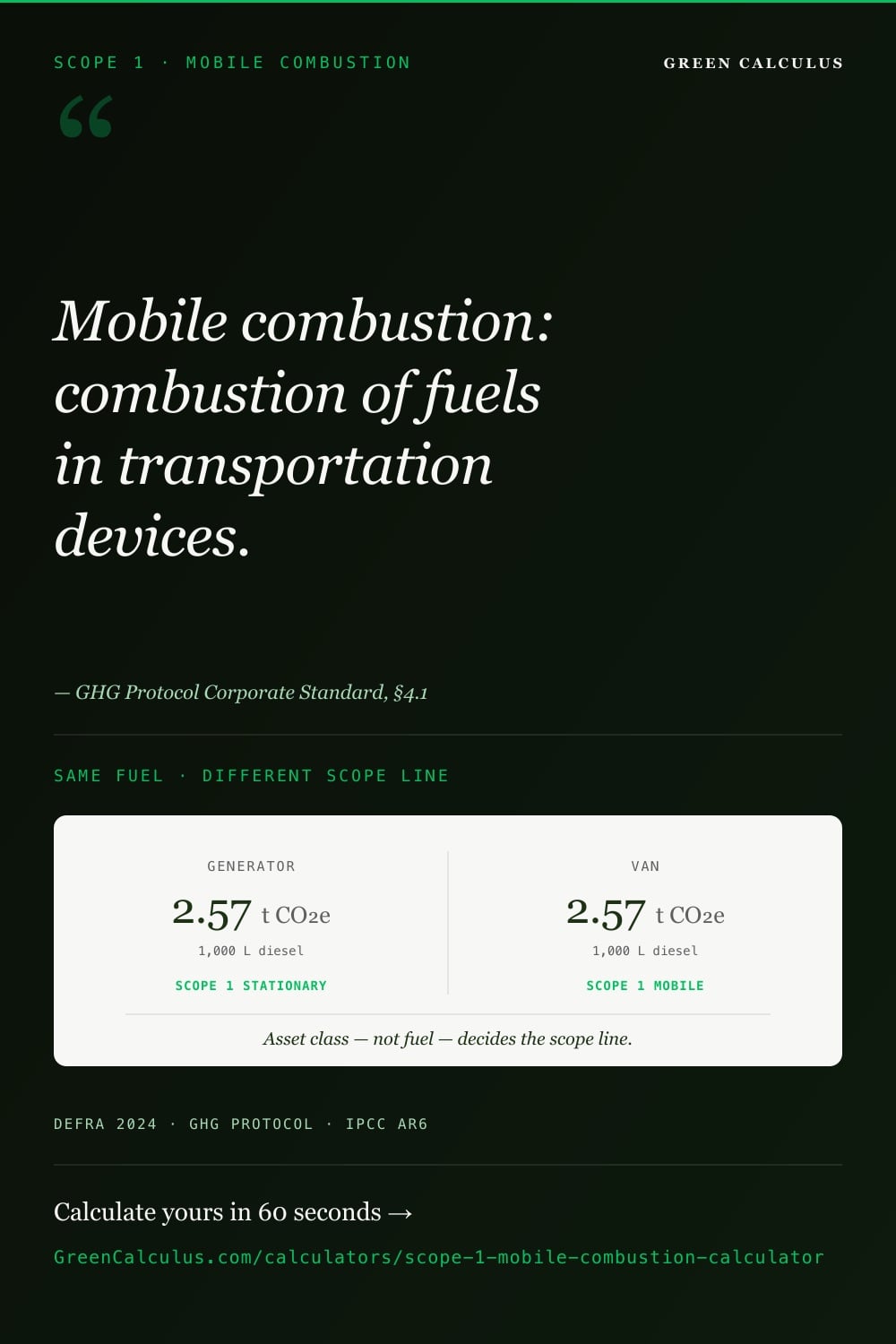
Factors are read live from the MasterBrain canonical-row keyspace at mobile_combustion.<fuel>.<unit_basis>, with a hardcoded fallback set matching the DEFRA 2026 published values for stale-cache safety. Mobile-combustion factors are numerically identical to the stationary equivalents for the eight shared fuels — the distinction is the asset, not the chemistry. The seven mobile-only fuels (aviation spirit, both marine grades, residual fuel oil, mineral petrol, CNG, LNG) have no stationary counterpart.
GWP basis is AR5 GWP-100, inherited from the DEFRA publication. Corporate inventories that report on an AR6 basis elsewhere can carry DEFRA fuel factors on AR5 without inconsistency — DEFRA has not republished on AR6, and the GHG Protocol permits using the source standard’s native basis for the factor as published.
DEFRA 2026 mobile combustion factor set, AR5 GWP-100 inherited.
Source: fuel delivery records or trip-mileage × fleet-consumption ratio.
Numeric, positive. Decimals allowed.
Please enter a valid positive number.
Annualised: result × (12 ÷ period months).
Audit mode exposes the full calculation chain for verification.
Enter fuel quantity above to calculate
Results appear instantly. Audit trail and Scope 3 Cat 3 (WTT) companion available after calculation.
Results are indicative, intended for screening and order-of-magnitude estimates. For ESOS, SECR, ISO 14064 verification, or other regulatory submissions, validate factors against the primary DEFRA dataset and document your full GHG inventory boundary and methodology. AR5 GWP-100 inherited from the DEFRA 2026 factor publication.
Mobile combustion is the fuel your organisation burns in assets it owns or controls that move — diesel vans, HGVs, forklifts, company cars, marine vessels, and owned aircraft. It sits in Scope 1 alongside stationary combustion, but the factor set, the unit conventions, and the boundary calls are different enough to trip up an inventory built for boilers.
Get the fuel-to-asset mapping right and mobile combustion is one of the most defensible lines in your Scope 1 total.
Scope 1 mobile combustion emissions equal fuel used multiplied by the DEFRA 2026 conversion factor for that fuel. Average-blend diesel is 2.58354 kg CO₂e per litre; petrol is 2.07500. Use litres for forecourt fuel and kWh or tonnes for bulk deliveries.
What Scope 1 mobile combustion covers
Mobile combustion is the direct burning of fuel in transport assets under your operational or financial control. It is a sub-category of Scope 1 direct emissions, distinct from the stationary combustion that powers fixed equipment such as boilers and generators.
The boundary question is asset ownership and control, not fuel type. The same litre of diesel can land in mobile combustion, stationary combustion, or a different scope entirely depending on what burns it and who controls that asset:
In scope — mobile combustion
Diesel burned in a company-owned delivery van, a forklift on your site, an owned marine vessel, or a leased vehicle you account for under the financial-control approach.
In scope — but stationary
Diesel burned in a fixed standby generator belongs in stationary combustion. Use the Scope 1 stationary combustion calculator for that line instead.
Out of scope — Scope 3
Fuel burned in a courier’s own vehicles, an employee’s private car on a business trip, or a chartered vessel you do not control moves to Scope 3 (categories 4, 6, or 9).
Mobile and stationary combustion both sit in Scope 1, but they are reported as separate activity lines. The split follows the asset type, and it matters for verification: an auditor expects fleet fuel and facility fuel to reconcile against different evidence — fuel cards and telematics for mobile, meter reads and delivery notes for stationary.

How the calculation works
Every mobile-combustion line reduces to one multiplication. The calculator above runs it for each fuel you enter and sums the result:
Emissions (kg CO₂e) = Fuel quantity × DEFRA conversion factor for that fuel and unit basis
The DEFRA factor already bundles the three combustion gases — carbon dioxide, methane, and nitrous oxide — into a single CO₂e value. You do not apply GWP values separately; that conversion is baked into the published factor. This is why fuel-based mobile combustion is simpler than it looks once the inventory boundary is settled.
Choosing the right unit basis
DEFRA publishes each mobile fuel on four unit bases. The factor changes with the basis, so the quantity you record has to match the basis you select:
| Unit basis | MasterBrain suffix | Use when |
|---|---|---|
| Per litre | per_litre |
Forecourt liquid fuels and most road / marine fleet records (litres from fuel cards). |
| Per tonne | per_tonne |
Solid or gaseous fuels delivered and recorded by mass. |
| Per kWh (gross CV) | per_kwh_gross_cv |
Energy-basis reporting where consumption is already in kWh on a gross calorific value. |
| Per kWh (net CV) | per_kwh_net_cv |
Energy-basis reporting on a net calorific value (common in continental European data). |
For a road fleet, default to per-litre. Fuel-card and pump data arrive in litres, and converting to energy basis only adds a calorific-value assumption you would have to defend in audit. Reserve the kWh bases for sites that already meter fuel in energy units.
DEFRA 2026 mobile fuel factors
The factor set covers 15 mobile fuels. The values below are the DEFRA 2026 per-litre headline factors, on an AR5 GWP-100 basis, sourced from the DEFRA 2026 conversion-factor publication. Eight of these share a value with their stationary equivalents; seven are mobile-only.
| Fuel | kg CO₂e / litre | Typical mobile use |
|---|---|---|
| Diesel (average biofuel blend) | 2.58354 | Vans, HGVs, company cars |
| Diesel (100% mineral) | 2.66155 | Older or off-spec fleet diesel |
| Petrol (average biofuel blend) | 2.07500 | Petrol company cars, small plant |
| Petrol (100% mineral) | 2.35372 | Mineral petrol, small engines |
| Gas oil (red diesel) | 2.75541 | Off-road plant, agricultural vehicles |
| Aviation spirit (avgas) | 2.33116 | Piston-engine owned aircraft |
| Aviation turbine fuel (Jet A/A-1) | 2.54269 | Owned jet aircraft |
| Marine gas oil | 2.77139 | Smaller owned vessels |
| Marine fuel oil (residual) | 3.10202 | Larger owned vessels |
| Fuel oil (residual) | 3.17492 | Heavy marine / industrial mobile plant |
| LPG | 1.55713 | LPG-converted vehicles, forklifts |
| Propane | 1.54358 | Specialist mobile plant |
| Butane | 1.74533 | Specialist mobile plant |
| CNG (compressed natural gas) | 0.43885 | CNG fleet vehicles |
| LNG (liquefied natural gas) | 1.14791 | LNG HGVs, marine |
The spread between fuels is wide enough to matter for fleet decarbonisation planning. The chart below shows the per-litre intensity of the most common road and plant fuels:
Note that CNG carries a far lower per-litre value than the liquid fuels because a litre of compressed gas holds less energy than a litre of diesel — the per-litre comparison flatters CNG. For a like-for-like decarbonisation comparison, normalise to an energy basis (per kWh) or to distance, where the gap narrows.
Why these factors use AR5, not AR6
DEFRA publishes its conversion factors on an AR5 GWP-100 basis, and the calculator inherits that basis directly. This can look inconsistent if the rest of your inventory reports on AR6 — but it is correct, and it is by design.
The GWP basis lives inside the published factor, not in your calculation. DEFRA has not republished its fuel factors on an AR6 basis, so a DEFRA-sourced mobile-combustion factor carries AR5 GWP-100 internally. Using it does not make your inventory “an AR5 inventory” — it means that one factor, from that one source, is published on the basis that source uses.
The practical effect is small for combustion fuels. The two non-CO₂ combustion gases, methane and nitrous oxide, are a minor share of a fuel’s total CO₂e, and the AR5-to-AR6 GWP shift for those gases moves the bundled factor by a fraction of a percent. The headline driver of a fuel’s factor is its CO₂ content, which carries a GWP of 1 on every basis. Where the AR5/AR6 distinction does bite is in high-GWP refrigerant and fugitive-gas inventories — not mobile combustion.
Worked example: a mixed road fleet
A logistics operator runs a year of fuel through three asset classes: diesel HGVs, petrol company cars, and a small fleet of LPG forklifts. All quantities are recorded in litres from fuel-card data, so the per-litre basis applies throughout. Factors are DEFRA 2026, AR5 GWP-100.
| Asset class | Fuel | Litres / year | Factor (kg CO₂e/litre) | Emissions (kg CO₂e) |
|---|---|---|---|---|
| HGVs | Diesel (avg blend) | 48,000 | 2.58354 | 124,009.92 |
| Company cars | Petrol (avg blend) | 9,500 | 2.07500 | 19,712.50 |
| Forklifts | LPG | 3,200 | 1.55713 | 4,982.82 |
| Total Scope 1 mobile combustion | 148,705.24 | |||
Each line is fuel × factor; the lines reconcile to the total. Converting to tonnes for the inventory:
The diesel HGV line is 83% of the total here — typical for a road-freight operator, and the obvious first target for any fleet-decarbonisation business case.
Common mistakes to avoid
Do not put standby-generator or fixed-plant diesel in this line. It is Scope 1, but stationary combustion — a separate activity line that reconciles against different evidence. Mixing the two double-reports against the wrong category and breaks the audit trail.
Match the unit basis to the quantity. A per-litre factor applied to a kWh quantity, or vice versa, produces a number that is wrong by the fuel’s calorific value — often a factor of ten or more. Confirm the basis selector matches the data before you trust the result.
For electric vehicles in an owned fleet, there is no Scope 1 mobile-combustion line — the charging electricity is Scope 2. Account for it in your Scope 2 electricity calculation instead, not here.
Dataset — the full factor set referenced on this page, versioned with source provenance and downloadable as CSV with a citable Zenodo DOI, is published as the DEFRA Well-to-Tank (WTT) emission factors dataset.
It is Scope 1 when the fuel is burned in an asset your organisation owns or controls — a company van, an owned vessel, a forklift on your site. It moves to Scope 3 when the asset belongs to someone else, such as a courier’s own vehicles (category 4) or an employee’s private car on business travel (category 6).
Both are Scope 1 fuel combustion. Mobile combustion is fuel burned in transport assets that move; stationary combustion is fuel burned in fixed equipment such as boilers and generators. They use the same DEFRA factors for shared fuels but are reported as separate activity lines, and they reconcile against different evidence in audit.
For most fleets, diesel (average biofuel blend) at 2.58354 kg CO₂e per litre, which reflects the biofuel content of UK forecourt diesel. Use diesel (100% mineral) at 2.66155 only where you can demonstrate the fuel had no biofuel content. Gas oil (red diesel) at 2.75541 applies to off-road and agricultural plant.
Because DEFRA publishes its conversion factors on an AR5 GWP-100 basis and has not republished on AR6. The GWP basis is built into the factor, so a DEFRA-sourced factor carries AR5 internally even in an inventory that otherwise uses AR6. For combustion fuels the effect is negligible, since the dominant gas is CO₂, which has a GWP of 1 on every basis.
Battery-electric vehicles produce no Scope 1 mobile-combustion emissions — there is no fuel burned on board. The charging electricity is a Scope 2 purchased-energy emission, accounted for using your grid factor in a Scope 2 electricity calculation rather than here.