
LPG Combustion Emissions: Methodology and Emission Factors

Step-by-step method for converting metered LPG consumption into a defensible Scope 1 inventory across all three meter bases (litres, kilograms, kWh), handling propane/butane composition uncertainty, separating tank-to-wheel from well-to-tank emissions, and comparing LPG against grid natural gas on a like-for-like energy basis. Aligned to the GHG Protocol Corporate Standard, UK DEFRA 2026 GHG Conversion Factors, and IPCC AR6.
A methodology page is the execution layer — it takes the gas definitions from the glossary, the factor publication from the standards page, and the raw factor dataset from the data layer, and tells you exactly how to translate metered LPG consumption into a defensible Scope 1 (and optional Scope 3 Cat 3a) inventory. Unlike diesel, where the dominant error is variant misselection, LPG’s dominant error is meter-basis confusion — the same delivery can be measured in litres (volume), kilograms (mass), or kWh (energy), and the conversions between them are not interchangeable. Jump to the worked example or open the Scope 1 Combustion Calculator.
Pre-check — what unit is your LPG actually metered in?
Unlike diesel, LPG’s primary reporting error is not variant selection — it is meter-basis confusion. The same 9.2-tonne annual delivery can be expressed as 9,200 kg, 17,367 L, or 126,065 kWh GCV — three different numbers that all describe the same molecules. Picking the wrong factor for your meter unit is the single largest error vector for LPG (up to −47% understatement). Confirm your meter basis before continuing.
2,939.36 kg CO₂e/t. Most common for industrial bulk LPG (Calor, Flogas). Direct mass-based calculation — no density assumption required. Continue to §5 — calculation.2,939.36 kg CO₂e/t applied to total cylinder content. Cylinder labels show net product mass; the labelled kg is the activity data.1.55713 kg CO₂e/L. Direct volume-based calculation. Confirm the pump is metered at 15°C reference (UK standard); ambient correction needed otherwise.0.21450 kg CO₂e/kWh. UK convention is GCV (gross calorific value); confirm before computing. NCV alternative: 0.23032 kg CO₂e/kWh — see §5.4 on basis confusion.Two reporting modes — choose by audit context
DEFRA-published factors and engineering-mode AR6 reconstructions are both valid disclosures. The choice depends on which framework you are reporting against, not which is “more correct”. For LPG specifically, the AR5→AR6 delta is even smaller than diesel (~0.007% vs ~0.04%) because trace gas contributions are tiny — but the disclosure principle still applies.
DEFRA pre-aggregated · AR5 GWP-100
Use the published DEFRA factor verbatim (1.55713 kg CO₂e/L for the standard LPG blend). GWP basis is IPCC AR5 (CH₄ fossil = 28, N₂O = 265) per the DEFRA workbook Introduction tab Row 35. Required for UK SECR (Streamlined Energy and Carbon Reporting) and most regulatory filings.
Gas-by-gas · AR6 GWP-100
Compute CO₂, CH₄, and N₂O separately, then apply AR6 GWP values (CH₄ fossil = 29.8, N₂O = 273). Preferred for SBTi target tracking and CSRD/ESRS E1 precision work. The diesel methodology page covers the AR5/AR6 reconstruction in full — for LPG the same logic applies with even smaller magnitudes.
Why LPG Combustion Matters for GHG Reporting
LPG (liquefied petroleum gas — a propane-butane blend) is the largest off-grid Scope 1 fuel in the UK and across most of Europe. It powers rural heating, commercial kitchens, care homes and hospitals beyond the gas grid, leisure-park cottages, food processing plants, glasshouse horticulture, and a substantial share of forklift fleets in distribution centres. For organisations whose physical footprint lies outside the natural-gas distribution network, LPG typically sits in the top three Scope 1 line items by emissions volume — sometimes the single largest.
That ubiquity in stationary heat applications makes LPG a routine target for Scope 1 verification. CSRD ESRS E1-6 requires gross Scope 1 disclosure with a breakdown by fuel type, separating mobile from stationary combustion. SBTi corporate net-zero targets set under the Absolute Contraction Approach require year-on-year LPG reduction trajectories — often the deepest decarbonisation lever for off-grid sites considering electrification or biomass conversion. The GHG Protocol Corporate Standard defines the inventory boundary inside which LPG sits. ISO 14064-1 verifiers will sample LPG transactions at the delivery-note level for traceability to the metered source.
Three things make LPG harder to get right than diesel: (1) the same fuel arrives in three different meter bases (litres, kilograms, kWh) depending on the supply route, (2) the propane/butane composition varies seasonally and regionally, with density swinging ~13.7% between pure propane and pure butane, and (3) bulk-tank, cylinder, and autogas activity data come from completely different sources (delivery weighbridge, cylinder manifest, pump receipt) with different audit-trail patterns. This methodology page addresses all three.
Provider directory
Now it has to hold up all year.
See who does this work. Every listing names the standards it works to, and paid placements are labelled. Including Attain Zero and Anthesis Group.
Browse 6 carbon accounting & inventory providers →Do this work? A listing is US$390 a year. Get listed →
The Three Gases — What LPG Actually Emits
LPG combustion produces three greenhouse gases: carbon dioxide (CO₂), methane (CH₄), and nitrous oxide (N₂O). CO₂ dominates by mass — even more so than for diesel, because LPG burns more cleanly with less unburnt hydrocarbon slip. CH₄ is a trace combustion product; N₂O forms in trace quantities from nitrogen in combustion air at high temperatures. The DEFRA published factor aggregates all three into a single CO₂-equivalent value, but understanding the underlying split matters for audit reconciliation and for engineering-mode AR6 reconstruction.
| Gas | Component (kg CO₂e/L at AR5) | Implied raw mass | Why it matters |
|---|---|---|---|
| CO₂ | 1.55491 | 1.55491 kg CO₂/L (no GWP — CO₂ is the reference gas) | Direct combustion product. Dominates the factor (99.86% of CO₂e at AR5) — even cleaner-dominant than diesel because LPG combustion is more complete. |
| CH₄ | 0.00136 | ~0.0486 g CH₄/L | Trace incomplete combustion. ~0.087% of CO₂e at AR5. Higher per-unit mass than diesel CH₄ slip but still a small share of the total factor. |
| N₂O | 0.00086 | ~0.00325 g N₂O/L | Trace high-temperature nitrogen oxidation. ~0.055% of CO₂e at AR5 — much smaller absolute contribution than diesel N₂O because LPG burners run cooler. |
| Total | 1.55713 | = sum of components above | This is the DEFRA published factor for standard LPG blend — aggregate exactly matches MasterBrain row 36. |
Source: UK Government GHG Conversion Factors 2025, DESNZ June 2025, Fuels tab, row 36 “LPG”. Components are stored as CO₂e at AR5 GWP-100 in the GreenCalculus MasterBrain v2025.4. Sum reconciliation: 1.55491 + 0.00136 + 0.00086 = 1.55713 (exact to 5dp).
The CO₂-dominant character of LPG (99.86%) explains why the AR5→AR6 GWP basis change has almost no effect on this fuel — the trace gases that benefit from the higher AR6 GWPs contribute too little to the total to move the headline number. This is a structural feature of LPG, not a coincidence; clean-burning gaseous fuels show the same pattern.
Propane / Butane Composition — and Why Volume↔Mass Conversion Is the Hardest Step
“LPG” is not a single chemical — it is a propane-butane blend whose composition varies by season and region. UK winter LPG is typically near-pure propane (boiling point −42°C, vaporises in cold weather), while UK summer and commercial-grade LPG often runs 70/30 propane/butane or higher butane content. Butane has a higher boiling point (−0.5°C), more energy per litre, and higher density. DEFRA publishes a single blended factor (1.55713 kg CO₂e/L) representing the UK pump-LPG average composition; pure-component factors are also available where the supply is documented.
| Variant | Factor (kg CO₂e/L) | Density (kg/L) | MasterBrain key | When to use |
|---|---|---|---|---|
| LPG (standard blend) | 1.55713 | 0.52975 | fuels.lpg | Default for UK pump LPG, bulk delivery, and cylinder use without composition documentation. The regulatory safe-harbour disclosure. |
| Propane (pure) | 1.54358 | ~0.508 | fuels.propane | Use only with documented evidence of pure propane supply (winter-grade or industrial off-grid heat with explicit specification). Slightly lower than the blend factor. |
| Butane (pure) | 1.74533 | ~0.580 | fuels.butane | Pure butane — significantly higher than the blend per litre because butane’s higher density carries more carbon per volume. Common for camping cylinders, some industrial chemistry feeds, and hot-climate supply. |
All three factors per DEFRA 2026 GHG Conversion Factors dataset. AR5 GWP-100 basis. Standard blend density (0.52975 kg/L) is the 15°C reference value from the Fuel properties tab; pure-component densities approximate.
3.1 Why density variation is the killer for volume↔mass conversion
The factor difference between pure propane (1.54358) and pure butane (1.74533) is +13.07% — small enough that a misclassified blend factor produces a manageable error in per-litre reporting. But the density difference between pure propane (~0.508 kg/L) and pure butane (~0.580 kg/L) is +14.2%, and that difference compounds with the factor when converting between mass and volume. The DEFRA standard blend density of 0.52975 kg/L assumes a UK-typical mostly-propane composition; using it on a butane-heavy supply (hot-climate or summer formulation) understates the volume that a tonne of LPG actually occupies, with a chained downstream error.
The practical implication: if you have a choice, report LPG by mass, not by volume. Mass-based reporting (delivery weighbridge, cylinder kg, bulk-tank inventory in tonnes) avoids the density assumption entirely — a kilogram of LPG is a kilogram regardless of composition. Volume-based reporting (autogas pump, tank dip in litres) inherits the density assumption and propagates composition uncertainty into the inventory. For most stationary LPG use (bulk delivery to a tank), the delivery note already gives kilograms — use them.
3.2 When the blended factor is wrong
The DEFRA blended factor is correct for UK pump LPG and for most undocumented bulk supply. It is the wrong choice in three specific cases. First, a documented pure-propane supply (winter-grade, industrial spec) should use the propane factor (1.54358) — the difference is small (−0.87%) but the methodology choice should be visible. Second, a documented pure-butane supply or near-pure butane (some chemical-industry feedstocks, hot-climate cylinder gas) should use the butane factor (1.74533) — the +12.09% difference is material enough that misclassification is a quantified disclosure risk. Third, refrigerant-grade R-290 (pure propane used as a working fluid) is not a combustion source and should not be in the combustion inventory at all — it sits in the refrigerants section under fugitive Scope 1.
Scope Boundary — TTW vs WTT
The combustion factors above are tank-to-wheel (TTW) Scope 1 figures. They cover the molecules released by burning LPG inside owned or controlled equipment. The full life-cycle carbon footprint of LPG includes upstream extraction, refining, and distribution: the well-to-tank (WTT) share, which sits in Scope 3 Category 3a (fuel- and energy-related activities not included in Scope 1 or 2).
| Variant | TTW (kg CO₂e/L) | WTT (kg CO₂e/L) | Full life-cycle | Reporting boundary |
|---|---|---|---|---|
| LPG (standard blend) | 1.55713 Scope 1 |
0.18551 S3 Cat 3a |
1.74264 | WTT is ~11.9% of TTW |
Both factors per DEFRA 2026. WTT factor from “WTT- fuels” tab row 35. Full life-cycle = TTW + WTT, displayed for organisations choosing voluntary upstream disclosure under the GHG Protocol Scope 3 Standard. WTT per-tonne: 349.29 kg CO₂e/t. WTT per-kWh GCV: 0.02548 kg CO₂e/kWh.
The LPG WTT-to-TTW ratio of ~11.9% is meaningfully smaller than diesel’s ~24%. Two reasons: LPG is a refinery by-product (lower attribution of refining energy to the LPG fraction than to road diesel), and the distribution chain is shorter (fewer transfer steps from refinery to user, no retail forecourt aggregation). For an organisation switching from oil heating to LPG and adding WTT to the disclosure, the headline Scope 1 reduction is supplemented by a smaller Scope 3 Cat 3a addition than the equivalent diesel switch would produce.
The GHG Protocol Corporate Standard requires Scope 1 (TTW) disclosure for owned combustion. Scope 3 Category 3a (WTT) disclosure is voluntary under the Corporate Standard but required under the Scope 3 Standard for organisations claiming Scope 3 coverage. The frequent error is to add WTT into the Scope 1 line — this double-counts when WTT is also reported in Scope 3, and inflates the regulatory-required Scope 1 figure used for SBTi target tracking. Magnitude: silently adding WTT into Scope 1 inflates a 9.2-tonne LPG base by 11.91% (§9 error trap E4).
The Calculation — Step by Step
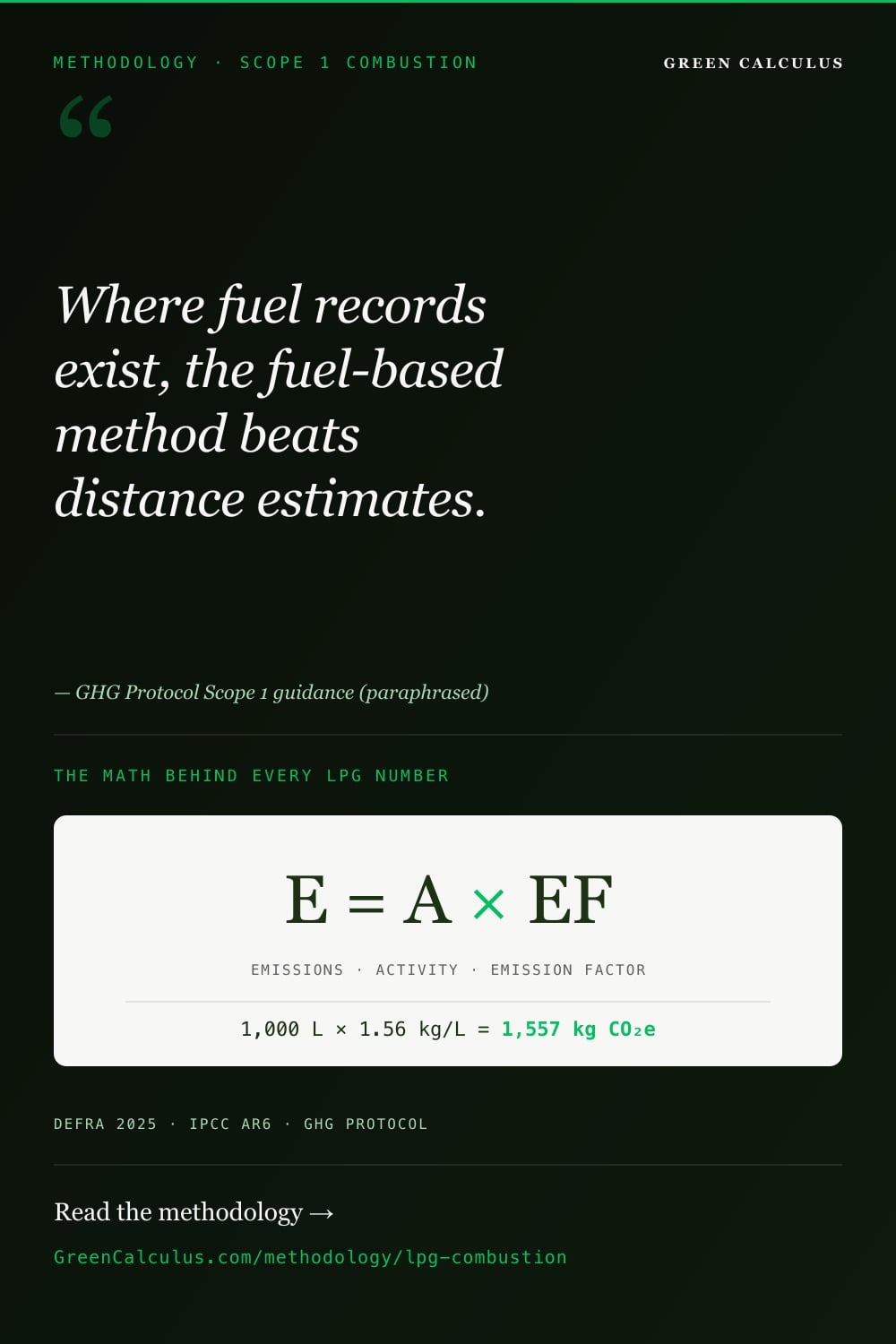
The core LPG combustion equation is identical regardless of meter basis. The variables differ; the structure does not.
5.1 Match the factor to the meter — do not pre-convert
The single most important methodology rule for LPG: use the factor that matches your meter unit; do not convert the activity data first. If your delivery note shows 9.2 tonnes, multiply by the per-tonne factor (2,939.36 kg CO₂e/t). If your pump receipt shows 250 litres, multiply by the per-litre factor (1.55713). Pre-converting tonnes to litres before multiplying inserts a density assumption (0.52975 kg/L) that may not match your supply composition, propagating ~10–14% composition uncertainty into the inventory unnecessarily. The four DEFRA factors are internally consistent — they describe the same molecules at different unit slices — but only when each is applied to its own native unit.
| Meter unit | Factor (LPG blend) | Conversion key |
|---|---|---|
| per litre (volume) | 1.55713 kg CO₂e/L | Direct from DEFRA Fuels tab. Use for autogas pump dispense and tank-dip volume readings. |
| per tonne (mass) | 2,939.36 kg CO₂e/t | Mass-based — no density assumption. Preferred for bulk LPG and cylinders where the delivery note or label gives kg. |
| per kWh (gross calorific value) | 0.21450 kg CO₂e/kWh | GCV basis: 7.259 kWh/L. UK convention for energy-bill reporting and CHP plant. |
| per kWh (net calorific value) | 0.23032 kg CO₂e/kWh | NCV basis. Required for some IEA-aligned international energy intensity reporting. ~6.9% higher than GCV factor — see §5.4. |
Conversion factors per DEFRA 2026 Fuel properties tab. Density 0.52975 kg/L and GCV 7.259 kWh/L are physical chemistry values stable across DEFRA publication years. Volume↔mass conversion is the highest-uncertainty step because of LPG composition variation — see §3.1.
5.2 Regulatory mode — DEFRA pre-aggregated
The simplest path. Take the metered quantity in its native unit, multiply by the matching DEFRA factor, divide by 1,000 to convert kilograms to tonnes. Document the meter basis and the DEFRA publication year in the methodology statement. This path is sufficient for UK SECR, GHG Protocol Corporate Standard compliance, and most Scope 1 disclosure obligations. The GWP basis is AR5 by virtue of using the DEFRA factor; no further GWP work is needed.
5.3 Engineering mode — gas-by-gas at AR6
Compute CO₂, CH₄, and N₂O separately using the implied raw masses from the §2 component table, then apply AR6 GWP-100 values (CH₄ fossil = 29.8, N₂O = 273). Sum the three CO₂e contributions for the engineering-mode total. For LPG, the AR5→AR6 delta is approximately +0.0073% — even smaller than the +0.04% delta on diesel — because CO₂ accounts for 99.86% of the LPG factor and CO₂ has no GWP attached. The natural gas methodology page covers the full AR5↔AR6 reconstruction logic in detail; for LPG the same logic applies with even smaller magnitudes.
5.4 GCV vs NCV — the 6.9% inversion risk
For any LPG inventory reported per kWh, the calorific basis must be declared explicitly. UK convention is gross calorific value (GCV, also called higher heating value); international energy reporting frequently uses net calorific value (NCV, also called lower heating value). The two factors differ by ~6.9% for LPG (0.21450 vs 0.23032 kg CO₂e/kWh). Using the wrong factor against an energy total inverts the disclosure direction — silent confusion produces a clean-looking but materially wrong number. The defence: capture the calorific basis at activity-data ingest, not at calculation. Energy bills from UK suppliers are GCV by default; meter readings from CHP plant should be checked at the meter spec sheet.
Stationary-Dominant — Heating, Cooking, and Process Heat
LPG is overwhelmingly a stationary combustion fuel. Unlike diesel — where mobile combustion (vehicle fleets, off-road plant) is the headline use case — LPG sits primarily in fixed installations: bulk tanks feeding boilers, cylinder banks supplying commercial kitchens, on-site process heat for food production and horticulture. Mobile LPG combustion is real but secondary, dominated by forklift fleets and a small autogas vehicle population. The activity-data sourcing pattern follows the application.
Source-type routing — LPG combustion in scope
All LPG combustion in owned or operationally-controlled equipment is Scope 1. The split below is for activity-data sourcing and disaggregation in CSRD ESRS E1-6 disclosure, not for total-emission scoping.
Cylinder, Bulk Tank, and Autogas — Three Activity-Data Patterns
The three LPG supply routes generate completely different activity-data trails, with different audit-quality characteristics. Understanding which route applies to your inventory determines what evidence you need to retain and which factor to apply.
7.1 Bulk tank — the highest-quality LPG activity data
Bulk LPG arrives by tanker delivery to an on-site storage tank, typically 1–10 tonnes capacity for commercial sites. Each delivery generates a weighbridge-certified delivery note in kilograms. The activity data is the sum of delivery notes for the reporting year, optionally reconciled against opening and closing tank-level readings. Audit quality is high: each kilogram traceable to a date, a tanker, and a delivery driver signature. Tank dip readings provide a sanity check but are not strictly required for bulk reporting where delivery notes are reliable. Use the per-tonne factor (2,939.36 kg CO₂e/t) directly — no density assumption required, no volume conversion needed. This is the cleanest LPG inventory pattern.
7.2 Cylinder — labelled mass and exchange manifests
Cylinder LPG comes in standard sizes — 47 kg (industrial / heating), 19 kg (forklift), 13 kg (commercial cooking), 6 kg (patio). Each cylinder is labelled with a net product mass; the supplier’s exchange manifest records the count and date of cylinders delivered against returned empties. The activity data is (cylinder size in kg × count) summed over the reporting year. Audit quality is good but slightly lower than bulk because the cylinder turnover at site introduces a timing question — was a cylinder delivered in December actually consumed in December or in January? The pragmatic answer is to use delivery-date as the consumption date for annual reporting, with a beginning/end-of-year stock check for material accounts. Use the per-tonne factor.
7.3 Autogas — pump dispense in litres
Autogas (LPG dispensed at fuel-station pumps for vehicles) is metered in litres. Activity data is the pump receipt or fuel card aggregation. Audit quality is good for the meter reading itself (calibrated dispense pumps), but volume-based reporting inherits the density assumption discussed in §3.1 — composition uncertainty propagates into the inventory. Autogas is the only LPG application where per-litre factor use is unavoidable; it is also the smallest application volumetrically, so the methodology consequence is bounded. Use 1.55713 kg CO₂e/L. Where ambient temperature deviates significantly from the 15°C UK pump reference (rare in UK climate; common abroad), temperature correction is required for material inventories.
LPG vs Natural Gas — When to Switch
Many off-grid sites face a strategic question: is LPG the right long-term choice, or should the site connect to the natural gas grid (where geographically feasible) or transition straight to electrification or heat pumps? The carbon-per-kWh comparison between LPG and natural gas is a first-order input to that decision. Both are gaseous fossil fuels with similar combustion chemistry; the difference at the point of use is consistent and meaningful.
Carbon intensity per kWh GCV — like-for-like energy basis
LPG (standard blend)
Scope 1 TTW. Add 0.02548 kg CO₂e/kWh for WTT (Scope 3 Cat 3a). Full life-cycle ~0.23998 per kWh GCV.
Natural gas (grid pipeline)
Scope 1 TTW. Source: DEFRA 2026 Fuels tab row 40, per-kWh GCV alternate. Grid gas WTT is comparable at ~0.026 per kWh GCV.
Two methodology cautions when comparing LPG and natural gas. First, the comparison must be on the same calorific basis — both factors above are GCV; mixing GCV and NCV across the two fuels inverts the comparison by ~6%. Second, the cleanest decision frame is per-kWh-of-useful-heat, not per-kWh-of-fuel — boiler efficiency on LPG vs natural gas typically differs by 2–4 percentage points (LPG burners run slightly more efficiently at small commercial scale) which narrows the headline +17.66% by roughly that margin. For strategic decarbonisation modelling, the per-kWh-of-useful-heat comparison is the right number to put in the business case.
Data Quality, Uncertainty, and the Activity-Data Hierarchy
The LPG emission factor is the easy part of a Scope 1 LPG inventory — DEFRA publishes it, the MasterBrain stores it, the calculator multiplies. The hard part is the activity data: how many kilograms (or litres or kWh) did the organisation actually combust? The hierarchy of data quality, from best to worst:
- Bulk delivery notes in kilograms (Tier 1 best practice) — Weighbridge-certified delivery records summed for the reporting year. Each kilogram traceable to a date, tanker, and supplier signature. Use the per-tonne factor directly. Audit-grade and the only acceptable basis for reasonable assurance on material accounts.
- Cylinder exchange manifest with labelled mass — Cylinder count × labelled kg-per-cylinder. Slightly weaker than bulk because of timing uncertainty (delivery date vs consumption date) but acceptable for annual reporting with stock-check reconciliation.
- Tank dip with delivery reconciliation — Periodic tank dip readings bracketing delivery records, with consumption derived as (opening + delivered − closing). Acceptable; requires temperature-corrected dip readings and a documented reconciliation cadence.
- Autogas pump receipts in litres — Pump dispense aggregated by fuel card or receipt. Acceptable for the pump-meter reading; inherits density-assumption uncertainty (§3.1) for any conversion to mass.
- kWh from energy bills — Acceptable for CHP and heat-network use. Confirm GCV vs NCV basis at ingest; a wrong-basis factor introduces ±6.9% systematic bias.
- Spend-based proxy — Expenditure ÷ assumed price per litre or per kg. Screening grade only; not acceptable for material categories at audit.
Three uncertainty sources matter for material LPG inventories:
- Composition variation. Pump and bulk LPG composition varies seasonally; the DEFRA blended factor is the regulatory safe harbour for this uncertainty band. Documented pure-component supply (winter propane spec, butane chemical feed) should switch to the pure factor and disclose the methodology choice.
- Density and temperature correction for volume-based reporting. LPG density varies ~10–14% between pure propane and pure butane, plus a smaller temperature dependence. The DEFRA 0.52975 kg/L is the 15°C reference for the standard UK blend; volume-based reporting should be avoided where mass-based data is available.
- Audit-trail retention. ISO 14064-1 verifiers will sample LPG transactions at the line level. Retain delivery notes, cylinder manifests, tank dip records, supplier composition declarations, and pump receipts for the inventory year plus the longer of (a) the regulator’s retention rule and (b) the planned re-validation cycle. SBTi 5-year re-validation cycles set a practical floor at 5 years.
Standards Alignment
Seven standards govern LPG combustion accounting. They nest rather than compete: each layer supplies a different input to the same audit-grade output.
| Standard | Role for LPG reporting |
|---|---|
| GHG Protocol Corporate Standard | Defines Scope 1 boundary (owned/controlled combustion) and activity data principles. Applies identically to bulk, cylinder, and autogas LPG. |
| UK DEFRA 2026 | Source of the LPG blend factor, pure-propane and pure-butane factors, and the WTT companion. AR5 GWP-100 basis. Annual publication. |
| IPCC AR6 | Source of GWP-100 values for engineering-mode reconstruction (CH₄ fossil = 29.8, N₂O = 273). For LPG the AR5→AR6 delta is ~0.0073% — small magnitude, mandatory disclosure when bases mix. |
| GHG Protocol Scope 3 Standard | Defines Cat 3a — the home for WTT LPG. Required for organisations claiming Scope 3 coverage. |
| ISO 14064-1 | Verification and data quality framework. Sets the audit-trail retention, traceability, and methodology disclosure requirements. |
| CSRD / ESRS E1 | EU mandatory disclosure requiring full Scope 1 combustion inventory with mobile vs stationary disaggregation — relevant for organisations with mixed bulk-heating + forklift LPG use. |
| SBTi Corporate Net-Zero Standard | Sets the AR6 GWP expectation for target validation and the year-on-year combustion reduction trajectory under the Absolute Contraction Approach. LPG-to-electrification is a typical decarbonisation lever for SBTi-aligned off-grid sites. |
Worked Example: A Rural Care Home on Bulk LPG Heating
A complete worked example, computed end-to-end with all arithmetic shown. Stationary-dominant by design — this is the most common LPG application. Hardcoded values throughout — this is an audit record at the snapshot date of this methodology revision.
Reporting year: 2026 | Reporting framework: SECR + voluntary CSRD
Site: Rural 80-bed care home, no mains gas
Fuel: Standard UK LPG blend, 6-tonne bulk tank
Supply: Calor Gas bulk delivery, weighbridge-certified delivery notes
Annual consumption: 9.2 tonnes (winter heating, hot water, kitchen)
Equivalent volume: 17,366.68 L at 0.52975 kg/L blend density Bulk delivery notes are Tier 1 (weighbridge-certified mass). Mass-basis reporting preferred — no density assumption needed for the headline calculation. AR5 baseline for SECR; AR6 reconstruction added for the parallel CSRD disclosure.
2,939.36 kg CO₂e/t) applied directly to the 9.2-tonne total — no volume conversion required. The per-litre factor would also work but adds a density assumption that the mass-based path avoids.
What the Calculator Handles vs What You Decide
The Scope 1 Combustion Calculator automates the mechanical steps. This methodology page covers the upstream decisions the calculator cannot make for you.
- Factor lookup for LPG blend, pure propane, and pure butane once you select the variant
- Unit-matched factor selection (per litre, per tonne, per kWh GCV, per kWh NCV)
- Volume↔mass conversion using DEFRA blend density (0.52975 kg/L) when explicitly requested
- Regulatory mode (DEFRA AR5) and engineering mode (AR6 reconstruction) side-by-side output
- Per-gas decomposition (CO₂ / CH₄ / N₂O) for engineering-mode disclosure
- WTT companion calculation for Scope 3 Cat 3a paired disclosure
- Methodology citation block with DEFRA publication year, GWP basis, calculation date
- Mass-balance check across multiple delivery records
- Meter basis — kg from delivery note, kg from cylinder label, L from autogas pump, kWh from energy bill — pick the meter’s native unit
- Variant selection — blend (default) vs pure propane vs pure butane; only switch with documented composition evidence
- Reporting mode — regulatory (AR5) vs engineering (AR6) vs both with disclosure
- Scope boundary — TTW only (Scope 1 minimum) vs TTW + WTT (full life-cycle, voluntary)
- Activity-data tier — bulk delivery (Tier 1, preferred) vs cylinder manifest vs tank dip vs pump receipt vs spend-based
- Mobile vs stationary classification — for ESRS E1-6 disaggregation; both are Scope 1, but the disclosure split matters
- Calorific basis — GCV vs NCV when reporting per kWh; affects the result by ~6.9%
- Source documentation — supplier composition declaration retention for pure-component variant claims
Ready to compute? Open the Scope 1 Combustion Calculator →
Error Traps with Calculable Magnitudes
Each error below produces a specific, quantifiable distortion. Magnitudes shown for CareCo’s 9.2-tonne / 17,367 L LPG base — large enough to assess validation and disclosure risk for a typical off-grid commercial site.
| Error | What happens | Magnitude (CareCo 9.2 t base) | How to avoid |
|---|---|---|---|
| E1 · Mass-as-volume confusion (kg entered as L) | Reporter has 9,200 kg of LPG from delivery notes but enters 9,200 directly into a litre-basis calculator without converting to litres first. | Understates Scope 1 by 12.72 tCO₂e/yr (−47.0%) Correct: 17,367 L × 1.55713 = 27.04 t. Wrong: 9,200 × 1.55713 = 14.33 t. The single largest error vector for LPG — the kg/L ratio of 0.53 makes this a near-halving error. |
Use the per-tonne factor (2,939.36) for kg-basis activity data. Match the factor to the meter unit; do not pre-convert. |
| E2 · Pure butane factor for blended supply | Reporter applies the pure butane factor (1.74533) to standard UK pump LPG without composition evidence, perhaps because of overseas literature using “butane” generically. | Overstates Scope 1 by 3.27 tCO₂e/yr (+12.09%) Factor difference: 1.74533 − 1.55713 = 0.18820 kg/L. Reverse error (pure butane reported as blend) understates by the same magnitude. |
Default to the LPG blend factor (1.55713) for UK supply. Switch to pure butane only with explicit supplier composition declaration. |
| E3 · WTT double-counted into Scope 1 | Reporter sums the 1.55713 TTW factor and the 0.18551 WTT factor into a single “Scope 1” line, then also reports WTT in Scope 3. | Overstates Scope 1 by 3.22 tCO₂e/yr (+11.91%) WTT is Scope 3 Cat 3a, never Scope 1. Double-counting also breaks SBTi target tracking and CSRD ESRS E1 line consistency. |
Always report TTW (Scope 1) and WTT (Scope 3 Cat 3a) as separate lines. Aggregate at inventory level only, never at line level. |
| E4 · GCV vs NCV confusion in kWh-basis reporting | Reporter uses the NCV factor (0.23032 kg CO₂e/kWh) against a GCV-basis energy total (or vice versa). | ±~6.9% systematic bias on kWh-basis inventories Inverts the disclosure depending on direction. UK convention is GCV; international energy reporting frequently uses NCV. |
Document the calorific basis at activity-data ingest, not at calculation. Energy bills from UK suppliers default to GCV. |
| E5 · Density assumption applied to non-blend supply | Reporter receives a near-pure butane supply (density ~0.58 kg/L) but uses the blend density (0.52975 kg/L) for tank-dip-to-mass conversion. | Up to ±10–14% on volume-basis reporting where composition departs from UK blend The error compounds with the per-litre vs per-tonne factor mismatch (E2). Worst-case combined effect on heavily butane-shifted supply is meaningful. |
Use mass-basis reporting wherever delivery data permits (avoids density assumption entirely). Volume-basis is acceptable for autogas where composition is regulated. |
| E6 · Pure propane factor for blend | Reporter applies pure propane factor (1.54358) to standard pump LPG, perhaps because winter UK LPG is “mostly propane”. | Understates Scope 1 by 0.24 tCO₂e/yr (−0.87%) Small magnitude per litre but consistent direction — under-reporting risk if undisclosed. Reverse error (pure propane supply reported as blend) overstates by the same. |
Default to the blend factor for UK pump LPG. Pure-propane factor requires explicit winter-grade or industrial-spec documentation. |
| E7 · LPG cylinder content treated as gross weight | Reporter uses the gross cylinder weight (cylinder + LPG) as activity data instead of the labelled net product mass. | Material overstatement; magnitude depends on cylinder size A 47 kg LPG cylinder typically weighs ~85 kg gross (steel cylinder ~38 kg). Using the gross weight overstates activity data by ~80%. |
The activity data is the labelled net product mass on the cylinder. Cylinder exchange manifests usually quote net kg directly. |
| E8 · Spend-based proxy retained beyond year 1 | Reporter uses LPG spend ÷ assumed price as activity data when delivery notes or cylinder manifests are available. | Qualified audit opinion likely LPG pricing is volatile (±20–30% across recent years). Spend-based reporting propagates pricing volatility directly into the inventory. Acceptable for first-year screening; not for material categories at limited assurance from year 2. |
Move to delivery-note or manifest-based activity data by year 2 for any material LPG category. |
Methodology Metadata — for GHG Inventory Documentation
Copy verbatim into your GHG inventory methodology statement for ISO 14064-1 transparency compliance. Adjust the variant selection, meter basis, and reporting mode lines to match your inventory choices.
29.8, N₂O = 273) per WGI Table 7.SM.7. Mixed-basis values disclosed explicitly per emission factor.
Building a multi-fuel inventory. This method covers one fuel. For the conventions that have to hold across all of them before a site total is defensible — one calorific-value basis, one GWP basis, three gases on every fuel, biogenic CO2 held as a memo item — see Stationary Combustion.
Frequently Asked Questions
No. Apply the per-tonne factor (2,939.36 kg CO₂e/t) directly to your kilogram total. Pre-converting kg to litres before multiplying inserts a density assumption (0.52975 kg/L for the UK standard blend) that you can avoid by using the mass-matched factor in the first place. This is the single most consequential rule for LPG accounting and the source of the largest reporting errors (see §13 error trap E1, magnitude −47% understatement). The four DEFRA factors (per litre, per tonne, per kWh GCV, per kWh NCV) are internally consistent — they describe the same molecules at different unit slices — but only when each is applied to its own native unit.
Default to the LPG blend factor (1.55713 kg CO₂e/L · 2,939.36 kg CO₂e/t) for any UK pump or bulk LPG without documented composition evidence. Switch to the pure-propane factor (1.54358) only with explicit winter-grade or industrial-spec documentation; switch to the pure-butane factor (1.74533) only with explicit chemical-feedstock or hot-climate cylinder documentation. The blend-vs-propane difference is small (−0.87%); the blend-vs-butane difference is material (+12.09%) and worth getting right where butane-heavy supply is in scope. CSRD voluntary precision disclosure is the most common legitimate trigger for using the pure-component factor; document the methodology choice explicitly when you do.
LPG is approximately 17.66% more carbon-intensive than grid natural gas on a per-kWh GCV basis (LPG: 0.21450 kg CO₂e/kWh; natural gas: 0.18231 kg CO₂e/kWh, both DEFRA 2026). For an off-grid site with grid-extension feasibility, switching from LPG to natural gas reduces operational Scope 1 by about one-sixth at constant heat output. This is meaningful but not transformational — the order-of-magnitude decarbonisation comes from electrification onto a low-carbon grid (heat pumps), not from the LPG-to-gas switch. Two important comparison cautions: keep both factors on the same calorific basis (GCV or NCV — not mixed), and where possible compare per kWh of useful heat rather than per kWh of fuel because boiler efficiencies differ slightly between the two fuels. See the natural gas combustion methodology for full grid-gas treatment.
WTT (well-to-tank) reporting for LPG is voluntary under the GHG Protocol Corporate Standard but required under the GHG Protocol Scope 3 Standard for organisations claiming Scope 3 coverage. Use 0.18551 kg CO₂e/L (or 349.29 kg CO₂e/t) and disclose as Scope 3 Category 3a — never as Scope 1. The WTT factor for LPG is ~11.9% of the TTW factor, smaller than diesel’s ~24% because LPG is a refinery by-product with a shorter distribution chain. The frequent error is to add WTT into the Scope 1 line, which inflates the Scope 1 figure by that 11.91% and double-counts when WTT is also reported in Scope 3 (see §13 error trap E3).
The retention list depends on your supply route. For bulk LPG: weighbridge-certified delivery notes from each tanker delivery, optional opening and closing tank-level dip readings, supplier composition declarations (where pure-component factor used). For cylinder LPG: cylinder exchange manifests showing count and date by cylinder size, supplier invoices, year-end stock count for material accounts. For autogas: fuel-card transaction logs or pump receipts. Across all routes: methodology statement, factor source citation (DEFRA publication year), GWP basis disclosure, and any reconciliation working papers. ISO 14064-1 requires retention for the inventory year plus a re-validation cycle; SBTi 5-year cycles set a practical floor at 5 years.
Patio gas is typically near-pure butane and should use the butane factor (1.74533 kg CO₂e/L · 3,033.38 kg CO₂e/t) where the supplier specification confirms the composition. For undocumented patio gas — a 13 kg “patio gas” cylinder in commercial hospitality use without a supplier composition sheet — the LPG blend factor is the regulatory safe-harbour default and produces a small (~0.7%) understatement on butane-heavy supply, which is a defensible disclosure position. The cylinder volumes for patio applications are typically small enough that the methodology choice is immaterial to the inventory total; for sites with material butane consumption (chemical feedstock, hot-climate logistics) the factor difference becomes consequential and explicit composition documentation is worth the audit trail work.
UK energy bills (LPG and natural gas) default to gross calorific value (GCV, also called higher heating value) — use the GCV factor (0.21450 kg CO₂e/kWh for LPG). International energy reporting and some IEA-aligned methodologies use net calorific value (NCV, also called lower heating value) — for LPG the NCV factor is 0.23032 kg CO₂e/kWh. The two differ by about 6.9%, and using the wrong one inverts the disclosure (see §13 error trap E4). The defensive practice is to capture the calorific basis at activity-data ingest from the supplier specification or meter sheet, not at calculation time. If you cannot determine the basis from your supplier paperwork, default to GCV for UK-domiciled organisations.
DEFRA publishes the UK Government GHG Conversion Factors annually, typically in June, on the GOV.UK website. The factors apply to the calendar year of publication and supersede the previous year’s values. The GreenCalculus MasterBrain refreshes within 30 days of each DEFRA release, with all calculator outputs and methodology pages updated in lockstep. For your own inventory: rebase activity data calculations using the latest factors at each annual reporting cycle, but retain the historical factor for restated comparisons (changing the factor mid-year breaks year-on-year trajectory). LPG factor revisions tend to be small (±1% or less per year on the blend) — material enough to disclose, not enough to disrupt long-term decarbonisation trajectories.
Calculator
Apply this methodology with audit-grade output, dual-mode (regulatory + engineering) display, automatic WTT companion calculation, unit-matched factor selection, and full source traceability: Open the Scope 1 Combustion Calculator →