
Coal

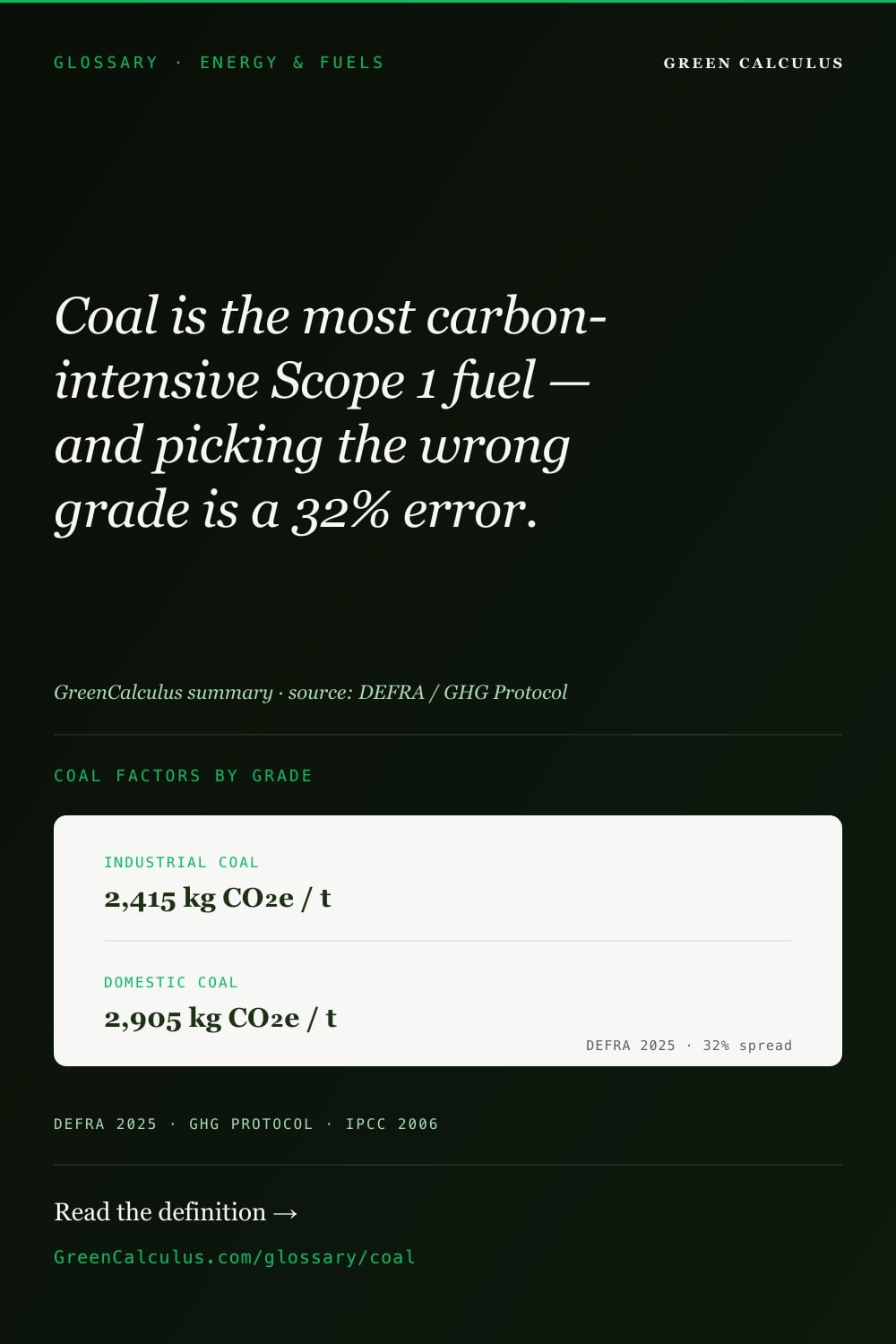
Coal is the most carbon-intensive Scope 1 fuel on the DEFRA conversion table — and the one where the choice of factor matters most. Industrial coal, domestic coal, and coking coal sit 32% apart at the extremes. Petroleum coke is higher still. Picking the wrong grade is not a rounding error; it is a structural mis-statement of the inventory line that coal occupies.
Two factors compound the difficulty. Procurement records rarely distinguish grade clearly. And the combustion factor is only part of the picture — coal mine methane, the fugitive release from upstream supply, is a separate Scope 3 line that most reporters miss entirely.
Coal is a solid fossil fuel spanning four geological ranks and three commercial grades — industrial, domestic and coking. Combustion is Scope 1; upstream supply and coal mine methane are Scope 3 Cat 3a. It is the highest-intensity Scope 1 fuel in standard inventories.
What Coal Is and the Four Geological Ranks
Coal is a solid fossil fuel formed from ancient plant matter compressed and heated over geological time. It is primarily carbon, with hydrogen, sulphur, oxygen, nitrogen, moisture, and mineral content varying by rank. The four ranks — anthracite, bituminous, sub-bituminous, and lignite — describe the degree of geological maturation, with anthracite the most mature (highest carbon content, highest energy density) and lignite the least (highest moisture, lowest energy density).
| Rank | Carbon content | Calorific value (typical) | Typical use |
|---|---|---|---|
| Anthracite | 86–97% | ~32 MJ/kg | Smokeless heating, sintering, filtration |
| Bituminous | 45–86% | ~24–30 MJ/kg | Industrial steam, power, coking |
| Sub-bituminous | 35–45% | ~18–24 MJ/kg | Power generation |
| Lignite (brown coal) | 25–35% | ~14–19 MJ/kg | Mine-mouth power generation |
Carbon content and calorific values are typical ranges; actual values vary by deposit and analysis method. Source: IPCC 2006 Guidelines for National Greenhouse Gas Inventories, Volume 2 Chapter 1.
DEFRA does not publish emission factors by geological rank. Instead, it publishes by commercial grade — three categories that map approximately to end use rather than to geological maturity:
Coal is the raw mined fossil fuel — anthracite, bituminous, sub-bituminous, or lignite. Coke is coal that has been heated in the absence of oxygen to drive off volatiles, producing a porous carbon mass used in blast furnaces. The DEFRA “coking coal” factor refers to the raw bituminous coal used to make coke, not to coke itself. Petroleum coke (“pet coke”) is a different material entirely — a solid carbon byproduct of crude oil refining, not coal in any geological sense, but reported alongside coal in DEFRA because it is combusted in similar equipment. The three carry different DEFRA factors and confusing them is the most common procurement-record error.
The DEFRA 2026 Emission Factors — and How Coal Compares to Other Fuels
DEFRA publishes coal emission factors in three units — per tonne, per kWh, and indirectly via calorific value per GJ. The per-tonne basis is the standard for coal because the fuel is sold and metered by weight, not volume. All three units are pre-aggregated CO₂e factors — the CO₂, CH₄, and N₂O combustion components have already been multiplied by their GWP-100 values and summed at publication.
| Grade | kg CO₂e per tonne | kg CO₂e per kWh (GCV) | kg CO₂e per kWh (NCV) | Typical use |
|---|---|---|---|---|
| Coal (industrial) | 2415.03994 | 0.32512 | 0.34223 | Industrial steam, process heat, kiln firing |
| Coal (domestic) | 2904.95234 | 0.34721 | 0.36549 | Residential solid-fuel heating (declining) |
| Coal (coking) | 3164.65002 | 0.3579 | 0.37675 | Iron and steel blast-furnace feedstock |
| Petroleum coke | 3386.57168 | 0.34092 | 0.35887 | Cement kilns, calcination, refinery internal use |
Source: DEFRA UK Government GHG Conversion Factors for Company Reporting 2025 (DESNZ, June 2025). Pre-aggregated CO₂e on AR5 GWP-100 basis per DEFRA convention. See complete DEFRA dataset →
How coal compares to other Scope 1 fuels
On a per-kWh NCV basis — the fair comparison for energy benchmarking — coal sits at the top of the Scope 1 fuel intensity ranking. Coking coal is roughly 70% more carbon-intensive than natural gas per unit of useful energy. Petroleum coke is higher still. Bar chart below normalises every fuel to kg CO₂e per kWh NCV.
Natural gas, petrol and diesel are DEFRA 2026 per-kWh NCV factors; LPG and coal render live from MasterBrain.
Three takeaways for practitioners:
- Coal is roughly 70% more carbon-intensive than natural gas per kWh delivered. The high carbon content per unit of energy — driven by the low hydrogen-to-carbon ratio of solid carbon vs methane — makes coal the highest-intensity Scope 1 fuel in standard inventories.
- The coking-to-industrial spread is around 32% per tonne but narrows substantially per kWh because coking coal also carries more energy per tonne. The per-tonne spread is the one that shows up in inventories built from procurement records; per-kWh comparisons require calorific-value normalisation.
- Petroleum coke sits above coking coal on every basis. Cement kilns and aluminium-calcination operations that have switched from coal to pet coke as a cost-driven supply substitution have inadvertently increased the carbon intensity of the fuel line.
Which Unit Is on Your Invoice — Per Tonne, Per kWh, Per GJ
Coal is overwhelmingly sold and metered in tonnes, which is the simplest case among fossil fuels. The exceptions are integrated power and cement operations that meter coal on a thermal-input basis (GJ or kWh) for boiler efficiency tracking. The mapping below covers the three live cases.
| Invoice / meter unit | DEFRA field to use | Industrial coal value | Typical context |
|---|---|---|---|
| Tonnes (t) or kilograms (kg) | factor | 2415.03994 | Bulk solid-fuel deliveries (most common) |
| kWh gross calorific value | per_kwh_gcv | 0.32512 | Integrated boiler thermal-input metering |
| kWh net calorific value | per_kwh_ncv | 0.34223 | EU ETS, ISO 14064 energy benchmarking |
| GJ (gigajoules) | Derived from per_kwh (×3.6) | Calculate | National inventories, IPCC methodology |
Coal moisture content drives a wider GCV/NCV spread than any other fossil fuel — typically 4–6% for industrial coal but reaching 10% or more for high-moisture lignite. Applying a GCV-basis emission factor to NCV-basis energy data (or vice versa) produces errors of this magnitude in the inventory line. The EU ETS convention is NCV; the UK convention for utility-billed energy is GCV. Always confirm which basis the meter or invoice uses before selecting the DEFRA field — for coal, the verification is non-optional.
Where Coal Sits in Scope Accounting — and a Worked Boiler Example
Coal combustion in owned or controlled equipment is Scope 1 under the GHG Protocol Corporate Standard — almost always stationary combustion for boilers, kilns, and process heaters. The upstream supply chain is Scope 3 Category 3a (well-to-tank, covering extraction, washing, and transport) — and unique to coal among fossil fuels, there is a substantial fugitive methane component released during mining that is conventionally reported separately. The CMM section below covers it in detail.
Scope 1 — combustion
Boilers, kilns, furnaces, blast furnaces, process heaters. Owned or under operational control. Use the DEFRA combustion factor matching the grade: industrial 2415.03994 [GreenCalculus fuels.gbr.coal_industrial.tonne · DEFRA 2026 'Fuels'!D131], coking 3164.65002 [GreenCalculus fuels.gbr.coking_coal.tonne], pet coke 3386.57168 kg CO₂e/tonne [GreenCalculus fuels.gbr.petroleum_coke.tonne].
Scope 3 Cat 3a — well-to-tank
Upstream extraction, washing, processing, and transport of coal to the point of consumption. DEFRA 2026 publishes WTT factors of about 390–500 kg CO₂e/tonne depending on grade (418.15 for industrial coal) — roughly 16–18% on top of combustion.
Scope 3 Cat 3 — coal mine methane
Fugitive methane released during coal extraction. Material for operators with own upstream supply or with major coal-derived feedstocks. Covered in §5 below.
Worked example: industrial coal boiler — annual Scope 1 footprint
A manufacturing site operates a 12 MW thermal industrial coal boiler at 60% utilisation, consuming 2,400 tonnes of bituminous industrial coal per year. Compute the annual Scope 1 combustion CO₂e, the Scope 3 Cat 3a well-to-tank component, and the indicative coal mine methane contribution.
| Step | Input or formula | Value | Source |
|---|---|---|---|
| 1. Boiler thermal output | Equipment spec | 12 MW | Engineering data |
| 2. Annual operating hours | 8,760 × 60% | 5,256 h/yr | Operations |
| 3. Annual coal consumption | Procurement records | 2,400 t/yr | Operations |
| 4. Scope 1 combustion | 2,400 × 2,415.03994 | 5,796,096 kg CO₂e | DEFRA 2026 industrial coal |
| 5. Scope 3 Cat 3a (WTT) | 2,400 × 418.14964 | 1,003,559 kg CO₂e | DEFRA 2026 WTT, industrial coal |
| 6. Coal mine methane (Scope 3) | 2,400 × 8.5 × 29.8 | 607,920 kg CO₂e | IPCC default × AR6 GWP |
| 7. Combined coal footprint | Sum of rows 4, 5, 6 | 7,407,575 kg CO₂e | Derived |
All values fixed. Combustion uses DEFRA 2026 industrial coal at 2,415.03994 kg CO₂e/tonne. WTT uses the DEFRA 2026 industrial-coal WTT factor of 418.14964 kg CO₂e/tonne. CMM uses an IPCC 2006 Tier 1 default of 8.5 kg CH₄ per tonne of underground-mined bituminous coal × AR6 GWP-100 of 29.8; actual values vary widely by mine and method. Run the combustion line interactively in the Scope 1 Combustion Calculator.
Pre-aggregated CO₂e — what is already inside the coal factor
The 2415.03994 kg CO₂e/tonne [GreenCalculus fuels.gbr.coal_industrial.tonne] figure looks like one number but is actually three. DEFRA composes the factor from the CO₂, CH₄, and N₂O combustion components, each multiplied by its GWP-100, and sums them at publication. CO₂ dominates because coal is overwhelmingly carbon by mass.
| Component | Gas mass per tonne coal | GWP-100 (AR5) | Contribution (kg CO₂e/t) |
|---|---|---|---|
| CO₂ (combustion) | 2,390.47 kg CO₂/t | 1 | 2,390.47 |
| CH₄ (incomplete combustion) | ~0.273 kg CH₄/t | 28 | 7.64 |
| N₂O | ~0.0639 kg N₂O/t | 265 | 16.93 |
| Sum — DEFRA pre-aggregated factor | 2,415.03994 | ||
Contributions are the DEFRA 2026 per-gas CO₂e values; gas masses are back-calculated at AR5 GWPs. The CO₂ component is about 99% of the total — coal is the cleanest case of “CO₂ dominates the inventory line” among fossil fuels. Note DEFRA’s stated GWP basis is AR5.
Calculate coal combustion across industrial, domestic, and coking grades with audit-grade per-gas breakdown and Scope 3 Cat 3a rollup.
Coal Mine Methane — the Scope 3 Line Most Reporters Miss
Coal seams contain methane adsorbed onto the coal surface and dissolved in groundwater. When the coal is mined, this coal mine methane (CMM) is released — either drained deliberately for safety reasons, vented passively from ventilation shafts, or emitted from abandoned workings long after closure. For underground bituminous mining, CMM is typically 8–25 kg CH₄ per tonne of coal extracted; for surface mining of lower-rank coals, it is generally below 2 kg CH₄ per tonne. At AR6 GWP-100 of 29.8 [GreenCalculus gwp.CH4_fossil.ar6_100 · IPCC AR6], even the low end is material.
CMM is conventionally categorised as Scope 3 for the company combusting the coal, because the methane release occurred at an upstream supplier. For an integrated mining company that extracts and combusts its own coal, CMM is Scope 1 fugitive. The accounting treatment follows the operational-control boundary that determines combustion-side scope assignment.
| Mining type | Coal rank | CMM (kg CH₄ per tonne) | CO₂e at AR6 (kg CO₂e/t) |
|---|---|---|---|
| Underground | Anthracite / Bituminous | 8–25 (typical 17) | ~507 (at 17 kg × 29.8) |
| Underground | Sub-bituminous / Lignite | 1–5 (typical 2) | ~60 |
| Surface (open-pit) | Anthracite / Bituminous | 0.3–2 (typical 1.2) | ~36 |
| Surface (open-pit) | Sub-bituminous / Lignite | 0.1–0.5 (typical 0.2) | ~6 |
| Abandoned underground | All ranks | 2–10 over 50+ yr decay | Variable — long-tail |
Source: IPCC 2006 Guidelines for National Greenhouse Gas Inventories, Volume 2 Chapter 4 — Fugitive Emissions from Mining. Fixed here — the fugitive_coal_methane namespace exists in the MasterBrain but is not yet surfaced via the [gc_fuel] shortcode.
For steel, cement, and coal-fired power operators with own upstream supply or direct mine ownership, CMM can add 15–25% to the combined coal footprint when calculated against AR6 GWP-100. For operators sourcing coking coal for blast-furnace use, the CMM line is typically 10–20% of the combustion line at the same AR6 basis. Reporters who include only DEFRA combustion factors and ignore CMM are under-stating the true coal-related footprint by an order similar to the WTT line — and CMM is the methane component DEFRA does not pre-aggregate into the combustion factor. The GHG Protocol Scope 3 Standard requires Category 3 fuel-and-energy-related activities reporting where material; for any coal-intensive operation, CMM almost always meets the materiality test.
Industrial, Domestic, or Coking — When the Distinction Matters
Coal procurement records frequently describe coal as simply “coal” without specifying grade. The DEFRA factor that fits depends on the equipment and the supplier description. The decision table below covers the four common deployments.
| Context | Industrial | Domestic | Coking | Petroleum coke |
|---|---|---|---|---|
| Industrial boiler, generic supply | ✓ | |||
| Cement kiln (alternative fuel co-fired) | ✓ | If pet coke is supply | ||
| Blast furnace / coke oven feedstock | ✓ | |||
| Residential / small commercial heating | ✓ | |||
| Refinery internal pet coke combustion | ✓ | |||
| Calcination (alumina, lime) | If coal | If pet coke | ||
| Smokeless solid-fuel briquettes | ✓ | |||
| Unknown grade, industrial equipment | ✓ (defensible default) |
The per-tonne spread between the grades is substantial:
- Industrial → Domestic: 2415.03994 [GreenCalculus fuels.gbr.coal_industrial.tonne] vs 2904.95234 [GreenCalculus fuels.gbr.coal_domestic.tonne] — about 21% higher for domestic per tonne
- Industrial → Coking: 2415.03994 [GreenCalculus fuels.gbr.coal_industrial.tonne] vs 3164.65002 [GreenCalculus fuels.gbr.coking_coal.tonne] — about 32% higher for coking per tonne
- Coking → Petroleum coke: 3164.65002 [GreenCalculus fuels.gbr.coking_coal.tonne] vs 3386.57168 [GreenCalculus fuels.gbr.petroleum_coke.tonne] — about 7% higher for pet coke per tonne
The spread comes from carbon content per tonne. Coking coal is selected for its high carbon content and low ash, which is what makes it suitable for blast-furnace metallurgy — and what makes it more carbon-intensive per tonne combusted. Domestic coal is similarly higher-carbon than industrial because residential heating demands clean burning with low smoke output, which steers supply toward more mature ranks. Petroleum coke is essentially refined elemental carbon and sits at the top of the carbon-per-tonne ranking.
Four sources. (1) Supplier delivery note — the line item description usually identifies grade explicitly (e.g. “Bituminous Industrial Type A”). (2) Coal Specification Sheet (CSS) — most industrial suppliers attach this to bulk deliveries; it gives proximate analysis (moisture, volatiles, fixed carbon, ash) and calorific value. (3) Equipment manual — boiler and kiln manufacturers specify the coal grade their equipment is rated for. (4) If grade is genuinely unclear, the industrial factor is the defensible default for industrial equipment. Flag the assumption in the methodology disclosure and document the basis.
Four Common Coal Reporting Mistakes
- Using one coal grade’s factor for another. The most common error — applying the industrial factor (2415.03994 kg CO₂e/tonne [GreenCalculus fuels.gbr.coal_industrial.tonne]) to coking coal supply or vice versa. The 31% spread between industrial and coking is large enough that a steel-sector inventory using the industrial factor would under-state coal CO₂e by approximately 24%. Conversely, an industrial boiler operator using the coking factor by mistake would over-state by approximately 32%. Verify the grade against the supplier specification before applying the factor.
- Ignoring coal mine methane (CMM). Coal is unique among fossil fuels in having a substantial Scope 3 methane component that is not included in the DEFRA combustion factor and not included in the standard WTT-fuels figure. For underground-mined coal, CMM at AR6 GWP-100 can add 15–25% to the combined coal footprint. Reporters who include only DEFRA combustion factors and the standard WTT line miss this entirely. Apply IPCC 2006 Tier 1 defaults or supplier-specific CMM data and report the line separately. See §5 above.
- GCV vs NCV basis mixing. Coal moisture content drives a wider GCV/NCV spread than any other fossil fuel — typically 4–6% for industrial coal, up to 10% for lignite. Multiplying activity in NCV-basis kWh by a GCV-basis factor (or vice versa) creates errors of this magnitude. The EU ETS uses NCV; UK utility billing uses GCV. Always confirm the basis on the meter or invoice and select the matching DEFRA field.
- AR5 (DEFRA) and AR6 (corporate inventory) basis confusion. DEFRA’s stated GWP basis is AR5. The corporate default for every framework — GHG Protocol, CSRD, CDP — is AR6. For coal combustion, the practical difference is sub-1% because CO₂ is about 99% of the combustion factor. For CMM, the difference is material: AR5 methane GWP-100 of 28 vs AR6 of 29.8 [GreenCalculus gwp.CH4_fossil.ar6_100] is a 6.4% upward revision for the methane component. Use the DEFRA factor as published for combustion. For CMM, apply AR6 GWP-100 — the methane line is large enough that the basis choice matters. See the AR5/AR6/DEFRA reconciliation rule on CO₂e.
Related Terms, Standards, and Tools
Quick converters: coal arrives on an invoice in tonnes but appears in boiler logs as energy — convert kg of coal to kWh.
Frequently Asked Questions
DEFRA 2026 publishes four coal-and-coke combustion factors: industrial coal 2415.03994 [GreenCalculus fuels.gbr.coal_industrial.tonne], domestic coal 2904.95234 [GreenCalculus fuels.gbr.coal_domestic.tonne], coking coal 3164.65002 [GreenCalculus fuels.gbr.coking_coal.tonne], and petroleum coke 3386.57168 kg CO₂e per tonne [GreenCalculus fuels.gbr.petroleum_coke.tonne]. The 31% spread between industrial and coking is driven by carbon content per tonne — coking coal is selected for high carbon density for blast-furnace metallurgy. All four are pre-aggregated CO₂e factors on AR5 GWP-100 basis per DEFRA convention. The practical AR5/AR6 difference for coal combustion is sub-1% because CO₂ is about 99% of the factor. Source: DEFRA UK Government GHG Conversion Factors 2025.
Coal combustion in owned or controlled equipment is Scope 1 — specifically stationary combustion under the GHG Protocol Corporate Standard. Coal is never Scope 2; Scope 2 covers purchased grid electricity, heat, steam, and cooling. The upstream supply chain (extraction, washing, transport) is Scope 3 Category 3a well-to-tank under the Scope 3 Standard — typically 10% additional on top of combustion. Coal mine methane (CMM) released during extraction is a separate Scope 3 line that the DEFRA combustion factor does not include and that most reporters miss entirely — see §5 for treatment.
DEFRA categorises coal by end-use rather than by geological rank. Industrial coal covers general industrial boiler, kiln, and process-heat use — typically bituminous with moderate carbon content (factor 2415.03994 kg CO₂e/tonne) [GreenCalculus fuels.gbr.coal_industrial.tonne]. Domestic coal covers residential and small-commercial solid-fuel heating — higher rank, cleaner burning, higher carbon content per tonne (2904.95234 [GreenCalculus fuels.gbr.coal_domestic.tonne]). Coking coal is bituminous coal selected for high carbon and low ash, used as feedstock for coke ovens supplying blast furnaces (3164.65002 [GreenCalculus fuels.gbr.coking_coal.tonne]). The 32% per-tonne spread between industrial and coking comes from carbon content — coking coal is denser carbon. Verify the grade against supplier specification before applying the factor; using one grade’s factor for another is the most common coal reporting error.
On a per-kWh NCV basis, coal is the most carbon-intensive Scope 1 fossil fuel in standard inventories. Industrial coal is approximately 0.34223 kg CO₂e per kWh NCV [GreenCalculus fuels.gbr.coal_industrial.kwh_ncv · DEFRA 2026 'Fuels'!D132], compared to 0.261 for diesel, 0.232 for petrol, 0.23032 [GreenCalculus fuels.gbr.lpg.kwh_ncv · DEFRA 2026 'Fuels'!D37] for LPG, and 0.202 for natural gas. Coking coal and petroleum coke are higher still. The difference vs natural gas is roughly 70% — driven by the low hydrogen-to-carbon ratio of solid carbon compared to methane. This makes fuel-switching from coal to natural gas a substantial direct Scope 1 reduction lever before any consideration of CCS or efficiency improvements.
Coal mine methane (CMM) is fugitive methane released during coal extraction — adsorbed onto the coal surface and dissolved in groundwater, released when the coal is mined, drained for safety reasons, or vented from ventilation shafts. Typical values: 8–25 kg CH₄ per tonne of coal for underground bituminous mining, below 2 kg CH₄ per tonne for surface mining of lower-rank coals. At AR6 GWP-100 of 29.8 [GreenCalculus gwp.CH4_fossil.ar6_100], underground CMM can add 15–25% to the combined coal footprint. CMM is not included in the DEFRA combustion factor and not included in the standard WTT-fuels figure. Under the GHG Protocol Scope 3 Standard, Category 3 fuel-and-energy-related activities reporting is required where material — for any coal-intensive operation, CMM almost always meets the materiality test. Apply IPCC 2006 Tier 1 defaults or supplier-specific data and disclose the line separately.
Build coal reporting on DEFRA 2026 with full industrial/domestic/coking/pet coke coverage, per-gas breakdown, and Scope 1 + Scope 3 (WTT + CMM) in one workflow.
Need someone who does this? 6 carbon accounting & inventory providers in our directory →