
Methane

Methane is the second-largest contributor to anthropogenic warming after carbon dioxide — yet most corporate inventories under-report it, mis-classify it, or apply the wrong Global Warming Potential to it.
Get methane right and you fix the most expensive line item in many Scope 1 inventories. Get it wrong and a single line in your CDP submission can be flagged for restatement.
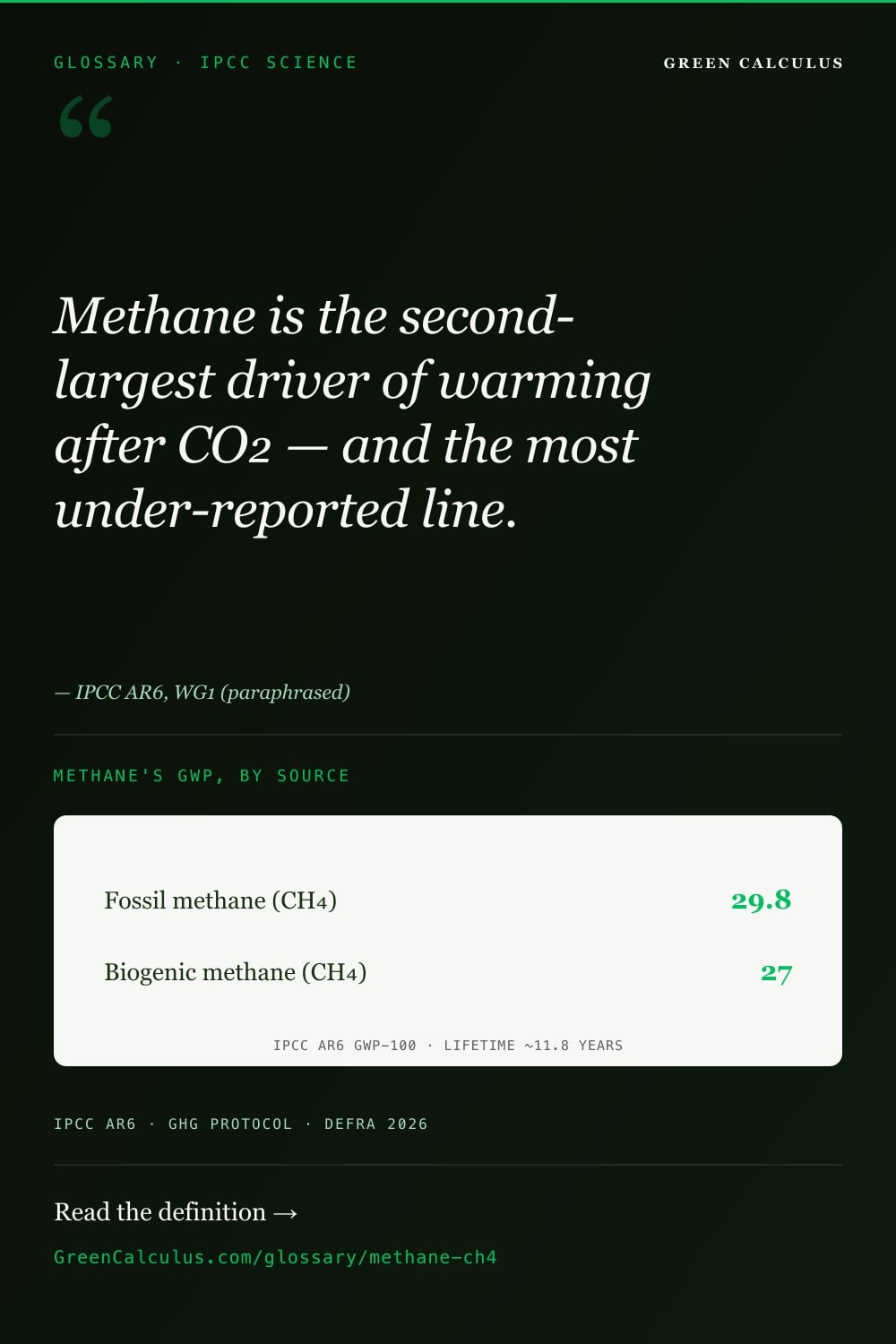
Methane (CH₄) is a greenhouse gas with an atmospheric lifetime of 11.8 years and an IPCC AR6 100-year GWP of 29.8 for fossil sources and 27 for biogenic. It is the second-largest gas in most corporate Scope 1 inventories.
Methane at a glance — key properties
Methane is a four-hydrogen, one-carbon molecule (CH₄) with an atmospheric lifetime of 11.8 years per IPCC AR6 — short enough that emission cuts produce measurable atmospheric concentration drops within a decade. Every property below is sourced directly from IPCC AR6 Working Group I, Table 7.SM.7.
| Property | Value | Notes |
|---|---|---|
| Chemical formula | CH₄ | One carbon, four hydrogen atoms |
| CAS number | 74-82-8 | Single registry identifier for both origin types |
| Atmospheric lifetime | 11.8 yrs | Removed via hydroxyl (OH) oxidation to CO₂ + H₂O |
| GWP-20 (fossil) | 80.8 | Near-term horizon — most CH₄ still airborne at year 20 |
| GWP-100 (fossil) reporting default | 29.8 | Use for GHG Protocol, CDP, CSRD/ESRS E1, SBTi disclosures |
| GWP-100 (biogenic) | 27 | Confirmed biogenic origin only — landfill, livestock, rice |
| GWP-100 with C-cycle feedbacks | 32.8 | Scientific use only — not for corporate inventories |
| GWP-500 (fossil) | 10.0 | Long horizon — most methane has decomposed by year 500 |
| AR5 GWP-100 (legacy) | 28 · outdated | Replaced by AR6 in CDP (2023), SBTi (2023), CSRD (2024) |
| AR5 → AR6 change (fossil) | +6.4% | Material for any inventory with sizeable CH₄ exposure |
| Source table | AR6 WGI 7.SM.7 | Stable until IPCC AR7 (~2028) |
Source: IPCC AR6 Working Group I, Table 7.SM.7, p.7-SM-47 (2021). For the full AR6 dataset across all Kyoto gases, see the IPCC AR6 GWP reference table.
Methane vs CO₂ — why time horizon decides everything
Methane is often summarised as “X times more potent than CO₂”, but the multiplier depends entirely on the time horizon you choose. For most greenhouse gases, GWP-20 and GWP-100 are similar enough that the choice does not move the inventory total. For methane, the two values differ by a factor of 2.7 — so the horizon decision is, in practice, a methane decision.
| Property | Methane | CO₂ | Practical implication |
|---|---|---|---|
| Atmospheric lifetime | 11.8 yrs | 100–300+ yrs | Methane acts fast then disappears; CO₂ accumulates for centuries |
| GWP-20 | 80.8 | 1 | ~81× CO₂ over 20 years — methane is the fastest near-term lever |
| GWP-100 (default basis) | 29.8 | 1 | Standard horizon for all corporate GHG inventories |
| GWP-500 | 10.0 | 1 | Most methane has broken down; CO₂ persists |
| Radiative efficiency | High per molecule | Lower per molecule | Methane absorbs IR radiation far more efficiently |
| Climate priority | Fastest near-term lever | Dominant long-term driver | Methane cuts produce observable temperature benefit within a decade |
For an organisation with significant natural gas combustion or fugitive methane, switching from GWP-100 to GWP-20 reporting raises Scope 1 by a factor of 2.7 on the methane component — with no change in actual emissions. Always document the horizon used and the reason. The default for almost every corporate framework (GHG Protocol, CSRD, CDP, SBTi) is GWP-100. See our GWP explainer for the full time-horizon decision tree.
Fossil vs biogenic methane — the AR6 split most inventories miss
IPCC AR6 was the first Assessment Report to publish two separate GWP-100 values for methane depending on its origin. The split is small in absolute terms (1.9 units) but matters for two reasons: it is required for accurate inventories under the GHG Protocol, and it is increasingly checked by external assurance providers and CDP reviewers.
From hydrocarbons sequestered for millions of years
GWP-100 (AR6) · Use for any methane originating in fossil fuel deposits — every kilogram is a net addition of ancient carbon to the active atmosphere.
- Natural gas combustion (boilers, CHP, process heat)
- Fugitive losses from pipelines, valves, compressors
- Coal mine ventilation methane
- Oil well associated gas and venting
Scope 1 — direct emissions
From recently living organic matter
GWP-100 (AR6) · Use only when the biological origin is documented. The slightly lower value reflects the shorter active-cycle origin of the carbon.
- Landfill gas from organic waste decomposition
- Livestock enteric fermentation (cattle, sheep)
- Anaerobic digestion of food and farm waste
- Rice cultivation (paddy methane)
Scope 1 or Scope 3 Cat 5 by ownership
For natural gas combustion, pipeline gas, and any fossil fuel source, 29.8 [GreenCalculus gwp.CH4_fossil.ar6_100] is always correct. The biogenic value of 27 [GreenCalculus gwp.CH4_biogenic.ar6_100 · IPCC AR6] applies only when the biological origin can be evidenced — for example landfill gas with a measurement programme, or a livestock inventory with verified animal headcount. In ambiguous cases, default to fossil; the small upward bias is the conservative choice for assurance.
Historical note. AR5 published a single CH₄ GWP-100 of 28 [GreenCalculus gwp.CH4_fossil.ar5_100 · IPCC AR6] applied to both origins. The AR6 split was introduced in 2021 as the science of carbon-cycle accounting matured. CDP, SBTi, and most major frameworks adopted AR6 from their 2023 reporting cycles onwards — using AR5 today is a methodology lag, not a choice. See our IPCC AR6 standards page for the full transition timeline.
Where methane shows up across Scope 1, 2, and 3
For a typical corporate reporter — a manufacturer, commercial property operator, agricultural business, or service company with natural gas use — methane appears in four places under the GHG Protocol Corporate Standard. The first three are common to almost every reporter; the fourth is specific to organisations with biogenic sources.
When natural gas burns, the overwhelming majority of emissions are CO₂ from the carbon content of the fuel. A small fraction of the CH₄ in the gas, however, does not combust completely — this uncombusted residual is known as methane slip, and it contributes to the Scope 1 total. DEFRA 2025 pre-aggregated CO₂e factors for natural gas already include this slip component, applied at the AR5 GWP-100 (DEFRA’s stated basis). If you are calculating from first principles using separate CO₂, CH₄, and N₂O factors instead, apply the AR6 GWP-100 of 29.8 [GreenCalculus gwp.CH4_fossil.ar6_100] to the methane mass — never both.
Any organisation that owns or operates natural gas pipework, valves, compressors, connectors, or storage has a potential fugitive methane source. These are Scope 1 direct emissions because the leaking equipment is owned or controlled by the reporting entity. Fugitive methane is the most under-reported Scope 1 source in practice — it requires deliberate estimation or measurement rather than meter readings. For organisations with extensive gas networks, fugitives can exceed combustion emissions in warming impact.
The natural gas that arrives at your meter came from a well, travelled through a transmission network, and was processed at a terminal — every step of which leaks methane before the gas reaches you. These upstream fugitive emissions are Scope 3 Category 3 (fuel and energy-related activities) under the GHG Protocol. They are calculated using a well-to-tank emission factor and reported separately from Scope 1 combustion. Many organisations omit them entirely — a significant completeness gap given that upstream methane intensity for some gas sources exceeds 1% of throughput.
Operational waste sent to landfill generates biogenic methane as the organic fraction decomposes anaerobically. This is Scope 3 Category 5 (waste generated in operations) where the waste is sent to a third-party landfill, or Scope 1 where the organisation owns and operates the landfill. Apply the biogenic GWP-100 of 27 [GreenCalculus gwp.CH4_biogenic.ar6_100] to the methane mass calculated from the organic fraction and the landfill-specific decay constant.
Whether you are calculating combustion methane slip, Scope 1 fugitives, or Scope 3 upstream methane, the GWP for fossil-origin CH₄ is the same: 29.8 [GreenCalculus gwp.CH4_fossil.ar6_100] under AR6. The Scope 1 Combustion Calculator applies this automatically — the audit trail shows the exact CH₄ mass, the GWP-100 factor, and the resulting CO₂e contribution for every fuel type, alongside an AR5 reconciliation column.
Converting methane mass to CO₂-equivalent
The conversion from methane mass to CO₂-equivalent is a single multiplication. The structure is identical for every source — combustion slip, fugitive, upstream, or biogenic — provided you select the GWP that matches the origin type.
The Scope 1 Combustion Calculator handles this conversion automatically for natural gas, biogas, and other methane-bearing fuels. It applies the correct AR6 GWP, shows the methane mass derived from the fuel input, and produces a downloadable audit trail aligned with assurance requirements.
Calculate methane emissions in seconds, with a verifier-ready audit trail.
The Scope 1 Combustion Calculator applies AR6 CH₄ GWP-100 = 29.8 [GreenCalculus gwp.CH4_fossil.ar6_100] automatically across all fossil and biofuels, with a per-gas breakdown and AR5/AR6 reconciliation column.
Regulatory landscape — methane is now disclosed, taxed, or both
Methane regulation has moved from voluntary to enforceable across most major jurisdictions in the past three years. Reporters with material methane exposure should track these four regimes.
| Jurisdiction | Regime | Scope | Status |
|---|---|---|---|
| EU | Methane Emissions Regulation 2024/1787 (MERR) | Oil, gas, coal — production and imports. LDAR programmes, venting/flaring restrictions, methane intensity limits | In force from 4 Aug 2024. Routine flaring/venting prohibition from 5 Feb 2026. Import equivalence from 1 Jan 2027. Maximum methane intensity from 5 Aug 2030 |
| EU | CSRD / ESRS E1 | All in-scope companies — methane reported as part of disaggregated GHG disclosure (E1-6) | In force. AR6 GWP-100 required |
| US | EPA NSPS OOOOb / EG OOOOc | Oil and gas — new and existing source methane standards. Super-emitter response programme | Final rule March 2024. Subject to ongoing reconsideration; certain compliance deadlines extended in 2025–2026 |
| US | GHGRP Subpart W | Petroleum and natural gas systems — facility-level methane reporting, >25,000 t CO₂e/yr | In force. Empirical-data revisions effective from reporting year 2025 |
| Global | CDP Climate Change disclosure | All voluntary corporate disclosure | AR6 GWP-100 mandatory from 2023 reporting cycle |
| Global | OGMP 2.0 | Voluntary oil and gas — Level 5 measurement-based methane reporting | De facto benchmark for EU MERR import equivalence |
Different frameworks adopted AR6 GWP-100 in different years (CDP and SBTi from 2023, CSRD from 2024). DEFRA pre-aggregated UK conversion factors still use the AR5 basis as of the 2025 release. Reporters with multi-jurisdictional disclosure obligations need to know which factor basis applies to which submission, and document the choice in the methodology appendix. The Scope 1 Combustion Calculator exposes both bases in parallel for exactly this reason.
Five methane-specific mistakes auditors flag
Need methane done right across your full inventory?
The GreenCalculus calculator suite covers Scope 1 combustion, Scope 1 fugitives, Scope 3 upstream fuel emissions, and refrigerant leakage — all using the latest IPCC AR6 GWP basis with full audit trails for assurance.
Frequently asked questions
The IPCC AR6 GWP-100 for fossil methane is 29.8 [GreenCalculus gwp.CH4_fossil.ar6_100], sourced from WGI Table 7.SM.7. This is the value used for natural gas combustion, oil and gas fugitive emissions, and any methane originating in fossil fuel deposits. For biogenic methane — landfill, livestock, rice cultivation — the AR6 GWP-100 is 27 [GreenCalculus gwp.CH4_biogenic.ar6_100]. The earlier AR5 value of 28 [GreenCalculus gwp.CH4_fossil.ar5_100] is outdated for current corporate reporting; CDP, SBTi, and CSRD all require AR6.
Methane absorbs infrared radiation far more efficiently than CO₂ per molecule, and because most of it is still airborne at year 20, its GWP-20 is 80.8 — roughly 81 times that of CO₂ over the same period. This makes methane reduction the fastest near-term lever for slowing warming. The reason GWP-100 (29.8 [GreenCalculus gwp.CH4_fossil.ar6_100]) is lower is simply that we are averaging over a longer period: by year 12–15 most of the methane has been oxidised to CO₂, so the cumulative 100-year impact per tonne is proportionally smaller.
Methane has a perturbation lifetime of approximately 11.8 years per IPCC AR6. It is removed from the atmosphere primarily through reaction with hydroxyl radicals (OH) in the troposphere, which oxidises it into CO₂ and water vapour. This is fundamentally different from CO₂, which has no equivalent removal sink and persists in the atmosphere for 100 to 300+ years. The short methane lifetime means that emission cuts produce measurable atmospheric concentration drops within a decade — unlike CO₂, where the benefit accumulates over centuries.
Fossil methane (GWP-100 = 29.8 [GreenCalculus gwp.CH4_fossil.ar6_100]) comes from underground hydrocarbon deposits — natural gas, oil wells, coal seams. Every tonne released is a net addition of ancient carbon to the active atmosphere. Biogenic methane (GWP-100 = 27 [GreenCalculus gwp.CH4_biogenic.ar6_100]) comes from biological processes involving recently living organic matter — livestock digestion, landfill decomposition, wetlands, rice paddies. IPCC AR6 introduced separate GWPs for the two origins. For corporate GHG Protocol reporting, use 29.8 [GreenCalculus gwp.CH4_fossil.ar6_100] for all fossil fuel combustion and fugitive sources, and 27 [GreenCalculus gwp.CH4_biogenic.ar6_100] only when biogenic origin can be evidenced.
For a typical reporter, methane appears in four places. First, as Scope 1 combustion methane slip — uncombusted CH₄ in natural gas. Second, as Scope 1 fugitive emissions from any natural gas pipework, valves, or equipment the organisation owns or controls. Third, as Scope 3 Category 3 (fuel and energy-related activities) — upstream methane lost during the extraction, processing, and transmission of the gas purchased. Fourth, as Scope 3 Category 5 biogenic landfill methane from operational waste sent to third-party disposal. Pre-aggregated DEFRA factors include the combustion slip automatically (at AR5 GWP); the other three sources require separate calculation.
For almost every current corporate framework — GHG Protocol Corporate Standard, CSRD/ESRS E1, CDP, SBTi — the answer is AR6. The AR5 fossil CH₄ GWP-100 of 28 [GreenCalculus gwp.CH4_fossil.ar5_100] is retained only for legacy comparisons and base-year restatement; it should not be used for new reporting. The exception is when working with pre-aggregated DEFRA UK conversion factors, which are themselves published on the AR5 basis — in that case, the factor is internally consistent with AR5 and you should not separately apply AR6 GWP on top. The Scope 1 Combustion Calculator exposes both bases and reconciles them in the audit trail.
Related terms, standards, and tools
Need someone who does this? 6 carbon accounting & inventory providers in our directory →