
Singapore Carbon Tax (Carbon Pricing Act)

The Singapore Carbon Tax is the first compliance carbon-pricing instrument in Southeast Asia and the operational reference for every multinational with a Singapore manufacturing footprint, regional headquarters, or APAC sustainability programme. Enacted as the Carbon Pricing Act 2018 (No. 23/2018) and amended through the Carbon Pricing (Amendment) Act 2022, it applies an upstream fixed-price tax on the direct (Scope 1) greenhouse gas emissions of facilities above a 25,000 tCO2e annual threshold — with no auctions, no free allocation outside the bounded EITE Transition Framework, and no cap-and-trade dynamics. Singapore implemented a carbon tax, the first carbon pricing scheme in Southeast Asia, on 1 January 2019. The carbon tax level was set at S$5/tCO2e for the first five years from 2019 to 2023 to provide a transitional period for emitters to adjust.
This page is the corporate practitioner’s reference to the regime as it actually operates after the 1 January 2026 rate step to S$45/tCO2e. It covers the chain of custody from the Carbon Pricing Act through NEA’s MRV machinery into a company’s P&L; the two-threshold structure (2,000 tCO2e reportable, 25,000 tCO2e taxable); the seven covered greenhouse gases and the reckonable / non-reckonable emissions distinction that determines threshold eligibility; the full rate trajectory and its legislative authority; the International Carbon Credit (ICC) Framework with the 5% facility-level offset cap, the seven environmental-integrity principles, the Article 6.2 bilateral implementation agreements, and the May 2026 rollover guidance; the EITE Transition Framework and what it does and does not cover; the worked liability calculation; and the interaction with SGX, MAS, ACRA, IFRS S2, TCFD, the SBTi, and the Singapore-Asia Taxonomy. Built for sustainability officers, regional CFO and tax offices, compliance teams at multinational manufacturers and power generators, ESG consultants advising APAC clients, and carbon-market practitioners navigating Singapore-eligible ICCs.
Singapore's carbon tax is a fixed-price tax on direct Scope 1 emissions under the Carbon Pricing Act 2018, levied on facilities emitting at least 25,000 tCO2e a year. The rate rose to S$45/tCO2e on 1 January 2026.
Executive Summary
The Singapore Carbon Tax did three things that reshape how every Singapore-footprint corporate plans its 2026–2030 carbon programme. First, it priced direct emissions through a fixed-price upstream tax rather than a cap-and-trade mechanism — meaning the carbon cost is knowable in advance from the legislated rate, with no auction volatility and no free allocation outside the bounded EITE Transition Framework. Second, it set a rate trajectory ramp that increases the effective carbon price by a factor of 9 from 2023 to 2026 (S$5 → S$25 → S$45) and potentially by a factor of 16 by 2030 (S$5 → S$80 at the upper end of the legislated band), reshaping the capex case for every emissions-reduction project at every Singapore facility above the threshold. Third, it created the International Carbon Credit (ICC) Framework with the 5% facility-level cap and Article 6.2 corresponding-adjustment mechanics — the first compliance carbon market in the world to operationalise Article 6 bilateral cooperation at scale.
The strategic question for any 2026 Singapore-footprint corporate is no longer whether the Carbon Tax is material — at S$45/tCO2e a 100,000 tCO2e facility now incurs S$4.5 million in annual carbon tax before any ICC offset, before any Transition Framework allowance, and before the 2030 ramp. The strategic question is how to position the capital plan and the ICC procurement plan against the legislated rate trajectory and the constrained Singapore-eligible credit supply. Three operational realities frame that positioning. (1) The S$45/tCO2e rate is now operative for emissions year 2026; the rate band S$50–S$80/tCO2e by 2030 is government policy but not yet enacted in primary legislation, with the lower end of that band the more probable outcome under weaker global climate-action conditions. (2) The 5% facility-level ICC offset cap is binding — even where credit supply expands, no facility can offset more than 5% of taxable emissions through ICCs, meaning 95% of taxable emissions must be paid at the legislated rate or reduced through on-site decarbonisation. (3) The Singapore-eligible ICC supply is materially constrained through 2027–2028 by Article 6.2 implementation timelines in host countries; the May 2026 NEA/MSE rollover guidance permits taxable facilities to carry forward unutilised ICC offset quota from emissions year 2025 into emissions year 2026, reflecting the constrained supply environment.
This page is the practitioner’s working translation of a regime that has more moving parts than any other carbon pricing scheme in the region: a dual-threshold MRV framework, seven covered greenhouse gases with reckonable / non-reckonable distinctions, a legislated rate ramp, a bounded EITE Transition Framework administered by EDB, an Article 6.2-anchored ICC offset mechanism with ten bilateral Implementation Agreements, and a disclosure stack (SGX, MAS, ACRA, Singapore-Asia Taxonomy) that consumes Carbon Tax data downstream. The remainder of the page covers each of these elements in operational depth, the line-by-line comparison with EU ETS / Safeguard Mechanism / China ETS, the worked liability calculation, and the interaction with IFRS S2, TCFD, the SBTi, and the GHG Protocol.
(1) The Carbon Tax is an upstream fixed-price tax on direct Scope 1 emissions above the 25,000 tCO2e facility threshold — not a cap-and-trade, not a downstream consumer tax, and not a Scope 2 or Scope 3 instrument. (2) The S$45/tCO2e rate is operative for emissions year 2026 and is the floor for any 2026 internal carbon price modelling on Singapore operations. (3) The ICC Framework allows up to 5% offset coverage through Singapore-eligible Article 6.2 credits, with binding host-country authorisation, corresponding adjustment, the 2% cancellation-at-issuance rule, and 5% share-of-proceeds-to-adaptation contributions — rules that make Singapore-eligible ICCs structurally different from voluntary-market credits. (4) The EITE Transition Framework is bounded relief, not exemption: allowances are benchmarked to efficiency, decline over time, and require demonstrated decarbonisation plans — companies modelling Singapore cost on the assumption that allowances will neutralise the tax are mismodelling.
Provider directory
Now it has to satisfy a regulator.
See who does this work. Every listing names the standards it works to, and paid placements are labelled. Including Verdis Group and SCS Consulting Services.
Browse 4 regulatory reporting providers →Do this work? A listing is US$390 a year. Get listed →
The Chain of Custody — From the Carbon Pricing Act to Your P&L
Before anything else on this page is useful, the practitioner needs to see the path. The Carbon Pricing Act is primary legislation passed by Parliament; the carbon tax liability that lands on a company’s P&L is the downstream output of a chain that runs through five distinct regulatory and operational layers. A 2026 tax payment almost always sits at the bottom of this chain — and assurance findings, NEA queries, and Ministry-level appeals can be triggered at any layer.
| Layer | Source | What it produces | Example |
|---|---|---|---|
| 1. Originating legislation | Carbon Pricing Act 2018 (No. 23/2018); Carbon Pricing (Amendment) Act 2022 | The legal authority to impose the tax, define taxable facilities, set the rate, and operate the ICC Framework | CPA Section 16 (carbon tax payable); First Schedule (covered GHGs and GWP values); Second Schedule (reckonable emission sources) |
| 2. Subsidiary regulations | Carbon Pricing (Measurement, Reporting and Verification) Regulations 2018 and subsequent amendments | The MRV machinery — monitoring plan content, emissions report format, verification methodology, registration mechanics | The MRV Regulations specify the form and content of the annual emissions report that NEA accepts |
| 3. NEA guidelines and the eligibility list | NEA Measurement and Reporting Guidelines; MSE/NEA ICC Framework Eligibility Criteria (4 October 2023); NEA ICC Eligibility List (from 19 December 2023, updated) | The operational rules — calculation methods by emission source, ICC eligibility criteria, the host country / programme / methodology list, the verifier accreditation framework | The NEA Eligibility List enumerates approved host countries, crediting programmes, and methodologies; ICCs outside the list are not Singapore-eligible |
| 4. Article 6.2 bilateral framework | Implementation Agreements with 10 host countries (PNG, Ghana, Bhutan, Chile, Peru, Rwanda, Paraguay, Thailand, Vietnam, Mongolia); MOUs with additional countries (Cambodia, Colombia, Dominican Republic, Fiji, Honduras, Indonesia, Kenya, Laos, Malaysia, Mongolia, Morocco, the Philippines, Sri Lanka, Zambia — not exhaustive) | The corresponding-adjustment mechanism — how a host-country mitigation outcome becomes an ICC usable for Singapore Carbon Tax offsetting without double counting against the host’s NDC | Singapore–Ghana Implementation Agreement (signed 27 May 2024, in force) governs project authorisation, the 2% cancellation-at-issuance, and the 5% adaptation share-of-proceeds |
| 5. Company compliance | The taxable facility’s monitoring plan, verified emissions report, ICC surrender, and tax credit purchase via NEA’s registry | The actual carbon tax payment that hits the P&L — net of any ICC offset (up to 5%) and any Transition Framework allowance | A 100,000 tCO2e facility surrenders fixed-price credits to NEA against verified emissions; up to 5,000 tCO2e may be offset by surrendered Singapore-eligible ICCs in lieu of cash payment |
Three things follow from this chain that re-orient how a practitioner reads any Singapore Carbon Tax question. First, the tax liability is not optional or discretionary — it flows from primary legislation, with NEA as the registration and assessment authority and the Minister for Sustainability and the Environment as the appeal authority under CPA Section 34. Second, ICC eligibility is a bilateral and methodological question, not a generic Article 6 question — an ICC must be issued from a host country with a Singapore Implementation Agreement in force, generated under a methodology that appears on the NEA Eligibility List, authorised by the host country, correspondingly adjusted in the host’s GHG inventory, retired in an approved registry, and supported by an Evidence of Retirement document. Third, the disclosure stack downstream of the Carbon Tax (SGX climate-related disclosures, MAS Guidelines on Environmental Risk Management, IFRS S2 financial-effect quantification, SBTi-aligned internal carbon pricing) all consume Carbon Tax data as a primary input — meaning the MRV emissions report that feeds the tax also feeds the financial statements and the climate-related disclosures.
This page documents Layers 1–4 in operational depth. See GHG Protocol Corporate Standard, IFRS S2, TCFD Recommendations, SBTi Corporate Net-Zero Standard, EU ETS, and Australian Safeguard Mechanism for the adjacent layers.
What the Singapore Carbon Tax Is
The Singapore Carbon Tax is a fixed-price upstream tax on the direct greenhouse gas emissions of large industrial facilities. The framing “upstream” matters: the tax is imposed on the emitter at the point of emission, not on the end consumer of the emitting product. A power generator pays the tax on its combustion emissions; an electricity retailer does not pay a separate Carbon Tax on the electricity it purchases from that generator. Whether the tax cost is passed downstream through wholesale electricity pricing, fuel prices, or product prices is a market question, governed by the Energy Market Authority’s electricity market framework and by competitive dynamics in other sectors — not by the structure of the tax itself.
Three design choices distinguish the Singapore Carbon Tax from every other compliance carbon-pricing instrument in the region.
Fixed-price, not market-priced. The tax rate is legislated. The mechanism uses what NEA calls a fixed-price credit-based system: taxable facilities purchase carbon credits from NEA at the legislated rate and surrender them to satisfy their tax obligation. The tax is currently implemented through a fixed-price credit-based mechanism. Liable companies have to apply and pay for such fixed-price credits at a fixed price and then surrender such credits to the government to satisfy their tax obligations under the Act. Unlike the EU ETS or China’s national ETS, there is no auction, no secondary trading of allowances, and no price discovery mechanism — the rate is what Parliament has legislated for the relevant emissions year.
No free allocation outside the bounded EITE Transition Framework. Every tonne of taxable reckonable emissions is paid for, either at the legislated rate (95% minimum) or through Singapore-eligible ICCs (up to 5%). The EITE Transition Framework provides bounded allowances to eligible emissions-intensive trade-exposed facilities, benchmarked to efficiency and tied to decarbonisation plans, but it is not “free allocation” in the EU ETS sense — it covers only a portion of qualifying facilities’ emissions and declines over time. The default is “all reckonable emissions paid for.”
Threshold-based, not economy-wide. The tax applies only to facilities above the 25,000 tCO2e annual direct-emissions threshold. About 80% of our total greenhouse gas (GHG) emissions are covered by carbon tax and fuel excise duties on our transport fuels. Of our emissions, around 70% are covered by the carbon tax levied on about 50 facilities in the manufacturing, power, waste, and water sectors. This coverage is one of the most comprehensive globally. The 70% Carbon Tax coverage through approximately 50 facilities reflects the high concentration of Singapore’s emissions in a small number of large industrial sites — refineries, petrochemical plants, semiconductor fabs, power generators, and waste management facilities — rather than economy-wide coverage. Sub-threshold facilities and households do not pay the Carbon Tax directly.
Legislative and Governance History
The Singapore Carbon Tax has a short legislative arc — from the 2018 enabling Act to the 2026 S$45/tCO2e rate step is seven years — but a dense one. Knowing the timeline is essential because different rate steps applied to different emissions years, and any historical compliance question turns on which version of the rate applied at the relevant date.
| Date | Event | Significance |
|---|---|---|
| February 2017 | Budget 2017 announces intent to introduce a carbon tax | First public signal of carbon-pricing intent; consultation phase begins |
| March 2018 | Carbon Pricing Act 2018 (No. 23/2018) passed by Parliament | The operative primary legislation; supersedes the GHG measurement-and-reporting provisions of the Energy Conservation Act for industrial facilities |
| 1 January 2019 | Carbon Tax in force at S$5/tCO2e | First carbon-pricing instrument in Southeast Asia; transitional rate for emissions years 2019–2023 |
| February 2022 | Budget 2022 announces accelerated trajectory and the ICC Framework | Government raises the planned 2030 rate from S$10–S$15 to S$50–S$80 per tonne; introduces ICC offset mechanism |
| November 2022 | Carbon Pricing (Amendment) Act 2022 passed | Amends CPA to introduce progressive rate increases, the ICC Framework, the Transition Framework for EITE facilities, and an updated list of covered GHGs |
| December 2023 | First Implementation Agreement signed with Papua New Guinea (8 December 2023, at COP28) | First Article 6.2 bilateral framework for Singapore; first Implementation Agreement signed between two countries which are part of the Alliance of Small Island States (AOSIS). |
| 19 December 2023 | MSE/NEA publish the ICC Framework Eligibility List | Operationalises the ICC Framework; identifies approved host countries, carbon-crediting programmes, and methodologies |
| 1 January 2024 | Rate step to S$25/tCO2e; ICC offset framework available | Operative rate for emissions years 2024 and 2025; up to 5% of taxable emissions may be offset by Singapore-eligible ICCs |
| 27 May 2024 | Implementation Agreement signed with Ghana (in force) | Second Implementation Agreement; eligible ICCs generated under this Implementation Agreement may be used by Singapore-based carbon tax-liable companies to offset up to 5% of their taxable emissions. |
| October 2025 | Ten Implementation Agreements signed (PNG, Ghana, Bhutan, Chile, Peru, Rwanda, Paraguay, Thailand, Vietnam, Mongolia) | As of October 2025, Singapore has signed Implementation Agreements with ten countries: Papua New Guinea, Ghana, Bhutan, Chile, Peru, Rwanda, Paraguay, Thailand, Vietnam and Mongolia. |
| 1 January 2026 | Rate step to S$45/tCO2e | Operative rate for emissions years 2026 and 2027; 80% increase versus the S$25 rate, an effective 9x increase from the S$5 transitional rate |
| 11 May 2026 | NEA/MSE joint news release: ICC offset rollover guidance | Companies liable to pay carbon tax will be allowed to roll over any unutilised International Carbon Credit offset quota from emissions year 2025 into emissions year 2026. Reflects constrained Singapore-eligible ICC supply through 2027–2028. |
| By 2030 (planned, not yet legislated) | Rate trajectory to S$50–S$80/tCO2e | Though not presently legislated, Singapore intends to increase the carbon tax rate to between S$50 and S$80/tCO2e by 2030. Specific rate to be set through future Budget announcements and CPA amendments. |
The complete legislative reference is “Carbon Pricing Act 2018 (No. 23/2018) as amended through the Carbon Pricing (Amendment) Act 2022.” Citations that name only the 2018 Act miss the rate trajectory, the ICC Framework, the Transition Framework, and the updated GHG list — all of which were added by the 2022 amendment. NEA Measurement and Reporting Guidelines have been further revised in subsequent versions to reflect the operationalisation of those features; the version current at this page’s review date should be cross-checked against the NEA website for any time-sensitive application. The legislated rate band of S$50–S$80/tCO2e by 2030 is government policy but has not yet been enacted in primary legislation; the specific 2028 and 2030 rates will be set through future Budget announcements and CPA amendments. Prime Minister Lawrence Wong indicated in the February 2026 Budget speech that weaker global climate action would point to the lower end of the S$50–S$80 band.
The Two Thresholds — Who Is In Scope
The Carbon Pricing Act applies on a facility-by-facility basis, with a “business facility” defined as a single site at which a business activity (or series of activities at adjacent parcels of land) is carried out. The decisive operational concept is the two-threshold structure: there are two separate emissions thresholds, each triggering a different compliance obligation, and the threshold test is applied against reckonable emissions only.
The first threshold — reportable facility (2,000 tCO2e)
2,000 t CO2-e/a of covered emissions triggers a requirement to register as a reportable facility to the NEA. A reportable facility must register through NEA’s Emissions Data Monitoring and Analysis (EDMA) System, develop and submit a Monitoring Plan, monitor emissions to NEA standards, and submit an annual Emissions Report. There is no tax liability at this threshold — reportable facilities pay no Carbon Tax, but they bear full MRV obligations. The reportable threshold typically captures medium-sized manufacturing facilities using diesel, town gas, or natural gas in boilers, generators, and other stationary applications, including larger food manufacturers that use town gas or natural gas for industrial cooking.
The second threshold — taxable facility (25,000 tCO2e)
The second, higher threshold of 25,000 t CO2-e/a of covered emissions means that a facility must register as a taxable facility. A taxable facility bears all the reportable-facility obligations plus: third-party verification of the annual Emissions Report by an NEA-accredited verifier, payment of the carbon tax at the legislated rate against verified emissions, eligibility to use ICCs (up to 5%) to offset taxable emissions, and eligibility (where applicable) for Transition Framework allowances.
The reckonable / non-reckonable distinction
The threshold test counts only reckonable emissions — the categories of emissions explicitly designated in the Second Schedule of the CPA. Non-reckonable emissions, even where they occur at the facility, do not count toward the threshold determination, are not subject to the tax, and are excluded from the verified emissions report figure used for tax calculation. Reckonable emissions are direct (Scope 1) emissions from fuel combustion (stationary) and industrial processes (IPPU) at the facility. Non-reckonable emissions include emissions from biogenic fuels (which are CO2-neutral under the CPA accounting framework), indirect emissions from imported electricity (Scope 2 — outside the Carbon Tax scope entirely), Scope 3 emissions across the value chain, emissions from land-based activities as defined by the UNFCCC, and emissions from transportation (which are covered by separate fuel excise duties, not the Carbon Tax). This distinction is fundamental and the source of recurring registration errors — a facility may have very large total Scope 1 + Scope 2 emissions, but only the reckonable Scope 1 portion determines threshold eligibility and tax liability.
Coverage today and the universe of taxable facilities
About 50 taxable facilities are currently subject to the Carbon Tax, accounting for approximately 70% of Singapore’s total greenhouse gas emissions (the broader figure of approximately 80% national coverage adds the fuel excise duties on transport fuels). The taxable facilities are concentrated in petroleum refining, petrochemicals and chemicals, semiconductor manufacturing, electric power generation, waste management, and water treatment. Currently, there are ~50 taxable facilities from ~40 companies that are subject to the carbon tax. These numbers are estimates from UNFCCC and IETA, as the Government does not publish facility-level data. The Government does not publish a facility-by-facility list, so the count of approximately 50 facilities is the best industry estimate rather than an official register.
The Seven Covered Greenhouse Gases
The First Schedule of the Carbon Pricing Act enumerates the greenhouse gases covered by the Act and the Global Warming Potential (GWP) values applied to convert each gas to a common CO2-equivalent unit for measurement, reporting, and tax calculation. Seven gas categories are covered, aligned with the gases addressed under the Kyoto Protocol and the Paris Agreement and substantially harmonised with the GHG Protocol Corporate Standard.
| Greenhouse gas | Code | Typical CPA sources |
|---|---|---|
| Carbon dioxide | CO2 | Fossil fuel combustion (natural gas, fuel oil, diesel, coal, LPG); cement clinker production; ammonia and hydrogen production; lime production |
| Methane | CH4 | Natural gas combustion (slip); landfill gas; wastewater treatment; fugitive emissions from natural gas processing |
| Nitrous oxide | N2O | Combustion (esp. high-temperature stationary sources); nitric acid and adipic acid production; wastewater treatment |
| Hydrofluorocarbons | HFCs | Industrial refrigeration; semiconductor process chemistry (limited use); air-conditioning equipment manufacturing (limited) |
| Perfluorocarbons | PFCs | Semiconductor manufacturing (etch and chamber-cleaning processes); aluminium smelting (not relevant in Singapore) |
| Sulphur hexafluoride | SF6 | Electrical switchgear; semiconductor manufacturing; certain magnesium-related processes |
| Nitrogen trifluoride | NF3 | Semiconductor manufacturing (chamber cleaning); display manufacturing |
The full list of HFCs and PFCs (each is a family of multiple individual compounds with distinct GWP values) appears in the First Schedule of the CPA itself; the NEA Measurement and Reporting Guidelines provide the operational reference for any compound-specific question. The PFC and SF6 coverage is particularly relevant for Singapore’s semiconductor sector, where PFCs are used in plasma etch and chamber-cleaning processes and SF6 is used in some legacy chamber-cleaning applications. NF3 is the high-GWP chamber-cleaning gas that the semiconductor industry has progressively adopted as a partial substitute for SF6.
GWP basis and the AR5-to-AR6 transition
The GWP values in the First Schedule of the CPA are the values applied in the threshold test and in the tax calculation. Historically these have been aligned with the IPCC Fifth Assessment Report (AR5) GWP100 values, consistent with the GHG inventory methodology Singapore reports under the UNFCCC. The transition to AR6 GWP values has been under consideration as the GHG Protocol’s emerging guidance and various national inventory frameworks transition. Any company using AR6 GWP values for its corporate inventory under the GHG Protocol should verify the operative GWP basis under the CPA First Schedule for the relevant emissions year — a mismatch between the corporate inventory GWP basis and the CPA First Schedule GWP basis is one of the recurring sources of MRV report variance. See Global Warming Potential and IPCC AR6 GWP values for the corporate-inventory side of this question.
The MRV Framework
The Measurement, Reporting and Verification (MRV) framework is the operational backbone of the Carbon Tax. It is established by the Carbon Pricing (Measurement, Reporting and Verification) Regulations 2018 and operationalised through the NEA Measurement and Reporting Guidelines (multi-part document, current version updated through 2025). Three core obligations sit within the MRV framework: the monitoring plan, the emissions report, and (for taxable facilities) third-party verification.
The Monitoring Plan
Every reportable and taxable facility must submit a Monitoring Plan to NEA for approval. The Monitoring Plan documents the facility boundary, the operational-control determination identifying the registered person, the inventory of emission sources (fuel combustion, industrial processes), the measurement methodology applied to each source (Tier 1 default factors / Tier 2 country-specific / Tier 3 facility-specific), the data quality and uncertainty assessment, the calibration and maintenance schedule for measurement equipment, and the personnel and management responsibilities (GHG Manager, Designated Representative). The Monitoring Plan is the foundational document — subsequent annual emissions reports must be prepared in accordance with the approved Monitoring Plan, and any change to the methodology requires Monitoring Plan amendment and re-approval.
The Annual Emissions Report
Every registered facility must submit an annual Emissions Report through NEA’s Emissions Data Monitoring and Analysis System (EDMAS). The report covers a calendar-year emissions period and includes activity data for every emission source, the calculation of CO2e emissions by gas and source, the total reckonable emissions for the facility, supporting documentation (fuel invoices, meter readings, sampling and analysis records, equipment calibration records), and disclosure of any material changes to the operations or the methodology. Reportable facilities self-submit; taxable facilities must have the report verified by a third party before submission.
Third-party verification (taxable facilities only)
For taxable facilities, the annual Emissions Report must be verified by an NEA-accredited third-party verifier before submission. Verification is conducted to a “reasonable assurance” level — meaningfully higher than the limited-assurance threshold typical of voluntary corporate sustainability reporting — and the verifier must follow NEA’s verification methodology (Part of the Measurement and Reporting Guidelines series). Verifiers are accredited by NEA against the qualifications and competence requirements documented in the MRV Regulations and the NEA Verification Guidelines. The verifier issues a Verification Statement that accompanies the Emissions Report; NEA may query the report, the underlying data, or the verification work paper trail.
The GHG Manager and Designated Representative
The CPA and MRV Regulations require every registered facility to appoint a GHG Manager (responsible for emissions data collection, calculation, and report submission) and a Designated Representative (the primary contact for all regulatory matters under the CPA). The GHG Manager must hold either a Singapore Certified Energy Manager qualification or equivalent qualifications plus at least three years of experience in energy management, GHG accounting, or facility operations. These personnel requirements are mandatory and audited by NEA — the absence of a qualified GHG Manager is grounds for monitoring plan rejection.
The Rate Trajectory — The Strategic Planning Table
The rate trajectory is the single most strategically important table in any Singapore Carbon Tax briefing. It governs every internal carbon price modelling assumption, every Singapore-vs-elsewhere production cost comparison, every capex prioritisation against carbon abatement opportunities, and every IFRS S2 anticipated-financial-effect quantification for Singapore-footprint operations. The full legislated and indicated trajectory is below.
| Emissions years | Rate (S$/tCO2e) | Legislative authority | Status |
|---|---|---|---|
| 2019 – 2023 | S$5 | Carbon Pricing Act 2018 (No. 23/2018) | Transitional rate; superseded |
| 2024 – 2025 | S$25 | Carbon Pricing (Amendment) Act 2022 | Superseded from 1 January 2026 |
| 2026 – 2027 | S$45 | Carbon Pricing (Amendment) Act 2022 | Operative |
| 2028 – 2029 (indicated) | To be legislated (within or approaching the S$50–S$80 band) | Future Budget announcement and CPA amendment expected | Indicated — not yet enacted |
| By 2030 (indicated band) | S$50 – S$80 | Government policy; specific rate to be set through future Budget and CPA amendment | Indicated band — not yet enacted in primary law |
The trajectory has three operational characteristics that matter for corporate planning. It is set in primary legislation, not regulation — meaning rate changes require parliamentary process, providing both political certainty within the legislated window and political process risk at the rate-step inflection points. It is signposted years in advance — the S$45/tCO2e rate for 2026–2027 was announced in February 2022 and legislated in November 2022, giving four full years of planning visibility. The 2028–2030 specific rates are not yet set — corporate planning models typically assume a linear or near-linear progression from S$45 through the S$50–S$80 band, with sensitivity analysis across the band’s range. Singapore’s carbon tax is expected to climb approaching 2030, though weak global climate action is expected to keep the tax at the low end of S$50-S$80/mtCO2e ($39.11-$62.58/mtCO2e), Prime Minister Lawrence Wong said during his budget speech on Feb. 12, local news media reported.
A practical sensitivity grid for 2030 planning typically uses three points within the band: a low case (S$50/tCO2e), a central case (S$65/tCO2e), and a high case (S$80/tCO2e). The Climate Action Tracker assessment notes that even the S$80 upper bound remains below the IPCC-estimated carbon price required for a 1.5°C-compatible pathway in advanced economies, meaning the rate trajectory is a real carbon cost but is not at the level that fully internalises a 1.5°C transition. Despite this improvement, the carbon tax is still far too low when compared to IPCC estimates for a 1.5°C compatible price.
The International Carbon Credit (ICC) Framework
The International Carbon Credit Framework is the offset mechanism introduced by the Carbon Pricing (Amendment) Act 2022 and operationalised through the MSE/NEA ICC Framework Eligibility Criteria (published 4 October 2023) and the NEA ICC Eligibility List (first published 19 December 2023, updated periodically). It is the most-complex element of the Singapore Carbon Tax and the most-distinctive in the global compliance carbon market landscape, because it is the first compliance market in the world to operationalise Article 6.2 of the Paris Agreement at scale for corporate offsetting.
The 5% facility-level cap
The headline rule: a taxable facility may use Singapore-eligible ICCs to offset up to 5% of its taxable emissions in any emissions year. Companies may use high quality international carbon credits (ICCs) to offset up to 5% of their taxable emissions from 2024. The 5% cap is facility-level — a corporate group cannot pool ICC offsets across multiple Singapore taxable facilities and concentrate offsetting on one facility above 5%. The cap is calculated against taxable emissions (post-Transition-Framework allowance, where applicable), not against the threshold-determining reckonable emissions number, although in most cases these are the same.
The seven environmental-integrity principles
The ICC Framework Eligibility Criteria define seven principles that every Singapore-eligible ICC must satisfy. ICCs must align with seven overarching principles: no double-counting, additional, real, quantified and verified, permanent, no net harm, and no leakage. Each principle has detailed operational requirements documented in the Eligibility Criteria document. The principles align with broadly accepted high-integrity benchmarks (the IC-VCM Core Carbon Principles, the ICROA Code of Best Practice, the Article 6.4 Supervisory Body’s operational rules) but the Singapore framing is binding for compliance use, not advisory. The “no double-counting” principle is operationalised through the Article 6.2 corresponding-adjustment mechanism described below.
The vintage and methodology rules
Singapore-eligible ICCs must represent emissions reductions or removals that occur between 2021 and 2030, aligning the Singapore compliance use with the Paris Agreement’s first NDC cycle and the corresponding-adjustment framework operative under Article 6. The criteria require ICCs to represent emissions reductions or removals that occur between 2021-2030, in order to comply with Article 6 of the Paris Agreement. The methodology under which the credit is generated must appear on the NEA Eligibility List, which enumerates approved carbon-crediting programmes (such as Verra VCS, Gold Standard, ART-TREES, Climate Action Reserve) and approved methodologies within each programme. Methodology eligibility is bilateral-agreement-specific — a methodology approved for use under the Singapore-Ghana Implementation Agreement is not automatically approved for use under the Singapore-Peru Implementation Agreement.
The Article 6.2 corresponding-adjustment mechanism
This is the operational core that distinguishes Singapore-eligible ICCs from voluntary-market credits. Under Article 6.2 of the Paris Agreement, when a mitigation outcome generated in a host country is internationally transferred and used by another country (or by a regulated entity in another country) for its NDC or compliance purposes, the host country must apply a “corresponding adjustment” to its national GHG inventory — effectively subtracting the transferred reduction from its own emissions account to prevent double-counting. For a Singapore-eligible ICC, the corresponding adjustment is mandatory and is recorded in the host country’s biennial transparency reports to the UNFCCC. The host country must also authorise the international transfer of the specific mitigation outcome under its Implementation Agreement with Singapore. Authorisation, corresponding adjustment, and retirement in an approved registry are the three procedural elements that convert a generic Article 6.2-eligible reduction into a usable Singapore-compliant ICC.
The ten Implementation Agreements
An Implementation Agreement is the legally binding bilateral framework between Singapore and a host country that establishes the rules for authorisation, corresponding adjustment, and use of mitigation outcomes from that country as Singapore-compliant ICCs. As of October 2025, ten Implementation Agreements are signed.
| Host country | Signed | Notable features |
|---|---|---|
| Papua New Guinea | 8 December 2023 (COP28) | First Singapore Implementation Agreement; first Implementation Agreement signed between two countries which are part of the Alliance of Small Island States (AOSIS). 2% cancellation-at-issuance; 5% adaptation share-of-proceeds to PNG. |
| Ghana | 27 May 2024 (in force) | First African Implementation Agreement; project developers will be required to make a contribution equivalent to 5% of the share of proceeds from authorised carbon credits towards climate adaptation in Ghana. 2% cancellation-at-issuance. Kwahu Landscape Restoration is among the contracted projects. |
| Bhutan | 2024 | Bhutan as a carbon-negative country provides a distinctive provenance for nature-based credits. |
| Chile | 2024 | Latin American framework; renewable-energy and nature-based methodologies of focus. |
| Peru | 2024 | Two REDD+ projects (Kowen Antami and Together for Forests) among the contracted nature-based portfolio announced September 2025. |
| Rwanda | 2024–2025 | Second African Implementation Agreement; cookstoves, agroforestry, and other nature-based methodologies expected. |
| Paraguay | 2025 | Soil-carbon sequestration in grasslands among the contracted projects (Boomitra-supplied, scheduled delivery 2026–2031). |
| Thailand | 2025 | First ASEAN Implementation Agreement; ASEAN-regional methodologies expected to dominate. |
| Vietnam | 2025 | ASEAN framework; Singapore is committed to channelling the value equivalent to 5% share of proceeds from authorised carbon credits towards climate adaptation measures in Vietnam. |
| Mongolia | 2025 | Most recent of the ten Implementation Agreements as at October 2025. |
Beyond the ten signed Implementation Agreements, Singapore has signed Memoranda of Understanding (MOUs) with additional host countries including Cambodia, Colombia, Dominican Republic, Fiji, Honduras, Indonesia, Kenya, Laos, Malaysia, Morocco, the Philippines, Sri Lanka, and Zambia, among others. Each MOU envisions joint work toward a binding implementation agreement, and Singapore is expected to enter into additional implementation agreements going forward. Each MOU represents a non-binding intention to negotiate a binding Implementation Agreement; ICCs from MOU countries are not Singapore-eligible until the relevant Implementation Agreement is signed, in force, and the relevant host-country project authorised.
The 2% cancellation-at-issuance and 5% adaptation share-of-proceeds
Two standardised contributions apply to every Singapore Implementation Agreement. First, project developers will be required to cancel 2% of the carbon credits authorised under the Implementation Agreement at first issuance to ensure additional contribution to overall mitigation of global emissions. This 2% is permanently retired and does not flow to either party — it is an Overall Mitigation in Global Emissions (OMGE) contribution, analogous to the OMGE share applied under Article 6.4. Second, project developers must contribute a value equivalent to 5% of the share of proceeds from authorised credits toward climate adaptation in the host country, either through direct host-country adaptation programmes or through the UNFCCC Adaptation Fund. The 7% combined deduction (2% + 5%) is structural to the Singapore-eligible ICC supply — for every 100 issued credits, only 93 are net-available for transfer and surrender against Singapore Carbon Tax obligations.
The Evidence of Retirement (EOR) and the surrender deadline
To use ICCs against Carbon Tax liability, the taxable facility must retire the credits in an approved registry under the corresponding Implementation Agreement, obtain an Evidence of Retirement document, and submit the EOR to NEA by 31 August of the year following the emissions year (RY+1). They must then be retired in approved registries and supported by an Evidence of Retirement (EOR) submitted by 31 August (RY+1). These rules ensure credits are not double-counted and are fully recognised for carbon tax obligations. The 31 August RY+1 deadline runs in parallel with the broader compliance calendar (mid-year reporting 30 June RY+1; final settlement 30 September RY+1) and is the operational pinch-point for ICC procurement.
The May 2026 rollover guidance — constrained supply
Singapore-eligible ICC supply has been materially constrained through 2024–2026, reflecting the time required for host-country Article 6.2 authorisation processes to operationalise. In response, on 11 May 2026, NEA and MSE issued joint guidance allowing companies liable to pay carbon tax to roll over any unutilised International Carbon Credit offset quota from emissions year 2025 into emissions year 2026. The rollover is a one-year carry-forward of unused quota only — it does not increase the 5% facility-level cap, does not permanently expand the cap, and does not apply to multi-year rollovers. The May 2026 rollover follows an earlier 2024-to-2025 rollover guidance and signals the regulator’s recognition that Singapore-eligible credit supply will catch up to the 5% cap-implied demand only progressively through the late 2020s.
Singapore-eligible ICC pricing
The Platts Singapore-eligible International Carbon Credits assessment (the principal market price reference for Singapore-eligible credits) launched at S$37/metric ton CO2e on January 2026 and traded in a contango structure with the third-year assessment at S$43.50/metric ton CO2e in March 2026. The Platts Singapore-eligible International Carbon Credits current-year assessment debuted at S$37/metric ton of CO2 equivalent ($28.94/mtCO2e) on Jan. Singapore-eligible ICCs price at a premium to voluntary-market credits, reflecting the procedural overhead (host-country authorisation, corresponding adjustment, the 7% structural deduction), but at a discount to the S$45/tCO2e legislated tax rate — making ICC offset use a cost-positive strategy for liable facilities able to secure eligible supply.
Build the Scope 1 emissions inventory that anchors the Carbon Tax filing
The GreenCalculus Scope 1 Combustion Calculator produces the GHG Protocol-aligned, AR6-GWP fuel-combustion inventory that maps to the reckonable emissions definition under the CPA — with audit-trail provenance for the Monitoring Plan and the verified Emissions Report.
Open the Scope 1 Combustion CalculatorThe Singapore Disclosure Stack — SGX, MAS, ACRA, Taxonomy
The Carbon Tax does not exist in isolation. Every Singapore-listed and Singapore-regulated entity navigates a stack of mandatory and supervisory disclosure regimes that consume Carbon Tax data as a primary input. The stack has four principal layers that practitioners must coordinate.
SGX Climate-related Disclosure rules
Singapore Exchange (SGX) mandates climate-related disclosures from listed issuers on a phased basis, with the framework anchored on TCFD/IFRS S2-aligned content. Scope 1 and Scope 2 emissions disclosure is mandatory for SGX-listed issuers; Scope 3 emissions disclosure is being phased in, with mandatory Scope 3 for SGX-listed issuers from emissions year 2026 onwards on a phased path. For any taxable facility’s parent SGX-listed entity, the Scope 1 emissions disclosed in the annual report must reconcile to the verified Emissions Report submitted to NEA — mismatches are a recurring assurance finding under ISAE 3000 / 3410. See TCFD Recommendations and IFRS S2 Climate Disclosures.
MAS Guidelines on Environmental Risk Management
The Monetary Authority of Singapore (MAS) issued Guidelines on Environmental Risk Management for banks, insurers, and asset managers, requiring financial institutions to integrate environmental risk (including climate-related transition risk) into governance, risk assessment, portfolio management, and disclosure processes. For Singapore-headquartered banks and insurers with material Singapore corporate-loan or fixed-income exposure, the Carbon Tax trajectory and the ICC market dynamics are direct inputs into the transition-risk component of MAS-supervised stress testing and portfolio-level scenario analysis. Financed emissions methodology (PCAF) flows through TCFD/IFRS S2-aligned reporting to MAS supervisory review.
ACRA sustainability reporting
The Accounting and Corporate Regulatory Authority (ACRA) has worked with regulators including SGX and MAS to align Singapore’s sustainability-reporting framework with IFRS S2 and to address the disclosure of large non-listed companies. The ACRA framework is the implementation vehicle for Singapore’s adoption of ISSB-aligned sustainability reporting standards; for taxable facilities operated by large non-listed corporate groups, ACRA-administered disclosure obligations are increasingly material.
Singapore-Asia Taxonomy for Sustainable Finance
The Singapore-Asia Taxonomy provides the classification framework for green and transition finance for ASEAN-relevant economic activities. The Taxonomy’s screening criteria for climate change mitigation are anchored on emissions thresholds, technology-substitution pathways, and time-bound transition milestones — meaning a Singapore-eligible green or transition bond issuance for facility decarbonisation must demonstrate alignment with the Taxonomy’s screening criteria, which in turn rely on verified emissions data of the underlying assets. The Carbon Tax MRV emissions data feeds the asset-level emissions intensity calculations that Taxonomy alignment requires.
The discipline this implies is that the verified Emissions Report submitted to NEA is the single source of truth for Singapore Scope 1 emissions data across all four layers of the disclosure stack. A 2026 Singapore-footprint corporate that maintains three parallel emissions inventories — one for the Carbon Tax, one for SGX, one for IFRS S2 — is doing extra work and creating reconciliation risk. The verified Emissions Report should be the authoritative source, with downstream disclosure preparation referencing it consistently.
Interaction with IFRS S2 and TCFD
The Singapore Carbon Tax is the single most-quantifiable Scope-1-side climate-related financial effect for any Singapore-footprint corporate, and the integration with IFRS S2 disclosure is operationally significant.
IFRS S2 paragraph 14 (current financial effects). The cash carbon tax paid in the current reporting period for verified emissions in the prior emissions year is a directly quantifiable current-period climate-related financial effect. It enters the income statement (or the relevant cost of goods sold or operating expense category) and is disclosable as the current-period climate-related cost under IFRS S2 paragraph 14.
IFRS S2 paragraphs 15–21 (anticipated financial effects). The legislated rate trajectory provides unusually precise visibility for forward-looking financial-effect disclosure. The 2026–2027 rate at S$45/tCO2e is legislated; the 2028–2030 trajectory in the S$50–S$80 band is government policy; the relevant emissions profile is the verified historical trajectory plus the company’s decarbonisation plan. The combination produces a tightly constrained range of anticipated financial effects through 2030. IFRS S2 requires disclosure of the assumptions, methodology, and time horizons used — the Singapore Carbon Tax trajectory is the easiest set of assumptions to defend in any IFRS S2 scenario analysis section.
TCFD scenario analysis. Under TCFD Strategy (c) and IFRS S2 paragraph 22, the company must test strategy resilience against multiple climate scenarios. For a Singapore taxable facility, the relevant scenarios typically include an IEA NZE-aligned transition scenario (which assumes high carbon prices globally consistent with the upper end of Singapore’s legislated band, and accelerated decarbonisation capex), a current-policies scenario (which assumes the low end of the S$50–S$80 band by 2030), and a higher-warming physical-risk scenario (which is mostly orthogonal to the Carbon Tax but matters for Singapore’s coastal infrastructure exposure). See TCFD Recommendations.
Carbon Tax vs. EU ETS vs. Safeguard Mechanism vs. China ETS
The most frequently searched comparison for the Singapore Carbon Tax is against other regional and global carbon-pricing instruments. Four instruments cover most of the relevant comparison space.
| Feature | Singapore Carbon Tax | EU ETS | Australian Safeguard Mechanism | China National ETS |
|---|---|---|---|---|
| Mechanism | Fixed-price upstream tax (credit-based) | Cap-and-trade with auctions and free allocation | Intensity-based baseline-and-credit | Intensity-based, transitioning toward cap-and-trade |
| Price determination | Legislated; S$45/tCO2e in 2026–2027 | Market; EUA price typically €70–€100/tonne in recent years | Market-derived ACCU price; typically A$30–A$50/tonne | Market-derived CEA price; typically RMB 70–100/tonne (~US$10–14) |
| Coverage threshold | 25,000 tCO2e direct/year (facility) | Sector-by-sector thresholds; broad cross-sector coverage | 100,000 tCO2e direct/year (facility) | Power sector (initial); expansion to industry phased |
| Free allocation / allowances | Bounded EITE Transition Framework only | Substantial free allocation declining over time; CBAM offsets phase-out | Decline-rate baseline reductions; some sectoral protection | Free allocation based on output benchmarking |
| Offset eligibility | Up to 5% via Singapore-eligible ICCs (Article 6.2) | No international offsets in current phase | ACCUs allowed; limited international offset use | CCERs (domestic offsets) allowed with quantitative limits |
| Scope of emissions | Direct Scope 1 (combustion + IPPU), facility level | Direct emissions from covered installations; aviation; maritime expansion | Direct Scope 1 emissions of covered facilities | Direct emissions from covered installations (power sector primary) |
| Geographic scope | Singapore facility-by-facility | EU + EEA + UK linked (until Brexit divergence) | Australian facilities | People’s Republic of China (mainland) |
| Compliance unit | NEA fixed-price carbon credits + Singapore-eligible ICCs | EU Allowances (EUAs) | Safeguard Mechanism Credits (SMCs); ACCUs | Chinese Emission Allowances (CEAs); CCERs (offsets) |
Three things follow from this comparison that re-orient cross-border carbon-cost planning. First, the Singapore Carbon Tax is operationally simpler than any of the three ETS regimes — no allowance accumulation strategy, no auction timing, no secondary-market trading desk required. Second, the price level is higher than China’s ETS and the Australian Safeguard Mechanism in 2026 but lower than the EU ETS, placing Singapore in the upper-mid range for the APAC region. Third, the ICC offset mechanism is the most-substantial Article 6.2 operationalisation in any compliance market globally — the EU ETS does not currently allow international offsets, China’s CCER system is domestic-only, and the Australian Safeguard Mechanism is primarily ACCU-driven. See EU ETS and Australian Safeguard Mechanism for detailed treatment of each.
Worked Example — Carbon Tax Liability Calculation
The framework is abstract; the worked example shows how it lands in practice. The example below is illustrative — it shows the structure of a defensible Carbon Tax liability calculation for emissions year 2026, with hardcoded numbers chosen to demonstrate the calculation chain rather than to represent any specific company. A practitioner can substitute their own facility’s parameters into the same structure.
The illustrative facility
“SingapoCo” is a chemicals manufacturing facility on Jurong Island with a verified emissions year 2026 reckonable emissions profile of 100,000 tCO2e — comprising 80,000 tCO2e CO2 from natural gas combustion in process furnaces, 15,000 tCO2e CO2 from natural gas combustion in steam boilers, 3,000 tCO2e CO2-equivalent process emissions, and 2,000 tCO2e CO2-equivalent fugitive emissions (CH4 slip + small HFC refrigeration losses, applied with First Schedule GWP values). The facility is registered as a taxable facility under the CPA; it is not currently eligible for the EITE Transition Framework (this assumption is illustrative, not a comment on chemicals-sector eligibility generally).
Step 1 — Gross carbon tax liability at the legislated rate
Gross liability = Reckonable emissions × Legislated rate
Gross liability = 100,000 tCO2e × S$45/tCO2e = S$4,500,000
Step 2 — ICC offset (up to 5% cap)
Maximum ICC offset volume = 100,000 tCO2e × 5% = 5,000 tCO2e. SingapoCo procures 5,000 Singapore-eligible ICCs at the prevailing market price (illustratively S$37/tCO2e using the Platts current-year reference, though actual procurement pricing varies by methodology, host country, and forward delivery vintage). The procurement cost is 5,000 × S$37 = S$185,000.
The 5,000 surrendered ICCs offset 5,000 tCO2e of tax liability that would otherwise have been paid at S$45/tCO2e — a notional avoided cost of 5,000 × S$45 = S$225,000. Net economic benefit of the ICC offset = avoided tax (S$225,000) − procurement cost (S$185,000) = S$40,000 savings versus paying the full tax. This positive economic spread is the rationale for ICC use up to the cap; if Singapore-eligible ICC market pricing ever rises above the legislated tax rate, the ICC mechanism becomes uneconomic and facilities default to full tax payment.
Step 3 — Net carbon tax payable
Net tax payable to NEA = (Reckonable emissions − ICC offset volume) × Legislated rate
Net tax payable = (100,000 − 5,000) × S$45 = 95,000 × S$45 = S$4,275,000
Step 4 — Total Carbon-Tax-related cost in the financial statements
Total = Net tax payable + ICC procurement cost = S$4,275,000 + S$185,000 = S$4,460,000.
The total Carbon Tax-related cost in the financial statements is S$4.46 million for emissions year 2026 — a saving of S$40,000 versus the gross-liability case (S$4.5 million) through the ICC mechanism. This figure flows through to the IFRS S2 paragraph 14 current-period financial effect disclosure and into the cost-of-sales or operating-expense line of the income statement.
Forward sensitivity — what S$80/tCO2e means
The same facility’s gross liability under the upper end of the legislated 2030 band would be 100,000 × S$80 = S$8,000,000 — or S$8.0 million annually before any ICC offset. The carbon cost as a percentage of revenue scales accordingly: at S$45/tCO2e, the gross tax is approximately 1.5% of a notional S$300m revenue facility; at S$80, it is approximately 2.7%. For lower-margin sectors (refining, petrochemicals), the multi-percentage-point cost increment between 2026 and 2030 is the central reason the Carbon Tax has reshaped Singapore facility capex prioritisation since the 2022 Amendment.
The 5% ICC offset cap is binding — even with full quota usage, the saving versus paying full tax is bounded at the spread between the ICC market price and the legislated rate, applied to 5% of emissions. The principal carbon-cost lever is not ICC procurement; it is on-site emissions reduction. Every tonne reduced through electrification, process efficiency, low-carbon feedstock substitution, or fuel switching saves the full legislated rate (S$45 in 2026, scaling toward S$80 in 2030) — substantially more economic value than the ICC arbitrage. A defensible 2026 Singapore facility capex plan ranks decarbonisation projects by abatement cost (S$ per tonne CO2e avoided) against the legislated rate trajectory; projects with abatement cost below the trajectory are economically positive.
Pass-Through and Competitiveness
An upstream tax does not stay where it is levied. The economic incidence of the Singapore Carbon Tax depends on the market structure of the emitting sector — specifically the pricing power of the regulated entity and the elasticity of demand for the output. Two distinct patterns dominate.
Power generation — pass-through through wholesale electricity
Singapore’s electricity market is structured around the wholesale Singapore Electricity Market operated under the Energy Market Authority (EMA), with retailers procuring from generators and reselling to commercial and household consumers. The Carbon Tax paid by gas-fired power generators flows into the marginal cost of generation and, through the merit-order dispatch mechanism, into the wholesale electricity price. The downstream effect is that commercial and industrial electricity consumers pay an effective carbon-tax pass-through embedded in their electricity tariff, even though they are not themselves taxable facilities under the CPA. Today’s electricity retail market is competitive and discourages retailers from raising their electricity rates excessively. Nevertheless, the Energy Market Authority will continue to ensure fair and efficient conduct of market players. The pass-through is partial — market competition limits the extent to which generators can raise prices beyond the carbon-tax cost — but it is real, and it means that electricity-consuming Singapore companies that fall below the 25,000 tCO2e direct-emissions threshold still face indirect carbon-tax cost exposure through electricity tariffs. This is the Scope 2 channel of the Carbon Tax’s economic effect, even though Scope 2 emissions are formally outside the Carbon Tax’s scope.
Direct process emissions — cost stays with the emitter
For taxable facilities whose direct emissions arise from process chemistry or on-site combustion for own use (rather than power generation for sale), pass-through depends entirely on the facility’s pricing power in its output market. A petroleum refinery serving export markets in a commoditised global product space has limited ability to pass the Singapore Carbon Tax to international buyers — the cost stays with the refiner and erodes margin. A specialty chemicals manufacturer with differentiated products and pricing power may pass some or all of the cost through. A semiconductor fab serving a tight global market with capacity-constrained customers may have substantial pricing power. The EITE Transition Framework was designed in recognition of this differential — the framework specifically targets emissions-intensive trade-exposed sectors where carbon-cost pass-through is structurally limited and the risk of carbon leakage (production relocation to lower-carbon-priced jurisdictions) is highest.
The GHG Protocol Connection
The Carbon Tax MRV framework is operationally aligned with the GHG Protocol Corporate Standard but is not identical to it. Three differences matter for the practitioner translating between the corporate inventory and the CPA filing.
Boundary — facility level vs. organisational level. The Carbon Tax operates at the facility level, with the registered person determined by operational control over the facility. A corporate group’s GHG Protocol inventory typically aggregates emissions across the entire organisational boundary (operational control, financial control, or equity share consolidation, depending on the elected approach). For a multi-facility Singapore footprint, each taxable facility files separately; the corporate GHG inventory aggregates those facility-level filings plus any Singapore facilities below the threshold.
Reckonable / non-reckonable vs. Scope 1 / Scope 2 / Scope 3. The reckonable emissions definition is a subset of the GHG Protocol Scope 1 definition — it captures direct stationary combustion and IPPU emissions at the facility but excludes biogenic CO2, transport emissions (covered by separate fuel excise duties), and certain other categories. A facility’s GHG Protocol Scope 1 inventory will typically be larger than its CPA reckonable emissions figure for these reasons. The reconciliation should be documented in the Monitoring Plan and audit trail.
GWP basis — First Schedule values vs. AR6. The CPA First Schedule sets the GWP values applied for threshold determination and tax calculation. Where these values are based on AR5 GWP100 and the corporate GHG Protocol inventory uses AR6 GWP100, the CO2e totals will diverge slightly for emissions categories with non-CO2 components (methane in particular — AR6 GWP100 of 27–30 vs. AR5 GWP100 of 28–36, depending on whether biogenic or fossil and whether climate-carbon feedbacks are included). See GHG Protocol Corporate Standard and IPCC AR6 GWP values.
Interaction with SBTi Targets and Internal Carbon Pricing
The relationship between the Singapore Carbon Tax and SBTi-aligned corporate decarbonisation programmes is structural: the Carbon Tax is the operational price signal that makes SBTi-aligned absolute emissions reduction at Singapore facilities economically defensible.
Internal carbon price. The Carbon Tax legislated rate is the floor for any defensible internal carbon price applied to capital-allocation decisions affecting Singapore operations. A company applying an internal carbon price below the legislated rate to Singapore facility investments is structurally underweighting carbon-reduction projects — the tax is a real cash cost at the legislated rate. TCFD Metrics & Targets (a) and IFRS S2 paragraph 29(f) both require disclosure of internal carbon prices where applied; for Singapore-footprint corporates the internal carbon price should explicitly reference the Carbon Tax legislated rate as the floor. See SBTi absolute contraction approach.
SBTi near-term target alignment. An SBTi-validated near-term target requires absolute reductions in Scope 1 and Scope 2 emissions on a 1.5°C-aligned trajectory through 2030, with documented base year, target year, scope coverage, and methodology. For Singapore taxable facilities, the verified Emissions Report is the authoritative source for the Scope 1 reduction trajectory measurement. The Carbon Tax provides the economic case for capex prioritisation; the SBTi target provides the public commitment trajectory. See SBTi Corporate Net-Zero Standard and the SBTi Near-Term Target Calculator.
ICCs and SBTi — the structural disconnect. ICCs used to offset Carbon Tax liability are not credit-able toward SBTi-validated absolute emissions reductions. The SBTi Corporate Net-Zero Standard requires absolute Scope 1 reductions in the inventory boundary; an ICC offset reduces tax liability under the CPA but does not reduce the company’s reported Scope 1 emissions for SBTi accounting. A facility using its full 5% ICC quota is paying tax on 95% of emissions and reporting 100% of those emissions in its corporate Scope 1 inventory — the ICC mechanism is a tax-management tool, not a decarbonisation tool, under SBTi accounting. This distinction is one of the recurring areas where Singapore-footprint corporates conflate two different frameworks.
Sector-Specific Implications
Petroleum refining and petrochemicals
The largest concentration of Carbon Tax liability sits in Singapore’s petroleum-refining and petrochemicals cluster on Jurong Island — ExxonMobil, Shell, Singapore Refining Company, and the integrated petrochemical complexes. Process furnaces, hydrogen production for hydrotreating, fluid catalytic cracking, and steam-methane reforming generate the bulk of facility-level reckonable emissions. The S$45/tCO2e rate at typical refinery emissions scales (1–3 million tCO2e per integrated complex) implies annual carbon-tax obligations in the tens of millions of Singapore dollars per facility. EITE Transition Framework eligibility applies to qualifying facilities; carbon-capture, hydrogen production decarbonisation, and feedstock electrification are the principal decarbonisation pathways.
Semiconductors
Singapore’s semiconductor sector (GlobalFoundries, Micron, Siltronic, UMC, and others) has direct exposure through PFC, NF3, and SF6 chamber-cleaning and etch process emissions. Each of these gases has very high GWP — PFC C2F6 has GWP100 of approximately 12,200; SF6 has GWP100 of approximately 23,500; NF3 has GWP100 of approximately 17,400 — meaning relatively small mass emissions translate into substantial CO2e and substantial tax exposure. Abatement technology (point-of-use plasma abatement, gas-recovery systems, fluorinated gas substitution) is the principal decarbonisation lever; the sector typically qualifies for EITE Transition Framework consideration given the trade-exposed nature of fab competition.
Power generation
Singapore’s gas-fired power generators (Tuas Power, Senoko, Keppel, PacificLight, YTL PowerSeraya) are taxable facilities and route the Carbon Tax cost through wholesale electricity market dynamics into the broader Singapore commercial-and-industrial energy cost base. With fossil gas providing approximately 94% of Singapore’s electricity generation, the power sector is the largest single category of Carbon Tax exposure and the sector with the most-direct path to substantive emissions reduction through generation mix change. The 4 GW low-carbon electricity import target by 2035 is the principal structural lever for the power-sector decarbonisation; Carbon Tax revenue is one of the supporting flows.
Data centres
Singapore’s data centre sector typically does not generate Scope 1 emissions above the taxable facility threshold — the principal emissions are Scope 2 from electricity consumption, which flows through the upstream Carbon Tax on power generators rather than as direct liability on the data centre. Larger campuses with on-site backup generation can approach the reportable facility threshold; the moratorium-and-now-managed-growth regulatory framework for Singapore data centres operates separately from the Carbon Tax.
Waste and water
Major waste-to-energy plants and water treatment facilities are within the taxable facility universe given combustion and process emissions at scale. The NEA itself is in the operational position of administering the Carbon Tax across waste and water operations for which it is also the parent regulator — an organisational structure unique to Singapore among major carbon-pricing regimes.
Aviation and maritime — explicitly out of scope
Singapore is one of the world’s largest aviation and maritime hubs. Both sectors are formally outside the Carbon Tax scope — aviation fuels (jet fuel) are subject to international aviation policy frameworks (ICAO CORSIA, with potential future EU ETS aviation interaction for Singapore-Europe routes); maritime fuel (bunker fuel) is subject to IMO emissions regulation and the developing IMO Net-Zero Framework. Singapore’s substantial bunkering volumes do not generate direct Carbon Tax liability, although the maritime decarbonisation pathway intersects with Singapore’s Carbon Services Hub strategy and the future bunker-fuel mix.
The Singapore Green Plan 2030 Context
The Carbon Tax does not stand alone — it is the price-signal anchor of Singapore’s broader climate policy architecture. Three policy frameworks set the strategic context that any Carbon Tax practitioner reads alongside the tax mechanics.
The Singapore Green Plan 2030. Launched in 2021 by five ministries, the Green Plan is the whole-of-government strategy across five pillars: City in Nature, Sustainable Living, Energy Reset, Green Economy, and Resilient Future. The Carbon Tax is the central economic instrument within the Energy Reset pillar and the underlying signal for the Green Economy pillar’s transition-finance and carbon-services-hub ambitions.
The net-zero-by-2050 commitment and the Second NDC. Singapore committed to net-zero emissions by 2050 in 2022 and submitted its Second NDC under the Paris Agreement with strengthened 2035 targets. The Carbon Tax rate trajectory and the ICC procurement programme are the principal mitigation instruments under the Second NDC; international cooperation under Article 6 is the contribution channel for emissions reductions where domestic abatement reaches structural limits.
The Future Energy Fund. The S$5 billion Future Energy Fund announced in Budget 2024 supports infrastructure investment in low-carbon energy — including hydrogen, geothermal exploration, and electricity import interconnection. The fund and the Carbon Tax operate as complementary pull (price signal on emissions) and push (capital availability for low-carbon infrastructure) instruments.
Reporting Obligations and Deadlines
The Carbon Tax compliance calendar runs on a calendar-year emissions period (Emissions Year = EY) with key deadlines in the year following the emissions period (EY+1, often called Reporting Year +1 or RY+1).
| Deadline | Obligation | Penalty for non-compliance |
|---|---|---|
| 30 June EY+1 | Submit verified Emissions Report through EDMAS for the prior emissions year | Late submission triggers NEA query and potential enforcement under CPA Part 8 |
| 31 August EY+1 | Submit Evidence of Retirement for any ICCs to be applied against the EY tax liability | Late submission means ICCs cannot be applied; full tax payable at the legislated rate |
| 30 September EY+1 | Final tax settlement — purchase and surrender fixed-price carbon credits to NEA in respect of verified emissions (net of approved ICC offset) | Late or non-payment triggers enforcement and potential penalty assessment |
| Continuing | Maintain Monitoring Plan; notify NEA of material operational changes; maintain records for 5 years (default retention requirement) | Monitoring Plan non-compliance grounds for emissions report rejection |
Practitioners coordinating Carbon Tax compliance, ICC procurement, and IFRS S2 disclosure typically operate a single calendar that runs from the EY+1 January (start of MRV report preparation) through 30 September EY+1 (final tax settlement) and onward to financial-statement publication. The 31 August ICC deadline is the operational pinch-point — ICCs that have been procured but not retired in an approved registry by that date cannot offset the relevant emissions year’s tax. Carbon-market practitioners typically advise procurement of ICCs at least 90–120 days before the 31 August deadline to allow for retirement processing across multiple registries.
Carbon Credits and the Singapore Carbon Services Hub
Singapore’s compliance Carbon Tax is the demand anchor of a broader Carbon Services Hub strategy positioning Singapore as the regional centre for carbon-market activity in Southeast Asia and adjacent regions.
Climate Impact X (CIX) is the Singapore-headquartered exchange and marketplace operating in the carbon-credit space. CIX runs auctions and standardised contracts for high-quality nature-based and technology-based credits; it is one of the principal market venues through which Singapore-eligible ICCs are sourced, with daily price assessments for the Platts Singapore-eligible ICC contract widely referenced.
Singapore’s Article 6 procurement programme. In addition to the corporate ICC market, the Singapore Government has begun direct procurement of Article 6.2 credits to support the country’s NDC. The announcement, made jointly by the National Climate Change Secretariat (NCCS) and the Ministry of Trade and Industry (MTI) on 16 September [2025], marks the Republic’s first tranche of carbon credits from overseas nature restoration and protection projects. The credits will offset emissions from 2026 to 2030, contributing to Singapore’s target of using high-quality credits to reduce around 2.51 million tonnes of greenhouse gas emissions annually over this decade. The September 2025 procurement contracted 2.175 million tonnes of nature-based credits from four projects in Ghana, Peru, and Paraguay, supplied through GenZero, Mercuria Asia Resources, and Boomitra.
The carbon-services GVA opportunity. Based on a study commissioned by the Economic Development Board and Enterprise Singapore, it is estimated that this could create a projected gross value added (GVA) of US$1.8-5.6 billion. The Singapore Government’s strategic positioning is to combine a credible domestic carbon price (the Carbon Tax) with regional carbon-market infrastructure (CIX, the Implementation Agreement network, ratings and verification services, legal and financial expertise) to capture a substantial share of the developing Article 6.2 transaction flow through Singapore.
The EITE Transition Framework
The Emissions-Intensive Trade-Exposed (EITE) Transition Framework is the bounded relief mechanism for facilities in sectors facing structural carbon-leakage risk. It is administered by the Economic Development Board (EDB) in coordination with NEA. It is the most-asked-about element of the Singapore Carbon Tax by multinationals evaluating Singapore production economics, and the most-mischaracterised.
What the framework is
The Transition Framework provides transitory allowances — effectively a partial offset against tax liability — to qualifying EITE facilities. The transition framework provides support for emissions-intensive trade-exposed (EITE) companies as they work to reduce emissions and invest in cleaner technologies, while managing the near-term impact on business competitiveness. The framework will also help to mitigate the risk of carbon leakage. The amount of allowances awarded to each facility is determined based on its performance on internationally-recognised efficiency benchmarks where available, and the facility’s decarbonisation plans. These transitory allowances are limited to only a portion of companies’ emissions, and the amount awarded to eligible facilities will also be reviewed regularly.
What the framework is not
The Transition Framework is not a blanket exemption. It does not cover all emissions of qualifying facilities — allowances are limited to a portion of emissions. It does not apply to new investments — New investments will not qualify for the transition framework. — meaning capacity expansions and greenfield developments at Singapore EITE-sector facilities pay full Carbon Tax on the incremental emissions. Allowances are benchmarked against internationally recognised efficiency references (where available); a facility operating below the efficiency benchmark receives reduced allowances. Allowances decline over time. Qualifying facilities continue to bear full MRV obligations.
Which sectors qualify
The framework targets sectors facing demonstrated carbon-leakage risk — including chemicals, electronics (semiconductors), and biomedical manufacturing among the principal categories. This Transition Framework arises from the recognition that EITE sectors face a higher risk of carbon leakage. These sectors include chemicals, electronics and biomedical manufacturing. Sector-by-sector eligibility is determined administratively with reference to the operationalisation guidance from EDB, MSE, and NEA; the framework’s operational mechanics (which precise efficiency benchmarks, which precise allowance percentages) are not publicly enumerated in the way the rate trajectory is, making the framework one of the more opaque elements of the Singapore Carbon Tax for non-eligible practitioners to assess from outside.
The strategic implication is that the Transition Framework is meaningful relief but is bounded, declining, and tied to a credible decarbonisation plan. Multinationals modelling Singapore production cost on the assumption that EITE allowances will neutralise the Carbon Tax through 2030 are typically modelling too optimistically — the explicit policy direction is for allowances to phase down as the underlying competitiveness gap narrows.
Future Evolution
Four trajectories will shape the Singapore Carbon Tax through the late 2020s and into the 2030s.
The S$50–S$80 trajectory by 2030. The specific 2028, 2029, and 2030 rates will be set through future Budget announcements and CPA amendments. The legislated band of S$50–S$80/tCO2e is established policy; the specific rate within the band depends on Singapore’s domestic economic conditions, the trajectory of regional and global carbon pricing, and the political assessment of how aggressively the price signal can ramp given the underlying competitiveness considerations. The lower end of the band remains the more likely outcome under weaker global climate-action conditions, per the February 2026 Budget signalling; the upper end of the band requires stronger global climate action and competitive carbon-price tightening in major export-market jurisdictions.
Potential threshold expansion. The 25,000 tCO2e taxable facility threshold has been stable since 2019. Periodic consultation has considered whether to lower the threshold to bring smaller facilities into the tax (potentially aligning with the 2,000 tCO2e reportable threshold or an intermediate value). Threshold expansion is not currently signalled in primary legislation but would substantively widen the universe of taxable facilities if adopted. Practitioners advising sub-threshold reportable facilities should monitor consultation activity for any signalling of threshold review.
ICC framework deepening. Singapore-eligible ICC supply is expected to expand through the late 2020s as additional Implementation Agreements are signed, MOU countries convert to Implementation Agreement status, and existing host countries operationalise their Article 6.2 authorisation infrastructure. The 5% facility-level cap is not currently signalled for adjustment, although periodic review is referenced in MSE guidance. The principle of facility-level rather than corporate-level offsetting is structural and unlikely to change.
ASEAN regional carbon-market development. Singapore’s Carbon Tax is the most-advanced compliance carbon-pricing instrument in ASEAN; Indonesia, Thailand, and Vietnam each have developing instruments at various stages. Cross-border carbon-market linkage within ASEAN is a long-term policy direction signalled by multiple member states, but no operational ASEAN carbon market exists in 2026. Singapore’s Implementation Agreements with Thailand and Vietnam are bilateral Article 6.2 frameworks, not ASEAN-level instruments.
Stay current with every Carbon Tax rate step, ICC eligibility update, and Implementation Agreement signing
GreenCalculus publishes a quarterly tracking update on APAC carbon-pricing evolution — legislated rate changes, new Singapore Implementation Agreements, ICC Eligibility List updates, MAS and SGX disclosure rule changes, and the cross-border implications for multinational decarbonisation programmes. Subscribe and stay ahead of every revision.
Read the GreenCalculus changelogCommon Compliance Errors
Seven technical errors that surface repeatedly during NEA review, third-party verification, and corporate audit:
- Wrong consolidation approach for multi-operator facilities. The CPA assigns the registered person based on operational control over the facility. Where two or more corporations could satisfy the operational-control test, the CPA specifies the determination mechanism. A facility registered by the wrong consolidator faces complete re-registration, monitoring plan re-submission, and potential retrospective tax assessment.
- Missed reportable-facility registration. A facility that crosses the 2,000 tCO2e threshold for the first time is required to register as a reportable facility within the period specified by the CPA. Facilities that incrementally grow into the reportable threshold without registering are not exempt — the registration obligation is mandatory and back-payable.
- GWP basis mismatch between corporate inventory and CPA filing. The CPA First Schedule GWP values are the operative values for tax calculation. Where the corporate GHG Protocol inventory uses AR6 GWP100 and the CPA First Schedule applies AR5, the CO2e totals for emissions sources with non-CO2 components will diverge. The reconciliation should be documented; an unreconciled mismatch is an assurance finding.
- ICC eligibility errors. ICCs that do not appear on the NEA Eligibility List, are not generated under an in-force Implementation Agreement, lack host-country authorisation, lack corresponding adjustment, or have not been retired in an approved registry with Evidence of Retirement are not Singapore-eligible. Procurement contracts that do not include all of the operational requirements as conditions precedent are exposed.
- 5% cap calculation error. The 5% cap is calculated against taxable emissions, applied per facility. Calculating against gross reckonable emissions before any Transition Framework allowance, or applying a corporate-level pool calculation across multiple facilities, is non-compliant.
- Late ICC EOR submission. Singapore-eligible ICCs procured but not retired with Evidence of Retirement submitted by 31 August EY+1 cannot offset the relevant emissions year’s tax liability. Procurement timing failure is one of the recurring high-cost compliance errors as ICC supply remains constrained through the 2026–2027 window.
- Reckonable / non-reckonable emissions confusion. Including non-reckonable emissions (biogenic CO2, transport fuel emissions covered by excise duties, indirect Scope 2 emissions) in the CPA-filed emissions inventory overstates the tax liability; excluding emissions categories that the CPA Second Schedule does designate as reckonable understates the liability and risks retrospective assessment. The Monitoring Plan should explicitly enumerate every emission source and its reckonable / non-reckonable status.
Common Misinterpretations
Six high-frequency misreadings of the Singapore Carbon Tax that surface in corporate briefings, consultancy decks, and supplier engagement documents.
Wrong. The Singapore Carbon Tax is a fixed-price upstream tax implemented through a credit-based mechanism — not a cap-and-trade. The rate is legislated; there is no allowance auction, no secondary market for primary allowances, and no cap on aggregate emissions. The credit-based implementation is a procedural mechanism for tax payment, not a market for emissions rights.
Wrong directly; partially right indirectly. Scope 2 emissions are formally outside the Carbon Tax scope — only direct Scope 1 reckonable emissions of taxable facilities are subject to the tax. However, gas-fired power generators are themselves taxable facilities, and the Carbon Tax cost flows through wholesale electricity pricing into the tariffs paid by commercial and industrial electricity consumers. Consumers face an indirect Scope 2 carbon cost without being directly taxable under the CPA.
Mostly wrong. The 25,000 tCO2e direct-emissions threshold for taxable facility status filters out essentially all SMEs by direct-emissions exposure. SMEs may face indirect exposure through electricity tariff pass-through (where electricity is a material cost) and through value-chain effects from supplier and customer Carbon Tax exposure, but the direct compliance obligation falls only on the approximately 50 large industrial facilities above the taxable threshold.
Wrong. The 5% facility-level ICC offset cap is binding. A taxable facility can offset at most 5% of its emissions; the remaining 95% must be paid at the legislated rate or reduced through on-site decarbonisation. Models that assume unlimited offset substitution misrepresent the structure of the regime. Within the 5% cap, ICCs are a cost-effective tax-management tool when ICC market price is below the legislated rate, but they do not substitute for the on-site decarbonisation that addresses 95% of the emissions base.
Wrong. Singapore-eligible ICCs offset tax liability under the CPA but do not reduce reported Scope 1 emissions for SBTi corporate accounting. The SBTi Corporate Net-Zero Standard requires absolute Scope 1 reductions in the inventory boundary; an ICC offset does not change the inventory figure. A facility using its full 5% ICC quota pays tax on 95% of emissions and reports 100% of those emissions in its corporate Scope 1 inventory.
Wrong. The S$50–S$80/tCO2e by 2030 trajectory is a legislated band, with the specific rate to be set through future Budget announcements and CPA amendments. The February 2026 Budget signalling suggests the lower end of the band is more probable under weaker global climate-action conditions. Corporate planning should model a sensitivity range across the band rather than a single point estimate.
Implementation Workflow
For a Singapore-footprint entity beginning its Carbon Tax compliance programme — a new facility approaching the reportable threshold, a multinational acquiring a Singapore facility, or a corporate re-organising its consolidation approach — the following workflow has held up across taxable-facility implementations:
- Threshold screening. Identify every Singapore facility under operational control. Estimate reckonable emissions per facility for the most recent complete calendar year using the GHG Protocol Scope 1 inventory filtered to the CPA reckonable categories (stationary combustion, IPPU; excluding transport, biogenic, Scope 2, Scope 3, land-based). Determine whether each facility is below the 2,000 tCO2e threshold (no CPA obligation), between 2,000 and 25,000 tCO2e (reportable facility), or above 25,000 tCO2e (taxable facility).
- Registration. For reportable and taxable facilities, register through NEA EDMAS within the timeframe specified by the CPA after threshold attainment.
- Monitoring Plan. Develop and submit the Monitoring Plan covering facility boundary, operational-control determination, emission-source inventory, measurement methodology (Tier 1 / 2 / 3 per source), data-quality and uncertainty assessment, equipment calibration and maintenance schedule, GHG Manager and Designated Representative appointments. Obtain NEA approval before proceeding to operational MRV.
- Operational MRV. Implement the measurement and data-collection systems specified in the approved Monitoring Plan. Maintain documentation including fuel invoices, meter readings, sampling and analysis records, equipment calibration records.
- Annual Emissions Report. Prepare the calendar-year Emissions Report per the approved Monitoring Plan. For taxable facilities, engage an NEA-accredited verifier for reasonable-assurance third-party verification.
- ICC planning (taxable facilities). Assess the value of ICC offset usage: ICC market price versus legislated rate; the 5% cap; the 31 August EY+1 deadline. For facilities planning ICC use, procure ICCs from approved host countries via approved methodologies, with host-country authorisation, and complete registry retirement with EOR submission to NEA. See Scope 1 Combustion Calculator for the underlying inventory.
- Tax settlement. Submit verified Emissions Report by 30 June EY+1; submit ICC EOR (if applicable) by 31 August EY+1; purchase and surrender NEA fixed-price credits against verified net taxable emissions by 30 September EY+1.
- Disclosure integration. Use the verified Emissions Report as the authoritative Scope 1 source for SGX climate-related disclosure, IFRS S2 paragraph 14 and 29 disclosure, CDP climate questionnaire reconciliation, and SBTi target progress tracking. See SBTi Readiness Checklist.
Build the inventory that anchors every Carbon Tax filing and every downstream disclosure
The GreenCalculus Scope 1 Combustion Calculator produces the GHG Protocol-aligned, AR6-GWP fuel-combustion inventory, with audit-trail provenance suitable for the Monitoring Plan, the verified Emissions Report, and the IFRS S2 financial-effect disclosure.
Open the Scope 1 Combustion CalculatorWhat the Carbon Tax Does Not Cover
The Singapore Carbon Tax is deliberately scoped to direct Scope 1 emissions of facilities above the 25,000 tCO2e threshold. Using the Carbon Tax framework as a substitute for emissions accounting in areas it does not cover is a recurring source of inventory and disclosure error.
- Scope 2 emissions. Imported electricity is outside the Carbon Tax scope. The carbon cost of Singapore electricity reaches consumers through wholesale-tariff pass-through from gas-fired generators, but consumers do not file separately for Scope 2 emissions under the CPA. For Scope 2 inventory and disclosure see GHG Protocol Scope 2 Guidance and the Scope 2 Electricity Calculator.
- Scope 3 emissions across the value chain. Upstream and downstream value-chain emissions are outside the Carbon Tax scope. For Scope 3 inventory see GHG Protocol Scope 3 Standard.
- Transport-fuel emissions. Emissions from the combustion of transport fuels (motor gasoline, diesel for road use, jet fuel for aviation, marine fuels for maritime) are covered by Singapore’s existing fuel excise duty regime, not by the Carbon Tax. Land transport sector decarbonisation is addressed through the parallel EV adoption framework, fuel efficiency standards, and the COE / road-pricing instruments.
- Aviation and maritime bunker fuels. International aviation and maritime emissions are governed by ICAO CORSIA and IMO frameworks respectively. Singapore’s bunker volumes do not generate Carbon Tax liability.
- Sub-threshold facility emissions. Facilities below the 25,000 tCO2e taxable threshold do not pay the tax. Sub-2,000 tCO2e facilities do not even register as reportable.
- Voluntary carbon-market activity. Singapore-headquartered companies’ purchase of voluntary carbon credits for corporate sustainability commitments (where not used for Carbon Tax compliance) is outside the CPA. Voluntary credits do not need to meet the Singapore-eligible ICC criteria; conversely, voluntary credits not meeting the criteria cannot be surrendered against Carbon Tax liability.
- Land-use, agriculture, and forestry emissions. UNFCCC-defined land-sector emissions are excluded from the CPA reckonable definition. Singapore has limited domestic land-use emissions; the operational implication is small for most practitioners but matters for any agriculture / food / forest-products company with Singapore operations referencing the FLAG methodology. See FLAG emissions methodology.
- Detailed disclosure requirements (TCFD, IFRS S2, ESRS). The Carbon Tax MRV produces verified emissions data; it does not produce the broader climate-related financial disclosure that TCFD, IFRS S2, and ESRS E1 require. The disclosure stack is layered above the Carbon Tax, not subsumed within it.
Assurance and Verification
Carbon Tax verification operates at one of the highest assurance bars in the global carbon-pricing landscape. Three layers of assurance discipline apply.
NEA-accredited third-party verification (mandatory for taxable facilities). The annual Emissions Report submitted by a taxable facility must be verified by an NEA-accredited verifier to a “reasonable assurance” level. The verifier follows NEA’s verification methodology and uses the templates published in the NEA Measurement and Reporting Guidelines series — verification notice, verification plan summary, and verification report. The verifier issues a Verification Statement that accompanies the Emissions Report submission.
ISAE 3000 / 3410 alignment. Although the CPA framework establishes its own verification methodology, the underlying professional-services standards align with ISAE 3000 (Assurance Engagements Other than Audits or Reviews of Historical Financial Information) and ISAE 3410 (Assurance Engagements on Greenhouse Gas Statements). NEA-accredited verifiers typically operate under both the NEA-specific methodology and the broader IAASB framework. See ISO 14064-1 for the underlying corporate-inventory standard that complements the CPA MRV.
Reasonable assurance, not limited assurance. The “reasonable assurance” threshold under the CPA is meaningfully higher than the “limited assurance” threshold typical of voluntary corporate sustainability reporting. The opinion language is correspondingly stronger (“we believe the disclosures present fairly…” rather than “nothing has come to our attention…”), and the verifier’s documentation, sample-size, and substantive-testing requirements are higher. Practitioners should not assume that limited-assurance sustainability-reporting work products satisfy CPA verification — the CPA verification is a separate engagement at a higher assurance standard.
Interaction with CDP
CDP is the dominant external disclosure platform for corporate climate reporting. For Singapore-footprint corporates, the CDP climate questionnaire interacts with the Carbon Tax MRV in three ways.
Scope 1 data reconciliation. The Scope 1 emissions disclosed in CDP for the Singapore footprint should reconcile to the verified Emissions Reports submitted to NEA. A material variance between CDP-reported Scope 1 and NEA-verified Scope 1 is a data-quality flag that affects the company’s CDP score and triggers questions in subsequent CDP assessment cycles. The reconciliation should reflect the legitimate accounting boundary differences (CDP at corporate-organisational level, CPA at facility level) but should not show unexplained variance.
Carbon pricing disclosure. CDP’s carbon pricing module asks whether the company is subject to a compliance carbon price and the price level. Singapore taxable facilities are a clear “yes” with the legislated rate disclosed. Internal carbon prices referencing the Singapore Carbon Tax legislated rate should also be disclosed.
ICC usage disclosure. CDP’s carbon-credit module asks about the use of carbon credits for compliance and voluntary purposes. Singapore-eligible ICCs used under the Carbon Tax framework should be disclosed under the compliance-credit category, with the host country, the methodology, and the volume specified.
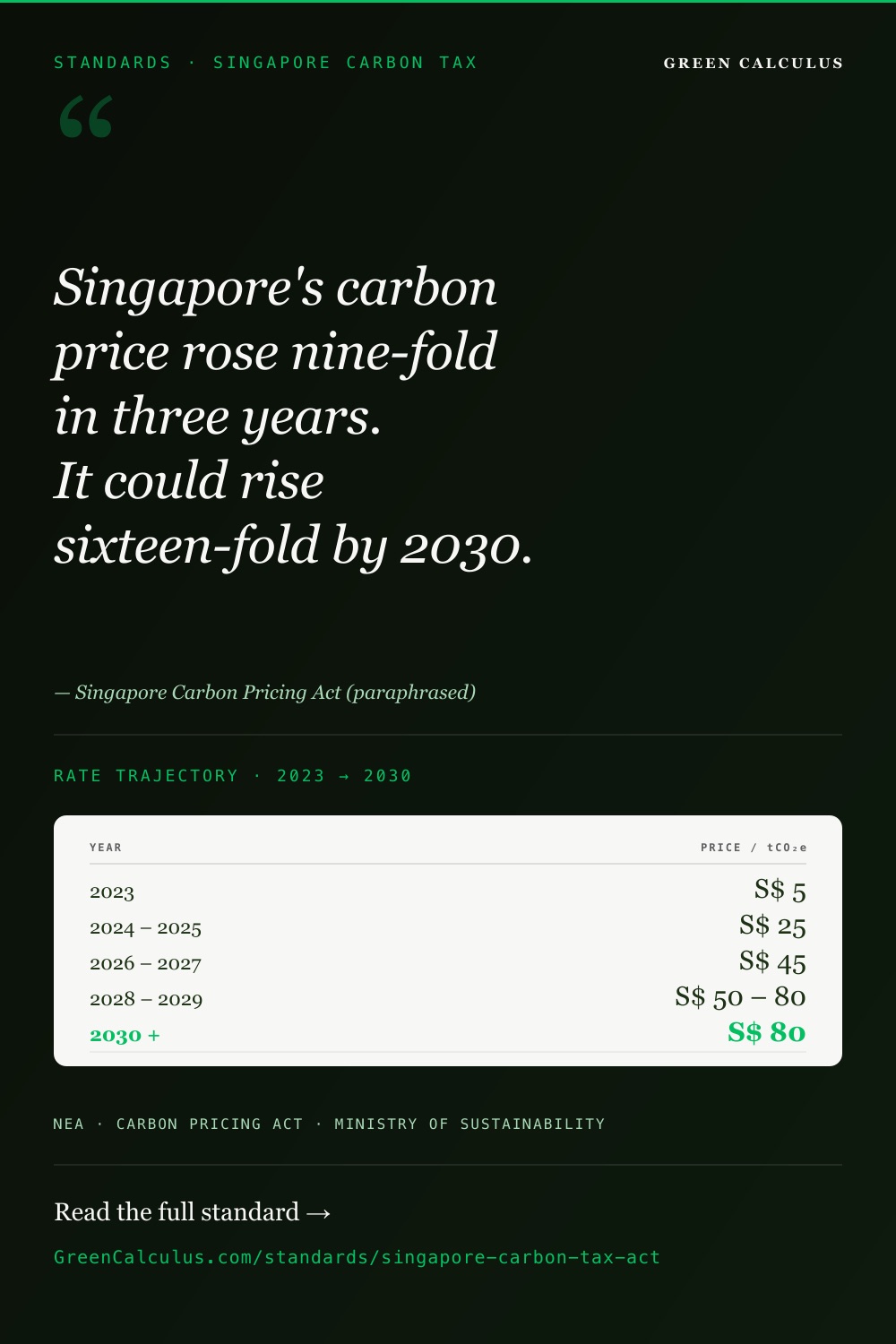
Frequently Asked Questions
The Singapore Carbon Tax rate is S$45 per tonne of carbon dioxide equivalent (S$45/tCO2e) for emissions years 2026 and 2027, with effect from 1 January 2026. The previous rate of S$25/tCO2e applied to emissions years 2024 and 2025; the rate trajectory continues toward a legislated band of S$50–S$80/tCO2e by 2030, with the specific rate to be set through future Budget announcements and Carbon Pricing Act amendments. Prime Minister Lawrence Wong indicated in the February 2026 Budget speech that weaker global climate action would point to the lower end of the S$50–S$80 band.
The Singapore Carbon Tax is paid by facilities that directly emit at least 25,000 tonnes of CO2-equivalent of reckonable greenhouse gas emissions in a calendar year. The tax is administered facility-by-facility, with the “registered person” determined by operational control over the facility. Approximately 50 facilities from about 40 companies are currently subject to the tax, concentrated in petroleum refining, petrochemicals, semiconductors, electric power generation, waste management, and water treatment. Facilities emitting between 2,000 and 25,000 tCO2e annually register as “reportable facilities” with mandatory emissions reporting but no tax liability.
Yes, up to 5% of taxable emissions per facility. Under the International Carbon Credit (ICC) Framework introduced by the Carbon Pricing (Amendment) Act 2022, taxable facilities can offset up to 5% of their taxable emissions in any emissions year using Singapore-eligible ICCs. To qualify, credits must be authorised under Article 6.2 of the Paris Agreement by a host country with a Singapore Implementation Agreement in force, be generated under a methodology on NEA’s Eligibility List, comply with the seven environmental-integrity principles (no double-counting, additional, real, quantified and verified, permanent, no net harm, no leakage), and be retired in an approved registry with Evidence of Retirement submitted to NEA by 31 August of the year following the emissions year.
Seven greenhouse gas categories are covered under the First Schedule of the Carbon Pricing Act: carbon dioxide (CO2), methane (CH4), nitrous oxide (N2O), hydrofluorocarbons (HFCs), perfluorocarbons (PFCs), sulphur hexafluoride (SF6), and nitrogen trifluoride (NF3). Each gas is converted to CO2-equivalent units using the Global Warming Potential values specified in the First Schedule for measurement, reporting, and tax calculation purposes. The covered gases are aligned with the gases addressed under the Kyoto Protocol and the Paris Agreement and are broadly harmonised with the GHG Protocol Corporate Standard.
The Singapore Carbon Tax is a fixed-price upstream tax administered through a credit-based mechanism; the EU ETS is a cap-and-trade system with auctioned allowances, free allocation (declining over time), and a secondary market. The Singapore rate is legislated at S$45/tCO2e for 2026–2027; the EU ETS price is market-determined and has traded typically in the €70–€100 range per tonne in recent years. Singapore allows up to 5% offsetting via Singapore-eligible International Carbon Credits authorised under Article 6.2; the EU ETS does not currently allow international offsets. Singapore applies at the facility level above a 25,000 tCO2e threshold; the EU ETS applies sector-by-sector with broad cross-sector coverage.
The Emissions-Intensive Trade-Exposed Transition Framework provides bounded transitory allowances to qualifying EITE facilities to manage near-term competitiveness impact and carbon-leakage risk while emissions reductions are implemented. The framework is administered by the Economic Development Board in coordination with NEA. Allowances cover only a portion of facility emissions, are benchmarked against internationally-recognised efficiency benchmarks where available, decline over time, and require a credible decarbonisation plan. New investments do not qualify. Target sectors include chemicals, electronics (semiconductors), and biomedical manufacturing. The framework is bounded relief, not exemption — full MRV obligations continue, and allowances do not eliminate the Carbon Tax for qualifying facilities.
Not directly. The Carbon Tax applies only to direct (Scope 1) reckonable emissions of taxable facilities above the 25,000 tCO2e threshold. Indirect (Scope 2) emissions from imported electricity consumption are explicitly outside the CPA reckonable definition. However, gas-fired power generators in Singapore are themselves taxable facilities, and their Carbon Tax cost is partially passed through to commercial and industrial electricity consumers via wholesale electricity market pricing. The effect is that consumers face an indirect Scope 2 carbon cost through their electricity tariffs without being directly registered or taxable under the CPA.
As of October 2025, Singapore has signed bilateral Implementation Agreements with ten host countries under Article 6.2 of the Paris Agreement: Papua New Guinea (December 2023, first agreement), Ghana (May 2024, second), Bhutan, Chile, Peru, Rwanda, Paraguay, Thailand, Vietnam, and Mongolia. Singapore has also signed Memoranda of Understanding with additional countries including Cambodia, Colombia, Dominican Republic, Fiji, Honduras, Indonesia, Kenya, Laos, Malaysia, Morocco, the Philippines, Sri Lanka, and Zambia, among others. MOUs are non-binding intentions to negotiate; only signed and in-force Implementation Agreements support Singapore-eligible ICC generation. Additional Implementation Agreements are expected to be signed through the late 2020s.
Two thresholds apply, each triggering different obligations. The first threshold of 2,000 tCO2e of reckonable emissions in a calendar year triggers registration as a “reportable facility” through NEA’s EDMAS system, with annual emissions reporting obligations but no tax liability. The second threshold of 25,000 tCO2e of reckonable emissions in a calendar year triggers registration as a “taxable facility,” adding third-party verified emissions reporting and Carbon Tax payment obligations on top of the reportable-facility requirements. Only reckonable emissions (direct stationary combustion and IPPU sources designated in the CPA Second Schedule) count toward threshold determination — biogenic CO2, transport fuel emissions covered by separate excise duties, indirect Scope 2 emissions, and Scope 3 emissions are non-reckonable and do not count toward the threshold.
The Carbon Tax compliance calendar runs on a calendar-year emissions period with three key deadlines in the following year. The verified Emissions Report must be submitted through NEA’s EDMAS system by 30 June of the year following the emissions year. Evidence of Retirement for any International Carbon Credits to be applied against the emissions year’s tax must be submitted by 31 August. Final tax settlement — purchase and surrender of NEA fixed-price carbon credits against net verified emissions — is by 30 September. Late submission triggers NEA query and potential enforcement under CPA Part 8; late ICC submission means the credits cannot offset the relevant emissions year’s tax and full tax becomes payable at the legislated rate.
No. Singapore-eligible International Carbon Credits used to offset Carbon Tax liability under the CPA do not reduce reported Scope 1 emissions for SBTi corporate accounting. The SBTi Corporate Net-Zero Standard requires absolute Scope 1 emissions reductions within the inventory boundary on a 1.5°C-aligned trajectory; an ICC offset reduces tax liability but does not change the inventory figure. A taxable facility using its full 5% ICC quota pays tax on 95% of emissions and reports 100% of those emissions in its corporate Scope 1 inventory. The ICC mechanism is a Carbon Tax management tool, not a decarbonisation accounting tool under SBTi.
At the upper end of the indicated S$50–S$80/tCO2e band, a 100,000 tCO2e facility faces an annual carbon-tax obligation of S$8 million before any ICC offset, compared with S$4.5 million at the current S$45/tCO2e rate. The economic case for on-site decarbonisation projects scales accordingly — abatement projects with a cost below S$80/tCO2e are economically positive at the upper-band scenario. Companies modelling the 2030 trajectory typically apply sensitivity across a low (S$50), central (S$65), and high (S$80) point in the band rather than assuming a single rate. The specific 2028, 2029, and 2030 rates will be set through future Budget announcements and CPA amendments; the lower end of the band is more probable under weaker global climate-action conditions, per the February 2026 Budget signalling.
Sources and References
Every claim and methodological statement on this page reconciles to the primary sources below. Where the originating body has published a definitive document on a topic, the primary source is cited directly; downstream regulatory regimes, adjacent frameworks, and corporate-side translations are identified as such.
Primary Singapore Carbon Tax sources
- Parliament of Singapore, Carbon Pricing Act 2018 (No. 23/2018), in force 1 January 2019.
- Parliament of Singapore, Carbon Pricing (Amendment) Act 2022, introducing the rate trajectory, the ICC Framework, and the Transition Framework.
- National Environment Agency, Carbon Pricing (Measurement, Reporting and Verification) Regulations 2018, with subsequent amendments.
- National Environment Agency, GHG Emissions Measurement and Reporting Guidelines (Parts 1A, 1B, 2, 3, current versions).
- National Environment Agency, Carbon Tax operational guidance and FAQs (NEA website, current).
- Ministry of Sustainability and the Environment / National Environment Agency, International Carbon Credit (ICC) Framework Eligibility Criteria, 4 October 2023.
- National Environment Agency, ICC Eligibility List (first published 19 December 2023, updated periodically).
- NEA and MSE Joint News Release, Carbon Tax-Liable Companies Can Carry Forward Unutilised Carbon Credits Offset Quota For Emissions Year 2025, 11 May 2026.
- Ministry of Sustainability and the Environment, Carbon Pricing Act policy page (current).
- National Climate Change Secretariat, Carbon Tax policy page (current).
Bilateral Implementation Agreements (selected)
- Singapore–Papua New Guinea Implementation Agreement, 8 December 2023.
- Singapore–Ghana Implementation Agreement, 27 May 2024.
- Singapore Implementation Agreements with Bhutan, Chile, Peru, Rwanda, Paraguay, Thailand, Vietnam, and Mongolia (2024–2025), as referenced through the Carbon Markets Cooperation portal.
- Carbon Markets Cooperation website operated by the National Climate Change Secretariat.
Singapore-specific contextual frameworks
- Singapore Government, Singapore Green Plan 2030 (launched 2021).
- National Climate Change Secretariat, Singapore’s Second Nationally Determined Contribution under the Paris Agreement.
- Monetary Authority of Singapore, Guidelines on Environmental Risk Management for banks, insurers, and asset managers (current).
- Singapore Exchange, Climate-related Disclosure rules (current, phased implementation).
- Accounting and Corporate Regulatory Authority, sustainability-reporting framework guidance (current).
- Monetary Authority of Singapore and partners, Singapore-Asia Taxonomy for Sustainable Finance.
- Economic Development Board and Enterprise Singapore, Carbon Services and Trading Hub strategy.
Global frameworks referenced
- UNFCCC, Paris Agreement, Article 6.2 cooperation framework.
- UNFCCC Article 6.2 Guidance and operational rules.
- International Sustainability Standards Board (ISSB), IFRS S2 Climate-related Disclosures, June 2023.
- Task Force on Climate-related Financial Disclosures (TCFD), Final Recommendations, June 2017 with October 2021 Annex.
- Science Based Targets initiative, Corporate Net-Zero Standard (current version).
- WRI & WBCSD, The Greenhouse Gas Protocol: A Corporate Accounting and Reporting Standard.
- WRI & WBCSD, GHG Protocol Scope 2 Guidance, January 2015.
- IPCC, Sixth Assessment Report (AR6), including AR6 GWP values.
- Integrity Council for the Voluntary Carbon Market (ICVCM), Core Carbon Principles.
- Verra, Gold Standard, ART-TREES, Climate Action Reserve programme documentation for methodologies appearing on the Singapore ICC Eligibility List.
- S&P Global Platts, Singapore-eligible International Carbon Credits assessment, current.
- IETA, Singapore Carbon Tax Business Brief, 2025.
- Climate Action Tracker, Singapore country profile, current assessment.
Related GreenCalculus reference pages
- GHG Protocol Corporate Standard
- GHG Protocol Scope 3 Standard
- GHG Protocol Scope 2 Guidance
- GHG Protocol Land Sector and Removals Standard
- SBTi Corporate Net-Zero Standard
- TCFD Recommendations
- IFRS S2 Climate Disclosures
- CSRD / ESRS E1
- EU ETS
- World Bank Carbon Pricing Dashboard
- Australian Safeguard Mechanism
- IPCC AR6
- ISO 14064-1
- RE100 Technical Criteria
- UK DEFRA Emission Factors
- SEC Climate Disclosure Rules
- IEA grid emission factors 2026
- IPCC AR6 GWP values
- Natural gas combustion methodology
- Diesel combustion methodology
- LPG combustion methodology
- Coal combustion methodology
- SBTi absolute contraction approach
- FLAG emissions methodology
- Scope 2 electricity methodology
- Scope 2 market-based methodology
- Scope 1 Combustion Calculator
- Scope 2 Electricity Calculator
- FLAG Emissions Calculator
- SBTi Near-Term Target Calculator
- SBTi Readiness Checklist
- Scope 1 emissions
- Scope 2 emissions
- Scope 3 emissions
- CO2e (carbon dioxide equivalent)
- Global Warming Potential
- Methane (CH4)
- Nitrous oxide (N2O)
- Electricity emission factor
- Scope 2 location-based vs market-based
- GreenCalculus changelog
What changed in this revision
Updated 12 May 2026. Initial publication. Reflects the Carbon Pricing Act 2018 (No. 23/2018) as amended through the Carbon Pricing (Amendment) Act 2022, with the operative S$45/tCO2e rate for emissions years 2026 and 2027 effective 1 January 2026, the indicated S$50–S$80/tCO2e band by 2030, the International Carbon Credit Framework with the 5% facility-level cap and seven environmental-integrity principles, the ten Implementation Agreements (Papua New Guinea, Ghana, Bhutan, Chile, Peru, Rwanda, Paraguay, Thailand, Vietnam, Mongolia) signed as of October 2025, the 11 May 2026 NEA/MSE rollover guidance for emissions year 2025 unutilised ICC quota, the EITE Transition Framework administered by EDB, the MRV framework (Monitoring Plan, annual Emissions Report, third-party verification), and the seven covered greenhouse gases. Documents the chain of custody from the primary legislation through subsidiary regulations, NEA operational guidelines and the Eligibility List, the Article 6.2 bilateral Implementation Agreement network, to the taxable facility’s verified Emissions Report and tax settlement. Includes the worked liability calculation for an illustrative 100,000 tCO2e chemicals facility, the line-by-line comparison with EU ETS, the Australian Safeguard Mechanism, and the China National ETS, and the disclosure-stack integration with SGX climate-related disclosures, MAS Guidelines on Environmental Risk Management, IFRS S2, TCFD, the Singapore-Asia Taxonomy, and SBTi target accounting. Cross-references to the GHG Protocol Corporate Standard, Scope 3 Standard, Scope 2 Guidance, IPCC AR6, ISO 14064-1, SBTi Corporate Net-Zero Standard, TCFD, and IFRS S2.