
ASHRAE TC 9.9 Thermal Guidelines for Data Centers

For two decades, the question “how warm can a data centre safely run?” had no shared answer — every IT manufacturer published its own environmental spec, and facility engineers had no common envelope to design to. The cost of that fragmentation was over-cooling: server halls held at 20°C and 50% humidity because no one could agree it was safe to do otherwise.
ASHRAE TC 9.9’s Thermal Guidelines are the document that settled the question — a single, consensus temperature-and-humidity framework that unlocked the entire free-cooling era of data-centre design.
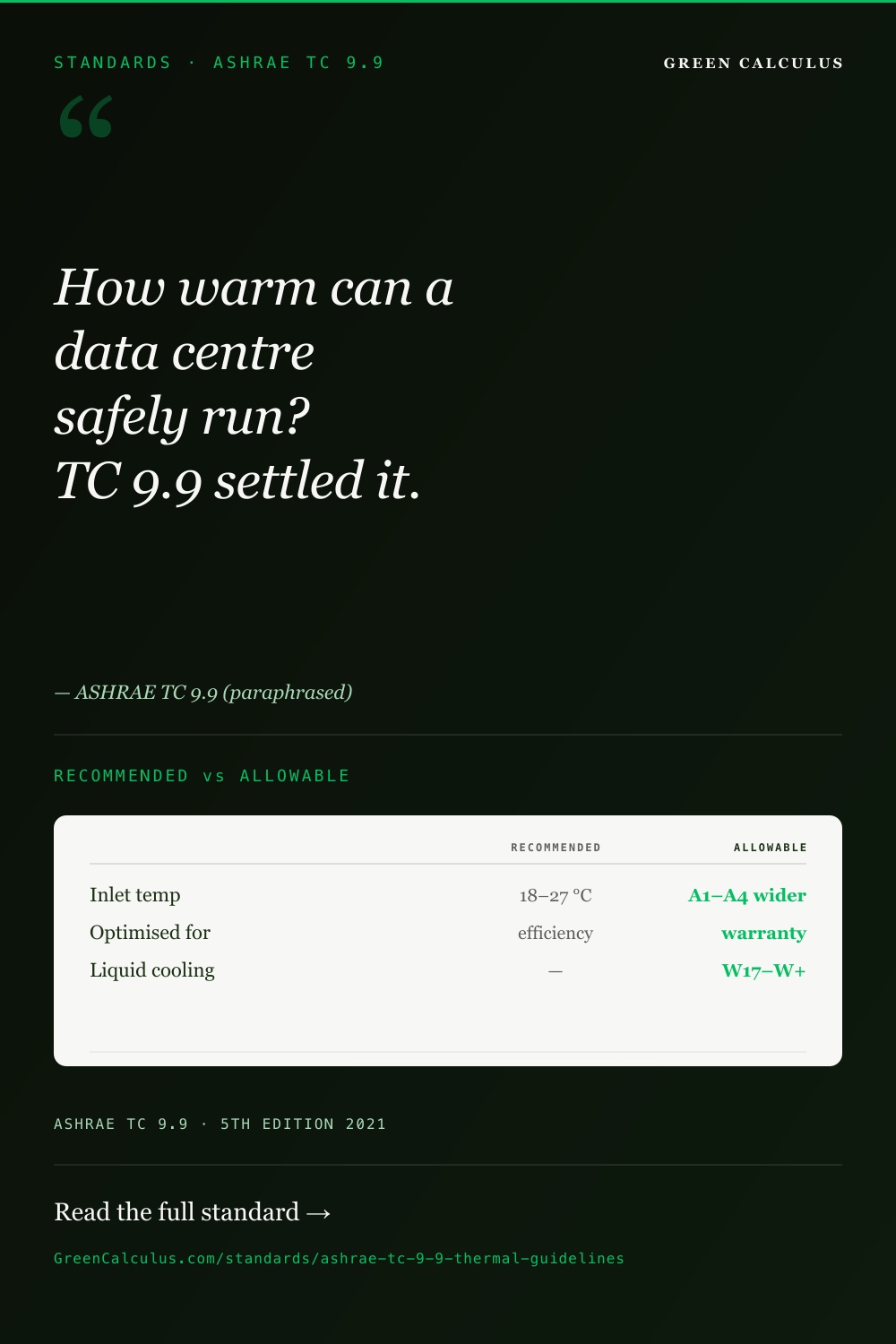
The ASHRAE TC 9.9 Thermal Guidelines define the temperature and humidity envelopes that IT equipment is built and operated to. They set a recommended envelope of 18–27°C at the server inlet for reliability and efficiency, plus wider allowable classes (A1–A4) that define warranty limits, and liquid-cooling classes (W17–W+) for water-cooled systems.
Executive Summary
The ASHRAE TC 9.9 Thermal Guidelines for Data Processing Environments are the foundational reference that links the design of IT equipment to the design of the facilities that house it. First published in 2004 and now in its fifth edition (2021), they establish a common vocabulary of equipment classes and environmental envelopes that both server manufacturers and facility engineers design to — so that a server rated to a given class will operate reliably in any facility provisioned to that class.
The guidelines distinguish two kinds of envelope. The recommended envelope — 18–27°C at the server inlet — is where equipment should normally operate for the best balance of reliability and energy efficiency. The allowable envelopes, expressed as Classes A1 through A4, are progressively wider temperature and humidity ranges within which manufacturers warrant the equipment will function, even if sustained operation there carries energy or reliability trade-offs. Separate W-classes (W17 through W+) cover liquid-cooled equipment, and a newer H1 class addresses high-density air-cooled systems.
TC 9.9 is not a code and not a compliance standard — it is an industry-consensus guideline. Its power lies in the recommended-versus-allowable distinction and the class taxonomy: by defining wider allowable ranges and proving equipment can tolerate them, the guidelines made free-air cooling defensible and unlocked the economiser-driven efficiency gains that reshaped data-centre design over the past fifteen years.
Provider directory
Now it has to hold up all year.
See who does this work. Every listing names the standards it works to, and paid placements are labelled. Including Attain Zero and Small World Consulting.
Browse 6 carbon accounting & inventory providers →Do this work? A listing is US$390 a year. Get listed →
What TC 9.9 Is — and Is Not
“TC 9.9” refers to two things that are easy to conflate. ASHRAE Technical Committee 9.9 is a standing committee — Mission Critical Facilities, Data Centers, Technology Spaces and Electronic Equipment — that produces guidance. The Thermal Guidelines for Data Processing Environments are the committee’s flagship publication. When practitioners say “design to TC 9.9,” they mean design to the envelopes in that publication.
Three clarifications about what the guidelines are not:
Not a code or mandatory standard
The Thermal Guidelines are guidance, not an enforceable standard like ASHRAE 90.4 or 90.1. They are adopted by reference and by industry convention, not by building-code mandate.
Not a single number
There is no one “ASHRAE temperature.” There is a recommended envelope, four allowable air-cooled classes, multiple liquid-cooling classes, and an H1 class — each with its own boundaries.
Not a facility-wide average
The envelopes specify conditions at the server inlet, not room average. Inlet temperatures can differ by several degrees from rack to rack, which is why sensor placement matters.
The guidelines specify environmental conditions at the point where cooling air enters the IT equipment — the server inlet. This is a deliberate and consequential choice: conditions vary substantially across a data hall, and in raised-floor environments temperature can differ by several degrees between floor and ceiling. Compliance and performance are judged where the air actually meets the equipment, not at a room thermostat.
Why the Thermal Guidelines Exist
Before 2004, the environmental conditions needed to operate data centres were anecdotal or specific to each IT manufacturer. A facility engineer designing a cooling system had to reconcile conflicting specifications from every vendor whose equipment would sit in the hall, and the safe default was to over-cool: hold the room cold and humid enough that no single vendor’s spec could be violated. That conservatism wasted enormous amounts of cooling energy.
TC 9.9 was formed in 2004 in response to the lack of effective information transfer between the building, HVAC, and IT industries. Its mission is to act as the unbiased engineering bridge between those worlds, drawing thermal engineers from the major IT manufacturers into a single committee — today numbering in the hundreds of members — so that equipment design and facility design speak the same language. The first edition of the Thermal Guidelines that same year gave the industry its first comprehensive, manufacturer-agreed set of temperature and humidity conditions.
Equipment designers build to a class; facility engineers provision to a class. When both sides use the same taxonomy, interoperability becomes predictable and the contractual question “will this server survive in this hall?” has a documented reference point. That shared taxonomy — not any single temperature — is the guidelines’ central contribution.
Recommended vs Allowable Envelopes
The single most important concept in the Thermal Guidelines — and the one most often misread — is the distinction between the recommended envelope and the allowable envelopes.
| Attribute | Recommended envelope | Allowable envelopes (A1–A4) |
|---|---|---|
| What it represents | The target operating range for the best long-term reliability and energy balance | Warranty limits — the range within which manufacturers verify the equipment will function |
| Temperature span | 18–27°C at the server inlet (all A-classes) | Wider, and class-specific (from 15–32°C for A1 up to 5–45°C for A4) |
| Intended use | Normal day-to-day operation | Excursions, economiser operation, and climates where mechanical cooling can be avoided |
| Trade-off of operating here | None — this is the sweet spot | May increase server fan power and accelerate component aging at the upper end |
The crucial point is that operating within an allowable range is not a failure — it is a deliberate design choice. A facility that lets inlet temperatures drift toward the upper allowable limit during cool-weather economiser hours can avoid mechanical cooling for much of the year. The penalty is that server fans spin faster at higher inlet temperatures, consuming more energy, so the gain from reduced mechanical cooling must be weighed against the rise in IT fan power. The recommended envelope is where that balance is most favourable for sustained operation; the allowable envelopes are the headroom that makes economiser strategies possible.
Manufacturers warrant function across the allowable range, but they do not promise that sustained operation at the extremes carries no cost. Higher inlet temperatures raise fan power and can shorten equipment life. “Within allowable” means “the equipment will work,” not “operate here indefinitely with no consequence.”
The Recommended Envelope
The recommended envelope applies to all A-class equipment and represents the conditions ASHRAE advises for normal operation.
On the temperature axis the recommended range is 18°C to 27°C (64.4°F to 80.6°F) measured at the server inlet. On the humidity axis the fifth edition expresses the recommended range primarily through dew point: a lower bound combining a −9°C dew point and 8% relative humidity, and an upper bound of a 15°C dew point and 60% relative humidity. The fifth edition extends the recommended relative-humidity ceiling toward 70% — but, importantly, only conditionally, where the data hall maintains low concentrations of pollutant gases (see the air-quality section below).
The lower humidity limit exists to control electrostatic discharge: dry air lets static build up and discharge into equipment. The upper limit exists to prevent condensation and corrosion on cold surfaces and to limit the risk of hygroscopic dust bridging. The dew-point-based framing of the fifth edition is what allows many climates to satisfy the humidity requirement with little or no active humidification — a significant energy saving discussed below.
Air-Cooled Equipment Classes A1–A4
The allowable envelopes for air-cooled IT equipment are expressed as four classes, A1 through A4, each widening the temperature and humidity range. The progression reflects the industry’s gradual acceptance of higher inlet temperatures as economiser economics improved.
| Class | Allowable dry-bulb range | Typical equipment | Design intent |
|---|---|---|---|
| A1 | 15–32°C (59–89.6°F) | Enterprise servers, storage; the most tightly controlled environments | Traditional enterprise rooms with narrow bands and tight humidity control |
| A2 | 10–35°C (50–95°F) | Volume servers, storage, networking | The common contemporary design point for mainstream IT |
| A3 | 5–40°C (41–104°F) | Equipment rated for extended temperature operation | Extended free-cooling range in temperate and warm climates |
| A4 | 5–45°C (41–113°F) | Equipment rated for the widest air-cooled tolerance | Maximum economiser flexibility; free-air cooling with minimal mechanical assist |
The ranges above are the allowable dry-bulb limits; each class also carries humidity and dew-point boundaries that tighten the usable envelope, and those full boundaries — along with the lettered notes that qualify them — live in the fifth-edition reference card. This page does not reproduce that table in full; the binding detail is in the published guidelines. What matters conceptually is the direction of travel: A1 is the narrowest, most conservative class, and each step up to A4 widens the temperature ceiling, trading thermal margin for the ability to run on outside air for more hours of the year.
An IT device is designed and rated to a class by its manufacturer. A facility is then provisioned to support a class. A room can be operated within, say, the A2 envelope, but only equipment rated to A2 or wider should be expected to tolerate the full A2 range. Mixing equipment of different classes means the most restrictive class in the room governs the safe operating envelope.
The Shift from Relative Humidity to Dew Point
One of the most consequential changes in the guidelines’ history was the move, from the fourth edition onward, to express the primary humidity control metric as dew point temperature rather than relative humidity. The original 2004 guidelines controlled humidity through a relative-humidity band; the modern guidelines lead with dew point.
This is not a cosmetic relabelling. Relative humidity depends on temperature, so a relative-humidity setpoint forces humidification or dehumidification as the air temperature changes, even when the actual moisture content of the air is fine. Dew point measures absolute moisture directly, decoupled from temperature. Controlling to a dew-point band lets a facility leave the moisture content alone across a wide temperature range, which under most climate conditions reduces or eliminates the need for active humidification.
Relative-humidity control often drives significant humidification in winter or in dry regions simply to hold a percentage figure that does not reflect a real moisture risk. Dew-point control targets the variable that actually matters — absolute moisture — and lets humidification needs fall away under most conditions. The lower recommended bound was reframed from the original 40% RH to a combined −9°C dew point and 8% RH condition, with the −9°C dew point judged sufficient to manage electrostatic-discharge risk.
The two humidity boundaries each guard against a specific failure. The lower bound protects against electrostatic discharge in dry air. The upper bound — a dew-point ceiling that varies by class — protects against condensation forming on chilled-water piping and cold-aisle surfaces, and against the hygroscopic-dust and corrosion risks that accompany high moisture. For the lower-density A-classes the upper dew-point limits rise as the class widens, reflecting the broader operating tolerance those classes were designed for.
Altitude Derating
Air density falls with altitude, and thinner air carries less heat away from a server’s components. To account for this, the guidelines apply an altitude derating: above a defined elevation, the maximum allowable dry-bulb temperature is reduced by a set amount per unit of additional altitude. The derating is class-specific, with the wider classes derated more steeply at altitude because they were already operating closer to their thermal limits.
The committee was careful, when introducing the wider A3 and A4 classes, not to apply a single derating curve across all classes — doing so would have driven undesirable increases in server energy at altitude for users of the lower classes. The derating is therefore calibrated per class. Above a high elevation threshold, the guidelines direct operators to consult the IT supplier for the specific equipment rather than rely on a generic curve, because behaviour at extreme altitude is equipment-dependent.
A design that complies at sea level can exceed an equipment class’s effective limit at a high-altitude site, because the maximum allowable temperature is derated with elevation. For data centres in mountainous or high-plateau regions, the altitude derating must be applied to the class limits before judging whether the cooling design provides adequate margin.
Rate-of-Change and Excursion Limits
Beyond the static temperature and humidity envelopes, the guidelines constrain how fast conditions may change. Rapid temperature swings stress equipment through thermal expansion and contraction, and abrupt humidity changes risk condensation. The guidelines therefore specify maximum rates of change.
- Tape storage is the most sensitive: a maximum change of 5°C in any one-hour period.
- All other IT equipment may tolerate up to 20°C in an hour, but no more than 5°C in any 15-minute window.
The guidelines are explicit that these figures describe a temperature change within a specified period — the maximum inlet temperature minus the minimum inlet temperature inside the time window — and not a continuous rate of change. The distinction matters for control-system design: the constraint is on the magnitude of swing within the window, which governs how aggressively cooling can be modulated in response to load changes or economiser transitions.
These limits become operationally important precisely when a facility runs near the edge of an allowable envelope. A data centre exploiting wide A3 or A4 limits to maximise economiser hours must still manage transitions — for instance, when switching between outside-air and mechanical cooling — within the rate-of-change constraints, or it risks condensation and thermal-stress events that the static envelope alone would not reveal.
Liquid-Cooling Classes (W17–W+)
As rack power densities climbed, air cooling alone became insufficient for the densest equipment, and the guidelines added a parallel taxonomy for liquid-cooled systems. Where the A-classes specify air dry-bulb temperature at the server inlet, the W-classes specify the supply water (or coolant) temperature delivered to the equipment.
The fifth edition redesignated the liquid-cooling classes around their upper supply-temperature limit, which both increased flexibility and made the naming easier to remember — the number in the class name is the temperature ceiling. The classes are W17, W27, W32, the new W40, W45, and W+ (the highest-temperature, open-ended class).
| Class | Approx. supply-water ceiling | Heat-rejection implication |
|---|---|---|
| W17 | ~17°C | Lowest supply temperature; typically needs chilled water for part of the year |
| W27 | ~27°C | Moderate; supports substantial per-CPU heat loads with cooler water |
| W32 | ~32°C | Warmer water; expands hours of chiller-less operation |
| W40 | ~40°C (new in 5th edition) | Added to fill the gap between W32 and W45 as densities rose |
| W45 | ~45°C | Warm-water cooling; cooling towers or dry coolers can reject heat year-round in many climates |
| W+ | Above 45°C (open-ended) | Highest-temperature class for designs pushing warm-water cooling furthest |
The higher-temperature classes are the energy prize: warm-water cooling at W40, W45, or above lets a facility reject heat using cooling towers or dry coolers alone, eliminating the chiller for much or all of the year. The trade-off is that warmer coolant carries less heat per unit of flow, so the densest configurations may need more capable pumps and heat exchangers, fewer blades per rack, or double-sided memory cooling to stay within a high-temperature class.
Earlier editions left W-class compliance loosely defined, and some manufacturers labelled equipment by the widest temperature it could survive rather than the temperature it was designed to operate at. The fifth edition clarified the compliance definition so that a W-class claim reflects a genuine design operating point, not a survival extreme.
The H1 High-Density Class and the AI Pressure
The fifth edition introduced the H1 class for high-density air-cooled equipment — high-performance computing and the dense accelerator-based systems that AI workloads run on. H1 is unusual in the taxonomy because it moves in the opposite direction to the A1–A4 progression: rather than widening the envelope, it tightens it, with a recommended range of roughly 18–22°C, narrower than the standard 18–27°C recommended envelope.
The logic is thermal density. A standard server can shed heat comfortably across the wide recommended band, but a rack packed with high-power accelerators generates so much heat per unit of airflow that it needs cooler, more tightly controlled inlet air to stay within component limits. H1 acknowledges that the economiser-friendly march toward higher inlet temperatures runs into a wall at extreme density.
The fifth edition was finalised in 2021, before the current generation of AI accelerators reached production. Modern AI racks routinely exceed the densities the air-cooled framework was built around, and for the densest systems liquid cooling has shifted from an edge case to the default thermal strategy. Practitioners are increasingly running hardware that materially outpaces the 2021 reference document, which is the principal pressure driving the next revision.
This is the central tension in the guidelines today. The A1–A4 history was a story of widening envelopes to save cooling energy. The H1 class and the rise of liquid cooling mark a partial reversal at the high-density frontier, where raw thermal load — not economiser opportunity — sets the design constraint.
Edition History: 2004 → 2021
The Thermal Guidelines have been revised repeatedly since 2004, and the dominant trend across editions was the progressive expansion of allowable temperature limits — until the fifth edition added density-driven caveats.
| Edition | Year | Substantive character |
|---|---|---|
| 1st | 2004 | First comprehensive, manufacturer-agreed envelope. A single recommended range of 20–25°C — conservative, reflecting the data available at the time. The first shared reference where none had existed. |
| 2nd | 2008 | Widened the recommended envelope to 18–27°C, increasing the opportunity for compressor-less (economiser) cooling and broadening the moisture range. Moved toward a psychrometric, multi-variable envelope. |
| 3rd | 2011 | Introduced the A1–A4 class structure (plus B and C), formalising progressively wider allowable envelopes and the per-class altitude derating. |
| 4th | 2015 | Expanded the A1 and A2 relative-humidity levels and advanced the shift toward dew-point-based humidity control. |
| 5th | 2021 | Current edition. Dew point established as the primary humidity metric; recommended RH ceiling extended toward 70% conditional on clean air; H1 high-density class added; liquid-cooling W-classes redesignated by upper temperature (W17/W27/W32/W40/W45/W+) with a clarified compliance definition. |
| Point | °C |
|---|---|
| 2004 | 25.0 °C |
| 2008 | 27.0 °C |
| 2011 | 45.0 °C |
| 2015 | 45.0 °C |
| 2021 | 45.0 °C |
Governance and the Datacom Series
Technical Committee 9.9 sits within ASHRAE’s technical-committee structure and is one of its most active committees, with a membership of thermal engineers drawn from across the IT and data-centre industry. Its stated mission is to be the unbiased engineering leader in HVAC for the datacom industry, providing technical information that connects the design of servers and storage with the requirements of the facilities that house them.
The Thermal Guidelines are the cornerstone of the broader ASHRAE Datacom Series — a family of books and white papers covering liquid cooling, particulate and gaseous contamination, power-equipment thermal management, IT-equipment power trends, and related topics. The Thermal Guidelines define the envelopes; the companion Datacom titles provide the supporting engineering depth on specific subsystems and risks.
Because TC 9.9 is a technical committee rather than a code body, its output evolves through evidence-gathering and consensus across the IT and facility industries rather than through a regulatory adoption cycle. Historically that process pushed toward wider, more efficient envelopes; the fifth edition shows the same process adding caveats where the evidence — on contamination and on high-density thermal loads — warranted caution.
Energy-Efficiency Implications
The Thermal Guidelines are, in effect, the lever that determines how much of the year a data centre can cool itself without mechanical refrigeration. Every widening of the allowable envelope expanded the set of climates and hours in which free cooling — air-side or water-side economisation — is viable, and that is where most of the energy story lives.
Two opposing effects must be balanced when choosing an operating point:
Higher inlet temperature → less mechanical cooling
Raising the inlet setpoint toward an allowable upper limit increases the hours when outside air or warm water can reject heat without a chiller, cutting compressor energy.
Higher inlet temperature → more fan power
Servers respond to warmer inlet air by spinning fans faster. Above the recommended band, IT fan power can rise materially, offsetting part of the mechanical-cooling saving.
Dew-point control → less humidification
Controlling humidity by dew point rather than relative humidity removes most unnecessary humidification, a direct energy saving independent of temperature setpoint.
The optimum is climate-specific and density-specific. In a cool, dry climate, pushing toward A3 or A4 inlet temperatures with dew-point humidity control can deliver large economiser gains with a modest fan-power penalty. In a hot, humid climate, the free-cooling window is narrower and the fan-power penalty bites sooner. This climate dependence is precisely why the related compliance standard, ASHRAE 90.4, tabulates its maximum cooling-efficiency values by climate zone — the thermal opportunity the guidelines unlock varies by location.
Illustrative depiction of how a wider allowable envelope increases free-cooling opportunity — directional only. Actual free-cooling hours depend on local climate, dew-point limits, and the fan-power penalty at higher inlet temperatures.
Relationship with ASHRAE 90.4 and 90.1
The Thermal Guidelines and the data-centre energy codes are complementary instruments that operate on different sides of the same problem. The guidelines define the thermal envelope the IT equipment can tolerate; the codes set the efficiency the facility must achieve in delivering cooling within that envelope.
The connection is explicit. ASHRAE Standard 90.4, the energy standard for data centres, references the TC 9.9 Thermal Guidelines for its allowable temperature ranges and built its Mechanical Load Component maxima around realistic thermal assumptions consistent with the guidelines. A designer exploiting the wider allowable envelopes the guidelines permit gains the headroom to meet 90.4’s cooling-efficiency targets — in fact, the 2022 edition of 90.4 was explicit that compliance can be achieved without an economiser precisely because the thermal envelope can be managed within the TC 9.9 guidelines.
TC 9.9 answers “what inlet conditions can this equipment safely tolerate?” ASHRAE 90.4 answers “how efficiently must the facility deliver cooling within those conditions?” The guidelines unlock the thermal headroom; the energy standard requires the facility to use it efficiently. Standard 90.1, in turn, governs the building envelope and lighting that sit outside the data hall. A design team holds all three in view, and the broader physical-infrastructure picture is covered in the ISO/IEC 22237 and EN 50600 data-centre design reference.
Air Quality and Contamination
A subtle but important feature of the fifth edition is that it ties part of its humidity guidance to air quality. The extension of the recommended relative-humidity ceiling toward 70% is conditional: it applies where the data hall maintains low concentrations of pollutant gases. The reasoning is that higher humidity accelerates corrosion when reactive gaseous contaminants are present, so the extra humidity headroom is only safe in a clean-air environment.
This reflects a broader concern in the Datacom Series with both gaseous and particulate contamination. As economiser strategies pull more outside air through data halls, that air can carry pollutants and particulates that, combined with humidity, attack circuit boards and connectors. The guidelines and their companion contamination references therefore treat air quality as a co-constraint on the humidity envelope, not an unrelated facilities concern.
Reading “the recommended RH ceiling went up to 70%” without the clean-air condition is a misinterpretation. The extra humidity headroom assumes low gaseous-contaminant concentrations. In a polluted or coastal environment, or a site drawing economiser air from a contaminated atmosphere, the corrosion risk can force tighter humidity control than the headline figure suggests.
Common Misinterpretations
The allowable classes are warranty limits, not operating recommendations. Sustained operation at the upper allowable limit can raise fan power and shorten equipment life. The recommended envelope (18–27°C) is the target for normal operation; the allowable range is headroom.
There is no single number. There is a recommended envelope, four air-cooled allowable classes, multiple liquid-cooling classes, and an H1 high-density class — each with distinct boundaries. “The ASHRAE limit” is meaningless without naming the envelope and class.
The envelopes specify conditions at the server inlet, not a room thermostat. Inlet temperatures vary across a hall, so meeting the envelope on average does not guarantee meeting it at every rack.
The fifth edition’s extension toward a 70% RH ceiling is conditional on low gaseous-contaminant concentrations. In contaminated air, the corrosion risk can require tighter control.
The modern guidelines lead with dew point, not relative humidity, because dew point tracks absolute moisture and avoids the unnecessary humidification that RH control drives. Designing to an RH band alone applies superseded thinking.
A4 warrants function up to 45°C, but server fan power rises sharply and component aging accelerates near the limit. The class enables economiser hours; it does not make 45°C operation free of consequence.
The Thermal Guidelines are guidance, not an enforceable code. They are adopted by reference and convention. The enforceable data-centre energy requirement is ASHRAE 90.4, which uses the guidelines for its thermal assumptions.
The fifth edition predates the current generation of AI accelerators. The H1 class and W-classes address high density, but modern AI racks frequently outpace the air-cooled framework, which is why liquid cooling has become the default at the high-density frontier.
Common Implementation Errors
- Measuring at the wrong point. Monitoring room-average or return-air temperature instead of server-inlet conditions, and missing hot spots at individual racks.
- Designing to the recommended envelope when allowable headroom is available. Holding a conservative 20–22°C setpoint and forgoing economiser hours the equipment’s class would safely permit.
- Ignoring the fan-power penalty. Pushing inlet temperatures up for mechanical-cooling savings without accounting for the rise in IT fan energy, which can erode the net benefit.
- Controlling humidity by relative humidity. Driving unnecessary humidification or dehumidification by holding an RH band rather than a dew-point band.
- Overlooking altitude derating. Applying sea-level class limits at a high-altitude site, where the maximum allowable temperature is reduced.
- Mixing equipment classes without governing to the strictest. Operating a mixed hall at a wide envelope when some equipment is rated only to a narrower class.
- Treating the 70% RH ceiling as unconditional. Extending humidity headroom without verifying low gaseous-contaminant concentrations.
- Violating rate-of-change limits during cooling-mode transitions. Switching between economiser and mechanical cooling too abruptly, risking condensation or thermal-stress events.
Interaction with GHG Accounting and Scope 2
The Thermal Guidelines are a thermal-engineering reference, not a carbon-accounting standard — but they sit close to the largest line in most data-centre operators’ greenhouse-gas inventories. Cooling is the dominant non-IT energy use in a data centre, and the electricity behind it lands almost entirely in Scope 2.
The link runs through energy intensity. A facility that operates within wider allowable envelopes — using economisers and dew-point humidity control to cut mechanical cooling — consumes less electricity per unit of IT load, which directly reduces the purchased electricity behind its Scope 2 emissions. The conversion from that electricity to a carbon figure is then governed by grid emission factors and the dual-reporting rules of the GHG Protocol Scope 2 Guidance, with operators modelling the result using tools like the Scope 2 electricity calculator and referencing current grid intensities such as EPA eGRID.
TC 9.9 sets the thermal headroom; the operator’s chosen operating point within that headroom drives cooling energy; the energy converts to Scope 2 carbon through the grid factor and the GHG Protocol method. Keeping the as-built facility operating to its intended thermal and efficiency design over time is the role of an energy-management system aligned with ISO 50001. The thermal guideline and the carbon ledger are different documents, but they describe the same kilowatt-hours.
Criticisms and Limitations
The Thermal Guidelines are the most influential thermal reference in the data-centre industry, and they carry real limitations worth stating plainly.
They lag the hardware
The most pressing criticism is currency. The fifth edition was finalised in 2021, and the explosive growth of AI workloads since has produced rack densities and accelerator thermal loads the air-cooled framework was not built for. For the densest systems, the guidelines have effectively been overtaken by liquid cooling, and practitioners are running hardware ahead of the reference document.
Guidance, not enforcement
Because the guidelines are advisory rather than a code, their adoption is uneven. Operators are free to ignore them, and some hold conservative legacy setpoints long after the equipment and the guidelines would permit warmer, more efficient operation — leaving economiser energy on the table.
Complexity of the full envelope
The headline temperature ranges are simple, but the full envelopes — dew-point limits that vary by class, altitude derating, rate-of-change constraints, and the conditional humidity headroom — are genuinely complex. The simplicity of “18–27°C” can mask the multi-variable psychrometric reality, and oversimplified implementations miss the humidity and altitude constraints that actually bind.
Reliability data is probabilistic
The trade-offs the guidelines describe — higher temperature versus equipment life and failure rate — rest on statistical reliability models, not deterministic limits. Operating within allowable but above recommended ranges shifts failure probabilities rather than guaranteeing a specific outcome, which makes the operational risk genuine but hard to quantify for a specific fleet.
These limitations are mostly the price of the guidelines’ strengths: a consensus, evidence-based document moves more slowly than the hardware, and a guideline rather than a mandate trades enforceability for flexibility. The guidelines remain the shared language of data-centre thermal design; the criticisms define the agenda for the next edition rather than displacing the document.
Future Evolution
Three forces will shape the next revision of the Thermal Guidelines.
AI and extreme density. The dominant pressure is the thermal load of AI accelerators, which has pushed rack densities far beyond the air-cooled framework’s assumptions. The next edition will need to deepen the high-density and liquid-cooling guidance, and to reconcile the H1 air-cooled class with the reality that the densest systems are now liquid-cooled by default.
Liquid cooling as the mainstream. Direct-to-chip and rear-door liquid cooling have moved from edge case to mainstream for high-density deployments. Expect the W-class framework and the compliance definitions introduced in the fifth edition to expand, with more granular guidance on coolant temperatures, flow, and heat-rejection strategy.
Contamination and water. As economisation and liquid cooling both grow, the interaction of humidity, gaseous and particulate contamination, and — increasingly — water consumption for heat rejection will draw more attention. The guidelines’ move to tie humidity headroom to air quality is likely to deepen, alongside the broader industry shift toward accounting for water as well as energy.
Frequently Asked Questions
TC 9.9 is an ASHRAE technical committee, and its flagship publication — the Thermal Guidelines for Data Processing Environments — defines the temperature and humidity envelopes that IT equipment is built and operated to. It sets a recommended range of 18–27°C at the server inlet, wider allowable classes (A1–A4) that are warranty limits, liquid-cooling classes (W17–W+), and an H1 class for high-density systems. It is guidance, not an enforceable code.
The recommended server-inlet temperature is 18–27°C (64.4–80.6°F), which applies to all A-class equipment. This is the range for the best balance of reliability and energy efficiency. Equipment can operate within wider allowable ranges (up to 45°C for Class A4), but sustained operation at the extremes raises fan power and can shorten equipment life. The H1 high-density class recommends a tighter 18–22°C.
The recommended envelope (18–27°C) is the target for normal operation — the best reliability-and-efficiency balance. The allowable envelopes (Classes A1–A4) are warranty limits: the wider ranges within which manufacturers verify the equipment will function. Operating within an allowable range is a legitimate design choice for economiser hours, but it can increase fan power and accelerate aging at the upper end. Allowable means “will work,” not “operate here with no cost.”
They are the four air-cooled allowable classes, each widening the temperature range: A1 is 15–32°C (enterprise servers, tightest control), A2 is 10–35°C (mainstream volume servers), A3 is 5–40°C (extended-temperature equipment), and A4 is 5–45°C (widest air-cooled tolerance). Each class also carries humidity and dew-point limits. A device is rated to a class by its manufacturer; a facility is provisioned to support a class.
The W-classes specify the supply water (coolant) temperature delivered to liquid-cooled equipment, named by their upper temperature limit: W17, W27, W32, W40, W45, and W+ (above 45°C). Higher-temperature classes such as W40 and W45 let facilities reject heat with cooling towers or dry coolers year-round, eliminating the chiller, at the cost of less heat carried per unit of coolant flow. The fifth edition redesignated these classes and clarified what compliance with each means.
Relative humidity changes with temperature, so an RH setpoint forces humidification or dehumidification even when the air’s actual moisture content is fine — wasting energy. Dew point measures absolute moisture directly, so controlling to a dew-point band lets a facility leave moisture alone across a wide temperature range, reducing or eliminating unnecessary humidification. The recommended lower bound was reframed from 40% RH to a combined −9°C dew point and 8% RH condition.
H1 is the high-density air-cooled class introduced in the fifth edition for high-performance computing and dense AI/accelerator systems. Unlike the A1–A4 progression toward wider envelopes, H1 tightens the recommended range to roughly 18–22°C, because dense, high-power equipment generates so much heat per unit of airflow that it needs cooler, tightly controlled inlet air to stay within component limits.
No. The Thermal Guidelines are advisory guidance from a technical committee, not an enforceable code. They are adopted by reference and by industry convention. The enforceable data-centre energy requirement is ASHRAE Standard 90.4, which uses the TC 9.9 thermal assumptions to set its cooling-efficiency targets.
They are complementary. TC 9.9 defines the thermal envelope IT equipment can tolerate; ASHRAE 90.4 sets the efficiency the facility must achieve in delivering cooling within that envelope. 90.4 references the TC 9.9 guidelines for its allowable temperature ranges and built its Mechanical Load Component maxima on consistent thermal assumptions — the 2022 edition of 90.4 noted compliance can be achieved without an economiser precisely because the thermal envelope can be managed within TC 9.9.
Indirectly, yes. Operating within wider allowable envelopes — more economiser hours, dew-point humidity control — lowers cooling electricity per unit of IT load, which reduces the purchased electricity behind a data centre’s Scope 2 emissions. The fan-power penalty at higher inlet temperatures partly offsets the saving, so the net depends on climate and density. Converting that electricity to a carbon figure is governed separately by grid factors and the GHG Protocol Scope 2 Guidance.
Sources and References
Every value and methodological statement on this page reconciles to the primary and authoritative sources below. Where ASHRAE has published a definitive document, it is cited directly; trade and engineering commentary is used only to corroborate interpretation. The full reference-card tables are not reproduced here, in line with ASHRAE’s reproduction restrictions — the binding detail is in the published guidelines.
Primary ASHRAE documents
- ASHRAE Technical Committee 9.9, Thermal Guidelines for Data Processing Environments, 5th Edition, ASHRAE Datacom Series, 2021.
- ASHRAE TC 9.9, prior editions: 1st (2004), 2nd (2008), 3rd (2011), 4th (2015).
- ASHRAE TC 9.9, 2021 Equipment Thermal Guidelines reference card (Table 2.1, air-cooling classes; SI and I-P versions).
- ASHRAE TC 9.9, Data Center Power Equipment Thermal Guidelines and Best Practices white paper.
- ASHRAE TC 9.9, Emergence and Expansion of Liquid Cooling in Mainstream Data Centers white paper (W-class supply-water cooling).
- ASHRAE Datacom Series — liquid cooling, particulate and gaseous contamination, and IT-equipment power-trend titles.
Corroborating engineering and industry sources
- Uptime Institute, analysis of the fifth-edition changes (conditional 70% RH ceiling and air-quality caveat).
- Upsite Technologies, coverage of the fifth-edition liquid-cooling chapter and the W-class redesignation.
- Engineering and data-centre industry commentary on the recommended-vs-allowable distinction, the H1 class, and AI-driven thermal loads.
Related GreenCalculus reference pages
- ASHRAE 90.4 — Energy Standard for Data Centers
- ISO/IEC 22237 and EN 50600 — Data-centre design and infrastructure
- ISO 50001 — Energy management
- GHG Protocol Scope 2 Guidance
- EPA eGRID
What changed in this revision
Published 19 June 2026. Initial publication. Reflects the ASHRAE TC 9.9 Thermal Guidelines for Data Processing Environments, 5th Edition (2021), its supporting Datacom Series white papers, and the edition history back to the original 2004 publication.