
Scope 1 Emissions

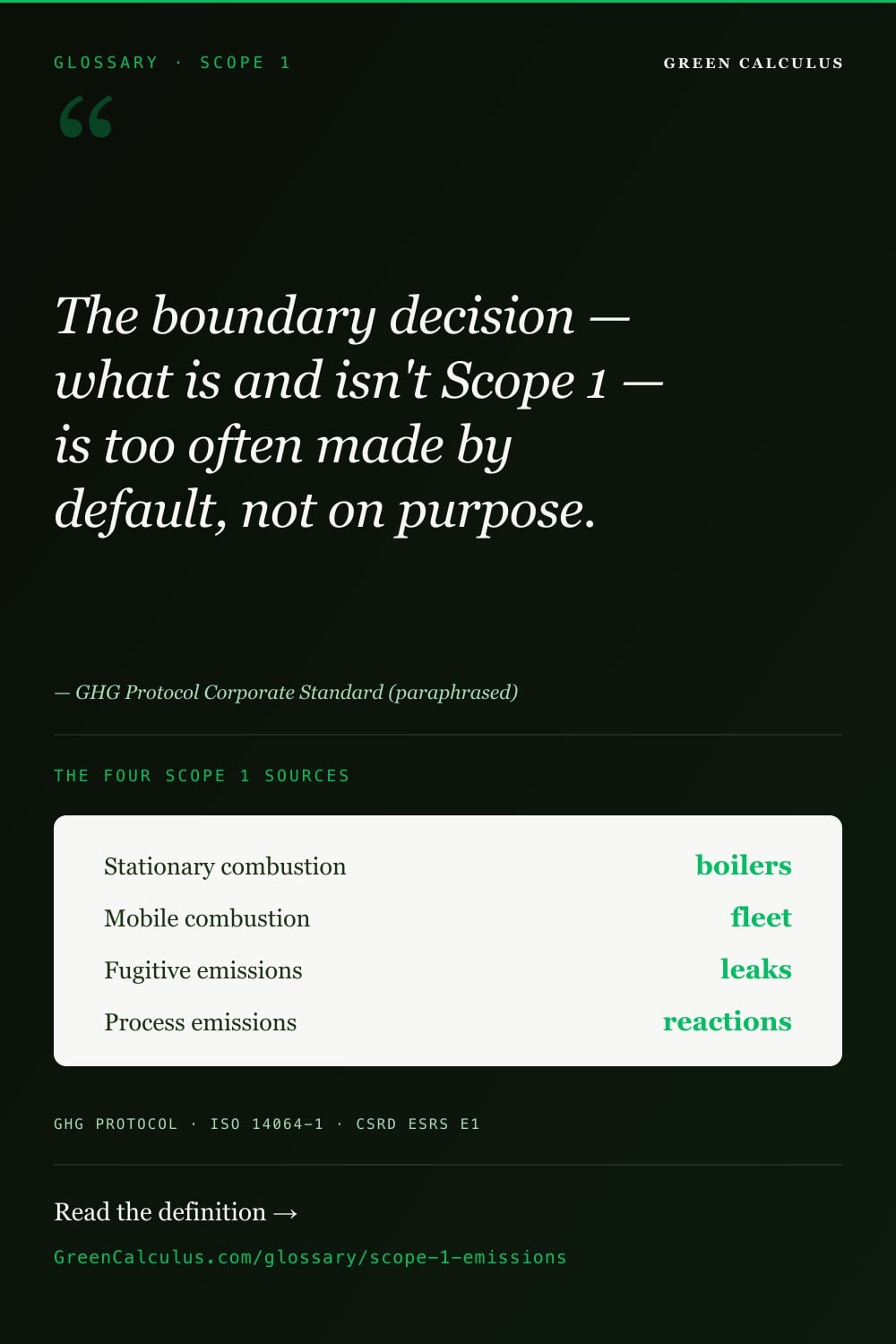
Most inventories get combustion right and miss everything else. Fugitive emissions are treated as maintenance costs. Process emissions are estimated from fuel use when they should be calculated from production volume. The boundary decision — the single choice that determines what is and is not Scope 1 — is often made by default rather than by design.
Scope 1 is where verifiers start. It is also where the largest methodology errors live — boundary misapplication, double-counted factors, and refrigerant omissions that compound silently across multi-year inventories.
Scope 1 emissions are the direct greenhouse gases from sources a company owns or controls. Under the GHG Protocol they fall into four categories: stationary combustion, mobile combustion, fugitive emissions and process emissions. The organisational boundary chosen decides which sources count.
Definition and GHG Protocol Basis
The GHG Protocol Corporate Accounting and Reporting Standard defines Scope 1 as direct GHG emissions from sources that are owned or controlled by the company. The phrase is short. The two operative words — owned and controlled — do most of the work.
Physical ownership is not required. A long-term leased facility where the company sets and implements the operating policies is a Scope 1 source. A company-owned facility leased out to a third party who controls operations is not. The structural test is whether the reporting company directs the activity that generates the emission, not whether the asset appears on the company’s balance sheet. This is why the organisational boundary decision in Section 2 matters so much: the same physical asset can be Scope 1 for one company and Scope 3 for another, depending on which entity has operational authority.
Scope 1 covers all seven greenhouse gases in the Kyoto Protocol basket: carbon dioxide (CO₂), methane (CH₄), nitrous oxide (N₂O), hydrofluorocarbons (HFCs), perfluorocarbons (PFCs), sulphur hexafluoride (SF₆), and nitrogen trifluoride (NF₃). Each gas is converted to a common reporting unit using its Global Warming Potential — currently AR6 GWP-100 for all major reporting frameworks. The result, expressed in tonnes of CO₂-equivalent (tCO₂e), is what aggregates across the four source categories below.
Scope 1 is a question of control over the emission source, not ownership of the asset. The organisational boundary approach defines what “control” means for your company — and the same approach must be applied to every facility, vehicle, and process across the inventory.
Organisational Boundary — The Decision That Shapes Everything
Before a single emission can be assigned to Scope 1, the company must choose its organisational boundary. This is a one-time structural decision that determines which entities, facilities, and operations are included in the inventory. The GHG Protocol offers three approaches — and the choice is irreversible mid-year. Switching approaches between reporting periods is a restatement event that requires recalculation of all prior years presented.
| Approach | What’s included | When to use |
|---|---|---|
| Equity share | Emissions proportional to the company’s equity share in each operation. A 40% stake in a joint-venture plant means 40% of the plant’s emissions are reported. | Common in financial reporting contexts and for operations where governance influence does not match share of economic interest. Typical in the extractive industries. |
| Financial control | 100% of emissions from operations where the company has financial control — the ability to direct financial and operating policies to gain economic benefits. | Aligns with entities included in consolidated financial accounts. Common where the inventory is being prepared alongside statutory financial reporting. |
| Operational control most common | 100% of emissions from operations where the company has full authority to introduce and implement operating policies — including health, safety, environmental, and energy policies. | The most common approach for corporate sustainability reporting. Aligns with the operational influence the sustainability team can actually exercise to drive reductions. |
The GHG Protocol Corporate Standard requires you to choose one approach and apply it consistently across the entire inventory and across all reporting years. Switching mid-inventory is a restatement event. Verifiers test boundary consistency explicitly under ISO 14064-1 assurance procedures.
The boundary choice matters most for companies with joint ventures, franchises, outsourced manufacturing, or leased facilities. A manufacturing company with a 50% equity stake in a joint-venture plant includes all plant emissions under operational control (assuming it sets the operating policies), but only half under equity share. For a franchise operator, owned outlets are Scope 1 but franchisee-operated outlets are Scope 3 Category 14 — regardless of brand. Verifiers are not checking for a particular approach; they are checking for consistent application of whichever approach you chose.
The Four Source Categories
Scope 1 is not a single calculation — it is four structurally different measurement problems. Each has its own data sources, its own emission factor conventions, and its own typical failure modes at third-party verification.
Stationary Combustion
Boilers, furnaces, generators — calculated from fuel quantity × emission factor.
Mobile Combustion
Vehicles, forklifts, owned aircraft — ownership or operational control triggers inclusion.
Fugitive Emissions
Refrigerant leaks, SF₆ from switchgear, methane from gas infrastructure — highest GWP per kg.
Process Emissions
Cement calcination, steel smelting, nitric acid — calculate from production volume, not fuel use.
1. Stationary Combustion Scope 1
Stationary combustion covers any fuel burned at a fixed location: boilers, furnaces, kilns, ovens, generators, and gas turbines. The fuel types vary by sector — natural gas dominates in commercial and light industrial settings; diesel powers backup generators at data centres and remote sites; LPG appears in food service and rural industrial settings; coal remains material in heavy industry and some legacy power generation.
The calculation is mechanically simple: fuel quantity × emission factor. The complexity is in choosing the right factor and converting fuel quantity into the units the factor expects (kWh on a gross or net calorific value basis, litres at standard temperature, kg dry mass for solid fuels).
DEFRA 2025 pre-aggregated CO₂e factors embed the CO₂, CH₄, and N₂O components at AR6 GWP-100 values. Apply the factor to fuel quantity directly — do not multiply by GWP separately on top of a DEFRA CO₂e factor. That is double-counting, and it is a finding verifiers catch immediately. Only apply GWP independently if you are working from raw component (CO₂ + CH₄ + N₂O) mass fractions.
For methodology guidance specific to each fuel, see natural gas combustion, diesel combustion, LPG combustion, and coal combustion. The full DEFRA 2025 factor set is available in the DEFRA emission factors dataset.
2. Mobile Combustion Scope 1
Mobile combustion covers fuel burned by company-owned or operationally-controlled vehicles: cars, vans, HGVs, forklifts, company aircraft, and company-operated vessels. The trigger for inclusion is ownership or operational control of the vehicle — not whether the vehicle is moving people, goods, or equipment.
Calculation can be either fuel-based (litres of diesel × kg CO₂e/litre, the higher-accuracy method where fuel-card data exists) or distance-based (km driven × kg CO₂e/km, where only mileage records are available). Fuel-based is preferred where the data supports it because it avoids the assumption embedded in distance-based factors about average vehicle efficiency.
Employee-owned vehicles used for business travel are Scope 3 Category 6 — Business Travel, not Scope 1 mobile combustion. Rental cars, hire cars, taxis, and ride-share are Scope 3 Category 6. Only vehicles the company owns or operates under its operational control policies belong in Scope 1. This is the single most common mobile-combustion boundary error in corporate inventories — and it inflates Scope 1 with emissions that should be reported in Scope 3 instead.
3. Fugitive Emissions Scope 1
Fugitive emissions are unintentional releases of greenhouse gases — leaks, vents, and equipment losses. They arrive in the inventory through three main sub-types:
- Refrigerant leaks from HVAC and commercial refrigeration systems. Most fluorocarbon refrigerants are HFC blends with very high GWPs: R-410A at 2256 [GreenCalculus gwp.HFC_410A.ar6_100 · IPCC AR6 · v2026.203]× per tonne; R-134a (still common in some chillers and mobile A/C) at 1530 [GreenCalculus gwp.HFC_134a.ar6_100 · IPCC AR6]× per tonne.
- SF₆ from electrical switchgear — high-voltage circuit breakers and gas-insulated substations use SF₆ as an arc-quenching dielectric. SF₆ has a GWP-100 of 25200 [GreenCalculus gwp.SF6.ar6_100 · IPCC AR6 WGI Ch 7 Table 7.SM.7 (2021) — AR6 GWP-100]× per tonne, the highest of any reported greenhouse gas.
- Methane from gas infrastructure — pipeline leaks, compressor station emissions, wellhead venting, and storage facility losses. Fossil methane has an AR6 GWP-100 of 29.8 [GreenCalculus gwp.CH4_fossil.ar6_100 · IPCC AR6 WGI Ch 7 Table 7.SM.7 (2021) — AR6 GWP-100]× per tonne. See methane (CH₄) for the full sectoral breakdown.
Refrigerant top-ups are recorded in maintenance logs, not energy bills. Most inventory data collection processes are built around utility invoices, which finance teams already collect — fugitive data lives in facilities and engineering systems that finance never touches. A single building that tops up 5 kg of R-410A in a year generates approximately 11.3 tCO₂e (5 kg × 2,256). That is material to most office-sector Scope 1 totals, and it will not appear in the inventory unless someone specifically queries the facilities or maintenance team.
For the full GWP table covering all common refrigerants, SF₆, and process gases, see IPCC AR6 GWP values — complete table.
4. Process Emissions Scope 1
Process emissions are non-combustion chemical reactions that release greenhouse gases as a direct by-product of a manufacturing process. The four highest-volume categories globally are: cement calcination (CaCO₃ → CaO + CO₂, the chemistry releases CO₂ regardless of how the kiln is heated); steel smelting (reduction of iron ore using metallurgical coke); nitric acid and adipic acid production (N₂O as a process by-product — see nitrous oxide (N₂O) for the full nitric/adipic methodology); and aluminium smelting (CF₄ and C₂F₆ released during anode effects).
Process emissions cannot be estimated from fuel consumption data alone — the chemistry is independent of the energy input. They must be calculated from production volume × process-specific emission factor, per IPCC 2006 Guidelines for National GHG Inventories (relevant sectoral volumes — Vol. 3 for industry). Tier 1 defaults are available for every major process; Tier 2 facility-specific factors and Tier 3 continuous emissions monitoring are used where the volumes justify the measurement investment. Applying combustion methodology to a process emission systematically understates Scope 1 and is a material methodology error at third-party verification.
Scope 1 vs Scope 2 vs Scope 3
The three GHG Protocol scopes are mutually exclusive: the same emission cannot be reported in two scopes simultaneously. Most boundary confusion in corporate inventories comes from misclassifying emissions across the Scope 1/Scope 2 line or the Scope 1/Scope 3 line — both directions, and both common.
| Scope | Definition | Examples | Calculation method | Disclosure status |
|---|---|---|---|---|
| Scope 1 | Direct — owned or controlled sources | Combustion, fugitive, process | Activity data × emission factor | Required under all major frameworks |
| Scope 2 | Indirect — purchased energy | Purchased electricity, steam, heat, cooling | Location-based or market-based | Required under all major frameworks |
| Scope 3 | Value chain indirect — upstream & downstream | Supply chain, business travel, product use | Spend-based, activity-based, or supplier-specific | Required under CSRD; 15 categories defined |
Error 1 — purchased heat or steam treated as Scope 1 combustion. If a company buys steam from a district energy provider and burns no fuel itself to generate it, there is no Scope 1 combustion. The steam emissions are Scope 2 purchased heat. Engineering teams sometimes include a boiler-equivalent estimate because “we know how much steam we use” — but if there is no on-site boiler, the emissions are not on-site, and this fabricates Scope 1.
Error 2 — business travel in non-owned vehicles reported as Scope 1 mobile combustion. Rental cars, hire cars, employee-owned vehicles, taxis, and ride-share are Scope 3 Category 6 — Business Travel, not Scope 1. Only vehicles the company owns or operationally controls are Scope 1.
For the 15 Scope 3 categories and their classification rules, see the GHG Protocol Scope 3 Standard. Scope 2 and Scope 3 will be covered in their own glossary entries (in preparation: /glossary/scope-2-emissions/ and /glossary/scope-3-emissions/).
How to Calculate Scope 1 — Worked Examples
Every Scope 1 calculation reduces to the same core multiplication, with two minor variations depending on whether you have a pre-aggregated CO₂e factor or you are working from raw gas mass.
tCO₂e = Activity Data × Emission Factor
For refrigerants and process gases: tCO₂e = Mass (tonnes) × GWP-100
Three calculation approaches are recognised under ISO 14064-1: activity-based (the most common — fuel quantity × DEFRA factor), mass-balance (used for process emissions where output equals input minus product, with the residual treated as emitted), and direct measurement via continuous emissions monitoring systems (CEMS) — Tier 2 or Tier 3, used at large industrial facilities where measurement infrastructure exists.
Worked examples — across all four source categories
| Scenario | Category | Calculation | Result (tCO₂e) |
|---|---|---|---|
| Natural gas boiler — 500,000 kWh (gross CV) | Stationary | 500,000 kWh × 0.18290 kg CO₂e/kWh | 91.5 |
| Diesel fleet — 10,000 litres consumed | Mobile | 10,000 L × 2.51839 kg CO₂e/L | 25.2 |
| R-410A refrigerant top-up — 5 kg | Fugitive | 0.005 t × 2,256 (HFC-410A GWP-100) | 11.3 |
| Cement plant — 10,000 t clinker produced | Process | 10,000 t × 0.525 t CO₂/t clinker | 5,250 |
| Nitric acid plant — 2 t N₂O measured (CEMS) | Process | 2 t × 273 (N₂O GWP-100) | 546 |
DEFRA 2025 factors used for the combustion rows. HFC-410A GWP-100 = 2,256 (mass-weighted from its AR6 components per IPCC AR6 WGI Table 7.SM.7; MasterBrain derives the blend’s AR6 GWP-20 and GWP-500 the same way). Clinker process factor per IPCC 2006 Vol. 3 Ch. 2 Tier 1 default. N₂O GWP-100 = 273 per IPCC AR6. CEMS = Continuous Emissions Monitoring System.
Calculate Scope 1 emissions across all fuels.
The Scope 1 Combustion Calculator applies DEFRA 2025 factors automatically across natural gas, diesel, LPG, coal, and more — with a per-gas and per-fuel audit trail that satisfies ISO 14064-1 transparency requirements without rebuilding from raw mass fractions.
Emission Factors and Data Sources
Scope 1 calculations draw from four families of data, layered by data quality and operational scale. The right factor for any given source is the one that minimises uncertainty for the size of emission involved — Tier 1 defaults are appropriate for small contributions; Tier 2 or Tier 3 facility-specific data is appropriate for material sources at large operations.
1. DEFRA 2026 — for UK and internationally-operating companies. Provides pre-aggregated CO₂e factors for stationary combustion, mobile combustion (fuel-based and distance-based), and most transport modes. The factor set is updated annually and is the fastest path to audit-grade Scope 1 calculations for standard fuels. The full table is available at DEFRA emission factors dataset.
2. IPCC AR6 GWP values — for refrigerants, SF₆, and process gases. Apply the gas-specific GWP to the mass of gas released to obtain CO₂e. The full table is available at IPCC AR6 GWP values — complete table.
3. IPCC 2006 Guidelines for National GHG Inventories (sectoral volumes) — for process emissions where facility-specific data is unavailable. Tier 1 defaults are provided for cement, steel, nitric acid, adipic acid, aluminium, and other major industrial processes.
4. Supplier-specific or facility-measured data (Tier 2 / Tier 3) — for large operations where default factors introduce material uncertainty. Continuous emissions monitoring (CEMS) is standard at large industrial facilities under regulatory regimes such as the EU Emissions Trading System.
CDP has required AR6 GWPs since its 2023 reporting cycle. SBTi adopted AR6 in Corporate Net-Zero Standard v1.1 (2023). The shift from AR5 to AR6 is material across most non-CO₂ gases: HFC-32 moves from 677 (AR5) to 771 [GreenCalculus gwp.HFC_32.ar6_100 · IPCC AR6 WGI Ch 7 Table 7.SM.7 (2021) — AR6 GWP-100] (AR6) — a +13.9% increase that compounds across modern split-system AC estates. HFC-134a moves from 1,300 to 1530 [GreenCalculus gwp.HFC_134a.ar6_100] (+17.7%). SF₆ moves from 23,500 to 25200 [GreenCalculus gwp.SF6.ar6_100] (+7.2%) — material for utilities and grid operators. The blends moved further still: a blend GWP is the mass-weighted average of its constituents, so it is re-derived whenever they change — R-410A goes from 1,923 to 2,256 (+17.3%) and R-404A from 3,943 to 4,728 (+19.9%). A blend figure that is identical on AR5 and AR6 is almost always an AR4 value carried forward. Check which basis your inventory software currently uses before reporting.
Regulatory and Disclosure Relevance
Scope 1 is required by every major corporate disclosure framework. The table below summarises where Scope 1 appears and which GWP basis each framework currently mandates.
| Framework | Scope 1 requirement | GWP basis | Reference |
|---|---|---|---|
| GHG Protocol Corporate Standard | Required — all four source categories | AR6 GWP-100 | View standard → |
| CSRD / ESRS E1 | E1-6 gross GHG emissions — Scope 1 required | AR6 GWP-100 (latest IPCC) | View standard → |
| CDP Climate Change | C6.1 Scope 1 emissions — required | AR6 GWP-100 (from 2023 cycle) | CDP guidance v2024+ |
| SBTi Corporate Net-Zero | All scopes — basket-of-gases approach | AR6 GWP-100 (Net-Zero Standard v1.1+) | View standard → |
| ISO 14064-1:2018 | Scope 1 quantification — completeness principle | Latest IPCC (AR6) | View standard → |
Five Common Scope 1 Mistakes
- Misapplying the organisational boundary after the fact. Choosing operational control as the inventory approach but then excluding a leased facility where the company sets operating policies (because “we don’t own it”) contradicts the chosen approach. The boundary choice — not physical ownership — defines inclusion. Verifiers test boundary consistency explicitly under ISO 14064-1, and inconsistent application is one of the highest-frequency findings at first-year assurance.
- Treating purchased steam or heat as Scope 1 combustion. If the company buys steam from a district energy provider and burns no fuel itself to generate it, there is no Scope 1 combustion — the steam is Scope 2 purchased heat. A common error is for engineering teams to include a boiler-equivalent estimate because steam consumption data is available; this fabricates Scope 1 emissions that do not physically exist on the company’s site.
- Omitting fugitive emissions entirely. Refrigerant top-ups are maintenance events recorded in facilities logs, not utility invoices. Most inventory data processes are built around bills. Until someone explicitly queries the facilities team for annual top-up quantities by refrigerant type, this category is zero by default — and wrong by default for any company with HVAC or commercial refrigeration. For a building topping up 5 kg of R-410A annually, the missing emission is approximately 10.4 tCO₂e — material to most office-sector Scope 1 totals.
- Double-counting N₂O and CH₄ on top of a DEFRA CO₂e factor. DEFRA 2025 pre-aggregated CO₂e combustion factors already embed the CO₂, CH₄, and N₂O components at AR6 GWP-100 values. Applying a DEFRA factor and then separately multiplying N₂O or CH₄ mass by GWP counts those gases twice. Apply GWP independently only when working from raw mass fractions of individual gases — never on top of a pre-aggregated factor.
- Using AR5 GWP values for HFC refrigerants and SF₆. The AR5 → AR6 transition changed several non-CO₂ GWPs materially: HFC-32 from 677 to 771 (+13.9%), HFC-134a from 1,300 to 1,530 (+17.7%), SF₆ from 23,500 to 25,200 (+7.2%). The blends moved too, and by more: a blend GWP is the mass-weighted average of its components, so R-410A rose from 1,923 to 2,256 (+17.3%) and R-404A from 3,943 to 4,728 (+19.9%). Companies that locked in AR5 values in their inventory software and have not updated are understating refrigerant Scope 1 — and will be flagged by CDP reviewers from the 2023 cycle onwards. Audit the GWP basis your software uses for every refrigerant in scope before annual close.
Related Terms, Standards, and Tools
Frequently Asked Questions
Scope 1 emissions are direct greenhouse gas emissions from sources owned or controlled by the reporting company, as defined by the GHG Protocol Corporate Standard. They are divided into four source categories: stationary combustion (boilers, furnaces, generators), mobile combustion (company-owned vehicles), fugitive emissions (refrigerant leaks, SF₆, methane from gas infrastructure), and process emissions (cement calcination, steel smelting, nitric acid production). Every corporate GHG inventory must quantify Scope 1 before it can address Scope 2 or Scope 3 — Scope 1 is the baseline of direct operational control, and the foundation on which the rest of the inventory is built.
Scope 1 is direct emissions from sources you own or control. Scope 2 is indirect emissions from purchased electricity, steam, heat, or cooling that you consume. Scope 3 is all other indirect emissions in your value chain — both upstream and downstream. The three scopes are mutually exclusive: the same emission cannot appear in two scopes simultaneously. The GHG Protocol Corporate Standard defines all three; the GHG Protocol Scope 3 Standard adds detail on the 15 Scope 3 categories. Under CSRD/ESRS E1, all three scopes are required for disclosure. Under GHG Protocol, Scope 1 and 2 are required; Scope 3 is required where material.
Concrete examples across all four categories. Stationary combustion: a natural gas boiler at a factory; a diesel generator at a data centre. Mobile combustion: a company-owned delivery van; a forklift running on LPG. Fugitive emissions: an annual refrigerant top-up for an HVAC system using R-410A (2256 [GreenCalculus gwp.HFC_410A.ar6_100]× per tonne); SF₆ loss from high-voltage switchgear (25200 [GreenCalculus gwp.SF6.ar6_100]× per tonne). Process emissions: CO₂ from cement clinker production; N₂O from nitric acid manufacture (273 [GreenCalculus gwp.N2O.ar6_100 · IPCC AR6 WGI Ch 7 Table 7.SM.7 (2021) — AR6 GWP-100]× per tonne). The unifying rule is that each source is owned or operationally controlled by the reporting company.
The core formula is tCO₂e = Activity Data × Emission Factor. For combustion, activity data is fuel quantity (kWh, litres, or kg) and the emission factor comes from DEFRA 2026 or an equivalent national dataset. For refrigerants and process gases, multiply the mass of gas in tonnes by the relevant AR6 GWP-100. For process emissions, use production volume × IPCC 2006 Tier 1 default factor for the relevant process. The Scope 1 Combustion Calculator applies DEFRA 2025 factors automatically across natural gas, diesel, LPG, and coal. A critical note: DEFRA CO₂e factors are pre-aggregated — do not apply GWP separately on top of a DEFRA factor, as that double-counts the N₂O and CH₄ components already embedded in the factor.
It depends on your organisational boundary approach. Under operational control — the most common corporate approach — Scope 1 includes emissions from any vehicle or building where the company has full authority to set and implement operating policies, regardless of whether the company owns the asset. A long-term leased office where the company sets its own energy and facilities policies is Scope 1 under operational control. Under financial control, inclusion depends on whether the lease meets the criteria for financial consolidation. Under equity share, leased assets held at less than 100% equity are pro-rated according to the equity share. The key question is not “do we own it?” but “which organisational boundary approach have we chosen, and does this asset fall within it?” See the GHG Protocol Corporate Standard for the full inclusion rules.
Get Scope 1 right the first time.
GreenCalculus tools apply DEFRA 2025 factors and AR6 GWP values automatically — and surface the per-gas, per-fuel breakdown your verifier will ask for. Built directly on the GHG Protocol Corporate Standard, IPCC AR6, and DEFRA 2025 source documents — audit-grade by default.
Need someone who does this? 6 carbon accounting & inventory providers in our directory →