
Carbon Dioxide Equivalent

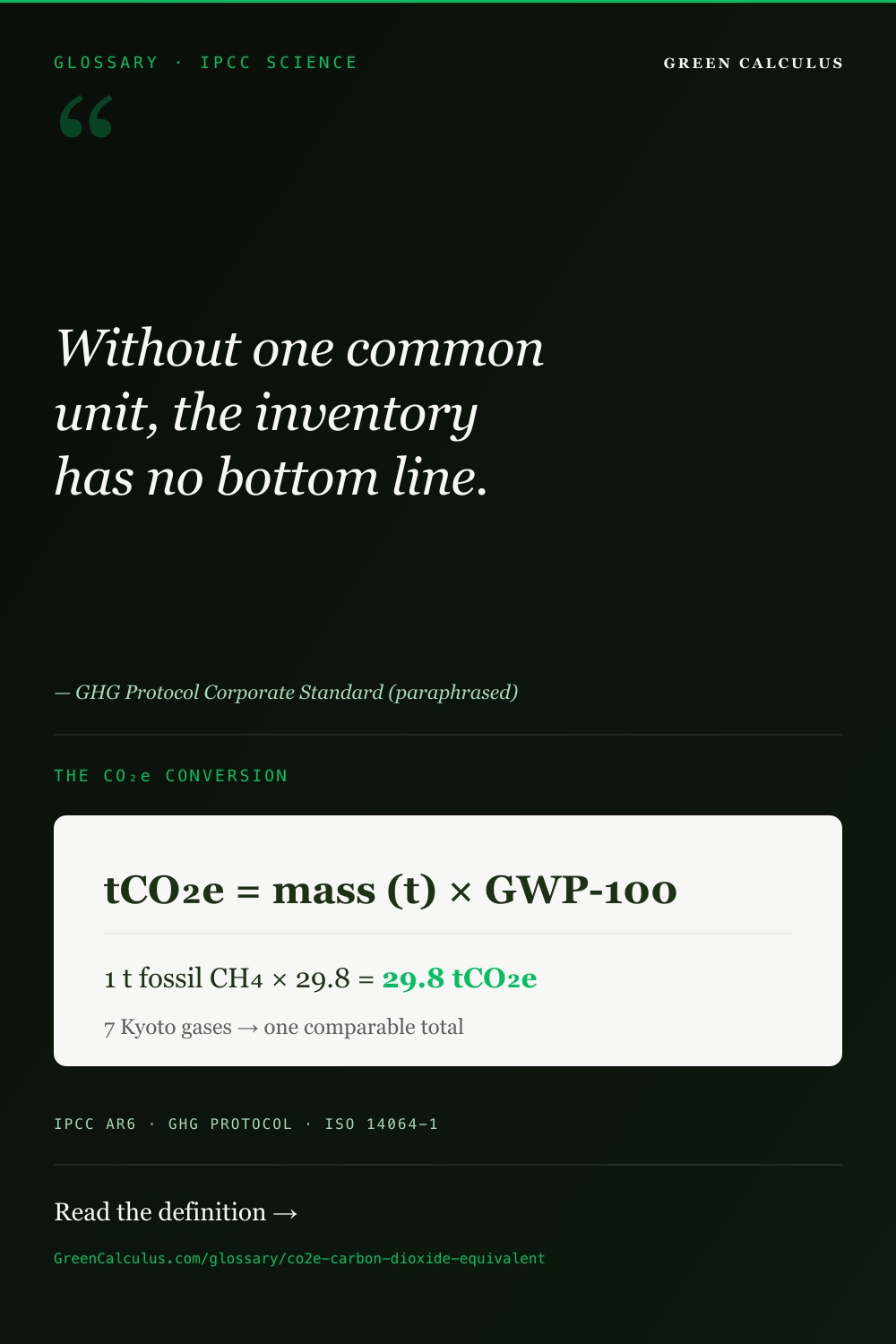
Every number in a corporate GHG inventory — every fuel consumption figure, every refrigerant leak, every tonne of fertiliser nitrogen — ends up expressed as a single unit. That unit is CO₂e. Without it, there is no way to add methane to nitrous oxide to HFCs and arrive at a total. The inventory has no bottom line.
CO₂e is not an approximation. It is a precisely defined conversion derived from IPCC assessment reports. Getting the GWP basis wrong — using AR4 values in an AR6 world, or mixing GWP-20 with GWP-100 within the same inventory — produces a total that is internally inconsistent and will not pass third-party verification.
CO₂e (carbon dioxide equivalent) is the mass of CO₂ that would cause the same 100-year warming as a given mass of another greenhouse gas. The conversion factor is the gas’s GWP-100: tCO₂e = tonnes × GWP-100. Fossil methane is 29.8, nitrous oxide 273, SF₆ 25200.
What CO₂e Means and Why It Exists
Greenhouse gases are not interchangeable. One kilogram of methane has approximately 30 times the 100-year warming impact of one kilogram of CO₂. One kilogram of nitrous oxide has 273 times the warming impact. One kilogram of sulphur hexafluoride (SF₆) has more than 25,000 times the warming impact. Adding raw mass figures across different gases produces a number that is mathematically meaningless — there is no shared denominator.
CO₂e (carbon dioxide equivalent) is the shared denominator. It expresses the mass of any greenhouse gas in terms of the mass of CO₂ that would cause the same warming effect over a chosen time horizon — almost always 100 years for corporate reporting. CO₂ itself is the reference gas, defined as having a Global Warming Potential of 1 [GreenCalculus gwp.CO2.ar6_100 · IPCC AR6 WGI Ch 7 Table 7.SM.7 (2021) — AR6 GWP-100 · v2026.203] at every horizon by convention. Every other gas is expressed as a multiple of CO₂.
CO₂e is the unit of every corporate inventory total, every GHG Protocol Scope 1, 2, and 3 line, every CSRD ESRS E1-6 gross emissions disclosure, every CDP submission, every SBTi baseline. A company that reports its emissions in tonnes of “CO₂” without converting other gases to their CO₂e equivalent is reporting a partial inventory, not a complete one.
CO₂ is one specific molecule — carbon dioxide. CO₂e is a unit that expresses the warming impact of all greenhouse gases in terms of an equivalent mass of CO₂. A natural gas boiler emits CO₂, CH₄, and N₂O — the CO₂ figure is the carbon dioxide molecule mass alone; the CO₂e figure is all three gases converted to a single equivalent total. Under GHG Protocol, both must be reported as separate line items in the per-gas breakdown — CO₂ first, then each non-CO₂ gas, then the rolled-up CO₂e total. Confusing the two is the most common labelling error in published sustainability reports.
The Seven Kyoto Basket Gases and Their AR6 GWP-100 Values
The GHG Protocol Corporate Standard requires corporate inventories to cover the seven greenhouse gases listed in the Kyoto Protocol’s Annex A, expressed in CO₂e using the most recent IPCC GWP-100 values. From the 2023 reporting cycle, that means IPCC AR6 values — adopted by CDP from its 2023 questionnaire and by SBTi in its Net-Zero Standard v1.1 (2023). The table below lists every gas covered, with current AR6 GWP-100 values rendered live from the GreenCalculus MasterBrain.
| Gas | Formula | AR6 GWP-100 | Primary sources | Scope relevance |
|---|---|---|---|---|
| Carbon dioxide | CO₂ | 1 | Combustion, industrial process, deforestation | S1, S2, S3 |
| Methane (fossil) ★ | CH₄ | 29.8 | Natural gas combustion, oil & gas fugitive, coal mining | S1, S3 |
| Methane (biogenic) ★ | CH₄ | 27 | Landfill, livestock enteric, rice cultivation, manure | S1, S3 |
| Nitrous oxide ★ | N₂O | 273 | Fertiliser, wastewater, combustion, nitric acid | S1, S3 |
| HFC-32 | CH₂F₂ | 771 | Modern AC refrigerant (R-32 systems) | S1 fugitive |
| HFC-134a | CH₂FCF₃ | 1530 | Automotive AC, commercial refrigeration | S1 fugitive |
| HFC-404A (blend) | R-125 / R-143a / R-134a | 4728 | Supermarket and industrial refrigeration | S1 fugitive |
| HFC-410A (blend) | R-32 / R-125 | 2256 | Building air conditioning, heat pumps | S1 fugitive |
| SF₆ | SF₆ | 25200 | Electrical switchgear, magnesium casting | S1 fugitive |
| PFC-14 (CF₄) | CF₄ | 7380 | Semiconductor etch, primary aluminium smelting | S1 process |
| NF₃ | NF₃ | 17400 | Semiconductor chamber cleaning, flat-panel display | S1 process |
★ = dedicated GreenCalculus glossary entry available. Source: IPCC AR6 WGI, Table 7.SM.7 (2021). Stable until IPCC AR7 (~2028). See the complete AR6 dataset →
GHG Protocol, IPCC AR6, CSRD/ESRS E1, CDP (from the 2023 questionnaire), and SBTi Corporate Net-Zero Standard v1.1 all require AR6 GWP-100 values. Inventories using AR4 (2007) or AR5 (2014) GWP values are methodologically inconsistent and will be flagged at CDP review and at any third-party assurance under ISO 14064-3. Base-year restatement using AR6 is required when migrating an inventory built on earlier IPCC values.
The Core Formula and How to Apply It
The conversion from any greenhouse gas mass to CO₂e is a single multiplication. Multiply the mass of the gas by its GWP-100 value to get CO₂e in the same mass unit. GWP-100 is dimensionless — kilograms in, kilograms out; tonnes in, tonnes out. The conversion does not change the unit of mass, only its meaning.
tCO₂e = mass (tonnes) × GWP-100
The worked examples below use AR6 GWP-100 values and represent fixed snapshots — the values shown are the values that applied at the time of publication and will not auto-update with future IPCC revisions. (For the always-current AR6 values, use the live reference table in Section 2.)
| Gas | Activity | Calculation | Result (tCO₂e) |
|---|---|---|---|
| CO₂ | 100 t combustion CO₂ | 100 × 1 | 100.00 |
| CH₄ (fossil) | 1 t fugitive methane from gas pipeline | 1 × 29.8 | 29.80 |
| CH₄ (biogenic) | 1 t methane from landfill | 1 × 27.0 | 27.00 |
| N₂O | 0.5 t N₂O from fertiliser | 0.5 × 273 | 136.50 |
| HFC-410A | 10 kg refrigerant leak | 0.010 × 2,256 | 22.56 |
| SF₆ | 1 kg leak from electrical switchgear | 0.001 × 25,200 | 25.20 |
| Mixed-gas inventory total (sum of above) | 341.06 | ||
All GWP-100 values from IPCC AR6 WGI Table 7.SM.7. Worked example values hardcoded — see header comment for shortcode policy.
GWP-100 is dimensionless — it converts mass of gas to mass of CO₂ equivalent without changing the unit. 1 kg of CH₄ × 29.8 [GreenCalculus gwp.CH4_fossil.ar6_100 · IPCC AR6 WGI Ch 7 Table 7.SM.7 (2021) — AR6 GWP-100] = 29.8 kg CO₂e. 1 tonne of CH₄ × 29.8 [GreenCalculus gwp.CH4_fossil.ar6_100] = 29.8 tonnes CO₂e. The unit of mass cancels and the output unit matches the input unit. Mixing kilograms in with tonnes out (or vice versa) is a unit error, not a CO₂e error — but it is a common one in spreadsheets that pull data from multiple source systems.
GWP Time Horizons — GWP-20, GWP-100, and GWP-500
GWP is defined over a chosen time horizon, because greenhouse gases have different atmospheric lifetimes. Methane breaks down within about 12 years; N₂O persists for 109 years; SF₆ lasts approximately 3,200 years; CO₂ has a complex multi-reservoir profile that effectively means parts of an emitted CO₂ pulse stay in the atmosphere indefinitely. Choosing a time horizon means choosing how long a window to integrate the warming effect over.
The corporate reporting default — and the only horizon currently accepted by GHG Protocol, CSRD, CDP, and SBTi — is GWP-100. GWP-20 is sometimes used in short-term climate action assessments because it amplifies the impact of short-lived climate pollutants (methane in particular). GWP-500 is used in scientific analysis for very persistent gases (SF₆, PFCs) that continue to accumulate warming over multi-century horizons. Neither GWP-20 nor GWP-500 is currently mandated for any major corporate disclosure framework.
| Gas | Atmospheric lifetime | GWP-20 | GWP-100 | GWP-500 | Time horizon effect |
|---|---|---|---|---|---|
| CO₂ | Variable | 1 | 1 | 1 | Reference gas — defined as 1 at every horizon by convention. |
| CH₄ (fossil) | 12 yr | 82.5 | 29.8 | 10 | GWP-20 is 2.8× GWP-100. Horizon choice is highly consequential. |
| N₂O | 109 yr | 273 | 273 | 130 | GWP-20 = GWP-100. Horizon choice is irrelevant for N₂O. |
| SF₆ | 3,200 yr | 18,300 | 25200 | 34,100 | GWP increases with horizon — still accumulating warming at 500 years. |
GWP-20 and GWP-500 values hardcoded — not yet available as MasterBrain shortcode keys. Source: IPCC AR6 WGI Table 7.SM.7 and Table 7.15 (CH₄ with oxidation effect).
A company cannot apply GWP-20 to methane (to emphasise short-term warming) and GWP-100 to nitrous oxide within the same total. The result is dimensionally incoherent — neither GWP-20 nor GWP-100, but a hybrid that cannot be benchmarked against any standard regulatory threshold. GHG Protocol, ISO 14064-1, and CDP all require one time horizon applied consistently across every gas in scope. If a company wishes to disclose a GWP-20 view alongside its GWP-100 mandatory disclosure, the GWP-20 view must be a complete parallel inventory — every gas converted at GWP-20, totalled separately, and labelled as such.
AR5 vs AR6 — Why the GWP Basis Matters
IPCC Assessment Reports periodically revise GWP values as the underlying climate science improves. The current standard is AR6 (Working Group I, 2021). It superseded AR5 (2014), which superseded AR4 (2007). Each revision changes specific gases by different amounts — the methane revision from AR5 to AR6 was one of the largest in the cycle, while CO₂ remains 1 by definition across every report.
The AR6 changes that matter most for corporate inventories are concentrated in three places: methane (fossil CH₄ rose from 28.0 to 29.8 [GreenCalculus gwp.CH4_fossil.ar6_100], a 6.4% increase), nitrous oxide (rose from 265 to 273 [GreenCalculus gwp.N2O.ar6_100 · IPCC AR6 WGI Ch 7 Table 7.SM.7 (2021) — AR6 GWP-100], a 3.0% increase), and the fluorinated gases (most rose 5–14%). The two HFC blends — HFC-404A and HFC-410A — rose furthest of all (+19.9% and +17.3%): a blend GWP is the mass-weighted average of its constituent gases, so it is re-derived at every assessment report rather than carried forward as a fixed figure.
| Gas | AR5 GWP-100 | AR6 GWP-100 | Delta | Material for… |
|---|---|---|---|---|
| CH₄ (fossil) | 28.0 | 29.8 | +6.4% | Oil & gas, gas distribution, coal mining |
| CH₄ (biogenic) | 28.0 | 27 | −0.4% | Landfill, livestock, rice cultivation |
| N₂O | 265 | 273 | +3.0% | Agriculture, wastewater, fertiliser supply chains |
| SF₆ | 23,500 | 25200 | +7.2% | Utilities, transmission, switchgear maintenance |
| HFC-32 | 677 | 771 | +13.9% | Modern AC, heat pump fleets |
| HFC-134a | 1,300 | 1530 | +17.7% | Automotive AC, commercial refrigeration |
| HFC-404A | 3,943 | 4728 | +19.9% | Supermarket refrigeration |
| HFC-410A | 1,923 | 2256 | +17.3% | Building AC |
| PFC-CF₄ | 6,630 | 7380 | +11.3% | Semiconductor, primary aluminium |
| NF₃ | 16,100 | 17400 | +8.1% | Semiconductor chamber cleaning |
AR5 column hardcoded — historical record. AR6 column rendered live from MasterBrain v2025.4. All values verified against IPCC AR6 WGI Table 7.SM.7.
For methane-intensive operators (oil & gas, landfill, wastewater, livestock), the AR5→AR6 transition produced an immediate 6.4% upward revision to the largest gas in the inventory. For agricultural and food-sector operators, the +3% N₂O revision is smaller per unit but compounds across high-volume operations. For semiconductor and electrical utilities, the fluorinated-gas revisions ranged from +6.7% (HFC-134a) to +13.9% (HFC-32) and +11.3% (PFC-CF₄). Companies still reporting on AR5 in the 2025 cycle were under-stating their CO₂e total against the current SBTi, CDP, and CSRD baseline.
CO₂e in Corporate GHG Inventories
Every line in a corporate GHG inventory ends in CO₂e. The arithmetic that gets it there differs by scope: Scope 1 typically calculates per-gas mass first and applies GWP-100 to each; Scope 2 uses pre-aggregated grid factors that have already done the GWP arithmetic; Scope 3 is a mix of both, depending on the category and the underlying dataset. Three contexts cover the operational reality.
Direct emissions
Combustion, fugitive, process — every gas multiplied by its AR6 GWP-100 to produce a CO₂e total.
Purchased energy
Grid emission factors are published as kg CO₂e/kWh — the GWP arithmetic is already done in the factor.
Value chain
Activity data × pre-aggregated CO₂e factors or per-gas factors depending on category and dataset.
Scope 1 — Direct emissions, per-gas arithmetic
Scope 1 covers direct emissions from sources owned or controlled by the reporting company — combustion of fuels in boilers and vehicles, fugitive releases of refrigerants and SF₆, process emissions from industrial chemistry. These typically arrive as per-gas mass figures (kg of CO₂, kg of CH₄, kg of N₂O, kg of HFC-410A, etc.), and each gas is multiplied by its AR6 GWP-100 individually to produce a CO₂e contribution. The contributions are summed to give the total Scope 1 CO₂e. The Scope 1 Combustion Calculator applies AR6 conversions across all fuel types and surfaces the per-gas breakdown in the audit trail.
Scope 2 — Purchased energy, pre-aggregated factors
Scope 2 covers emissions from purchased electricity, heat, steam, and cooling. Grid emission factors are published by national authorities (DEFRA for the UK, EPA eGRID for the US, IEA for international) as a single number per unit of energy consumed — for example, the DEFRA 2025 UK grid factor is published in kg CO₂e/kWh, with the CO₂, CH₄, and N₂O components from generation already converted to CO₂e and summed by the publishing authority. The reporting company multiplies activity (kWh consumed) by the factor and gets CO₂e directly — no per-gas arithmetic required.
Scope 3 — Value chain, mixed methodology
Scope 3 spans 15 categories per the GHG Protocol Scope 3 Standard, and the CO₂e arithmetic varies by category and by dataset. Spend-based and activity-based factors for purchased goods (Cat 1) typically arrive pre-aggregated as kg CO₂e per unit; supplier-specific data may arrive as per-gas figures requiring GWP application. Wastewater (Cat 5) uses pre-aggregated DEFRA factors. Capital goods (Cat 2) and use of sold products (Cat 11) often involve embodied-carbon datasets that need careful inspection of what is and is not already in CO₂e form.
The gases with the highest GWP-100 produce the largest CO₂e totals per kilogram emitted. One kilogram of SF₆ is equivalent to 25200 kg CO₂e [GreenCalculus gwp.SF6.ar6_100 · IPCC AR6 WGI Ch 7 Table 7.SM.7 (2021) — AR6 GWP-100]. A single kilogram leak from an HFC-410A air conditioning system is 2256 kg CO₂e [GreenCalculus gwp.HFC_410A.ar6_100 · IPCC AR6]. One kilogram of NF₃ from semiconductor chamber cleaning is 17400 kg CO₂e [GreenCalculus gwp.NF3.ar6_100 · IPCC AR6 WGI Ch 7 Table 7.SM.7 (2021) — AR6 GWP-100]. These are the lines where physical mass is negligible against an inventory total but the CO₂e contribution is material — they demand careful tracking even though the underlying activity data is small.
Calculate Scope 1 CO₂e correctly across every gas.
The Scope 1 Combustion Calculator applies AR6 GWP-100 conversions automatically for CO₂, CH₄, and N₂O across every fuel type — with a per-gas breakdown in the audit trail to satisfy ISO 14064-1 transparency requirements.
How Pre-Aggregated Emission Factors Embed CO₂e
Most emission factors that practitioners use day-to-day — DEFRA for the UK, EPA for the US, IEA for cross-border — are pre-aggregated CO₂e factors. The publishing authority has already taken the per-gas component figures (kg CO₂ per unit, kg CH₄ per unit, kg N₂O per unit), applied the GWP conversion, and summed them into a single CO₂e factor per unit of activity. Practitioners multiply activity by the factor and get CO₂e directly. The GWP arithmetic is invisible.
The DEFRA 2025 natural gas factor illustrates the structure clearly. The headline factor is 0.18296 kg CO₂e/kWh (gross calorific value basis). Behind that single number sits a CO₂ component (the dominant contributor, around 0.18229 kg CO₂/kWh), a methane slip component (kg CH₄/kWh × GWP-100), and an N₂O component (kg N₂O/kWh × GWP-100). The three are summed by DEFRA at publication. A reporter using the headline 0.18296 figure has already applied AR5 GWP-100 (DEFRA’s stated basis) to the methane and N₂O components without realising it.
Per-gas raw mass fraction datasets — used by some methodology approaches and by some scientific studies — publish kg CO₂, kg CH₄, and kg N₂O separately for each fuel. In that workflow, the practitioner is responsible for applying GWP-100 to each gas and summing. This produces the same result as a pre-aggregated factor only if the same GWP basis is used at the same precision; mixing pre-aggregated with raw fraction inputs is the most common source of double-counting in corporate inventories.
A practitioner who uses the DEFRA 2025 natural gas CO₂e factor (0.18296 kg CO₂e/kWh) and then separately calculates CH₄ slip × 29.8 [GreenCalculus gwp.CH4_fossil.ar6_100] and adds it to the result has double-counted the methane component. The CH₄ contribution is already in the DEFRA factor. The same trap exists for N₂O — the pre-aggregated factor already includes it. Only calculate from raw mass fractions if you are explicitly building from a per-gas dataset that does not pre-aggregate (such as IPCC national inventory Tier 1 default factors used as raw component inputs). When working with DEFRA, EPA eGRID, or IEA pre-aggregated CO₂e factors, the GWP arithmetic is finished — do not redo it.
Three quick indicators. One: the unit. A factor labelled “kg CO₂e/kWh” or “kg CO₂e/litre” is pre-aggregated; a factor labelled “kg CO₂/kWh” or “kg CH₄/kWh” is a raw component. Two: the source document’s stated GWP basis. DEFRA, EPA eGRID, and IEA publish a stated GWP reference (DEFRA 2025 states AR5; check before using). If a basis is stated, the factor is pre-aggregated. Three: the structure of the dataset. A single number per fuel and unit = pre-aggregated. Multiple numbers per fuel (one per gas) = raw component, GWP application required.
Five Common CO₂e Mistakes in GHG Inventories
- Using AR4 or AR5 GWP values instead of AR6. AR4 (2007) methane GWP-100 was 25; AR5 (2014) was 28; the AR6 value is now 29.8 [GreenCalculus gwp.CH4_fossil.ar6_100]. A methane-intensive inventory still using AR4 values understates methane CO₂e by 19%. CDP flags AR5 usage as methodology inconsistency from its 2023 questionnaire onwards; AR4 usage is simply wrong by every current standard. Base-year restatement to AR6 is the correct response — not silently keeping AR5 values for trend-line continuity.
- Mixing GWP time horizons within a single inventory total. Applying GWP-20 to methane (to emphasise short-term warming impact) and GWP-100 to nitrous oxide within the same CO₂e total produces a number that is neither a GWP-20 view nor a GWP-100 view — it is an inconsistent hybrid that cannot be compared to any standard regulatory threshold or science-based target baseline. Pick one horizon, apply it across every gas in scope, and disclose it explicitly.
- Double-counting by applying GWP on top of a pre-aggregated DEFRA CO₂e factor. DEFRA 2025 emission factors are already in CO₂e — the GWP multiplication has been performed by DEFRA at publication. Adding a separate CH₄ × 29.8 [GreenCalculus gwp.CH4_fossil.ar6_100] or N₂O × 273 [GreenCalculus gwp.N2O.ar6_100] calculation on top inflates the total. The reverse error — applying a pre-aggregated factor to a raw mass fraction dataset — under-counts. Verify upfront which type of factor you have.
- Confusing CO₂ and CO₂e in published disclosures. CO₂ is the carbon dioxide molecule — one specific gas. CO₂e is a unit of warming impact across all greenhouse gases expressed as CO₂ equivalent. A company that publishes “50,000 tonnes of CO₂” when it means “50,000 tonnes of CO₂e (all gases)” is either under-reporting or mislabelling, and verifiers will flag it. Under GHG Protocol, CO₂ alone and total CO₂e must both be reported in the per-gas breakdown, not collapsed into one figure.
- Applying fossil methane GWP to biogenic methane sources. Fossil and biogenic methane have separate AR6 GWP-100 values: fossil 29.8 [GreenCalculus gwp.CH4_fossil.ar6_100] and biogenic 27 [GreenCalculus gwp.CH4_biogenic.ar6_100 · IPCC AR6]. The 1.9-unit difference reflects the fossil-CO₂ tail of fossil methane oxidation that is absent for biogenic methane (where the carbon was already in the biological cycle). For landfill, livestock, rice cultivation, and anaerobic digestion, use the biogenic value. For natural gas combustion, fugitive gas, and coal mine methane, use the fossil value. Note also: biogenic CO₂ has GWP = 1 by GHG Protocol convention but is reported “outside scopes” in the carbon balance — biogenic methane, by contrast, is fully in scope at GWP-100 = 27 [GreenCalculus gwp.CH4_biogenic.ar6_100].
Related Terms, Standards, and Tools
Quick converters: move between the plain gas and its equivalent basis with CO₂ to CO₂e.
Frequently Asked Questions
CO₂e stands for “carbon dioxide equivalent” and is the unit used to express the combined warming impact of multiple greenhouse gases as a single number. Each gas’s mass is multiplied by its GWP-100 value — for example, fossil methane × 29.8 [GreenCalculus gwp.CH4_fossil.ar6_100], nitrous oxide × 273 [GreenCalculus gwp.N2O.ar6_100], SF₆ × 25200 [GreenCalculus gwp.SF6.ar6_100] — and the results are summed to give a total CO₂ equivalent. CO₂e is the unit used for every line in a corporate GHG inventory under GHG Protocol, CSRD/ESRS E1, CDP, and SBTi. Without CO₂e, there is no way to add the warming impact of different gases into a single total.
CO₂ is the carbon dioxide molecule — one specific gas with a defined chemical formula. CO₂e is a unit of measurement that represents the climate warming impact of any greenhouse gas (or a mix of greenhouse gases) expressed as the equivalent mass of CO₂ that would cause the same warming over 100 years. A natural gas boiler emits CO₂, methane (CH₄), and nitrous oxide (N₂O) — the CO₂ figure counts only the carbon dioxide molecules; the CO₂e figure converts all three gases to a single equivalent total. Under GHG Protocol, both must be reported as separate line items: CO₂ alone in the per-gas breakdown, and total CO₂e for the inventory rollup.
The formula is tCO₂e = mass (tonnes) × GWP-100. Multiply the mass of each greenhouse gas by its IPCC AR6 GWP-100 value, then sum across gases. For example, 1 tonne of fossil methane × 29.8 [GreenCalculus gwp.CH4_fossil.ar6_100] = 29.8 tCO₂e. 0.5 tonnes of N₂O × 273 [GreenCalculus gwp.N2O.ar6_100] = 136.5 tCO₂e. 10 kg of HFC-410A × 2256 [GreenCalculus gwp.HFC_410A.ar6_100] = 22,560 kg CO₂e (or 22.56 tCO₂e). Most emission factors used in practice — DEFRA, EPA, IEA — are already published in CO₂e form, with the GWP arithmetic done at the source. In that workflow, the calculation simplifies to activity × pre-aggregated CO₂e factor, and no separate per-gas GWP step is required.
Use IPCC AR6 GWP-100 values for all corporate reporting from 2023 onwards. Key AR6 values: CO₂ = 1 [GreenCalculus gwp.CO2.ar6_100], fossil methane = 29.8 [GreenCalculus gwp.CH4_fossil.ar6_100], biogenic methane = 27 [GreenCalculus gwp.CH4_biogenic.ar6_100], nitrous oxide = 273 [GreenCalculus gwp.N2O.ar6_100], SF₆ = 25200 [GreenCalculus gwp.SF6.ar6_100], HFC-134a = 1530 [GreenCalculus gwp.HFC_134a.ar6_100 · IPCC AR6], HFC-410A = 2256 [GreenCalculus gwp.HFC_410A.ar6_100], NF₃ = 17400 [GreenCalculus gwp.NF3.ar6_100]. AR5 values (used 2014–2022) are now retained only for base-year restatement reference. AR4 values (used 2007–2013) are obsolete and methodologically incorrect under any current framework. GHG Protocol, CDP (from 2023), SBTi v1.1, and CSRD/ESRS E1 all require AR6.
GWP values are derived from atmospheric science — specifically, each gas’s radiative efficiency (how much warming it causes per molecule), atmospheric lifetime (how long it persists), and the chemistry of its breakdown products. Each IPCC Assessment Report incorporates the latest measurements and modelling, and revises the values accordingly. The AR5 → AR6 revision (2014 to 2021) raised fossil methane from 28 to 29.8 [GreenCalculus gwp.CH4_fossil.ar6_100] (+6.4%), nitrous oxide from 265 to 273 [GreenCalculus gwp.N2O.ar6_100] (+3.0%), and most fluorinated gases by 5–14%. AR6 values are stable until IPCC AR7 publishes (~2028). Until then, AR6 GWP-100 is the required basis for every major corporate disclosure framework. The MasterBrain behind GreenCalculus tools auto-updates the AR6 values used in calculations the moment a MasterBrain version bumps — without requiring per-page edits.
Build inventory totals on AR6 CO₂e — by default.
GreenCalculus tools apply AR6 GWP-100 conversions automatically across every gas, surface the per-gas breakdown your verifier will ask for, and update the moment IPCC AR7 publishes. Built directly on the GHG Protocol Corporate Standard, IPCC AR6, and DEFRA 2025 source documents — audit-grade by default.
Need someone who does this? 6 carbon accounting & inventory providers in our directory →