
Carbon Intensity

Two companies each emit 50,000 tonnes of CO₂e. One is a corner workshop; the other is a multinational. Are they equally carbon-intensive? Obviously not — but their absolute emissions say they are. To compare them, or to judge whether a single company is genuinely getting cleaner as it grows, you need to divide the emissions by something: revenue, output, floor space, kilowatt-hours. That division turns a raw total into a measure of efficiency.
Carbon intensity is that ratio — emissions per unit of output — and it reveals how much carbon it takes to produce a unit of something, in a way that absolute emissions alone never can.
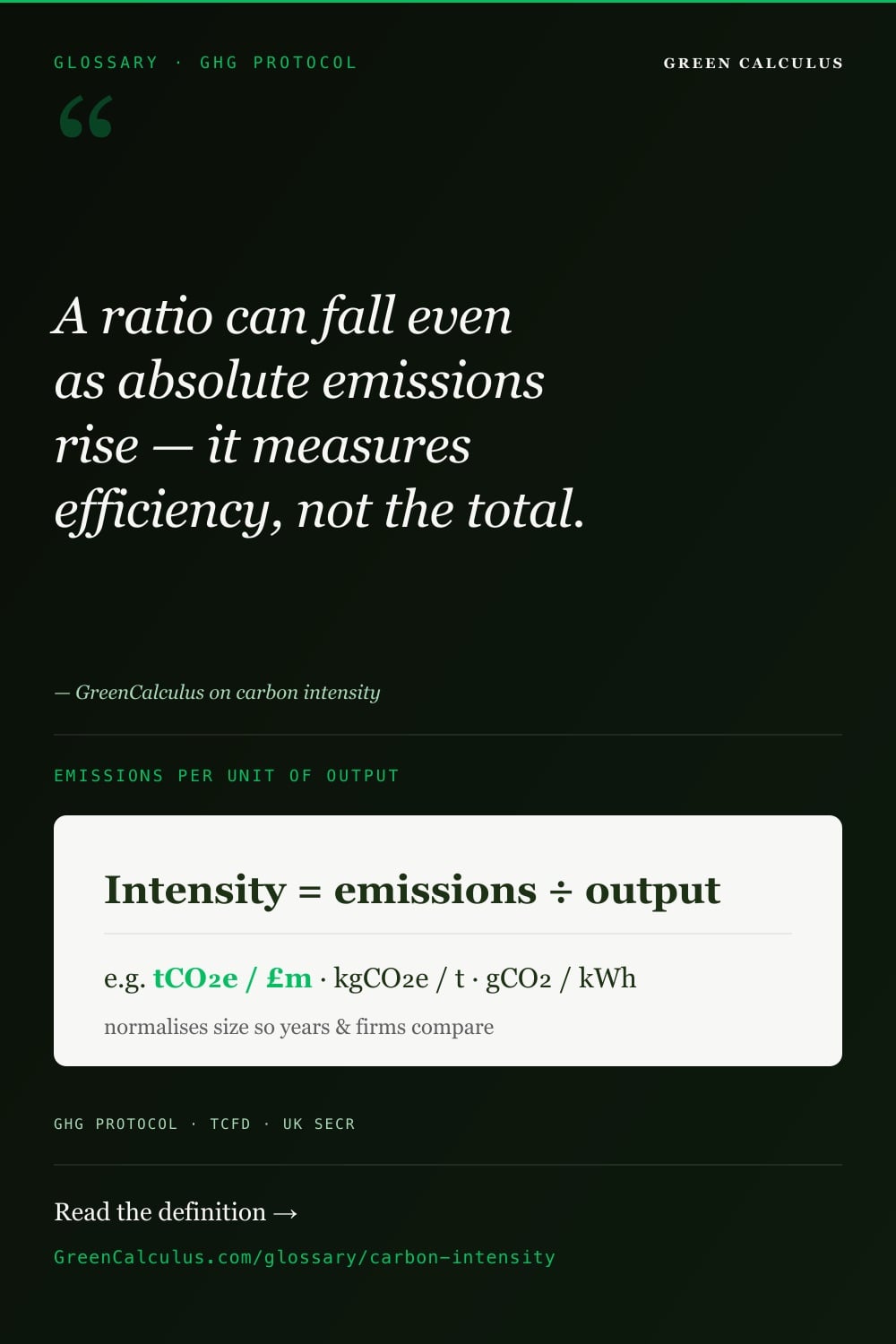
Carbon intensity is greenhouse gas emissions divided by a measure of activity or output — revenue, production, floor area, electricity generated. It normalises emissions so different sizes and years compare, but because it is a ratio it can fall while absolute emissions rise.
Definition — Emissions per Unit of Output
Carbon intensity is a company’s greenhouse gas emissions expressed relative to a measure of its activity or output, rather than as an absolute total. It is calculated by dividing emissions (in tCO₂e) by a chosen denominator — revenue, units produced, tonnes of material, floor area, passenger-kilometres, or kilowatt-hours generated. The result is a rate: how much carbon accompanies each unit of the thing being measured. It is also called emissions intensity.
Its purpose is normalisation. Absolute emissions tell you a company’s total climate impact but nothing about how efficiently it operates, and they make companies of different sizes impossible to compare. Dividing by output strips out scale, so a small efficient firm and a large one can be compared on equal terms, and a growing company can show whether its emissions are rising faster or slower than its business.
Carbon intensity is closely related to, but distinct from, an emission factor. An emission factor is emissions per unit of an emitting activity (kg CO₂e per litre of fuel); carbon intensity is emissions per unit of output or value (tCO₂e per £m of revenue). One is an input to a calculation; the other is a performance metric derived from the finished inventory.
Definition at a glance
| Also known as | Emissions intensity · GHG intensity · carbon intensity ratio |
|---|---|
| What it is | Emissions per unit of a normalising metric (output, revenue, energy…) |
| Formula | Emissions ÷ an activity or output metric |
| Two main types | Physical intensity (per physical unit) · economic intensity (per unit of revenue) |
| Common units | tCO₂e/£m revenue · kgCO₂e/tonne · gCO₂/kWh |
| Not to be confused with | Absolute emissions · an emission factor |
The GHG Protocol Corporate Standard presents intensity ratios as performance metrics — a company’s emissions divided by an appropriate business metric — reported alongside, not instead of, its absolute emissions. UK SECR goes further and makes it mandatory for the companies and LLPs it covers: they must express their emissions by at least one intensity ratio, such as tCO₂e per unit of revenue or per square metre of floor space.
In the EU, the original ESRS E1 (2023) required a “GHG intensity” figure: total GHG emissions per net revenue. The simplified ESRS adopted in 2026 (Delegated Regulation (EU) 2026/1563, applying from financial year 2027) drop that disclosure. Intensity now appears only in targets: a company that sets only an intensity target must also disclose the absolute emissions it implies for the target year.
For investors, the TCFD recommends a portfolio-level intensity metric — the weighted average carbon intensity (WACI) — as a standard way to compare the carbon exposure of holdings.
Physical vs Economic Intensity
Carbon intensity comes in several forms, distinguished by what sits in the denominator. The two headline types are physical and economic; two other common usages complete the picture:
| Type | Denominator | Typical unit | Used for |
|---|---|---|---|
| Physical intensity | Physical output | kgCO₂e/tonne, /MWh, /m², /km | Operational efficiency, product benchmarking |
| Economic intensity | Revenue or value added | tCO₂e/£m revenue | Corporate disclosure, cross-company comparison |
| Grid carbon intensity | Electricity generated | gCO₂/kWh | The carbon content of electricity |
| Portfolio (WACI) | Revenue, portfolio-weighted | tCO₂e/£m revenue | Investor climate metric |
Physical intensity is the truer measure of operational efficiency, because it is not distorted by prices — but it only works within a single product or process. Economic intensity can compare across wildly different businesses, but a price rise flatters it (more revenue for the same emissions) even when nothing physical has changed. The grid carbon intensity of electricity is simply a physical intensity applied to power generation.
The Formula and a Worked Example
Carbon intensity = total emissions ÷ a chosen activity or output metric
A factory emits 8,000 tCO₂e making 40,000 tonnes of product, on £20m of revenue. Its physical intensity is 8,000 ÷ 40,000 = 0.2 tCO₂e per tonne of product (200 kgCO₂e/tonne). Its economic intensity is 8,000 ÷ 20 = 400 tCO₂e per £m of revenue. Both describe the same factory and the same 8,000 tonnes — they simply answer different questions: how clean is each tonne of product, and how carbon-heavy is each pound of turnover.
Intensity vs Absolute Emissions
The most important thing to understand about carbon intensity is what it does not tell you. Because it is a ratio, intensity can fall while absolute emissions rise — if output grows faster than emissions. A company can look like it is decarbonising on an intensity basis while putting more CO₂ into the atmosphere in absolute terms.
| Point | tCO₂e/£m |
|---|---|
| 2020 | 14.2 tCO₂e/£m |
| 2021 | 12.9 tCO₂e/£m |
| 2022 | 11.8 tCO₂e/£m |
| 2023 | 10.9 tCO₂e/£m |
| 2024 | 9.80 tCO₂e/£m |
Suppose a company’s emissions rise 12% over five years while its revenue rises 55%. Its carbon intensity falls by about 28% (1.12 ÷ 1.55) — a genuine efficiency gain — yet it has emitted more CO₂, not less. Intensity measures efficiency; only absolute emissions measure total climate impact, and the atmosphere responds to absolute tonnes. This is why intensity targets are scrutinised, and why frameworks such as the SBTi require most companies to set absolute reduction targets, allowing intensity targets only in limited circumstances.
Where Carbon Intensity Is Used
Despite its limits, carbon intensity is indispensable, because efficiency and scale are different questions and both need answering:
- Mandatory disclosure. UK SECR requires at least one intensity ratio. The original ESRS E1 required GHG intensity per net revenue; the simplified ESRS that apply from financial year 2027 no longer do. Our intensity metric disclosure checker tests a ratio against these rules.
- Targets. Some companies set intensity-based reduction targets, particularly where output is expected to grow; the SBTi permits these under defined conditions.
- Benchmarking. Intensity is the only way to compare the carbon performance of companies, products, or facilities of different sizes on a like-for-like basis.
- Investor metrics. The portfolio-weighted WACI lets investors compare the carbon exposure of holdings and portfolios.
Common Confusions
- Reading a falling intensity as a falling footprint. Intensity can drop while absolute emissions climb; only absolute figures show total impact.
- Confusing carbon intensity with an emission factor. An emission factor is per unit of an emitting activity; intensity is per unit of output or revenue.
- Comparing physical and economic intensities. They use different denominators and are not interchangeable — a per-tonne figure cannot be set against a per-pound one.
- Letting price movements flatter economic intensity. A price rise lowers tCO₂e per unit of revenue with no physical improvement at all.
- Assuming an intensity target is as ambitious as an absolute one. An intensity target can be met while emissions grow, which is why absolute targets are generally preferred.
- Comparing intensities with mismatched scopes or boundaries. Two intensity ratios are only comparable if the emissions in the numerator cover the same scopes.
Frequently Asked Questions
Carbon intensity, also called emissions intensity, is a company’s greenhouse gas emissions divided by a measure of its activity or output — such as revenue, physical production, floor area, or electricity generated. It normalises emissions so companies of different sizes, or the same company across years, can be compared on efficiency rather than raw total. Typical units are tonnes of CO₂e per million pounds of revenue, kilograms of CO₂e per tonne of product, or grams of CO₂ per kilowatt-hour. Because it is a ratio, it measures how efficiently a business emits, not its total climate impact.
They differ in the denominator. Physical intensity divides emissions by a physical output — tonnes of product, MWh, square metres, kilometres — and measures true operational efficiency, undistorted by prices, but only within a single product or process. Economic intensity divides emissions by revenue or value added (for example tCO₂e per £m of revenue) and can compare very different businesses, but it is flattered by price rises, which lower emissions per pound of revenue without any physical change. Companies often report both, because each answers a different question about the same emissions.
Yes, and this is the key caveat. Because intensity is emissions divided by output, it falls whenever output grows faster than emissions — even if absolute emissions increase. A company whose emissions rise 12% while revenue rises 55% cuts its carbon intensity by about 28%, yet emits more CO₂ in absolute terms. Intensity captures efficiency; only absolute emissions capture total impact, and the atmosphere responds to absolute tonnes. This is why a falling intensity should never be read, on its own, as a falling footprint, and why absolute targets are generally regarded as more rigorous.
No, though they look similar. An emission factor is emissions per unit of an emitting activity — kilograms of CO₂e per litre of fuel or per kWh of electricity — and is an input used to calculate emissions. Carbon intensity is emissions per unit of output or value — tonnes of CO₂e per £m of revenue or per tonne of product — and is a performance metric derived from the finished inventory. One helps you compute the emissions; the other helps you interpret them relative to the size of the business. The grid carbon intensity of electricity (gCO₂/kWh) is the case where the two coincide.
UK SECR makes at least one intensity ratio mandatory. The original EU ESRS E1 required GHG intensity per net revenue, but the simplified ESRS that apply from financial year 2027 drop it and mention intensity only for targets. Some companies set intensity-based reduction targets, which the SBTi permits under defined conditions, particularly where output is expected to grow. Intensity is also the standard basis for benchmarking companies, products, or facilities of different sizes, and investors use the portfolio-weighted weighted average carbon intensity (WACI) to compare the carbon exposure of holdings. In every case it complements, rather than replaces, the absolute figures.
GHG intensity, also called greenhouse gas or emission intensity, is the same metric as carbon intensity: total greenhouse gas emissions in tonnes of CO₂e divided by a measure of activity, such as revenue, tonnes of product or kWh generated. The original EU ESRS E1 defined it as total GHG emissions per net revenue. A company emitting 8,000 tCO₂e on £20m of revenue has a GHG intensity of 400 tCO₂e per £m. Report it alongside absolute emissions, because the ratio can fall while total emissions grow.
Need someone who does this? 6 carbon accounting & inventory providers in our directory →