
Global Warming Potential (GWP) Calculator — CO2e, AR6/AR5, GWP-100
Convert a mass of any greenhouse gas into carbon dioxide equivalent (CO2e) using IPCC AR6 or AR5 GWP-100 values, for a single gas or a full multi-gas inventory.
The conversion (per gas):
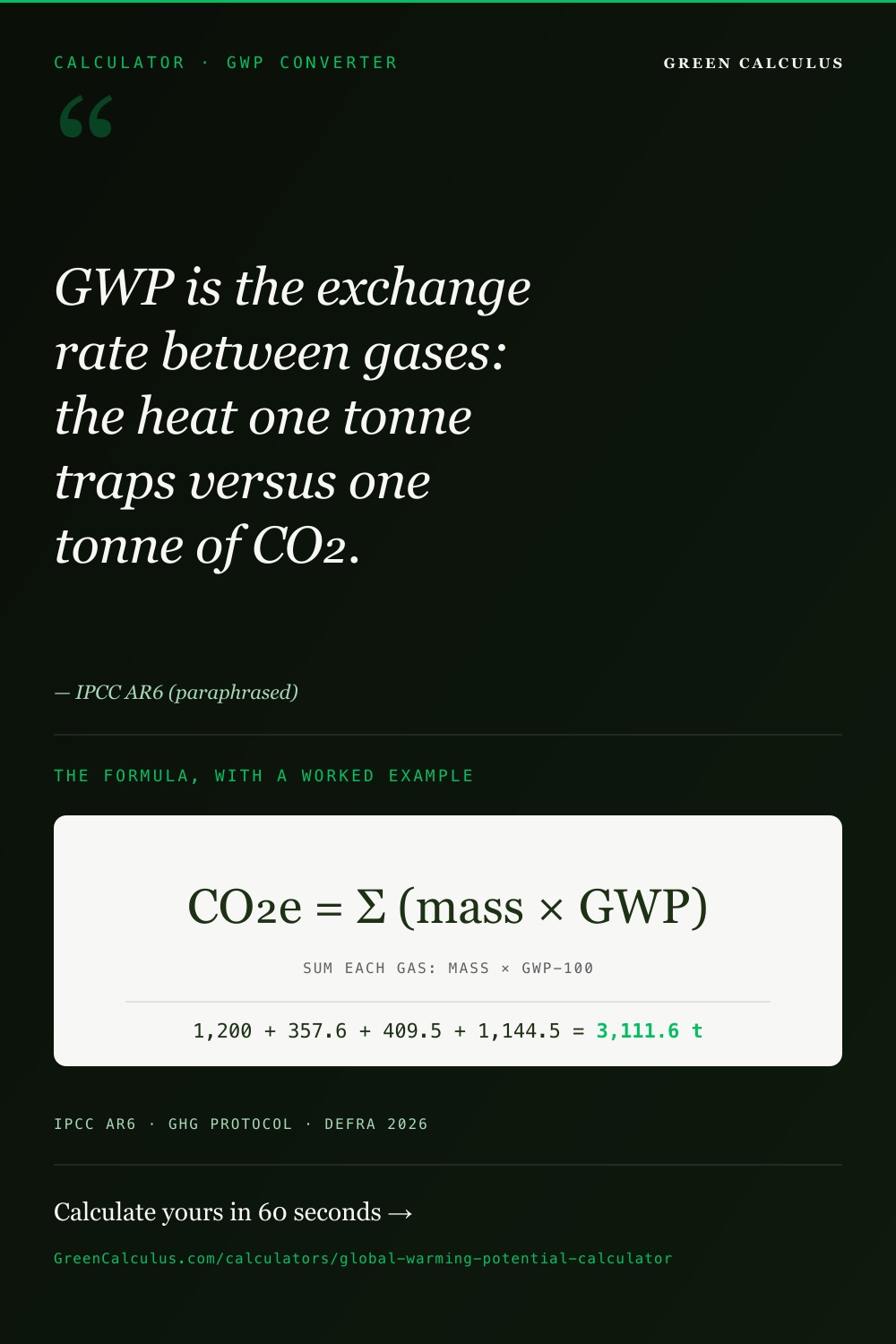
CO2e (mass) = Gas mass × Global Warming Potential (GWP) of that gas over the chosen time horizon.
Global Warming Potential is the metric that lets non-CO2 greenhouse gases be added into a single number. It expresses how much energy the emission of one tonne of a gas traps over a given period, relative to the emission of one tonne of carbon dioxide over the same period. Carbon dioxide is the reference gas, so its GWP is 1 by definition on every time horizon and in every assessment report. A gas with a GWP-100 of 273 (nitrous oxide, AR6) traps 273 times as much energy over 100 years as the same mass of CO2.
Time horizon. This calculator uses the 100-year horizon (GWP-100), the basis mandated across corporate GHG reporting — the GHG Protocol Corporate Standard, ISO 14064-1, CSRD ESRS E1, and the SBTi Corporate Net-Zero Standard all report on GWP-100. A 20-year horizon (GWP-20) exists in IPCC science and weights near-term warming more heavily — most consequential for methane — but is a sensitivity or advocacy lens, not a reporting basis. A GWP-20 horizon toggle is a planned addition; see the time-horizon section below.
Assessment-report basis. The GWP number for a given gas differs between IPCC assessment reports as the underlying radiative-forcing science is refined. This tool offers two: AR6 (the current science, 2021) and AR5 (2013). Pick the basis your reporting framework specifies. Corporate reporting defaults to AR6; some factor libraries — notably UK DEFRA — still carry AR5 internally by design. Never mix bases inside one inventory total.
Fossil vs biogenic methane. AR6 splits methane into two GWP values: fossil-origin methane (GWP-100 of 29.8) and non-fossil/biogenic methane (27.0). They are separate, non-interchangeable rows. Use the fossil value for methane from fossil-fuel extraction, gas systems, and coal; the biogenic value for methane from livestock, landfill, wetlands, and other biological sources.
What this tool does not do. It converts a mass you supply into CO2e; it does not estimate the mass of gas emitted. To go from an activity (litres of diesel, kWh of gas, kg of refrigerant leaked) to a mass or directly to CO2e, use the relevant activity calculator — for example the refrigerant leakage calculator for F-gases or the stationary combustion calculator for fuels.
IPCC AR6 WGI Ch 7 (Table 7.SM.7). AR6 is the current default; switch to AR5 for DEFRA/UK-regulatory alignment.
Each gas’s mass × its GWP-100 factor = its CO₂-equivalent. Factors are read live from MasterBrain (IPCC AR6) — GreenCalculus estimates nothing; gases without a factor are excluded and flagged.
Enter a gas and a mass to convert to CO₂-equivalent
Results appear instantly. The total CO₂e, each gas’s share, the AR6-vs-AR5 basis delta, and the full per-gas audit trail appear after conversion.
This tool applies published IPCC AR6 100-year Global Warming Potential factors (WGI Ch 7, Table 7.SM.7), read live from MasterBrain, to convert gas masses into CO₂-equivalent. GWP factors are reference multipliers, not emissions in themselves — the resulting CO₂e is scope-agnostic: whether a figure is Scope 1, 2, or 3 depends on the source activity. Fossil and biogenic methane use different factors; pick the one matching your source. The AR5 basis is provided for DEFRA/UK-regulatory alignment and historical comparison. The 20-year horizon and AR4 are not offered. State which basis you used when you disclose the result.
Every corporate carbon number — every “tonnes CO2e” on every disclosure — rests on a single conversion that most people never see. Methane, nitrous oxide, refrigerants, and the industrial fluorinated gases are all physically different substances that trap different amounts of heat over different timescales. Global Warming Potential is the exchange rate that turns them into one currency.
Get the GWP wrong — the wrong assessment report, the wrong time horizon, fossil methane where biogenic was meant — and every downstream total inherits the error.
CO2e = gas mass × its Global Warming Potential (GWP-100). On IPCC AR6, methane is 29.8 (fossil) or 27.0 (biogenic), nitrous oxide is 273, and CO2 is 1 by definition. Sum across gases for an inventory total.

What Global Warming Potential measures
Greenhouse gases are not equally potent. A tonne of methane released today traps far more heat over the following century than a tonne of carbon dioxide — but it also breaks down in the atmosphere much faster, so the comparison depends entirely on the timescale you choose. Global Warming Potential is the index the IPCC publishes to make that comparison precise: it is the ratio of the energy trapped by one tonne of a gas, integrated over a chosen number of years, to the energy trapped by one tonne of CO2 over the same years.
Why CO₂e is the common currency
A greenhouse-gas inventory contains many different molecules. You cannot add a tonne of methane to a tonne of nitrous oxide and get anything physically meaningful — they are different substances. GWP solves this by converting every gas into the mass of CO2 that would trap the same amount of heat over the horizon: carbon dioxide equivalent, written CO2e. Once every gas is expressed in CO2e, the numbers are additive, and a single portfolio-, facility-, or product-level total becomes possible.
Carbon dioxide is the reference gas. Its GWP is 1 by definition — on every time horizon, in every assessment report. Every other gas is measured relative to it. This is why a CO2-only figure and its CO2e equivalent are identical, and why the interesting question is always about the non-CO2 gases.
The GWP-100 time horizon — and why 20-year values exist
The number of years over which the heat-trapping is integrated is the time horizon. The 100-year horizon (GWP-100) is the near-universal reporting convention, and the one this calculator uses. A 20-year horizon (GWP-20) also exists in IPCC science, and it weights near-term warming much more heavily — the difference matters most for short-lived gases, methane above all, whose potency is concentrated in the decades right after release. On a 20-year view methane’s warming influence is several times larger than its GWP-100 suggests.
This tool uses GWP-100 because that is the basis every corporate reporting framework mandates — GWP-20 is a sensitivity and advocacy lens, not a reporting standard, so a GWP-100-only tool omits no compliance requirement. A GWP-20 horizon toggle is a planned addition; the underlying 20-year values are tabulated in the same IPCC source as the 100-year ones, so it is a clean future extension rather than new science.
How the conversion works
The conversion is a single multiplication per gas, summed across the inventory:
CO2e (tonnes) = Σ [ mass of gasi (tonnes) × GWP-100 of gasi ]
Single gas
A facility vents 4 tonnes of fossil-origin methane over a reporting year. On AR6 GWP-100, fossil methane is 29.8. The CO2e is 4 × 29.8 = 119.2 tCO2e. The same 4 tonnes entered as biogenic methane (GWP 27.0) would be 108.0 tCO2e — a 10% difference that turns entirely on selecting the correct methane row.
Mixed-gas inventory
For an inventory, each gas is converted with its own GWP and the CO2e figures are summed. Because CO2e is a common unit, the sum is valid even though the underlying gases are chemically unrelated. The worked example below runs this end to end for a four-gas facility. The one rule that governs the sum: every gas must be converted on the same assessment-report basis and the same horizon — an AR6 methane figure and an AR5 nitrous-oxide figure cannot share a total.
If you already know the mass of each gas, this calculator is the whole job. If you only have an activity — litres of fuel, kWh of electricity, kilograms of refrigerant lost — the mass or CO2e usually comes straight from an activity-specific factor, so start with the matching calculator (combustion, electricity, refrigerant leakage) and use this tool to sanity-check or re-base the GWP.
AR6 vs AR5 — which values to use
The GWP of a gas is not a fixed constant. It is a scientific estimate that the IPCC refines with each assessment cycle as the understanding of atmospheric lifetimes and radiative efficiency improves. The number you use should match the basis your reporting framework specifies — and the two bases can differ by enough to move a total.
Why the numbers moved between reports
Between AR5 (2013) and AR6 (2021), most GWP-100 values shifted. Nitrous oxide rose from 265 to 273. Fossil methane rose from 28 to 29.8, and AR6 additionally introduced the fossil/biogenic split that AR5 did not carry. Several fluorinated gases moved by 10–20%. These are refinements to the radiative-forcing science, not corrections of errors — which is exactly why both bases remain in use, tied to whichever framework or factor library a given report is built on. Values here trace to IPCC AR6.
Which report your framework mandates
| Framework / source | GWP basis in current use | Note |
|---|---|---|
| GHG Protocol Corporate Standard | AR6 GWP-100 (AR5 still widely reported) | The Protocol points to the latest IPCC values; many inventories are mid-transition from AR5 |
| ISO 14064-1 | AR6 GWP-100 | References current IPCC GWP-100 for CO2e aggregation |
| CSRD ESRS E1 (EU) | AR6 GWP-100 | Latest available IPCC GWP-100 for the reporting period |
| SBTi Corporate Net-Zero | AR6 GWP-100 | Baseline and target inventories on current IPCC values |
| UK DEFRA conversion factors | AR5 GWP-100 (internally) | DEFRA-sourced fuel and grid factors carry AR5 by design; a DEFRA-based inventory is on an AR5 basis unless restated |
Fossil vs biogenic methane — the AR6 split
AR6 reports two methane GWP-100 values where AR5 reported one: fossil-origin methane at 29.8 and non-fossil/biogenic methane at 27.0. The difference reflects the extra CO2 produced when fossil methane oxidises in the atmosphere — carbon that was previously locked underground. Use the fossil value for methane from oil and gas systems, coal, and other fossil sources; the biogenic value for methane from livestock (enteric fermentation), manure, landfill, wastewater, and wetlands. On AR5, both collapse to a single value (28), so an AR5 inventory does not make this distinction.
Do not mix bases inside one total
A single inventory total must be built on one GWP basis. The most common way this breaks: pulling CO2e for fuels straight from a DEFRA-based calculator (AR5 internally) and adding an F-gas or process figure computed on AR6, then reporting the sum as “AR6”. The number is neither basis. If your fuel and grid figures come from an AR5-based library and the rest of your inventory is AR6, restate one side before summing — and state the basis explicitly in the disclosure.
GWP reference values (AR6 & AR5, GWP-100)
The values below are the ones this calculator applies, for the greenhouse gases most readers will recognise. Both columns are drawn from IPCC AR6, Working Group I, Chapter 7, Table 7.SM.7. The AR5 column is the AR5 GWP-100 as tabulated in that same AR6 table for historical comparison — not the AR5 report directly. All values are GWP-100 (the 100-year horizon).
| Greenhouse gas | Formula | AR6 GWP-100 | AR5 GWP-100 |
|---|---|---|---|
| Carbon dioxide | CO2 | 1 | 1 |
| Methane — fossil | CH4 | 29.8 | 28 |
| Methane — non-fossil / biogenic | CH4 | 27.0 | 28 |
| Nitrous oxide | N2O | 273 | 265 |
| Sulphur hexafluoride | SF6 | 25,200 | 23,500 |
| Nitrogen trifluoride | NF3 | 17,400 | 16,100 |
| HFC-134a (refrigerant) | CH2FCF3 | 1,530 | 1,300 |
Two points worth reading off the table. Carbon dioxide is 1 on both bases — that is the definition of the reference gas, not a coincidence. And the two methane rows are genuinely different gases-of-origin, not a rounding artefact: 29.8 for fossil, 27.0 for biogenic on AR6, both collapsing to 28 on AR5. Entering biogenic methane against the fossil value (or the reverse) is a real 10% error, not a display quirk.
This is the curated shortlist — the gases most inventories actually touch. The full 15-gas set, including the HFC and PFC families and the fluorinated blends, with the complete AR6/AR5 comparison and a sortable ranking, lives on the dedicated IPCC AR6 GWP values data page.
Worked example — a multi-gas facility inventory
A single manufacturing site reports four greenhouse gases for the year, on an AR6 GWP-100 basis. The masses come from the site’s own metering and mass-balance records; this calculator does the CO2e conversion and the sum. Every figure below reproduces exactly from the AR6 GWP-100 values in the reference table above.
Four gases, one facility, one reporting year, AR6 GWP-100 throughout. CO2e per gas = mass × GWP-100; the total is the sum.
| Gas | Mass emitted (t) | AR6 GWP-100 | CO2e (t) | Share of total |
|---|---|---|---|---|
| Carbon dioxide (CO2) | 1,200 | 1 | 1,200.0 | 38.5% |
| Methane — fossil (CH4) | 12 | 29.8 | 357.6 | 11.5% |
| Nitrous oxide (N2O) | 1.5 | 273 | 409.5 | 13.1% |
| HFC-134a | 0.75 | 1,530 | 1,147.5 | 36.8% |
| Facility total | 3,114.6 | 100.0% | ||
The instructive feature is the mismatch between mass and impact. Carbon dioxide is 1,200 of the roughly 1,214 tonnes of gas by mass — over 98% of the physical emissions — yet contributes under 39% of the CO2e. The 0.75 tonnes of HFC-134a, a rounding error by mass, contributes 1,147.5 tCO2e — nearly as much as all 1,200 tonnes of CO2 — because its GWP is over 1,500. This is why fluorinated-gas leaks dominate the footprint of refrigeration- and cooling-heavy sites, and why an inventory that measures only the obvious combustion CO2 can understate the real total by a wide margin.
Re-run on AR5 and the total shifts: fossil methane at 28 instead of 29.8, nitrous oxide at 265 instead of 273, HFC-134a at 1,300 instead of 1,530 — giving a facility total of about 2,908 tCO2e, roughly 6.6% lower. Same physical emissions, different basis, different number. That is the whole reason the disclosure must state which basis it used.
Common mistakes in GWP / CO₂e conversion
Most GWP errors are not arithmetic — the multiplication is trivial. They are selection errors: the wrong row, the wrong basis, the wrong horizon. The five below account for the large majority of GWP-related findings in inventory review.
Mixing AR5 and AR6 in one total
Fuel CO2e from a DEFRA-based (AR5) calculator, summed with process or F-gas figures on AR6, reported as one basis. The total belongs to neither. Restate one side, or compute the whole inventory on a single basis.
Fossil vs biogenic methane confusion
Applying 29.8 to livestock or landfill methane (which should be 27.0), or 27.0 to gas-system leaks (which should be 29.8). A 10% error on the methane line, invisible unless the origin is checked.
Reaching for a GWP-20 value
Pulling a 20-year methane figure from a campaign or a paper into a corporate inventory that is meant to be GWP-100. The horizons are not interchangeable; a GWP-20 methane number is several times the GWP-100 one and will not reconcile.
Using a blend GWP for a component gas
Refrigerant blends (HFC-404A, HFC-410A) have their own blended GWP that differs from any single constituent. Applying HFC-134a’s GWP to an R-410A charge, or vice versa, misstates the leak. Use the blend’s own value.
Treating CO₂e as if it were CO₂
Reporting a CO2e total as “CO2“, or double-converting an already-CO2e figure by multiplying it by a GWP again. CO2e is the output of the conversion, not an input to another one.
Where GWP values are mandated
GWP is not an optional analytical choice for most reporters — the framework you report under fixes both the basis and the horizon. The conversion this calculator performs is the same one embedded in every standard below; the difference is only which GWP values each one points to.
| Standard / framework | Role of GWP | Basis · horizon |
|---|---|---|
| IPCC AR6 | The source of the GWP values themselves — WGI Chapter 7, Table 7.SM.7 | AR6 · publishes 20- and 100-year |
| GHG Protocol Corporate Standard | Requires CO2e aggregation across the seven Kyoto gases using latest IPCC GWP-100 | AR6 GWP-100 |
| ISO 14064-1 | Organisation-level inventory quantification and CO2e reporting | AR6 GWP-100 |
| CSRD ESRS E1 | EU sustainability reporting; gross Scope 1/2/3 in CO2e on latest IPCC values | AR6 GWP-100 |
| IFRS S2 | Global disclosure baseline; GHG metrics in CO2e | Latest IPCC GWP-100 |
| UK DEFRA factors | Activity emission factors with GWP already embedded | AR5 GWP-100 (internal) |
Beyond GWP-100 — the horizon debate and GWP*
GWP-100 is the reporting convention, but it is not the only way to compare gases, and the alternatives matter most for methane. A 20-year horizon (GWP-20) captures the intense near-term warming of short-lived gases that GWP-100 averages away — the reason methane-focused analyses often present both.
A further metric, GWP* (GWP-star), addresses a known limitation of conventional GWP for short-lived gases: it relates the rate of change of a gas’s emissions to warming, so a stable flow of methane and a rising one are treated differently. GWP* is a warming-equivalent metric used in climate science and increasingly in agricultural analysis, but it is not a corporate-reporting basis and requires emissions-trajectory inputs rather than a single mass. A dedicated GWP* / warming-equivalent calculator is planned; this converter stays deliberately focused on the standard mass-to-CO2e conversion that reporting frameworks require.
Data sources and versioning
Every GWP value in this calculator and on this page comes from IPCC AR6, Working Group I, Chapter 7, Table 7.SM.7, for both the AR6 column and the AR5 historical-comparison column. The values are assessment-cycle-stable: they will not change until the next IPCC assessment report (AR7, expected around 2028), which is why they are safe to read as fixed reference figures rather than fast-moving factors.
The calculator carries all 15 gases the MasterBrain holds on the two available bases (AR6 GWP-100 and AR5 GWP-100). The reference table on this page shows a recognisable subset; the full 15-gas set — including the HFC and PFC families and the refrigerant blends — is on the IPCC AR6 GWP values data page. One thing to note when you get there: the blended refrigerants HFC-404A and HFC-410A show identical AR6 and AR5 values, because IPCC did not re-evaluate the blends between the two reports. That is correct, not a data error.
For the science behind the numbers, see IPCC AR6; for the glossary treatment of the metric, Global Warming Potential and CO2e; and for the two headline non-CO2 gases, methane and nitrous oxide.
Frequently asked questions
Global Warming Potential (GWP) is a number that says how much heat a greenhouse gas traps compared to the same mass of carbon dioxide, over a set number of years — usually 100. Carbon dioxide is the reference, so its GWP is 1. Methane’s GWP-100 is about 28–30, meaning a tonne of methane traps roughly 28–30 times as much heat over a century as a tonne of CO2. Multiplying a gas’s mass by its GWP converts it into carbon dioxide equivalent (CO2e), the common unit that lets different gases be added together.
Multiply the mass of the gas by its GWP-100 value. For example, 3 tonnes of nitrous oxide on AR6 (GWP-100 of 273) is 3 × 273 = 819 tCO2e. For an inventory with several gases, convert each one separately and add the CO2e figures — as long as every gas uses the same assessment-report basis and the same time horizon. This calculator does the conversion and the sum for you.
Use whichever your reporting framework specifies. AR6 (2021) is the current science and the default for GHG Protocol, ISO 14064-1, CSRD ESRS E1, IFRS S2, and SBTi. AR5 (2013) is still in wide use — most notably, UK DEFRA conversion factors carry AR5 internally, so a DEFRA-based inventory is on an AR5 basis unless restated. The key rule is consistency: build any single inventory total on one basis, and state which basis in the disclosure.
AR6 splits methane into fossil-origin (GWP-100 of 29.8) and non-fossil/biogenic (27.0). Fossil methane gets the higher value because when it oxidises in the atmosphere it produces CO2 from carbon that was previously locked underground; biogenic methane’s carbon was already part of the active carbon cycle. Use the fossil value for oil, gas, and coal sources; the biogenic value for livestock, manure, landfill, and wetlands. On AR5, both use a single value (28) and the distinction is not made.
The number is the time horizon over which heat-trapping is measured. GWP-100 integrates over 100 years and is the standard for corporate reporting. GWP-20 integrates over 20 years and weights near-term warming more heavily, which raises the relative impact of short-lived gases — methane most of all. GWP-20 is a sensitivity and advocacy lens, not a reporting basis, so this calculator uses GWP-100. A GWP-20 horizon toggle is a planned addition.
Not quite. CO2 is the actual gas carbon dioxide. CO2e (carbon dioxide equivalent) is a common unit that expresses any greenhouse gas as the mass of CO2 that would trap the same heat. For pure carbon dioxide the two are numerically identical, because CO2 has a GWP of 1. For every other gas, the CO2e is larger than the mass. Report totals in CO2e, and don’t relabel a CO2e figure as CO2.
Among the common reporting gases, sulphur hexafluoride (SF6) is the highest at 25,200 on AR6 GWP-100 — over 25,000 times the warming impact of CO2 per tonne. Nitrogen trifluoride (NF3) is 17,400, and several PFCs exceed 10,000. These are used in electrical switchgear, semiconductor manufacturing, and specialist industry, and even tiny leaked masses carry large CO2e. The full ranked list of all 15 gases is on the IPCC AR6 GWP values data page.
Directly from IPCC Sixth Assessment Report (AR6), Working Group I, Chapter 7, Table 7.SM.7 — the authoritative published source for GWP values. Both the AR6 and the AR5 comparison figures on this page are tabulated in that AR6 table. The values are stable across an assessment cycle and will next change with AR7, expected around 2028.
Methodology notes and limitations
Metric and source. The calculator applies IPCC AR6 (WGI, Chapter 7, Table 7.SM.7) GWP-100 values, with AR5 GWP-100 as an optional historical-comparison basis tabulated in the same source. CO2e per gas = mass × GWP-100; the inventory total is the sum across gases. The conversion is deterministic — there is no estimation, allocation, or factor-set derivation beyond the GWP multiply.
Horizon. GWP-100 only. A 20-year horizon exists in the same IPCC source and is a planned MasterBrain extension (see the engineering flag below); it is not available in this version, and no 20-year value should be inferred from the 100-year figures.
Basis consistency. The tool will convert on whichever basis (AR6 or AR5) the user selects, but does not police cross-basis mixing across separate sessions or against externally-computed figures. The user is responsible for building any single reported total on one basis, and for restating DEFRA-sourced (AR5) activity figures before combining them with AR6 process or F-gas figures.
Fossil vs biogenic methane. AR6 carries two methane values (29.8 fossil, 27.0 biogenic); AR5 carries one (28). Selecting the correct methane row is the user’s responsibility — the tool cannot infer origin from a mass.
Refrigerant blends. Blended refrigerants (e.g. HFC-404A, HFC-410A) carry their own blended GWP, distinct from any single constituent, and — because IPCC did not re-evaluate the blends between reports — identical on AR5 and AR6. Do not substitute a component gas’s GWP for a blend. The blends are on the data page, not this page’s curated subset.
Mass in, not activity in. This tool converts a known mass to CO2e. It does not estimate the mass emitted from an activity. For activity-to-emissions estimation, use the relevant Scope 1/2/3 calculator, then bring the mass or re-base the GWP here.
No assurance opinion. Results are estimates for screening and cross-checking. They do not constitute an assurance opinion and should be reviewed by a qualified practitioner before use in regulatory submissions. For the full metric treatment, see the GWP unit conversion methodology, the Global Warming Potential glossary entry and IPCC AR6.