
Petrol / Gasoline

It is the fuel most people picture when they think of “burning fossil fuels” — the stuff in the tank of a billion cars. Yet even here the accounting has subtleties: the same litre is called two different things on two sides of the Atlantic, already contains a slice of renewable fuel, and lands in different emission scopes depending on who is driving.
That fuel is petrol. Petrol — gasoline in American English — is a light liquid fuel refined from crude oil for spark-ignition engines, and the two names refer to exactly the same fuel.
Petrol (gasoline in North America) is a light crude-oil distillate for spark-ignition engines. UK pump petrol emits about 2.075 kg CO₂e per litre at the tailpipe, plus an upstream well-to-tank factor. It emits less per litre than diesel, but diesel engines are more efficient.
Definition — A Light Crude-Oil Distillate
Petrol is a volatile, light liquid fuel produced by refining crude oil, made up mainly of hydrocarbons in the roughly C4–C12 range. It is designed for spark-ignition (Otto-cycle) engines, where a spark plug ignites a compressed air–fuel mixture — as opposed to diesel‘s compression ignition. Its resistance to premature ignition (“knock”) is measured by the octane rating; UK regular unleaded is 95 octane. The name differs by region: “petrol” (from the French pétrole) is standard across the UK, Ireland, India and most Commonwealth countries, while “gasoline” (often shortened to “gas”) is American and Canadian English — but the fuel is identical.
Modern pump petrol is not pure fossil fuel. Since 2021 the UK standard grade has been E10 — up to 10% renewable bioethanol blended with fossil petrol (the previous E5 grade contained up to 5%). This matters for carbon accounting, because the bioethanol fraction is biogenic: a small part of the CO₂ from every litre is reported separately from the fossil total.
Definition at a glance
| What it is | A light liquid fuel refined from crude oil for spark-ignition engines |
|---|---|
| Also called | Gasoline (US/Canada); “gas”; historically “motor spirit” |
| Engine | Spark ignition (Otto cycle); rated by octane number (UK regular = 95) |
| Blend | UK E10 = up to 10% bioethanol (was E5 = up to 5%) |
| Combustion factor | ~2.075 kg CO₂e/litre (DEFRA, live) |
| In accounting | Scope 1 (own vehicles) or Scope 3 (business travel/commuting), plus WTT |
Petrol vs Diesel
Petrol and diesel are the two dominant road fuels, and the comparison is more nuanced than “which emits more”. The key facts, with live per-litre factors:
| Petrol | Diesel | |
|---|---|---|
| Ignition | Spark (Otto cycle) | Compression |
| Energy density | Lower (~33.7 MJ/litre) | Higher (~36.9 MJ/litre, ~15% more) |
| CO₂ per litre (live) | 2.075 kg CO₂e | 2.58354 kg CO₂e |
| Engine efficiency | Lower | Higher (can be ~40% more efficient) |
| Per kilometre | Closer than per-litre suggests — diesel’s efficiency partly offsets its higher per-litre CO₂; diesel also emits more NOx and particulates | |
Per litre, petrol emits less CO₂ than diesel because it is less energy-dense — but that is the wrong basis for comparing vehicles. A diesel engine extracts more useful work from each litre, so per kilometre driven the gap narrows and can reverse. This is exactly why fuel emissions should be compared on the service delivered (per kilometre, per tank-to-wheel), not per litre — and why diesel’s local air-quality penalty (NOx, particulates) is weighed separately from its CO₂.
Petrol’s Emission Factors (Live)
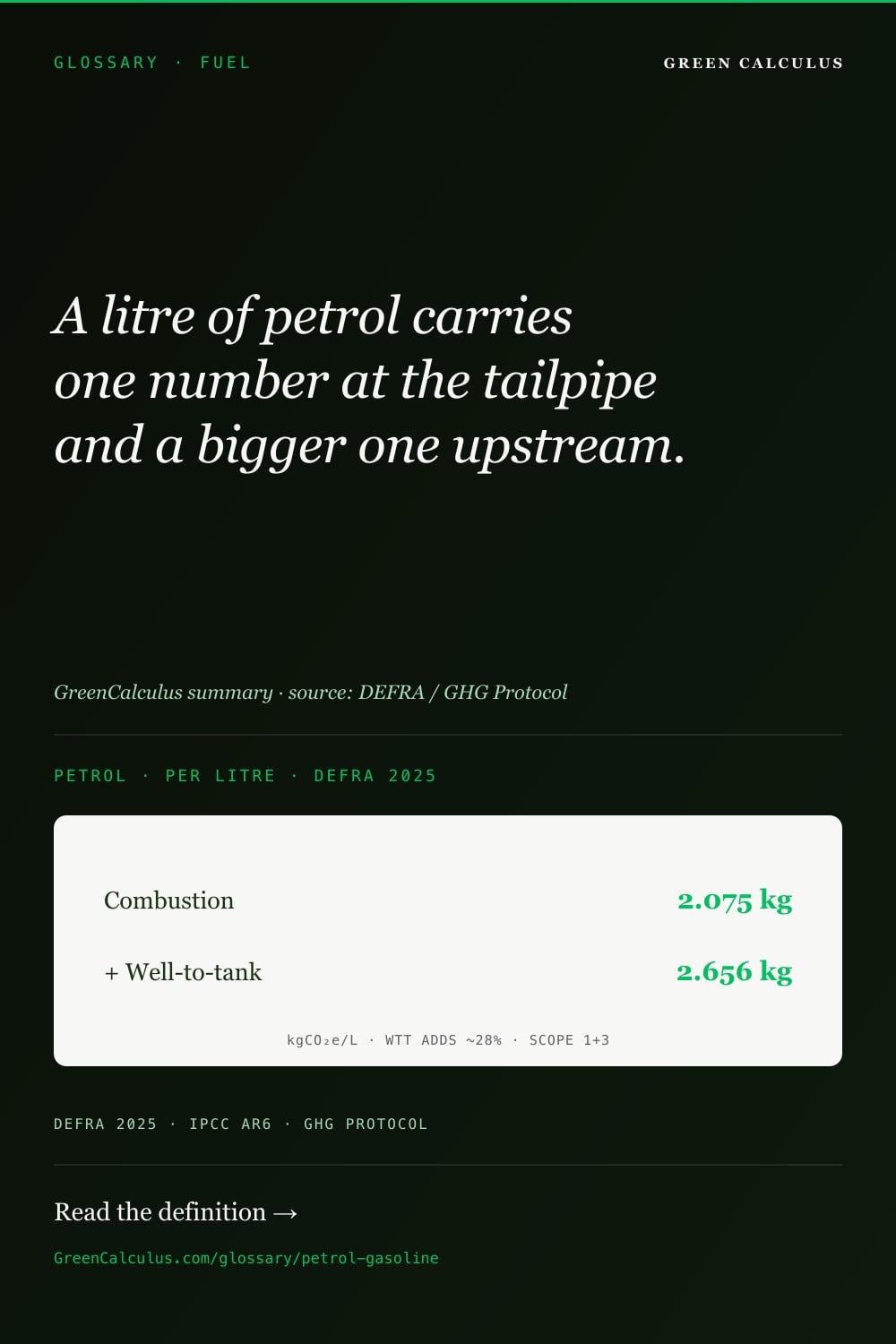
A litre of petrol carries emissions at two stages: burning it (the tailpipe), and producing and delivering it (upstream). The live DEFRA factors split them out, and also separate the biogenic slice from the E10 blend:
| Stage | Factor kg CO₂e / litre · live, DEFRA | Scope |
|---|---|---|
| Combustion (tailpipe) | 2.075 | Scope 1 (own vehicle) |
| Well-to-tank (upstream) | 0.58094 | Scope 3 |
| of which biogenic (E10) | 0.13 | Memo (outside total) |
Adding the combustion and well-to-tank factors gives the full well-to-wheel footprint of a litre — roughly 2.075 [GreenCalculus fuels.gbr.petrol_average_biofuel_blend.litre · DEFRA 2026 'Fuels'!D96 · v2026.284] + 0.58094 kg CO₂e [GreenCalculus fuels.gbr.petrol_average_biofuel_blend.wtt.litre · DEFRA 2026 'WTT- fuels'!D95] once upstream extraction, refining and distribution are counted. On an energy basis the same fuel is about 0.23164 kg CO₂e per kWh [GreenCalculus fuels.gbr.petrol_average_biofuel_blend.kwh_ncv · DEFRA 2026 'Fuels'!D97] (net calorific value) — see calorific value for why the basis matters.
Petrol in GHG Accounting
It depends on who owns the vehicle. Petrol burned in a company’s own or controlled vehicles is mobile combustion and sits in Scope 1. Petrol used for employee business travel in private or hired cars, and for commuting, is Scope 3 (categories 6 and 7). In every case the well-to-tank emissions from producing the fuel are Scope 3. And because pump petrol is an E10 blend, the bioethanol portion’s CO₂ is reported as a biogenic memo rather than in the scope total. The mobile combustion calculator applies these factors by fuel and distance; the EV vs petrol lifecycle calculator compares petrol against electric on a full lifecycle basis.
Common Confusions
- Thinking petrol and gasoline are different fuels. They are the same fuel — “petrol” is British/Commonwealth English, “gasoline” (or “gas”) is American.
- Comparing petrol and diesel per litre. Petrol emits less CO₂ per litre, but diesel is denser and more efficient — compare per kilometre (tank-to-wheel), not per litre.
- Counting only the tailpipe. The combustion factor is Scope 1, but the well-to-tank emissions from extracting and refining the fuel are a real Scope 3 addition.
- Assuming pump petrol is 100% fossil. UK E10 contains up to 10% bioethanol, so a small biogenic slice of its CO₂ is reported separately.
- Confusing petrol with LPG or “gas”. “Gas” in American usage means petrol; in British usage it usually means natural gas or LPG — different fuels entirely.
Quick converters: move a pump-litre figure onto an energy basis with litres of petrol to kWh. For a communications figure rather than an inventory one, CO₂e to gallons of gasoline gives the familiar equivalence.
Frequently Asked Questions
Yes — petrol and gasoline are two names for exactly the same fuel: a light liquid refined from crude oil for spark-ignition engines. “Petrol” (from the French pétrole) is the standard term in the UK, Ireland, India and most Commonwealth countries, while “gasoline” — frequently shortened to “gas” — is American and Canadian English. There is no difference in the fuel itself. The only regional variations are in grade and blend, such as octane rating and the amount of bioethanol mixed in, not in whether it is “petrol” or “gasoline”.
Burning one litre of UK pump petrol emits about 2.075 kg CO₂e [GreenCalculus fuels.gbr.petrol_average_biofuel_blend.litre] at the tailpipe (the DEFRA combustion factor for the average E10 blend, shown live). Producing and delivering that litre — extraction, refining and distribution — adds a further well-to-tank factor of about 0.58094 kg CO₂e [GreenCalculus fuels.gbr.petrol_average_biofuel_blend.wtt.litre], so the full well-to-wheel figure is higher than the tailpipe number alone. A small part of the combustion CO₂ — around 0.13 kg [GreenCalculus fuels.gbr.forecourt_biogenic.petrol_average_biofuel_blend.litre · DEFRA 2026 'Outside of scopes'!D25] — is biogenic, from the E10 bioethanol, and is reported separately from the fossil total.
It depends on the basis. Per litre, petrol emits less CO₂ than diesel — about 2.075 kg CO₂e [GreenCalculus fuels.gbr.petrol_average_biofuel_blend.litre] for petrol versus 2.58354 kg [GreenCalculus fuels.gbr.diesel_average_biofuel_blend.litre · DEFRA 2026 'Fuels'!D72] for diesel (DEFRA, live) — because diesel is denser and carries more carbon and energy per litre. But per kilometre driven the comparison narrows, because diesel engines are more efficient and can extract up to around 40% more work from each litre. So a diesel car often emits less CO₂ per kilometre than an equivalent petrol one, even though its fuel emits more per litre. Diesel also emits more nitrogen oxides and particulates, which is a separate air-quality issue from CO₂. The right way to compare vehicles is per kilometre, not per litre.
E10 is petrol containing up to 10% renewable bioethanol blended with fossil petrol; it became the UK standard 95-octane grade in 2021, replacing E5 (up to 5% ethanol). The bioethanol is made from crops such as wheat and sugar beet, and blending it reduces the fossil fraction of the fuel. For carbon accounting, the important consequence is that part of the CO₂ released when E10 burns is biogenic — recently absorbed from the atmosphere by the crop — and is therefore reported as a memo outside the Scope 1 total, while the fossil portion remains in it. This is why the live DEFRA petrol factor includes a small separately-reported biogenic component.
It depends on who is driving. Petrol burned in a company’s own or controlled vehicles is mobile combustion and falls in Scope 1. Petrol used for employee business travel in private or hired vehicles, and for commuting, falls in Scope 3 (categories 6 and 7). In all cases, the well-to-tank emissions from producing the fuel are a separate Scope 3 item, and the biogenic portion from the E10 blend is reported as a memo outside the scope total. So the same litre of petrol can appear in different scopes depending on the vehicle and the accounting boundary — which is why fuel type alone does not determine the scope.
Need someone who does this? 6 carbon accounting & inventory providers in our directory →