
SBTi Readiness Checklist — Pre-Submission Diagnostic

SBTi validation is not a checklist exercise — it is an audit. The Target Validation Team reads your submission against the Corporate Net-Zero Standard criteria with the same scepticism a financial auditor brings to a closing balance. Roughly half of first submissions are returned for revision; a meaningful slice are returned a second time. Every revision adds weeks to a process that boards and customers expect to close on a schedule.
This checklist is the diagnostic you would run if you sat in the validator’s chair before submitting. It mirrors the structure of an actual review: an inventory test, a target-architecture test, and a submission-package test. Five items are flagged as blockers — the issues that cause an immediate return rather than a request for clarification. Everything else is addressable in revision but still costs you a week.
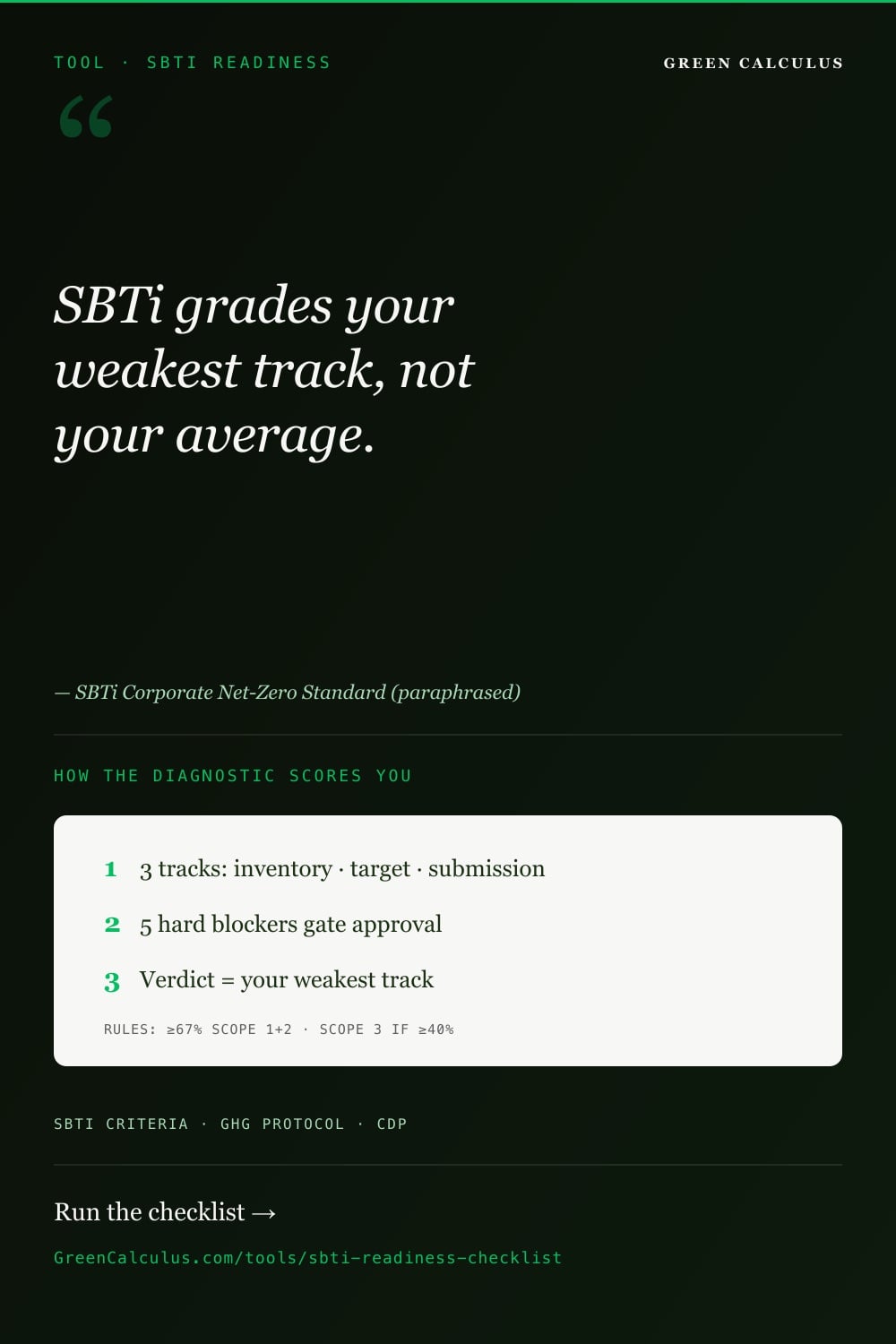
SBTi validators check three things in sequence: whether the inventory is solid enough to set a target on, whether the target architecture meets the ambition and coverage rules, and whether the submission package is complete. The weakest of the three decides your outcome.
The diagnostic — three tracks, five blockers
Use the qualifier toggles to scope the checklist to your situation. Items appear or stay hidden based on whether you are setting a near-term target only or a full net-zero commitment, and whether your sector requires FLAG (Forest, Land and Agriculture) treatment. The verdict at the bottom updates live and reads the weakest track — it does not average.
SBTi criteria move on their own schedule — the Corporate Net-Zero Standard is under revision and the near-term criteria have been re-versioned several times. We will email you when something this checklist applies changes — not otherwise.
How SBTi validation actually works
SBTi validation is a four-stage pipeline. Each stage has its own failure modes and its own typical duration. Understanding where you are in the pipeline is the difference between a six-month process and a fourteen-month process.
The five reasons submissions are returned
The SBTi Target Validation Team publishes anonymised pattern data on common revision causes. Five reasons account for the substantial majority of returns. They map directly to the five blockers in the checklist above — that mapping is not a coincidence.
The most common rejection. A target framed as “well below 2°C” or aligned with a 2°C pathway has been ineligible since July 2022. The minimum near-term ambition is 4.2% absolute annual reduction (or the equivalent under a sector-specific Sectoral Decarbonization Approach pathway). Submissions that quote pre-2022 SBTi guidance or use a 2°C trajectory are returned without a methodology review.
The second most common rejection. Where Scope 3 is ≥40% of total emissions, a Scope 3 target covering at least two-thirds of Scope 3 is mandatory. Submissions with Scope 1+2 targets only — when the inventory shows Scope 3 dominates — are returned with a request to add a Scope 3 target. This adds months to the process because the Scope 3 target requires its own trajectory analysis.
SBTi targets are gross targets. A submission that frames the target as “net of offsets” or that counts purchased removals toward target progress is structurally non-aligned. The validator does not interpret intent — language that mixes gross emissions reductions with credit-based abatement is returned for restatement. Credits and removals belong in a separately disclosed Beyond Value Chain Mitigation (BVCM) action, not in the target arithmetic.
A methodology defect rather than a target defect, but it surfaces during target validation because the validator recalculates key inventory totals to test the trajectory. AR5 inventories understate methane-bearing portfolios by approximately 6%, which can flatter a near-term reduction percentage. SBTi rebases to AR6 during review and rejects targets whose ambition fails on the rebased numbers. See the GWP reference.
The most preventable rejection. Inventory totals quoted in the target boundary document do not match the totals in the validation form, or the consolidation approach in one document differs from another, or scope coverage percentages do not reconcile across documents. The validator’s first pass is a reconciliation pass — mismatches return the package before the substantive review begins.
V1.2 vs V2 — what’s changing and when
SBTi published the Corporate Net-Zero Standard V2 draft in 2025 and entered a pilot phase. As of May 2026, V1.2 remains the validation basis for live submissions — V2 has not yet replaced it. The transition is structured rather than sudden; understanding which version applies to your submission window is essential.
| Element | V1.2 (current validation basis) | V2 (pilot, transition expected) |
|---|---|---|
| Status | Active — used for all 2026 validations to date | Pilot phase; V2.1 draft expected mid-2026; mandatory adoption date not yet announced |
| Near-term ambition | 4.2% absolute annual reduction (1.5°C-aligned) | Maintained, with proposed differentiation by company size and sector |
| Scope 3 coverage rule | ≥67% if Scope 3 ≥40% of total | Proposed shift to a “category-by-category materiality” approach with mandatory targets on the largest categories rather than a single % threshold |
| Target validity | 5-year recalculation cycle | Maintained; clearer triggers for off-cycle recalculation |
| Removals treatment | Removals separate from gross target; counted only at net-zero target year for residual emissions | Proposed allowance for limited removals contribution to ongoing decarbonisation reporting (controversial; unsettled at draft stage) |
| Validation routes | Single Corporate Net-Zero validation track | Tiered validation (foundational vs. comprehensive) under proposal |
Submit to V1.2. The V2 draft is not yet a validation basis and SBTi has stated that targets validated under V1.2 will be honoured through their five-year cycle even after V2 becomes mandatory. The risk of waiting for V2 — months of additional delay against an unsettled standard — is materially greater than the risk of submitting under V1.2 now and recalculating at the next cycle. The five blockers in the checklist above apply to V1.2 and are highly likely to remain in V2 in some form.
FLAG sectors — when separate FLAG targets apply
The SBTi Forest, Land and Agriculture (FLAG) Guidance applies to companies in land-intensive sectors (forestry, agriculture, food production, paper, leather, and others) and to any company with material commodity-deforestation exposure in its value chain. FLAG companies must set a separate FLAG target alongside the energy and industry target — the two are scored independently and a single combined target is rejected.
Companies in SBTi-defined FLAG sectors (forestry products, agricultural production, food production and processing, food and staples retailing, tobacco) are automatically in scope. Companies in any other sector with FLAG-related emissions of ≥20% of their total inventory are also in scope. Most large food, beverage, and apparel companies fall under the second test even when their primary sector is not FLAG.
FLAG emissions and removals must be reported as a distinct inventory layer in line with the GHG Protocol Land Sector and Removals Standard. Energy emissions from FLAG operations (tractor diesel, processing plant electricity) stay in the general energy/industry target. Land-based emissions (livestock methane, soil N₂O, deforestation) and land-based removals (afforestation, soil carbon) sit in the FLAG target. Run the math via the FLAG Emissions Calculator.
The 2025 no-commodity-deforestation rule applies to all companies with deforestation-linked commodities in their value chain — beef, soy, palm oil, timber, paper, leather — regardless of FLAG sector classification. Compliance with this rule is a precondition for FLAG target validation.
After you pass — communication and recalculation
Validation is not the end of the process. Three commitments come into force the moment a target is validated, and breaching them forfeits the validated status.
Frequently asked questions
Typical end-to-end timeline from commitment letter to validated target is 12–18 months. The breakdown: 2–4 weeks for the commitment stage; 6–18 months for inventory and target development (depends entirely on starting maturity); 1 week to prepare the submission package; 4–6 months from submission to validation outcome. A submission with one or more blocker-level issues that gets returned for revision adds 3–6 months for the revision cycle. Companies that fail the diagnostic in this checklist before submitting save the revision cycle.
V1.2 is the active validation basis as of May 2026 — every live submission is being scored against it. V2 is in pilot phase; the V2.1 draft is expected mid-2026 and the mandatory adoption date has not yet been announced. The five blockers in this checklist (AR6 GWP, Scope 3 coverage at the 40% trigger, scope-comprehensive target boundary, 1.5°C ambition, no offsets in the target) apply to V1.2 and are highly likely to survive in some form into V2. SBTi has confirmed that targets validated under V1.2 will be honoured through their five-year recalculation cycle even after V2 becomes mandatory, so there is no first-mover penalty in submitting now under V1.2.
Not in every target — only when Scope 3 is ≥40% of the total inventory (Scope 1+2+3). The 40% trigger is the structural rule. Where Scope 3 falls below 40%, a Scope 1+2 target alone is acceptable. Where Scope 3 is at or above 40%, the target must cover at least two-thirds of Scope 3 in addition to ≥95% of Scope 1+2. The trigger is calculated on the full screened inventory, not on the partially calculated subset — a frequent source of revision requests is companies who calculated only the easy Scope 3 categories, found they came in below 40% of an artificially small denominator, and submitted Scope 1+2 only. SBTi requires the full screen first.
No. SBTi targets are gross reduction targets — physical decarbonisation of the company’s own and value chain emissions. Carbon credits, offsets, avoided emissions, and removals do not count toward target achievement at any point in the trajectory. Removals contribute only at the net-zero target year, and only against the residual ≤10% of emissions remaining after the 90% absolute reduction. Outside the target architecture, SBTi recommends Beyond Value Chain Mitigation (BVCM) — voluntary purchases of high-quality credits or removals as an additional climate contribution — but BVCM is reported separately and never netted against the target.
Yes, since SBTi V1.1 (2024). AR6 GWP-100 values without climate-carbon cycle feedbacks are required: CO₂ = 1, fossil CH₄ = 29.8, biogenic CH₄ = 27.9, N₂O = 273, SF₆ = 25,200. The AR5 values widely used in pre-2024 inventories (CH₄ = 28, N₂O = 265) are no longer accepted for new validations. Targets validated before V1.1 are grandfathered through their first 5-year cycle. If your base year was calculated under AR5 and your current year under AR6, you must restate the base year to AR6 — a methodology change rather than a data correction. Detail: Global Warming Potential reference; complete dataset: AR6 GWP values.
The standard validation service tier is USD 14,500 plus applicable taxes as of 2026, covering one validation cycle including one revision. Pricing is tiered by company revenue and validation scope (corporate, FLAG, financial institutions, SME) and is updated periodically — confirm current pricing on the SBTi target validation services page before budgeting. The fee covers SBTi staff time only and excludes any internal cost (consultants, software, internal labour) of preparing the submission. Real total cost for a first-time submission, including internal preparation, typically runs USD 50,000–250,000 depending on inventory maturity and company size.
The validator returns the submission with a list of items requiring revision. A first revision is included in the booking fee and is normally addressable within 4–8 weeks if the issues are documentation rather than methodology. If the revision is itself rejected, a second revision incurs an additional fee. Rejected status does not delist a company from “Committed” status — the 24-month commitment window keeps running. Companies that cannot validate within 24 months of commitment are removed from the SBTi dashboard with a status of “Removed” and must restart the process.
Not quite. SBTi has two separable validation tracks: a near-term target (5–10 year horizon, 1.5°C-aligned reductions) and a long-term net-zero target (≥90% absolute reduction by 2050 at the latest, with residual ≤10% addressed by durable removals at the target year). A company can hold an SBTi-validated near-term target without a validated net-zero target — the near-term target is itself meaningful. SBTi-validated net-zero requires both: the near-term target as the on-ramp, and the long-term target as the destination. “Net-zero” claims without both validated targets are not SBTi-aligned even if SBTi has validated the near-term component.
Run the trajectory math before you submit.
The SBTi Near-Term Target Calculator computes the absolute annual reduction your target needs to meet under the 1.5°C absolute contraction approach, by base year, target year, and scope coverage — the same arithmetic the SBTi validator runs against your submission.