
IPCC 2019 Refinement to the 2006 IPCC Guidelines for National Greenhouse Gas Inventories — The Definitive Reference

The 2019 Refinement to the 2006 IPCC Guidelines for National Greenhouse Gas Inventories is the methodological backbone of every national greenhouse gas inventory submitted under the Paris Agreement. It is the document Annex I and non-Annex I Parties use to compile the Biennial Transparency Reports (BTRs) that the Enhanced Transparency Framework under Article 13 of the Paris Agreement requires. It is the upstream source from which national emission factor databases — DEFRA in the UK, EPA in the United States, the European Environment Agency, the IEA grid factors — derive their default values, tier methodologies, and source-category classifications. And it is the methodology document that, via that national-database chain, ultimately determines the emission factors that show up in every corporate carbon calculator on the public web.
This page documents the 2019 Refinement as it stands in May 2026: the five-volume structure (General Guidance, Energy, IPPU, AFOLU, Waste) and what each contains; the volume-by-volume substantive changes from the 2006 Guidelines (updated coal and natural gas emission factors, expanded fugitive emissions guidance, new HFC and PFC source categories, refined livestock enteric fermentation methodology, wetlands and harvested wood products updates, new wastewater methodology); the tier system (Tier 1 default factors, Tier 2 country-specific, Tier 3 facility-level modelling) and how the tier choice in a national inventory propagates downstream into the corporate emission factors that practitioners inherit; the operative-status reconciliation showing which 2006 chapters are refined, which are replaced, and which remain unchanged; the AR5 GWP basis that the Refinement is locked to and how that reconciles against frameworks that have migrated to AR6; the UNFCCC Enhanced Transparency Framework connection through Decision 18/CMA.1; the chain of custody from IPCC methodology to corporate calculator; the interaction with the GHG Protocol Corporate Standard, the GHG Protocol Land Sector and Removals Standard 2026, and the major carbon credit methodologies; and the implementation realities national inventory compilers face during recalculation and time-series consistency. Built for national inventory compilers, corporate sustainability officers wanting to understand where their emission factors actually come from, life-cycle assessment specialists, carbon credit methodology developers, climate policy researchers, and anyone who needs a working reference that treats the 2019 Refinement not as a standalone document but as the methodological keystone of the entire downstream GHG accounting stack.
The 2019 Refinement to the 2006 IPCC Guidelines for National Greenhouse Gas Inventories is the IPCC Task Force on National Greenhouse Gas Inventories’ methodological supplement to the 2006 Guidelines, published in May 2019 at IPCC-49 in Kyoto and operative for all national inventories submitted under the Paris Agreement Enhanced Transparency Framework from the first round of Biennial Transparency Reports due 31 December 2024 onward. It does not replace the 2006 Guidelines; it refines them — updating emission factors and methods where new science or measurement experience warranted, adding new source categories (HFC-1234yf and other low-GWP refrigerants, new fluorinated gases, additional wetland categories, harvested wood products refinements), and providing more detailed Tier 2 and Tier 3 methodologies for high-emission source categories. The Refinement uses IPCC AR5 GWP-100 values throughout, retaining AR5 as the GWP basis under UNFCCC reporting requirements per Decision 18/CMA.1. The document is structured in five volumes mirroring the 2006 Guidelines: Volume 1 General Guidance and Reporting; Volume 2 Energy; Volume 3 Industrial Processes and Product Use (IPPU); Volume 4 Agriculture, Forestry and Other Land Use (AFOLU); Volume 5 Waste. It is the upstream source of emission factors and tier methodologies that propagate through national inventory databases (DEFRA, EPA, EEA, IEA) into the GHG Protocol-aligned corporate carbon accounting practice. The next IPCC TFI methodology product is anticipated mid-decade pending the IPCC’s seventh assessment cycle (AR7) work programme.
Executive Summary
The 2019 Refinement to the 2006 IPCC Guidelines for National Greenhouse Gas Inventories is, by some distance, the most consequential methodology document in greenhouse gas accounting that most corporate practitioners have never read. It is the document that compiles the emission factors and tier methodologies that the world’s 196 Parties to the UNFCCC use to construct their national inventories. It is the document the UNFCCC Enhanced Transparency Framework specifies, via Decision 18/CMA.1, as the methodological basis for Biennial Transparency Reports under the Paris Agreement. It is the upstream input to every national emission factor database that corporate practitioners draw on — DEFRA’s annual conversion factors, the U.S. EPA’s emission factors, the European Environment Agency’s EMEP/EEA inventory guidebook, the IEA’s grid factor publications. And it is the document that, when an accountant in a corporate sustainability function looks up the emission factor for natural gas combustion in a national database, sits two or three steps upstream of the number she enters into her spreadsheet.
The Refinement is a supplement to the 2006 Guidelines, not a replacement. This distinction is structural and is the source of more misreadings than any other feature of the document. The 2006 Guidelines remain operative and in force; the 2019 Refinement updates specific chapters and sections, adds new source categories where the science has matured, and provides new and more detailed Tier 2 and Tier 3 methods for high-emission source categories. A national inventory in 2026 uses the 2006 Guidelines as refined by the 2019 Refinement — a compound methodological stack, not a single document.
Three things distinguish the 2019 Refinement from its 2006 predecessor and from every prior IPCC inventory methodology product. First, it is the first IPCC inventory methodology product issued during the Paris Agreement era and engineered to support the Enhanced Transparency Framework’s universal applicability — the same methodology supporting both developed and developing country inventories, replacing the bifurcated Annex I / non-Annex I architecture of the Kyoto era. Second, it incorporates fifteen years of national inventory review experience accumulated through UNFCCC review processes, identifying systematic measurement issues across countries and prescribing methodology updates accordingly. Third, it explicitly addresses source categories that did not exist or were of marginal importance in 2006 — HFC-1234yf and other fourth-generation refrigerants, hydrogen as an energy carrier, novel agricultural management practices, expanded coverage of wetlands and harvested wood products — reflecting the methodology’s adaptation to a changed industrial and energy landscape.
The Refinement uses IPCC AR5 GWP-100 values throughout. This was a deliberate choice: the IPCC AR6 Working Group I report (which published the AR6 GWP values in Chapter 7) was published in August 2021, more than two years after the Refinement. Switching the Refinement’s GWP basis to AR6 would have required a new round of plenary approval through the IPCC governance process. More importantly, the UNFCCC reporting framework under Decision 18/CMA.1 specifies AR5 as the GWP basis for Biennial Transparency Reports, locking the AR5 basis in for the foreseeable future. For corporate practitioners working with frameworks that have migrated to AR6 (the original 2023 text of IFRS S2, DEFRA’s 2024 factor update, GHG Protocol Land Sector and Removals Standard 2026), the AR5-to-AR6 reconciliation is one of the most operationally consequential interfaces between the IPCC methodology layer and the corporate disclosure layer.
For corporate practitioners, the practical implication is this: the emission factors they apply to fuel combustion, refrigerant leakage, fugitive emissions, livestock activities, and waste treatment all trace back, through one or two intermediate national databases, to either the 2006 Guidelines or the 2019 Refinement (whichever the national database has incorporated as of its publication date). When DEFRA publishes a Scope 1 stationary combustion factor for natural gas, the underlying methodology is Volume 2 Chapter 2 of the 2006 Guidelines as refined by Volume 2 Chapter 2 of the 2019 Refinement. When EPA publishes an HFC emission factor for an industrial refrigeration system, the underlying methodology is Volume 3 Chapter 7 of the 2006 Guidelines as refined by Volume 3 Chapter 7 of the 2019 Refinement. The methodology this page documents is, downstream, the methodology behind virtually every corporate Scope 1 disclosure published in 2026.
(1) It is a supplement to the 2006 Guidelines, not a replacement — both documents are operative as a compound stack. (2) It is the operative methodology for all Paris Agreement Biennial Transparency Reports from the first BTR cycle (due 31 December 2024) onward, under UNFCCC Decision 18/CMA.1. (3) It uses IPCC AR5 GWP-100 values throughout — not AR6 — locking the AR5 basis into UNFCCC reporting for the foreseeable future. (4) It introduces material methodology updates across all five volumes, with the most extensive changes in Volume 4 AFOLU (livestock enteric fermentation, manure management, wetlands, harvested wood products) and Volume 2 Energy (coal and natural gas factors, fugitive emissions). (5) It is the upstream source of emission factors and tier methodologies that propagate downstream, through national inventory databases (DEFRA, EPA, EEA, IEA), into the GHG Protocol-aligned corporate carbon accounting practice that every sustainability function in 2026 depends on.
Provider directory
Now it has to hold up all year.
See who does this work — chosen by us, never paid placement, with the standards each one works to. Including Anthesis Group and Attain Zero.
Browse 4 carbon accounting & inventory providers →Do this work? A listing is $390 a year. Get listed →
The Chain of Custody — From IPCC Methodology to Corporate Calculator
The single most under-appreciated fact about the 2019 Refinement, from a corporate practitioner’s perspective, is that the emission factors used in every corporate Scope 1 disclosure trace back to it through a four-step chain of methodological custody. Most corporate practitioners interact only with the last step in that chain — the national emission factor database — and treat the factor as a given. Understanding the upstream chain explains why factors differ between databases, why factors change year-over-year, why the AR5-vs-AR6 GWP basis matters operationally, and why national inventory compilation choices ripple through to corporate disclosure quality.
| Step | Layer | Function | Examples |
|---|---|---|---|
| 1 | IPCC Methodology | Specifies the inventory compilation methodology: source categorisation, default emission factors (Tier 1), country-specific factor guidance (Tier 2), facility-level modelling guidance (Tier 3), uncertainty methodology, time-series consistency rules, recalculation rules, QA/QC requirements. | 2006 IPCC Guidelines + 2019 Refinement (compound stack) |
| 2 | National Inventory | UNFCCC Parties compile annual or biennial inventories applying IPCC methodology, choosing tier levels for each source category based on data availability and source significance, producing the national GHG inventory submitted to UNFCCC. | UK National Atmospheric Emissions Inventory; U.S. Inventory of U.S. Greenhouse Gas Emissions and Sinks; EU GHG Inventory; Japan’s National GHG Inventory |
| 3 | National Factor Database | National authorities publish standardised emission factor databases for use by corporate reporters, derived from the same activity data and methodology as the national inventory but packaged for corporate-scale application. | DEFRA UK Government GHG Conversion Factors (annual); EPA Emission Factors for GHG Inventories; EEA EMEP/EEA Air Pollutant Emission Inventory Guidebook; IEA Emissions Factors database |
| 4 | Corporate Methodology | The GHG Protocol Corporate Standard specifies the accounting framework (organisational boundary, operational scope, Scope 1/2/3 architecture); the published national factors supply the numerical values that the methodology multiplies against activity data. | GHG Protocol Corporate Standard; Scope 2 Guidance; Scope 3 Standard |
| 5 | Corporate Calculator | The endpoint: a corporate sustainability practitioner enters activity data (e.g. kWh of natural gas consumed) and the calculator returns CO2e emissions using the GHG Protocol architecture and the underlying national factor. | GreenCalculus Scope 1 Combustion Calculator; corporate ERP-integrated tools; enterprise emissions software |
The chain is real, traceable, and consequential. A practitioner using a DEFRA natural gas combustion factor in 2026 is, in effect, applying a number that DEFRA derived from the UK National Atmospheric Emissions Inventory, which the UK compiled using the 2006 IPCC Guidelines Volume 2 Chapter 2 as refined by the 2019 Refinement Volume 2 Chapter 2. Two implications follow.
First, factor differences across national databases reflect upstream methodology choices. Why does a DEFRA natural gas combustion factor differ from an EPA factor for the same activity? Partly because the underlying gas composition differs by national supply mix, but also because the two national inventories may use different tier levels for the source category, may have incorporated different vintages of IPCC guidance, and may apply different uncertainty treatments. A practitioner who picks DEFRA factors for a UK operation and EPA factors for a U.S. operation is not making an arbitrary choice — the factor difference reflects the methodological reality of the two national contexts.
Second, the AR5-to-AR6 GWP basis question is a chain-of-custody question. The 2019 Refinement uses AR5 GWPs. National inventories submitted under UNFCCC ETF use AR5 GWPs (Decision 18/CMA.1 requirement). National factor databases — DEFRA, EPA, EEA, IEA — have been migrating to AR6 on different timelines, but their underlying activity data and methodology are still the 2019 Refinement’s. When a corporate practitioner uses a DEFRA AR6-converted factor in 2026, the activity data and methodology underneath are AR5-era Refinement methodology; the AR6 GWP basis is applied as a post-processing conversion. Understanding this is essential to reconciling factor vintages across reporting frameworks.
The remainder of this page documents the Refinement at each level — what it is, what changed from 2006, how the tier system works, how each volume’s substantive updates flow into national inventories, and how the entire stack ultimately propagates into the corporate practitioner’s daily work.
What the 2019 Refinement Is — and What It Is Not
The 2019 Refinement is a methodology document. It is not an accounting standard, not a corporate reporting framework, not a target-setting framework, not a scientific assessment, and not a treaty obligation in its own right. Its purpose is to specify, in technically auditable terms, how a national government compiles its greenhouse gas inventory for submission to the UNFCCC: which source categories to include, how to classify activities within each category, which default emission factors to apply at Tier 1, how to develop country-specific factors at Tier 2, how to construct facility-level models at Tier 3, how to characterise uncertainty, how to ensure time-series consistency, and how to perform recalculation when methodology updates require historical revision.
This positioning has three consequences that shape how the Refinement should be read and applied.
First, it is downstream of climate science and upstream of disclosure. The climate science — the GWP values, the atmospheric residence times, the radiative forcing — comes from the IPCC’s scientific assessment process (currently AR6 Working Group I, 2021, with AR7 in development). The Refinement consumes that science (with the AR5 GWP basis built in, for the reasons in §15) and produces a methodology that national inventories then consume. The corporate disclosure standards (GHG Protocol, ISO 14064-1, IFRS S2, CSRD ESRS E1) then consume the national-database factors that the Refinement methodology produces. Each layer has its own governance, its own update cycle, and its own role in the stack.
Second, it is the operative methodology for national inventories under the Paris Agreement. Under the 2006 IPCC Guidelines stand-alone, national inventories prior to the 2019 Refinement applied 2006 methodology directly. Under the post-Refinement reality, national inventories apply the 2006 Guidelines as refined by the 2019 Refinement — the compound stack documented in §4 below. The UNFCCC Decision 18/CMA.1 modalities, procedures, and guidelines for the Enhanced Transparency Framework specify this compound methodology as the basis for Biennial Transparency Reports, the first round of which were due 31 December 2024.
Third, it is not a corporate accounting standard. Corporate GHG accounting is governed by the GHG Protocol Corporate Standard and its supplements; corporate disclosure is governed by Scope 2 Guidance, Scope 3 Standard, IFRS S2, ESRS E1, and others. The 2019 Refinement does not specify organisational boundaries (operational control vs equity share), does not address Scope 2 location-based vs market-based methodology, does not address Scope 3 categorisation, and does not address corporate target-setting or transition planning. It supplies the numerical and methodological substrate that those corporate frameworks rest on.
What the 2019 Refinement does is one thing: it codifies, with paragraph-level granularity across five volumes and approximately 1,500 pages, how a national inventory should be compiled in the Paris Agreement era. Everything else — the corporate disclosures, the carbon credit baselines, the academic emissions literature — rests on that codification, directly or via the national-database intermediary layer.
2019 Refinement vs 2006 Guidelines — The Operative Status Table
The single most-frequent misreading of the 2019 Refinement is that it replaced the 2006 Guidelines. It did not. The Refinement is a supplement that updates specific chapters and sections; the unrefined portions of the 2006 Guidelines remain fully operative. National inventories in 2026 apply the 2006 Guidelines as refined by the 2019 Refinement — a compound methodological stack where the choice of which document to consult, for any given source category, depends on whether that category was refined.
The table below maps the operative status of each volume’s content. “Refined” means the 2019 Refinement supersedes the 2006 chapter or section for the affected content; the 2006 document remains the source for unrefined content within that chapter. “Replaced” means a 2006 chapter or section is fully superseded by 2019 Refinement content. “Unchanged” means the 2006 Guidelines content remains operative without modification.
| Volume | Operative status | What this means in practice |
|---|---|---|
| Vol 1 General Guidance and Reporting | Refined (selective) | Selected chapters refined: uncertainty methodology (Ch 3), time-series consistency (Ch 5), QA/QC and verification (Ch 6), some reporting tables. Unrefined chapters (e.g. introductory material) remain 2006 operative. |
| Vol 2 Energy | Refined (extensive) | Stationary combustion (Ch 2) refined with updated default factors and new fuel categories. Mobile combustion (Ch 3) refined for road transport and aviation. Fugitive emissions (Ch 4) extensively refined with new oil and gas methodology, abandoned mines, and shale operations. CO2 transport and storage (Ch 5) refined. |
| Vol 3 IPPU | Refined (selective) | Mineral industry (Ch 2), chemical industry (Ch 3), metal industry (Ch 4) partially refined. Product uses as substitutes for ODS (Ch 7) extensively refined with new HFC source categories and updated F-gas methodology. Electronics industry (Ch 6) refined for new semiconductor processes. |
| Vol 4 AFOLU | Refined (most extensive) | The most-changed volume. Generic methodologies (Ch 2) refined. Livestock (Ch 10) refined for enteric fermentation and manure management methods. Land categories (Ch 4–9) refined with new wetland subcategories (Wetlands as a distinct land-use category, Ch 7), updated harvested wood products methodology (Ch 12), and refined soil organic carbon methods. N2O emissions from managed soils (Ch 11) refined. |
| Vol 5 Waste | Refined (selective) | Solid waste disposal (Ch 3) refined with updated First Order Decay methodology. Biological treatment (Ch 4) refined. Wastewater treatment and discharge (Ch 6) extensively refined with updated methodologies for domestic and industrial wastewater, and new approaches for sludge handling. |
The practical implication for inventory compilers is operational: for each source category in the national inventory, the compiler consults the 2019 Refinement first; if the Refinement contains updated content for that category, that updated content is operative; if not, the 2006 Guidelines content for that category remains operative. The Refinement’s foreword and Volume 1 Chapter 1 explicitly establish this supplementary architecture.
The practical implication for corporate practitioners is that the national factor databases they use will have absorbed the Refinement’s updates on different timelines and to different depths. DEFRA’s UK Government GHG Conversion Factors absorbed Refinement-era methodology updates through the 2020–2024 publication cycles. EPA’s emission factor publications have absorbed Refinement updates on a category-by-category basis. The European Environment Agency’s EMEP/EEA Guidebook follows a similar update pattern. A given factor in a given national database in 2026 may reflect 2006 methodology, Refinement methodology, or a hybrid — and the database documentation specifies which.
Why the 2019 Refinement Exists — The Gap Between 2006 and Paris
The reason the 2019 Refinement exists is the reason national inventory methodology needed updating in the late 2010s, and that reason has four components: scientific updates, methodological learning from fifteen years of UNFCCC review, new source categories that did not exist or were marginal in 2006, and the institutional transition from the Kyoto-era bifurcated reporting architecture to the Paris-era universal applicability of the Enhanced Transparency Framework.
The scientific update component. The 2006 Guidelines were finalised based on IPCC Third Assessment Report (TAR, 2001) and early Fourth Assessment Report (AR4, 2007 final) science. By the late 2010s, AR5 (published in three working group reports during 2013–2014) had updated GWP values, atmospheric concentration histories, and emission factor estimates for many source categories. The Refinement incorporates AR5 science throughout, including AR5 GWP-100 values, updated default emission factors derived from post-2006 literature, and updated default values for parameters such as oxidation factors, carbon contents of fuels, and methane conversion factors for wastewater systems.
The UNFCCC review learning component. Between the 2006 Guidelines’ adoption and the late 2010s, the UNFCCC inventory review process generated extensive documentation of systematic measurement issues across Parties. The Annex I Party review process (the in-country reviews under the Kyoto Protocol) and the technical analysis of biennial update reports for non-Annex I Parties surfaced recurring issues: inconsistent application of tier methodologies, gaps in source category coverage, inadequate documentation of country-specific factor derivation, methodological inconsistencies in time-series construction. The Refinement responds to these specifically — for example, the expanded Tier 2 and Tier 3 guidance for high-emission source categories addresses the recurring review finding that countries with significant emissions in a category were defaulting to Tier 1 because Tier 2 methodology was insufficiently developed.
The new source categories component. Between 2006 and 2019, several new or expanded source categories became material. Hydrofluoroolefins (HFOs) including HFC-1234yf and HFC-1234ze became commercial in mobile air conditioning and stationary refrigeration as fourth-generation low-GWP refrigerants under the Montreal Protocol Kigali Amendment trajectory. Shale gas operations became globally significant fugitive emission sources. Unconventional oil and gas production, abandoned underground coal mines, and biogas operations all required expanded methodology. Wetlands as a distinct land-use category gained material attention. New agricultural management practices — including biochar amendment, no-till cultivation, and improved livestock feed additives — required methodological treatment.
The Paris transition component. The 2006 Guidelines were designed in the Kyoto Protocol era, when only Annex I Parties had binding quantified emission limitation and reduction commitments and the inventory methodology supported that bifurcated architecture. The Paris Agreement, adopted in December 2015, established universal applicability — all Parties submit Nationally Determined Contributions and all Parties report under the Enhanced Transparency Framework using common methodology. The Refinement supports this transition by providing more accessible Tier 1 methodologies (suitable for capacity-constrained Parties), more sophisticated Tier 2 and Tier 3 methodologies (for Parties with developed inventory infrastructure), and a coherent uncertainty framework applicable across both. The shift from Annex I / non-Annex I bifurcation to universal applicability under Article 13 made universal methodology necessary, and the Refinement was IPCC TFI’s response.
Governance and Publication History
The IPCC Task Force on National Greenhouse Gas Inventories (TFI) is the IPCC subsidiary body responsible for developing inventory methodology. The TFI was established in 1998 by the IPCC’s plenary as part of the IPCC’s response to the UNFCCC’s request for technical assistance on national inventory methodology. It is supported by the Technical Support Unit (TSU) located at the Institute for Global Environmental Strategies (IGES) in Hayama, Japan. The TFI’s products are developed through a multi-year work programme involving lead authors drawn from inventory experts worldwide, peer review through expert review and government review stages, and final approval by the IPCC plenary.
| Date | Event |
|---|---|
| 1998 | IPCC Task Force on National Greenhouse Gas Inventories (TFI) established by IPCC plenary, supported by Technical Support Unit at IGES in Hayama, Japan. |
| 1996 | Revised 1996 IPCC Guidelines for National Greenhouse Gas Inventories published. The predecessor methodology, operative through 2006. |
| 2003 | Good Practice Guidance for Land Use, Land-Use Change and Forestry (GPG-LULUCF) published, extending the 1996 Guidelines for LULUCF source categories. |
| 2006 | 2006 IPCC Guidelines for National Greenhouse Gas Inventories published. The compound foundation document that the 2019 Refinement supplements. Adopted by UNFCCC for Annex I Party reporting from 2015 onwards. |
| December 2015 | Paris Agreement adopted at COP21. Article 13 establishes the Enhanced Transparency Framework, requiring universal applicability of inventory methodology across all Parties. |
| February 2016 | IPCC TFI work programme on the 2019 Refinement initiated, following IPCC plenary decision at IPCC-43 (Nairobi, April 2016). |
| December 2018 (COP24) | UNFCCC adopts Decision 18/CMA.1 on modalities, procedures and guidelines (MPGs) for the Enhanced Transparency Framework, specifying use of “the 2006 IPCC Guidelines for National Greenhouse Gas Inventories, and any subsequent version or refinement of the IPCC Guidelines agreed upon by the CMA” as the methodological basis for BTRs. |
| May 2019 (IPCC-49) | 2019 Refinement adopted at IPCC-49 in Kyoto, Japan. The final methodology product comprises five volumes mirroring the 2006 Guidelines structure, with approximately 1,500 pages of refinement content. |
| 2020–2023 | National inventory agencies (DEFRA, EPA, EEA, MOE Japan, MEE China, others) begin incorporating Refinement updates into national inventory submissions and national factor publications, on category-by-category timelines. |
| August 2021 | IPCC AR6 Working Group I report published, with updated GWP-100 values in Chapter 7. The AR6 values are not retroactively applied to the 2019 Refinement, which retains AR5 GWPs. |
| 31 December 2024 | First round of Paris Agreement Biennial Transparency Reports (BTRs) due. The first BTRs require application of the 2006 IPCC Guidelines as refined by the 2019 Refinement, per Decision 18/CMA.1. |
| 2024–2026 | National factor databases (DEFRA UK Government GHG Conversion Factors, EPA Emission Factors, EEA Air Pollutant Emission Inventory Guidebook) progressively incorporate Refinement methodology into corporate-facing factor publications. |
| 2025–ongoing | IPCC TFI work programme on potential next methodology product begins, aligned with the AR7 cycle. No formal new methodology product yet scheduled; the Refinement remains operative. |
The 2019 Refinement remains the operative IPCC inventory methodology product as of May 2026. There is no successor publication. The IPCC TFI work programme has not yet announced a next methodology product, and any such product would follow the IPCC’s multi-year development cycle of scoping, drafting, review, and plenary approval. A consultancy brief or implementation deck that anticipates an imminent post-2019 IPCC methodology update is working from an aspirational timeline; the 2006 Guidelines + 2019 Refinement compound stack is the operative methodology for the foreseeable future.
The Five-Volume Structure
The 2019 Refinement mirrors the 2006 Guidelines’ five-volume architecture. Each volume addresses a specific dimension of the national inventory: the general methodology and reporting framework (Vol 1), then the four substantive emission sectors (Vol 2 Energy, Vol 3 IPPU, Vol 4 AFOLU, Vol 5 Waste). The five volumes are intended to be applied together, with cross-references between volumes managing the boundaries between source categories.
| Volume | Title | Scope | Corporate sectors most affected |
|---|---|---|---|
| 1 | General Guidance and Reporting | Inventory methodology framework, key category analysis, uncertainty, time-series consistency, QA/QC, verification, reporting tables | All sectors (cross-cutting methodology) |
| 2 | Energy | Stationary combustion, mobile combustion, fugitive emissions from fuels, CO2 transport, injection and geological storage | Utilities, oil & gas, transport, manufacturing, real estate, all corporate Scope 1 fuel consumption |
| 3 | Industrial Processes and Product Use (IPPU) | Mineral industry, chemical industry, metal industry, non-energy products from fuel and solvent use, electronics, ODS substitutes (F-gases), other product manufacture | Cement, steel, aluminium, chemicals, electronics, refrigeration / HVAC, semiconductor manufacturing |
| 4 | Agriculture, Forestry and Other Land Use (AFOLU) | Generic methodologies for land categories; forest land; cropland; grassland; wetlands; settlements; other land; livestock; managed soils; harvested wood products; biochar | Food & beverage, agriculture, forestry, real estate (land-use change), nature-based carbon credit buyers |
| 5 | Waste | Solid waste disposal on land, biological treatment, incineration and open burning, wastewater treatment and discharge | Waste management, food & beverage (waste streams), municipalities |
The volume architecture is durable across IPCC methodology generations — the 1996 Guidelines used a similar five-domain structure, the 2006 Guidelines refined it, and the 2019 Refinement preserves it. This continuity matters for inventory compilers, who can navigate between document generations using a stable conceptual map of source categories. For corporate practitioners, the mapping from corporate sector to relevant volume tells the practitioner which volume to consult when investigating the methodological provenance of a particular emission factor.
The Tier System — How It Works
The tier system is the IPCC methodology’s mechanism for accommodating varying levels of data availability and inventory sophistication across Parties. For each source category, the methodology specifies a hierarchy of tiers, with higher tiers requiring more granular data and producing more accurate results. Parties choose the tier level appropriate to the source category’s significance and to the available data.
| Tier | Data requirement | Methodology | Use case |
|---|---|---|---|
| Tier 1 | Activity data + IPCC default emission factor | Multiply activity data (e.g. tonnes of fuel combusted) by IPCC-provided default emission factor. The Refinement provides Tier 1 default factors for every source category. | Small source categories; capacity-constrained Parties; initial inventory; minor sources in any inventory. |
| Tier 2 | Activity data + country-specific emission factor | Apply country-specific emission factor derived from national measurements, technology mix, or fuel composition studies. Methodology provides guidance on country-specific factor development. | Key source categories where Tier 1 default would not adequately represent national circumstances; intermediate inventory sophistication. |
| Tier 3 | Facility-level activity data + facility-level model or measurement | Apply facility-level emission models (e.g. for stationary combustion: plant-level fuel composition, combustion technology, control equipment) or direct facility-level measurement. The most data-intensive and accurate tier. | Major source categories where facility-level data is available; advanced inventories; high-uncertainty categories where direct measurement justified. |
The tier choice for each source category is made through the key category analysis — a methodology specified in Volume 1 Chapter 4 that identifies source categories accounting for the largest share of national emissions, the largest share of uncertainty, or both. Key categories typically warrant Tier 2 or Tier 3 methodology to support inventory quality. Non-key categories can be Tier 1 with limited impact on overall inventory accuracy.
The Refinement’s most substantial Tier 2 and Tier 3 methodology additions are concentrated where national inventory reviews historically identified gaps: livestock enteric fermentation (Vol 4 Ch 10, refined with country-specific feed digestibility and methane conversion factor methodology), fugitive emissions from oil and gas (Vol 2 Ch 4, refined with new measurement-based Tier 3 methodology), wastewater treatment (Vol 5 Ch 6, refined with country-specific treatment-system-mix Tier 2 methodology), and managed soils N2O (Vol 4 Ch 11, refined with country-specific synthetic fertiliser and crop residue methodology).
The tier choice has direct implications for national factor databases and, through them, for corporate practitioners. A national database publishes factors derived from the national inventory’s tier methodology for the relevant source category. If the national inventory uses Tier 1 for natural gas stationary combustion (as most countries do), the published national factor closely tracks the IPCC default factor. If the national inventory uses Tier 2 (incorporating national gas composition and combustion technology mix), the published factor diverges from the IPCC default. If Tier 3 (facility-level data aggregated), the factor diverges further. The corporate practitioner who uses a national factor inherits this tier-dependent precision.
Worked Example — Tier 1 vs Tier 2 vs Tier 3 for a Natural Gas Boiler
To make the tier system concrete, consider a stationary combustion source category: natural gas boilers used for heat generation in industrial and commercial buildings. The same physical activity — one tonne of natural gas combusted in an industrial boiler — produces different inventory results depending on which tier the national inventory applies. The values below are illustrative and hardcoded for pedagogical purposes; they are not factor recommendations.
Tier 1 — IPCC default emission factor approach
Volume 2 Chapter 2 of the 2019 Refinement provides Tier 1 default emission factors for stationary combustion of natural gas. For CO2, the default factor is based on the average carbon content of natural gas globally combined with the stoichiometric oxidation factor. For CH4 and N2O, the defaults are derived from the literature average for industrial boiler combustion conditions.
- CO2 factor (Tier 1 default): 56,100 kg CO2 / TJ (Net Calorific Value basis)
- CH4 factor (Tier 1 default): 1 kg CH4 / TJ
- N2O factor (Tier 1 default): 0.1 kg N2O / TJ
For one tonne of natural gas combusted (approximately 48 GJ NCV), Tier 1 yields approximately 2.69 tonnes CO2, 0.048 kg CH4, and 0.005 kg N2O. Converting to CO2e with AR5 GWP-100 values (CH4 = 28, N2O = 265): approximately 2.69 tCO2e from CO2, 0.0013 tCO2e from CH4, 0.0013 tCO2e from N2O — total approximately 2.69 tCO2e per tonne of natural gas.
Tier 2 — country-specific emission factor approach
A national inventory applying Tier 2 develops a country-specific CO2 factor by measuring the actual carbon content of natural gas in the national supply mix. UK natural gas, with its particular North Sea + LNG import + biomethane blend composition, has a slightly different carbon content than the global average. A typical Tier 2 result for the UK supply mix might be approximately 56,500 kg CO2 / TJ — an approximately 0.7% increase over the Tier 1 default, reflecting the specific gas composition. The CH4 and N2O factors can also be refined for national combustion technology mix.
For one tonne of natural gas at Tier 2: approximately 2.71 tonnes CO2, with the CH4 and N2O contributions broadly similar to Tier 1. The marginal precision gain — on the order of 1% — would justify Tier 2 methodology where natural gas combustion is a key source category for the country (it is, for almost every developed economy).
Tier 3 — facility-level modelling approach
A facility-level Tier 3 application uses plant-specific data: the specific gas composition delivered to the boiler (which may differ from the national average due to pipeline location), the boiler combustion technology and operating conditions, any installed combustion control or efficiency equipment, and plant-specific oxidation efficiency. For a modern condensing boiler operating at the design heat rate, Tier 3 might yield CO2 factor results within approximately 0.5% of the Tier 2 country-specific factor, but with CH4 and N2O factors substantially different from defaults (potentially 50%+ different) due to modern combustion-technology emission control.
For one tonne of natural gas at Tier 3: approximately 2.70 tonnes CO2, with CH4 and N2O contributions that can be either materially higher (for older inefficient combustion) or materially lower (for modern controlled combustion). Tier 3 is rarely applied to commercial boiler stationary combustion in national inventories because the marginal precision over Tier 2 typically does not justify the data collection cost; it is more often applied to large industrial point sources (refineries, power plants, cement kilns) where the facility-level data is collected for other operational reasons.
What the worked example shows
The numerical differences across tiers for natural gas combustion are modest — on the order of 1% to a few percent for CO2, with potentially larger differences for trace gases (CH4, N2O) at facility-specific Tier 3. But the cumulative effect across the national inventory is substantial. Natural gas combustion is a key source category for virtually every developed economy; the choice to apply Tier 2 rather than Tier 1 implies the country has invested in national-scale composition and combustion-technology data collection, which feeds back into more accurate published national emission factors. When DEFRA publishes a natural gas combustion factor that differs from EPA’s natural gas combustion factor for the same activity, part of the difference reflects this tier-and-country-specific data underpinning. Corporate practitioners inherit this national methodological choice when they use the published national factor.
This is the chain of custody (§2) made concrete. The corporate practitioner who applies a DEFRA natural gas combustion factor in 2026 is applying a number that traces back, via the UK National Atmospheric Emissions Inventory’s Tier 2 methodology for the natural gas source category, to the 2019 Refinement Volume 2 Chapter 2 methodology specification. The chain is real and traceable, and understanding it is essential to understanding why corporate emission factors are what they are.
Volume 1: General Guidance and Reporting — What Changed
Volume 1 provides the cross-cutting methodology framework: key category analysis, uncertainty assessment, time-series consistency, methodological choice and recalculation, QA/QC and verification, and the reporting tables. The 2019 Refinement updates Volume 1 selectively, with the most substantive changes in uncertainty methodology (Chapter 3), time-series consistency (Chapter 5), and QA/QC and verification (Chapter 6).
Uncertainty methodology (Volume 1 Chapter 3, refined). The Refinement extends the 2006 Guidelines’ two-approach uncertainty methodology (Approach 1, error propagation; Approach 2, Monte Carlo simulation) with additional guidance on combining uncertainty across source categories, propagating uncertainty through time series, and accounting for correlation between activity data and emission factors. The refined guidance addresses systematic underestimation of uncertainty that UNFCCC reviews identified in many Annex I inventories.
Time-series consistency (Volume 1 Chapter 5, refined). National inventories report time series back to 1990 (or 2000 for non-Annex I Parties under ETF). When methodology changes mid-time-series — a country moves from Tier 1 to Tier 2 for a category, or a new source category is added — the entire time series must be recalculated for consistency. The refined Chapter 5 provides expanded guidance on recalculation techniques, splicing methodology where direct recalculation is impossible, and documentation of methodological changes.
QA/QC and verification (Volume 1 Chapter 6, refined). The refined chapter expands quality assurance and quality control guidance, with new sections on verification using independent data sources (atmospheric measurements, satellite remote sensing, energy statistics cross-checks) and on documenting QA/QC procedures for transparency in UNFCCC review.
Reporting tables (Volume 1 Annex 8 and associated tables, refined). Reporting tables for the Common Reporting Format (CRF) are updated to reflect the new and refined source categories across Volumes 2–5, with new disaggregation requirements supporting the ETF transparency mandate.
Volume 2: Energy — What Changed
Volume 2 is the most quantitatively important volume for most national inventories — energy-sector emissions typically account for 70–80% of national totals for most developed economies. The 2019 Refinement extensively refines Volume 2, with substantive updates in stationary combustion (Chapter 2), mobile combustion (Chapter 3), fugitive emissions (Chapter 4), and CO2 transport, injection and geological storage (Chapter 5).
Stationary combustion (Chapter 2, refined). Updated default emission factors for coal (across multiple coal types), natural gas, and oil products. New fuel categories addressing biomethane, hydrogen blends in natural gas networks, and synthetic fuels. Updated Tier 2 and Tier 3 methodology for combustion in power generation, industry, and buildings. The refined chapter is the upstream methodology source for the natural gas, coal, and oil combustion factors that propagate into national factor databases used by corporate practitioners for Scope 1 stationary combustion. See natural gas combustion methodology, coal combustion methodology, and the Scope 1 Combustion Calculator for GreenCalculus’s application of these factors.
Mobile combustion (Chapter 3, refined). Updated emission factors for road transport addressing modern vehicle emission control technology and the increasing share of hybrid and electric vehicles. Refined aviation methodology distinguishing more clearly between domestic and international aviation emissions, with updated factors for fuel composition and combustion characteristics. Marine transport methodology refined for heavy fuel oil and the IMO 2020 sulphur regulation transition.
Fugitive emissions (Chapter 4, extensively refined). The most substantively refined chapter in Volume 2. Updated methodology for fugitive emissions from oil and gas operations, with new Tier 2 and Tier 3 methods reflecting the post-2006 understanding of methane leakage from natural gas infrastructure. New methodology for shale gas operations (hydraulic fracturing, well completion, production), addressing a source category that was marginal in 2006 but is now globally significant. New methodology for abandoned oil and gas wells and abandoned underground coal mines, addressing post-closure methane emissions. New methodology for biomethane production and distribution.
CO2 transport, injection and geological storage (Chapter 5, refined). Updated methodology for carbon capture, utilisation and storage (CCUS) operations, reflecting the operational experience accumulated since 2006 with commercial-scale CCS projects. The refined methodology addresses CO2 capture efficiency, pipeline transport emissions, injection-well operations, and geological storage monitoring — relevant for inventories of jurisdictions with operational CCS infrastructure.
Volume 3: IPPU — What Changed
Volume 3 addresses Industrial Processes and Product Use (IPPU) — emissions from industrial processes that are not energy-related (e.g. process CO2 from cement clinker production) and from the use of fluorinated gases and other industrial products. The 2019 Refinement refines Volume 3 selectively, with the most substantial changes in product uses as substitutes for ozone-depleting substances (Chapter 7) and electronics industry (Chapter 6).
Mineral industry (Chapter 2, partially refined). Updated methodology for cement production (clinker emissions), lime production, and glass production. The refined methodology addresses the use of alternative raw materials and the increasing share of supplementary cementitious materials in clinker production, both of which affect the process CO2 factor.
Chemical industry (Chapter 3, partially refined). Updated methodology for ammonia production, nitric acid production, adipic acid production, and other major chemical processes. The refined methodology addresses modern process technology and emission control equipment for N2O abatement.
Metal industry (Chapter 4, partially refined). Updated methodology for iron and steel production (blast furnace, basic oxygen furnace, electric arc furnace), aluminium production (including PFC emissions from anode effects), and other metal industries. The refined methodology addresses modern process technology and the increasing share of secondary (recycled) production.
Electronics industry (Chapter 6, refined). Updated methodology for semiconductor manufacturing emissions, including PFC, NF3, and SF6 emissions from etch and chamber clean processes. The refined methodology addresses the new process technologies and abatement equipment introduced since 2006, including extreme ultraviolet (EUV) lithography processes and the expanded use of fluorinated gases in flat panel display and photovoltaic manufacturing.
Product uses as substitutes for ODS (Chapter 7, extensively refined). The most substantively refined chapter in Volume 3. New methodology for fourth-generation refrigerants including HFC-1234yf and HFC-1234ze (low-GWP HFOs), which became commercial in mobile and stationary refrigeration after 2006 under the Kigali Amendment phase-down trajectory. Updated methodology for emissions from refrigeration and air-conditioning equipment across the lifecycle (manufacturing, use, end-of-life). Updated methodology for foam blowing, fire extinguishing, aerosols, and solvent applications. The refined methodology is the upstream source for the F-gas factors that feed downstream into F-Gas Regulation compliance and Kigali Amendment implementation in national inventories.
Volume 4: AFOLU — What Changed
Volume 4 addresses Agriculture, Forestry and Other Land Use (AFOLU) — the source categories that combine human management of land with biological processes. AFOLU is the most-changed volume in the 2019 Refinement, reflecting fifteen years of intensive scientific and methodological development across livestock, soil organic carbon, wetlands, and harvested wood products.
Generic methodologies for land categories (Chapter 2, refined). Updated methodology for the IPCC’s six land-use categories (forest land, cropland, grassland, wetlands, settlements, other land) and the transitions between them. The refined chapter provides updated default carbon stock change factors, expanded methodology for biomass and soil organic carbon estimation, and improved Tier 2 and Tier 3 methodology for land-use change accounting.
Land categories (Chapters 4–9, refined). Each of the six land-use category chapters refined with updated default biomass and soil organic carbon factors. Wetlands (Chapter 7) elevated to a distinct land-use category with new methodology for drained inland organic soils, coastal wetlands (mangroves, tidal marshes, seagrass meadows), and constructed wetlands. The wetlands refinement is the most consequential single update in Volume 4, addressing a source/sink category that was inadequately treated in 2006.
Livestock (Chapter 10, refined). Updated methodology for enteric fermentation (methane production by ruminant livestock during digestion) and manure management (methane and N2O production from manure storage and application). New Tier 2 methodology for enteric fermentation incorporating country-specific feed digestibility and methane conversion factor. Updated default factors for cattle, sheep, goats, and other livestock species. The refined methodology is the upstream source for the livestock emission factors that feed into FLAG emissions methodology and the FLAG Emissions Calculator.
Managed soils N2O (Chapter 11, refined). Updated methodology for direct and indirect N2O emissions from synthetic nitrogen fertiliser application, manure application, crop residue decomposition, and cultivation of organic soils. Refined emission factors disaggregated by climate zone, soil type, and management practice. The refined methodology addresses the systematic underestimation that earlier inventories had been criticised for in academic literature.
Harvested wood products (Chapter 12, refined). Updated methodology for carbon stored in harvested wood products (sawnwood, wood-based panels, paper) over their use phase and end-of-life. The refined methodology addresses the systematic accounting of wood-product carbon as a transient storage pool in the AFOLU inventory, with implications for the GHG Protocol Land Sector and Removals Standard 2026 downstream.
Biochar (Appendix 4, new). Entirely new methodology for biochar production and soil amendment as a carbon dioxide removal practice. Biochar was not addressed in the 2006 Guidelines; the Refinement’s new appendix establishes Tier 1 and Tier 2 methodology for biochar carbon storage accounting, recognising biochar’s emergence as a commercially deployed CDR pathway.
Volume 5: Waste — What Changed
Volume 5 addresses waste sector emissions: solid waste disposal on land, biological treatment (composting and anaerobic digestion), incineration and open burning, and wastewater treatment and discharge. The 2019 Refinement refines Volume 5 selectively, with the most substantial changes in solid waste disposal (Chapter 3) and wastewater treatment (Chapter 6).
Solid waste disposal on land (Chapter 3, refined). Updated First Order Decay (FOD) methodology for methane emissions from landfilled solid waste. Refined default values for degradable organic carbon (DOC) content of waste streams, decay rates by climate zone, methane correction factor for different disposal site categories, and methane oxidation in cover soils. The refined methodology improves the accuracy of long-term landfill methane projections, which is increasingly important as waste-sector emission inventories drive policy interventions including landfill gas capture mandates.
Biological treatment (Chapter 4, refined). Updated methodology for composting and anaerobic digestion emissions. Refined default factors for CH4 and N2O emissions during composting, accounting for different feedstock types and treatment technologies. New methodology for emissions from anaerobic digestion of biogenic feedstocks (food waste, agricultural residues, sewage sludge), reflecting the post-2006 growth of biogas as a waste-management and energy-recovery pathway.
Incineration and open burning (Chapter 5, partially refined). Updated default factors for fossil carbon content in mixed municipal solid waste, addressing the changing composition of waste streams as plastic content has grown. Updated methodology for waste incineration with energy recovery, distinguishing the energy-recovery component (reported in Volume 2 Energy) from the waste-treatment component.
Wastewater treatment and discharge (Chapter 6, extensively refined). The most substantively refined chapter in Volume 5. Updated methodology for both domestic wastewater (urban populations, rural populations on septic systems, untreated discharge) and industrial wastewater (across different industry types). New Tier 2 methodology incorporating country-specific treatment-system-mix data — the share of wastewater treated by aerobic, anaerobic, septic, and untreated discharge pathways — substantially improves the accuracy of wastewater methane and N2O inventory accounting. New methodology for sewage sludge handling and disposal addressing the integration with solid waste disposal and biological treatment.
GWP Values — The AR5 Basis and the AR6 Reconciliation
The 2019 Refinement uses IPCC AR5 GWP-100 values throughout. This is one of the most operationally consequential features of the Refinement, because it locks the AR5 basis into UNFCCC reporting under Decision 18/CMA.1, even as corporate frameworks have variously migrated to AR6 or remained on AR5 on framework-specific timelines.
The AR5 basis — why and what it is
The 2019 Refinement was finalised in May 2019. IPCC AR6 Working Group I was finalised in August 2021 — more than two years after the Refinement’s publication. The AR5 Working Group I report (published in 2013, with the chapter containing GWP-100 values updated in subsequent corrigenda) was the latest IPCC scientific assessment available at the time the Refinement was developed. Accordingly, the Refinement uses AR5 GWP-100 values across all volumes for converting non-CO2 gas emissions to CO2-equivalent.
The key AR5 GWP-100 values that the Refinement applies are: CH4 = 28 (fossil and biogenic), N2O = 265, and the various HFCs, PFCs, SF6, and NF3 values from AR5 Chapter 8. The AR5 values for short-lived gases include indirect effects from atmospheric chemistry (the “with-feedback” values), which the UNFCCC reporting framework specifies as the basis for inventory reporting.
UNFCCC Decision 18/CMA.1, adopted at COP24 in December 2018, specifies the AR5 GWP-100 values as the basis for Biennial Transparency Reports under the Paris Agreement Enhanced Transparency Framework. This locks the AR5 basis into UNFCCC reporting independently of what subsequent IPCC assessments publish. A future CMA decision could update the GWP basis, but until that happens, national inventories submitted under ETF use AR5 GWPs.
The reconciliation matrix — which framework uses which GWP basis in 2026
For corporate practitioners working across multiple frameworks in 2026, the GWP basis question becomes operationally important. Different frameworks have different positions on AR5 vs AR6, and reconciliation matters because numerical results differ — CH4 with AR5 GWP-100 is 28, with AR6 GWP-100 is 30 (fossil) or 27 (non-fossil); N2O with AR5 is 265, with AR6 is 273. The shift looks small in percentage terms but compounds in inventories where non-CO2 gases are material.
| Framework | GWP basis | Notes |
|---|---|---|
| 2019 Refinement / 2006 IPCC Guidelines | AR5 | Locked. Future IPCC inventory methodology product would specify the new basis. |
| UNFCCC ETF Biennial Transparency Reports | AR5 | Specified by Decision 18/CMA.1. National inventories submit on AR5 basis. |
| GHG Protocol Corporate Standard | Latest available IPCC assessment | Corporate-Standard guidance follows the latest IPCC assessment, which in May 2026 is AR6. Many corporates have implemented the transition; some still report on AR5. |
| DEFRA UK Government GHG Conversion Factors | AR6 (since 2024 publication cycle) | DEFRA migrated to AR6 GWP basis from the 2024 conversion factors publication onwards. |
| U.S. EPA Emission Factors | Mixed AR4/AR5 (transitioning) | EPA emission factor publications have transitioned at category level rather than wholesale. Some factor categories remain on AR4 GWP; others have moved to AR5 or AR6. |
| IFRS S2 (original 2023 text) | Latest available IPCC assessment (AR6) | Original text requires AR6 GWP. December 2025 amendments add jurisdictional relief permitting alternative GWP basis where jurisdiction requires. |
| CSRD ESRS E1 | Latest available IPCC assessment | Follows GHG Protocol guidance; in 2026 typically AR6. |
| GHG Protocol Land Sector and Removals Standard 2026 | AR6 | 2026-published standard adopts AR6 GWP values directly. |
| SBTi target-setting | Aligned with reporting framework | SBTi accepts AR5 or AR6 as appropriate to the reporting framework; baselines typically calculated on the framework’s basis. |
How practitioners reconcile across the gap
Corporate practitioners reporting on AR6 basis (under IFRS S2, ESRS E1, or AR6-converted DEFRA factors) but drawing on national emission factor databases that themselves rest on AR5-era 2019 Refinement methodology are not facing a methodology mismatch — they are facing a unit-conversion. The underlying activity data and emission factor (in mass terms of CH4, N2O, etc.) is identical; only the CO2e conversion multiplier differs. Reconciliation is a post-processing step: report CO2e on the framework’s required basis (AR6 for IFRS S2, AR5 for UNFCCC), with the underlying gas-mass data documented for either basis. For a typical industrial reporter where CH4 and N2O are minor contributions to total CO2e, the AR5-vs-AR6 difference at the total inventory level is typically <1%. For livestock-intensive or waste-management reporters where CH4 dominates, the difference can be 5–10% of total CO2e.
For the underlying values, see the IPCC AR6 GWP values reference dataset, the global warming potential glossary entry covering the AR5 vs AR6 distinction, and the CO2e glossary entry covering the conversion mechanics. The methane (CH4) and nitrous oxide (N2O) glossary entries cover the gas-specific properties that determine the GWP values.
The UNFCCC Enhanced Transparency Framework Connection
The Enhanced Transparency Framework (ETF) under Article 13 of the Paris Agreement is the post-2020 reporting and review architecture under the UNFCCC. It replaces the bifurcated Annex I / non-Annex I reporting regime of the Kyoto Protocol era with a universal framework applicable to all Parties, with built-in flexibility for developing-country Parties that need it in light of their capacities.
UNFCCC Decision 18/CMA.1, adopted at COP24 in Katowice in December 2018, specifies the modalities, procedures and guidelines (MPGs) for the ETF. The MPGs cover four reporting elements: (i) national inventory reports; (ii) information on tracking progress in implementing and achieving Nationally Determined Contributions; (iii) information on climate change impacts and adaptation; (iv) information on financial, technology development and transfer, and capacity-building support provided or received. The 2019 Refinement is the methodological basis for element (i), the national inventory report.
The specific methodological language in Decision 18/CMA.1 specifies that Parties “shall use the 2006 IPCC Guidelines for National Greenhouse Gas Inventories, and any subsequent version or refinement of the IPCC Guidelines agreed upon by the CMA.” The phrase “subsequent version or refinement of the IPCC Guidelines agreed upon by the CMA” is the contractual hook through which the 2019 Refinement becomes operative for ETF reporting — once the CMA agrees on the Refinement (as it has done at subsequent sessions), the compound 2006 + 2019 stack becomes the methodological basis.
Biennial Transparency Reports (BTRs) are the principal ETF reporting product. The first BTRs were due 31 December 2024, with subsequent BTRs due every two years (i.e., 31 December 2026, 31 December 2028, etc.). National inventory reports submitted as part of BTRs apply the 2006 Guidelines as refined by the 2019 Refinement, with AR5 GWP-100 values per Decision 18/CMA.1.
The implication for corporate practitioners is that, from December 2024 onwards, every national greenhouse gas inventory submitted under the Paris Agreement — covering virtually every economy on Earth — rests on the same methodological foundation: the 2006 Guidelines + 2019 Refinement compound stack with AR5 GWPs. This is the most institutional standardisation of national inventory methodology in the history of the UNFCCC, and it determines the upstream input to every national emission factor database that corporate practitioners use.
How National Inventories Propagate into Corporate Emission Factors
The propagation from IPCC methodology to corporate emission factor runs through national factor databases. The three databases that dominate corporate use globally are DEFRA UK Government GHG Conversion Factors, U.S. EPA emission factor publications, and IEA Emissions Factors for electricity grid factors. The European Environment Agency’s EMEP/EEA Air Pollutant Emission Inventory Guidebook serves the same function in the European context. Understanding how each consumes IPCC methodology illuminates why corporate factors differ across databases.
DEFRA UK Government GHG Conversion Factors. Published annually by the UK Department for Environment, Food & Rural Affairs in cooperation with the Department for Energy Security and Net Zero (DESNZ), the DEFRA factors are derived from the UK National Atmospheric Emissions Inventory (NAEI). The NAEI applies the 2006 IPCC Guidelines as refined by the 2019 Refinement, with country-specific Tier 2 or Tier 3 methodology for key categories. The DEFRA conversion factors are a corporate-facing reformatting of NAEI-derived emission factors, presenting them in units convenient for corporate use (kg CO2e per kWh, kg CO2e per litre, kg CO2e per kg of material). DEFRA migrated to AR6 GWP values from the 2024 conversion factors publication onwards; the underlying activity data and methodology remain the 2019 Refinement’s. See the DEFRA emission factors reference for the current factor set documentation.
U.S. EPA emission factor publications. EPA publishes emission factors through several channels: the Emission Factors for Greenhouse Gas Inventories table (covering corporate Scope 1/2/3 reporting), the eGRID database (covering electricity grid factors), the AP-42 Compilation of Air Pollutant Emission Factors (covering criteria pollutants and some GHGs), and the GHG Reporting Program (GHGRP) factors for the federal mandatory reporting programme. The U.S. Inventory of U.S. Greenhouse Gas Emissions and Sinks — the national inventory submitted to UNFCCC — applies the 2006 IPCC Guidelines as refined by the 2019 Refinement. EPA’s emission factor publications transition between IPCC methodology vintages at category level rather than wholesale, and the GWP basis has been transitioning from AR4 to AR5 across publication cycles, with AR6 transitions pending for some categories.
EEA EMEP/EEA Air Pollutant Emission Inventory Guidebook. Published by the European Environment Agency, the EMEP/EEA Guidebook covers both greenhouse gas and air pollutant emission factors for European national inventories. EU Member States apply IPCC methodology (2006 + 2019 Refinement) for their UNFCCC submissions, with the EMEP/EEA Guidebook providing additional regional methodology for air pollutants and harmonised approaches for European application.
IEA Emissions Factors. Published by the International Energy Agency, the IEA Emissions Factors database provides electricity grid emission factors by country and region. The IEA derives its factors from national energy statistics and inventory data submitted by national energy ministries and the UNFCCC, applying a harmonised methodology that draws on the 2006 IPCC Guidelines + 2019 Refinement for the underlying fossil fuel combustion emission accounting. The IEA factors are the dominant source for Scope 2 location-based grid emission accounting in international corporate reporting.
The propagation chain explains why the same activity — one kWh of electricity from a UK grid connection, or one tonne of natural gas combusted in a German boiler — produces different reported emissions in different databases. The differences are not arbitrary; they reflect the methodological choices each national inventory makes within the IPCC methodology framework, the tier level applied for each source category, the country-specific factor values incorporated, and the publication-cycle vintage of IPCC methodology absorbed into the published factor database. The 2019 Refinement is the upstream methodology source; the national databases are the propagation layer; the corporate calculator is the consumer.
Interaction with the GHG Protocol Corporate Standard
The GHG Protocol Corporate Standard and the 2019 Refinement operate at different levels of the GHG accounting stack and serve complementary functions. The Corporate Standard specifies the corporate accounting framework: the organisational boundary (operational control, financial control, equity share), the operational scope architecture (Scope 1 / 2 / 3), the inventory boundary, the consolidation approach, and the principles (relevance, completeness, consistency, transparency, accuracy). The 2019 Refinement specifies the inventory methodology: source category definitions, emission factor values, tier methodology, uncertainty treatment, and time-series consistency rules.
The interaction occurs at the point where the Corporate Standard’s accounting architecture meets the Refinement’s measurement methodology. The Corporate Standard does not specify emission factors — it specifies that the reporting entity uses appropriate emission factors. The appropriate factors are typically national-database factors (DEFRA, EPA, EEA, IEA) that themselves derive from the Refinement methodology applied at national-inventory scale.
Where the GHG Protocol provides operational guidance — the Scope 2 Guidance with its location-based and market-based dual reporting framework, the Scope 3 Standard with its fifteen-category architecture, the Land Sector and Removals Standard with its carbon-stock-change accounting — the Refinement supplies the underlying physical methodology. The Scope 2 Guidance’s location-based factor for a national grid traces upstream to national inventory grid emission accounting, which traces to Volume 2 Chapter 2 of the 2019 Refinement. The Scope 3 Standard’s Category 5 (Waste Generated in Operations) emission factor traces to Volume 5 Chapter 3 of the 2019 Refinement. The Land Sector and Removals Standard’s carbon-stock-change methodology aligns with Volume 4 of the 2019 Refinement.
The differences between the two frameworks are matters of architecture and boundary, not measurement methodology. The Corporate Standard defines what a company’s emissions are (the consolidation boundary, the scope architecture); the Refinement defines how to measure them physically (the emission factors, the tier methodology). Both are operative for any corporate GHG accounting exercise, and both are inherited — the Refinement explicitly through the chain of custody, the Corporate Standard explicitly through corporate disclosure standards (IFRS S2, ESRS E1, ISO 14064-1) that reference it.
Interaction with the GHG Protocol Land Sector and Removals Standard 2026
The GHG Protocol Land Sector and Removals Standard, published in 2026, is the corporate accounting standard for the AFOLU domain — agricultural land management, forestry, land-use change, and CO2 removals. Its relationship with Volume 4 of the 2019 Refinement is direct: the Refinement’s AFOLU methodology is the upstream physical methodology that the Land Sector Standard’s accounting framework consumes for the underlying measurement.
The Land Sector Standard inherits, from the Refinement, the source category architecture for AFOLU (the six land-use categories, the livestock subcategories, the managed soils architecture, the harvested wood products treatment, and the wetlands subcategories elevated in the 2019 Refinement). It inherits the default emission factors and tier methodology for each source category. It inherits the carbon stock change accounting approach for biomass, dead organic matter, and soil organic carbon pools.
What the Land Sector Standard adds, beyond the Refinement’s methodology, is the corporate accounting architecture: how a corporate reporter consolidates emissions and removals across operations, how Scope 1 / 2 / 3 categorisation applies to land-sector activities, how transient storage in harvested wood products and durable storage in biochar or geological sequestration are accounted, how reversal risk is treated for nature-based removals, and how the FLAG (Forest, Land and Agriculture) target architecture interfaces with the underlying measurement methodology. See the Land Sector and Removals Standard 2026 reference page for the corporate accounting framework, FLAG emissions methodology for the SBTi-aligned target-setting approach, and the FLAG Emissions Calculator for application.
The single most consequential interface between the two standards is the AR5-vs-AR6 GWP basis. The Land Sector Standard 2026 adopts AR6 GWPs; the 2019 Refinement methodology underneath uses AR5. For livestock and managed soil source categories where CH4 and N2O dominate the CO2e total, this means the Land Sector Standard’s reported CO2e values are approximately 5–10% different from what the same activity data would produce under AR5-basis reporting — not because the underlying physical methodology changed, but because the CO2e conversion multiplier did.
Interaction with Carbon Credit Methodologies
Carbon credit methodologies under Verra (VCS), Gold Standard, ART-TREES, the Climate Action Reserve, and other major crediting programmes reference the 2006 IPCC Guidelines and the 2019 Refinement for baseline emission accounting, additionality testing, and quantification of crediting outcomes. The Refinement is, in effect, the upstream physical methodology layer for nature-based carbon credit issuance.
For forestry credits — reforestation, afforestation, improved forest management, REDD+ — the underlying biomass and soil organic carbon stock change methodology references Volume 4 Chapter 4 (Forest Land) of the 2019 Refinement. For agricultural credits — soil organic carbon sequestration through no-till, cover cropping, biochar amendment — the methodology references Volume 4 Chapter 5 (Cropland), Chapter 11 (managed soils N2O), and Appendix 4 (biochar). For livestock-management credits — enteric fermentation reduction through feed additives, manure management improvements — the methodology references Volume 4 Chapter 10. For wetlands credits — coastal blue carbon, peatland rewetting — the methodology references Volume 4 Chapter 7 (Wetlands), which the 2019 Refinement substantially expanded.
The implication for corporate buyers of nature-based credits is operational: the integrity of the credit’s underlying carbon accounting traces back to the Refinement’s methodology, and credit quality is partly a function of how well the credit methodology applies the Refinement-specified tier methodology and emission factor architecture. A reforestation credit that applies Tier 1 default biomass factors will have systematically different (often higher uncertainty) carbon accounting than one that applies Tier 2 country-specific factors or Tier 3 site-specific models, with implications for credit integrity assessment under frameworks like the Integrity Council for the Voluntary Carbon Market’s Core Carbon Principles or the Voluntary Carbon Markets Integrity Initiative.
Compliance crediting mechanisms — the EU Emissions Trading System, the Singapore Carbon Tax, the Australian Safeguard Mechanism, and others — reference IPCC methodology for the underlying emissions accounting of regulated entities, though their crediting and offsetting frameworks (where applicable) sit within the compliance regime rather than under voluntary crediting methodology programmes.
Interaction with IPCC AR6
The IPCC’s Sixth Assessment Report (AR6) and the 2019 Refinement serve different functions in the IPCC’s institutional architecture and are complementary rather than sequential. AR6 is a scientific assessment of climate change — the physical science (Working Group I, 2021), impacts and adaptation (Working Group II, 2022), and mitigation (Working Group III, 2022). The 2019 Refinement is an inventory methodology document. The two are governed under separate IPCC subsidiary bodies (the AR6 Working Groups under the IPCC Working Group structure; the Refinement under the IPCC TFI), produced on separate update cycles, and serve separate functions.
The principal interface between AR6 and the 2019 Refinement is the GWP-100 values published in AR6 Working Group I Chapter 7. The Refinement was finalised in May 2019, before AR6 Working Group I (August 2021), so the Refinement uses AR5 GWP values. A future IPCC inventory methodology product would, presumably, incorporate AR6 GWPs — subject to UNFCCC adoption through the CMA process. Until that happens, the AR5 basis remains the methodological reference for UNFCCC national inventory reporting and, via the propagation chain, for many corporate factor databases.
The secondary interface is in source-category-specific emission factor science. Where AR6 working group reports cite updated emission factor literature for specific source categories — for example, expanded scientific understanding of methane emissions from natural gas systems documented in AR6 Working Group III — that science would inform the development of any future IPCC inventory methodology product but does not retroactively modify the 2019 Refinement. See the IPCC AR6 reference page for the comprehensive treatment of AR6’s scope and structure.
Sector-Specific Notes for Practitioners
For corporate practitioners working in specific sectors, the relevant Refinement volume and chapters are typically a narrow subset of the full methodology. The mapping below identifies the most-consulted Refinement content by sector.
Energy utilities. Volume 2 Chapter 2 (stationary combustion) is the primary reference for power generation emission factors. Volume 2 Chapter 4 (fugitive emissions) is relevant for utilities operating fuel-supply infrastructure (gas distribution, coal mining). Volume 3 Chapter 6 (electronics) and Chapter 7 (ODS substitutes) are relevant for SF6 emissions from electrical equipment (switchgear, transformers).
Oil and gas. Volume 2 Chapter 4 (fugitive emissions) is the most-consulted chapter, with the Refinement’s expanded methodology for shale operations, abandoned wells, and biomethane infrastructure. Volume 2 Chapter 2 (stationary combustion) is relevant for refining and processing. Volume 2 Chapter 5 (CO2 transport, injection and storage) is relevant for CCS-active operations.
Heavy industry — cement, steel, aluminium, chemicals. Volume 3 IPPU is the primary volume. Chapter 2 (mineral industry) for cement and lime. Chapter 3 (chemical industry) for ammonia, nitric acid, adipic acid, and other chemicals. Chapter 4 (metal industry) for iron, steel, and aluminium production. Volume 2 Chapter 2 (stationary combustion) for the substantial energy-related emissions across all heavy industry.
Manufacturing — general. Volume 2 Chapter 2 (stationary combustion) and Chapter 3 (mobile combustion, for industrial fleets) are the primary references. Volume 3 Chapter 7 (ODS substitutes) is relevant for facilities operating refrigeration and air-conditioning systems.
Food and beverage and agriculture. Volume 4 AFOLU is the primary volume. Chapter 10 (livestock) for enteric fermentation and manure management emissions. Chapter 11 (managed soils N2O) for synthetic fertiliser and crop-residue emissions. Chapters 4–9 (land categories) for any direct land-use or land-use-change emissions. Volume 5 (Waste) for organic-waste streams. See FLAG emissions methodology for the corporate-target-setting application.
Real estate. Volume 2 Chapter 2 (stationary combustion) for natural gas and oil-fired heating in commercial buildings. Volume 3 Chapter 7 (ODS substitutes) for refrigeration and HVAC F-gas emissions. Volume 4 Chapter 6 (Settlements) for land-use-related emissions associated with property development.
Waste management. Volume 5 is the primary volume. Chapter 3 (solid waste disposal) for landfill methane emissions. Chapter 4 (biological treatment) for composting and anaerobic digestion. Chapter 6 (wastewater treatment) for wastewater methane and N2O emissions.
Financial services. No direct application of Refinement methodology to financial-sector operations (Scope 1 is typically minor); the relevant interaction is via Scope 3 Category 15 (Investments) financed emissions, where the underlying methodology for the investees’ emissions is, ultimately, IPCC-derived through the national-database chain.
What the 2019 Refinement Does Not Cover
For corporate practitioners encountering the Refinement for the first time, the boundaries of what it does not cover are as important as the content within scope.
Corporate organisational boundaries. The Refinement is a national-inventory methodology. National inventories use a country boundary — emissions occurring within the country’s territory (with some adjustments for international aviation and shipping). Corporate inventories use organisational boundaries (operational control, financial control, equity share) defined by the GHG Protocol Corporate Standard. The Refinement does not address corporate consolidation choices.
Scope 2 methodology. The Refinement is a Scope 1 methodology at corporate translation — it covers direct emissions from sources within the inventory boundary. Scope 2 (indirect emissions from purchased electricity, heat, steam, cooling) is a corporate accounting construct addressed by the GHG Protocol Scope 2 Guidance, with its location-based and market-based dual-reporting framework. The Refinement’s emission factors for grid generation feed into Scope 2 location-based factors but the location-based / market-based architecture itself is corporate-disclosure-layer, not Refinement-layer.
Scope 3 categorisation. The fifteen-category Scope 3 architecture is the GHG Protocol Scope 3 Standard‘s construct. The Refinement’s source categories serve different purposes than the Scope 3 categories, and there is no direct mapping. A corporate practitioner constructing a Scope 3 inventory draws on Refinement-derived factors at the activity level but uses Scope 3 Standard for categorisation.
Carbon credit integrity standards. The Refinement supplies physical methodology that crediting programmes reference; it does not adjudicate credit integrity, additionality, permanence, leakage, or co-benefits. Those are the remit of crediting programme rules and integrity initiatives.
Corporate target-setting and transition planning. Target-setting frameworks (SBTi Corporate Net-Zero Standard, RE100 technical criteria) and disclosure frameworks (IFRS S2, CSRD ESRS E1) sit downstream of the Refinement; the Refinement supplies measurement methodology, not target architecture.
Physical climate risk assessment. Climate-related risk and opportunity assessment under TCFD, IFRS S2, or ESRS E1 frameworks is forward-looking and concerns climate impacts on the entity. The Refinement is backward-looking and concerns the entity’s emissions on the climate.
The Next Revision — What Comes After 2019
As of May 2026, the IPCC TFI has not announced a new methodology product to succeed the 2019 Refinement. The Refinement’s planned operative period extends through the Paris Agreement Enhanced Transparency Framework’s ongoing BTR cycles, with no scheduled replacement in the IPCC TFI work programme.
Three factors will shape when (and whether) a new methodology product emerges. First, the IPCC’s seventh assessment cycle (AR7) is now active, with AR7 Working Group I, II, and III reports under development on a roughly six-to-seven year cycle from AR6. New scientific findings in AR7 — particularly updated GWP values from AR7 Working Group I — would create methodological pressure for an inventory-methodology update. Second, accumulating UNFCCC review experience from the post-2024 BTR cycle will identify implementation challenges and methodological gaps that would inform any future product. Third, source categories that remain inadequately treated in 2019 — emerging carbon dioxide removal technologies (direct air capture, ocean alkalinity enhancement, enhanced rock weathering), hydrogen energy systems at scale, evolving battery and electric vehicle supply chain emissions — will create pressure for methodological expansion as they become quantitatively material.
The historical pattern suggests an IPCC inventory methodology update on a 10–15 year cycle: 1996 Guidelines, 2003 GPG-LULUCF, 2006 Guidelines, 2019 Refinement. A successor methodology product in the late 2020s or early 2030s would be consistent with this cycle. Until that happens, the 2006 + 2019 compound stack remains operative, and corporate practitioners can plan their methodology infrastructure on the assumption that the underlying IPCC layer is stable.
Common Misinterpretations
Five high-frequency misreadings of the 2019 Refinement. Each appears in consulting briefs, corporate reporting documentation, and academic literature; each is corrected by reference to the primary methodology document.
It did not. The Refinement supplements the 2006 Guidelines, updating specific chapters and sections where new science or methodological experience warranted. Unrefined portions of the 2006 Guidelines remain operative. National inventories in 2026 apply the 2006 Guidelines as refined by the 2019 Refinement — a compound stack, not a single document.
It does not. The Refinement uses AR5 GWP-100 values throughout, locked in by the publication sequence (Refinement May 2019; AR6 WGI August 2021) and the UNFCCC reporting framework under Decision 18/CMA.1. Frameworks like DEFRA’s 2024+ publications, the original IFRS S2 text, and the GHG Protocol Land Sector and Removals Standard 2026 have migrated to AR6, but this is a downstream-of-IPCC-Refinement change, not a change to the Refinement itself.
They typically do not. Corporate reporters use national emission factor databases (DEFRA, EPA, EEA, IEA, regional equivalents) that themselves derive from the IPCC methodology applied at national-inventory scale. The chain of custody (§2) runs IPCC → national inventory → national database → corporate methodology → corporate calculator. Direct application of IPCC Tier 1 default factors at corporate scale is methodologically inappropriate in most contexts.
It is not. The Refinement is an IPCC product, developed by the IPCC TFI through the IPCC’s governance process and approved at IPCC-49 in May 2019. The UNFCCC subsequently adopted it (via the CMA, under Decision 18/CMA.1’s mechanism for adopting “any subsequent version or refinement”) as the operative methodology for Enhanced Transparency Framework reporting. The institutional separation matters: IPCC develops the methodology; UNFCCC adopts it for treaty reporting; the methodology itself is IPCC’s, not UNFCCC’s.
They are not. Tier 1 factors are defaults intended for use where country-specific data is unavailable or where the source category is minor. For key source categories — categories that account for the largest share of national emissions or uncertainty — the methodology expects Tier 2 or Tier 3 application. National inventories that apply Tier 1 to key categories generally receive UNFCCC review findings recommending tier upgrades. Corporate practitioners who use Tier 1 default factors directly, without going through a national-database intermediary, may be applying defaults to contexts where country-specific factors would be substantially different.
Common Errors in Corporate Practice
Seven errors that surface when corporate practitioners engage with IPCC-derived emission factors without understanding the upstream chain.
- Using superseded national factors. Practitioners apply factors from a national-database vintage that pre-dates the 2019 Refinement’s incorporation into the national inventory, missing the methodological update. Best practice: use the most recent national-database publication, which has typically absorbed the Refinement update on the relevant timeline.
- GWP basis mismatch. Practitioners apply emission factors from a database on one GWP basis (e.g. AR5) and report under a framework on a different basis (e.g. AR6 for IFRS S2). The correct approach is to apply factors on the gas-mass basis (using the database’s underlying gas-mass factor where available) and convert to CO2e using the framework’s specified GWP basis. See §15 for the reconciliation approach.
- AFOLU category misclassification. Land-use change emissions misclassified as Scope 1 stationary or mobile combustion. The Refinement’s six land-use categories and the transitions between them are an entirely separate methodological framework from the Energy sector’s fuel-combustion architecture. Corporate Scope 1 inventories should not aggregate AFOLU emissions with Energy emissions without preserving the source-category distinction.
- Refinement-pre-2019 factor application. Where a corporate database still publishes factors derived from pre-2019 IPCC methodology (typically the 2006 Guidelines as initially adopted), practitioners may inherit factors that no longer reflect best methodology. Particularly affected: oil and gas fugitive emissions, livestock enteric fermentation, wastewater treatment, F-gas refrigeration leakage.
- Tier inconsistency across the inventory. Mixing tier levels arbitrarily across source categories without a key-category-analysis rationale. Where a national database publishes Tier 2 factors for major categories, applying Tier 1 factors elsewhere may be appropriate where the category is minor; applying Tier 1 to a major category for which Tier 2 factors are published represents an avoidable methodology downgrade.
- Lack of recalculation when methodology updates. When national factor databases incorporate Refinement updates (e.g. DEFRA’s 2024 publication cycle’s AR6 migration), corporate reporters often apply the updated factors to current-year reporting without recalculating prior-year baselines. The result is an apparent emission change that reflects only the methodology update, not a real change in activity-data-driven emissions. Best practice: recalculate prior-year baselines using the updated methodology to preserve time-series consistency, mirroring the Refinement’s Volume 1 Chapter 5 guidance for national inventories.
- Confusion of methodology and assessment. Practitioners treating AR6 (a scientific assessment) and the 2019 Refinement (an inventory methodology) as competing or substitutable documents. They are not — they serve different functions and update on different cycles. AR6 informs future methodology updates; the 2019 Refinement is the current operative methodology.
Implementation Notes for Inventory Compilers
For national inventory compilers (and for corporate sustainability functions building inventory infrastructure modelled on national-inventory practice), the practical workflow for applying the 2019 Refinement runs as follows.
- Establish the compound methodology baseline. Confirm that the inventory will apply the 2006 IPCC Guidelines as refined by the 2019 Refinement, with AR5 GWP-100 values per Decision 18/CMA.1 (for ETF-aligned inventories) or per the relevant national or corporate disclosure framework.
- Conduct key category analysis. Apply Volume 1 Chapter 4 methodology to identify key source categories by emissions level and uncertainty. Allocate Tier 2 or Tier 3 methodology to key categories; Tier 1 may be appropriate for non-key categories.
- Apply volume-specific methodology. For each source category, consult the relevant Refinement chapter for refined methodology; fall back to the 2006 Guidelines chapter for unrefined content. Document methodology vintage (which document, which chapter, which section) for each category.
- Construct activity data and emission factor pairs. Match activity data sources (energy statistics, agricultural statistics, waste statistics) to the tier-appropriate emission factors. Document data sources, vintages, and quality.
- Apply GWP basis. Apply AR5 GWP-100 values for UNFCCC ETF reporting. For corporate or other frameworks requiring AR6, apply AR6 GWP-100 values via post-processing conversion from gas-mass data.
- Conduct uncertainty assessment. Apply Volume 1 Chapter 3 methodology (refined) to assess inventory uncertainty using either Approach 1 (error propagation) or Approach 2 (Monte Carlo), depending on inventory sophistication.
- Construct time series. Apply Volume 1 Chapter 5 methodology (refined) to ensure consistency across the time series. When methodology updates require recalculation, recalculate historical years; when full recalculation is impossible, apply splicing techniques and document the methodology.
- Apply QA/QC. Apply Volume 1 Chapter 6 methodology (refined) to verify inventory completeness, accuracy, and documentation quality. Use independent verification data (atmospheric measurements, satellite remote sensing, cross-checks with energy and agricultural statistics) where feasible.
- Prepare reporting submission. Compile inventory results into the relevant reporting tables (Common Reporting Format for UNFCCC; the equivalent corporate reporting format for IFRS S2 / ESRS E1 / ISO 14064-1 compliance).
- Document methodological choices for transparency. Maintain a transparent record of tier choices, country-specific factor derivation, uncertainty estimates, and time-series consistency decisions, supporting external review (UNFCCC review for national inventories; assurance engagement for corporate inventories per ISO 14064-1 alignment).
Stay current with every IPCC methodology development
GreenCalculus publishes a quarterly tracking update on IPCC TFI work-programme developments, national factor database updates, GWP basis transitions, and the full propagation chain from IPCC methodology to corporate emission factor. Subscribe to the next issue and stay ahead of every revision.
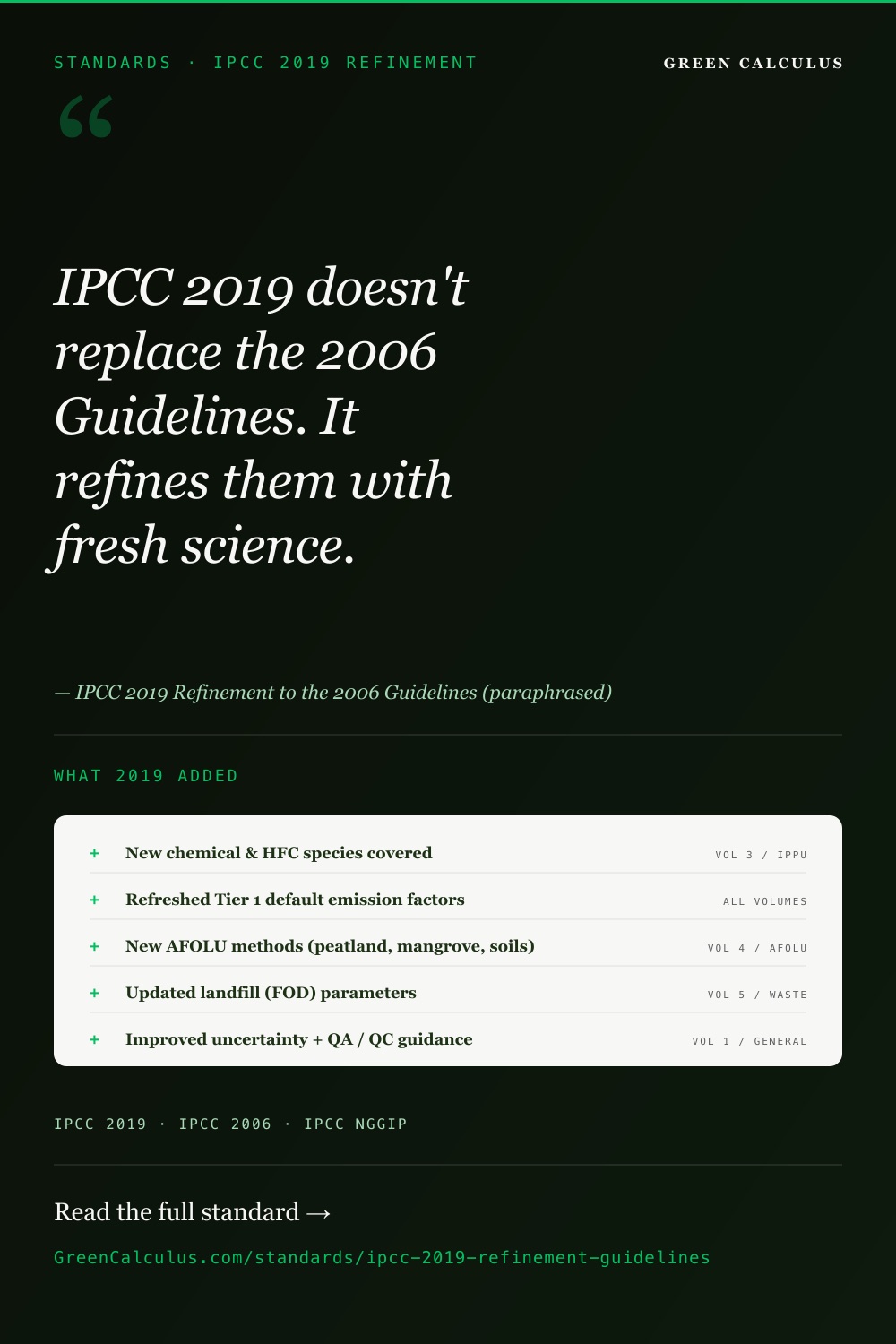
Frequently Asked Questions
The 2019 Refinement to the 2006 IPCC Guidelines for National Greenhouse Gas Inventories is the IPCC Task Force on National Greenhouse Gas Inventories’ methodological supplement to the 2006 Guidelines, published in May 2019 at IPCC-49 in Kyoto. It updates emission factors and methods, adds new source categories, and provides expanded Tier 2 and Tier 3 methodology for high-emission source categories. It is the operative methodology for all Paris Agreement Biennial Transparency Reports from the first BTR cycle (due 31 December 2024) onward, under UNFCCC Decision 18/CMA.1. It does not replace the 2006 Guidelines — the two documents form a compound methodological stack with the 2006 Guidelines remaining operative for unrefined content.
The 2019 Refinement updates specific chapters and sections of the 2006 Guidelines where new science or methodological experience warranted, adds new source categories that did not exist or were marginal in 2006 (HFC-1234yf and other low-GWP refrigerants, shale gas operations, expanded wetland categories, biochar), and provides more detailed Tier 2 and Tier 3 methodologies for high-emission source categories. The most extensively refined volume is Volume 4 AFOLU (livestock enteric fermentation, manure management, wetlands, harvested wood products, managed soils N2O); Volume 2 Energy is also extensively refined (coal and natural gas factors, fugitive emissions). Unrefined content in the 2006 Guidelines remains operative.
The 2019 Refinement uses IPCC AR5 GWP-100 values throughout, including CH4 = 28 and N2O = 265. This is locked in by the publication sequence (Refinement May 2019; AR6 Working Group I August 2021) and by UNFCCC Decision 18/CMA.1, which specifies AR5 GWPs as the basis for Biennial Transparency Reports under the Paris Agreement Enhanced Transparency Framework. The Refinement’s AR5 basis is independent of subsequent IPCC assessments — AR6 published its own updated GWP values in 2021, but those have not been retroactively applied to the Refinement.
Yes — indirectly but materially. Corporate GHG reporting uses national emission factor databases (DEFRA, EPA, EEA, IEA) that derive from national inventories, which in turn apply the 2006 IPCC Guidelines as refined by the 2019 Refinement. When DEFRA, EPA, or EEA publishes a Scope 1 stationary combustion factor for natural gas, the underlying methodology is the Refinement’s Volume 2 Chapter 2 applied at national-inventory scale. Corporate Scope 1, Scope 2 (location-based), and parts of Scope 3 all rest, via this propagation chain, on Refinement methodology. Corporate practitioners do not typically apply the Refinement directly; they apply national-database factors that propagate Refinement methodology to corporate scale.
Volume 4 AFOLU is the most extensively changed volume. Livestock (Chapter 10) was refined with updated enteric fermentation methodology including new Tier 2 methodology incorporating country-specific feed digestibility and methane conversion factors, and updated manure management methods. Managed soils N2O (Chapter 11) was refined with updated emission factors for synthetic nitrogen fertiliser, manure application, and crop residue decomposition, disaggregated by climate zone, soil type, and management practice. Wetlands (Chapter 7) was elevated to a distinct land-use category with new methodology for drained inland organic soils, coastal wetlands (mangroves, tidal marshes, seagrass meadows), and constructed wetlands. Harvested wood products (Chapter 12) was refined with updated carbon storage accounting. An entirely new appendix on biochar was added, recognising biochar as an emerging commercially deployed carbon dioxide removal pathway.
Volume 2 Energy was extensively refined. Stationary combustion (Chapter 2) was refined with updated default emission factors for coal types, natural gas, and oil products, and new fuel categories addressing biomethane, hydrogen blends in natural gas networks, and synthetic fuels. Mobile combustion (Chapter 3) was refined for modern vehicle emission control technology, hybrid and electric vehicles, aviation domestic/international distinction, and marine transport heavy fuel oil. Fugitive emissions (Chapter 4) was the most substantively refined chapter, with new methodology for shale gas operations, abandoned oil and gas wells, abandoned underground coal mines, and biomethane production and distribution. CO2 transport, injection and geological storage (Chapter 5) was refined to reflect operational experience with commercial-scale CCUS projects.
The tier system is the IPCC methodology’s mechanism for accommodating varying levels of data availability and inventory sophistication across Parties. For each source category, the methodology specifies a hierarchy of tiers: Tier 1 uses IPCC default emission factors with national activity data; Tier 2 uses country-specific emission factors derived from national measurements or technology mix; Tier 3 uses facility-level activity data combined with facility-level emission models or direct measurement. Higher tiers require more data and produce more accurate results but are more resource-intensive. National inventories apply different tier levels to different source categories based on key-category analysis (which identifies categories accounting for the largest share of emissions or uncertainty). The 2019 Refinement expanded Tier 2 and Tier 3 methodology for several high-emission source categories where Tier 1 methodology was identified as inadequate by UNFCCC reviews.
UNFCCC Decision 18/CMA.1, adopted at COP24 in December 2018, specifies the modalities, procedures and guidelines (MPGs) for the Enhanced Transparency Framework under Article 13 of the Paris Agreement. The MPGs specify use of “the 2006 IPCC Guidelines for National Greenhouse Gas Inventories, and any subsequent version or refinement of the IPCC Guidelines agreed upon by the CMA” as the methodological basis for national inventory reports submitted as part of Biennial Transparency Reports. The 2019 Refinement is the operative “subsequent version or refinement” once adopted by the CMA. The first BTRs were due 31 December 2024, with subsequent BTRs due every two years. From the first BTR cycle onwards, all Parties’ national inventories submitted under ETF apply the 2006 Guidelines as refined by the 2019 Refinement, with AR5 GWP-100 values.
National factor databases (DEFRA UK Government GHG Conversion Factors, U.S. EPA emission factor publications, EEA EMEP/EEA Air Pollutant Emission Inventory Guidebook, IEA Emissions Factors) are corporate-facing reformattings of national inventory data. National inventories apply the 2006 IPCC Guidelines as refined by the 2019 Refinement, with country-specific Tier 2 or Tier 3 methodology for key categories. The databases derive their published factors from this national-inventory methodology, presenting them in units convenient for corporate use (kg CO2e per kWh, per litre, per kg of material). Corporate practitioners use these database factors directly; the IPCC methodology is the upstream source via the national inventory layer. Different national databases may incorporate Refinement updates on different timelines and to different depths, and the GWP basis may transition at different times.
Partially. The Refinement addresses removals in the AFOLU domain (Volume 4) where land-use, forest, and soil-management activities can result in net removal of CO2 from the atmosphere through biomass and soil organic carbon stock change. The new appendix on biochar (Volume 4 Appendix 4) addresses biochar as an emerging CDR pathway. CO2 transport, injection and geological storage (Volume 2 Chapter 5) addresses CCS operations. Other CDR pathways — direct air capture and storage, ocean alkalinity enhancement, enhanced rock weathering, ocean-based CDR — are not yet addressed at full methodology depth in the 2019 Refinement, reflecting their emergent status as commercially deployed technologies. The GHG Protocol Land Sector and Removals Standard 2026 provides expanded corporate accounting guidance for AFOLU removals; a future IPCC inventory methodology product is anticipated to address novel CDR pathways more comprehensively.
Carbon credit methodologies under Verra (VCS), Gold Standard, ART-TREES, Climate Action Reserve, and other crediting programmes reference the 2006 IPCC Guidelines and the 2019 Refinement for baseline emission accounting, additionality testing, and quantification of crediting outcomes. For forestry credits (reforestation, afforestation, improved forest management, REDD+), the underlying biomass and soil organic carbon methodology references Volume 4 Chapter 4. For agricultural credits, the methodology references Volume 4 Chapter 5 (Cropland), Chapter 11 (managed soils N2O), and the biochar appendix. For livestock-management credits, the methodology references Volume 4 Chapter 10. For wetlands credits (coastal blue carbon, peatland rewetting), the methodology references Volume 4 Chapter 7. The Refinement supplies the physical methodology; the crediting programmes add the integrity architecture (additionality, permanence, leakage, co-benefits).
The IPCC Task Force on National Greenhouse Gas Inventories has not announced a specific successor methodology product. The historical pattern suggests an inventory methodology update on a 10–15 year cycle (1996 Guidelines, 2003 GPG-LULUCF, 2006 Guidelines, 2019 Refinement), suggesting a successor in the late 2020s or early 2030s. New science from IPCC AR7 (currently under development), accumulated UNFCCC review experience from the post-2024 BTR cycle, and methodological pressure from emerging source categories (novel CDR pathways, hydrogen energy systems) will all shape any future product. Until a successor is published, the 2006 + 2019 compound stack remains operative; corporate practitioners can plan their methodology infrastructure on the assumption that the underlying IPCC layer is stable for the foreseeable future.
Sources and References
Every claim and methodological statement on this page reconciles to the primary sources below. Where the IPCC TFI or UNFCCC has published a definitive document on a topic, the primary source is cited directly; secondary commentary is used only for interpretation.
Primary IPCC documents
- IPCC Task Force on National Greenhouse Gas Inventories, 2019 Refinement to the 2006 IPCC Guidelines for National Greenhouse Gas Inventories, adopted at IPCC-49 in Kyoto, Japan, May 2019. Five volumes: Volume 1 General Guidance and Reporting; Volume 2 Energy; Volume 3 Industrial Processes and Product Use; Volume 4 Agriculture, Forestry and Other Land Use; Volume 5 Waste.
- IPCC TFI, 2006 IPCC Guidelines for National Greenhouse Gas Inventories, adopted 2006. The foundational document that the 2019 Refinement supplements.
- IPCC TFI, Good Practice Guidance and Uncertainty Management in National Greenhouse Gas Inventories, 2000 (GPG2000). Predecessor methodology, partially superseded by the 2006 Guidelines.
- IPCC TFI, Good Practice Guidance for Land Use, Land-Use Change and Forestry, 2003 (GPG-LULUCF). Predecessor LULUCF methodology, superseded by the 2006 Guidelines Volume 4.
- IPCC TFI, Revised 1996 IPCC Guidelines for National Greenhouse Gas Inventories, 1996. The predecessor methodology, operative through the adoption of the 2006 Guidelines.
UNFCCC framework documents
- UNFCCC, Paris Agreement, adopted at COP21 in December 2015. Article 13 establishes the Enhanced Transparency Framework.
- UNFCCC, Decision 18/CMA.1: Modalities, procedures and guidelines for the transparency framework for action and support referred to in Article 13 of the Paris Agreement, adopted at COP24 in Katowice, December 2018. Specifies the methodological basis for Biennial Transparency Reports including the 2006 IPCC Guidelines as refined.
- UNFCCC, Annex to Decision 18/CMA.1, Modalities, procedures and guidelines (MPGs), specifying detailed reporting requirements for National Inventory Reports, NDC progress information, climate impacts and adaptation, and financial / technology / capacity-building support.
IPCC scientific assessments referenced by the Refinement
- IPCC, Fifth Assessment Report (AR5), Working Group I, 2013 (with corrigenda 2014–2017). The source of the AR5 GWP-100 values used throughout the 2019 Refinement.
- IPCC, Sixth Assessment Report (AR6), Working Group I, 2021. Published after the Refinement; its updated GWP-100 values are not retroactively applied to the Refinement.
Foundational accounting and methodology references
- WRI & WBCSD, The Greenhouse Gas Protocol: A Corporate Accounting and Reporting Standard, revised edition 2004. The corporate accounting framework that consumes IPCC methodology via national-database propagation.
- WRI & WBCSD, Corporate Value Chain (Scope 3) Accounting and Reporting Standard, 2011.
- WRI & WBCSD, GHG Protocol Scope 2 Guidance, January 2015.
- WRI & WBCSD, GHG Protocol Land Sector and Removals Standard, First Edition, 2026.
- ISO, ISO 14064-1:2018 Greenhouse gases — Part 1: Specification with guidance at the organization level.
National factor database sources
- UK Department for Environment, Food & Rural Affairs and Department for Energy Security and Net Zero, UK Government GHG Conversion Factors for Company Reporting, annual publications 2020–current. The propagation layer that incorporates IPCC methodology updates into corporate-facing factor publications.
- UK National Atmospheric Emissions Inventory (NAEI), maintained by UK National Inventory Agency, annual submissions to UNFCCC.
- U.S. Environmental Protection Agency, Inventory of U.S. Greenhouse Gas Emissions and Sinks, annual publication. The U.S. national inventory submitted to UNFCCC.
- U.S. EPA, Emission Factors for Greenhouse Gas Inventories, periodic publication for corporate use.
- European Environment Agency, EMEP/EEA Air Pollutant Emission Inventory Guidebook, periodic publication covering both GHG and air pollutant factors.
- International Energy Agency, Emissions Factors Database, annual publication of country-level grid emission factors.
Related GreenCalculus reference pages
- 2006 IPCC Guidelines for National Greenhouse Gas Inventories — the foundational document the Refinement supplements
- IPCC AR6 — the scientific assessment that publishes AR6 GWP values
- GHG Protocol Corporate Standard — the corporate accounting framework that consumes IPCC methodology
- UK DEFRA Emission Factors — the dominant national factor database in UK and international corporate use
- GHG Protocol Land Sector and Removals Standard 2026 — the corporate AFOLU accounting standard that builds on Refinement Volume 4
- IFRS S2 Climate-related Disclosures — the global climate disclosure standard that ultimately consumes IPCC-derived factors
- IPCC AR6 GWP values reference dataset
- Scope 1 Combustion Calculator — the application endpoint of the chain of custody
What changed in this revision
Updated 12 May 2026. Initial publication. Reflects the operative state of the 2019 Refinement as of May 2026: the May 2019 IPCC-49 adoption text in five volumes; the operative compound stack with the 2006 IPCC Guidelines; the UNFCCC Decision 18/CMA.1 adoption for Enhanced Transparency Framework BTR reporting from December 2024 onwards; the AR5 GWP-100 basis locked in by both the Refinement’s publication date and the UNFCCC reporting framework; the chain-of-custody propagation from IPCC methodology to national inventory to national factor database (DEFRA, EPA, EEA, IEA) to GHG Protocol corporate accounting to corporate calculator; the volume-by-volume substantive changes from the 2006 Guidelines across all five volumes; the AR5-vs-AR6 GWP reconciliation matrix covering the major reporting frameworks and national databases; the interactions with the GHG Protocol Corporate Standard, the GHG Protocol Land Sector and Removals Standard 2026, the major carbon credit methodologies (Verra, Gold Standard, ART-TREES), and IPCC AR6. No successor IPCC inventory methodology product is currently scheduled; the 2006 + 2019 compound stack remains operative for the foreseeable future.