
Hydrofluorocarbons (HFCs)

When the world banned the chemicals eating a hole in the ozone layer, industry needed a replacement fast — and it found one in hydrofluorocarbons. They did the job: they cooled our fridges and cars without touching the ozone. Only later did the catch become clear. The gases we chose to save the ozone layer turned out to be some of the most powerful greenhouse gases ever put into widespread use.
HFCs are ozone-safe refrigerants that are potent greenhouse gases — and the world is now unwinding its reliance on them.
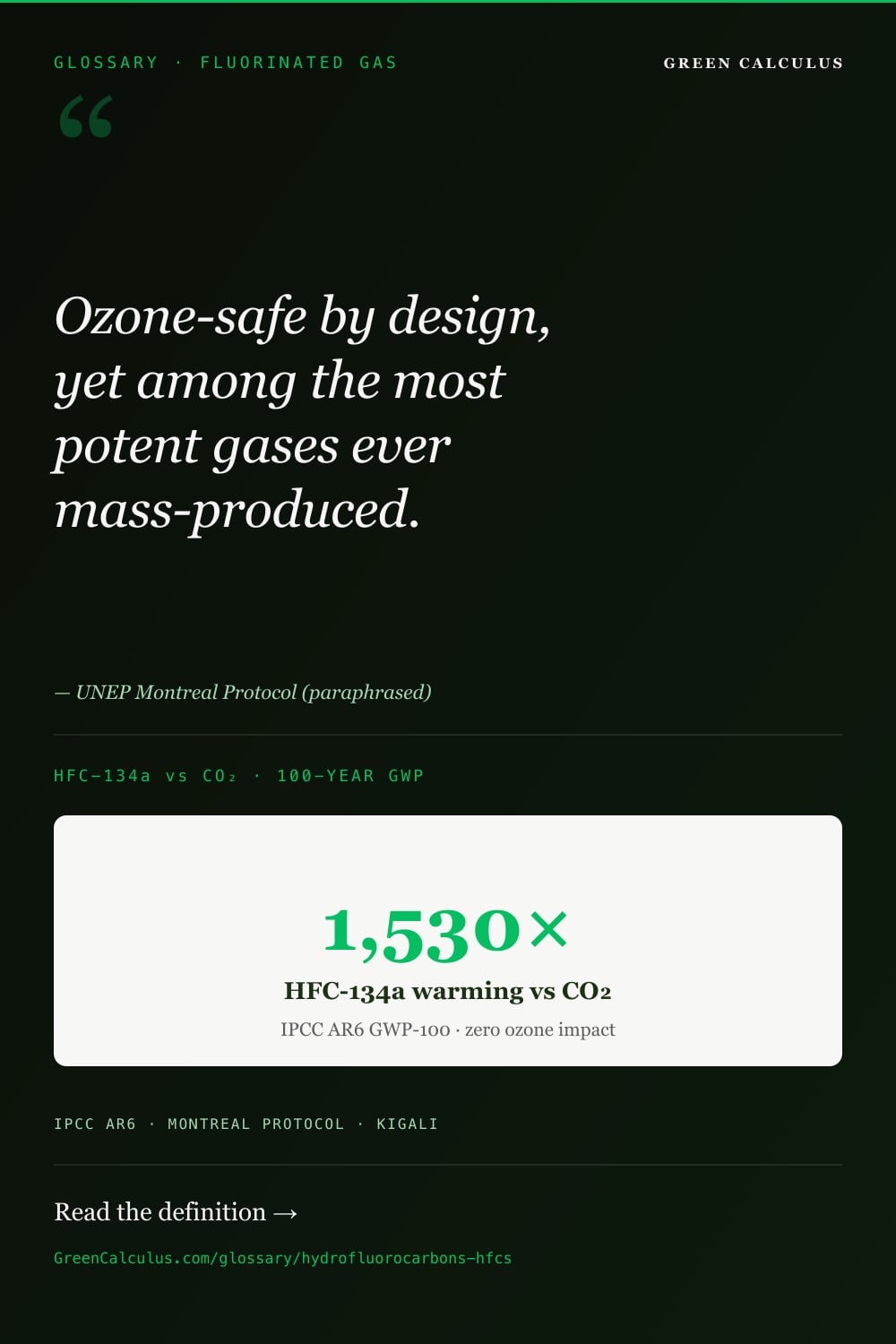
Hydrofluorocarbons (HFCs) are synthetic fluorinated greenhouse gases used mainly as refrigerants. They replaced ozone-depleting CFCs but are potent warmers — HFC-134a has an AR6 GWP-100 of 1530, and some exceed 10,000. In inventories they are Scope 1 fugitive emissions.
Definition — What HFCs Are
Hydrofluorocarbons are a family of synthetic gases made of hydrogen, fluorine, and carbon. The crucial thing they lack is chlorine — and it is chlorine that destroys stratospheric ozone. That single difference is why HFCs were adopted so widely: they could do the cooling and propelling jobs of the ozone-depleting chemicals they replaced, without harming the ozone layer.
Today HFCs are found mostly as refrigerants in fridges, freezers, air-conditioners, and heat pumps, and also as aerosol propellants, foam-blowing agents, solvents, and fire-suppression agents. They belong to the wider group of fluorinated gases (“F-gases”), which also includes other potent industrial gases, and they are one of the greenhouse gases covered by international climate agreements and corporate inventories.
HFCs solve one environmental problem and create another. They do not deplete the ozone layer — but they are potent greenhouse gases. Their warming impact comes almost entirely from leaks: gas escaping from equipment during operation, servicing, and disposal, which is why HFC emissions are treated as fugitive Scope 1 emissions.
Ozone-Safe but Climate-Potent: HFCs vs CFCs
HFCs are the third generation in a line of refrigerants, each introduced to fix the flaw of the last. Understanding that lineage is the clearest way to see what an HFC is — and isn’t.
| Family | Contains chlorine? | Depletes ozone? | Greenhouse gas? | Status |
|---|---|---|---|---|
| CFCs Chlorofluorocarbons | Yes | Yes — severely | Yes | Banned under the Montreal Protocol |
| HCFCs Hydrochlorofluorocarbons | Yes (less) | Yes (less) | Yes | Being phased out under the Montreal Protocol |
| HFCs Hydrofluorocarbons | No | No | Yes — potent | Being phased down under the Kigali Amendment |
The 1987 Montreal Protocol banned CFCs and began phasing out HCFCs to heal the ozone layer — one of the most successful environmental treaties ever signed. HFCs were the replacement, and by design they carry no chlorine and pose no ozone threat. But removing the ozone problem left the climate problem untouched: molecule for molecule, HFCs trap heat far more effectively than CO₂.
The GWP Numbers: AR5 vs AR6
An HFC’s climate impact is captured by its global warming potential (GWP) — how much more heat one tonne traps than one tonne of CO₂ over 100 years. The values below are the current IPCC AR6 figures (the reporting default since the 2023 cycle) alongside the older AR5 values still found in legacy inventories.
| HFC / blend | Typical use | AR5 GWP-100 | AR6 GWP-100 |
|---|---|---|---|
| HFC-32 | Newer, lower-GWP split air-conditioning | 677 | 771 |
| HFC-134a | Vehicle A/C, domestic & commercial refrigeration | 1300 | 1530 |
| R-410A | Air-conditioning (HFC blend) | 1923 | 2256 |
| R-404A | Commercial refrigeration (HFC blend) | 3943 | 4728 |
| HFC-23 | Specialty / byproduct — the most potent | 12400 | 14600 |
Live values from the GreenCalculus data layer · complete IPCC AR6 GWP dataset for all gases →
Two things stand out. First, the range is enormous: a lower-GWP refrigerant like HFC-32 sits below 1,000, while HFC-23 tops 14,000 — so which HFC leaks matters as much as how much. Second, AR6 revised most HFC values upward versus AR5, so an inventory built on the older figures understates its refrigerant emissions. This is also why the low-GWP shift within the family — from R-404A and R-410A toward HFC-32 and non-HFC alternatives — delivers such large reductions.
The Kigali Amendment: Phasing HFCs Down
Because HFCs were adopted to protect the ozone layer, the world chose to tackle their climate impact through the same treaty that created them. The Kigali Amendment to the Montreal Protocol, agreed in 2016 and in force since 1 January 2019, commits countries to phase down the production and consumption of HFCs — cutting them by 80–85% over roughly three decades.
The prize is large: fully implemented, the Kigali Amendment is expected to avoid up to 0.5°C of global warming by 2100 — one of the single biggest climate gains available from any one measure. Note the wording, though: it is a phase-down, not a phase-out. HFCs are being steeply reduced and replaced with lower-GWP refrigerants (including HFC-32, hydrofluoro-olefins, and natural refrigerants like ammonia and CO₂), not banned outright.
A common mistake is to read “Kigali” as an HFC ban. It is a managed reduction of the highest-GWP HFCs, backed in many regions by national rules such as F-gas regulations. High-GWP blends like R-404A are being squeezed out fastest, while lower-GWP HFCs continue in use during the transition.
HFCs in Greenhouse-Gas Accounting
In a corporate inventory, HFCs almost always appear as fugitive Scope 1 emissions — refrigerant that has leaked from owned or controlled equipment. The mass of gas lost is multiplied by its GWP to convert it into CO₂-equivalent, the common unit that lets it be added to CO₂, methane, and nitrous oxide in a single total.
The arithmetic is simple but unforgiving: because GWPs are so high, a modest leak becomes a large CO₂e figure. A 5 kg leak of R-404A converts to roughly 4728 [GreenCalculus gwp.HFC_404A.ar6_100 · IPCC AR6 · v2026.203] × 5 — well over 20 tonnes of CO₂e from a single service event. Our converters do the maths for specific refrigerants — for example HFC-134a to CO₂e and R-410A to CO₂e — using the same live IPCC AR6 values shown above, under the GHG Protocol.
Common Confusions
- Confusing HFCs with CFCs. CFCs deplete the ozone layer and are banned; HFCs do not deplete ozone but are potent greenhouse gases. Different problem, different treaty.
- Assuming “ozone-safe” means “climate-safe”. HFCs spare the ozone layer while trapping heat thousands of times more effectively than CO₂.
- Reading Kigali as a ban. It is a phase-down — a managed reduction — not an outright phase-out.
- Treating all HFCs alike. GWPs span from the hundreds to over 14,000; switching to a lower-GWP HFC can cut refrigerant emissions dramatically.
- Using AR5 GWPs. AR6 raised most HFC values and is the reporting default since 2023; older figures understate emissions.
- Forgetting the blends. Common refrigerants like R-404A and R-410A are HFC mixtures; their GWP is a weighted blend of their component gases.
Related Terms, Standards, and Tools
An HFC’s climate impact is expressed through its global warming potential — the same measure that ranks methane and nitrous oxide — drawn from IPCC AR6, reported as fugitive Scope 1 emissions under the GHG Protocol, and convertible to CO₂e with our refrigerant converters.
Frequently Asked Questions
Hydrofluorocarbons (HFCs) are a family of synthetic gases made of hydrogen, fluorine, and carbon, used mainly as refrigerants and also in air-conditioning, foams, aerosols, and solvents. Because they contain no chlorine, they do not deplete the ozone layer, which is why they were adopted as replacements for CFCs under the Montreal Protocol. However, they are potent greenhouse gases — one of the fluorinated “F-gases” covered by climate agreements and corporate inventories — and their emissions come mainly from leaks in refrigeration and air-conditioning equipment.
Because they are extremely effective at trapping heat. Sparing the ozone layer and sparing the climate are two different things: HFCs solve the first but not the second. Molecule for molecule they trap hundreds to over ten thousand times more heat than CO₂ over 100 years, so even small leaks from refrigeration and air-conditioning equipment produce large amounts of CO₂-equivalent. That combination — rapidly growing use plus very high global warming potential — is why HFCs became a major climate concern and the target of the Kigali Amendment.
Under IPCC AR6, the 100-year global warming potentials of common HFCs are approximately: HFC-32, 771 [GreenCalculus gwp.HFC_32.ar6_100 · IPCC AR6 WGI Ch 7 Table 7.SM.7 (2021) — AR6 GWP-100]; HFC-134a, 1530 [GreenCalculus gwp.HFC_134a.ar6_100 · IPCC AR6]; R-410A, 2256 [GreenCalculus gwp.HFC_410A.ar6_100 · IPCC AR6]; R-404A, 4728 [GreenCalculus gwp.HFC_404A.ar6_100]; and HFC-23, 14600 [GreenCalculus gwp.HFC_23.ar6_100 · IPCC AR6 WGI Ch 7 Table 7.SM.7 (2021) — AR6 GWP-100] — the most potent. These are the reporting defaults for greenhouse-gas inventories, and they are generally higher than the older AR5 figures. The full set for every gas is in our IPCC AR6 GWP dataset.
The Kigali Amendment is a 2016 addition to the Montreal Protocol, in force since 2019, that commits countries to phase down the production and consumption of HFCs — cutting them by roughly 80–85% over about three decades. It is a managed reduction, not an outright ban: high-GWP HFCs are being steadily replaced with lower-GWP refrigerants such as HFC-32, hydrofluoro-olefins, and natural refrigerants like ammonia and CO₂. Fully implemented, it is expected to avoid up to 0.5°C of global warming by 2100, making it one of the most significant single climate measures available.
HFCs are reported as fugitive Scope 1 emissions — refrigerant that has leaked from owned or controlled equipment during operation, servicing, or disposal. The mass of gas lost is multiplied by the refrigerant’s GWP to convert it into CO₂-equivalent, which is then added to the CO₂, methane, and nitrous oxide totals. Because HFC GWPs are so high, a small leak can dominate a site’s Scope 1 figure, so accurate leak tracking matters. Our refrigerant-to-CO₂e converters apply the current IPCC AR6 values automatically.
Need someone who does this? 6 carbon accounting & inventory providers in our directory →