
Organizational Boundary — Definition and GHG Accounting Context
Few companies are a single, tidy legal entity. They are groups — parents, subsidiaries, joint ventures, franchises, leased sites — each with its own emissions and its own tangle of ownership and control. Before anyone can add those emissions up, someone has to answer a prior question: which of these operations are actually ours to report? The answer is rarely obvious, and different defensible answers produce very different totals.
The organizational boundary is the rule that settles it — it decides which operations’ emissions a company counts as its own, and it is the first decision in building any GHG inventory.
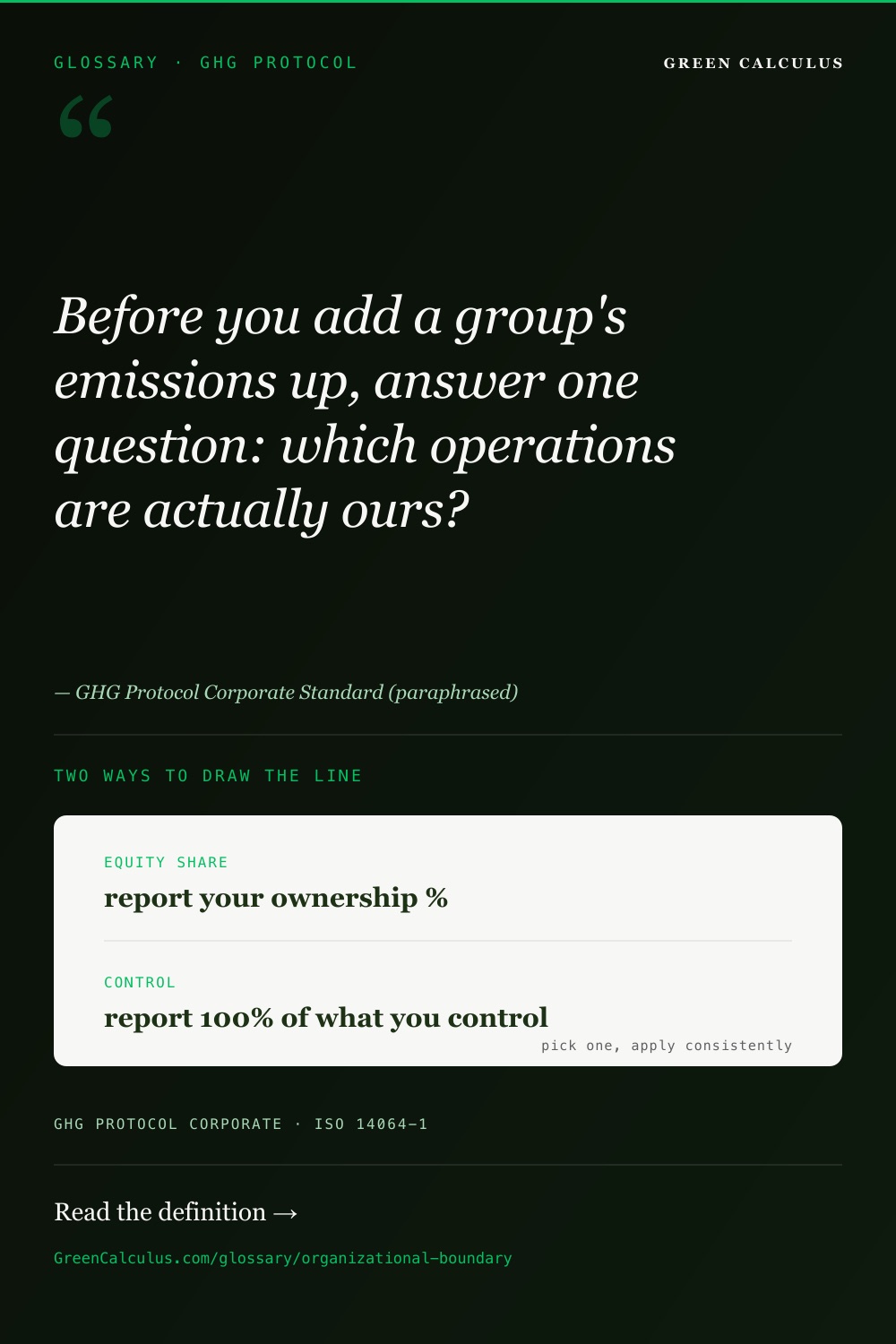
An organizational boundary is the rule that determines which operations’ emissions a company counts as its own — how a group consolidates emissions across the entities it owns or controls. The GHG Protocol offers two approaches: the equity-share approach (report your ownership percentage) and the control approach (report 100% of what you control, via operational or financial control).
Definition — Which Operations Count as Yours
An organizational boundary is the rule that determines which operations’ greenhouse gas emissions a company reports as its own. In a group of companies — with subsidiaries, joint ventures, and part-owned facilities — it is the method used to consolidate emissions from all those operations into a single corporate total. It answers the question “whose emissions are these?” before any of them are counted.
It is the first of two boundary decisions in building a GHG inventory. The organizational boundary decides which operations are inside the inventory; the operational boundary then decides which sources within those operations count, and how they map to Scopes 1, 2, and 3. Get the organizational boundary wrong and everything downstream — scope classification, the total, the target — rests on the wrong set of operations.
Both the GHG Protocol Corporate Standard and ISO 14064-1 require a company to pick one consolidation approach and apply it consistently. There are two: equity share and control.
Definition at a glance
| Also known as | Consolidation approach · reporting boundary |
|---|---|
| What it decides | Which operations’ emissions a company counts as its own |
| The choices | Equity share · control (financial or operational) |
| Set by | GHG Protocol Corporate Standard · ISO 14064-1 |
| Comes before | The operational boundary (which sources; Scope 1 / 2 / 3) |
| Not to be confused with | The operational boundary — a separate, second step |
The GHG Protocol Corporate Standard requires a company to consolidate its emissions using one of two approaches — the equity-share approach or the control approach — with control defined as either financial control or operational control.
ISO 14064-1:2018 requires the same choice, described as the “consolidation approach”, and asks the organization to state and justify it — the two standards are aligned on how the boundary is drawn.
The Two Consolidation Approaches
Every consolidation method resolves to one of two ideas: report by how much you own, or report by what you control. The control approach then splits into two definitions of control.
| Approach | What it means | Emissions the company reports |
|---|---|---|
| Equity share | Share of economic interest (ownership percentage) in the operation | Its ownership percentage of each operation’s emissions |
| Financial control | Ability to direct the financial and operating policies of the operation to gain economic benefit | 100% of operations it financially controls; 0% of the rest |
| Operational control | Full authority to introduce and implement operating policies at the operation | 100% of operations it operationally controls; 0% of the rest |
A company chooses one approach for its whole inventory — it cannot mix equity share for some operations and control for others. Under either control approach, emissions are all-or-nothing (100% or 0%) for each operation; only equity share reports a partial share. Financial and operational control usually — but not always — capture the same operations; they diverge for arrangements like operating a facility you have only a minority stake in.
How the Choice Changes the Number
The approach is not an accounting technicality — for part-owned operations it can change the reported figure from nothing to everything. Consider a joint venture emitting 100,000 tCO₂e a year, in which a company holds a 40% equity stake and runs the site day to day (operational control) but does not have financial control. How much of those emissions land in its inventory depends entirely on the approach it has chosen:
Emissions reported from one 100,000 tCO₂e joint venture
One joint venture, three consolidation approaches, three different answers for the identical emissions: all of it under operational control, 40% under equity share, and none under financial control. Illustrative figures based on the GHG Protocol Corporate Standard’s consolidation rules for an operation held at 40% equity, operated by the company, without financial control.
The same tonne of emissions can be entirely yours, partly yours, or none of your concern — decided not by the smokestack but by the boundary you draw around it.
Organizational vs Operational Boundary
Setting an inventory boundary is two decisions, not one, and conflating them is the most common boundary error:
- The organizational boundary (this term) decides which operations count — how the company consolidates emissions across the entities it owns and controls.
- The operational boundary decides, within those operations, which sources count and how they are classified into Scope 1, Scope 2, and Scope 3.
The organizational boundary comes first. You cannot decide whether a source is Scope 1 or Scope 3 until you have decided whether the operation it belongs to is inside your boundary at all — and, if it is, whether you consolidate it by control (Scope 1 and 2) or by equity share. The two decisions together define the shape of the whole GHG inventory.
Which Approach to Use
In practice, most companies choose operational control. It aligns the inventory with the operations managers can actually influence — you account for what you can change — and it maps cleanly onto the scopes. Equity share is common in sectors built on joint ventures, such as oil and gas and mining, where economic interest better reflects responsibility for the emissions.
Whatever the choice, three rules hold: it must cover the whole inventory, it must be disclosed, and it must stay consistent over time. Because the boundary determines what is counted, changing it — or restructuring through an acquisition or divestment — is a leading trigger for recalculating the base year, so that year-on-year comparisons remain honest. A tool such as the Scope 1–3 inventory aggregator assumes a single, stated boundary across all the operations it rolls up.
Common Confusions
- Confusing the organizational boundary with the operational boundary. One decides which operations count; the other decides which sources within them count. Different step, different question.
- Assuming control means majority ownership. Operational control is about the authority to run the operation, not the size of the equity stake — you can operate a facility you only part-own, or own most of one you do not operate.
- Switching approaches between years. Moving from equity share to operational control (or vice versa) changes the total without any real change in emissions, breaking the consistency principle.
- Overlooking joint ventures and leased assets. These are exactly where the approaches diverge — and where emissions are most often dropped or double counted.
- Not disclosing the chosen approach. Without stating the consolidation approach, a total is uninterpretable and cannot be compared with another company’s.
- Mixing approaches across the inventory. A company applies one approach to all operations; it cannot equity-share the inconvenient ones and control-consolidate the rest.
Frequently Asked Questions
An organizational boundary is the rule that determines which operations’ greenhouse gas emissions a company counts as its own. In a group with subsidiaries, joint ventures, and part-owned facilities, it is the method used to consolidate emissions into one corporate total. The GHG Protocol Corporate Standard and ISO 14064-1 offer two approaches — equity share and control — and it is the first of two boundary decisions in building a GHG inventory, ahead of the operational boundary.
Two. Under the equity-share approach, a company reports its ownership percentage of each operation’s emissions. Under the control approach, it reports 100% of the emissions from operations it controls and none from those it does not. Control is defined two ways: financial control (the ability to direct financial and operating policies for economic benefit) and operational control (full authority to introduce and implement operating policies). A company picks one approach and applies it across its whole inventory.
They are the two steps of setting an inventory boundary. The organizational boundary decides which operations count as the company’s — how it consolidates across the entities it owns and controls. The operational boundary decides, within those operations, which emission sources count and how they are classified into Scope 1, Scope 2, and Scope 3. The organizational boundary comes first: you cannot assign a source to a scope until you know whether its operation is inside the boundary.
Most companies choose operational control, because it aligns the inventory with the operations managers can actually influence and maps cleanly onto the scopes. Equity share is common in joint-venture-heavy sectors such as oil and gas and mining, where economic interest better reflects responsibility. There is no single “correct” approach, but whichever is chosen must cover the whole inventory, be disclosed, and stay consistent year to year so that trends and base-year comparisons remain meaningful.
Joint ventures are where the choice matters most. Take a JV emitting 100,000 tCO₂e in which a company holds a 40% stake and operates the site but lacks financial control. Under operational control it reports all 100,000 tonnes; under equity share, 40,000 tonnes; under financial control, none. The identical emissions appear as everything, part, or nothing purely because of the consolidation approach — which is why the approach must be stated and applied consistently, and why JVs and leased assets are the sources most often mis-counted.