
Hotel Carbon Measurement Initiative (HCMI)

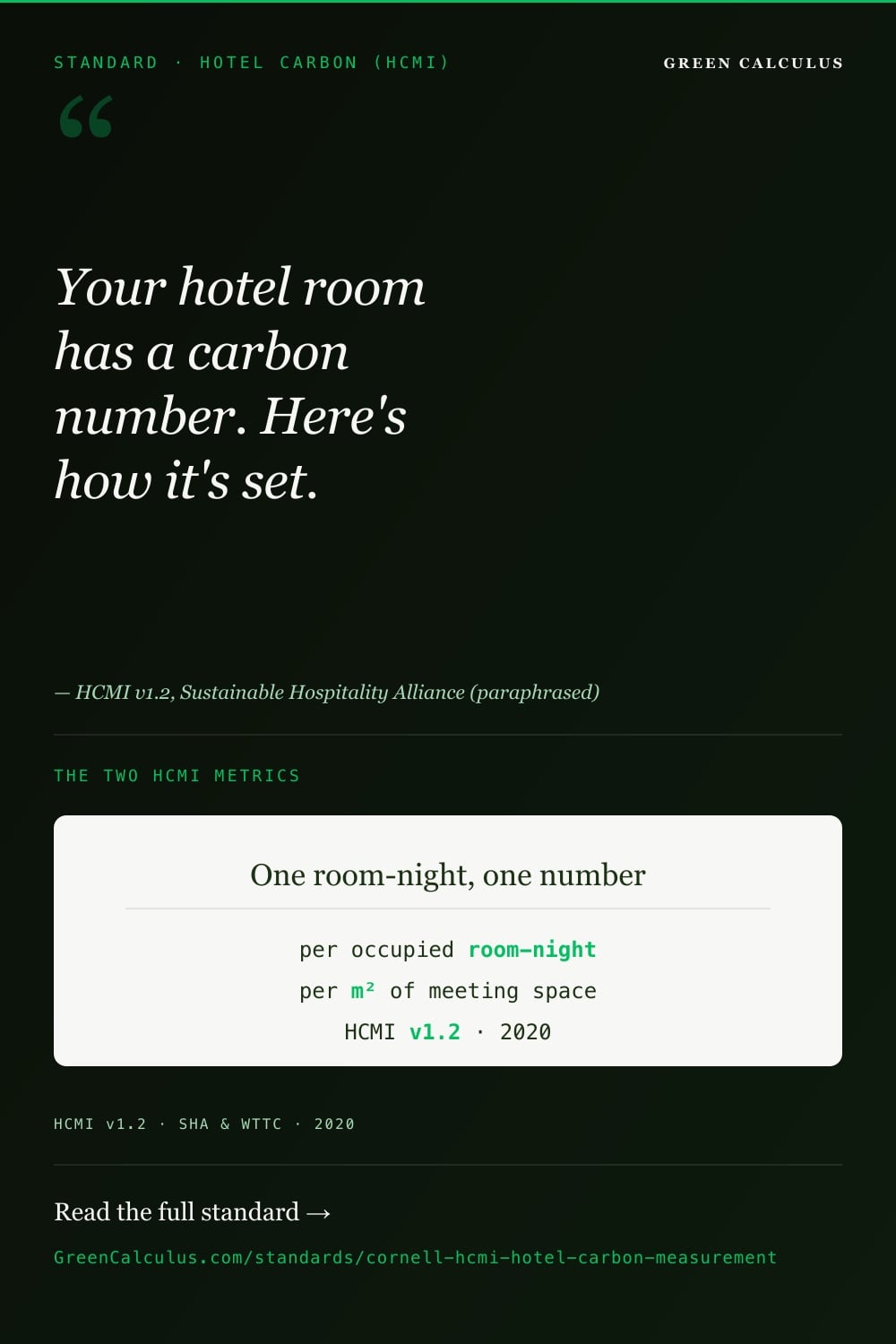
The Hotel Carbon Measurement Initiative is the hospitality industry’s common language for the carbon footprint of a hotel stay. Before HCMI, every hotel group calculated and reported emissions differently, and a corporate travel buyer comparing two properties was comparing two incompatible numbers. HCMI fixed that by standardising on two metrics every hotel can produce and every buyer can compare: kilograms of CO2e per occupied room-night, and kilograms of CO2e per square metre of meeting space per hour. For a sustainability team building a Scope 3 Category 6 business-travel inventory, the per-room-night figure is the single most useful number a hotel can hand over.
The initiative is also one of the most consistently mis-attributed standards in corporate GHG accounting. It is routinely called “the Cornell methodology” — but HCMI is owned by the Sustainable Hospitality Alliance (formerly the International Tourism Partnership) together with the World Travel & Tourism Council, and was built by a working group of 23 hotel companies advised by KPMG. Cornell University’s role was specific and limited: its Center for Hospitality Research supplied the materiality research that shaped how HCMI treats mobile and fugitive emissions. The “Cornell” name people reach for usually belongs to a different artefact entirely — the Cornell Hotel Sustainability Benchmarking Index (CHSB), a benchmarking dataset that consumes HCMI-format data rather than defining it. This page documents HCMI as it stands in 2026: what it is, who actually owns it, how its calculation chain works end to end, how it aligns with and diverges from the GHG Protocol and ISO 14064-1, how it feeds corporate Scope 3 reporting, where it sits relative to CHSB, and how GreenCalculus implements its benchmark factors.
1. What HCMI Is — and the “Cornell” Naming Untangled
HCMI is a free, voluntary methodology for calculating and communicating the carbon footprint of a hotel stay and of meeting-space usage. It was launched in June 2012 by the Sustainable Hospitality Alliance and the WTTC in collaboration with 23 leading global hospitality companies, applying aspects of the GHG Protocol. It defines a reporting boundary (the whole hotel under operational control, minus private space, plus outsourced laundry), a calculation chain, and two standard output metrics. It deliberately trades some accuracy for ease of implementation so that any hotel — large or small, with or without prior carbon-reporting experience — can produce a comparable number.
The naming confusion is worth resolving before anything else, because using the wrong name in a methodology statement produces an unsupportable citation. Three distinct things share the same conceptual space:
| Artefact | What it is | Owner / steward | Role of the other two |
|---|---|---|---|
| HCMI Hotel Carbon Measurement Initiative |
The methodology — boundary rules, calculation chain, two output metrics. The subject of this page. | Sustainable Hospitality Alliance + WTTC (23 hotel companies; KPMG advisor) | Cornell CHR contributed materiality research; CHSB consumes its output. |
| CHSB Cornell Hotel Sustainability Benchmarking Index |
A benchmarking dataset — annual energy, water and carbon figures from tens of thousands of hotels, expressed per-room-night by region and class. | Cornell University (with Greenview) | Reports data in HCMI-compatible units; is not itself a calculation method. |
| Hotel Footprinting Tool hotelfootprints.org |
A free public calculator that returns a median per-room-night footprint by location and star rating. | Greenview | Runs the HCMI methodology over CHSB benchmark data. |
If you are citing the calculation method — boundaries, apportionment, the per-room-night metric — cite “HCMI v1.2 (Sustainable Hospitality Alliance, 2020).” If you are citing a benchmark number for a country or hotel class, cite “Cornell Hotel Sustainability Benchmarking Index (CHSB)” with the data year. “The Cornell methodology” is ambiguous and usually wrong: Cornell publishes the benchmark, not the method.
Provider directory
Now it has to hold up all year.
See who does this work. Every listing names the standards it works to, and paid placements are labelled. Including Attain Zero and KERAMIDA.
Browse 6 carbon accounting & inventory providers →Do this work? A listing is US$390 a year. Get listed →
2. Governance and Lineage
HCMI was not built by a single body. A joint Carbon Measurement Working Group — representatives of the Sustainable Hospitality Alliance and WTTC’s hotel members — was established in May 2011, with KPMG as technical advisor. The methodology applied aspects of the GHG Protocol from the outset and was reviewed before launch by the World Resources Institute, one of the GHG Protocol’s two development partners. Cornell University’s Center for Hospitality Research entered as a research contributor, specifically informing how the working group judged the materiality of mobile emissions (hotel cars, shuttles, lawnmowers) and fugitive emissions (refrigerants).
The 2020 v1.2 document is the operative written methodology and clarifies the treatment of refrigerants, mobile fuels and on-site generation. The 2022 update was primarily to the supporting tool: it re-aligned with the latest GHG Protocol guidance, improved how renewable energy is incorporated, and embedded publicly available emission factors so hotels without their own factor library could still use it. HCMI is voluntary and carries no fixed mandatory review cadence; updates are issued as user feedback and research accumulate. A standing review process exists precisely so the working group can refine the method over time.
3. Scope and Boundaries
HCMI uses the operational control consolidation approach and draws the boundary at the hotel premises. Everything inside the premises that guests or conference attendees can access is in; private space is the principal exclusion; outsourced laundry is the one source pulled in from outside the premises because it is material and within the hotel’s influence.
| Source | Scope | Treatment | Rationale (HCMI) |
|---|---|---|---|
| On-site fuel (gas, oil, LPG) — heating, kitchens, generators | Scope 1 | Included | Direct combustion under operational control. |
| Owned/controlled mobile fuel — shuttles, hotel cars, mowers | Scope 1 | Included | Material per Cornell CHR research; third-party taxis/limos excluded. |
| Refrigerant leakage — AC, fridges, chillers | Scope 1 | Included | Fugitive emissions; applied via refrigerant GWP (see §7). |
| Purchased electricity | Scope 2 | Included | Indirect energy; renewable share handled market-based (see §8). |
| Purchased heat / steam / district cooling | Scope 2 | Included | District energy guidance in the v1.2 appendix. |
| Outsourced laundry | Scope 3 | Included (the one Scope 3 inclusion) | Material, comparability-critical, within hotel influence. |
| Private space — apartments, leased third-party floors, on-site staff accommodation | — | Excluded | Sub-metered or area-apportioned out of the hotel total. |
| Guest travel to/from the hotel | Scope 3 | Excluded | Outside premises; sits in the traveller’s own footprint. |
| Upstream supply chain (food, amenities, construction) | Scope 3 | Excluded | Out of scope — HCMI is operational, not full life-cycle. |
| Employee business travel in non-company vehicles | Scope 3 | Excluded | Third-party operated. |
Private space is removed from the hotel total in one of two ways: by subtracting sub-metered consumption where the private areas are sub-metered, or by subtracting a share of consumption proportional to the private conditioned floor area versus total conditioned floor area. Where private areas are separately metered and billed, no adjustment is needed because their consumption never entered the hotel’s figures. This boundary discipline is what makes one hotel’s per-room-night number comparable to another’s — the operational-control logic is the same one set out in the GHG Protocol Corporate Standard.
4. The Two Output Metrics
HCMI produces two headline figures. Both are derived from the same total hotel footprint, apportioned between the two revenue-generating uses of hotel space.
The guest-room footprint divided by the number of occupied room-nights in the period. This is the number a corporate travel buyer multiplies by nights stayed to get the Scope 3 Category 6 footprint of an employee’s stay.
The meeting-space footprint divided by (meeting area × hours of use). This is the figure used to footprint a conference or event booking, typically in response to an RFP from a corporate client.
The choice of metrics is deliberate: occupied room-nights (not available room-nights) and area-hours of meeting space are the units in which hotels already transact with corporate clients, so the carbon figure attaches directly to a booking. The 2020 methodology also supports an energy-use-per-area supplement for clients who request intensity in energy rather than carbon terms.
5. The Calculation Chain
HCMI computes a single whole-hotel footprint first, then strips out non-hotel space, then apportions what remains between guest rooms and meeting space, then divides by the relevant activity units. The five steps:
For the reporting period, collect consumption for every in-boundary source: fuel, electricity, purchased heat/cooling, owned mobile fuel, refrigerant top-ups, and outsourced laundry. Standing data (floor areas, room counts, meeting area) is gathered once and reused.
Apply the appropriate emission factor to each activity (GHG-Protocol-aligned factors; refrigerants via their GWP). Sum to a gross whole-hotel footprint in kg CO2e across Scope 1, Scope 2, and outsourced laundry.
Remove the energy of private/leased/staff-accommodation areas — by sub-meter where available, otherwise by conditioned-area apportionment — to get the net hotel footprint.
Split the net footprint between guest rooms and meeting space on a consistent, floor-area-based basis (see §6). This is the mechanic that lets the two metrics share one underlying total without double-counting.
Guest-room footprint ÷ occupied room-nights → kg CO2e per room-night. Meeting footprint ÷ (area × hours) → kg CO2e per m²·hour.
5.1 Worked Example
A simplified illustration with round numbers. All values below are illustrative inputs chosen to show the arithmetic, not benchmark figures for any real hotel.
| Gross whole-hotel footprint (Scope 1 + 2 + laundry) | 1,000,000 kg CO2e |
| Less private/leased space (area-apportioned, 8%) | −80,000 kg CO2e |
| Net hotel footprint | 920,000 kg CO2e |
| Apportioned to guest rooms (85% of conditioned area) | 782,000 kg CO2e |
| Apportioned to meeting space (15%) | 138,000 kg CO2e |
| Occupied room-nights in period | 52,000 |
| Per occupied room-night = 782,000 ÷ 52,000 | 15.04 kg CO2e |
| Meeting area × hours used | 920,000 m²·h |
| Per m²·hour = 138,000 ÷ 920,000 | 0.150 kg CO2e |
Illustrative arithmetic only. Real apportionment uses the hotel’s actual conditioned-area split; real factors come from the hotel’s energy mix and the applicable national grid factor.
6. Apportionment Logic
Apportionment is HCMI’s signature mechanic and the part most often mishandled. Because a hotel meters energy at the building level, not by function, HCMI cannot read the guest-room footprint directly — it has to allocate the net hotel total between rooms and meeting space on a defensible, repeatable basis. The methodology allocates proportionally so that the whole footprint is distributed exactly once: guest-room share plus meeting-space share equals 100% of the net total, with no source left unallocated and none counted twice.
The practical consequence is that two hotels with identical energy bills can report different per-room-night figures if their meeting-space-to-room ratios differ, and that is the intended behaviour — a convention-heavy property carries more of its energy in meeting space, so each room-night legitimately carries less. The discipline that matters for comparability is that every hotel applies the same apportionment basis consistently across periods, so year-on-year trends in a single property are meaningful even where cross-property comparison needs care.
HCMI divides by occupied room-nights, not the total available. A half-empty hotel therefore reports a higher per-room-night figure than the same hotel at full occupancy, because the largely fixed energy base is spread over fewer nights. This makes the metric sensitive to occupancy — a point to disclose when comparing properties or periods with very different occupancy levels.
7. Emission Factors, GWP and Refrigerants
HCMI applies GHG-Protocol-aligned emission factors to each activity and converts the non-CO2 greenhouse gases — chiefly methane and nitrous oxide from combustion, and the refrigerant gases — into CO2-equivalent using global warming potentials. In practice most hotels use a national factor set such as the UK’s DEFRA emission factors for fuels, and the applicable national grid factor for electricity. The choice of GWP basis (the IPCC assessment report behind the factor set) follows whatever the source factor library uses; the dominant default for corporate reporting in 2026 is IPCC AR6 GWP-100, while DEFRA-sourced fuel factors carry AR5 internally by design — a basis mismatch worth noting but not “correcting” inside a single total.
Refrigerant leakage is the fugitive-emissions component. The amount of gas lost when AC units, fridges and chillers are installed, serviced or retired is usually small in mass terms but can be significant in CO2e terms because refrigerant GWPs are high — a kilogram of a common HFC can carry a GWP in the thousands. HCMI’s v1.2 appendix provides refrigerant GWPs; the mechanics are the same mass-balance leakage logic covered in depth on the refrigerant leakage calculator, and the phase-down trajectory of high-GWP refrigerants under the Kigali Amendment and the EU F-gas Regulation is steadily lowering this component for hotels that re-equip.
Early HCMI guidance applied a 10% uplift to certain Carbon Trust factor data, both to account for the uncertainty of estimated data and to nudge hotel managers toward sourcing primary data directly. This uplift is a feature of the earlier factor tables rather than a permanent rule; modern implementations using current national factor sets do not carry it. Knowing it existed helps when reconciling an older HCMI figure that looks slightly high against a recent one.
8. Renewable Energy Treatment
HCMI’s handling of renewable electricity is a deliberate simplification and a common source of confusion. The methodology draws on the GHG Protocol Scope 2 Guidance to let hotels report renewable-energy use, but it implements only the market-based view — it does not run the full dual location-based-and-market-based reporting that the Scope 2 Guidance requires of a corporate inventory. In HCMI terms, a hotel that has contracted renewable electricity through certificates or a supplier-specific tariff can reflect that in its footprint and in its reported renewable share; the methodology offers a simplified aggregation rather than the complete dual-reporting machinery.
The implication for a corporate consuming a hotel’s HCMI figure: if your own inventory reports Scope 2 on a location-based basis (as many regimes require alongside market-based), an HCMI per-room-night figure built on market-based renewable claims is not directly substitutable for a location-based line. For a clean Scope 3 Category 6 input, confirm which basis the hotel’s figure uses, and prefer a location-based or benchmark figure where your reporting boundary calls for one. The 2022 tool update improved the renewable-energy treatment specifically because this was a frequent practitioner pain point.
9. HCMI vs GHG Protocol and ISO 14064-1
HCMI is built on the GHG Protocol’s five principles — relevance, completeness, consistency, transparency, accuracy — and follows the principles of ISO 14064-1, but it is a deliberately scoped, hotel-specific instrument. None of the four GHG Protocol standards fits the per-stay use case on its own, so HCMI borrows from several. The matrix below shows where it aligns and where it simplifies.
| Dimension | GHG Protocol / ISO 14064-1 | HCMI treatment |
|---|---|---|
| Consolidation | Operational control, financial control or equity share | Operational control, at the individual hotel level (not corporate) |
| Scope coverage | Scope 1, 2 required; Scope 3 per the Corporate Value Chain Standard | Scope 1 & 2 required; only outsourced laundry from Scope 3 |
| Scope 2 method | Dual reporting — location-based and market-based | Market-based only, simplified (see §8) |
| Life-cycle scope | Product Standard covers cradle-to-grave | Operational only — no construction, materials, amenities |
| Verification | ISO 14064-3 / ISAE 3410 external assurance available | Recommends internal review; no mandated external verification |
| Inventory quality management | ISO 14064-1 requires documented QA/QC | Not required to document GHG-management activities or QA system |
| Output unit | Absolute tonnes CO2e by scope | Intensity per room-night and per m²·hour |
The headline takeaway is that HCMI is an intensity instrument for a single asset, not a corporate inventory standard. A hotel group still needs the GHG Protocol Scope 3 Standard and a full corporate inventory for group-level reporting; HCMI gives it a consistent per-property number to roll up and a comparable figure to hand to corporate clients.
10. CHSB — The Benchmarking Sibling
The Cornell Hotel Sustainability Benchmarking Index is the dataset most people mean when they say “Cornell.” It is an industry-led global data collection run by Cornell University with Greenview, covering energy, water and carbon from tens of thousands of hotels, and it expresses carbon in the same per-room-night units HCMI defines — which is exactly why the two are so easily confused. CHSB does not define a calculation method; it aggregates HCMI-compatible data into benchmark medians by region, country, climate zone and hotel class.
CHSB applies minimum-sample thresholds before it publishes a benchmark, so that no single property is identifiable and no segment is reported on thin data:
For a corporate without a specific hotel’s own HCMI figure, a CHSB benchmark median for the right country and class is the standard fallback per-room-night factor — and it is precisely these benchmark figures that GreenCalculus carries in its hotel_stay data (see §13). The CHSB dataset and its guidance document are freely available through Cornell’s Center for Hospitality Research.
11. How HCMI Plugs Into Corporate Reporting
For a hotel operator, HCMI is the per-asset intensity layer beneath a full corporate inventory. For everyone else — the far larger audience — HCMI is a Scope 3 Category 6 (business travel) input. The per-room-night factor, multiplied by employee nights stayed, is the cleanest way to footprint hotel accommodation in a corporate travel inventory.
11.1 Scope 3 Category 6 — Business Travel
Under the GHG Protocol Scope 3 Standard, hotel nights are part of Category 6. The calculation is simply nights × per-room-night factor, with the factor sourced in a clear hierarchy: a specific hotel’s own HCMI figure where it provides one; otherwise a CHSB benchmark median for the country and class; otherwise a national average. This sits alongside the flight and ground-transport legs of the same category — the business travel air calculator handles the aviation leg, and the hotel leg uses the HCMI/CHSB factor.
11.2 Disclosure Frameworks
Where business travel is material, the hotel footprint flows into mandatory disclosure. Under CSRD ESRS E1, material Scope 3 must be disclosed, and Category 6 is frequently material for service-sector reporters; an HCMI- or CHSB-derived hotel figure is a defensible input provided its basis is stated. The same input supports IFRS S2 Scope 3 disclosure and underpins the value-chain coverage that SBTi expects when business travel falls inside a target boundary. In each case the discipline is identical: disclose whether the factor is a property-specific HCMI figure or a CHSB benchmark, and on what GWP and Scope 2 basis it was built.
12. Implementation Workflow
A practical sequence for a hotel producing its own HCMI figure, or a corporate validating a figure a hotel has supplied:
13. GreenCalculus Implementation — Provenance
GreenCalculus carries hotel per-room-night factors in the MasterBrain hotel_stay section, tagged to Scope 3 Category 6 business travel. The section holds two distinct source families so that a corporate can pick the most appropriate fallback for the country and class it is reporting on.
Roughly forty country-level per-room-night factors keyed as hotel_stay.<country>, sourced from the UK DEFRA 2025 set. These are the convenient default for a single national average where a property-specific figure is unavailable.
Around fifty benchmark factors keyed as hotel_stay.cha.<iso3>.<class>, sourced from the Cornell Hotel Sustainability Benchmarking Index. These give per-room-night medians differentiated by hotel class where CHSB’s sample thresholds were met — the closest standardised match to a real property’s HCMI figure.
Both families carry scope='scope3_cat6' and activity='business_travel', and resolve through the V3 canonical-row keyspace so calculator engines read the same value the data page displays. Each result carries its source tag (DEFRA 2025 or Cornell CHSB) into the exported audit trail, keeping the per-room-night factor’s provenance visible end to end.
14. Common Misuses of HCMI
Six patterns that surface routinely in hotel footprints and the corporate inventories that consume them:
15. Limitations and Edge Cases
- Accuracy traded for accessibility. HCMI explicitly balances ease of implementation against precision; it is a first step in an environmental programme, not a complete environmental assessment.
- Occupancy sensitivity. Because it divides by occupied room-nights, the per-room-night figure rises at low occupancy and falls at high occupancy for the same physical hotel — disclose occupancy when comparing.
- Seasonality and refurbishment. A reporting period spanning a major refurbishment or a strongly seasonal trade can distort the figure; the methodology flags both as effects to handle and disclose.
- Mixed-use complexity. Properties with significant leased retail, residences or third-party operations require careful private-space subtraction; the area-apportionment fallback is an approximation where sub-metering is absent.
- No mandated verification. HCMI recommends internal review only. A figure destined for assured disclosure may need external verification under ISO 14064-1-aligned processes that HCMI itself does not require.
- Operational, not life-cycle. Construction, materials and amenities are out of scope — HCMI does not capture the embodied carbon of the building or its fit-out.
16. Frequently Asked Questions
No. HCMI is owned and stewarded by the Sustainable Hospitality Alliance (formerly the International Tourism Partnership) together with the World Travel & Tourism Council, built by a working group of 23 hotel companies with KPMG as advisor and reviewed by the World Resources Institute. Cornell University’s Center for Hospitality Research contributed materiality research on mobile and fugitive emissions. The “Cornell” name usually refers to the separate Cornell Hotel Sustainability Benchmarking Index (CHSB), a benchmarking dataset that uses HCMI-format data.
HCMI is a calculation methodology — it defines the boundary, the apportionment logic and two output metrics. CHSB is a benchmarking dataset — it aggregates per-room-night figures from tens of thousands of hotels into medians by region and hotel class. HCMI tells you how to calculate; CHSB tells you what a typical figure looks like. CHSB reports in HCMI-compatible units, which is why the two are so often confused.
Kilograms of CO2e per occupied room-night, and kilograms of CO2e per square metre of meeting space per hour. Both are derived from the same whole-hotel footprint, apportioned between guest rooms and meeting space. The per-room-night figure is the one corporate travel buyers use to footprint a stay.
Scope 1 (on-site fuel, owned mobile fuel, refrigerant leakage) and Scope 2 (purchased electricity, heat and cooling) are required. From Scope 3, HCMI includes only outsourced laundry, because it is material, comparability-critical and within the hotel’s influence. Guest travel, the upstream supply chain, construction and third-party-operated transport are out of scope.
HCMI implements a simplified market-based view drawn from the GHG Protocol Scope 2 Guidance: a hotel with contracted renewable electricity can reflect that in its footprint and reported renewable share. It does not run the full dual location-based-and-market-based reporting a corporate inventory requires. If you need a location-based figure, confirm the basis of any HCMI number before substituting it.
Yes — that is its most common corporate use. Multiply nights stayed by the per-room-night factor. Use a specific hotel’s own HCMI figure where provided; otherwise fall back to a Cornell CHSB benchmark median for the country and hotel class, then to a national average. Disclose which source and basis you used.
The operative written methodology is HCMI v1.2, published June 2020, which clarified the treatment of refrigerants, mobile fuels and on-site generation. The supporting tool was refreshed in 2022 to re-align with the latest GHG Protocol guidance, improve renewable-energy treatment and embed publicly available emission factors. HCMI is voluntary and has no fixed mandatory review cycle.
No. HCMI recommends an internal review process but does not mandate external verification, and it does not require the documented QA/QC that ISO 14064-1 expects of a full inventory. A figure destined for assured disclosure may need verification under processes HCMI itself does not impose.
Because HCMI divides by occupied room-nights, not available ones. A hotel’s energy base is largely fixed, so spreading it over fewer occupied nights raises the per-room-night figure. This makes the metric occupancy-sensitive — worth disclosing whenever you compare properties or periods with very different occupancy.
Apply HCMI factors in your travel inventory
The hotel per-room-night factors described here feed Scope 3 Category 6 business-travel calculations. Pair the hotel leg with the business travel air calculator for flights, cross-reference the GHG Protocol Scope 3 Standard for the Category 6 boundary, and see the Scope 2 Guidance for the location-vs-market-based distinction that governs how a hotel’s electricity is counted.
Related GreenCalculus References
The accounting frameworks HCMI borrows from: GHG Protocol Corporate Standard · GHG Protocol Scope 3 Standard · Scope 2 Guidance · ISO 14064-1
Factor and GWP sources: UK DEFRA emission factors · IPCC AR6 GWP-100
Refrigerant context: Kigali Amendment · EU F-gas Regulation · Refrigerant leakage calculator
Where the figure lands: CSRD ESRS E1 · SBTi Corporate Net-Zero Standard · Business travel air calculator