
ISO 14083

Freight and logistics is the part of a corporate inventory where two suppliers calculating “the same” shipment routinely report numbers that differ by a factor of two or more — different boundaries, different units, different allocation rules, different fuel-cycle assumptions. ISO 14083:2023 exists to remove that ambiguity. It is the first globally harmonised methodology for quantifying and reporting the greenhouse gas emissions of transport chains — passenger and freight, across road, rail, sea, air, and inland waterway — and it is the methodology that now sits underneath the GLEC Framework, the EU’s emerging CountEmissionsEU regulation, and the transport line items of most Scope 3 disclosures.
This reference covers the full standard: the transport-chain decomposition into transport chain elements, transport operation categories, and hub operation categories; the well-to-wheel boundary; the emission-intensity calculation chain; the allocation rules that govern shared vehicles and temperature-controlled freight; the data-quality hierarchy; mode-specific considerations; and how an ISO 14083 result maps onto GHG Protocol Scope 3 Categories 4 and 9.
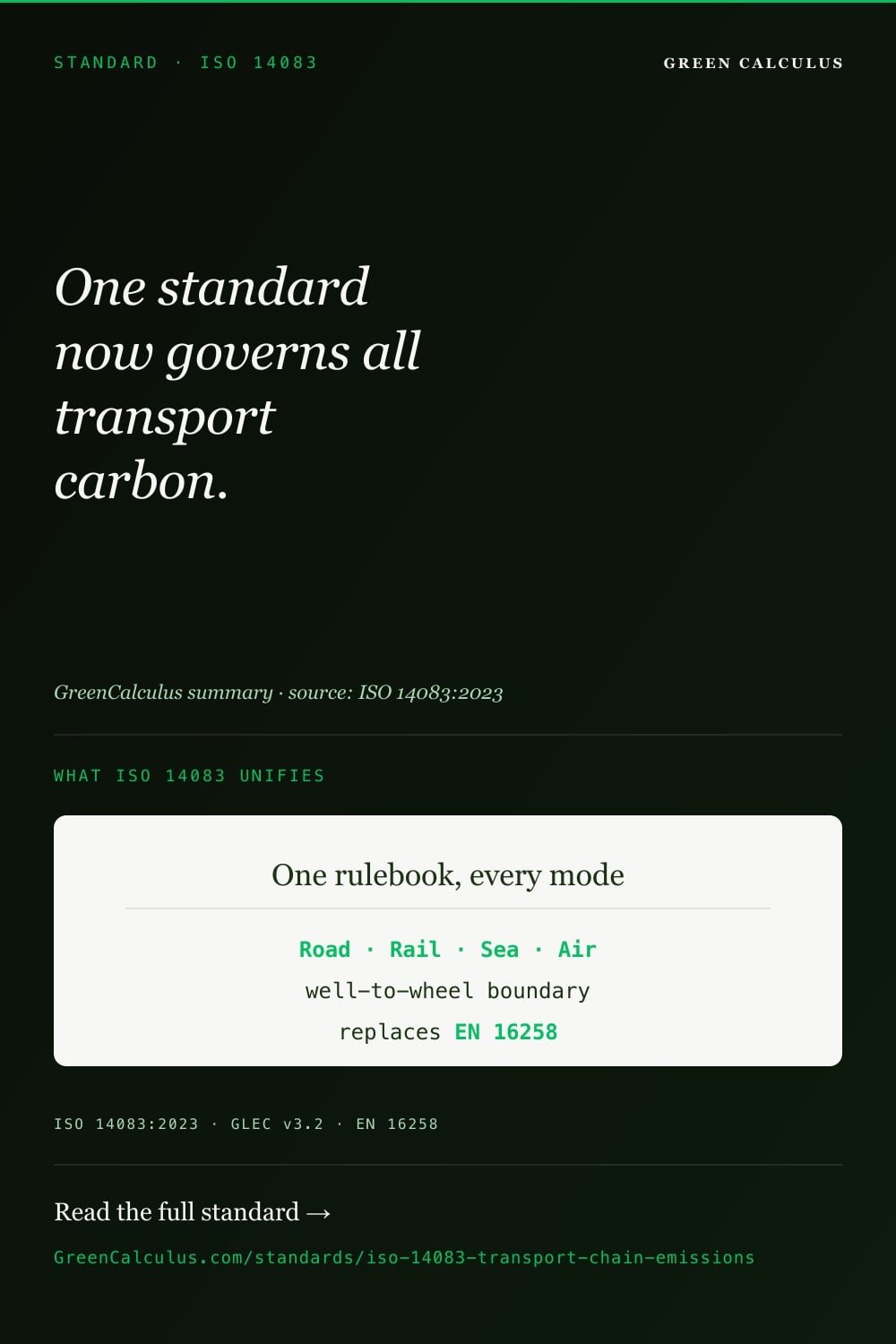
ISO 14083:2023 is the international standard for quantifying and reporting greenhouse gas emissions from transport chains — passengers and freight, all modes. It works well-to-wheel, decomposing a journey into transport chain elements and hub operations.
1. What ISO 14083 Is
ISO 14083:2023, titled Greenhouse gases — Quantification and reporting of greenhouse gas emissions arising from transport chain operations, was published by the International Organization for Standardization in March 2023 after roughly three and a half years of development by ISO/TC 207/SC 7. It is the first standard to give the freight and logistics sector a single, mode-agnostic, internationally recognised method for calculating the carbon footprint of moving people and goods.
The problem it solves is comparability. Before ISO 14083, a shipper asking three carriers for the emissions of an identical container move could receive three incompatible answers — one tank-to-wheel, one well-to-wheel, one allocating by weight, another by volume, each citing different default factors. ISO 14083 fixes the boundary, the units, the allocation logic, and the calculation sequence, so that two organisations following the standard on the same transport activity should arrive at results that are genuinely comparable, even if the absolute numbers differ because of legitimate data differences.
Three properties define its role. First, universality of mode: the same calculation logic applies to road, rail, sea, air, and inland waterway, and to both passenger and freight transport. Second, the transport-chain unit of analysis: emissions are built up element by element across a whole multimodal journey, not estimated as a single lump. Third, methodological status: ISO 14083 specifies how to calculate, not which factors to use — it is a methodology standard, not a factor-set standard, which is why it pairs with sources like the DEFRA emission factors and the GLEC default library rather than replacing them.
ISO 14083 is a methodology, not a factor database. It tells you the boundary (well-to-wheel), the structure (transport chain elements grouped into operation categories), and the maths (emission intensity × activity). The emission factors you feed into it come from elsewhere — national datasets, modelled defaults, or primary operator data — provided the source is credible and disclosed.
Provider directory
Need help keeping this up all year?
See who does this work. Every listing names the standards it works to, and paid placements are labelled. Including Anthesis Group and The Carbon Trust.
Browse 6 carbon accounting & inventory providers →Do this work? A listing is US$390 a year. Get listed →
2. Scope, Coverage and What It Replaces
The standard’s scope is broad by design. It covers the operation of transport chains for both freight and passengers; all transport modes; and the operation of the hubs (terminals, warehouses, ports, airports, transhipment centres) that sit between transport legs. It does not cover the manufacture of vehicles, the construction of infrastructure, or the embodied carbon of the goods being moved — those belong to product and corporate accounting standards, not transport-chain accounting.
ISO 14083 superseded EN 16258:2012, the earlier European methodology for energy consumption and GHG emissions of transport services, which was expected to be withdrawn following the new standard’s publication. The headline difference is the energy boundary: where EN 16258 and much earlier practice often stopped at tank-to-wheel (the emissions from burning the fuel), ISO 14083 mandates a well-to-wheel boundary that adds the upstream emissions of producing and distributing that fuel or electricity. This is examined in section 5.
| In scope | Out of scope |
|---|---|
| Freight transport operations, all modes | Vehicle and vessel manufacture |
| Passenger transport operations, all modes | Infrastructure construction (roads, rail, ports) |
| Hub operations (terminals, warehouses, ports, airports) | Embodied carbon of the goods carried |
| Well-to-wheel energy emissions (WTT + TTW) | End-of-life of vehicles or packaging |
| Multimodal chains spanning several operators | Setting which emission factor source is “correct” |
3. The Core Architecture — TCE, TOC and HOC
The conceptual heart of ISO 14083 is a three-level decomposition. A complete journey is a transport chain. The chain breaks into discrete, sequential transport chain elements (TCEs) — each TCE is one leg of the journey, either a movement or a stay in a hub. Each TCE draws its emission intensity from a reference group: a transport operation category (TOC) for movements, or a hub operation category (HOC) for hubs. A TOC or HOC is defined in the standard as a group of operations sharing similar characteristics over a defined time period — for example “diesel articulated trucks, 40 tonne, long-haul” or “ambient distribution warehouse.” Emission intensities are established at the TOC/HOC level and then applied to each TCE’s activity.
The logic is bottom-up. You calculate the emissions of each TCE from its TOC or HOC emission intensity and its activity; you sum the TCEs to get the transport chain’s emissions; you aggregate transport chains to get a service, a trade lane, or an organisation’s total freight and logistics footprint. Because every level uses the same definitions, a chain calculated by a freight forwarder reconciles with the legs calculated by the individual carriers who operated them — the comparability property the standard was built to deliver.
Treat the TOC/HOC as the reusable unit. An operator establishes the emission intensity of a TOC once for a period (say, a quarter), then applies it to every shipment that rode that category. This is what makes ISO 14083 tractable at scale — you are not recalculating fuel burn for every parcel, you are multiplying a periodic intensity by each shipment’s activity.
4. Lineage — Relationship to GLEC, GHG Protocol and EN 16258
ISO 14083 did not appear from nothing. The Smart Freight Centre’s GLEC Framework, developed by the Global Logistics Emissions Council from 2014 onward, formed much of the methodological basis for the standard, and the Smart Freight Centre led the ISO working-group process. Understanding which document does what prevents the most common citation error in this area.
| Dimension | ISO 14083:2023 | GLEC Framework v3.2 | EN 16258:2012 | GHG Protocol |
|---|---|---|---|---|
| What it is | Formal ISO methodology standard | Implementation guidance + default factors | Superseded European methodology | Corporate / value-chain accounting standard |
| Status | Published 2023, current | Current (v3.2, Oct 2025), ISO 14083-aligned | Withdrawn / superseded | Current; Scope 3 governs transport categories |
| Scope | Passenger + freight, all modes | Freight logistics, all modes | Transport services (mainly freight) | Whole organisation, all scopes |
| Energy boundary | Well-to-wheel (WTT + TTW) | Well-to-wheel, ISO-aligned | Tank-to-wheel + well-to-tank reported separately | Defers to activity methodology |
| Provides factors? | No — bring credible factors | Yes — default emission intensities | Limited defaults | No |
| Role in practice | The rulebook | The how-to that operationalises the rulebook | Historical reference only | Where the result is disclosed |
4.1 GLEC Framework — the implementation layer
Where ISO 14083 sets the technical requirements and principles, the GLEC Framework translates them into actionable, mode-specific guidance — documented mode by mode for road, rail, sea, and air freight — and supplies default emission intensities for organisations without primary data. GLEC v3.0 (September 2023) was the first version aligned to the published ISO standard; v3.2 (October 2025) continued that alignment and added a module on air-pollutant emissions. A practitioner typically complies with ISO 14083 by following the GLEC Framework — the two are designed to be used together, not as alternatives.
4.2 GHG Protocol — where the result lands
ISO 14083 produces the transport-chain number; the GHG Protocol Scope 3 Standard determines where that number is reported in a corporate inventory. Upstream transport of purchased goods sits in Scope 3 Category 4; transport of sold products sits in Category 9. The two standards are complementary: ISO 14083 governs the calculation, the GHG Protocol governs the categorisation and disclosure. This mapping is detailed in section 13.
4.3 EN 16258 — what changed
For organisations migrating from the older EN 16258 methodology, two changes matter most. The energy boundary moved to a mandatory well-to-wheel basis, so upstream fuel-production emissions are now inside the result rather than a separate optional line. And the structure became explicitly chain-based through the TCE/TOC/HOC decomposition, replacing the looser transport-service framing of the earlier standard. A number that was correct under EN 16258 tank-to-wheel will be materially lower than the same activity under ISO 14083 well-to-wheel — that is expected, not an error.
5. The Well-to-Wheel Boundary
ISO 14083 quantifies emissions on a well-to-wheel basis. This is the single most consequential boundary decision in the standard, and the one most likely to trip up an organisation comparing an ISO 14083 result against a legacy figure.
Well-to-wheel is the sum of two stages. Well-to-tank (WTT) covers the upstream emissions of producing, refining, and distributing the energy carrier — extracting crude, refining diesel, transmitting and generating electricity — up to the point it enters the vehicle. Tank-to-wheel (TTW) covers the emissions of actually using that energy in the vehicle: combustion in the engine, or the direct emissions of operating an electric drivetrain (zero at the tailpipe, with the upstream electricity captured in WTT). The standard requires both stages; reporting TTW alone understates the footprint.
Illustrative proportions only — the WTT share of total well-to-wheel varies by fuel and energy carrier (typically larger for grid electricity, smaller for diesel combustion). The bar widths are schematic and are not emission factors.
Do not compare an ISO 14083 well-to-wheel number against a historical tank-to-wheel figure and conclude emissions “rose.” The increase is the upstream fuel cycle becoming visible, not a change in the physical activity. When restating a transport baseline onto ISO 14083, recalculate prior years on the same well-to-wheel basis or clearly flag the boundary change. The upstream component connects directly to the broader well-to-tank accounting concept used elsewhere in Scope 3.
The greenhouse gases counted are the Kyoto basket expressed in carbon dioxide equivalent (CO2e), so carbon dioxide, methane, and nitrous oxide from energy use are aggregated using global warming potentials. The GWP basis used should be stated; current practice aligns with the IPCC AR6 values that GreenCalculus applies across its calculator fleet.
6. The Quantification Workflow — Five Steps
ISO 14083 reduces to a repeatable five-step sequence. The same sequence applies to every mode; only the activity unit and the data inputs change.
Map the full origin-to-destination journey and break it into transport chain elements — one per movement leg and one per hub stay. Establish the system boundary and the reporting period.
Group each movement into a transport operation category (mode, vehicle type, fuel, load profile) and each hub into a hub operation category (terminal type, ambient vs temperature-controlled).
Determine GHG emissions per unit of activity for the category over the period — from primary energy data where available, or credible default factors where not. This is the well-to-wheel intensity.
Multiply the TOC/HOC emission intensity by the TCE’s activity — for freight, typically tonne-kilometres; for hubs, throughput. Apply allocation where the vehicle or hub is shared (see section 8).
Sum TCE emissions to the transport chain; aggregate chains to the service, lane, or organisation. Report the result with its boundary, factors, data quality, and allocation method disclosed.
A 12-tonne shipment moves 800 km by 40-tonne articulated diesel truck. Suppose the established well-to-wheel emission intensity for that TOC is 0.062 kg CO2e per tonne-kilometre. Activity = 12 t × 800 km = 9,600 tonne-km. Emissions = 9,600 × 0.062 = 595.2 kg CO2e for that TCE. The 0.062 figure is a stated illustrative input for this example only — it is not a GreenCalculus live factor and must not be reused as one. In practice the intensity comes from the operator’s primary data or a credible default library such as the GLEC Framework, and the GreenCalculus freight calculators apply mode-specific factors from their own factor-set sources.
7. Emission Intensity of a TOC or HOC
The emission intensity of a transport operation category is the pivot of the whole method. It is the well-to-wheel GHG emissions of the category divided by the transport activity of the category over the same period. For freight, the canonical relationship is:
Several subtleties follow from this definition. The intensity is a period average over the category, not a per-trip measurement, which is what allows one intensity to serve thousands of shipments. Empty running and load factor are absorbed into the intensity because they affect the denominator — a poorly utilised fleet has a higher intensity per tonne-kilometre. And the intensity must be on the same well-to-wheel boundary as the reported result, so an operator computing intensity from fuel records must add the well-to-tank uplift, not stop at fuel combustion.
For hubs, the same structure applies with throughput replacing tonne-kilometres: the HOC emission intensity is the well-to-wheel emissions of operating the hub (energy for handling equipment, refrigeration, lighting) divided by the freight throughput, giving emissions per tonne or per unit handled.
8. Allocation Rules
Most real transport is shared — a truck carries several customers’ freight, a passenger ferry also carries trailers, a refrigerated container sits in a warehouse alongside ambient goods. ISO 14083 specifies how to divide shared emissions so that each shipment carries its fair portion and nothing is double-counted or dropped.
| Allocation situation | Basis applied |
|---|---|
| Between passengers and freight on the same vehicle | Allocate by an appropriate physical measure reflecting each segment’s share of the transport work. |
| Between passengers of different travel classes | Allocate using class-related factors reflecting the space and mass each class occupies. |
| Between ambient and temperature-controlled freight | Allocate the additional refrigeration energy to the temperature-controlled portion; share base transport on a common measure. |
| Among shipments sharing a vehicle | Allocate on tonne-kilometres (or an equivalent activity measure) so each shipment bears its share of the load. |
The temperature-controlled rule is the one most often missed and the one with the biggest financial and reporting consequences for cold-chain operators. Refrigeration is an additional energy demand on top of the base transport; ISO 14083 directs that this incremental energy be assigned to the temperature-controlled freight rather than smeared across the whole load. An organisation moving both ambient and chilled goods that allocates refrigeration evenly will understate its cold-chain footprint and overstate its ambient footprint.
9. Data Quality and Default Factors
ISO 14083 lets organisations choose their own emission factors, provided the source is credible and disclosed — it does not prescribe a single mandatory factor table. This flexibility is paired with a clear preference order: primary, measured operator data is preferred over modelled or default data, and the basis of any factor used must be transparent. The standard’s comparability promise rests on disclosure, not on everyone using identical numbers.
Primary data
Actual measured energy or fuel consumption from the operator of the leg, converted to well-to-wheel emissions. Highest quality; preferred wherever obtainable.
Modelled data
Energy estimated from operational parameters — distance, load, vehicle characteristics, route — using a validated model. Mid-tier; used where primary data is unavailable.
Default factors
Published default emission intensities for a mode and vehicle class, such as the GLEC Framework library. Lowest granularity; the fallback when neither primary nor modelled data exists.
Because the factor source is a disclosed choice rather than a fixed input, two compliant ISO 14083 calculations of the same activity can legitimately differ — one carrier with primary telematics data, another using GLEC defaults. The standard treats this as acceptable provided each discloses its data quality. This is why a GreenCalculus freight calculator names its factor source explicitly on every result rather than presenting a single “the” answer.
10. Mode-Specific Considerations
The general calculation logic is mode-agnostic, but the boundaries, the way a TOC is defined, and the calculation parameters differ by mode. The table summarises the practical differences a practitioner meets when applying the standard across road, rail, sea, and air.
| Mode | Typical activity unit | Key TOC parameters | Mode-specific note |
|---|---|---|---|
| Road freight | Tonne-kilometres | Vehicle class, fuel, load factor, empty running | Empty-return legs are a major driver of intensity; back-haul utilisation matters. |
| Rail freight | Tonne-kilometres | Traction type (electric/diesel), gradient, train load | Electric traction shifts most emissions upstream into the grid WTT. |
| Sea freight | Tonne-kilometres | Vessel type/size, deep-sea vs feeder, utilisation | Vessel-specific data materially changes results; container vs bulk vs tanker differ. |
| Air freight | Tonne-kilometres | Bellyhold vs freighter, distance band | Allocation between bellyhold cargo and passengers on combination flights is decisive. |
GreenCalculus is building dedicated mode-specific freight calculators — road, sea, air, rail, last-mile, and cold-chain — that apply ISO 14083 chain logic with GLEC-aligned and DEFRA factors. For the air leg, the live business travel air calculator already implements distance-band logic of the kind ISO 14083 expects, and the well-to-tank calculator handles the upstream fuel-cycle uplift that the well-to-wheel boundary requires.
11. Reporting Requirements and the GHG Statement
A result is only ISO 14083-conformant if it is reported with the context needed to interpret and verify it. The standard requires the quantified emissions to be accompanied by a disclosure of the methodology, boundary, factors, and assumptions — what is in effect a GHG statement for the transport chain.
At minimum a conformant report makes clear the system boundary (confirming well-to-wheel), the transport activity and its unit, the emission factors and their source, the data quality (primary, modelled, or default), the allocation methods used, and the reporting period. This disclosure is what allows a customer, an auditor, or a regulator to reconcile the number and is the mechanism by which the standard delivers comparability across organisations that may use different factor sources.
Build the disclosure fields into the data model from the start, not as an afterthought. The boundary, factor source, data-quality tier, and allocation basis are required outputs of every conformant calculation — a calculator or spreadsheet that produces only a number, with no provenance, cannot support an ISO 14083 report no matter how accurate the arithmetic.
12. CountEmissionsEU and the Regulatory Trajectory
ISO 14083’s status is shifting from a voluntary best-practice methodology toward a regulatory reference. The European Commission proposed CountEmissionsEU in July 2023 as a common EU framework for GHG emissions from passenger and freight transport, building on the ISO 14083 methodology, and the regulation was agreed at European Council and Parliament level in November 2025. CountEmissionsEU establishes a single calculation method for transport emissions across the EU; it does not by itself make emissions reporting mandatory, but where an entity does report transport GHG, it would need to follow the CountEmissionsEU rules — which rest on ISO 14083.
The practical implication is that organisations adopting ISO 14083 now are positioning ahead of a regulatory baseline rather than merely following good practice. The standard already underpins how transport emissions feed disclosure under CSRD ESRS E1 and IFRS S2, where the transport line of a Scope 3 inventory increasingly needs a defensible, standardised methodology behind it.
CountEmissionsEU detail is still settling as implementing acts follow the November 2025 political agreement. Treat the exact obligations, thresholds, and dates as subject to confirmation against the final published regulation rather than fixed. The durable point — that the EU framework is built on the ISO 14083 methodology — is firm; the specific compliance mechanics are not yet final.
13. Mapping to Corporate GHG Inventory
ISO 14083 produces transport-chain emissions; a corporate inventory needs those numbers placed into the right Scope 3 categories. The two transport-relevant categories of the GHG Protocol Scope 3 Standard are Category 4 and Category 9.
Scope 3 Category 4 — upstream transport
Transport and distribution of products purchased by the reporting company, between its tier-1 suppliers and its own operations, plus third-party transport services it pays for. ISO 14083 supplies the per-shipment well-to-wheel number.
Scope 3 Category 9 — downstream transport
Transport and distribution of sold products after they leave the reporting company’s control, paid for by others. The same ISO 14083 chain logic applies; only the categorisation and who pays differ.
The connection to the rest of the inventory runs through the energy boundary. Because ISO 14083 is well-to-wheel, the upstream fuel-cycle portion of transport overlaps conceptually with the fuel- and energy-related accounting handled in Scope 3 Category 3 and the broader Scope 3 emissions framework — practitioners must take care not to double-count the well-to-tank component across Category 3 and Category 4/9 when both are calculated. The ISO 14083 result already contains the WTT uplift for the transport legs it covers.
14. Verification and Assurance
An ISO 14083 result intended for external disclosure usually needs to be assurable. The standard is designed to dovetail with the ISO 14064 family: ISO 14064-1 for organisation-level GHG inventories and ISO 14064-3 for the verification and validation of GHG assertions. The Smart Freight Centre has positioned ISO 14083 as the quality standard and methodological basis for conformity assessment, with ISO 14064-1 and 14064-3 providing the assurance scaffolding.
For a verifier, the auditable chain runs from the disclosed transport-chain number back through the TCE decomposition, the TOC/HOC emission intensities, the factor sources and their data-quality tiers, the activity data, and the allocation methods. The reporting requirements in section 11 exist precisely so this trace is possible — a number without its boundary, factors, and allocation basis cannot be verified to ISO 14083 even if it is arithmetically correct.
15. Common Misconceptions
Six recurring errors surface in transport-chain methodology statements and assurance findings:
16. Implementation Checklist
A practical sequence for an organisation standing up ISO 14083-conformant transport accounting:
17. Limitations and Edge Cases
ISO 14083 is the strongest available transport-chain methodology, but it has boundaries practitioners should understand and disclose.
- Factor freedom cuts both ways. Allowing organisations to choose credible factors maximises flexibility but means two conformant results can differ on factor source alone — comparability depends on disclosure, not identical inputs.
- Default data is coarse. Where primary data is unavailable, default emission intensities average over wide vehicle and route populations and can misstate a specific operation’s footprint in either direction.
- Allocation introduces judgement. The allocation rules give a basis, but real shared-vehicle, multi-class, and mixed-temperature situations require choices that two careful analysts may make differently within the standard.
- Boundary excludes vehicles and infrastructure. The well-to-wheel boundary is energy-cycle only; vehicle manufacture, infrastructure, and the embodied carbon of goods are out of scope and must be captured by other standards if material.
- Regulatory layer is still forming. The CountEmissionsEU obligations that will sit on top of ISO 14083 are not yet fully specified; the methodology is stable, the regulatory mechanics around it are not.
18. Frequently Asked Questions
ISO 14083:2023 is the international standard that establishes a common methodology for quantifying and reporting greenhouse gas emissions arising from transport chain operations, covering both passengers and freight across all transport modes. Published in March 2023, it calculates emissions on a well-to-wheel basis and provides the methodological basis for the GLEC Framework and the EU’s CountEmissionsEU framework.
No. ISO 14083 is the formal ISO methodology standard; the GLEC Framework is the implementation guidance and default-factor library that operationalises it. The GLEC Framework formed much of the methodological basis for the standard, and its current version (v3.2, October 2025) is aligned to ISO 14083. In practice an organisation complies with ISO 14083 by following the GLEC Framework — they are designed to be used together.
Well-to-wheel is the sum of well-to-tank (the upstream emissions of producing and distributing the fuel or electricity) and tank-to-wheel (the emissions of using that energy in the vehicle). ISO 14083 requires both, so reporting only tank-to-wheel understates the footprint. This is a key change from the older EN 16258 practice, which often reported tank-to-wheel and the upstream component separately.
A transport chain element (TCE) is one leg of a journey — either a movement or a hub stay. A transport operation category (TOC) groups movements with similar characteristics (mode, vehicle, fuel, load) and a hub operation category (HOC) does the same for hubs. Emission intensities are established at the TOC/HOC level and applied to each TCE’s activity; summing the TCEs gives the transport chain’s emissions.
Yes. ISO 14083 superseded the European standard EN 16258:2012, which was expected to be withdrawn after the new standard’s publication. The main changes were the mandatory well-to-wheel boundary and the explicit transport-chain decomposition into TCEs, TOCs, and HOCs. CEN transposed the ISO standard as EN ISO 14083:2023.
ISO 14083 produces the transport-chain emissions number; the GHG Protocol Scope 3 Standard places it. Upstream transport of purchased goods sits in Scope 3 Category 4, and transport of sold products sits in Category 9. The same ISO 14083 chain logic applies to both — only the categorisation differs. Because results are well-to-wheel, avoid double-counting the upstream fuel cycle against Scope 3 Category 3.
No. ISO 14083 lets organisations choose their own emission factors provided the source is credible and disclosed. It sets a data-quality preference — primary measured data over modelled data over default factors — but does not mandate a single factor table. The comparability the standard delivers comes from disclosing the factor source and data quality, not from everyone using identical numbers.
CountEmissionsEU is an EU framework, agreed at European Council and Parliament level in November 2025, that establishes a single calculation method for transport emissions across the EU and is built on the ISO 14083 methodology. It does not by itself make transport-emissions reporting mandatory, but entities that do report would follow its rules — which rest on ISO 14083. The detailed obligations are still being finalised through implementing acts.
ISO 14083 is the methodology; the factors and disclosure come from the surrounding cluster. Pair it with the GLEC Framework for default intensities and mode guidance, the GHG Protocol Scope 3 Standard for Category 4 and 9 placement, and ISO 14064-3 for assurance. The well-to-tank calculator handles the upstream fuel-cycle uplift the well-to-wheel boundary requires.