
EU F-Gas Regulation 2024 — The Definitive Reference

Regulation (EU) 2024/573 is the EU’s binding legal instrument governing fluorinated greenhouse gases — hydrofluorocarbons (HFCs), perfluorocarbons (PFCs), sulphur hexafluoride (SF6), nitrogen trifluoride (NF3), and the wider set of fluorinated substances listed in its Annexes I and II. It replaces the previous Regulation (EU) No 517/2014, implements the EU’s Kigali Amendment commitments at a substantially accelerated pace, and drives the bulk-HFC supply phase-down to zero by 1 January 2050. For sustainability officers, the regulation is the operative legal anchor for the fugitive-emission Scope 1 line in any corporate GHG inventory that includes refrigeration, air-conditioning, heat-pump, switchgear, fire-protection, or insulating-foam equipment placed on the EU market.
This page documents the regulation as it stands in May 2026, drawing on Regulation (EU) 2024/573 itself, the repealed Regulation (EU) No 517/2014, the Kigali Amendment to the Montreal Protocol (adopted October 2016, in force for the EU since 1 January 2019), the GHG Protocol Corporate Accounting and Reporting Standard’s treatment of fugitive emissions, ESRS E1 Climate Change disclosure requirements under the CSRD, IPCC AR4 / AR5 / AR6 GWP-100 values for the regulated substances, the operative ECHA F-Gas Portal quota-allocation regime, and the parallel UK F-Gas regime retained under Statutory Instrument 2015/168 as amended. It is built for sustainability officers building Scope 1 fugitive-emission inventories, HVAC and refrigeration system owners, OEMs and importers navigating the quota and product-ban schedules, certified F-Gas technicians, EU competent authorities, customs and CBAM officers, assurance providers, and the broader compliance ecosystem that depends on knowing exactly what the regulation says and exactly which GWP basis applies to which calculation.
Regulation (EU) 2024/573 is the EU’s binding regulation on fluorinated greenhouse gases. Adopted on 7 February 2024, entered into force on 11 March 2024, and applied from 11 March 2024 with phased provisions running to 2050, it replaces Regulation (EU) No 517/2014 and implements the EU’s Kigali Amendment HFC phase-down at a substantially accelerated pace — cutting bulk-HFC supply (in CO2e terms) from a 2015 baseline to zero placing-on-market by 1 January 2050, with stepped reductions in 2025, 2027, 2030, 2033, 2036, 2039, 2042, 2045, and 2048. It introduces stringent product-and-equipment bans (Annex IV), tightens leak-checking and recovery obligations (Articles 5–9), reforms the quota-allocation and reporting regime (Articles 16–26 via the ECHA F-Gas Portal), and extends the regulated scope to additional fluorinated substances and to fluorinated ethers, ketones, and alcohols where they have a GWP-100 of 150 or greater. Crucially for emission accounting, the CO2e values used for F-Gas quota math and the 150 / 750 / 2,500 GWP product-ban thresholds are calculated using IPCC AR4 GWP-100 values hardcoded in Annex VI — not the AR5 or AR6 values that the GHG Protocol Corporate Standard and CSRD ESRS E1 expect for fugitive Scope 1 reporting. The divergence is the single most consequential operational subtlety of the regulation.
Executive Summary
Regulation (EU) 2024/573 (the “F-Gas Regulation”) is the EU’s binding legal instrument governing the placing on the market, use, recovery, and emission of fluorinated greenhouse gases. It was adopted by the European Parliament and Council on 7 February 2024, published in the Official Journal on 20 February 2024, entered into force on 11 March 2024, and applied from that same date with a substantial number of provisions phased in across the period from 2024 to 2050. It repealed and replaced Regulation (EU) No 517/2014 (the “2014 F-Gas Regulation”) in full.
The regulation does five things uniquely. It implements the EU’s Kigali Amendment HFC phase-down obligations at a substantially accelerated pace — driving bulk HFC supply (measured in CO2e using the AR4 GWP-100 values in Annex VI) from the 2015 baseline to a complete zero placing-on-market position by 1 January 2050, with stepped reductions every two to three years in the intervening period. It substantially expands and tightens the Annex IV product-and-equipment ban schedule, including bans on most new split air-conditioners using HFCs from 2027–2035, on stationary refrigeration above defined GWP thresholds from 2025–2030, on most new SF6 electrical switchgear from 2026–2032, and on F-Gas-blown insulating foams across most applications. It modernises and consolidates the quota-allocation, importer-reporting, and equipment-pre-charge regime through the ECHA-administered F-Gas Portal, replacing the previous Commission-run system. It tightens leak-checking, recovery, certification, and record-keeping obligations, including extending coverage to additional substance categories and to fluorinated substances meeting GWP thresholds. And it aligns enforcement by mandating Member State penalty regimes that are “effective, proportionate, and dissuasive” with explicit minimum levels for the most serious infringements.
Every credible F-Gas compliance position satisfies: (1) a current operator’s-equipment register identifying all stationary refrigeration, air-conditioning, heat-pump, switchgear, fire-protection, and solvent equipment containing fluorinated gases, with the charge mass and substance identified per Annex I; (2) leak-check frequencies calibrated to the equipment’s CO2e charge under Article 5, using the AR4 GWP-100 values in Annex VI; (3) a maintained equipment log per Article 7 capturing every intervention, every quantity added or recovered, and the certified personnel involved; (4) annual reporting to the Commission via the F-Gas Portal where the relevant Article 26 thresholds are crossed (one tonne of F-gases, 100 tonnes CO2e, or one tonne for HFCs); and (5) a clean documentary chain from the F-Gas equipment log through the corporate Scope 1 fugitive inventory and onward into ESRS E1-6 disclosure — recognising that the CSRD inventory must use IPCC AR6 (or latest IPCC) GWP-100 values, not the AR4 values used inside the F-Gas Regulation itself.
Provider directory
Now it has to hold up all year.
See who does this work — chosen by us, never paid placement, with the standards each one works to. Including Attain Zero and Small World Consulting.
Browse 4 carbon accounting & inventory providers →Do this work? A listing is $390 a year. Get listed →
What the EU F-Gas Regulation Is — and Is Not
The F-Gas Regulation is a binding EU regulation under Article 192(1) of the Treaty on the Functioning of the European Union. As a regulation (not a directive), it has direct legal effect in every Member State without national transposition — the obligations on operators, manufacturers, importers, and exporters apply directly from the date of application. Member States retain responsibility for designating competent authorities, establishing inspection regimes, implementing certification schemes, and setting penalty levels within the framework defined by the regulation itself.
The regulation is not the Montreal Protocol, the Kigali Amendment, an EU directive, an EU emissions-reporting regime, or a standard. It is a direct-effect regulatory instrument that implements the EU’s Kigali Amendment commitments and supplements them with EU-specific accelerations. It is also not a standalone climate-disclosure regime — compliance with the F-Gas Regulation does not, by itself, satisfy CSRD ESRS E1, SBTi, or GHG Protocol fugitive Scope 1 reporting; these are separate downstream uses of the same underlying equipment-leakage data, with different GWP bases and different aggregation rules.
“F-gases” under the regulation means the fluorinated greenhouse gases listed in Annex I — hydrofluorocarbons (HFCs), perfluorocarbons (PFCs), sulphur hexafluoride (SF6), and nitrogen trifluoride (NF3), together with other fluorinated substances meeting the GWP threshold — plus the wider set of fluorinated substances listed in Annex II that are subject to specific obligations (containment, recovery, reporting, but not the HFC quota system). The 2024 regulation expanded the Annex II coverage significantly compared to the 2014 regulation, bringing more PFAS-adjacent fluorinated substances into the regulatory framework.
Why the F-Gas Regulation Exists
The regulation exists because the fluorinated greenhouse gases it targets are climate forcers of an entirely different order of magnitude to CO2. A kilogram of R-404A released to the atmosphere has roughly the 100-year warming impact of 3,922 kilograms of CO2 under the AR4 basis used in F-Gas math, or 4,728 kilograms under IPCC AR5, or 3,943 kilograms under IPCC AR6 — meaningfully different numbers but all in the multi-thousand range. SF6 sits at 22,800 (AR4) / 23,500 (AR5) / 25,200 (AR6) times the climate impact of CO2 over 100 years. Without targeted regulation, the global supply of these substances was forecast to grow substantially as HCFC phase-outs under the Montreal Protocol’s original ozone-layer mandate transitioned air-conditioning, refrigeration, and foam-blowing applications to HFCs — substances which do not deplete the ozone layer but are powerful greenhouse gases.
The regulatory response evolved in three waves. The first — Regulation (EC) No 842/2006 — introduced basic containment, recovery, and labelling obligations across the EU. The second — Regulation (EU) No 517/2014 — introduced the headline mechanism that defines the modern regime: a CO2e-denominated quota for placing HFCs on the EU market, with a published reduction schedule that drove the supply of HFCs down by 79% over 2015–2030. The third — Regulation (EU) 2024/573 — accelerated the schedule, expanded the product bans, tightened enforcement, and committed the EU to zero bulk-HFC placing-on-market by 2050 — an obligation substantially stronger than the EU’s bare Kigali Amendment commitment.
The driver behind the 2024 acceleration was the EU’s Fit for 55 climate-neutrality framework. Fluorinated gases account for around 2.5% of EU greenhouse-gas emissions on a CO2e basis — modest in absolute terms, but with an unusual property: they are concentrated in equipment fleets with known service lifetimes, the supply chain has identifiable choke points (a small number of bulk producers and importers), the substitutes are technically mature, and the abatement cost per tonne CO2e is low compared to the marginal cost of the same emission reduction elsewhere in the economy. The 2024 regulation is therefore one of the highest-leverage individual climate instruments in the EU policy stack relative to its administrative footprint.
Publication History
The F-Gas Regulation has a clear three-generation lineage running from the original 2006 instrument through the 2014 quota-introducing regulation to the current 2024 accelerated regime. Key milestones below are reconciled to the Official Journal entries.
| Date | Event |
|---|---|
| 16 September 1987 | Montreal Protocol on Substances that Deplete the Ozone Layer signed — the foundational international treaty that subsequently expanded its scope to climate-forcing fluorinated substances via the Kigali Amendment. |
| 17 May 2006 | Regulation (EC) No 842/2006 on certain fluorinated greenhouse gases adopted — the EU’s first dedicated F-Gas instrument, focused on containment, recovery, certification, labelling, and reporting. No quota system. |
| 17 May 2006 | Directive 2006/40/EC (Mobile Air Conditioning Directive) adopted — ban on HFC-134a in new passenger car MAC systems from 2017, the EU’s first F-Gas product ban. |
| 16 April 2014 | Regulation (EU) No 517/2014 adopted by the European Parliament and Council — the second-generation F-Gas Regulation introducing the CO2e quota for HFC placing-on-market, a substantially expanded product-ban schedule, and tightened containment obligations. Applied from 1 January 2015. |
| 15 October 2016 | Kigali Amendment to the Montreal Protocol adopted in Kigali, Rwanda. Added HFCs to the Montreal Protocol’s controlled-substance framework, establishing a global HFC phase-down with differentiated schedules for developed and developing countries. |
| 27 September 2018 | EU deposited its instrument of ratification of the Kigali Amendment. |
| 1 January 2019 | Kigali Amendment entered into force globally and for the EU. |
| 5 April 2022 | European Commission proposal for a new F-Gas Regulation published (COM(2022)150 final), launching the legislative process that became Regulation (EU) 2024/573. |
| 5 October 2023 | Political agreement between the European Parliament and the Council on the new F-Gas Regulation. |
| 7 February 2024 | Regulation (EU) 2024/573 adopted by the European Parliament and Council. |
| 20 February 2024 | Published in the Official Journal of the European Union (OJ L of 20 February 2024). |
| 11 March 2024 | Entered into force on the twentieth day following publication. Most provisions applied from this date; certain provisions delayed under the transitional regime in Article 36. |
| 1 January 2025 | First stepped HFC quota reduction under the new Annex VII schedule. First wave of product bans under the new Annex IV. |
| 1 January 2026 | Quota allocation methodology fully transitioned to ECHA-administered F-Gas Portal. Tighter SF6 electrical switchgear provisions begin to apply for new high-voltage equipment. |
| 1 January 2027 | Second stepped quota reduction. Ban on most new single-split air-conditioners using HFCs with GWP ≥ 150 placing-on-market. |
| 1 January 2030 | Third stepped quota reduction. Major wave of Annex IV product bans — including most new stationary refrigeration above defined GWP thresholds, most new heat-pump categories above defined GWP thresholds, and most new SF6 medium-voltage switchgear. |
| 1 January 2033 | Fourth stepped quota reduction. Further Annex IV product bans, including additional heat-pump categories. |
| 1 January 2036 | Fifth stepped quota reduction. Ban on new monobloc heat pumps using HFCs with GWP ≥ 150 (with limited derogations). |
| 1 January 2050 | Zero placing-on-market quota for HFCs. End-point of the Annex VII phase-down trajectory. End-of-life servicing with reclaimed material remains permitted under defined conditions. |
Governance: Who Owns and Enforces the Regulation
The F-Gas Regulation operates on a multi-level governance model. Strategic ownership sits with the European Commission’s Directorate-General for Climate Action (DG CLIMA), which is responsible for the regulation’s policy direction, for proposing implementing and delegated acts, and for the high-level annual reporting that aggregates Member State data into the EU’s Kigali Amendment compliance position.
Operational quota administration and the F-Gas Portal sit with the European Chemicals Agency (ECHA) in Helsinki, which took over the system from the Commission’s previous in-house arrangement during the 2024–2025 transitional period. ECHA operates the F-Gas Portal, manages quota allocation to registered producers and importers, administers the quota authorisation system for equipment containing pre-charged HFCs, and operates the importer/exporter declaration regime. The transition to ECHA was designed to bring F-Gas administration onto the same infrastructure that ECHA already operates for REACH, the Ozone Depleting Substances Regulation, and the Persistent Organic Pollutants Regulation.
National competent authorities — designated by each Member State under Article 30 of the regulation — are responsible for enforcement on the ground: inspections of operators, verification of leak-checking and record-keeping compliance, oversight of national certification schemes, and the prosecution or administrative-penalty regime for infringements. The competent authority designations and inspection regimes vary substantially across Member States, and a single multi-site operator typically interacts with multiple competent authorities across its EU footprint.
Customs and border enforcement is handled by Member State customs authorities working with the F-Gas Portal’s customs data link. Imports of HFCs and of products containing HFCs are checked against the importer’s quota authorisation in real-time at the EU border, with non-authorised imports refused entry. This is the operational mechanism behind the “no quota, no import” principle that prevents the quota system from being circumvented by third-country supply.
The European Environment Agency (EEA) compiles the annual EU-level F-Gas inventory that feeds into the Commission‘s Article 36 implementation reporting and into the EU’s UNFCCC GHG inventory submission. The Joint Research Centre (JRC) provides technical support, particularly on the gas-by-gas atmospheric verification studies that cross-check the bottom-up inventory against atmospheric measurements.
Scope — Gases, Sectors, and Operators
The regulation’s scope runs along three dimensions: which substances are covered, which sectors and applications are covered, and which operators or undertakings are subject to which specific obligations. Each is defined precisely by the regulation and matters for compliance.
Substances in scope
The regulation distinguishes two principal substance categories. Annex I lists the fluorinated greenhouse gases — HFCs, PFCs, SF6, NF3, and other fluorinated substances meeting GWP thresholds. These are the substances subject to the full set of obligations: quota system (for HFCs in bulk), leak-checking, recovery, certification, labelling, and reporting. Annex II lists additional fluorinated substances subject to a narrower set of obligations — reporting and certain placing-on-market provisions, but not the bulk quota system or the same leak-checking regime as Annex I. The 2024 regulation expanded Annex II to bring more fluorinated substances into the reporting net, particularly in response to growing concern about PFAS-adjacent compounds released from F-Gas applications.
Sectors in scope
Stationary refrigeration, stationary air-conditioning, heat pumps (commercial, industrial, residential), refrigerated transport (including refrigerated trucks and containers), high-voltage switchgear and other electrical equipment, fire-protection systems and extinguishers, foam-blowing applications (rigid and flexible), aerosol applications (technical and medical), solvents, and other specialty applications including organic Rankine cycles, magnesium die-casting, and semiconductor manufacturing. Each sector has its specific provisions in Articles 5–15 (containment) and Annex IV (product bans).
Operators in scope
The regulation distinguishes between several operator categories, each with its specific obligations:
- Operators — the natural or legal persons exercising actual control over the technical functioning of products or equipment containing F-gases. Subject to Articles 5–9 containment, leak-checking, recovery, and record-keeping obligations.
- Producers — entities producing F-gases in the EU. Subject to quota and reporting obligations.
- Importers — entities placing F-gases or F-gas-containing products on the EU market from third countries. Subject to quota authorisation for bulk HFCs and to the equipment-pre-charge regime for products containing pre-charged HFCs.
- Distributors — entities placing F-gases on the EU market downstream of the producer or importer. Subject to certified-recipient verification.
- Installers, servicers, decommissioners, and recoverers — the certified-personnel and certified-company categories that perform interventions on F-gas-containing equipment.
- Exporters — subject to reporting obligations for exports of F-gases.
The HFC Phase-Down Mechanism
The HFC phase-down is the F-Gas Regulation’s signature instrument and the policy lever with the largest measurable climate impact. The mechanism is simple in concept and tightly engineered in execution. The Commission allocates an annually fixed pool of “quota” — denominated not in tonnes of HFC but in tonnes of CO2-equivalent — among registered producers and importers, on the basis of historical baselines and new-entrant reserve allocations. Anyone wishing to place bulk HFCs on the EU market must hold quota covering the CO2e of the supply, calculated using the GWP-100 values in Annex VI (which are IPCC AR4 values). The total quota pool reduces on the schedule in Annex VII, driving the aggregate supply down to zero by 2050.
The CO2e denomination is the critical design feature
Denominating the quota in CO2e rather than physical tonnes is what gives the phase-down its abatement-driving property. A producer holding a quota of 1,000 tonnes CO2e can use it to supply roughly 254 kg of R-404A (AR4 GWP-100 of 3,922), or 745 kg of R-410A (AR4 GWP-100 of 2,088), or 718 kg of R-134a (AR4 GWP-100 of 1,430), or essentially any quantity of R-32 (AR4 GWP-100 of 675), R-1234yf (AR4 GWP-100 of 4), or R-290 propane (AR4 GWP-100 of 3). The economics drive producers toward the lowest-GWP fluid that meets the technical requirement of the downstream application, which is precisely the policy outcome the regulation was designed to produce.
Quota authorisation for pre-charged equipment
Bulk HFC supply is one entry route into the EU market; equipment pre-charged with HFCs is the other. The regulation closes the loophole by requiring that the HFCs contained in pre-charged equipment (refrigerators, air-conditioners, heat pumps, etc.) imported into the EU also be covered by quota authorisation. Importers of pre-charged equipment must hold a Quota Authorisation Document and the HFCs in the equipment count against their CO2e quota in the same way as bulk supply.
New-entrant reserve and quota allocation
A portion of the annual quota pool (3% in the 2024 regulation, up from a smaller percentage in 2014) is held in reserve for new entrants — producers and importers without a historical baseline. The remaining quota is allocated to incumbent operators on the basis of historical reference values, with the 2024 regulation introducing a small charge on quota allocation (Article 17) designed to recover the administrative cost of the F-Gas Portal and to ensure quota holdings are actively traded toward their highest-value use.
The 2024–2050 HFC Quota Trajectory
The Annex VII schedule defines the annual maximum quantity of HFCs (in tonnes of CO2e, calculated using AR4 GWP-100 from Annex VI) that may be placed on the EU market in each year from 2024 through 2050. The 2015 baseline used for the percentage calculation is the average annual quantity placed on the market in the EU over 2009–2012 (the methodology established by the 2014 regulation), with adjustments for the Croatian accession and other minor methodological updates. The full schedule:
| Year | Maximum quantity (CO2e tonnes per year) | Percentage of baseline |
|---|---|---|
| 2024 | 41,701,077 | 22.61% |
| 2025 | 17,688,360 | 9.59% |
| 2026 | 17,688,360 | 9.59% |
| 2027 | 9,132,097 | 4.95% |
| 2028 | 9,132,097 | 4.95% |
| 2029 | 9,132,097 | 4.95% |
| 2030 | 8,605,956 | 4.67% |
| 2031 | 8,605,956 | 4.67% |
| 2032 | 8,605,956 | 4.67% |
| 2033 | 4,397,217 | 2.39% |
| 2034 | 4,397,217 | 2.39% |
| 2035 | 4,397,217 | 2.39% |
| 2036 | 3,371,318 | 1.83% |
| 2037–2038 | 3,371,318 | 1.83% |
| 2039–2041 | 1,665,294 | 0.90% |
| 2042–2044 | 1,665,294 | 0.90% |
| 2045–2047 | 1,665,294 | 0.90% |
| 2048–2049 | 1,665,294 | 0.90% |
| 2050 onwards | 0 | 0% |
The trajectory is the binding upper limit on aggregate EU HFC supply. The 2025 step-down from 41.7 to 17.7 million tonnes CO2e (a 58% reduction in a single year compared to 2024) is the largest single-year cut in the schedule and was the deliberate accelerant that the 2024 regulation added relative to the trajectory previously in place under the 2014 regulation. The subsequent steps in 2027, 2030, 2033, 2036, and 2039 carry the supply curve to less than 1% of baseline by the end of the 2040s.
What the trajectory does to material economics
Each stepped reduction creates a market-clearing constraint on bulk HFC supply that drives prices for high-GWP fluids sharply upward and creates a corresponding economic pull toward low-GWP substitutes. Practitioners have already observed substantial price increases in R-410A and R-404A supply through 2024–2026 as the 2025 step-down has constrained quota availability, with corresponding rapid adoption of R-32, R-454B, R-1234yf, and CO2 in new equipment.
Banned Applications — Annex IV Product Restrictions
Annex IV is the regulation’s product-and-equipment ban schedule. Where the quota system regulates aggregate supply, Annex IV regulates specific applications by prohibiting the placing on the EU market of new products and equipment that contain F-gases above defined GWP thresholds. The bans are absolute (subject to narrow derogations for safety-critical applications) and operate independently of the quota system — an importer with available quota cannot legally place a banned product on the EU market regardless of quota availability.
The bans below are reproduced from Annex IV of Regulation (EU) 2024/573 with the operative date and the GWP threshold for each restriction. The full Annex IV contains over 20 distinct product categories with staggered effective dates; the table below summarises the principal bans in chronological order. All GWP thresholds are evaluated against the AR4 GWP-100 values in Annex VI.
| From | Product / equipment category | Restriction |
|---|---|---|
| (Already in force) | Non-refillable F-gas containers | Prohibited. |
| (Already in force) | Single-component HFC foams (one-part polyurethane foams for the technical market) | Prohibited where GWP ≥ 150, with limited exceptions. |
| 1 Jan 2025 | Domestic refrigerators and freezers | New equipment containing HFCs with GWP ≥ 150 prohibited. |
| 1 Jan 2025 | Centralised commercial refrigeration systems ≥ 40 kW capacity | New equipment using HFCs with GWP ≥ 150 prohibited in primary circuit (limited derogation for cascade systems). |
| 1 Jan 2025 | Movable room air-conditioners (monobloc plug-in units) | New equipment using HFCs with GWP ≥ 150 prohibited. |
| 1 Jan 2026 | Self-contained refrigeration equipment (plug-in commercial cabinets and chillers) | New equipment using HFCs with GWP ≥ 150 prohibited. |
| 1 Jan 2027 | Stationary single-split air-conditioning equipment < 12 kW | New equipment using HFCs with GWP ≥ 150 prohibited. |
| 1 Jan 2027 | SF6 in medium-voltage electrical switchgear with rated voltage 1 kV to ≤ 24 kV (primary distribution) | New equipment using F-gases with GWP ≥ 1 prohibited (subject to technical-feasibility derogations until 2030). |
| 1 Jan 2028 | Foams (extruded polystyrene XPS, polyurethane PUR) | New foams placed on the market with HFCs of GWP ≥ 150 prohibited (with limited derogations). |
| 1 Jan 2029 | Stationary monobloc air-conditioners and heat pumps with capacity ≤ 12 kW | New equipment using HFCs with GWP ≥ 150 prohibited. |
| 1 Jan 2030 | Stationary multi-split air-conditioners and heat pumps with capacity ≤ 12 kW | New equipment using HFCs with GWP ≥ 150 prohibited (subject to safety-derogation review). |
| 1 Jan 2030 | SF6 in medium-voltage electrical switchgear > 24 kV to ≤ 52 kV | New equipment using F-gases with GWP ≥ 1 prohibited (with technical-feasibility review). |
| 1 Jan 2032 | SF6 in high-voltage electrical switchgear > 52 kV to ≤ 145 kV with short-circuit rating ≤ 50 kA | New equipment using F-gases with GWP ≥ 1 prohibited. |
| 1 Jan 2032 | Stationary monobloc air-conditioners and heat pumps with capacity ≤ 50 kW | New equipment using HFCs with GWP ≥ 150 prohibited (with safety-derogation review). |
| 1 Jan 2033 | Stationary multi-split air-conditioners and heat pumps with capacity ≤ 50 kW | New equipment using HFCs with GWP ≥ 150 prohibited (with technical-feasibility review). |
| 1 Jan 2035 | Stationary air-conditioning and heat-pump equipment of any capacity | New equipment using HFCs with GWP ≥ 150 prohibited (with safety and technical-feasibility derogations). |
| 1 Jan 2025 | Servicing of stationary refrigeration equipment with virgin HFCs of GWP ≥ 2,500 | Prohibited (limited derogations apply; reclaimed material remains usable until 1 Jan 2030 across most categories). |
| 1 Jan 2030 | Servicing of stationary refrigeration equipment with HFCs of GWP ≥ 2,500 (including reclaimed material) | Prohibited in most stationary refrigeration applications. |
Several Annex IV bans include technical-feasibility derogations, military and safety-equipment derogations, and time-limited servicing exemptions for installed equipment. The derogations are narrow, conditional, and in some cases subject to Commission delegated act revision. Read Annex IV directly — including its column-by-column footnotes — before relying on an exception for a specific application.
GWP Basis — AR4 vs AR5 vs AR6 and the Regulatory–Reporting Divergence
The single most consequential operational subtlety of the F-Gas Regulation is the GWP basis it uses. Regulation (EU) 2024/573 Annex VI hardcodes IPCC AR4 GWP-100 values as the legally operative basis for every CO2e calculation inside the regulation — quota math, the 150 / 750 / 2,500 GWP product-ban thresholds, the leak-checking CO2e charge thresholds, the labelling CO2e disclosures, and the importer/exporter reporting CO2e totals. AR4 was published in 2007 and is two IPCC assessment-report generations behind the AR6 values that the modern climate-disclosure stack (CSRD ESRS E1, GHG Protocol updated guidance, SBTi target validation) uses. The result is a structural divergence: the same kilogram of leaked R-410A is one CO2e number for F-Gas Regulation compliance and a different CO2e number for the corporate Scope 1 fugitive inventory.
Why AR4 is hardcoded in the regulation
The 2014 F-Gas Regulation hardcoded AR4 because AR4 was the operative IPCC reference at the time of drafting. The 2024 regulation retained AR4 in Annex VI primarily for continuity — the quota baseline, the historical leak-checking thresholds, the existing product-ban thresholds, and the entire administrative history of the regulation are denominated in AR4 CO2e. Changing the GWP basis mid-regulation would have shifted every threshold, every quota holding, and every historical compliance position by the AR4-to-AR6 ratio for each substance. The Commission’s drafting rationale explicitly favoured continuity, with the expectation that the Commission may revise Annex VI by delegated act when warranted.
What the modern climate-disclosure stack uses
- GHG Protocol Corporate Standard — “the latest GWP-100 values published by the IPCC”, which in practice means AR6 in 2026; AR5 remains widely used in legacy inventories. See GHG Protocol Corporate Standard.
- CSRD ESRS E1-6 — the most recent IPCC GWP-100 values, which in practice means AR6 for any inventory year from 2024 onward. See CSRD / ESRS E1.
- SBTi target validation — AR6 expected from 2024 onward, with AR5-based historical baselines accepted where consistently applied. See SBTi Corporate Net-Zero Standard.
- UK DEFRA emission factors — AR5 GWP-100 in the operative 2025 factor set, with the transition to AR6 anticipated in the next major DEFRA cycle. See UK DEFRA Emission Factors.
- IPCC AR6 WGI Chapter 7 and Table 7.SM.7 — the source for the latest IPCC GWP-100 values. See IPCC AR6.
- UNFCCC national-inventory reporting — AR5 under the operative reporting guidelines, with transition to AR6 under negotiation.
An F-Gas-exposed operator running both compliance and Scope 1 inventories needs a discipline that maintains both GWP bases in parallel. The F-Gas equipment log captures the physical mass of refrigerant added or recovered (in kilograms), with the substance identifier per Annex I. The compliance reports (quota usage, Annex IV thresholds, leak-checking thresholds) compute CO2e using AR4 values from Annex VI. The Scope 1 fugitive inventory computes CO2e using AR6 values for ESRS E1-6, SBTi, and CDP reporting. Both numbers are correct, for their respective purposes, and must be kept separately traceable to avoid mixing AR4 quota math into a Scope 1 disclosure or AR6 disclosure values into a regulatory submission.
Hardcoded GWP Reference Table for F-Gas-Regulated Substances
The table below lists GWP-100 values for the most commonly encountered F-Gas-regulated substances under all three IPCC assessment report bases: AR4 (the legally operative basis under Regulation (EU) 2024/573 Annex VI), AR5 (the basis still widely used in UK DEFRA factor sets and UNFCCC national inventories), and AR6 (the basis adopted by GHG Protocol Corporate Standard, CSRD ESRS E1, and SBTi from 2024 onward). All values are GWP-100 (the 100-year time-horizon characterisation factor), without climate-carbon feedback unless noted. Values are hardcoded to the cited source.
| Substance | Chemical formula / composition | AR4 (Reg. 2024/573 Annex VI) | AR5 GWP-100 | AR6 GWP-100 |
|---|---|---|---|---|
| HFC-23 | CHF3 | 14,800 | 12,400 | 14,600 |
| HFC-32 (R-32) | CH2F2 | 675 | 677 | 771 |
| HFC-125 | C2HF5 | 3,500 | 3,170 | 3,740 |
| HFC-134a | C2H2F4 | 1,430 | 1,300 | 1,530 |
| HFC-143a | C2H3F3 | 4,470 | 4,800 | 5,810 |
| HFC-152a | C2H4F2 | 124 | 138 | 164 |
| HFC-227ea | C3HF7 | 3,220 | 3,350 | 3,600 |
| HFC-245fa | C3H3F5 | 1,030 | 858 | 962 |
| R-404A | HFC-125 / 143a / 134a (44/52/4) | 3,922 | 3,943 | 4,728 |
| R-407C | HFC-32 / 125 / 134a (23/25/52) | 1,774 | 1,624 | 1,909 |
| R-410A | HFC-32 / 125 (50/50) | 2,088 | 1,924 | 2,256 |
| R-507A | HFC-125 / 143a (50/50) | 3,985 | 3,985 | 4,776 |
| R-454B | HFC-32 / HFO-1234yf (68.9/31.1) | 466 | 467 | 533 |
| HFO-1234yf (R-1234yf) | C3H2F4 | 4 | <1 | <1 |
| HFO-1234ze(E) | C3H2F4 | 7 | <1 | <1 |
| R-290 (propane) | C3H8 | 3 | 3 | 0.02 |
| R-600a (isobutane) | C4H10 | 3 | 3 | 0.006 |
| R-717 (ammonia) | NH3 | 0 | 0 | 0 |
| R-744 (carbon dioxide) | CO2 | 1 | 1 | 1 |
| PFC-14 (CF4) | CF4 | 7,390 | 6,630 | 7,380 |
| PFC-116 (C2F6) | C2F6 | 12,200 | 11,100 | 12,400 |
| SF6 | SF6 | 22,800 | 23,500 | 25,200 |
| NF3 | NF3 | 17,200 | 16,100 | 17,400 |
The table is reproduced for reference. Where the same substance appears with different values across AR4 / AR5 / AR6, the AR4 column is the legally binding value for F-Gas Regulation compliance under Annex VI of Regulation (EU) 2024/573; the AR6 column is the operative value for ESRS E1-6 and SBTi-aligned Scope 1 fugitive disclosure for inventory year 2024 onward; the AR5 column is the value that remains in use across many legacy inventory systems and in UK DEFRA factor sets through the current cycle. For the live, machine-readable IPCC AR6 GWP dataset used by GreenCalculus calculators and methodology pages, see IPCC AR6 GWP values.
Need the AR6 GWP values for your Scope 1 fugitive calculation?
The GreenCalculus IPCC AR6 GWP dataset documents every substance-level value from IPCC AR6 WGI Table 7.SM.7, with CSV and JSON download formats and full provenance to the IPCC source. Hardcoded against the primary IPCC document and ready to drop into a Scope 1 fugitive-emission inventory or an ESRS E1-6 disclosure.
Open the IPCC AR6 GWP datasetLow-GWP Alternatives — HFOs, Hydrocarbons, CO2, Ammonia
The phase-down trajectory and Annex IV bans only work because technically mature low-GWP alternatives exist for most application categories. The substitution pathways have firmed up substantially since the 2014 regulation, and a practitioner today has a clear short-list of alternatives for almost every previously HFC-dominant application.
HFOs — hydrofluoroolefins
R-1234yf and R-1234ze(E) are the headline HFOs. AR4 GWP-100 of 4 and 7 respectively; AR6 GWP-100 of less than 1 for both. R-1234yf has replaced R-134a as the standard refrigerant in new passenger-car mobile air-conditioning systems under the MAC Directive. R-1234ze(E) is widely used in commercial chillers. Blends of HFO with HFC (e.g. R-454B, R-454C, R-513A) deliver intermediate GWP values suitable for split-system air-conditioning, heat pumps, and chillers.
Hydrocarbons — R-290 (propane) and R-600a (isobutane)
R-600a dominates domestic refrigeration globally (most new household refrigerators sold in the EU since the late 1990s use isobutane). R-290 is increasingly used in commercial plug-in refrigeration, monobloc heat pumps, and small split air-conditioners. Both have negligible GWP. The constraint is flammability — A3 safety classification under ISO 817 limits charge sizes and requires equipment design and installation compliant with EN 378 for refrigeration systems and IEC 60335-2-40 for heat pumps and air-conditioners.
Ammonia — R-717
Dominant in industrial refrigeration, increasingly used in large commercial systems and district cooling. Zero GWP, zero ODP. Constraints are toxicity (B2L safety classification) and materials compatibility (corrosion of copper), which limit it to industrial-scale machinery with appropriate detection, ventilation, and safety engineering.
Carbon dioxide — R-744
Dominant in supermarket refrigeration in cooler European climates, growing rapidly in heat-pump water heaters, increasingly used in commercial-scale air-conditioning. GWP of 1 by definition. The constraint is the high operating pressure (transcritical CO2 cycles operate at 80–100 bar discharge pressures) which drives equipment design and component costs upward but is now well-established in the supply chain.
Application-by-application substitution map
- Domestic refrigeration: R-600a (isobutane) — dominant since 1990s; ban on HFC GWP ≥ 150 from 1 Jan 2025 confirms the transition.
- Plug-in commercial refrigeration: R-290 (propane), R-1270 (propylene), or CO2.
- Centralised supermarket refrigeration: Transcritical CO2 (R-744) systems in most new European installations.
- Domestic / small commercial split air-conditioning: R-32 (transitional, GWP 675 AR4), then R-290 or HFO blends below 150 GWP.
- Large commercial chillers: R-1234ze(E), R-1233zd(E), R-513A, R-450A, or ammonia for the largest.
- Industrial process refrigeration: Ammonia (R-717) or CO2.
- Mobile air-conditioning (cars): R-1234yf (under MAC Directive); CO2 in some heat-pump variants for electric vehicles.
- Heat pumps (domestic): R-290 (propane) increasingly dominant; R-32 transitional.
- Heat pumps (commercial): R-1234ze, R-744, ammonia depending on capacity.
- High-voltage electrical switchgear: Vacuum and clean-air alternatives (dry-air, fluoronitrile blends, fluoroketones); some specialty fluids with low GWP-100.
- Fire protection: Inert-gas systems (IG-541, IG-55, IG-100); water mist; some fluoroketones for clean-agent specialty applications.
- Foams: Hydrocarbon blowing agents (pentane, cyclopentane); HFO blowing agents; CO2.
Containment, Leak-Checking, and Inspection Requirements
Article 5 of Regulation (EU) 2024/573 sets out the operator obligation to prevent emissions of F-gases from installed equipment, including the leak-checking frequency requirements that have been the operational backbone of the regulation since the 2006 instrument. The frequencies are calibrated to the equipment’s CO2e charge, with the CO2e calculated using AR4 GWP-100 values from Annex VI.
The leak-checking frequency table
The base leak-checking frequencies for stationary equipment (refrigeration, air-conditioning, heat pumps, fire-protection, organic Rankine cycle, electrical switchgear) under Article 5:
| CO2e charge (AR4 basis) | Base frequency | With automatic leak-detection (Article 5(8)) |
|---|---|---|
| < 5 tonnes CO2e | No mandatory leak-check (Article 5(2)(a)) | n/a |
| 5 to < 50 tonnes CO2e | At least every 12 months | At least every 24 months |
| 50 to < 500 tonnes CO2e | At least every 6 months | At least every 12 months |
| ≥ 500 tonnes CO2e | At least every 3 months | At least every 6 months |
Translating CO2e thresholds to physical charge
The CO2e thresholds correspond to physical charge masses that depend on the refrigerant. For R-404A (AR4 GWP 3,922), the 5-tonne CO2e threshold is reached at a charge of 1.27 kg — effectively a one-circuit commercial freezer. For R-410A (AR4 GWP 2,088), the same 5-tonne threshold is reached at 2.39 kg. For R-32 (AR4 GWP 675), at 7.40 kg. For R-290 (AR4 GWP 3), at 1,667 kg — a charge size larger than virtually any practical hydrocarbon installation. This is the design feature that effectively exempts hydrocarbon and natural-refrigerant systems from the leak-checking burden while preserving full coverage of HFC-charged equipment.
Mandatory automatic leak-detection
Article 5(8) requires installed automatic leak-detection systems for equipment with charges of 500 tonnes CO2e or more (and certain electrical switchgear). The system must be checked at least once every 12 months to verify proper functioning.
Repair obligation
Article 5(7) requires that any detected leak be repaired without undue delay, with a follow-up leak-check within one month of repair to verify effectiveness. The 2024 regulation tightened this with more explicit timeframes and clearer demarcation between “leak repair” and “topping-up”, the latter of which is not a repair.
Vehicle and transport refrigeration
Refrigerated transport (trucks, trailers, and refrigerated containers) is covered by adapted leak-checking provisions reflecting the mobile nature of the equipment. Heavy-duty refrigerated transport with charges above defined thresholds is subject to the leak-checking regime in a form adapted to depot-based maintenance cycles.
Recovery, Reclamation, and Destruction Obligations
Article 8 of Regulation (EU) 2024/573 obliges operators to ensure that F-gases are recovered from installed equipment at end-of-life and during servicing, by certified personnel using certified procedures, with the recovered material then routed to reclamation, recycling, or destruction. Together with the leak-checking regime, the recovery obligation is the second principal mechanism by which the regulation suppresses fugitive emissions across the operating fleet.
Operator’s primary obligation
The operator of equipment containing F-gases must ensure that the F-gases are recovered — not vented — at every point of intervention where the substance is removed from the equipment: servicing, maintenance, charge-down, conversion, decommissioning, or end-of-life disposal. The recovery must be performed by personnel certified under the applicable national scheme (Article 10) using equipment that meets the minimum technical requirements set by Annex VIII.
Reclamation, recycling, and destruction
Recovered F-gases must be routed to one of three downstream fates: (a) reclamation — processing to original-specification purity, after which the material may be re-used in the same applications as virgin material (subject to the Annex IV servicing bans on high-GWP HFCs from 2030); (b) recycling — lower-purity processing for use in less-demanding applications; or (c) destruction at an authorised facility, typically a high-temperature incinerator with specific licensing for fluorinated-substance destruction. Direct venting to atmosphere is prohibited.
End-of-life equipment
End-of-life recovery is the single largest emission-prevention opportunity in the F-Gas regulatory framework. The Waste Electrical and Electronic Equipment (WEEE) Directive (2012/19/EU) regime intersects with the F-Gas Regulation for refrigeration, air-conditioning, and heat-pump equipment falling within WEEE scope. End-of-life vehicle treatment under Directive 2000/53/EC intersects with the regulation for MAC-system recovery from scrapped passenger cars. Industrial-scale and commercial equipment end-of-life recovery is typically managed by certified contractors operating under the F-Gas Regulation’s recovery obligations directly.
Record-Keeping and the F-Gas Equipment Log
Article 7 of Regulation (EU) 2024/573 obliges operators to maintain a record for each item of equipment subject to leak-checking under Article 5. The record — commonly called the F-Gas equipment log — is the operational document that translates the regulation’s compliance obligations into a continuous, auditable trail.
The minimum content of the equipment record under Article 7:
- Quantity (in kg) and type of F-gas installed in the equipment, including the original installation quantity.
- Quantities of F-gas added during servicing or maintenance, with the date of each addition and the reason (top-up after leak repair, charge-up after intervention, recharge after recovery).
- Whether the quantities added were of virgin, recycled, or reclaimed material, with the name and address of the recycling or reclamation facility where applicable.
- Quantities recovered from the equipment, with the date of each recovery.
- Identity of the certified company or undertaking that performed each intervention, and the certified personnel involved.
- Dates and results of all leak-checks conducted under Article 5 and of all automatic leak-detection system checks.
- If decommissioned, the measures taken to recover and dispose of the F-gases.
Records must be kept for at least five years and made available to the competent authority and to the European Commission on request. In practice, large multi-site operators centralise the records in an F-Gas log management system that aggregates the site-level data into corporate-level reporting feeds.
The audit chain into corporate Scope 1
The F-Gas equipment log is the foundational data source for the corporate Scope 1 fugitive emissions inventory. The leak quantities added during servicing represent the equipment-specific actual leak volume for the period since the last intervention — the highest-quality data available for a Scope 1 fugitive calculation. The audit chain runs from the equipment log (with kilograms physically logged) through the corporate inventory database (kilograms converted to CO2e using the relevant GWP basis — AR6 for ESRS E1-6, AR4 for F-Gas Regulation compliance reports) and onward into the CSRD disclosure.
Reporting to Competent Authorities and the European Commission
The regulation establishes a layered reporting regime running through Article 26. The reporting universe is wider than under the 2014 regulation, with new categories of reporter added and tighter thresholds in some cases.
Annual reports to the Commission (Article 26)
The following entities must report annually to the Commission via the ECHA F-Gas Portal for the preceding calendar year, due by 31 March:
- Producers of one tonne or more of F-gases (Annex I or II) in the reporting year.
- Importers of one tonne or more of F-gases (Annex I or II).
- Importers of products and equipment containing pre-charged HFCs above defined CO2e thresholds.
- Exporters of one tonne or more of F-gases.
- Undertakings destroying one tonne or more of F-gases.
- Feedstock users of one tonne or more of F-gases.
- Reclaimers of one tonne or more of F-gases.
- Operators of equipment containing 100 tonnes CO2e or more of F-gases (where Article 26 applies; thresholds were significantly tightened from the 2014 regulation).
Verification of reports
Reports above defined thresholds (typically 1,000 tonnes CO2e of placing-on-market activity) must be verified by an accredited verifier under an ISO 14064-3-compatible verification scheme. The verification confirms that the quantities, substances, and origin/destination declared in the report reconcile to the underlying business records. The verified report is then submitted via the F-Gas Portal.
Customs data link
Customs and border enforcement is integrated into the F-Gas Portal through the regulation’s customs-data-link provisions. Importers must declare F-Gas quota authorisation references at the time of customs submission, with the F-Gas Portal reconciling the declared customs quantities against the importer’s available quota in real time. This is the operational mechanism by which the quota system is enforced at the border.
F-Gas Certification — Personnel and Companies
Article 10 requires that all interventions on F-gas-containing equipment — installation, servicing, maintenance, repair, decommissioning, leak-checking, and recovery — be performed by personnel and companies holding valid certification under a national certification scheme approved by the Commission.
The certification categories
Personnel certifications are categorised by activity and equipment type. The principal categories under the implementing acts:
- Stationary refrigeration, air-conditioning, heat pumps — categories I to IV by capacity and intervention type, with Category I covering all interventions on all equipment regardless of charge and Category IV restricted to leak-checking only.
- Fire-protection systems — covering installation, maintenance, and decommissioning of F-gas-based fire systems.
- Electrical switchgear — covering SF6 installation and decommissioning for high-voltage equipment.
- Mobile air-conditioning — covering MAC systems in passenger cars and light commercial vehicles.
- Refrigerated transport — new category under the 2024 regulation reflecting the growth of cold-chain logistics.
- Solvent applications — new category for industrial cleaning applications.
- Organic Rankine cycle equipment — new category reflecting industrial waste-heat recovery.
Companies performing interventions must hold a company certification that aligns with the personnel certifications of their employees and the equipment categories they service. National competent authorities maintain registers of certified personnel and certified companies, and operators are obliged to verify the certification status of any contractor performing interventions on their equipment.
Labelling Requirements
Article 12 obliges that products and equipment containing F-gases be labelled before being placed on the market. The label must include:
- A reference to “fluorinated greenhouse gases”.
- The accepted industry designation of the F-gas concerned, or, if no such designation exists, the chemical name.
- The mass (in kg) and CO2e (in tonnes, using AR4 GWP-100 from Annex VI) of the F-gas contained in the product or equipment, or for which the product or equipment is designed.
- The GWP-100 of the F-gas concerned, in AR4 basis.
The label must be durable, legible, and located so as to be readable by installers and servicers. The 2024 regulation tightened the labelling provisions for foams, aerosols, and specialty applications, and introduced an electronic-labelling option for products meeting defined criteria (a precursor to the Digital Product Passport infrastructure being rolled out under the parallel Ecodesign for Sustainable Products Regulation).
F-Gas and Scope 1 Fugitive Emissions — the GHG Protocol Link
For sustainability officers, the F-Gas Regulation’s most consequential downstream connection is to the corporate Scope 1 fugitive-emission inventory. Refrigerant leakage from owned or operated equipment is the canonical Scope 1 fugitive emission under the GHG Protocol Corporate Standard. The F-Gas Regulation supplies the operational data — the equipment-by-equipment kilogram leakage logged under Article 7 — that the inventory calculation depends on.
The Scope 1 boundary
Under the GHG Protocol Corporate Accounting and Reporting Standard, fugitive emissions from owned or controlled equipment are Scope 1 — specifically the unintentional releases from refrigeration, air-conditioning, heat-pump, fire-protection, and electrical-equipment leaks, plus the intentional one-time releases at end-of-life that escape recovery. Refrigerant leakage is classified as Scope 1 because it is a direct emission from sources within the reporting entity’s operational or financial control boundary. See Scope 1 emissions for the underlying definition.
Three calculation tiers
The GHG Protocol allows three calculation approaches for refrigerant fugitive emissions, in decreasing data-quality order:
- Tier 1 — actual leak measurement (mass-balance approach). The kilograms of refrigerant added to each piece of equipment during servicing — recorded under F-Gas Regulation Article 7 — equals the kilograms that leaked since the last intervention. This is the highest-quality method and is the one that F-Gas-compliant operators have natively in their equipment logs. The annual leakage is the sum of refrigerant added across the year minus any new equipment install or expansion charge.
- Tier 2 — sales-based / supply-and-disposal. Annual refrigerant purchases minus the change in inventory minus end-of-life recovered material. Used where equipment-level records do not cover the full corporate footprint.
- Tier 3 — screening / default leakage rates. Annual leakage estimated as an assumed percentage of total system charge (commonly 5–15% per year for commercial refrigeration, 1–10% for HVAC). Used only where measured data is not available; the lowest data quality.
F-Gas-compliant operators by construction have Tier 1 data because the equipment log is mandatory. The audit recommendation for any F-Gas-touching corporate is to use Tier 1 for the entire fleet covered by Article 7, with Tier 2 or Tier 3 as fallback only for equipment outside Article 7 scope (typically very small equipment under the 5 tonnes CO2e threshold).
Worked Example — Annual Fugitive Emissions for a Commercial HVAC System
The following walks through an illustrative annual Scope 1 fugitive calculation for a commercial HVAC system under both F-Gas Regulation compliance reporting and corporate Scope 1 disclosure. The example is stylised; real fleet data and refrigerant choices vary by site.
The scenario
A regional supermarket operator runs a centralised commercial refrigeration system at one of its larger stores. The system is charged with 850 kg of R-404A (installed 2018, pre-2025 regulation). The F-Gas equipment log records the following interventions during calendar year 2025:
- 5 March 2025 — routine leak-check; small leak identified at one compressor fitting; 12 kg R-404A added after repair.
- 8 July 2025 — scheduled maintenance; condenser-coil pipework leak identified and repaired; 18 kg R-404A added.
- 22 November 2025 — routine leak-check; no leak detected; no refrigerant added.
Total refrigerant added during the year: 30 kg of R-404A. No equipment expansion or new install during the year. Therefore, by the mass-balance method, the annual fugitive emission from this system is 30 kg of R-404A.
F-Gas Regulation compliance report (AR4 basis)
R-404A AR4 GWP-100 = 3,922 (Annex VI of Regulation (EU) 2024/573).
30 kg × 3,922 = 117,660 kg CO2e = 117.66 tonnes CO2e.
This is the figure that appears in the operator’s F-Gas Regulation report if reporting thresholds are crossed (Article 26 reporting kicks in at 100 tonnes CO2e for equipment operators, so this single store is above threshold; the corporate aggregate is essentially guaranteed to be reportable).
Corporate Scope 1 fugitive disclosure (AR6 basis, ESRS E1-6 / GHG Protocol)
R-404A AR6 GWP-100 = 4,728 (IPCC AR6 WGI Table 7.SM.7).
30 kg × 4,728 = 141,840 kg CO2e = 141.84 tonnes CO2e.
This is the figure that flows into the corporate Scope 1 inventory line for refrigerant leakage at this site, into the ESRS E1-6 gross Scope 1 disclosure, into the SBTi near-term target tracking, and into the CDP climate-change response.
The 21% difference is structural
The same 30 kg of R-404A leak produces 117.66 tonnes CO2e for F-Gas Regulation purposes and 141.84 tonnes CO2e for Scope 1 reporting — a difference of 24 tonnes CO2e, or 21% of the F-Gas figure. The difference is not a calculation error; it reflects the regulatory–reporting GWP basis divergence built into the regulatory architecture. Both numbers are correct. The audit-grade response is to maintain separate calculation feeds, with the AR4 figure tied to F-Gas Regulation compliance and the AR6 figure tied to corporate climate disclosure.
Step 4 — The leak-rate sense-check
30 kg added on an 850 kg installed charge equals an annual leakage rate of 3.5%. This is broadly typical for a well-maintained centralised commercial refrigeration system; industry-average leak rates for centralised supermarket refrigeration are around 10–15%, so the operator’s 3.5% is meaningfully better than industry average and reflects effective leak-detection and repair practice. A leak rate substantially above 15% would suggest a system maintenance issue and would warrant operational investigation; below 2% would be unusual and warrant a sense-check on the log data.
Note: values are illustrative for methodology demonstration. Actual leak rates vary widely by system age, refrigerant, installation quality, maintenance regime, and ambient conditions. Use site-specific F-Gas equipment log data, not these example values, for any real reporting position.
F-Gas in the CSRD ESRS E1 Disclosure Chain
Refrigerant fugitive emissions flow into the CSRD disclosure stack through ESRS E1 Climate Change. The reporting chain — from the F-Gas equipment log at the bottom to the audited ESRS E1-6 gross Scope 1 line at the top — is well-defined, with several specific touchpoints that practitioners need to get right.
ESRS E1-6 gross Scope 1 emissions
ESRS E1-6 requires disclosure of gross Scope 1 GHG emissions for the reporting year, broken down by GHG and by activity where applicable. Fugitive HFC/PFC/SF6/NF3 emissions are a Scope 1 line item, calculated in CO2e using the most recent IPCC GWP-100 values — AR6 in practice for any reporting year from 2024 onward. The data source is the F-Gas equipment log under Article 7, aggregated across all sites within the consolidation boundary, with the kilograms converted to AR6 CO2e at the inventory level.
ESRS E1-1 climate transition plan
The transition plan disclosure (E1-1) is the strategic-narrative location where F-Gas-touching operators describe how the F-Gas Regulation’s Annex IV product-ban schedule interacts with their equipment-replacement strategy — specifically, how the operator plans to migrate refrigeration, air-conditioning, and heat-pump equipment from high-GWP HFCs to low-GWP alternatives in line with the regulation’s trajectory and the operator’s own decarbonisation pathway.
ESRS E1-3 actions and resources
Specific actions the operator has taken or plans to take to reduce F-Gas emissions — equipment-replacement programmes, automatic-leak-detection retrofits, certification-scheme participation, recovery-rate improvement initiatives — are disclosed under E1-3 with associated capex and opex.
ESRS E1-4 targets
Where the operator has set a Scope 1 reduction target (SBTi-aligned or otherwise) that includes fugitive emissions, the target is disclosed under E1-4. The F-Gas Regulation’s Annex VII trajectory provides a useful external reference point against which the operator’s own ambition can be calibrated.
F-Gas, SBTi, and Near-Term Target Integrity
For operators committed to Science Based Targets, F-Gas fugitive emissions are a Scope 1 line item that must be included in the near-term target boundary. The SBTi Corporate Net-Zero Standard requires Scope 1 + 2 reductions of at least 42% by 2030 from a recent base year for 1.5°C-aligned near-term targets, and the F-Gas reduction trajectory is one of the highest-leverage pathways to that reduction in service-intensive sectors. See SBTi Corporate Net-Zero Standard for the broader target architecture and SBTi readiness checklist for an end-to-end target-submission preparation workflow.
The base-year recalculation question
SBTi requires base-year recalculation where structural changes (acquisitions, divestments, calculation-methodology changes) materially affect base-year emissions. A change in GWP basis (e.g. AR5 to AR6) is a calculation-methodology change that typically triggers recalculation, with the recalculated base year then applied consistently across the target period. Operators recalculating an F-Gas-heavy base year onto AR6 will see modest upward adjustment in most refrigerants (R-410A increases roughly 17% AR5-to-AR6, R-404A increases roughly 20%), which the SBTi recalculation procedure accommodates.
The “high-GWP equipment replacement” lever
For refrigeration-intensive sectors (food retail, cold-chain logistics, food and beverage manufacturing, data centre cooling, hospitality), replacing high-GWP HFC systems with low-GWP alternatives is one of the largest single-action Scope 1 reductions available. A supermarket operator transitioning from R-404A (AR6 GWP 4,728) to R-744 (CO2, AR6 GWP 1) effectively eliminates the refrigerant-leakage CO2e from the affected systems — a 99.98% reduction in that line. Sequencing the transition with the F-Gas Regulation’s Annex IV ban-driven natural replacement cycle minimises stranded asset risk.
Sector Notes
Commercial refrigeration — food retail
The single most F-Gas-affected sector. Centralised supermarket refrigeration systems historically used R-404A, R-407A, or R-507A — all above the 2,500 GWP threshold for the 2030 servicing ban. The transition path is to transcritical CO2 for new installations and to lower-GWP HFC/HFO blends for existing-system retrofits. Major European supermarket chains have been on transition programmes since 2018–2020; the 2024 regulation accelerated those programmes by shortening the Annex IV deadlines and tightening the servicing prohibition.
Building HVAC — commercial and residential
R-410A dominated new commercial HVAC installations through the mid-2020s; the 2027 Annex IV ban on single-split GWP ≥ 150 has driven rapid R-32 and R-454B adoption, with R-290 increasingly visible in smaller units. The 2030–2032 monobloc and multi-split ban widens the transition to sub-150 GWP across the entire HVAC fleet over the late 2020s. The interaction with the recast EU EPBD (Directive (EU) 2024/1275, zero-emission buildings from 2028–2030) accelerates heat-pump adoption, which in turn brings the refrigerant choice for new heat pumps directly into scope.
Industrial refrigeration
Long-standing ammonia (R-717) dominance for industrial-scale systems means industrial refrigeration is the least HFC-exposed of the major sectors. CO2 and HFO refrigerants cover the niche applications where ammonia is unsuitable. Industrial process refrigeration is one of the sectors least affected by the 2024 regulation’s accelerations.
Electrical switchgear — transmission and distribution
SF6 dominates high-voltage switchgear globally. The 2024 regulation introduces a stepped phase-out of new SF6 switchgear by voltage category — medium voltage (1–24 kV) from 2027, 24–52 kV from 2030, 52–145 kV (with short-circuit rating ≤ 50 kA) from 2032. The substitutes (vacuum interrupters, clean-air, fluoronitrile blends, fluoroketones) are mature for medium voltage and increasingly available for high voltage. Network operators across the EU are in active transition programmes synchronised to the Annex IV deadlines.
Fire protection
Halon was phased out under the original Montreal Protocol. The fluorinated successors (HFC-227ea, HFC-125, FK-5-1-12) are now subject to F-Gas Regulation containment, recovery, and reporting. Most new total-flooding systems use inert gases (IG-541, IG-55, IG-100) or fluoroketones, with HFC-based clean-agent systems retained primarily for specialty applications where the inert-gas alternatives are unsuitable.
Heat pumps
Heat pumps are the F-Gas Regulation’s most policy-tensioned sector. The EU’s heat-pump deployment ambition under REPowerEU and the EPBD requires rapid scale-up; the 2024 F-Gas Regulation simultaneously tightens the refrigerant constraints on new heat-pump equipment. R-290 (propane) is emerging as the dominant low-GWP refrigerant for domestic and small commercial heat pumps, with manufacturers redesigning around the IEC 60335-2-40 flammability provisions for residential installation. CO2 heat-pump water heaters are particularly prominent in domestic-hot-water applications.
Mobile air-conditioning — passenger cars and light commercial vehicles
The MAC Directive (2006/40/EC) banned R-134a in new passenger-car MAC systems from 2017. R-1234yf is the dominant successor across European passenger-car production. CO2 is used in some heat-pump cabin-heating variants on electric vehicles. The MAC Directive overlaps with the F-Gas Regulation in containment and reporting; see Mobile Air Conditioning below.
Foams — insulating, packaging, technical
Hydrocarbon (pentane, cyclopentane) blowing agents dominate insulating foams for new buildings. HFO blowing agents and water are increasingly used. The 2024 regulation extends the foam restrictions and accelerates the transition deadlines.
Pharmaceutical metered-dose inhalers
MDIs historically used HFC-134a or HFC-227ea as propellants. The 2024 regulation introduces a phased transition timeline for MDIs, with derogations for medically-essential applications. The pharmaceutical industry is in active transition to HFO-152a (R-152a) and other low-GWP propellants with appropriate clinical bridging studies.
Mobile Air Conditioning — Directive 2006/40/EC Overlap
Directive 2006/40/EC (the MAC Directive) covers air-conditioning systems in passenger cars and light commercial vehicles. The directive’s principal substantive provision is the ban on F-gases with GWP > 150 in new MAC systems from 1 January 2017 — the provision that drove the EU-wide transition from R-134a to R-1234yf in new passenger cars.
The MAC Directive and the F-Gas Regulation overlap on:
- Refrigerant choice and the GWP threshold for new vehicles — MAC Directive provides the sectoral ban; F-Gas Regulation provides the surrounding containment, recovery, and reporting framework.
- Personnel certification — the F-Gas Regulation’s Article 10 certification scheme covers MAC-system servicing personnel.
- End-of-life recovery — the End-of-Life Vehicles Directive (2000/53/EC) intersects with F-Gas Regulation Article 8 recovery obligations at vehicle scrapping.
The MAC Directive remains in force as a separate instrument; the F-Gas Regulation does not repeal it. Practitioners working on light-vehicle fleet emissions need to navigate both instruments simultaneously.
Third-Country Imports, Customs Enforcement, and UK F-Gas Divergence
Third-country imports of bulk HFCs and pre-charged equipment
Imports of HFCs (bulk and in pre-charged equipment) into the EU are gated through the F-Gas Portal’s quota authorisation system. An importer without quota authorisation cannot lawfully place bulk HFCs or pre-charged HFC-containing equipment on the EU market. Customs authorities at the EU border verify the quota authorisation reference at the time of import declaration, and shipments without authorisation are refused entry.
The system has been the principal mechanism for closing the third-country supply circumvention loophole that emerged in the 2018–2021 period (when illegally imported HFCs from non-EU producers entered the EU market in significant volumes). Enforcement has progressively tightened, including OLAF investigations and Member State customs crackdowns; recent years have seen a substantial fall in detected illegal-import volumes alongside a marked rise in customs prosecutions.
Carbon Border Adjustment Mechanism interaction
The EU Carbon Border Adjustment Mechanism (Regulation (EU) 2023/956) does not currently cover F-gases — the CBAM’s product scope is iron, steel, cement, aluminium, fertilisers, electricity, and hydrogen as at May 2026. Expansion to additional sectors is under review. For F-Gas-touching importers, the operative border-enforcement mechanism is the F-Gas Portal quota authorisation system, not CBAM.
UK F-Gas divergence — the retained GB regime
The UK left the EU on 31 January 2020. The UK’s retained F-Gas regime is operated under the Fluorinated Greenhouse Gases Regulations 2015 (Statutory Instrument 2015/168) as amended, which incorporates the substantive provisions of the 2014 EU F-Gas Regulation (Regulation (EU) No 517/2014) into GB law. Northern Ireland continues to apply the EU regime under the Windsor Framework.
The substantive divergence between the GB and EU regimes has been growing since the EU’s 2024 acceleration:
- The GB quota trajectory follows the 2014 EU regulation’s original schedule (which ran to 21% of baseline by 2030 and stayed there), not the 2024 EU regulation’s accelerated trajectory to zero by 2050.
- The GB product-ban schedule is the 2014 EU regulation’s Annex III, not the 2024 EU regulation’s Annex IV — meaning a substantial number of equipment categories that are banned in the EU from 2025–2035 are not currently banned in GB.
- GB consulted on F-Gas regime reform in 2025; the UK government’s stated direction (as of the consultation outcomes published in 2025–2026) is broadly to align GB more closely with the EU 2024 trajectory, but legislative reform has not yet completed.
Operators with cross-border EU/GB activity need to maintain dual compliance — the EU regime via Regulation (EU) 2024/573 and the GB regime via SI 2015/168 as amended — and to watch for the GB reform legislation that may close the divergence in the late 2020s.
Penalties and Enforcement
Article 31 of Regulation (EU) 2024/573 requires Member States to establish penalty regimes for infringement that are “effective, proportionate, and dissuasive”. The 2024 regulation tightened the penalty framework compared to 2014 by specifying minimum levels for the most serious categories of infringement — particularly for illegal imports, illegal placing-on-market of banned equipment, quota circumvention, and venting of recovered F-gases.
Penalty regimes vary substantially across Member States, but typical sanctions include:
- Administrative fines, with maxima ranging from several thousand euros per minor compliance failure (missed leak-check, incomplete equipment log) up to several million euros for major infringements (illegal import of bulk HFCs).
- For quota-related infringements: a quota penalty applying for two years after the infringement, reducing the operator’s quota allocation by a percentage proportionate to the infringement.
- Confiscation of illegally imported substances and equipment.
- Withdrawal of company or personnel certification.
- Criminal sanctions in some Member States for serious offences (the Environmental Crime Directive, Directive (EU) 2024/1203, harmonises the criminal-law dimension across the EU).
Enforcement activity has intensified across the late 2010s and into the 2020s, with cross-border cooperation through OLAF and Member State customs and environment authorities. F-Gas Portal-detected anomalies (e.g. inconsistent quantities between importer declaration and customs records) are now a primary inspection trigger.
Decision Tree: Does My Equipment Fall Under F-Gas?
For an operator working through whether a specific piece of equipment is in scope of Regulation (EU) 2024/573, the following decision sequence captures the principal scope tests.
- Does the equipment contain a fluorinated substance listed in Annex I or Annex II? Annex I covers HFCs, PFCs, SF6, NF3, and other fluorinated GHGs above the GWP threshold. Annex II covers additional fluorinated substances subject to narrower obligations. If no — out of scope.
- What is the application? Refrigeration / air-conditioning / heat pumps / fire protection / electrical switchgear / foams / aerosols / solvents / specialty. Each application has specific containment, certification, and Annex IV provisions; some applications (notably feedstock use of HFCs in chemical synthesis) have narrower obligations.
- Is the equipment “stationary” or “mobile”? Stationary equipment falls under the principal Articles 5–9 regime. Mobile (transport refrigeration, MAC, refrigerated containers) falls under adapted provisions, with passenger-car MAC also under Directive 2006/40/EC.
- Is the equipment “hermetically sealed” under the regulation’s definition? Hermetically sealed equipment with charge below a defined threshold (typically 3 kg) may be exempt from leak-checking, though labelling and end-of-life recovery still apply.
- What is the equipment’s CO2e charge under AR4 GWP-100? Determines leak-checking frequency under Article 5: nil below 5 tonnes CO2e, annual above 5, semi-annual above 50, quarterly above 500.
- Is the equipment being newly placed on the market, or is it already installed? Annex IV bans apply to new placement on the EU market; pre-existing installed equipment can continue operating subject to the Article 5–9 maintenance regime and to the servicing-ban deadlines for high-GWP virgin and reclaimed HFCs.
- Will the operator’s annual emissions cross any of the Article 26 reporting thresholds? 1 tonne for placing-on-market or destruction or reclamation of F-gases; 100 tonnes CO2e for operator-equipment aggregated holdings; 1 tonne for HFCs specifically.
Decision Tree: Which Alternative Refrigerant Is Compliant?
For a project specifying a new system in 2026 onward, the alternative-refrigerant decision turns on application category, capacity, safety classification, GWP threshold, and Annex IV ban-date trajectory. The simplified decision logic:
- Application category and capacity — identify which Annex IV row applies. The row gives the operative ban-date and GWP threshold for new placing-on-market.
- Is GWP < 150 required at the relevant date? Most Annex IV bans for 2025–2035 set the threshold at GWP ≥ 150. Below 150 is generally safe; above 150 is banned on the relevant date.
- Safety classification constraints — A1 (non-flammable, non-toxic) is the broadest. A2L (mildly flammable, e.g. R-32, R-454B, R-1234yf) requires installation-design compliance with EN 378 or IEC 60335-2-40. A3 (flammable, e.g. R-290, R-600a) imposes charge-size limits in residential and similar settings. B2L (toxic, mildly flammable, e.g. R-717 ammonia) restricted to industrial settings.
- Equipment-charge size — some natural refrigerants (R-290) are limited by safety standards to charges that may be too small for the target application. R-290 in a heat pump is currently practical to about 1–1.5 kg charge per circuit under IEC 60335-2-40, sufficient for most residential heat pumps but requiring multi-circuit design for larger commercial units.
- Long-term trajectory — if specifying a transitional refrigerant (e.g. R-32 at GWP 675), consider whether the equipment service life will outlast the next Annex IV step. A long-life centralised system specified in 2026 with a 25-year service life should be designed for the 2050 zero-quota endpoint.
Common Misinterpretations
Annex VI of Regulation (EU) 2024/573 hardcodes IPCC AR4 GWP-100 values for every CO2e calculation inside the regulation — quota math, the 150 / 750 / 2,500 GWP thresholds, leak-checking thresholds, labelling disclosures. The CSRD ESRS E1 disclosure stack uses AR6. They are different numbers for the same substance. A compliance officer who uses AR6 for F-Gas reporting or AR4 for ESRS E1-6 has misapplied both.
The Annex VII trajectory cuts HFC supply by 96% by 2036 and to zero by 2050. Until 2050, HFC supply continues, but at progressively reduced volumes. The Annex IV product bans operate independently and prohibit specific high-GWP applications regardless of quota availability. The two mechanisms together are what drive the transition; neither alone is the full story.
Annex IV restricts the placing-on-market of new equipment. Existing installed equipment containing high-GWP HFCs can continue operating, subject to leak-checking, recovery, and the servicing-ban deadlines on high-GWP virgin/reclaimed material. Operators do not need to scrap working high-GWP systems early; they need to plan replacement with low-GWP equipment in line with their natural equipment-replacement cycle and the servicing-ban deadlines.
The Annex VII numbers are millions of tonnes of CO2e per year, calculated using AR4 GWP-100 from Annex VI. A producer’s quota holding is a CO2e allocation that converts to physical tonnes of HFC at a substance-dependent rate. A 1,000 tonne CO2e quota covers roughly 255 kg of R-404A or 14.8 tonnes of R-32 or 250 tonnes of R-1234yf — very different physical quantities for the same nominal quota.
Refrigerant equipment using hydrocarbons (R-290, R-600a) or CO2 (R-744) or ammonia (R-717) is not regulated under the F-Gas Regulation because the refrigerants are not fluorinated GHGs. However, the equipment is still subject to general safety standards (EN 378, IEC 60335-2-40), pressure-equipment directive obligations where applicable, and the broader corporate inventory and Scope 1 reporting obligations — the CO2 in a transcritical refrigeration system is a Scope 1 fugitive emission with GWP of 1 (small but non-zero in CO2e terms for very large systems).
The 2024 regulation introduced a quota allocation charge under Article 17, and quota is allocated on application via the F-Gas Portal on the basis of historical reference values and new-entrant reserve allocations. A producer or importer without an active quota holding cannot lawfully place bulk HFCs or pre-charged HFC equipment on the EU market.
GB operates under the retained 2014 EU regulation as amended by SI 2015/168. The GB quota trajectory and product-ban schedule are not the EU 2024 trajectory and bans. Cross-border operators must maintain dual compliance, and a position that is fully EU-compliant may still create GB exposure or vice versa.
Common Reporting Errors
- Mixing GWP bases. Computing fugitive Scope 1 emissions for ESRS E1-6 disclosure using the AR4 values in F-Gas Regulation Annex VI, or computing F-Gas Regulation quota usage using AR6 values. Both produce wrong numbers for their respective uses.
- Counting refrigerant additions during new installs or expansions as leakage. Charge added to bring a newly installed system up to operating charge is not a fugitive emission — it remains in the system. Only the additions that compensate for actual leakage are fugitive.
- Using a single default leak rate across mixed equipment fleets. Applying a 5% or 10% default to total system charge across an entire fleet, when equipment-specific log data is available, is GHG Protocol Tier 3 where Tier 1 data exists.
- Omitting end-of-life releases from the inventory. Refrigerant not recovered at end-of-life is a fugitive Scope 1 emission for the operator that disposed of the equipment, even if the recovery would have been physically performed by a contractor.
- Treating R-32 or R-454B as “non-F-Gas” because their GWP is below 750. Below 750 GWP under AR4 is the threshold for certain product bans; it is not a definition of “non-F-Gas”. R-32 (AR4 GWP 675) is fully an HFC and fully in scope of all F-Gas Regulation provisions.
- Missing the Article 26 reporting threshold. The 100 tonnes CO2e threshold for operator-equipment aggregated holdings catches more operators than they realise. A multi-site retail operator with 50–100 small refrigeration systems can easily cross 100 tonnes CO2e in aggregate even with each individual site under 5 tonnes.
- Failure to record reclaimed-vs-virgin source. Article 7 requires equipment-log entries to record whether the F-gas added was virgin, recycled, or reclaimed. This becomes increasingly material as the 2030 servicing bans on virgin high-GWP HFCs phase in.
- Inconsistent CO2e summation across the F-Gas Portal report and the corporate inventory. The two reports use different GWP bases. Both can be correct; trying to make them sum to the same number is the error.
- Not maintaining personnel and company certification status verification. An intervention performed by an uncertified contractor is non-compliant regardless of the operator’s own status; the operator’s record-keeping must demonstrate that the certification status was verified.
- Missing the cross-border quota verification at customs. An importer of pre-charged HFC equipment that fails to declare the F-Gas Portal quota authorisation reference at the customs declaration creates a non-compliance position that is detected by the customs data link.
Implementation Workflow
For a multi-site operator implementing F-Gas Regulation compliance from a fresh start, the practical workflow runs as follows.
- Equipment census (4–12 weeks). Identify every F-gas-containing equipment item across the operational footprint — stationary refrigeration, air-conditioning, heat pumps, fire-protection, electrical switchgear, foams in stock, MAC if relevant. Record location, equipment type, manufacturer and model, refrigerant identity, installed charge mass.
- CO2e classification (1–2 weeks). Compute the AR4 CO2e charge for each item using Annex VI GWP values. Classify each item into the leak-check frequency bands: nil, annual, semi-annual, quarterly. Identify items above the 500 tonnes CO2e threshold requiring automatic leak-detection.
- Equipment log establishment (2–4 weeks). Set up the Article 7 equipment log for every leak-check-eligible item. Backfill the installation record where the historical data is available; document gaps explicitly.
- Certified contractor verification (2–4 weeks). For every existing contractor performing F-gas interventions on the operator’s equipment, verify current certification status against the national register. Reject or renegotiate any contracts with uncertified providers.
- Leak-check schedule (1–2 weeks). Build the rolling schedule of mandatory leak-checks based on the CO2e bands. Synchronise with planned-maintenance cycles to minimise additional site visits.
- Replacement-strategy plan (4–8 weeks). Identify equipment likely to be affected by Annex IV bans, the servicing-ban deadlines (1 January 2025 virgin high-GWP, 1 January 2030 reclaimed high-GWP), and equipment with end-of-economic-life within the next 5–10 years. Build a phased replacement programme that minimises stranded-asset exposure and aligns with the corporate decarbonisation pathway.
- Reporting infrastructure (2–4 weeks). Build the Article 26 reporting feed (if thresholds are crossed) and the parallel Scope 1 fugitive inventory feed for ESRS E1-6 / SBTi reporting. Maintain the two GWP bases in parallel.
- Annual cycle. Each year: aggregate the equipment-log data, compute the annual fugitive emissions in both AR4 (regulatory) and AR6 (disclosure) bases, submit the Article 26 report by 31 March, feed the AR6 inventory into the ESRS E1 disclosure, refresh the equipment census for new installs and decommissions, refresh the replacement plan in light of equipment ageing and regulatory step-downs.
- Periodic review (annually or on major regulatory milestone). Review the operator’s compliance position against the upcoming Annex IV ban dates and the upcoming quota step-downs. Refresh the replacement strategy as supply economics shift.
Future Evolution
Three trajectories will shape the F-Gas regulatory landscape over the coming decade.
The 2025–2050 implementation curve. The Annex VII quota trajectory and the Annex IV ban schedule are now set in legally binding form. The implementation arc — equipment fleet transition, supply-chain repositioning, training and certification scale-up, and the inevitable enforcement-priority shifts as the 2030 / 2036 / 2050 milestones approach — will define the operational experience of the regulation. Expect heavy enforcement activity around the 2030 servicing-ban deadlines on high-GWP HFCs and around the 2032 SF6 switchgear transition.
The PFAS interaction. The European Commission’s wider work on per- and polyfluoroalkyl substances (PFAS) under REACH and related instruments is creating regulatory pressure on substances adjacent to the F-Gas Regulation’s scope — particularly HFOs and fluoroketones, some of which break down to trifluoroacetic acid (TFA) under atmospheric oxidation. The interaction between the F-Gas Regulation’s CO2e-focused architecture and the PFAS framework’s broader-environmental-impact lens is an active policy question. Expect Annex I and Annex II revisions over the late 2020s.
The IPCC GWP basis revision. The Commission retains the power under Regulation (EU) 2024/573 to revise Annex VI by delegated act. A future revision moving Annex VI from AR4 to a more recent IPCC basis would close the regulatory–reporting GWP divergence but would also reset every threshold in the regulation (the 150 / 750 / 2,500 GWP product bans, the leak-checking CO2e thresholds, the quota math) and would carry substantial operational consequences. As of May 2026, no such delegated act has been adopted, and the AR4 basis remains operative. The timing and substance of any future revision is one of the most-watched policy variables in the F-Gas regulatory space.
Track every F-Gas, CSRD, and SBTi regulatory milestone in one feed
GreenCalculus publishes a quarterly tracking update on Regulation (EU) 2024/573, UK F-Gas reform, CSRD ESRS E1 disclosure expectations, SBTi target-validation updates, IPCC AR6 / AR7 GWP transitions, and the broader corporate climate-disclosure regulatory landscape. Subscribe to the next issue and stay ahead of every revision.
Subscribe to the GreenCalculus quarterly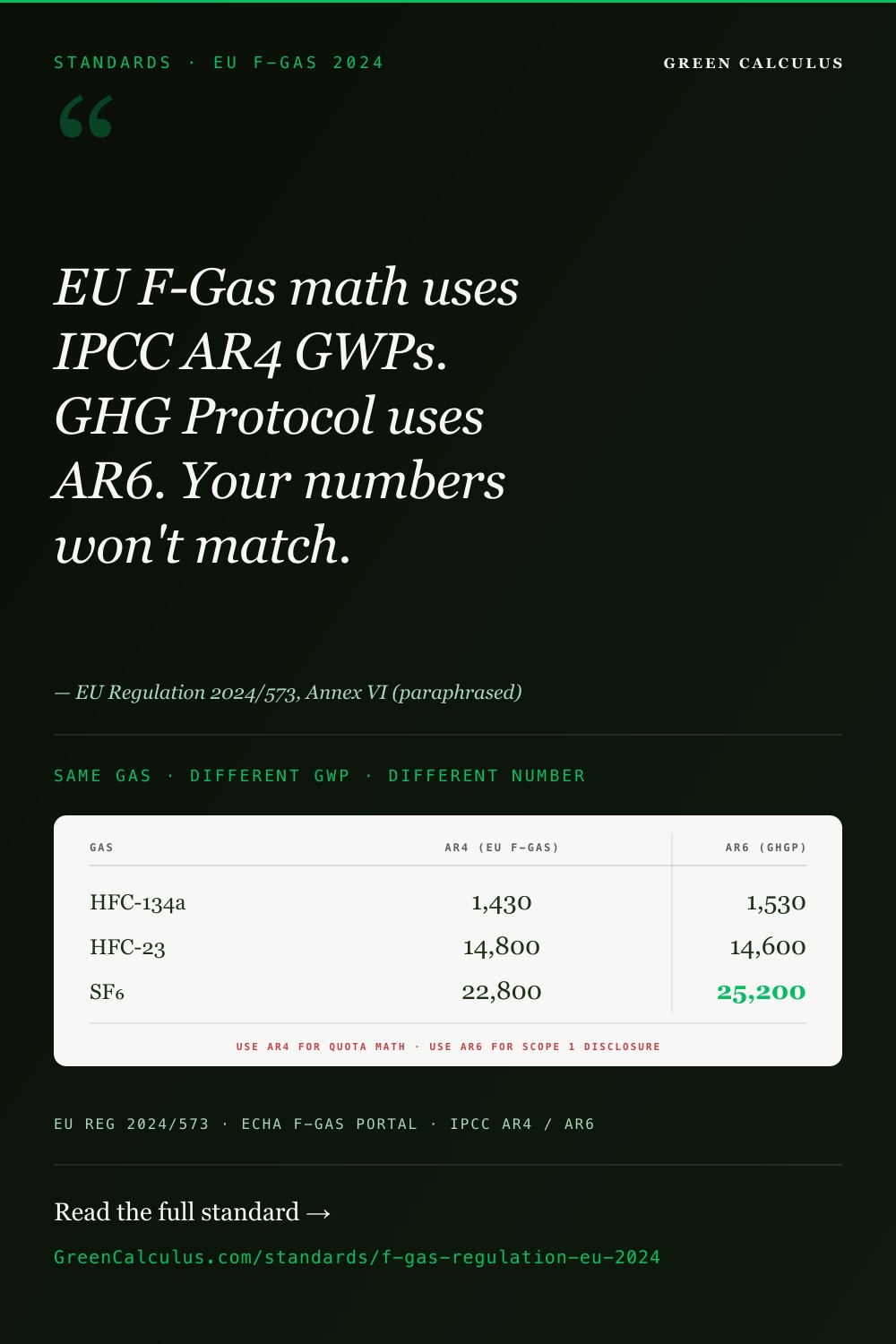
Frequently Asked Questions
Regulation (EU) 2024/573 is the EU’s binding legal regulation governing fluorinated greenhouse gases — hydrofluorocarbons (HFCs), perfluorocarbons (PFCs), sulphur hexafluoride (SF6), nitrogen trifluoride (NF3), and other fluorinated substances above defined GWP thresholds. It was adopted on 7 February 2024, entered into force on 11 March 2024, and replaced the previous Regulation (EU) No 517/2014. The regulation implements the EU’s Kigali Amendment HFC phase-down at an accelerated pace, driving bulk HFC supply (in CO2e using AR4 GWP-100 values from Annex VI) to zero placing-on-market by 1 January 2050, with stepped reductions every two to three years. It also bans specific high-GWP product categories under Annex IV (refrigeration, air-conditioning, heat pumps, switchgear, foams) and tightens leak-checking, recovery, certification, labelling, and reporting obligations.
Regulation (EU) 2024/573 was adopted on 7 February 2024, published in the Official Journal on 20 February 2024, and entered into force on 11 March 2024 (twenty days after publication). Most provisions applied from that date. A subset of provisions were phased in subsequently under the transitional regime in Article 36, and the Annex VII quota trajectory and Annex IV product bans take effect on specific dates running from 2025 through 2050.
Annex VI of Regulation (EU) 2024/573 hardcodes IPCC AR4 GWP-100 values as the legally operative basis for all CO2e calculations inside the regulation — quota math, the 150 / 750 / 2,500 GWP product-ban thresholds, leak-checking CO2e thresholds, labelling disclosures, and importer/exporter reporting CO2e totals. AR4 was published in 2007 and is two IPCC assessment-report generations behind the AR6 values (published 2021) that GHG Protocol Corporate Standard, CSRD ESRS E1-6, and SBTi use for corporate Scope 1 fugitive disclosure. The divergence is structural and intentional: the same kilogram of leaked R-410A produces 2,088 kg CO2e for F-Gas Regulation compliance and 2,256 kg CO2e for CSRD disclosure. Both numbers are correct for their respective uses.
Annex VII of Regulation (EU) 2024/573 sets the annual maximum quantity of HFCs (in tonnes of CO2e, AR4 basis) that may be placed on the EU market. The trajectory drops from 41.7 million tonnes CO2e in 2024 to 17.7 million in 2025 (a 58% single-year reduction), to 9.1 million in 2027, to 8.6 million in 2030, to 4.4 million in 2033, to 3.4 million in 2036, to 1.7 million in 2039–2049, and to zero from 1 January 2050. The schedule is binding on aggregate EU bulk HFC supply (including the HFCs contained in pre-charged imported equipment) via the quota authorisation system administered through the ECHA F-Gas Portal.
Annex IV bans the placing-on-market of new products and equipment containing F-gases above defined GWP thresholds, on a staggered schedule running from 2025 through 2035. Headline bans include: domestic refrigeration and centralised commercial refrigeration with HFCs of GWP ≥ 150 from 1 January 2025; single-split air-conditioners < 12 kW from 1 January 2027; medium-voltage (1–24 kV) electrical switchgear with F-gases of GWP ≥ 1 from 1 January 2027; most stationary AC and heat-pump categories below 12 kW from 1 January 2029–2030; high-voltage switchgear up to 145 kV from 1 January 2032; and most remaining AC and heat-pump categories at any capacity from 1 January 2035. Servicing prohibitions on virgin HFCs of GWP ≥ 2,500 from 2025 and on reclaimed HFCs of GWP ≥ 2,500 from 2030 affect maintenance of existing high-GWP installed systems.
Article 5 of Regulation (EU) 2024/573 calibrates leak-checking frequencies to the equipment’s CO2e charge (calculated using AR4 GWP-100 from Annex VI). Equipment below 5 tonnes CO2e is not subject to mandatory leak-checking; 5 to <50 tonnes CO2e requires checking at least every 12 months; 50 to <500 tonnes at least every 6 months; and 500 tonnes CO2e or more at least every 3 months. Frequencies are halved (i.e. intervals doubled) where an installed automatic leak-detection system meeting Article 5(8) requirements is fitted. The leak-check must be performed by certified personnel and recorded in the Article 7 equipment log.
The Kigali Amendment to the Montreal Protocol (adopted October 2016, in force for the EU since 1 January 2019) added HFCs to the Montreal Protocol’s controlled-substance framework and established a global HFC phase-down with differentiated schedules for developed countries (90% reduction by 2036), Article 5 Group 1 developing countries, and Article 5 Group 2 (10% reduction by 2045). The EU F-Gas Regulation implements the EU’s Kigali commitments and substantially exceeds them — the EU’s Annex VII trajectory reaches zero placing-on-market by 2050, far more ambitious than the 85% reduction the Kigali Amendment requires of developed-country parties by 2036. The F-Gas Regulation is the EU’s domestic-law implementation; the Kigali Amendment is the underlying international obligation.
The Article 7 equipment log under the F-Gas Regulation is the primary data source for the corporate Scope 1 fugitive-emission inventory under the GHG Protocol Corporate Accounting and Reporting Standard. Kilograms of refrigerant added to equipment during servicing — recorded under Article 7 — equals kilograms leaked since the last intervention (the mass-balance approach), which is GHG Protocol Tier 1 data quality. The same kilograms then flow into ESRS E1-6 gross Scope 1 disclosure, into SBTi near-term target tracking, and into CDP climate-change reporting. The critical discipline is to maintain two parallel CO2e calculations: AR4 for F-Gas Regulation compliance reporting, AR6 for corporate climate disclosure.
The principal low-GWP alternatives are: hydrofluoroolefins (HFOs) R-1234yf and R-1234ze(E), with GWP-100 of 4 and 7 (AR4) or less than 1 (AR6), used in MAC, commercial chillers, and HFC/HFO blends; hydrocarbons R-290 (propane) and R-600a (isobutane), with GWP near zero, used in domestic refrigeration, plug-in commercial refrigeration, and increasingly in monobloc heat pumps and small AC; carbon dioxide R-744, with GWP of 1, dominant in supermarket refrigeration and growing in heat-pump water heaters; ammonia R-717, with zero GWP, dominant in industrial refrigeration. HFC/HFO blends (R-454B at GWP 466 AR4, R-32 at GWP 675 AR4) serve as transitional refrigerants for split AC and heat pumps. Each alternative has specific safety-classification constraints (flammability, toxicity, pressure) that drive equipment-design and installation requirements.
Annual reports to the European Commission (via the ECHA F-Gas Portal, due 31 March for the preceding calendar year) are required from: producers placing one tonne or more of F-gases on the EU market; importers of one tonne or more of bulk F-gases; importers of products and equipment containing pre-charged HFCs above defined CO2e thresholds; exporters of one tonne or more of F-gases; destruction undertakings handling one tonne or more; feedstock users of one tonne or more; reclaimers of one tonne or more; and operators of equipment containing 100 tonnes CO2e (AR4 basis) or more in aggregate. Reports above defined verification thresholds (typically 1,000 tonnes CO2e of placing-on-market activity) must be third-party verified.
Under Article 10 of Regulation (EU) 2024/573, every intervention on F-gas-containing equipment — installation, servicing, maintenance, repair, leak-checking, decommissioning, recovery — must be performed by personnel and companies holding valid certification under a national certification scheme approved by the Commission. Personnel certifications cover stationary refrigeration/AC/heat-pumps (Categories I–IV by capacity and intervention type), fire-protection systems, electrical switchgear, MAC, refrigerated transport, solvent applications, and organic Rankine cycle equipment. Companies performing interventions must hold company certification aligned to the personnel certifications of their employees and the equipment categories they service. National competent authorities maintain registers of certified personnel and companies; operators must verify a contractor’s certification status before commissioning any intervention.
No. Annex IV restricts the placing-on-market of new equipment as of the dates specified; existing installed equipment containing high-GWP HFCs can continue operating, subject to leak-checking under Article 5, recovery at end-of-life under Article 8, and the servicing-ban deadlines on high-GWP HFCs (virgin HFCs of GWP ≥ 2,500 prohibited for servicing from 1 January 2025; reclaimed HFCs of GWP ≥ 2,500 prohibited for most stationary refrigeration servicing from 1 January 2030). Operators do not need to scrap working high-GWP systems early; they need to plan replacement aligned with the natural equipment-replacement cycle, the servicing-ban deadlines, and their broader decarbonisation strategy.
The UK left the EU on 31 January 2020. The UK’s retained F-Gas regime is operated under the Fluorinated Greenhouse Gases Regulations 2015 (Statutory Instrument 2015/168) as amended, which incorporates the substantive provisions of the 2014 EU F-Gas Regulation. Northern Ireland continues to apply the EU regime under the Windsor Framework. The substantive divergence between GB and the EU has grown since the EU’s 2024 acceleration: the GB quota trajectory follows the 2014 EU regulation’s original schedule (not the 2024 accelerated trajectory), and the GB product-ban schedule is the 2014 Annex III (not the 2024 Annex IV). The UK consulted on F-Gas reform in 2025; legislative reform is not yet complete. Cross-border EU/GB operators must maintain dual compliance.
Article 31 requires Member States to establish penalties that are “effective, proportionate, and dissuasive”, with specified minimum levels for serious infringements (illegal imports, illegal placing-on-market of banned equipment, quota circumvention, venting of recovered F-gases). Typical sanctions across Member States include administrative fines (from thousands of euros for minor compliance failures to millions for major infringements), quota penalty reductions applying for two years after a quota infringement, confiscation of illegally imported substances and equipment, withdrawal of certification, and criminal sanctions for serious offences under the Environmental Crime Directive (Directive (EU) 2024/1203). Enforcement has intensified, with the F-Gas Portal’s customs data link enabling real-time detection of import declarations inconsistent with quota holdings.
The Commission has the power under the regulation to revise Annex VI (the GWP-100 table), the implementing acts on certification and reporting, and various technical provisions via delegated and implementing acts. A future delegated act revising Annex VI from AR4 to a more recent IPCC basis would close the regulatory–reporting GWP divergence but would also reset every threshold in the regulation, with substantial operational consequences. As of May 2026, no such revision has been adopted, and the AR4 basis remains operative. The wider regulation is subject to ongoing review under Article 34, with potential revision linked to the EU PFAS regulatory framework and the Commission’s wider Fit for 55 trajectory. Practitioners should watch for delegated act activity through the late 2020s.
Sources and References
Every numerical claim and methodological statement in this article reconciles to the primary sources below.
Primary EU and international sources
- European Parliament and Council, Regulation (EU) 2024/573 of 7 February 2024 on fluorinated greenhouse gases, amending Directive (EU) 2019/1937 and repealing Regulation (EU) No 517/2014, OJ L of 20 February 2024.
- European Parliament and Council, Regulation (EU) No 517/2014 of 16 April 2014 on fluorinated greenhouse gases and repealing Regulation (EC) No 842/2006 (repealed by Regulation (EU) 2024/573).
- European Parliament and Council, Regulation (EC) No 842/2006 of 17 May 2006 on certain fluorinated greenhouse gases (repealed by Regulation (EU) No 517/2014).
- European Parliament and Council, Directive 2006/40/EC of 17 May 2006 relating to emissions from air-conditioning systems in motor vehicles (the Mobile Air Conditioning Directive).
- European Parliament and Council, Directive (EU) 2024/1203 on the protection of the environment through criminal law, OJ L of 30 April 2024.
- European Parliament and Council, Regulation (EU) 2023/956 establishing a carbon border adjustment mechanism (CBAM).
- European Commission, COM(2022)150 final — Proposal for a Regulation of the European Parliament and of the Council on fluorinated greenhouse gases, 5 April 2022.
- European Commission, Implementing Regulation (EU) 2015/2068 establishing pursuant to Regulation (EU) No 517/2014, the format of labels for products and equipment containing fluorinated greenhouse gases and successor implementing acts.
- European Commission, Implementing Regulation (EU) 2015/2066 establishing minimum requirements and the conditions for mutual recognition for the certification of natural persons.
- United Nations Environment Programme, Kigali Amendment to the Montreal Protocol on Substances that Deplete the Ozone Layer, adopted Kigali, 15 October 2016.
- United Nations Environment Programme, Montreal Protocol on Substances that Deplete the Ozone Layer, adopted 1987 and subsequently amended.
- European Chemicals Agency (ECHA), F-Gas Portal documentation and quota allocation guidance.
UK and national instruments
- The Fluorinated Greenhouse Gases Regulations 2015 (UK Statutory Instrument 2015/168) as amended.
- Department for Environment, Food and Rural Affairs (DEFRA), UK F-Gas Regulation: consultation on reform, 2025.
Scientific basis
- IPCC, AR6 Working Group I Contribution to the Sixth Assessment Report — Chapter 7 and Table 7.SM.7 (GWP-100 values), 2021.
- IPCC, AR5 Working Group I Contribution to the Fifth Assessment Report — Table 8.A.1 (GWP-100 values), 2013.
- IPCC, AR4 Working Group I Contribution to the Fourth Assessment Report — Chapter 2.10 and Table 2.14 (GWP-100 values; basis for Regulation (EU) 2024/573 Annex VI), 2007.
- IPCC, 2006 IPCC Guidelines for National Greenhouse Gas Inventories — Volume 3, Chapter 7 (Emissions of Fluorinated Substitutes for Ozone-Depleting Substances).
Adjacent corporate disclosure frameworks
- WRI & WBCSD, The Greenhouse Gas Protocol Corporate Accounting and Reporting Standard, revised edition.
- WRI & WBCSD, Corporate Value Chain (Scope 3) Accounting and Reporting Standard, 2011.
- European Sustainability Reporting Standards, ESRS E1 (Climate change), EFRAG, 2023.
- Science Based Targets initiative, Corporate Net-Zero Standard.
Technical safety standards
- EN 378-1 to EN 378-4, Refrigerating systems and heat pumps — Safety and environmental requirements.
- IEC 60335-2-40, Household and similar electrical appliances — Safety — Particular requirements for electrical heat pumps, air-conditioners and dehumidifiers.
- ISO 817, Refrigerants — Designation and safety classification.
Related GreenCalculus reference pages
- GHG Protocol Corporate Standard
- GHG Protocol Scope 3 Standard
- GHG Protocol Scope 2 Guidance
- CSRD / ESRS E1
- SBTi Corporate Net-Zero Standard
- ISO 14064-1
- IPCC AR6
- IPCC 2006 Guidelines
- UK DEFRA Emission Factors
- ISO 14067 Product Carbon Footprint
- ISO 14040 / 14044 LCA
- BS EN 15978 Whole-Life Carbon for Buildings
- TCFD Recommendations
- RE100 Technical Criteria
- GHG Protocol Land Sector and Removals Standard
- Global warming potential
- CO2e — carbon dioxide equivalent
- Scope 1 emissions
- Scope 2 emissions
- Scope 3 emissions
- Methane (CH4)
- Nitrous oxide (N2O)
- IPCC AR6 GWP values
- DEFRA emission factors
- IEA grid emission factors 2026
- Natural gas combustion methodology
- Diesel combustion methodology
- Scope 2 electricity methodology
- Scope 2 market-based methodology
- Scope 1 combustion calculator
- Scope 2 electricity calculator
- SBTi near-term target calculator
- SBTi readiness checklist
What changed in this revision
Updated 11 May 2026. Initial publication. Reflects Regulation (EU) 2024/573 as the current operative EU F-Gas Regulation (adopted 7 February 2024, entered into force 11 March 2024, replacing Regulation (EU) No 517/2014), the Annex VII HFC quota trajectory from 41.7 million tonnes CO2e in 2024 to zero by 1 January 2050, the Annex IV product-and-equipment ban schedule running from 2025 through 2035, the Annex VI AR4 GWP-100 values used as the legally operative basis for all in-regulation CO2e calculations, the ECHA-administered F-Gas Portal that took over from the Commission in-house quota system during the 2024–2025 transition, the Mobile Air Conditioning Directive (2006/40/EC) interaction, the Kigali Amendment (in force for the EU since 1 January 2019) as the international-law underlay, the Environmental Crime Directive (Directive (EU) 2024/1203) as the criminal-law instrument for serious infringements, the retained UK F-Gas regime under SI 2015/168 as amended (now substantively diverged from the EU 2024 trajectory pending UK reform that was consulted on in 2025), the GHG Protocol Corporate Standard’s classification of refrigerant leakage as Scope 1 fugitive emissions, the CSRD ESRS E1-6 disclosure expectation of AR6 GWP-100 values, IPCC AR4 / AR5 / AR6 GWP-100 values for the principal refrigerants and other regulated substances, and the technical safety standards (EN 378, IEC 60335-2-40, ISO 817) that govern installation of low-GWP alternative refrigerants.