
CIBSE TM46 Energy Benchmarks — The Definitive Reference

CIBSE TM46, published in 2008, is the benchmark set that turns a building’s metered annual energy into a Display Energy Certificate. It defines 29 building categories, each with a separate electricity benchmark and a fossil-thermal benchmark in kWh/m²/year, against which a building’s actual consumption is scored. Those 29 rows are the denominator behind every DEC Operational Rating issued in England, Wales and Northern Ireland.
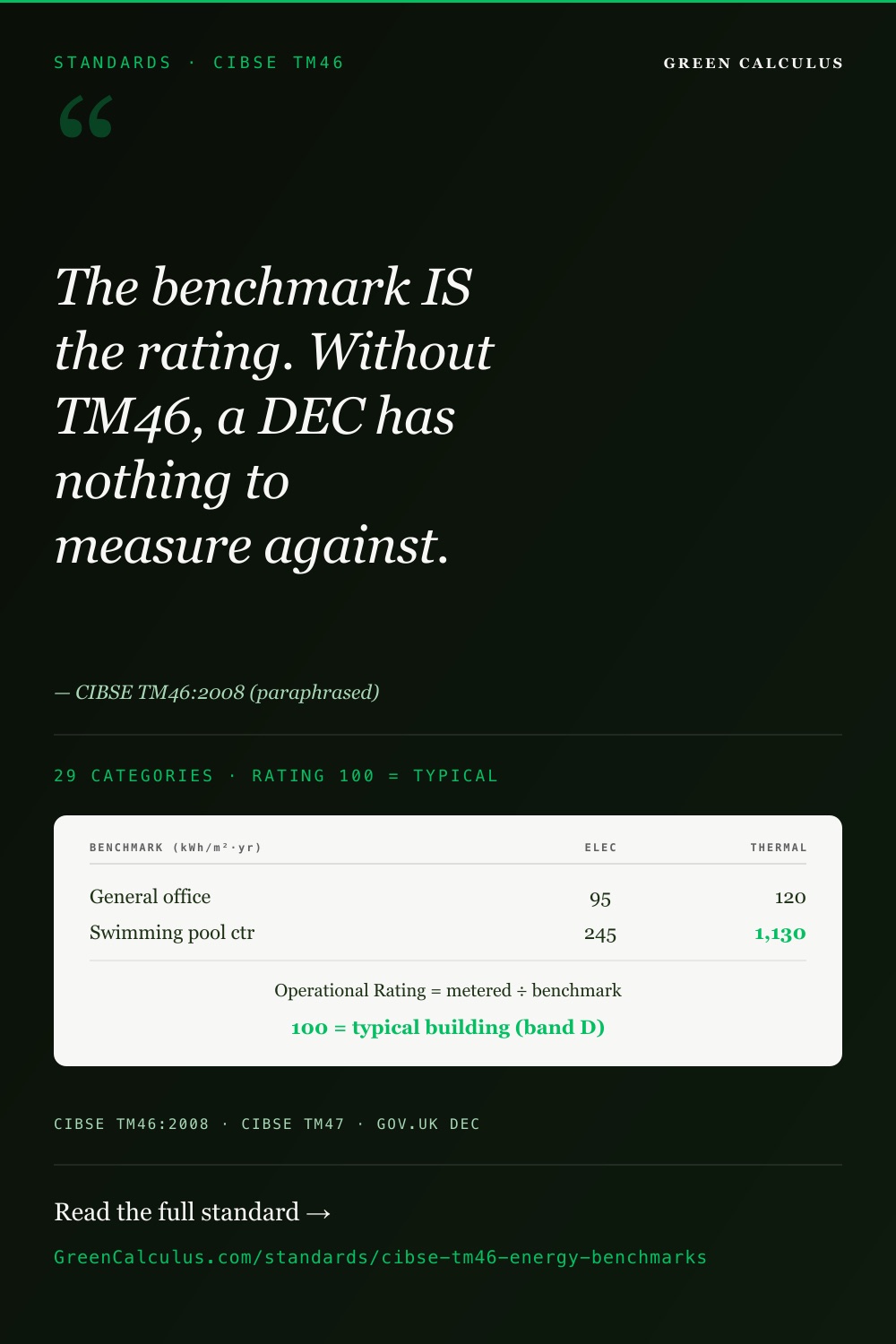
Without TM46, the A–G rating on a public building’s wall has nothing to measure against — the benchmark is the rating.
CIBSE TM46:2008 sets 29 building-type energy benchmarks (separate electricity and fossil-thermal kWh/m²/year) used to produce the Display Energy Certificate Operational Rating, where a score of 100 equals a typical building and lands on band D.
What TM46 Is — and What It Is Not
TM46 is an operational benchmark set. It describes how much energy a real, occupied building of a given type typically consumes per square metre over a year, based on metered data from the existing UK stock at the time of publication. It is not a design tool, not a modelling methodology, and not a prediction of how an efficient building could perform. The distinction matters because the UK building-energy landscape contains two parallel rating systems that are frequently confused.
- Modelled energy under standardised occupancy and weather
- Calculated by SBEM/SAP from the building’s physical fabric and services
- Independent of how the occupier actually runs the building
- Required on construction, sale or lease
- Does not use TM46
- Measured energy from meter readings or bills over 12 months
- Scored against the TM46 benchmark for the building’s category
- Reflects real occupier behaviour, hours, and management
- Required annually for larger public buildings
- TM46 supplies the benchmark denominator
An asset rating can be excellent while the operational rating is poor — an efficiently designed building run badly. The two are complementary, not interchangeable. TM46 governs only the operational side. The benchmark set itself was developed from Chapter 20 of CIBSE Guide F and refined through a 2007 consultation with public- and private-sector practitioners before being adopted as the statutory benchmark complement to the Operational Rating procedure.
An Operational Rating is, at its core, a ratio: actual annual CO₂ emissions per m² divided by the TM46 benchmark emissions per m² for that building type, indexed so that a typical building scores 100. Everything else in the procedure — weather correction, separables, occupancy adjustment — exists to make that ratio a fair comparison. Change the benchmark and you change every rating built on it.
Provider directory
Now it has to hold up all year.
See who does this work — chosen by us, never paid placement, with the standards each one works to. Including Attain Zero and Small World Consulting.
Browse 4 carbon accounting & inventory providers →Do this work? A listing is $390 a year. Get listed →
Historical Context and Evolution of the Standard
TM46 emerged from the UK’s transposition of the EU Energy Performance of Buildings Directive, which required member states to display energy certificates in public buildings. England, Wales and Northern Ireland implemented this through the Display Energy Certificate, and the DEC needed a national benchmark set against which actual consumption could be scored. CIBSE produced that set as TM46.
| Year | Milestone | Significance |
|---|---|---|
| 2002 | EU Energy Performance of Buildings Directive (2002/91/EC) | Requires display of energy certificates in public buildings across member states. |
| 2007 | Benchmark consultation | Draft benchmark set, derived from CIBSE Guide F Chapter 20, circulated to ~80 practitioners across 40 organisations. |
| 2008 | CIBSE TM46:2008 published; DEC regime begins | 29 benchmark categories fixed; statutory benchmark complement to the Operational Rating procedure. |
| 2008 | CIBSE TM47 published | Defines the Operational Rating, DEC and advisory-report procedure that consumes TM46 benchmarks. |
| 2008 | DEC initially required for public buildings >1,000 m² | Large public estate brought into scope first. |
| 2015 | DEC threshold lowered to >250 m² | Smaller public buildings (libraries, clinics, schools) brought into scope from 9 July 2015. |
| 2008–present | CIBSE Energy Benchmarking Tool | Online platform layering newer measured data over the static TM46 table; the TM46:2008 statutory table itself remains unchanged. |
The TM46:2008 benchmark table has not been revised since publication. The static nature of the table is both its strength — a stable, consistent yardstick across the whole stock — and its principal criticism, addressed in the limitations section. CIBSE’s separate Energy Benchmarking Tool was introduced to provide more current, data-driven benchmarks, but the statutory DEC procedure continues to rest on the 2008 table.
The Display Energy Certificate Regime TM46 Underpins
TM46 has no independent legal force on its own — its authority is entirely derivative of the DEC regime. A Display Energy Certificate shows a building’s energy performance based on actual measured energy consumption over the previous 12 months, expressed as an Operational Rating on an A-to-G scale. The benchmark that anchors that scale is TM46.
The division of responsibility between the two CIBSE technical memoranda is precise and worth stating clearly, because it determines where each rule lives:
Defines the 29 categories, each category’s typical electricity and fossil-thermal benchmark in kWh/m²/year, the rules for separable energy uses, weather adjustment via degree-days, occupancy/hours adjustment, and the mixed-use build-up method. TM46 answers: what is a typical building of this type?
Defines how the Operational Rating, the certificate itself, and the accompanying advisory report are produced from the TM46 benchmarks and the building’s measured data. TM47 answers: how do I turn metered energy and a benchmark into a published A–G certificate?
Both are implemented inside government-approved DEC software operated by accredited energy assessors. The CO₂ intensity factors that convert kWh into kgCO₂ are set centrally by government (originally CLG, now DESNZ) and applied by that software — they are deliberately not part of the TM46 benchmark set, because the benchmarks are specified in energy terms (kWh/m²) and the carbon conversion is a separate, updatable layer.
The 29 TM46 Benchmark Categories
Below is the complete TM46:2008 Table 1 benchmark set. Each category carries a typical electricity benchmark and a typical fossil-thermal benchmark, both in kWh/m²/year. Categories with a 0.0 fossil-thermal benchmark (high-street agency, general retail, small food store, covered car park) are those expected to have negligible heating demand in the benchmark stock. The illustrative kgCO₂/m² columns are TM46:2008’s own published illustrative carbon figures, derived using the CO₂ intensity factors current at publication; the DEC software applies whatever factors are current at assessment, so treat these carbon columns as a 2008 snapshot, not a live conversion.
| # | Category | Brief description | Electricity (kWh/m²) |
Fossil-thermal (kWh/m²) |
Illustrative total (kgCO₂/m²) |
|---|---|---|---|---|---|
| 1 | General office | General office and commercial working areas | 95.0 | 120.0 | 75.1 |
| 2 | High street agency | High street agency | 140.0 | 0.0 | 77.0 |
| 3 | General retail | General street retail and services | 165.0 | 0.0 | 90.8 |
| 4 | Large non-food shop | Retail warehouse or other large non-food store | 70.0 | 170.0 | 70.8 |
| 5 | Small food store | Small food store | 310.0 | 0.0 | 170.5 |
| 6 | Large food store | Supermarket or other large food store | 400.0 | 105.0 | 240.0 |
| 7 | Restaurant | Restaurant | 90.0 | 370.0 | 119.8 |
| 8 | Bar, pub or licensed club | Bar, pub or club | 130.0 | 350.0 | 138.0 |
| 9 | Hotel | Hotel or boarding house | 105.0 | 330.0 | 120.5 |
| 10 | Cultural activities | Museum, art gallery or other public building, normal occupancy | 70.0 | 200.0 | 76.5 |
| 11 | Entertainment halls | Entertainment halls | 150.0 | 420.0 | 162.3 |
| 12 | Swimming pool centre | Swimming pool hall, changing and ancillaries | 245.0 | 1,130.0 | 349.5 |
| 13 | Fitness & health centre | Fitness centre | 160.0 | 440.0 | 171.6 |
| 14 | Dry sports & leisure facility | Dry sports and leisure facility | 95.0 | 330.0 | 115.0 |
| 15 | Covered car park | Car park with roof and side walls | 20.0 | 0.0 | 11.0 |
| 16 | Public buildings, light usage | Light use public and institutional buildings | 20.0 | 105.0 | 31.0 |
| 17 | Schools & seasonal public buildings | Public buildings nominally used for part of year | 40.0 | 150.0 | 50.5 |
| 18 | University campus | University campus | 80.0 | 240.0 | 89.6 |
| 19 | Clinic | Health centres, clinics and surgeries | 70.0 | 200.0 | 76.5 |
| 20 | Hospital (clinical & research) | Clinical and research hospital | 90.0 | 420.0 | 129.3 |
| 21 | Long-term residential | Long term residential accommodation | 65.0 | 420.0 | 115.6 |
| 22 | General accommodation | General accommodation | 60.0 | 300.0 | 90.0 |
| 23 | Emergency services | Emergency services | 70.0 | 390.0 | 112.6 |
| 24 | Laboratory or operating theatre | Laboratory or operating theatre | 160.0 | 160.0 | 118.4 |
| 25 | Public waiting or circulation | Bus or train station, shopping centre mall | 30.0 | 120.0 | 39.3 |
| 26 | Terminal | Regional transport terminal with concourse | 75.0 | 200.0 | 79.3 |
| 27 | Workshop | Workshop or open working area (not office) | 35.0 | 180.0 | 53.5 |
| 28 | Storage facility | Storage warehouse or depot | 35.0 | 160.0 | 49.7 |
| 29 | Cold storage | Refrigerated warehouse | 145.0 | 80.0 | 95.0 |
Source: CIBSE TM46:2008, Table 1 (Benchmark categories and values). Electricity and fossil-thermal benchmarks are typical (median) annual values per unit of useful floor area.
Every category carries two benchmarks because electricity and fossil-thermal energy are measured, benchmarked and (later) carbon-weighted separately. A swimming pool centre’s 1,130 kWh/m² fossil-thermal benchmark — by far the highest in the table — reflects pool-water and hall heating; its electricity benchmark of 245 kWh/m² covers pumps, ventilation and lighting. A building is scored against both columns for its category, and the two are combined on a carbon basis to produce the single Operational Rating.
From Benchmark to Operational Rating
The Operational Rating is an index, not an absolute energy figure. It expresses a building’s actual carbon intensity as a percentage of the benchmark carbon intensity for its category, scaled so that a typical building scores exactly 100. The calculation chain runs through four stages.
The assessor collects a complete 12 months of metered electricity and fossil-thermal (and any district heating/cooling) consumption from meter readings or bills. Where a fuel is not directly metered — fuel oil, coal, wood — delivery records are reviewed to estimate annual use. Consumption is divided by the building’s total useful floor area.
The raw TM46 benchmark is adjusted to match the building’s real circumstances: separable energy uses are removed from the comparison, the fossil-thermal benchmark is weather-corrected to the building’s location and year using 15.5 °C degree-days, and an occupancy/hours adjustment is applied where the building operates well beyond standard hours. These adjustments make the actual-vs-benchmark comparison fair.
Actual energy and adjusted benchmark energy are each converted to kgCO₂/m² using the government-set CO₂ intensity factors for electricity and fossil-thermal energy, applied automatically by the approved DEC software. Carbon — not raw kWh — is the common currency in which electricity and heat are combined.
The Operational Rating is the building’s actual carbon intensity divided by the adjusted benchmark carbon intensity, multiplied by 100. A score of 100 means the building performs exactly at the benchmark — band D. A score of 50 means the building emits half the benchmark — band B. The score, not the underlying kWh, is what appears on the certificate.
The Three Benchmark Adjustments
The fairness of a DEC rests almost entirely on three adjustments defined in TM46. Misapplying any one of them produces a rating that penalises or flatters a building for reasons unrelated to how well it is managed.
Weather adjustment — 15.5 °C degree-days
Heating energy depends heavily on outside temperature, so comparing a cold-year building against a fixed benchmark would be unfair. TM46 corrects the fossil-thermal benchmark (not electricity) using heating degree-days to a base temperature of 15.5 °C. The benchmark is scaled by the ratio of the building location’s actual degree-days in the assessment year to the long-run average degree-days, so a building assessed in a cold winter is judged against a proportionately higher benchmark.
Why 15.5 °C for everything: TM46 applies the 15.5 °C base across all sectors, including offices where a lower balance-point temperature might be argued. The single consistent base keeps the benchmark set comparable across the whole stock rather than introducing category-specific weather bases. Degree-day data is organised across 14 UK regions (Thames Valley through Northern Ireland) drawn from long-run records.
Separable energy uses
Some energy end-uses are unusual for a building’s category or highly variable between buildings — a server room in an otherwise ordinary office, a commercial kitchen, major process equipment. TM46 allows these “separable” uses to be removed from the Operational Rating calculation, provided they are separately sub-metered and meet the criteria set out in the standard. The separated energy still appears in the building’s total carbon footprint on the certificate; it is simply excluded from the benchmark comparison so the building is not penalised for an atypical load.
Analysis of the national DEC database found that only around 0.3 per cent of certificates made any use of separables. The low figure reflects missing sub-metering and limited awareness of the provision. Buildings carrying a large atypical load — a data centre, a commercial kitchen — that is not separated are scored as though that load were normal for their category, producing an artificially poor rating. Where sub-metering exists, separating qualifying loads is one of the few legitimate ways to improve a DEC without changing actual consumption.
Occupancy and hours-of-use adjustment
The TM46 benchmark assumes standard operating hours for each category. A building that operates substantially longer — a 24-hour control centre, an extended-hours leisure facility — would consume more energy than the standard-hours benchmark for reasons of legitimate use, not inefficiency. TM46 provides an occupancy/hours adjustment that raises the benchmark in proportion to the building’s actual operating pattern, again making the comparison fair rather than mechanical.
Worked Example — An Office Operational Rating
The following worked example uses the General Office benchmark (Category 1) and is illustrative: it applies the published TM46:2008 illustrative CO₂ intensities (electricity ≈ 0.55 kgCO₂/kWh, fossil-thermal ≈ 0.19 kgCO₂/kWh, the values underlying the table’s illustrative columns) so the arithmetic reconciles with the benchmark table above. A live DEC would use whichever government CO₂ factors are current at assessment. Weather, separables and occupancy adjustments are assumed neutral for clarity.
Scenario: A 4,000 m² general office. Metered annual consumption: 520,000 kWh electricity and 400,000 kWh natural gas.
Actual intensities: electricity 130 kWh/m² (520,000 ÷ 4,000); fossil-thermal 100 kWh/m² (400,000 ÷ 4,000).
Benchmark (Category 1): electricity 95 kWh/m²; fossil-thermal 120 kWh/m².
Actual carbon: (130 × 0.55) + (100 × 0.19) = 71.5 + 19.0 = 90.5 kgCO₂/m²
Benchmark carbon: (95 × 0.55) + (120 × 0.19) = 52.3 + 22.8 = 75.1 kgCO₂/m² (matches the table’s illustrative total for Category 1)
Operational Rating: (90.5 ÷ 75.1) × 100 ≈ 121 → band E
The office uses about 21 per cent more carbon per m² than a typical office of its type, landing it in band E. The electricity overshoot (130 vs 95 kWh/m²) drives most of the gap; the gas figure is actually below benchmark. A category-level read like this is exactly what the two-column benchmark structure enables — it points an energy manager at electricity, not heating.
The A–G Operational Rating Scale
The Operational Rating index maps onto seven bands. The scale is anchored so that 100 — a building performing exactly at its TM46 benchmark — sits at the top of band D. Lower scores are better; a score of 0 would mean zero net carbon, and scores above 150 (worse than 1.5× the benchmark) fall into band G.
Because 100 equals the median building, a typical public building rates D, not A. This surprises occupiers who expect a “normal” building to score well; the scale is deliberately benchmarked against real stock performance, so half of buildings of a given type historically scored worse than D. The score printed large on the certificate is this index; the certificate also shows the building’s actual and typical kWh/m² for electricity and other fuels side by side, exposing which fuel stream drives the rating.
Mixed-Use Buildings and Category Selection
Few real buildings are pure single-category. A school with a swimming pool, a hospital with a laboratory wing, an office with a basement car park — each combines TM46 categories. The standard handles this through a mixed-use build-up rather than forcing a single category.
The composite benchmark is assembled from the component category benchmarks weighted by the floor area each activity occupies. A school of 9,000 m² teaching space plus a 1,000 m² pool hall takes the Category 17 benchmark for the teaching area and the Category 12 benchmark for the pool area, area-weighted into one blended benchmark.
Total useful floor area is measured to the internal face of external walls, including staircases and galleries, and excludes areas not serving the primary function — notably uncovered or separately benchmarked car parking. Getting the floor area wrong scales every intensity figure and is a frequent source of rating error.
Each distinct activity area is matched to the category whose description best fits its function, using the TM46 building-type allocation list (Table 2 of the standard). Misallocation — scoring a laboratory wing as general office — produces a benchmark that does not reflect the real load and distorts the whole composite.
Because the composite benchmark is area-weighted, the accuracy of the rating depends on accurate floor-area apportionment between activities. A pool hall benchmarked at 1,130 kWh/m² fossil-thermal dominates a blended figure even at modest area share. Under-stating the pool area, or folding it into a lower-intensity category, produces a benchmark that is too low and a rating that looks worse than the building deserves. Mixed-use apportionment deserves the same scrutiny as the meter data.
DEC Compliance — Thresholds, Validity and Penalties
The obligation to hold and display a DEC, and therefore to apply TM46, is triggered by building use, public access and floor area. The rules differ by building size, which also sets how often the certificate must be renewed.
| Parameter | 250–1,000 m² | Over 1,000 m² |
|---|---|---|
| DEC required? | Yes — public authority occupation, frequent public visits | Yes — public authority occupation, frequent public visits |
| DEC validity | 10 years | 1 year (renewed annually) |
| Advisory report validity | 10 years | 7 years |
| Energy data basis | Previous 12 months’ actual consumption | Previous 12 months’ actual consumption |
| Display obligation | Prominent position, clearly visible to the public | Prominent position, clearly visible to the public |
The DEC must be produced by an accredited energy assessor and accompanied by a valid advisory report setting out measures to improve the building’s energy performance. Useful floor area for the threshold test excludes areas not used for the building’s primary function, such as car parks. Private organisations are not obliged to obtain a DEC but may do so voluntarily.
Enforcement sits with the local authority. Failure to display a valid DEC carries a penalty of £500; failure to possess a valid advisory report carries a penalty of £1,000. These are per-building obligations, so a public estate with many in-scope buildings faces cumulative exposure if certificates lapse — a real risk for buildings over 1,000 m² where the certificate must be renewed every 12 months.
Operational Rating vs Asset Rating — A Comparison Matrix
TM46-based operational ratings and SBEM-based asset ratings are routinely confused because both produce an A–G label on a building. They measure fundamentally different things, and a building can hold very different grades on each.
| Dimension | Operational rating (DEC) | Asset rating (EPC) |
|---|---|---|
| What it measures | Actual measured energy in use | Modelled energy of the building as designed |
| Benchmark/engine | CIBSE TM46 benchmarks via TM47 procedure | SBEM (non-domestic) / SAP (domestic) |
| Reflects occupier behaviour? | Yes — hours, management, plug loads | No — standardised occupancy assumptions |
| Data source | Meter readings / bills, 12 months | Building fabric and services specification |
| Trigger | Annual (public buildings in scope) | Construction, sale or lease |
| Scale anchor | 100 = typical existing building (band D) | Notional reference building (band varies) |
| Can it improve without works? | Yes — better operation, separables, controls | No — requires fabric/services change |
Limitations and the Benchmark-Staleness Problem
TM46’s central limitation is structural: the benchmark table was fixed in 2008 from stock data of that era and has not been revised. The UK building stock has changed materially since — LED lighting has displaced fluorescent and halogen, IT loads have shifted, heating controls have improved, and decarbonisation of the electricity grid has changed the carbon weighting of the electricity column relative to gas. A benchmark frozen in 2008 increasingly compares modern buildings against an outdated definition of “typical”.
Interoperability With Carbon and Disclosure Frameworks
A DEC is not a greenhouse-gas inventory, but the metered annual energy that TM46 benchmarking consumes is the same data that feeds corporate carbon accounting and disclosure. For an organisation already producing DECs across a public estate, the energy dataset is reusable across several frameworks.
| Framework | Connection to TM46/DEC data |
|---|---|
| GHG Protocol Scope 1 | The fossil-thermal energy benchmarked under TM46 is the same on-site gas/oil combustion that stationary combustion accounting converts to Scope 1 emissions. |
| GHG Protocol Scope 2 | The electricity benchmarked under TM46 is the purchased electricity that Scope 2 guidance converts to emissions on a location- or market-based basis. |
| UK DEFRA conversion factors | Converting benchmarked kWh into CO₂e for corporate reporting uses the DEFRA conversion factors, distinct from the CO₂ intensities the DEC software applies internally. |
| ISO 50001 | An energy management system uses operational benchmarking of the kind TM46 formalises to set energy baselines and track performance improvement. |
| UK climate disclosures (SECR/TCFD) | The annual energy and emissions data underlying a DEC feeds directly into mandatory UK climate disclosures for in-scope organisations. |
| Real-estate decarbonisation pathways | Operational energy intensity (kWh/m²) is the input to CRREM stranding analysis, which assesses whether a building’s in-use carbon trajectory will breach decarbonisation targets. |
| CSRD / ESRS E1 · IFRS S2 | Building energy and emissions data supports the operational-emissions disclosures required under ESRS E1 and IFRS S2 for organisations holding property portfolios. |
The operational/embodied distinction is worth holding in mind: TM46 measures only energy in use. The carbon embodied in a building’s construction is a separate accounting question addressed by whole-life carbon assessment, and a complete building carbon picture needs both.
Common Errors That Distort a DEC
How GreenCalculus Uses TM46 Benchmarks
GreenCalculus treats the TM46 benchmark set as an operational-energy reference layer that connects building performance to carbon accounting. The 29-category benchmark table supports operational benchmarking of property portfolios and provides the kWh/m² baseline that converts, via standard factors, into Scope 1 and Scope 2 emissions for corporate reporting.
| Function | Status | Where it connects |
|---|---|---|
| 29-category benchmark reference | Published on this page | TM46:2008 Table 1, full electricity + fossil-thermal benchmarks |
| Fossil-thermal energy → Scope 1 | Live | Scope 1 Combustion Calculator for on-site gas/oil |
| Electricity → Scope 2 | Live | Scope 2 Electricity Calculator |
| Operational-rating index calculator | Planned | Benchmark-vs-actual indexing with weather and separables adjustment |
| Portfolio benchmarking tool | Planned | Multi-building TM46 comparison across a public or commercial estate |
Turn benchmarked building energy into reportable Scope 1 and Scope 2 emissions. The fossil-thermal column feeds on-site combustion; the electricity column feeds purchased-electricity accounting.
Frequently Asked Questions
CIBSE TM46:2008 is the UK energy benchmark set that defines 29 building categories, each with a typical electricity benchmark and a typical fossil-thermal benchmark in kWh/m²/year. These benchmarks are the statutory yardstick against which a building’s actual measured energy is scored to produce the Display Energy Certificate Operational Rating. TM46 supplies the benchmarks; the companion CIBSE TM47 defines the rating procedure that uses them.
There are 29 benchmark categories, from General office (Category 1) through to Cold storage (Category 29). Each represents a major functional building type and carries a separate electricity and fossil-thermal benchmark. Categories with no expected heating load — high street agency, general retail, small food store, covered car park — carry a fossil-thermal benchmark of 0.0 kWh/m². Mixed-use buildings are benchmarked by area-weighting the relevant component categories.
A score of 100 means the building performs exactly at the TM46 benchmark for its category — a typical building. On the A–G scale, 100 sits at the top of band D. Lower scores are better: band A is 0–25, band B 26–50, band C 51–75, band D 76–100, band E 101–125, band F 126–150, and band G above 150. Because the benchmark is set at the median of existing stock, a typical public building rates D rather than A.
TM46 defines the benchmarks — the 29 categories, their typical energy values, and the rules for separables, weather correction and occupancy adjustment. TM47 defines the procedure — how the Operational Rating, the Display Energy Certificate, and the advisory report are produced from those benchmarks and the building’s metered data. In short, TM46 answers “what is a typical building of this type?” and TM47 answers “how do I turn metered energy and a benchmark into a published certificate?”
A DEC is required for buildings over 250 m² that are occupied by a public authority and frequently visited by the public — schools, hospitals, libraries, government buildings. For buildings over 1,000 m² the certificate is valid for one year and must be renewed annually; for buildings between 250 m² and 1,000 m² it is valid for ten years. The accompanying advisory report is valid for seven years (over 1,000 m²) or ten years (250–1,000 m²). Private organisations may obtain a DEC voluntarily but are not obliged to.
TM46 weather-corrects the fossil-thermal (heating) benchmark using heating degree-days to a base temperature of 15.5 °C, applied consistently across all building categories. The benchmark is scaled by the ratio of the building location’s actual degree-days in the assessment year to the long-run regional average, so a building assessed in a cold year is compared against a proportionately higher heating benchmark. Electricity is not weather-corrected.
The statutory TM46:2008 benchmark table has not been revised since publication, so it reflects the UK building stock of that era rather than current performance. This is its main criticism — modern efficiency gains and grid decarbonisation are not captured in the fixed table. CIBSE introduced a separate Energy Benchmarking Tool to provide more current, data-driven benchmarks, but the statutory Display Energy Certificate procedure continues to rest on the 2008 table.
Separable energy uses are end-uses that are unusual for a building’s category or highly variable — a server room in an office, a commercial kitchen, major process equipment. TM46 allows these to be removed from the Operational Rating comparison, provided they are separately sub-metered and meet the standard’s criteria, so the building is not penalised for an atypical load. The separated energy still appears in the building’s total carbon footprint on the certificate. In practice separables are heavily under-used, largely because the required sub-metering is often absent.