
Business Travel (Air) Calculator | DEFRA 2026 + ICAO Carbon Calculator v13.1
Convert passenger flight distances into Scope 3 Category 6 CO2e using DEFRA 2025 passenger-km factors, with optional radiative-forcing uplift and ICAO Carbon Calculator v13.1 great-circle correction.
Factor basis. Distance-based passenger-km factors are sourced from the DEFRA 2026 conversion factor set, split by haul (domestic, short-haul, long-haul, international) and cabin class (economy, premium economy, business, first), each available with and without a radiative-forcing (RF) uplift. The RF multiplier accounts for non-CO2 high-altitude effects (contrails, NOx, water vapour) and is applied by DEFRA as an embedded factor rather than a separate line.
Distance method. Where a flight is entered as an origin–destination pair, the engine derives great-circle distance (GCD) and applies the ICAO Carbon Calculator v13.1 distance correction to approximate routing, holding, and stacking that lengthen the real flown path beyond the straight-line GCD.
GWP basis. DEFRA factors are published on an AR5 100-year GWP basis. This is the DEFRA convention and is retained as-is; corporate inventory totals that default to AR6 elsewhere do not require these aviation factors to be restated (see the GHG Protocol Scope 3 Standard for cross-category treatment).
Scope placement. Employee air travel on commercial carriers is reported under Scope 3 Category 6 (Business Travel). Air freight, by contrast, sits under Category 4 (Upstream Transportation and Distribution) and uses tonne-km freight intensities, not passenger-km factors.
Default DEFRA matches UK CDP / SECR / ESOS reporting practice.
DEFRA “with RF” applies a 1.9× non-CO₂ uplift.
Report WTT as a separate Scope 3 Cat 3 line.
Audit mode exposes the full per-leg calculation chain.
Build a trip leg-by-leg. Each leg is calculated independently — connecting flights are not approximated as a single great-circle line (DEFRA convention undercounts; ICAO route-group methodology requires per-leg).
-
Leg 1Doubles distance for this leg
Distance: —
Roll up a full quarter or year of business travel from a single CSV. Parsing is fully client-side — your data never leaves your browser. Per-traveller aggregation is computed automatically when a traveler_id column is present.
CSV schema (click to expand)
Required columns: origin, dest. Optional: cabin (economy / premium_economy / business / first / average), pax (default 1), return (Y/N — default N), aircraft (IATA equivalent code, triggers Tier 3 for that row), date (YYYY-MM-DD), traveler_id (any string), trip_purpose, cost_center. Column order is free; first row is the header.
Download a 3-row template with one example of each required + optional column populated.
Drop a CSV file here or .
Or paste CSV text below.
Compare two trip options side-by-side. Useful for “fly direct vs. 1-stop”, “economy vs. business”, “old aircraft vs. new”. The result panel shows the delta plus what drove it (cabin choice, aircraft choice, RF inclusion).
Option A
Option B
Distance: —
Enter a trip above to calculate
Results appear instantly. Methodology spread (DEFRA / ICAO / aircraft-specific), per-leg audit trail, and Scope 3 Cat 3 WTT companion all available after calculation.
Results are indicative, intended for screening and order-of-magnitude estimates. For CDP, SECR, CSRD, or other regulatory submissions, validate factors against the primary DEFRA / ICAO datasets and document your full Scope 3 Category 6 inventory boundary. AR5 GWP-100 inherited from DEFRA 2026; “with RF” applies DEFRA’s 1.9× non-CO₂ radiative-forcing multiplier per its published methodology.
Business air travel is, for most service-sector organisations, the single largest line in the Scope 3 Category 6 inventory — and the one most exposed to methodology choices. Whether radiative forcing is included, which haul band a route falls into, and whether cabin class is tracked can move the reported figure by a factor of three or more for the same itinerary.
This calculator applies the DEFRA 2026 passenger-km factor set with the ICAO Carbon Calculator v13.1 distance correction, so the number it returns reconciles with both the UK reporting convention and the methodology most travel-management systems already expose.
A one-way long-haul economy flight of 6,000 passenger-km emits roughly 917 kg CO2e using the DEFRA 2026 long-haul economy factor of 0.15282 kg CO2e per passenger-km with radiative forcing included.

How business air travel emissions are calculated
The distance-based method multiplies passenger-kilometres by an emission factor specific to the flight’s haul band and cabin class. The calculation chain is deliberately simple; the precision lives in selecting the correct factor, not in the arithmetic:
Emissions (kg CO2e) = distance (passenger-km) × haul-and-class factor (kg CO2e per passenger-km)
Two inputs determine the factor: how far the flight travels, and in which cabin the traveller sits. Both are governed by the DEFRA 2026 set and the GHG Protocol Scope 3 Standard guidance on Category 6 reporting.
Great-circle distance and the ICAO v13.1 correction
A flight’s straight-line great-circle distance understates the path actually flown. Air traffic routing, holding patterns, and approach stacking add measurable distance, particularly on congested corridors. The ICAO Carbon Calculator v13.1 applies a distance-band correction to close this gap before the passenger-km factor is applied, which is why an origin–destination entry and a raw distance entry for the same route can return slightly different totals.
Cabin class multipliers
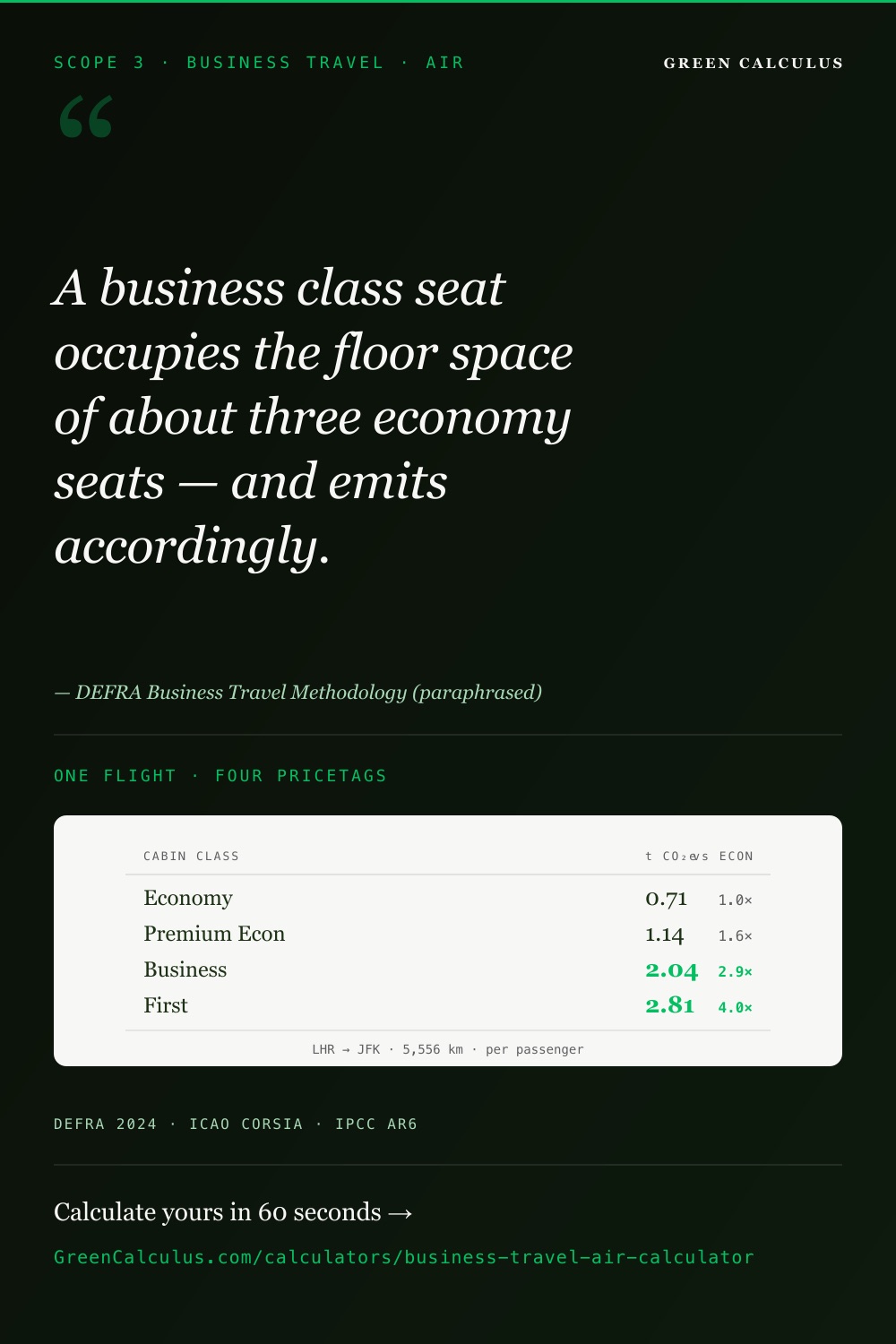
DEFRA assigns higher factors to premium cabins because they consume more floor area per passenger, distributing the aircraft’s total fuel burn across fewer seats. The multipliers below are relative to the economy factor for the same haul band, derived from the DEFRA 2026 long-haul row set:
| Cabin class | Relative to economy | Basis |
|---|---|---|
| Economy | 1.0× | Reference cabin |
| Premium economy | 1.6× | DEFRA 2026 long-haul |
| Business | 2.9× | DEFRA 2026 long-haul |
| First | 4.0× | DEFRA 2026 long-haul |
Multipliers are DEFRA’s published cabin ratios for long-haul; short-haul ratios differ and economy/business are the only classes DEFRA distinguishes on short-haul routes.
Radiative forcing
The single most common Category 6 reporting error is mixing with-RF and without-RF factors within one inventory. Choose one basis and apply it consistently. DEFRA recommends including radiative forcing for a fuller picture of aviation’s climate impact, but some disclosure frameworks expect the CO2e-only figure — confirm which your reporting obligation requires before selecting.
DEFRA 2026 passenger-km factors by haul
The headline distance-based factors below are the values the engine reads from the MasterBrain at runtime. They are reproduced here for reference, with radiative forcing included (the with_rf variant):
Domestic flights carry the highest per-km factor because take-off and climb — the most fuel-intensive phases — dominate a short total distance. Long-haul flights amortise that climb energy across thousands of cruise kilometres, lowering the per-km figure even though the absolute footprint of any single long-haul trip is far larger.
| Haul band | Economy, with RF | Unit | Source |
|---|---|---|---|
| Domestic | 0.22928 | kg CO₂e/pkm | DEFRA 2026 |
| Short-haul | 0.12786 | kg CO₂e/pkm | DEFRA 2026 |
| Long-haul | 0.15282 | kg CO₂e/pkm | DEFRA 2026 |
Average economy factors, AR5 100-year GWP basis (DEFRA convention). Premium-cabin factors are higher per the multipliers above. The full factor set, including without-RF variants and per-aircraft fuel-burn rows, is read live by the calculator.
Worked example
A return business-class trip from London to New York, one traveller, distance-based method, radiative forcing included:
Inputs
Route: LHR–JFK return. One-way GCD ≈ 5,540 km; return ≈ 11,080 passenger-km. Haul band: long-haul. Cabin: business (2.9× economy).
Formula
11,080 pkm × 0.15282 × 2.9 = 4,911 kg CO₂e
Result
Approximately 4,911 kg CO2e (4.91 tonnes) for the single return business-class trip. The same itinerary in economy returns roughly 1,694 kg CO2e.
Distance figure is illustrative GCD before the ICAO v13.1 correction; the live calculator applies the correction, so its result will differ marginally. Cabin multiplier hardcoded from the DEFRA 2026 long-haul ratio set.
DEFRA, ICAO, and IATA — which methodology applies
Three standards govern aviation accounting and they answer different questions. Most corporate Category 6 reporting uses DEFRA; the other two appear when a route-level or fuel-level result is required.
DEFRA 2026
Distance-based passenger-km factors by haul and class. The default for UK corporate Scope 3 Category 6 reporting and the primary source for this calculator. See the UK DEFRA emission factors reference.
ICAO Carbon Calculator v13.1
Route-level methodology applying great-circle correction, load factors, and per-aircraft fuel burn. Used here for the distance correction; relevant where offsetting under CORSIA is in scope.
IATA RP1726
Fuel-allocation methodology built around the jet fuel CO2 factor of 3.16 kg CO2 per kg of Jet A/A-1. Applied for fuel-based reconciliation rather than per-traveller passenger-km accounting.
For organisations also reporting upstream logistics, note that air freight is a separate calculation under Category 4, using GLEC tonne-km intensities rather than passenger factors — covered in the GLEC Framework reference and adjacent to the Scope 3 spend-based calculator for categories without activity data.
Want the full method behind this number? The methodology page walks through the distance-based, spend-based, and supplier-specific approaches, the decision framework for choosing between them, and how each holds up under Scope 3 assurance.
Frequently asked questions
DEFRA recommends including radiative forcing to reflect aviation’s full climate impact, and it is the more conservative basis. However, the decision depends on your disclosure obligation — some frameworks expect a CO2e-only figure. The critical rule is consistency: never mix with-RF and without-RF factors inside one inventory.
Employee travel on commercial flights is Scope 3 Category 6 (Business Travel). Air freight is reported separately under Category 4 (Upstream Transportation and Distribution) using tonne-km freight intensities, not passenger-km factors.
Take-off and climb are the most fuel-intensive phases of any flight. On a short domestic route they dominate a small total distance, raising the per-km figure. Long-haul flights spread that climb energy across thousands of cruise kilometres, lowering emissions per passenger-km even though the absolute trip footprint is larger.
Yes. Premium cabins occupy more aircraft floor area per passenger, so the same fuel burn is allocated across fewer seats. DEFRA publishes higher factors for premium economy, business, and first relative to economy on the same haul band.