
ISO 20121 Sustainable Events

An event is a concentrated burst of impact: a stadium fills, ten thousand people travel to one place, generators run, marquees go up, and within days it is all dismantled and gone. The carbon, the waste, the strain on a host community — those linger long after the last attendee leaves. ISO 20121 exists to make sure someone planned for that, deliberately, before the event began.
It is not a carbon standard. It is the management system that decides where the carbon work, the waste work and the social work actually happen.
ISO 20121:2024 is the international standard for event sustainability management systems. It gives organisers an Annex SL framework to manage the social, economic and environmental impacts of events of any size, and it is certifiable.
What ISO 20121 is — a management system, not a carbon standard
ISO 20121:2024 specifies the requirements for an event sustainability management system (ESMS): a structured way for any organisation involved in the design, management or delivery of events to identify, manage and continually improve the social, economic and environmental impacts of its event-related activities. It applies across the full event lifecycle — from research and concept through planning, delivery, review and post-event legacy — and scales from a community gathering to the Olympic Games.
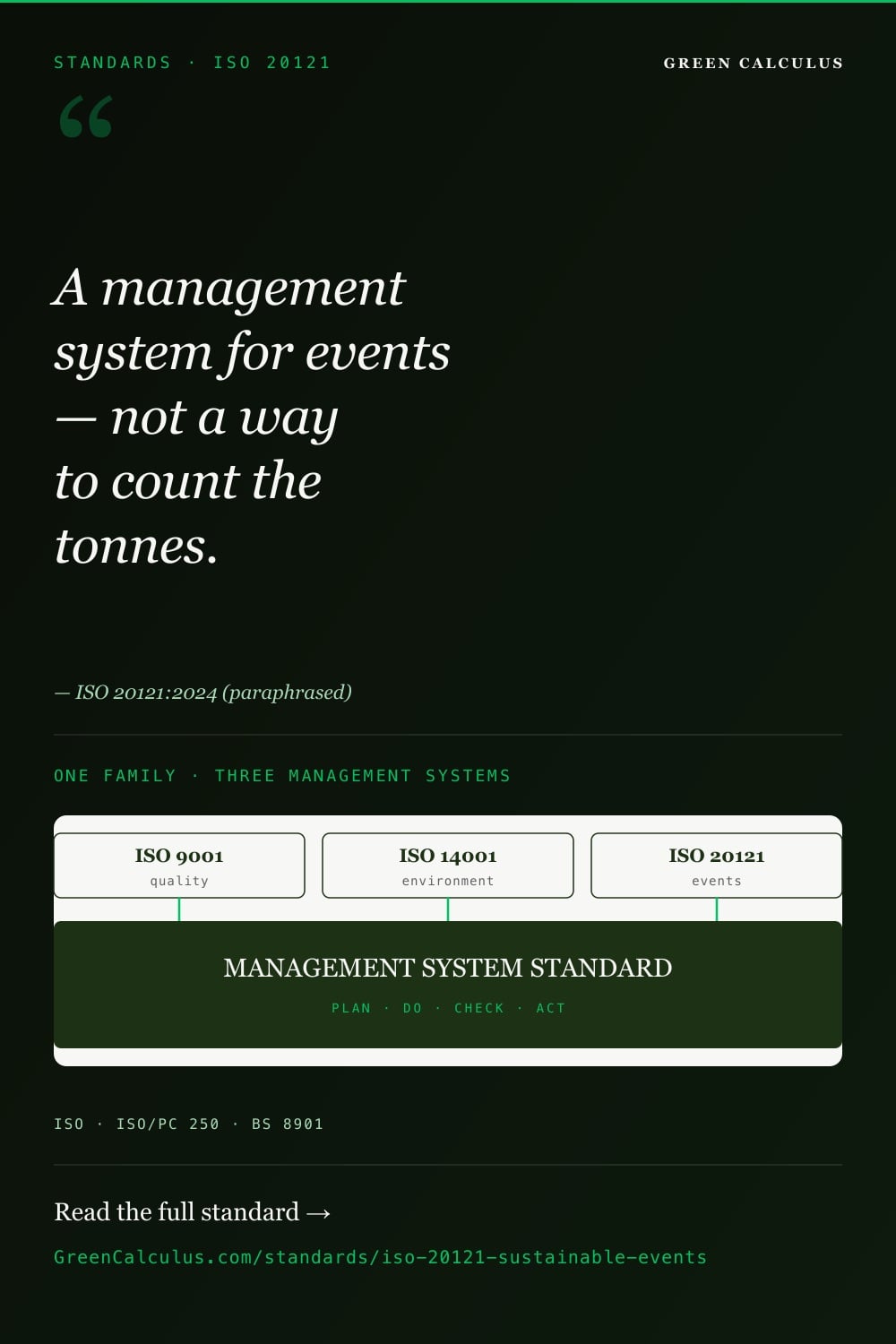
The most important thing to understand at the outset is what the standard is not. It is not a carbon footprinting methodology, it sets no emission factors, and it does not tell you how to calculate the tonnes of CO₂e your event produces. It is a management-system standard in the same family as ISO 9001 (quality) and ISO 14001 (environmental management): it requires you to put a system in place — policy, objectives, processes, monitoring, review — and to drive continual improvement through it. The actual carbon numbers come from elsewhere; ISO 20121 is the structure that makes sure they get produced, acted on, and reported.
ISO 20121 answers “does this event have a working system to manage its impacts?” — not “how many tonnes of CO₂e did it emit?“. The first is a management-system question the standard certifies; the second is a quantification question answered by a GHG Protocol or ISO 14064-1 inventory that the ESMS then consumes. Treating ISO 20121 certification as proof of a low-carbon event is a category error: it proves the process exists, not the outcome.
This is also its strength. Because sustainability is embedded as a system rather than left to one motivated individual on the event team, it survives staff turnover, scales with the event, and forces sustainability into every functional area — procurement, logistics, catering, transport, communications — rather than bolting it on at the end.
Provider directory
Now it has to hold up all year.
See who does this work. Every listing names the standards it works to, and paid placements are labelled. Including The Carbon Trust and Pangolin Associates.
Browse 6 carbon accounting & inventory providers →Do this work? A listing is US$390 a year. Get listed →
Provenance — from BS 8901 to Paris 2024
ISO 20121 has an unusually clear origin story, and it is bound to two Olympic Games. The need was first articulated by event practitioners in the mid-2000s, taken to the British Standards Institution, and published as BS 8901:2007 (revised 2009) — a UK specification for a sustainable event management system, developed in the run-up to the London 2012 Olympic and Paralympic Games. BS 8901 was adopted internationally so quickly that BSI and ABNT (the Brazilian standards body) jointly proposed an ISO version, which was published as ISO 20121:2012 in June 2012, in time to underpin the London 2012 sustainability programme.
The 2024 second edition continues the pattern: it was revised in time for the Paris 2024 Olympic and Paralympic Games, with suppliers to Paris 2024 — including small and medium enterprises — trialling the draft and contributing case studies. ISO 20121:2024 cancels and replaces the 2012 edition, which has been technically revised.
Where ISO 20121 sits in the sustainability stack
ISO 20121 sits at the framework layer. It does not produce numbers; it organises the work that produces them and the disclosures that report them. Below it are the quantification standards that supply emissions data; alongside it are the procurement and inventory standards it explicitly references; above it are the disclosure regimes that an event’s parent organisation may report into.
The practical consequence is that ISO 20121 and carbon accounting are complementary, not alternatives. An organiser certified to ISO 20121 still needs a Scope 3 inventory to know its numbers; an organiser with a perfect carbon inventory still needs a management system to act on it consistently event after event. The strongest programmes run both.
What changed in the 2024 second edition
The 2024 revision is a technical revision, not a wholesale rewrite — the management-system bones are unchanged — but it modernises the standard substantially around the ESG expectations that matured between 2012 and 2024.
| Area | What changed in 2024 |
|---|---|
| Structure | Text and clause sequence aligned to the harmonised Annex SL high-level structure (ISO/IEC Directives Part 1, 2022) shared with ISO 9001, ISO 14001, ISO 45001. |
| Climate | Explicit emphasis on climate change mitigation and adaptation, GHG reduction and carbon-removal projects, and climate resilience within issue identification. |
| Social | New, stronger focus on human and child rights (Annex D), labour standards, mental health and wellbeing, accessibility, and diversity, equity and inclusion. |
| Circularity & nature | Circular-economy principles, biodiversity preservation, and “digital responsibility” added to the list of issues to evaluate. |
| Sponsors | New requirement that promotional activities, products and services offered by sponsors align with the organisation’s or event’s sustainable development principles and values. |
| Supply chain | Clause 8.3 strengthened: suppliers must show evidence of sustainability in procurement, with explicit consideration that requirements stay manageable for small businesses (links to ISO 20400). |
| Documentation | Softened — organisations choose the most suitable way to document the system, lowering a barrier that had encouraged literal, box-ticking audits. |
| Management review | Strengthened around timing and documenting outcomes, to counter “set and forget” and keep top management engaged. |
| Legacy & conformity | Stronger treatment of event legacy (hard and soft); multiple conformity routes made explicit to widen access for SMEs. |
The 2024 edition deliberately lets an organisation choose how to document its system rather than prescribing forms. This removes a long-standing barrier where auditors assessed the standard “in literal translation” — counting documents — rather than judging whether the event organiser actually operated sustainably. The system now only needs to be as complex as the event itself, which is what makes ISO 20121 workable for a one-day community event as well as a mega-event.
The ten-clause structure, clause by clause
Like every modern ISO management-system standard, ISO 20121:2024 follows the Annex SL high-level structure. Clauses 1–3 are scope, references and terms; the requirements that an organisation is audited against live in clauses 4 to 10. Mapping them to the event context is the core of implementation.
| Clause | Annex SL theme | What it requires of an event organiser |
|---|---|---|
| 4 | Context of the organisation | Determine internal and external issues, understand interested parties (attendees, sponsors, suppliers, host community, authorities), and set the ESMS scope. The 2024 edition adds the “outside-in” view — sustainability-related risks and opportunities to the organisation. |
| 5 | Leadership | Top-management commitment; a sustainability policy; and integration of the four governing principles — stewardship, inclusion, integrity and transparency — into the mission and roles. |
| 6 | Planning | Identify and evaluate the significance of sustainability issues across environmental, social and economic pillars (Clause 6.1.2); address risks and opportunities; set measurable event sustainability objectives. |
| 7 | Support | Resources, competence, awareness, communication, and documented information — now with the freedom to document in whatever form suits the event. |
| 8 | Operation | Operational planning and control across the event lifecycle, including the strengthened supply-chain and procurement requirements (Clause 8.3) and the sponsor-alignment requirement. |
| 9 | Performance evaluation | Monitor, measure, analyse and evaluate (9.1–9.2); internal audit; and a strengthened management review with documented outcomes and timing. |
| 10 | Improvement | Nonconformity and corrective action, and continual improvement of the ESMS — the engine that turns one event’s lessons into the next event’s plan. |
The two clauses event teams most often underestimate are Clause 6.1.2 — issue identification and evaluation, where the real materiality work happens — and Clause 8.3, supply chain, where most of an event’s impact actually sits but the organiser has the least direct control. Both are expanded below.
The PDCA cycle applied to an event lifecycle
Under the structure sits the Plan-Do-Check-Act cycle that drives every management-system standard. For events, PDCA maps neatly onto the lifecycle from concept to legacy — and crucially, it loops, so each event feeds the next.
Plan
Set the sustainability policy and objectives; identify and evaluate the material environmental, social and economic issues for this specific event; assign roles and resources. Clauses 4, 5, 6 and 7.
Do
Deliver the event under operational control — procurement, logistics, energy, catering, transport, waste — with suppliers held to the defined sustainability requirements. Clause 8.
Check
Monitor and measure performance against objectives and KPIs (waste diversion, energy use, emissions per attendee, accessibility); run internal audit and management review. Clause 9.
Act
Correct nonconformities and feed lessons learned into the next event’s plan, closing the loop on continual improvement. Clause 10.
Events are inherently repeatable in structure even when each instance is unique. A festival, a conference series, or a touring production runs the same lifecycle every cycle. PDCA exploits that: the “Act” phase of one event becomes the “Plan” phase of the next, so an ESMS compounds — the second year’s plan is built on the first year’s measured results rather than starting from intentions again.
Three ways to demonstrate conformity
One of the 2024 edition’s most practically significant features is that it makes explicit three different routes to demonstrate conformity, so that organisations — especially SMEs for whom third-party certification can be costly — are not shut out.
The organisation assesses its own ESMS against the standard and declares conformity (first-party). Lowest cost and barrier; appropriate for smaller events and for organisations building maturity before seeking external validation. Carries the least external assurance weight.
A customer, client or other interested party validates the organisation’s conformity (second-party). Common where a major client requires its event suppliers to demonstrate an ESMS without mandating full certification.
An accredited independent certification body audits the ESMS and issues a certificate (third-party). The highest-assurance route, expected for mega-events and where stakeholders, regulators or sponsors require independent proof.
Whichever route is used, conformity demonstrates that a functioning event sustainability management system exists and is being improved — it does not certify a specific emissions figure, a waste-diversion rate, or any particular outcome. A certified organiser can still run a high-carbon event; what certification guarantees is that the impacts were identified, managed and reviewed through a system. Marketing that conflates ISO 20121 certification with a “carbon-neutral” or “low-impact” claim is misleading and a common source of greenwashing risk.
Where carbon accounting plugs into the ESMS
This is where ISO 20121 meets GreenCalculus’s core discipline. The standard requires an organiser to identify and manage environmental impacts — including emissions and climate change — but leaves the quantification to dedicated carbon-accounting standards. The ESMS is the demand side; the GHG inventory is the supply side. The integration points are specific.
| ESMS clause / activity | Carbon-accounting input it needs | Where the number comes from |
|---|---|---|
| 6.1.2 — Issue identification | A screening of which emission sources are material for this event | A Scope 3 materiality screen across travel, energy, freight, catering, waste |
| 6.2 — Objectives & KPIs | A baseline footprint and an intensity metric (e.g. tCO₂e per attendee) | A GHG Protocol / ISO 14064-1 event inventory |
| 8 — Operation (attendee travel) | Emissions from spectator and participant travel — usually the largest source | The business-travel air calculator and surface-travel factors |
| 8 — Operation (venue energy) | Scope 2 electricity and Scope 1 generator fuel | Grid factors and combustion factors via the relevant calculators |
| 8 — Operation (waste & catering) | Waste-by-route and food/catering emissions | The waste-by-route calculator and catering factors |
| 9.1 — Monitoring | Actual measured emissions to evaluate against objectives | The same inventory, re-run on actuals after the event |
For most events, attendee and participant travel dwarfs every other source — frequently the majority of the total footprint, and overwhelmingly a Scope 3 category outside the organiser’s direct control. An ESMS that sets objectives without a travel inventory is optimising the wrong things: energy and waste are visible and satisfying to reduce, but the leverage is in audience-travel mode shift, venue location, and hybrid/digital participation. The carbon inventory is what tells the management system where to aim.
Issue identification — the three impact pillars
Clause 6.1.2 requires the organisation to establish a process for identifying its sustainable development issues and evaluating their significance for its event-related activities. The 2024 edition modernises and expands the list of issues to consider across the three pillars of sustainability.
- Resource use, materials choice and circularity
- Resource conservation and emissions reduction
- Climate change — mitigation, adaptation, resilience
- Biodiversity preservation
- Releases to land, water and air
- Digital responsibility
- Human and child rights; labour standards
- Health, safety, mental health and wellbeing
- Civil liberties and social justice
- Local community and indigenous peoples’ rights
- Culture, religion and accessibility
- Diversity, equity and inclusion; digital responsibility
- Local economy, market presence and capacity
- Employment and skills
- Shareholder value and return on investment
- Innovation
- Direct and indirect economic impact
- Economic risk and resilience
The honest reading of this list is that carbon is one issue among many, and ISO 20121 is deliberately broader than climate. An event team coming from a carbon-only mindset will under-weight the social pillar — rights, accessibility, community — which the 2024 edition pushes hardest. The evaluation step decides which of these are significant for a given event; that significance assessment, not a generic checklist, is what an auditor scrutinises.
Supply chain and procurement (Clause 8.3)
Most of an event’s impact is delivered through its supply chain — stages, catering, AV, freight, accommodation, energy — and Clause 8.3 is where the 2024 edition tightened the screws. The organiser must identify its suppliers, define sustainability requirements based on the event’s objectives and principles, and develop processes to evaluate and assess suppliers against those requirements. The new edition adds a requirement to ask suppliers to show evidence of sustainability in their procurement processes — with an explicit balancing requirement that the demands stay manageable for small businesses.
For carbon specifically, the supply chain is where Scope 3 emissions are won or lost. The Clause 8.3 supplier requirements are the mechanism through which an event’s ESMS reaches into supplier emissions data — making procurement, not energy metering, the highest-leverage carbon control an organiser holds.
The annexes — maturity, reporting and rights
The normative requirements are in clauses 4–10, but a great deal of the standard’s practical value is in its informative annexes. They are guidance, not auditable requirements, but they are where the standard becomes usable.
| Annex | Provides |
|---|---|
| Annex A | General implementation guidance, including the list of interested parties (A.1), the governing principles of sustainable management (A.2), and the maturity matrix (A.5) for assessing how embedded the system is. |
| Annex B | Supply-chain management guidance, cross-referencing ISO 20400 sustainable procurement for supplier evaluation. |
| Annex C | Guidance on reporting — how to communicate sustainability performance to interested parties credibly. |
| Annex D | Guidance on human and child rights — new emphasis in the 2024 edition, reflecting the social-pillar strengthening. |
Legacy and the maturity matrix
Two ideas distinguish ISO 20121 from a generic environmental management system: legacy and maturity. The 2024 edition strengthens both.
Legacy is the planned and unplanned result of hosting an event on interested parties. Hard legacy is material — infrastructure, facilities. Soft legacy is non-material — new knowledge, training, standards, skills, relationships, partnerships and innovations created as a consequence of the event. The standard asks organisers to consider legacy in issue identification, and it grows in relevance with event size.
The maturity matrix lets an organisation assess how deeply the ESMS is embedded — from a system that exists on paper to one woven through every functional area and decision point. It reframes ISO 20121 as a journey rather than a pass/fail gate, and gives smaller organisers a path to build capability over successive events rather than all at once.
Implementation roadmap
Implementing an ESMS is a sequence, not a single project. A workable path moves from baseline to system to delivery to review.
Run a sustainability baseline, identify material issues across the three pillars, and define the ESMS scope and boundaries (Clauses 4, 6.1.2).
Secure top-management commitment, publish a policy embedding the four governing principles, and set measurable objectives and KPIs — including a carbon baseline (Clauses 5, 6.2).
Deliver under operational control; hold suppliers to defined requirements and align sponsors to the event’s values (Clause 8, incl. 8.3).
Measure against objectives, run internal audit and management review, choose a conformity route, and feed lessons into the next cycle (Clauses 9, 10).
The discipline that makes this stick is treating the carbon inventory as a recurring input, not a one-off report. The baseline footprint sets the objectives; the post-event actuals close the loop in performance evaluation; and the gap between them drives the corrective actions that improvement (Clause 10) demands.
ESMS readiness checklist
This checklist covers the gaps between an intention to “run a greener event” and a defensible ISO 20121 management system. Tick what is already in place; the panel summarises where the system stands.
Common implementation errors
Frequently asked questions
ISO 20121:2024 is the international standard for event sustainability management systems. It gives any organisation involved in designing, managing or delivering events — organisers, venues, production companies, suppliers, promoters, public bodies — a structured framework to manage the social, economic and environmental impacts of events across their full lifecycle. It is scalable, applying equally to a community gathering and to a mega-event such as the Olympic Games, and the system only needs to be as complex as the event itself.
No. ISO 20121 is a management-system standard, not a carbon quantification methodology — it sets no emission factors and prescribes no calculation method. It requires you to identify and manage environmental impacts, including emissions and climate change, but the actual footprint is calculated using dedicated standards such as the GHG Protocol or ISO 14064-1. The ESMS commissions, consumes and acts on that inventory; it does not produce it. Certification proves the management system exists, not that the event achieved a particular emissions figure.
The 2024 second edition is a technical revision that keeps the management-system structure but modernises the content. It aligns the text to the harmonised Annex SL high-level structure shared with ISO 9001 and ISO 14001; strengthens climate, circular-economy, biodiversity and digital-responsibility content; adds a strong human and child rights focus (Annex D); expands stakeholder engagement to include sponsors, whose promotion must now align with the event’s values; tightens supply-chain and procurement requirements (Clause 8.3) while keeping them manageable for SMEs; softens documentation requirements; strengthens management review; and makes multiple conformity routes explicit.
No. ISO 20121 is a voluntary standard and there is no legal requirement to certify to it. It is, however, certifiable, and the 2024 edition offers three explicit conformity routes: self-declaration (first-party), supplier or second-party validation, and accredited third-party certification. The flexibility is deliberate, so that smaller organisations for whom full certification is costly can still demonstrate conformity at a level appropriate to their event.
They are complementary layers. ISO 20121 is the framework that decides which impacts matter, sets objectives, and drives improvement; the GHG Protocol and ISO 14064-1 are the quantification standards that calculate the event’s Scope 1, 2 and 3 emissions. In practice the ESMS uses a carbon inventory at three points: to screen which emission sources are material (Clause 6.1.2), to set a baseline and intensity KPIs such as tCO₂e per attendee (Clause 6.2), and to measure post-event actuals against those objectives (Clause 9.1). The strongest event programmes run the management system and the carbon inventory together.
For most events, attendee and participant travel is by far the largest source and frequently the majority of the total footprint — a Scope 3 category largely outside the organiser’s direct control. Energy and waste are more visible and easier to reduce, but the real leverage usually lies in audience travel: encouraging public transport and rail over car and air, choosing accessible venue locations, and offering hybrid or digital participation. This is why an ISO 20121 programme should set its objectives from a travel-inclusive carbon inventory rather than from the impacts that are simplest to see.
Legacy is the planned and unplanned result of hosting an event on its interested parties. Hard legacy is material — physical infrastructure, facilities and assets that remain after the event. Soft legacy is non-material — the new knowledge, training, skills, best practices, relationships, partnerships and innovations created as a consequence of the event. ISO 20121 asks organisers to consider both in issue identification, and legacy tends to grow in relevance with event size, which is why it features so heavily in mega-event applications of the standard.
Two. The standard’s origin lies in BS 8901, the British standard developed ahead of the London 2012 Olympic and Paralympic Games, which became ISO 20121:2012 in time to underpin London 2012’s sustainability programme. The 2024 second edition was then revised in time for the Paris 2024 Olympic and Paralympic Games, with Paris 2024 suppliers — including SMEs — trialling the draft. The standard’s two editions are effectively bookended by these two Games.
Give your event sustainability management system real numbers.
GreenCalculus calculators quantify the travel, energy, waste and catering emissions an ISO 20121 ESMS needs for its baseline, objectives and post-event evaluation — with the factor provenance an auditor expects.