
Fuel, Distance and Energy Conversion — Methodology and Calculation Approach

Citation-grade reference for converting between the three interchangeable representations of a fuel event — volume or mass, energy content, and distance travelled — and the CO₂e that follows. Defines the physical links that connect them (density, calorific value and fuel economy), isolates the gross-versus-net calorific value trap that swings energy totals by roughly a tenth and the gallon and factor-basis traps that can distort a footprint by a fifth, works three audit-record examples, and fixes the provenance discipline that keeps a conversion chain reconcilable. Emission factors and fuel properties resolve live from the GreenCalculus MasterBrain; pure unit conversions are hardcoded as exact definitional constants.
The Conversion Triangle
⚐ The central tension this page resolves
A single physical quantity of fuel wears three interchangeable numeric faces — a volume or mass (litres, tonnes), an energy content (kWh, GJ), and, once burned in a vehicle, a distance (kilometres, miles) — and each converts to the others through a physical property. The emissions follow from whichever face you start with, via the matching emission factor. The danger is that the same fuel gives different numbers depending on which basis you use, and mixing bases silently corrupts the result. The same litre of diesel is 0.8375 kg, about 10.96 kWh of usable energy, and roughly 2.58 kgCO₂e — but only if you pick net calorific value, not gross, and only if you pair a per-litre factor with a volume, not with an energy figure. Choose gross calorific value where net is required and the energy total is off by a tenth; read a US “40 mpg” as if it were a UK one and the per-kilometre figure is off by a fifth. This page maps the conversion triangle, names each trap with its magnitude, and enforces the provenance discipline that keeps a fuel-distance-energy chain auditable end to end.
Figure 1.1 — The conversion triangle: three faces of one fuel event, one emissions output
Volume / mass
litres, m³, tonnes
what you buy and meter
Energy
kWh, MJ, GJ
usable heat content
Distance
km, miles
vehicle output
volume ↔ mass via density · volume/mass ↔ energy via calorific value · distance ↔ fuel via fuel economy
Emissions output
CO₂e = (any face) × matching emission factor — per-litre, per-tonne, or per-kWh. Pair the factor basis to the activity basis.
Every fuel calculation is a walk around this triangle. A fleet manager starts with litres purchased; an energy manager starts with metered kWh; a vehicle analyst starts with distance and fuel economy. All three arrive at the same physical fuel and the same emissions — provided the conversions between the faces use the right physical property and the emission factor is drawn on the matching basis. The rest of this page defines the links, isolates the three basis traps, and works the chains end to end.
The Physical Links: Density, Calorific Value, Fuel Economy
Named concept · Citable definition
The three conversion properties
The three faces of a fuel event are connected by three physical properties. Density (kg per litre) converts volume to mass. Calorific value (kWh or MJ per litre or per kg) converts volume or mass to energy content — and comes in two forms, gross and net, that differ by roughly a tenth. Fuel economy (litres per 100 km, or miles per gallon) converts distance travelled to fuel consumed. Density and calorific value are fuel properties that resolve live from the DEFRA dataset; fuel economy is a vehicle property supplied by the analyst. Getting any of the three wrong propagates directly into the emissions total.
Density — volume ↔ mass
Density converts between the volume a fuel occupies and the mass it carries: mass = volume × density. Diesel is about 0.8375 kg per litre, petrol about 0.7475, so a litre of diesel weighs more and carries more energy than a litre of petrol. Density matters wherever an emission factor is published on a mass basis (per tonne) but the fuel is metered by volume, or vice versa — coal and petroleum coke factors are per tonne, liquid road fuels per litre, and converting between them requires the density. The [gc_fuel] shortcode exposes density directly via its density_kg_litre field, so the value resolves live and stays current with each DEFRA release.
Calorific value — volume/mass ↔ energy
Calorific value (also heating value) converts a quantity of fuel to its usable energy content: energy = volume × calorific value. It is the property that lets a litre of diesel be expressed as roughly 10.96 kWh, or a cubic metre of natural gas as its kWh equivalent. Calorific value is why the same fuel can be reported on a volume basis or an energy basis and reconcile — and it is the site of the single most consequential trap on this page, because it comes in two forms that differ materially. The [gc_fuel] shortcode exposes it via cv_kwh_litre, and the emission factor itself is published on both a volume basis (per_litre) and two energy bases (per_kwh_gcv, per_kwh_ncv) so the analyst can work from whichever face the activity data uses.
Fuel economy — distance ↔ fuel
Fuel economy converts distance travelled to fuel consumed: fuel = distance × consumption rate. It is expressed as litres per 100 km (the SI-adjacent convention) or miles per gallon (the imperial and US convention), and unlike density and calorific value it is a property of the vehicle, not the fuel — so it is supplied by the analyst, not looked up in the fuel dataset. Fuel economy is the bridge that lets a distance-based activity figure (odometer readings, telematics) become a fuel quantity and then an emissions figure, and it carries the second major trap of this page: mpg is ambiguous between US and imperial gallons. For a more direct distance-to-emissions route that skips the fuel-quantity step, the per-kilometre vehicle factors used in business-travel car accounting and fleet emissions apply the fuel economy and factor in one combined coefficient.
Gross vs Net Calorific Value
Named concept · Citable definition
The gross/net calorific value distinction
Calorific value is published two ways. Gross calorific value (GCV, or higher heating value) counts the energy recovered if the water vapour produced by combustion is condensed back to liquid; net calorific value (NCV, or lower heating value) does not, because most equipment vents that vapour as hot exhaust. NCV is lower than GCV by roughly 10% for gaseous fuels and 5–7% for liquid fuels. The two are not interchangeable: an energy figure, a calorific value, and an emission factor must all be on the same basis, or the emissions total is wrong by the gross-net gap.
The distinction matters because emission factors and energy figures both come in gross and net flavours, and combining a gross energy figure with a net factor (or the reverse) introduces a silent error of several percent. DEFRA publishes UK natural gas and grid-gas figures on the gross basis by convention, while IPCC and much international energy accounting use net; the [gc_fuel] factor exposes both energy-basis factors (per_kwh_gcv and per_kwh_ncv) precisely so the analyst can match the basis of their metered energy data. The rule is simple and absolute: identify whether the energy figure is gross or net, then use the calorific value and the emission factor on the same basis. The volume-basis route (per-litre, per-tonne) sidesteps the question entirely, which is one reason it is the safer default when the fuel is metered by volume.
| Fuel | Net CV (approx) | Gross CV (approx) | Net/gross gap | Emission-factor bases available |
|---|---|---|---|---|
| Natural gas | ~9.8 kWh/m³ | ~10.9 kWh/m³ | ~10% | per_kwh_gcv · per_kwh_ncv (live) |
| Diesel | ~10.96 kWh/L | ~11.75 kWh/L | ~7% | per_litre · per_kwh_gcv · per_kwh_ncv (live) |
| Petrol | ~9.6 kWh/L | ~10.3 kWh/L | ~7% | per_litre · per_kwh_gcv · per_kwh_ncv (live) |
| LPG | ~6.6 kWh/L | ~7.1 kWh/L | ~7% | per_litre · per_kwh_gcv · per_kwh_ncv (live) |
The calorific values in the table are indicative and rounded for illustration; the authoritative current values resolve live through the [gc_fuel] cv_kwh_litre field and the two energy-basis factor fields. The point of the table is the gap column: for gaseous fuels the gross-net gap is around a tenth, large enough that a basis mismatch is a material error rather than a rounding nuance.
The Unit Traps: Gallons, Miles, and Energy Units
Beyond the gross-net distinction, three unit ambiguities routinely corrupt fuel conversions. Two are pure-definition traps (gallons and energy units) that carry exact answers once the definition is fixed; the third is a factor-basis pairing error. Unlike fuel properties, the definitional conversions never change — they are fixed by the SI and imperial systems — so this page hardcodes them as exact constants rather than resolving them from a dataset.
US vs imperial gallon (and mpg)
The gallon is not one unit. A US gallon is 3.78541 litres; an imperial (UK) gallon is 4.54609 litres — about 20% larger. Because miles-per-gallon divides distance by gallons, a US mpg and a UK mpg for the identical vehicle are different numbers, and a fuel economy quoted in “mpg” without its gallon is ambiguous by 20%. This is the most common cross-border fuel-conversion error: a US-sourced “40 mpg” figure read as a UK one, or vice versa, distorts the resulting per-kilometre emissions by a fifth. Example C works both readings of the same “40 mpg” to show the gap explicitly. The safe practice is to convert fuel economy to litres per 100 km — an unambiguous SI-adjacent unit — before any emissions calculation.
Distance and energy unit definitions
Distance and energy carry their own definitional conversions, all exact: one mile is 1.60934 kilometres; one kilowatt-hour is exactly 3.6 megajoules; one gigajoule is 277.778 kilowatt-hours. These are fixed constants, not measured data, so they never drift and are hardcoded with their definitions. The only error they produce is arithmetic — dropping a factor of 1,000 between kWh and MWh, or between MJ and GJ — which is why a conversion chain should carry its units through every step rather than tracking bare numbers.
Volume-basis vs energy-basis emission factors
The third trap is a pairing error rather than a definition. Every fuel emission factor is published on multiple bases — per litre, per tonne, per kWh gross, per kWh net — and the factor must match the basis of the activity data. Multiplying litres of diesel by a per-kWh factor, or metered kWh by a per-litre factor, produces a number that is wrong by the calorific value. The pairing rule is mechanical: volume activity data takes a per-volume factor, mass data takes a per-mass factor, energy data takes a per-energy factor on the matching gross/net basis. The [gc_fuel] shortcode carries all bases for exactly this reason, and the correct discipline is to read the factor field that matches the activity unit rather than converting the activity to fit a single factor.
The Conversion and Emissions Calculation
The conversions are a chain of multiplications, each applying one physical property, terminating in the emissions factor on the matching basis.
The chains compose: distance becomes fuel via economy, fuel becomes energy via calorific value, and any face becomes emissions via the matching factor. Because each link is a documented physical property, a conversion chain is fully auditable — a reviewer can reconstruct the emissions from the activity data and the stated properties. That auditability is the whole value of doing the conversion transparently rather than reaching for a single opaque per-kilometre coefficient, and it is why every worked example below states its density, calorific value and factor basis explicitly.
Worked Examples — Audit Records
Three audit-record snapshots. Emission factors and fuel properties are cross-checked against the live [gc_fuel] values at this page’s review date; unit-conversion constants are the exact definitional values. All inputs are stated so each example reconciles independently.
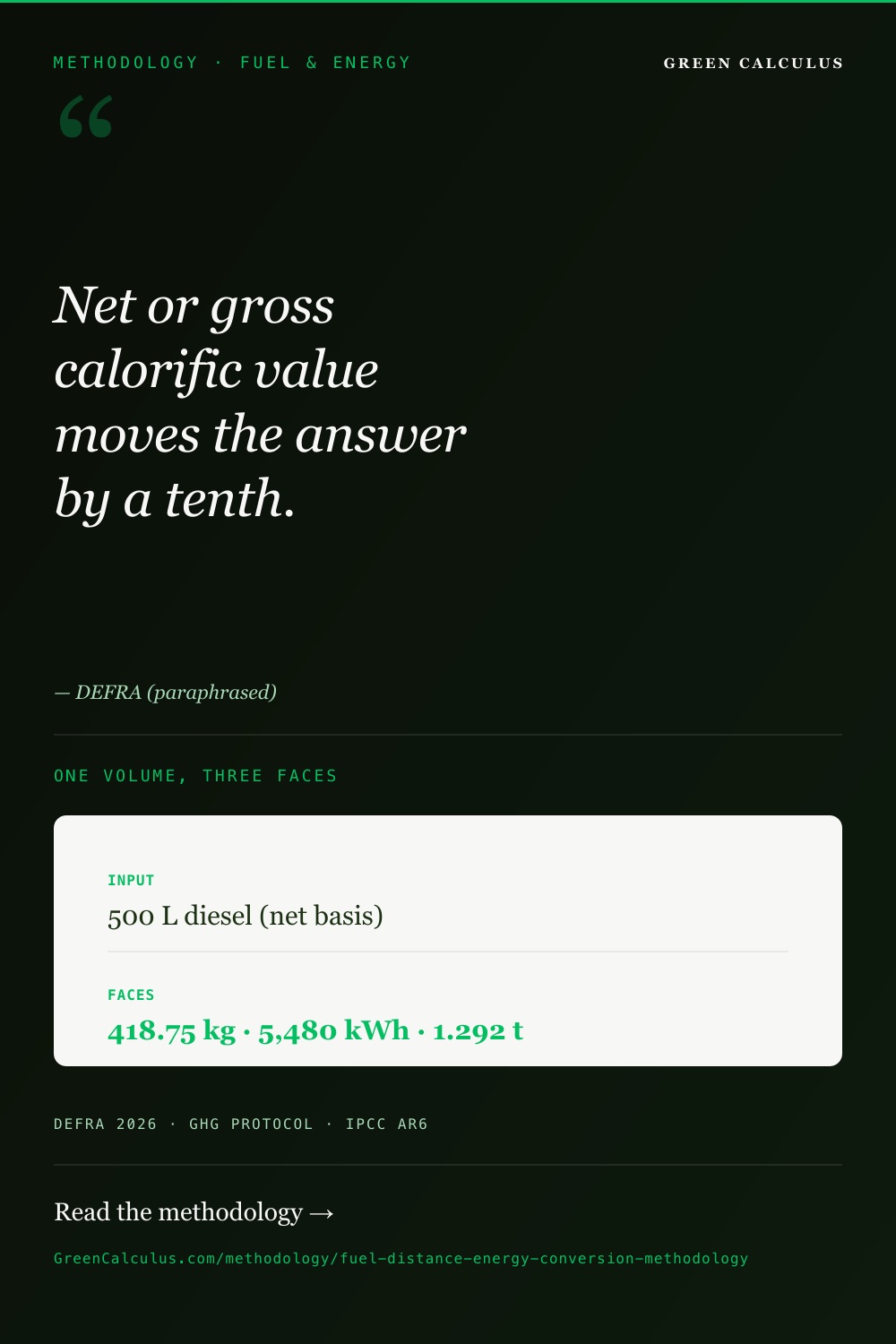
Fuel purchased: 500 litres diesel (average biofuel blend)
Density: 0.8375 kg/L (DEFRA fuel properties, [gc_fuel field=”density_kg_litre”])
Net calorific value: 10.96 kWh/L (DEFRA, net basis)
Emission factor: 2.58354 kgCO₂e/L (DEFRA 2026, AR5, matches 2.58354) The base case — one volume figure expressed as all three faces plus emissions, each via its property.
Distance: 10,000 km (odometer)
Fuel economy: 7.0 L/100 km diesel (resolved to L/100 km — no gallon ambiguity)
Emission factor: 2.58354 kgCO₂e/L (DEFRA 2026, matches 2.58354) The distance route — economy converts distance to fuel, then the factor converts fuel to emissions.
Fuel economy: 40 mpg (petrol) — gallon unspecified
Imperial gallon: 4.54609 L (exact) · US gallon: 3.78541 L (exact)
Mile: 1.60934 km (exact)
Emission factor: 2.075 kgCO₂e/L petrol (DEFRA 2026, matches 2.075) The failure case. An unlabelled mpg yields two different per-km figures — a 20% spread from the gallon alone.
Sensitivity: Which Basis Choice Moves the Number Most
The conversion traps differ in magnitude, and ranking them tells the analyst where to concentrate care. The table shows the error introduced by each basis mistake, referenced to a correct baseline.
| Basis mistake | Correct | Mistaken | Error | Where it bites |
|---|---|---|---|---|
| US mpg read as imperial (or reverse) | correct gallon | wrong gallon | ±20% | Cross-border fleet / vehicle-spec data |
| Gross CV used where net required (gas) | net basis | gross basis | ~10% | Gaseous-fuel energy totals |
| Gross/net mismatch (liquid fuels) | matched basis | crossed basis | ~7% | Energy-basis liquid-fuel totals |
| Diesel vs petrol density confusion | 0.8375 (diesel) | 0.7475 (petrol) | ~11% | Volume ↔ mass conversions |
| Factor-basis mismatch (per-litre vs per-kWh) | matched | crossed | order-of-magnitude | Any face-to-emissions step |
Two points. First, the factor-basis mismatch (last row) is not a percentage error but an order-of-magnitude one — multiplying litres by a per-kWh factor produces a nonsensical result off by roughly the calorific value, so it is usually caught by a sanity check, unlike the subtler gallon and gross-net errors that produce plausible-looking wrong numbers. Second, the gallon trap tops the percentage ranking at ±20%, which is why it earns its own worked example: it is both the largest common error and the easiest to make silently, because an mpg figure looks complete even when its gallon is unstated.
Conversion Reference
The constants and properties used across the page, with their render basis. Fuel emission factors and physical properties resolve live from the MasterBrain and re-baseline with each DEFRA release. Pure unit conversions are exact definitional constants — fixed by the SI and imperial systems, never drifting — and are hardcoded as such; they are not a data gap.
| Quantity | Value | Converts | Render |
|---|---|---|---|
| US gallon | 3.78541 L | gallon → litre (US) | ◆ exact definition |
| Imperial gallon | 4.54609 L | gallon → litre (UK) | ◆ exact definition |
| Mile | 1.60934 km | mile → km | ◆ exact definition |
| Kilowatt-hour | 3.6 MJ | kWh → MJ | ◆ exact definition |
| Gigajoule | 277.778 kWh | GJ → kWh | ◆ exact definition |
| Diesel density | ~0.8375 kg/L | volume → mass | ● live [gc_fuel density_kg_litre] |
| Diesel net CV | ~10.96 kWh/L | volume → energy (net) | ● live [gc_fuel cv_kwh_litre] |
| Diesel emission factor | 2.58354 kgCO₂e/L | volume → CO₂e | ● live 2.58354 |
| Petrol emission factor | 2.075 kgCO₂e/L | volume → CO₂e | ● live 2.075 |
| Natural gas emission factor | 0.18231 kgCO₂e/kWh | energy (gross) → CO₂e | ● live 2.02633 |
The two render bases are not interchangeable in maintenance terms: the definitional constants are cited to the SI and imperial standards and never need updating, while the live fuel properties and factors flush automatically on each MasterBrain release. Presenting them together, clearly labelled, is what lets a reader know which numbers to trust as permanent and which to re-verify against the current dataset.
Governance: Every Conversion Carries a Basis
Named concept · Citable definition
The basis-provenance rule
A fuel conversion is only auditable if every step declares its basis: the gross or net flavour of any calorific value and energy figure, the US or imperial flavour of any gallon or mpg, the unit of every activity figure, and the matching basis of every emission factor. A conversion chain that reaches an emissions total without stating these cannot be verified and cannot be reproduced — and because the errors they hide (gross-net, gallon, factor-basis) produce plausible-looking wrong numbers, an unstated basis is not a cosmetic omission but a defect.
The discipline is procedural, not calculative, and it is what separates a defensible fuel inventory from an unreproducible one. Two provenance notes recur. First, the DEFRA emission factors this page draws on are published on the IPCC AR5 GWP-100 basis by DEFRA convention — that is part of their definition, and they should not be mixed with AR6-basis totals within a single inventory, nor “corrected” to AR6. Second, the CO₂e itself is formed from the underlying gases via their global warming potentials, defined in the global warming potential glossary and the IPCC AR6 GWP dataset; the fuel factors already embed this conversion at AR5, so the analyst applying a per-litre diesel factor does not re-apply a GWP. The converted quantities feed directly into the diesel, natural gas and LPG combustion methodologies as Scope 1 activity, and the upstream fuel supply is handled separately in the well-to-tank methodology — keeping combustion and upstream on their own factors, never double-counted.
Failure Modes
Five recurring ways a fuel-distance-energy conversion goes wrong, each with the signature that lets a reviewer detect it.
[gc_fuel], not a generic constant.Implementation Workflow
- 01Identify the starting face. Volume, mass, energy or distance — the form the activity data actually arrives in (litres purchased, kWh metered, km driven).
- 02Resolve every ambiguous unit. Convert mpg to litres per 100 km stating the gallon; label every energy figure gross or net; carry units through each step.
- 03Source fuel properties live. Read density (
density_kg_litre) and calorific value (cv_kwh_litre) for the specific fuel via[gc_fuel]; use exact definitional constants for pure unit conversions. - 04Convert to the emissions face. Apply the physical properties in a documented chain, keeping every intermediate value and its unit.
- 05Apply the matching factor. Multiply by the emission factor on the basis that matches the activity unit — per-litre for volume, per-tonne for mass, per-kWh (gross or net) for energy. Never cross bases.
- 06Record the provenance. Document every basis (gross/net, US/imperial, factor basis, AR5 GWP) so the chain reconciles and a reviewer can reproduce it.
Converting fuel for a fleet or combustion inventory? The converted quantities feed the diesel and natural gas combustion methodologies, and the DEFRA emission factor dataset supplies the underlying factors and properties.
Standards Alignment
| Standard | Role for fuel-distance-energy conversion |
|---|---|
| UK DEFRA 2025 | Source of the fuel emission factors (per-litre, per-tonne, per-kWh gross/net), densities and calorific values that drive every conversion. AR5 GWP-100 basis. |
| IPCC AR6 | The GWP-100 values behind the CO₂e conversion, and the gross/net calorific-value conventions the international energy accounting community follows. |
| GHG Protocol Corporate Standard | Defines the Scope 1 combustion boundary the converted fuel quantities feed, and the requirement for transparent, reproducible calculation methods. |
Methodology Metadata — for GHG Inventory Documentation
Copy into the methodology notes accompanying a fuel conversion. Adjust the fuel, basis and unit lines to match the conversion performed.
[gc_fuel field="density_kg_litre"], calorific value [gc_fuel field="cv_kwh_litre"] (live, DEFRA). CV basis: [gross | net] stated. Diesel ~0.8375 kg/L, ~10.96 kWh/L net at review date.
2.58354, per-kWh gross/net per_kwh_gcv/per_kwh_ncv, per-tonne per_tonne (live, DEFRA 2026, AR5 GWP-100). Factor basis matched to activity unit.
Frequently Asked Questions
Two separate conversions, each via its own property. For energy, multiply litres by the calorific value: a litre of diesel is about 10.96 kWh on the net basis, so 500 litres is about 5,480 kWh (19.73 GJ) — but state whether you are using net or gross calorific value, because gross is about 7% higher for diesel. For emissions, multiply litres by the per-litre emission factor: at 2.58354 kgCO₂e/L, 500 litres is 1,291.8 kgCO₂e (Example A). The two conversions are independent — you do not go through kWh to reach CO₂e when you have a per-litre factor. Use the calorific value only if you actually need the energy figure, or if your emission factor is on a per-kWh basis, in which case match the gross/net flavour.
Gross calorific value (higher heating value) counts the energy recovered if the water vapour from combustion is condensed; net calorific value (lower heating value) does not, because most equipment vents that vapour. Net is lower — about 10% lower for gaseous fuels, 5–7% for liquids. Which to use depends on your data and factor: the rule is that the energy figure, the calorific value and the emission factor must all be on the same basis. DEFRA publishes UK gas on the gross basis; IPCC and much international accounting use net. The [gc_fuel] factor carries both energy-basis factors (per_kwh_gcv and per_kwh_ncv) so you can match. If your fuel is metered by volume, the per-litre route sidesteps the question entirely and is the safer default.
Because a US gallon (3.78541 L) and an imperial gallon (4.54609 L) are different volumes, about 20% apart. Miles per gallon divides distance by gallons, so “40 miles per US gallon” and “40 miles per imperial gallon” describe different fuel consumption — the imperial figure uses more fuel per mile because the gallon is bigger. In Example C the same “40 mpg” gives 182.5 gCO₂e/km read as imperial and 151.9 read as US, a 20% spread from the gallon alone. An mpg quoted without stating its gallon is unusable for emissions accounting, and cross-border datasets that mix the two silently bias every affected vehicle. Always convert mpg to litres per 100 km, stating the gallon, before calculating.
Two categories, and the distinction matters for maintenance. Fuel properties and emission factors — density, calorific value, and the per-litre/per-tonne/per-kWh factors — are DEFRA data that re-baseline with each annual release, so they resolve live via the [gc_fuel] shortcode and flush automatically when the dataset updates. Pure unit conversions — a US gallon is 3.78541 litres, a mile is 1.60934 km, a kWh is exactly 3.6 MJ — are exact definitional constants fixed by the SI and imperial systems; they never change, so they are hardcoded with their definitions rather than pulled from a dataset. Treating a definitional constant as if it needed updating, or a live factor as if it were fixed, are both errors — the reference table (§8) labels each so you know which to re-verify.
No — that is a factor-basis mismatch and produces a result off by roughly the calorific value (failure mode 10.3). The emission factor must match the basis of the activity data: litres take a per-litre factor, tonnes take a per-tonne factor, kWh take a per-kWh factor on the matching gross/net basis. Multiplying litres by a per-kWh factor mixes a volume with an energy coefficient, giving a number that is nonsensical by about a factor of ten — usually caught by a sanity check, but a real error nonetheless. The [gc_fuel] shortcode publishes the factor on every basis precisely so you can read the field that matches your activity unit. Read the matching factor rather than converting your activity data to fit a single factor.
Multiply the litres-per-100km figure by the per-litre emission factor, then divide by 100 to get per-kilometre, and convert kg to grams. For diesel at 7.0 L/100km and 2.58354 kgCO₂e/L: 7.0 × 2.58354 = 18.08 kgCO₂e per 100 km, which is 180.8 gCO₂e/km (Example B). If your fuel economy is in mpg, first resolve the gallon and convert to L/100km (Example C) — otherwise the result is ambiguous by up to 20%. For a route that combines fuel economy and factor into a single per-kilometre coefficient, the business-travel car and fleet methodologies use DEFRA per-km vehicle factors directly, which is convenient when you have distance but not a measured fuel economy.
Not separately — the DEFRA fuel emission factors already embed the global-warming-potential conversion. A per-litre diesel factor of 2.58354 kgCO₂e/L is a CO₂-equivalent figure: it has already combined the fuel’s CO₂, methane and nitrous oxide emissions using their GWP-100 values (on the AR5 basis, by DEFRA convention). So when you multiply litres by that factor you get CO₂e directly, with no further GWP step. You would only apply a GWP yourself if you were working from raw per-gas masses rather than a pre-aggregated CO₂e factor. One provenance note: because the DEFRA factors carry AR5, do not mix them with AR6-basis totals in one inventory, and do not “correct” them to AR6 — the AR5 basis is part of their definition (§9).
Both are valid; the transparent chain is more auditable. A single per-kilometre vehicle factor (distance × combined coefficient) is convenient and correct when you have only distance and want a quick figure — the fleet methodology uses exactly this. But it hides the density, calorific value and fuel economy inside one number, so a reviewer cannot see how it was built or check the basis assumptions. Converting through the explicit chain — distance to fuel via economy, fuel to emissions via the per-litre factor — keeps every property visible and every basis stated, so the result can be reconstructed and verified. Use the combined coefficient for speed when only distance is available; use the transparent chain when the calculation must be audited or when you hold measured fuel data.