
ISO 14067 Product Carbon Footprint

ISO 14067:2018 is the international standard that defines how to quantify, document, and communicate the carbon footprint of a product (CFP) — from raw material extraction through manufacturing, distribution, use, and end-of-life disposal. It is the methodology that underpins supplier carbon data requests from CSRD-reporting companies, the EU Digital Product Passport’s product carbon footprint requirement, the Environmental Product Declarations now standard in construction procurement, and almost every supplier engagement programme operating under an SBTi-validated Scope 3 target.
This page documents the standard as it stands in May 2026, drawing on ISO 14067:2018 itself, the underpinning ISO 14040/14044 life cycle assessment series, ISO 14064-3 verification, the EU Ecodesign for Sustainable Products Regulation (ESPR) Working Plan 2025–2030, the EN 15804 / EN 15978 module structure that ISO 14067 is routinely paired with in construction, and the Product Category Rules infrastructure that operationalises the standard in industry practice. It is built for product designers, procurement teams, sustainability officers running supplier engagement programmes, and assurance providers verifying CFP claims.
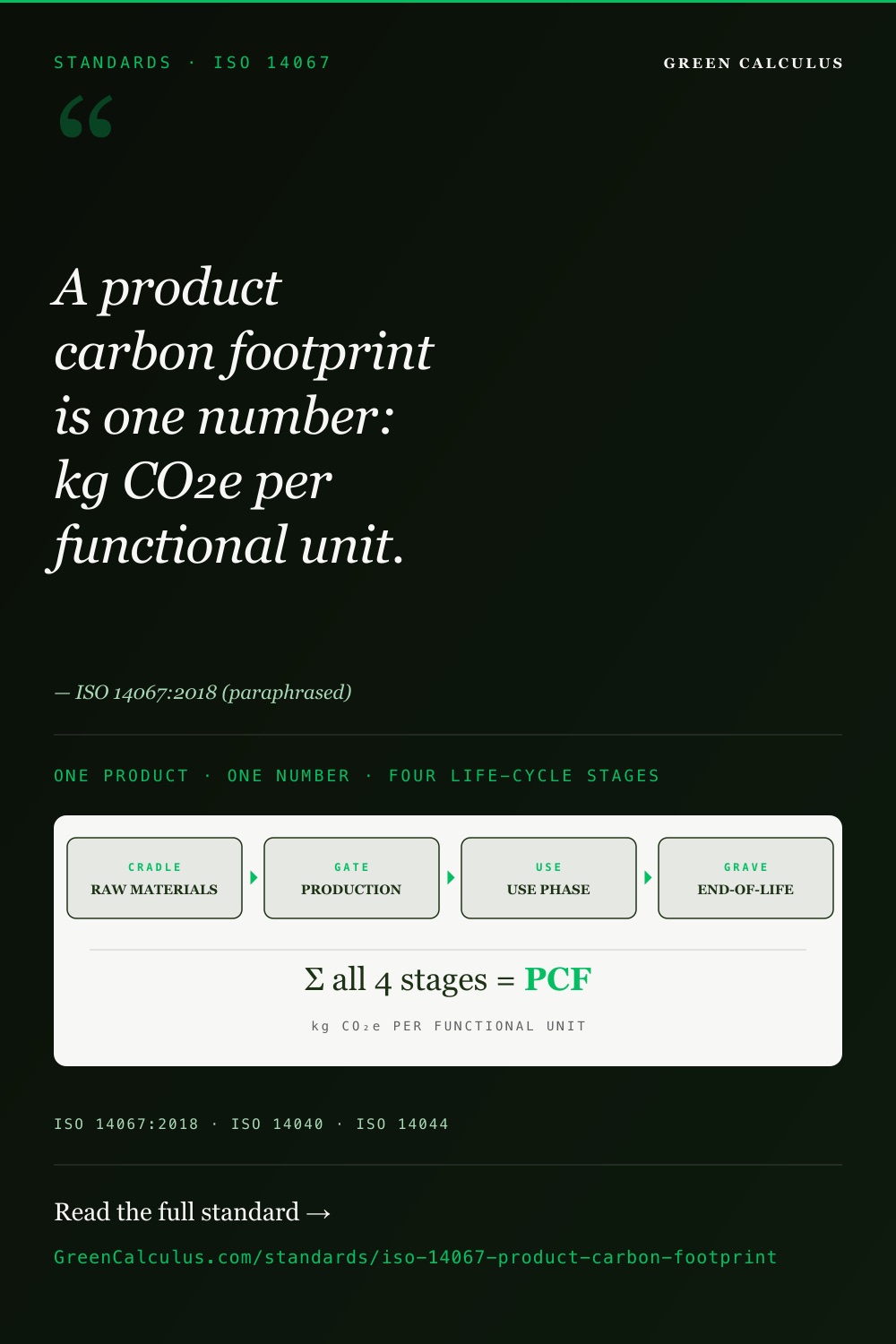
ISO 14067:2018 specifies how to quantify and report the carbon footprint of a product — the greenhouse gases emitted and removed across its life cycle, in CO2e. It applies the ISO 14040/14044 LCA framework to one impact category only: climate change.
Executive Summary
ISO 14067:2018 is the international standard for quantifying the carbon footprint of a product. It is the application of the ISO 14040/14044 life cycle assessment framework to one specific impact category — climate change — and the methodology that the rest of the corporate climate stack now relies on for product-level emission data. CSRD ESRS E1-6 Scope 3 Category 1 disclosures, SBTi supplier engagement programmes, the EU Digital Product Passport, the EU Battery Regulation’s mandatory product carbon footprint, and most B2B procurement specifications all reference ISO 14067 either directly or through frameworks (PCRs, EPDs) that themselves are built on it.
The standard does five things uniquely. It applies LCA discipline to GHG accounting specifically — not water, not toxicity, not biodiversity. It mandates the latest IPCC GWP values over a 100-year time horizon, with biogenic CO2 reported separately from fossil CO2. It requires direct land use change emissions to be quantified using internationally recognised methods such as the IPCC Guidelines for National Greenhouse Gas Inventories. It distinguishes a full CFP from a partial CFP, with mandatory disclosure of what a partial CFP excludes. And it provides a communication framework — the CFP Report and the CFP Performance Tracking Communication — that allows supplier-to-buyer claims to be compared and improvement to be tracked over time.
Every credible ISO 14067 study satisfies: (1) a clearly defined functional unit and system boundary aligned to the intended application, (2) gas coverage of all Kyoto-protocol GHGs converted to CO2e using the latest IPCC GWP-100 values, (3) explicit and separate reporting of biogenic CO2 fluxes and direct land use change, (4) an allocation approach that follows the ISO preference hierarchy — subdivision or system expansion first, physical allocation second, economic allocation last — with full transparency, and (5) an uncertainty assessment, qualitative at minimum.
Provider directory
Now it has to survive the next design change.
See who does this work. Every listing names the standards it works to, and paid placements are labelled. Including Enviropass Consulting and WAP Sustainability.
Browse 4 embodied carbon & LCA providers →Do this work? A listing is US$390 a year. Get listed →
What ISO 14067 Is
ISO 14067 is a methodology standard, not a labelling scheme, a verification scheme, or a database. It tells a practitioner how to calculate a product carbon footprint — what to include, what to exclude, what to disclose, how to handle the contested treatments — but it does not award certifications, does not publish emission factors, and does not run a registry of compliant products. Those functions are operated by other parts of the ecosystem: ISO 14064-3 covers verification, third-party programme operators (the International EPD System, EPD Norge, IBU, UL Environment, and others) operate Type III declaration registries, and background data is supplied by databases such as ecoinvent and Sphera GaBi.
The standard’s scope is narrower than many practitioners assume. It addresses one impact category only — climate change — and explicitly excludes water footprint, toxicity, biodiversity, eutrophication, acidification, and the broader environmental impact categories that a full ISO 14040/14044 LCA would cover. It excludes carbon offsetting (a CFP cannot be reduced by retiring carbon credits) and explicitly excludes the rules for communicating CFP information to consumers, which are governed by ISO 14026 (footprint communication) and ISO 14025 (Type III environmental declarations).
“Product” under ISO 14067 means goods and services. A printed book, a kilogram of cheese, a steel beam, a kilowatt-hour of electricity, a streamed hour of video, a year of cloud storage — all are products under the standard, all can have an ISO 14067 CFP. The methodology adapts to each through the choice of functional unit, system boundary, and allocation rules.
Why ISO 14067 Exists
The standard exists to solve the proliferation problem. By the early 2010s, dozens of product-level carbon accounting methodologies had emerged from different jurisdictions and trade associations — PAS 2050 in the UK, BPX 30-323 in France, the Japanese Carbon Footprint of Products programme, the GHG Protocol Product Standard, and an expanding constellation of sector-specific approaches. Each treated key technical questions differently — biogenic carbon, allocation, system boundary, the partial CFP — and a CFP calculated under one methodology was rarely directly comparable to a CFP calculated under another. ISO 14067 was published in 2013 (initially as a Technical Specification) and revised to a full International Standard in 2018, providing a single international reference.
The standard’s importance has grown sharply since 2018 because the regulatory and disclosure landscape has converged on it. CSRD ESRS E1-6 requires gross Scope 3 emissions disclosure with primary data preferred for material categories — in practice, ISO 14067 CFPs from suppliers. The EU Battery Regulation’s product carbon footprint declaration (mandatory from February 2027) references ISO 14067 methodology. The ESPR Working Plan 2025–2030 names ISO 14067-aligned product carbon footprints as expected content of Digital Product Passports for textiles, furniture, mattresses, tyres, iron, steel, and aluminium. SBTi-validated supplier engagement targets are increasingly evidenced by ISO 14067 documentation. The standard is no longer optional infrastructure for any company selling material volumes of physical product into the EU market.
Publication History
ISO 14067 has a longer pre-history than its 2018 publication date suggests. The intellectual lineage runs through PAS 2050, the early ISO/TS 14067, and the parallel GHG Protocol Product Standard.
| Date | Event |
|---|---|
| 2008 | PAS 2050 published by BSI, sponsored by DEFRA and the Carbon Trust — the first widely adopted product carbon footprint specification, focused on the UK market. |
| 2011 | GHG Protocol Product Life Cycle Accounting and Reporting Standard published by WRI and WBCSD — the corporate-oriented complement that ran in parallel. |
| 2011 | PAS 2050 second edition. |
| 2013 | ISO/TS 14067:2013 published as a Technical Specification — not a full International Standard, signalling that consensus on key methodological choices was still being built. |
| 2018 | ISO 14067:2018 published as a full International Standard — current operative version. Replaced ISO/TS 14067:2013. Aligned with the 2018-edition ISO 14040/14044 amendments and incorporated learning from PAS 2050 and the GHG Protocol Product Standard. |
| April 2025 | EU ESPR Working Plan 2025–2030 adopted — identifies textiles, furniture, mattresses, tyres, iron, steel, and aluminium as priority product groups, with ISO 14067-aligned methodology expected for the carbon footprint datapoints in Digital Product Passports. |
| 18 February 2027 | EU Battery Regulation: mandatory digital battery passport including a verified product carbon footprint. The first legally binding application of the ISO 14067 framework in EU regulation. |
| 2028 (mid-term review) | ESPR Working Plan mid-term review. Expected expansion of priority product list and possible revision of horizontal carbon footprint requirements. |
| ~2028 (anticipated) | ISO 14067 next review cycle. Likely focus areas: alignment with IPCC AR7 GWP values when published, biogenic carbon treatment, alignment with the revised GHG Protocol Land Sector and Removals guidance, treatment of digital and software products. |
Governance: Who Owns the Standard
ISO 14067 is developed and maintained under ISO Technical Committee 207 (Environmental management), Subcommittee 7 (Greenhouse gas management and related activities). TC 207 also owns the broader ISO 14000 family, including the ISO 14040/14044 LCA series that ISO 14067 builds on, the ISO 14064 series on greenhouse gas inventories and verification, the ISO 14068 series on carbon neutrality and net zero, and the ISO 14025 / ISO 21930 standards governing Type III environmental declarations.
Revisions follow ISO’s standard five-year systematic review cycle. A working group within SC 7 prepares draft amendments, the draft circulates through the participating national standards bodies for comment and vote (BSI in the UK, DIN in Germany, ANSI in the US, JISC in Japan, AFNOR in France, SCC in Canada, and equivalents in dozens of other jurisdictions), and the final standard is issued by ISO once approved. National adoption follows automatically in member countries that publish the standard through their domestic body (BS EN ISO 14067, DIN EN ISO 14067, NF EN ISO 14067).
Operational interpretation of the standard — how to apply it to a specific product category — is delegated to Product Category Rules (PCRs) developed under ISO 14025 by Programme Operators such as the International EPD System, EPD Norge, the Institut Bauen und Umwelt, UL Environment, and EPD Australasia. PCRs are the practical bridge between ISO 14067’s general methodology and the calculations that an individual study must actually perform.
CFP vs LCA: How ISO 14067 Relates to ISO 14040/14044
Practitioners coming from a broader LCA background sometimes assume ISO 14067 is a complete LCA standard. It is not. It is a single-impact-category application of the ISO 14040/14044 framework, and the relationship is hierarchical.
ISO 14040 and ISO 14044 are the foundational standards that define what an LCA is — the four phases (goal and scope definition, life cycle inventory, impact assessment, interpretation), the principles (life cycle perspective, environmental focus, relative approach, iterative approach, transparency, comprehensiveness, priority of scientific approach), and the requirements that any study calling itself an LCA must satisfy. They cover all impact categories — climate change, acidification, eutrophication, ozone depletion, photochemical oxidation, water use, land use, abiotic resource depletion, human toxicity, ecotoxicity, biodiversity loss — without privileging any.
ISO 14067 takes the ISO 14040/14044 framework, restricts the impact assessment phase to climate change only (using IPCC GWP-100 as the characterisation method), and adds GHG-specific requirements that ISO 14040/14044 does not impose — the explicit treatment of biogenic CO2, the requirement to quantify direct land use change emissions, the partial CFP disclosure rules, and the dedicated communication framework. A study that is ISO 14067-compliant is a particular kind of ISO 14040/14044-compliant study; the reverse is not true.
The practical implication for project managers: an ISO 14067 study can be a starting point for a fuller multi-impact LCA, but a CFP cannot be retro-fitted into a Type III EPD or a multi-impact study without additional impact assessment work to cover the categories ISO 14067 omitted.
Full CFP vs Partial CFP
The distinction between a full CFP and a partial CFP is foundational and often misunderstood. ISO 14067 explicitly accommodates both, but it imposes different disclosure obligations on each.
Full CFP
A full CFP is cradle-to-grave: it covers the complete life cycle of the product from raw material extraction through manufacturing, distribution, use, and end-of-life. All Kyoto-protocol greenhouse gases are included. All life cycle stages are included, with documented justification for any exclusions on grounds of materiality (typically a cumulative cut-off threshold of 1% per item and 5% total). A full CFP is the form ISO 14067 prefers and the form that supports the broadest set of claims.
Partial CFP
A partial CFP is any CFP that does not cover the full cradle-to-grave scope. The most common form is cradle-to-gate — from raw material extraction through the manufacturer’s gate, omitting distribution, use, and end-of-life. Partial CFPs are not in any way deficient or inferior — they are appropriate where the use phase or end-of-life is determined by parties downstream of the manufacturer (typical in B2B intermediate goods, construction materials, packaging materials), where the use phase is not yet known with sufficient confidence to model, or where the partial scope is what the intended audience needs.
The mandatory disclosure rule
What ISO 14067 does require for a partial CFP is unambiguous identification of the scope. A partial CFP must clearly state which life cycle stages are included and which are excluded, with reasoning, and must not be communicated as if it were a full CFP. Calling a cradle-to-gate study “the carbon footprint of the product” without the cradle-to-gate qualifier is a category error that the standard explicitly prohibits.
For some product categories, the use phase dominates the full CFP. A long-lived appliance, a fuel-burning vehicle, a building material that affects operational energy consumption — in each case the cradle-to-gate share can be a small fraction of the cradle-to-grave total. Comparing one supplier’s cradle-to-gate CFP to another supplier’s cradle-to-grave CFP will give a misleading answer. Always confirm the system boundary before comparing two numbers.
The System Boundary — The Most Consequential Decision
The system boundary determines what unit processes are inside the study and what is outside. It is the single most consequential methodological decision in any ISO 14067 study because it directly determines the magnitude of the result and what the result can validly be used for.
Boundary types
- Cradle-to-grave. Raw material extraction through end-of-life disposal. The full CFP form.
- Cradle-to-gate. Raw material extraction through the manufacturer’s factory gate. The most common partial CFP form, particularly in B2B supply chains.
- Cradle-to-gate with options. Cradle-to-gate plus selected downstream stages — for example, plus distribution to a regional warehouse, or plus a known recycled-content end-of-life route.
- Gate-to-gate. Manufacturing only, omitting upstream raw material production. A narrow scope used for benchmarking process improvement, not for product-level claims.
- Cradle-to-grave with module D. The EN 15804 convention used in construction-product EPDs, with potential reuse, recovery, and recycling benefits reported separately as a “Beyond System Boundary” module D and not netted into the headline result.
Cut-off rules
Within a chosen boundary, ISO 14067 permits the exclusion of inputs and outputs whose contribution to the CFP is immaterial. The standard does not prescribe a specific threshold; PCRs typically operationalise the rule with a cumulative cut-off of 1% per individual item and 5% total mass-or-energy contribution, with the rule that no excluded item may individually exceed 1% of the CFP. All exclusions must be documented with the rationale.
The biogenic carbon boundary decision
A separate boundary decision concerns biogenic CO2 fluxes. ISO 14067 requires biogenic CO2 uptake (during plant growth) and biogenic CO2 release (at combustion or decomposition) to be quantified within the system boundary and reported separately from fossil CO2. The standard does not permit biogenic CO2 to be zeroed out as “carbon neutral” without explicit accounting. See Biogenic Carbon below for the detailed rules.
The Functional Unit — The Reference Point
The functional unit is the quantified performance of a product system used as the reference unit for the study. It is the denominator: every emission, every input, every allocation is expressed per functional unit. Choosing it well is the single most important step in making a CFP comparable, and choosing it poorly is the single most common reason two studies of nominally the same product produce non-comparable results.
Why the functional unit is rarely the physical unit
The physical unit (1 kilogram, 1 litre, 1 unit) tells you nothing about what the product does. A functional unit captures the service the product delivers. For a carton of milk, the physical unit is “1 kilogram of milk”; the functional unit might be “1 litre of milk delivering X grams of protein and Y kilocalories of energy at retail-shelf condition for a defined consumption window”. For a wall paint, the physical unit is “1 kilogram of paint”; the functional unit is “1 square metre of wall covered to a defined hiding power and durability over a defined service life”.
The functional unit’s role is to anchor comparability. Two products that deliver the same function in different ways — a heavy long-lived light fitting vs a light short-lived one, a concentrated detergent vs a dilute one, a durable garment vs a fast-fashion equivalent — can only be compared on the basis of equal function, which the functional unit defines.
The declared unit alternative
For partial CFPs (typically cradle-to-gate), the use phase is outside the system boundary, so the function the product delivers in use is also out of scope. In this case, ISO 14067 (following ISO 21930 and EN 15804 in the construction context) allows a declared unit — a physical reference (1 kilogram, 1 cubic metre, 1 square metre at a defined thickness) that does not claim to capture function. EPDs for construction materials almost universally use a declared unit at the cradle-to-gate scope, with the integration into a functional unit happening at the building or whole-life-carbon level.
Common functional unit errors
- Using “1 kilogram of product” for products with very different in-use service lives (e.g. a kilogram of long-lived furniture vs a kilogram of single-use packaging).
- Defining function only on a single dimension (mass, volume) when the product also delivers performance dimensions (durability, energy efficiency in use, capacity).
- Failing to specify the time period over which the function is delivered.
- Comparing CFPs across studies that used different functional units, without rebasing.
Life Cycle Stages: The EN 15804 Module Structure
ISO 14067 itself does not prescribe a specific life cycle stage taxonomy. In practice, the EN 15804 module structure — developed for construction product EPDs — has become the de facto convention in many adjacent sectors because it provides a granular, unambiguous decomposition of the life cycle that maps cleanly onto the cradle-to-gate, cradle-to-grave, and cradle-to-gate-with-options scopes ISO 14067 recognises.
| Stage group | Module | Content |
|---|---|---|
| Product (A1–A3) | A1 | Raw material supply. |
| A2 | Transport of raw materials to the manufacturer. | |
| A3 | Manufacturing. | |
| Construction / Installation (A4–A5) | A4 | Transport from the manufacturer to the customer or installation site. |
| A5 | Installation or assembly into the final product or building. | |
| Use (B1–B7) | B1 | Use-phase emissions intrinsic to the product (e.g. refrigerant leakage). |
| B2 | Maintenance. | |
| B3 | Repair. | |
| B4 | Replacement. | |
| B5 | Refurbishment. | |
| B6 | Operational energy use. | |
| B7 | Operational water use. | |
| End of life (C1–C4) | C1 | Deconstruction or demolition. |
| C2 | Transport to waste processing. | |
| C3 | Waste processing for reuse, recovery, or recycling. | |
| C4 | Final disposal. | |
| Beyond system boundary | D | Reuse, recovery, recycling potential. Reported separately, not netted into the headline result under EN 15804. |
An ISO 14067 cradle-to-gate study covers A1–A3. A cradle-to-grave study covers A1–C4 (with module D reported separately if EN 15804 is being followed). A “cradle-to-gate with options” study might cover A1–A4 (adding distribution) or A1–A5 (adding installation).
Data Hierarchy: Primary vs Secondary Data
Every ISO 14067 study is built on two layers of data: foreground data describing the modelled product system and the unit processes the practitioner controls or has direct visibility of, and background data describing the upstream and ancillary processes that supply the foreground.
Primary (site-specific) data
Primary data is measured or directly calculated activity data from the actual production process being studied: kilowatt-hours of electricity from the manufacturer’s meter, kilograms of input material from the bill of materials, tonnes of waste from the waste contractor’s manifest, kilometres of transport from the carrier’s logbook. ISO 14067 expects primary data to be used for unit processes that are owned or controlled by the entity commissioning the study, and for foreground processes whose contribution to the CFP is material.
Secondary (background) data
Secondary data describes processes the practitioner does not directly observe — the production of upstream raw materials, the mix of electricity at the supplier’s grid, the manufacture of capital equipment used in upstream processes, the disposal route of waste at the regional waste system. This is supplied by background life cycle inventory databases, of which the dominant ones are ecoinvent, Sphera GaBi (formerly thinkstep GaBi), the European Reference Life Cycle Database (ELCD), the U.S. Federal LCA Commons, and a growing constellation of sector-specific datasets.
The data quality requirement
ISO 14067 requires the data quality assessment to address temporal coverage (how recent), geographic coverage (how representative of the location), technological coverage (how representative of the technology), precision (variability of the values), completeness (share of the relevant flows captured), representativeness (overall fit to the system being studied), consistency (between similar processes), and reproducibility (whether another practitioner could reach the same result). The pedigree matrix — a structured scoring system originally developed by Weidema and Wesnaes and widely implemented in LCA software — is the most common operationalisation.
The CSRD primary-data preference
CSRD ESRS E1-6 disclosure increasingly drives the demand for primary data in supplier engagement programmes. Where Scope 3 Category 1 emissions are material, CSRD-reporting buyers are pushing suppliers to deliver ISO 14067 CFPs grounded in primary activity data rather than spend-based or industry-average secondary data. This is the largest current driver of ISO 14067 adoption in supplier networks. See CSRD / ESRS E1 for the disclosure architecture and DEFRA emission factors for the spend-based alternative.
GWP Basis and Gas Coverage
ISO 14067 requires every greenhouse gas emission and removal to be converted to carbon dioxide equivalent (CO2e) using Global Warming Potential characterisation factors over a 100-year time horizon (GWP-100). The standard’s wording — “the latest IPCC’s GWP should be used; if not, justification shall be provided” — means the operative GWP set evolves as the IPCC publishes successive Assessment Reports.
The current AR6 basis
At the publication date of ISO 14067:2018, the latest IPCC Assessment Report was AR5 (2013), and AR5 GWP-100 values were the operative basis. With the publication of the IPCC Sixth Assessment Report (AR6, Working Group I, 2021) and its widespread adoption across the corporate climate stack — SBTi, GHG Protocol Corporate Standard, EU CSRD ESRS E1 — AR6 GWP-100 values have become the operative basis for new ISO 14067 studies. Studies that use AR5 (or earlier) values must justify the choice. Studies that mix AR5 and AR6 values across different gases or unit processes are non-compliant. See AR6 GWP values for the full table and global warming potential for the underlying concept.
Other time horizons
ISO 14067 fixes GWP-100 as the headline characterisation. Other time horizons (GWP-20, GWP-500) and other metrics (GTP, the Global Temperature change Potential) may be reported as additional information but cannot replace GWP-100 in the headline result.
Gas coverage
All Kyoto-protocol greenhouse gases must be included where present in the system: carbon dioxide (CO2), methane (CH4) — with fossil and biogenic CH4 reported separately, nitrous oxide (N2O), hydrofluorocarbons (HFCs), perfluorocarbons (PFCs), sulphur hexafluoride (SF6), and nitrogen trifluoride (NF3). Glossary: methane (CH4), nitrous oxide, CO2e.
Biogenic CO2 reporting separately
The treatment of biogenic CO2 is a defining feature of ISO 14067. Biogenic CO2 uptake (during plant growth) and biogenic CO2 release (at combustion or decomposition) must be quantified within the system boundary and reported as a separate line, distinct from fossil CO2. The standard does not permit a “biomass is carbon neutral” simplification. See Biogenic Carbon below.
Access the AR6 GWP values required for ISO 14067 calculations
The GreenCalculus AR6 GWP reference dataset documents every IPCC AR6 Table 7.SM.7 GWP-100 value — including the fossil/biogenic methane split, climate-carbon feedback variants, and the full gas list required by ISO 14067. Hardcoded against the primary IPCC source.
Open the AR6 GWP datasetAllocation, Part 1: Co-Product Allocation
Allocation is the procedure for dividing the inputs and outputs of a multi-product process among its products. It is the most technically complex part of any LCA — and the part where well-intentioned practitioners produce the largest unintended divergences in CFP results.
The ISO 14067 allocation hierarchy
ISO 14067 inherits the ISO 14044 allocation hierarchy and applies it specifically to GHG emissions and removals. The order is preferential:
- Avoid allocation. Where possible, divide the multi-product process into sub-processes and collect data for each sub-process separately, or expand the system boundary so that the function of the co-product is included.
- Physical allocation. Where allocation cannot be avoided, divide the inputs and outputs based on a physical relationship reflecting how the inputs and outputs are caused by the process — mass, volume, energy content, or molar quantity.
- Other-relationship allocation. Where no physical relationship can be established, allocate using another relationship — most commonly economic value (revenue share). Economic allocation is permitted only as a last resort because it is sensitive to commodity price fluctuations and can produce unstable CFP results.
The dairy example
A dairy farm produces milk, cream (after separation), butter (after churning), and whey (a by-product of cheese-making downstream). The farm’s GHG emissions — enteric methane, manure management, feed production, energy use — must be allocated across these products. ISO 14067’s preference order says: first try to subdivide (do you have separate data for the milk-side vs the cream-side of the process?); if not, allocate by mass or by energy content (a physical basis); only if no physical basis works, allocate by economic value — and document the reasoning.
The transparency requirement
Whatever allocation choice is made, ISO 14067 requires the choice and its rationale to be transparently documented in the CFP Report. A CFP that does not disclose the allocation method used is non-compliant. Sensitivity analysis on the allocation choice (see below) is good practice and increasingly expected by verifiers.
Allocation, Part 2: Recycled Content and End-of-Life
Recycled content and end-of-life recycling raise a separate allocation question: how should the GHG burden of producing virgin material, using it, recycling it, and reusing the recyclate be distributed between the original producer, the user, and any subsequent users? Three competing methods are in widespread use, each with very different CFP implications.
| Method | How it works | Where used |
|---|---|---|
| Cut-off (recycled content) | Each life cycle is treated independently. The first product takes all the burden of virgin production. The second product takes only the burden of the recycling process plus any incremental processing. No credit for end-of-life recyclability. | EN 15804+A2 default for construction products. Common in textiles. The default in ecoinvent’s “cut-off” system model. |
| 50/50 (Avoided burden, equal share) | The burden of virgin production and the credit of avoided virgin production at end-of-life are split equally between the first and second product life cycles. | Used in some product categories, particularly metals where recyclate substitutes near-perfectly for virgin material. |
| Substitution / avoided burden | The first product gets the full burden of virgin production, and at end-of-life receives a credit equal to the avoided virgin production of any material recycled into a subsequent life cycle. | EN 15804 module D. Common in metals and aggregates. Aligned with the “Circular Footprint Formula” in the EU Product Environmental Footprint method. |
Why the choice matters
For the same physical product, the cut-off, 50/50, and substitution methods can produce CFPs differing by 20% or more. A high-recycled-content steel product looks dramatically lower-carbon under the cut-off method (which gives full credit for using recyclate) than under the substitution method (which gives the credit to the producer of the original virgin steel). Both calculations are defensible; they answer different questions about who deserves the credit.
The EN 15804 +A2 convention
In construction-product EPDs — the most institutionally important application of ISO 14067 in the EU — EN 15804+A2 mandates the cut-off approach for the headline cradle-to-gate result, with substitution-method credits reported separately as Module D (“benefits and loads beyond the system boundary”). This convention prevents Module D credits from being netted into the headline number, which preserves comparability.
The PCR-driven convergence
Where a Product Category Rule exists for the product type, the allocation method is typically prescribed by the PCR — removing practitioner discretion and improving comparability across studies of the same product type. This is one of the most important practical reasons to follow a PCR rather than develop a bespoke methodology.
Biogenic Carbon — The Most Contested Calculation
Biogenic carbon — carbon that cycles through the atmosphere–biosphere system on relatively short timescales — is the single largest source of incomparability between ISO 14067 studies. Different methodological choices defensibly produce CFPs differing by orders of magnitude for products where biomass is a significant input.
What biogenic CO2 is
When a plant grows, it absorbs CO2 from the atmosphere through photosynthesis. When biomass is combusted (in a biomass power plant, in an open fire) or when it decomposes (at end-of-life landfill, on the forest floor), that CO2 is released back to the atmosphere. The flux in is biogenic CO2 uptake; the flux out is biogenic CO2 release. Over a closed cycle, in a steady-state managed forest or agricultural system, uptake and release are nominally balanced — but the timing matters, the assumption of steady state often does not hold, and the products of biomass conversion (biogenic CH4, in particular) have very different climate impacts than the original CO2.
The ISO 14067 rule
The standard requires biogenic CO2 uptake (negative, a removal) and biogenic CO2 release (positive, an emission) to be quantified within the system boundary and reported separately from fossil CO2. The standard explicitly does not permit a “biogenic CO2 is zero” simplification — the carbon-neutral biomass assumption is not allowed. Biogenic CH4 and biogenic N2O are reported as fossil-equivalent emissions, because their warming impact is real even if they originated from biomass.
Temporary storage and the time-correction question
For products that store biogenic carbon over a long period — wood in long-lived buildings, paper archived in libraries — ISO 14067 allows a temporary-storage credit calculated using a time-correction factor that accounts for the delayed release. This calculation is technically optional and methodologically contentious; many PCRs explicitly disallow it for the headline CFP and require it to be reported as supplementary information.
Connection to land sector accounting
Biogenic carbon accounting under ISO 14067 connects to the broader land-sector carbon accounting framework, including the new GHG Protocol Land Sector and Removals Standard (2026) and the IPCC Guidelines for National Greenhouse Gas Inventories that ISO 14067 references for direct land use change calculations. For agricultural and forest products, the land-sector framework typically dominates the CFP and is the area of fastest current methodological evolution.
Two ISO 14067 studies of the same wood product can defensibly report CFPs differing by an order of magnitude depending on (1) whether biogenic CO2 is reported separately or netted, (2) whether a temporary-storage credit is taken, (3) what reference land use is assumed for direct land use change, and (4) whether indirect land use change is included. Always read the methodology statement before comparing two CFPs.
Land Use Change Emissions
Land use change emissions — carbon released from soil and biomass when land is converted from one use to another — are mandatory in ISO 14067 studies for direct land use change, and recommended for indirect land use change.
Direct land use change (dLUC)
Direct land use change is land conversion that is causally attributable to the product being studied: a forest cleared specifically to plant the soybeans that feed the cattle that produce the milk in the CFP. ISO 14067 requires dLUC emissions to be quantified using internationally recognised methods, of which the most widely used is the IPCC 2006 Guidelines for National Greenhouse Gas Inventories (Volume 4, Agriculture, Forestry and Other Land Use). The standard requires dLUC over the past 20 years to be assessed, with the conversion-period emissions amortised over a defined period.
Indirect land use change (iLUC)
Indirect land use change is land conversion that occurs elsewhere as a consequence of the product being studied displacing other production: soybeans grown on existing cropland for the studied product cause cropland expansion in another region for the displaced soy demand. ISO 14067 recommends iLUC be considered but recognises that the methodology for quantifying iLUC is still developing and that different models can produce very different results. Most practitioner studies report iLUC as supplementary information rather than netting it into the headline result.
Why this matters
For agricultural and forest products, land use change emissions can dominate the CFP. A beef product, a soybean meal, or a palm oil product calculated without dLUC can have a CFP one-quarter the size of the same product calculated with dLUC. The same is true for construction products that source biomass from regions where forest conversion is occurring. This is the single most material driver of CFP comparability problems in food, agriculture, and forestry — and the area where SBTi FLAG, the GHG Protocol Land Sector and Removals Standard, and ISO 14067 are converging fastest.
Uncertainty and Sensitivity Analysis
ISO 14067 requires uncertainty assessment — qualitative at minimum, quantitative where feasible — and a sensitivity analysis on the most consequential methodological choices.
Sources of uncertainty
- Activity data uncertainty. Measurement precision in primary data; representativeness of secondary data.
- Emission factor uncertainty. Variability across the underlying generation processes feeding the GWP factor.
- Model uncertainty. Choices on system boundary, allocation, biogenic carbon, temporal scope.
- Stochastic uncertainty. Inherent variability in the underlying biophysical processes (e.g. soil emissions from nitrogen fertiliser).
Quantitative methods
Where quantitative uncertainty is calculated, the dominant approach is Monte Carlo simulation: input distributions are assigned to each uncertain parameter, the model is run thousands of times with random draws from each distribution, and the resulting distribution of CFP outcomes is reported (typically as a 95% confidence interval around the central estimate). Standard LCA software supports this natively. The pedigree matrix is the most common method for assigning input distributions where empirical uncertainty data is unavailable.
Sensitivity analysis
Sensitivity analysis tests how the CFP changes when individual methodological choices or input values are varied. The minimum expected sensitivity tests in a CFP report are: allocation method (cut-off vs substitution), biogenic carbon treatment (separate vs zeroed), temporal scope of dLUC, electricity grid mix used for upstream processes, and end-of-life route assumed. A CFP that is robust to these sensitivity tests is a stronger basis for claims than one that swings widely.
The disclosure gap
Most supplier-provided CFPs in current practice omit uncertainty disclosure entirely, which is a material gap for buyers conducting Scope 3 inventories under CSRD or assurance under ISAE 3410. The 2026 trajectory is clear: assurance providers and CSRD assurance protocols are increasingly requiring at least qualitative uncertainty statements, and the 2027 EU Battery Regulation product carbon footprint requires explicit uncertainty reporting in the digital battery passport.
Worked Example: A Cradle-to-Gate PCF
The following walks through an illustrative cradle-to-gate ISO 14067 study for 1 kg of finished cotton t-shirt fabric at the manufacturer’s gate, using stylised but realistic numbers. The example demonstrates the structure of an ISO 14067 calculation; it is not intended as a real-world emission factor for cotton t-shirts and should not be cited as one.
Step 1 — Goal and scope
Goal: quantify the cradle-to-gate carbon footprint of 1 kg of bleached, dyed, finished cotton woven fabric at the textile manufacturer’s gate, for use as supplier data in a CSRD-reporting buyer’s Scope 3 Category 1 inventory.
System boundary: A1 (cotton cultivation) + A2 (transport to ginning, spinning, weaving, finishing) + A3 (manufacturing, including ginning, spinning, weaving, dyeing, finishing). Cradle-to-gate. Use phase, end-of-life, and module D excluded — partial CFP.
Functional unit: declared unit of 1 kg of finished cotton woven fabric, 180 g/m2, ex-works at the manufacturer’s gate.
Step 2 — Life cycle inventory (illustrative values)
| Process | Activity | Indicative GHG flow per kg fabric |
|---|---|---|
| A1 Cotton cultivation | Synthetic N fertiliser, irrigation, mechanised cultivation, dLUC where applicable | 3.5 kg CO2e (illustrative) |
| A2 Inbound transport | Road and sea transport from cotton field to spinning mill (avg) | 0.4 kg CO2e (illustrative) |
| A3 Ginning | Electricity for separation of cotton fibre from seed | 0.3 kg CO2e (illustrative) |
| A3 Spinning | Electricity-intensive yarn formation | 2.1 kg CO2e (illustrative) |
| A3 Weaving | Electricity for fabric formation | 1.6 kg CO2e (illustrative) |
| A3 Dyeing & finishing | Heat (often natural gas), water, chemicals | 2.8 kg CO2e (illustrative) |
| Cradle-to-gate total (A1–A3) | 10.7 kg CO2e per kg fabric (illustrative) |
Step 3 — Methodological choices recorded
- GWP basis: IPCC AR6, GWP-100. Documented in CFP Report.
- Biogenic CO2: reported separately. Cotton fibre uptake during plant growth recorded as −1.6 kg CO2-bio per kg fabric; biogenic release at end-of-life is out of scope (cradle-to-gate).
- dLUC: assessed using IPCC 2006 Guidelines Vol 4 method over a 20-year window. dLUC contribution included in A1 cotton cultivation if relevant for the supply region.
- Allocation: cotton seed (a co-product of ginning) allocated by economic value, since physical allocation by mass produces a counter-intuitive result and the seed has a substantial market value. Documented in CFP Report.
- Background data: ecoinvent v3.12, cut-off system model, regionalised electricity mixes for the spinning, weaving, and dyeing locations.
- Cut-off: 1% per item, 5% cumulative.
Step 4 — Uncertainty and sensitivity
- Quantitative uncertainty: Monte Carlo (n=10,000), 95% CI = 8.4 to 13.5 kg CO2e per kg fabric (illustrative range).
- Sensitivity to allocation: if cotton seed is allocated by mass instead of economic value, A1 falls from 3.5 to 2.7 kg CO2e per kg fabric, and the headline drops from 10.7 to 9.9 kg CO2e per kg fabric.
- Sensitivity to electricity mix: if all A3 electricity is sourced from a coal-dominated grid (~0.9 kg CO2e/kWh) rather than the regional baseline assumed, the headline rises by approximately 4.5 kg CO2e per kg fabric.
- Sensitivity to biogenic treatment: netting biogenic CO2 uptake into the headline (not ISO 14067-compliant but commonly seen in informal reporting) would lower the headline to approximately 9.1 kg CO2e per kg fabric.
Step 5 — Result reporting
The CFP Report would record the partial CFP as 10.7 kg CO2e per kg of finished cotton woven fabric, cradle-to-gate (A1–A3), with biogenic CO2 reported separately as −1.6 kg CO2-bio per kg fabric, calculated under ISO 14067:2018 with IPCC AR6 GWP-100 values, ecoinvent v3.12 background data, economic allocation of cotton seed co-products, and dLUC assessed per IPCC 2006 Guidelines. The full CFP Report would include the inventory tables, sensitivity analysis, uncertainty bounds, and disclosure that the use phase and end-of-life are excluded.
Note: values shown are illustrative for methodology demonstration only. Real cotton-fabric CFPs vary widely by cultivation region (irrigation source, fertiliser intensity, dLUC), spinning technology, and dyeing practice. Use a verified ISO 14067 study or a published Product Category Rule-based EPD for the actual product, not these example values.
Product Category Rules and EPDs
In GreenCalculus, ISO 14067 product-footprint principles underpin the plastics and packaging methodology and the material-substitution methodology, where the functional unit and recycled-content allocation decide the result.
ISO 14067 sets out the methodology in general terms. Real-world product carbon footprints are calculated under more specific rules — Product Category Rules (PCRs) developed under ISO 14025 by Programme Operators — and most often communicated through Environmental Product Declarations (EPDs), the Type III environmental label that EPD programmes operate.
What a PCR is
A Product Category Rule is a document that specifies how an ISO 14067 (or ISO 14025-based) study must be conducted for a specific product category — precast concrete elements, hot-rolled structural steel, residential carpets, dairy milk, single-use plastic packaging. It pins down the choices ISO 14067 leaves open: the functional or declared unit, the allowed system boundary, the cut-off threshold, the allocation method for co-products, the specific data quality requirements, the mandatory and optional impact categories, and the format of the declaration.
Why PCRs matter
Without a PCR, two practitioners studying the “same” product can defensibly produce non-comparable CFPs, because they will make different methodological choices. With a PCR, every study of that product category follows the same rules — functional unit, allocation, system boundary — and the resulting CFPs are directly comparable. PCRs are the single most important practical mechanism for making ISO 14067 outputs comparable across suppliers. Procurement teams running supplier engagement programmes increasingly specify “EPD under PCR XXXX” rather than “ISO 14067 CFP” because the latter still leaves comparability on the table.
The major Programme Operators
- The International EPD System (EPD International). The largest international Programme Operator. Operates a global PCR library across construction, food, electronics, packaging, and other categories.
- EPD Norge / EPD Norway. Strong in Nordic construction.
- Institut Bauen und Umwelt (IBU). Germany-based, focused on construction products.
- UL Environment. North America focus, broad product range.
- EPD Australasia. Australia and New Zealand.
- FDES / INIES (France). French national construction-product database.
- NSF (US). Sustainability and product environmental declarations.
EN 15804 and the construction-product EPD
For construction products, EN 15804 is the European core PCR — mandatory for any product wishing to be EPD-declared in the EU construction context. EN 15804+A2 (the current revision) tightens the methodology in three areas critical to ISO 14067 alignment: GWP must be reported as four separate sub-indicators (GWP-fossil, GWP-biogenic, GWP-luluc, GWP-total), the cut-off allocation method is mandatory for the headline result, and the most updated IPCC characterisation factors must be used unless explicitly justified otherwise. EN 15978 extends this to whole-buildings whole-life carbon assessment, drawing on the underlying EN 15804 product EPDs.
Where to find PCRs
Each Programme Operator publishes its PCR library on its website. The International EPD System’s library at environdec.com is the most extensive multi-sector resource. For construction products in the EU, the IBU and INIES libraries are the most extensive. Programme Operators routinely cross-recognise each other’s PCRs to reduce fragmentation, but the alignment is incomplete — an EPD under one Programme’s PCR is not automatically valid under another Programme.
Practitioner Data Collection Checklist
For practitioners commissioning or conducting an ISO 14067 study, the binding constraint is almost always activity data quality, not methodology. The following is the practical checklist of what to collect, by life cycle stage, before the modelling begins.
A1 — Raw material supply
- Bill of materials at the unit-of-product level (kg per kg product, or per declared unit).
- Supplier identification for each material input — needed for regionalised background data selection and for any supplier-provided primary CFP data.
- Recycled-content share for each input material (mandatory for EN 15804, increasingly required for DPP).
- Country of origin and method of production for biomass-derived materials (needed for dLUC assessment).
A2 — Inbound transport
- Distance (km) from supplier to manufacturer, by mode (road, rail, sea, air).
- Vehicle type and load factor where available.
- For multi-leg transport, each leg recorded separately.
A3 — Manufacturing
- Total electricity consumption (kWh) for the manufacturing process, allocated to the product if the facility makes multiple products.
- Electricity grid mix or supplier-specific factor, with documentation of the GHG Protocol Scope 2 method used (location-based vs market-based; see Scope 2 Guidance).
- Process fuel consumption (natural gas, diesel, LPG, coal) by fuel type and quantity. Methodology pages: natural gas, diesel, LPG, coal.
- Process water consumption and wastewater treatment route.
- Process refrigerant top-ups (kg, by refrigerant type) — HFCs, PFCs.
- Manufacturing waste — quantities by waste type, treatment route (recycling, incineration, landfill).
- Yield rate — tonnes of product produced per tonne of input material consumed.
A4–A5 (if cradle-to-gate-with-options or cradle-to-grave)
- Distribution route(s) and distance(s) from manufacturer to retailer/installer.
- Installation energy and material inputs.
B1–B7 (if cradle-to-grave)
- Use-phase energy consumption (the largest single line for energy-using products).
- Maintenance and replacement schedule and material flows.
- Use-phase electricity grid mix — market-specific, since this varies by where the product is consumed.
C1–C4 (if cradle-to-grave)
- End-of-life route distribution — share to recycling, share to incineration, share to landfill, by region of consumption.
- Recycling process inputs and outputs.
- Landfill methane emissions for biodegradable materials (modelled per IPCC 2006 Guidelines).
Cross-cutting
- Reporting period for primary data (typically a calendar year or a 12-month moving average).
- Geographic representativeness for primary data.
- Pedigree matrix scoring or equivalent for each significant data point.
Software and Database Landscape
ISO 14067 studies are almost always conducted in dedicated LCA software, drawing on a small number of background life cycle inventory databases. The landscape has consolidated significantly in the past five years.
LCA software
- SimaPro (PRé Sustainability) — the longest-established commercial LCA package; deep integration with ecoinvent and other databases.
- GaBi (Sphera; formerly thinkstep) — commercial LCA package built around the GaBi database; strong in industrial and construction applications.
- openLCA (GreenDelta) — open-source LCA package; supports ecoinvent, ELCD, the U.S. Federal LCA Commons, and others.
- One Click LCA — commercial software focused on construction and the EPD workflow, with embedded EN 15804+A2 logic.
- Ecochain — commercial automated LCA platform focused on manufacturing.
- SCS Engineers / SCS Global Services — verification-house tools alongside consulting.
Background life cycle inventory databases
- ecoinvent — the dominant international LCI database. Current version v3.12 (released November 2025), with approximately 26,000 datasets across all sectors. Four system models (cut-off, allocation at the point of substitution, consequential, and a recent EN 15804+A2-aligned variant) corresponding to different methodological treatments of recycling and co-product allocation.
- Sphera GaBi databases — commercial database integrated with GaBi software; strong in industrial and metals data.
- European Reference Life Cycle Database (ELCD) — European Commission-curated; free.
- U.S. Federal LCA Commons — U.S. federal-government-curated; free.
- WorldSteel LCI — sector-specific database for steel, widely used in construction-product LCAs.
- ICE database (University of Bath, Inventory of Carbon and Energy) — widely used embodied-carbon reference for construction materials, particularly in the UK.
- Agri-footprint — specialised in agriculture and food.
- USDA LCA Digital Commons — U.S. agriculture and forestry.
The version-stability rule
Background databases are revised annually. ISO 14067 requires the database version used to be documented in the CFP Report. Best practice is to fix one database version for an entire publishing cycle — mid-cycle swaps between, say, ecoinvent v3.11 and v3.12 introduce noisy version-driven differences that are easily mistaken for real product changes. Where comparison across years is needed, the comparison should be conducted in a single database version with both years recalculated.
Communication: CFP Reports and Performance Tracking
ISO 14067 specifies two communication forms for the output of a CFP study, with different purposes and disclosure requirements.
The CFP Report
The CFP Report is the full technical documentation of the study. It is not a consumer-facing document. It records the goal and scope, the system boundary (with explicit identification of full vs partial CFP), the functional or declared unit, the cut-off rules, the data sources and their pedigree, the allocation method and rationale, the GWP basis, the biogenic and dLUC treatment, the inventory results, the sensitivity analysis, the uncertainty assessment, the verification status, and the headline result.
The CFP Report is the document that an assurance provider, a procurement auditor, or a regulator needs to review the study. Without a CFP Report — only a single CFP number, with no underlying methodology disclosure — the result is non-compliant with ISO 14067 regardless of how the calculation was conducted.
The CFP Performance Tracking Communication (CFPPTC)
The CFPPTC is a simplified, time-series communication format designed to track CFP improvement across product versions or production years. It reports a CFP value for the current period alongside a baseline period (with explicit disclosure of any methodology changes that affect comparability) and is intended to support claims of CFP reduction over time. It is not a stand-alone document — an underlying CFP Report must exist for each period reported.
What ISO 14067 communication is not
ISO 14067 explicitly excludes two communication forms from its scope:
- Consumer-facing CFP labels. Communication of CFP information to consumers is governed by ISO 14026 (footprint communication) and, for full Type III environmental declarations, ISO 14025. An ISO 14067 study can be the technical basis for an ISO 14026 or ISO 14025 communication, but the consumer-facing label has its own compliance requirements.
- Carbon offsetting. ISO 14067 does not govern the use of carbon credits to offset a product CFP. Offset claims are governed by other standards (notably ISO 14068-1 for carbon neutrality at the organisation level) and are separate from the CFP itself. A CFP cannot be reduced by retiring offsets — offsets are an accounting layer above the CFP, not within it.
Verification and Third-Party Assurance
ISO 14067 supports but does not mandate third-party verification. The verification of CFP studies is conducted under ISO 14064-3, the verification standard in the broader ISO 14064 series. The level of assurance — reasonable vs limited — and the type of verification — first-party, second-party, third-party — depends on the intended audience and the regulatory or contractual requirements applying to the claim.
Verification levels
- First-party. Internal review by the entity commissioning the study. Lowest assurance. Sufficient for internal management reporting; not generally accepted for external claims.
- Second-party. Review by a customer or other stakeholder — for example, a CSRD-reporting buyer reviewing a supplier’s CFP data. Common in supplier engagement programmes.
- Third-party. Review by an independent verifier (typically an accredited certification body) operating under ISO 14064-3 and ISO 17029 or ISO 14065 accreditation. The standard for external claims and the form expected by EPDs, the EU Battery Regulation, and most CSRD assurance contexts.
Verification statement contents
A typical Carbon Footprint Verification Statement (CFVS) under ISO 14064-3 records:
- The verifier’s identity and accreditation status.
- The intended user of the verification statement.
- The verification scope — the CFP Report and the underlying calculation tool.
- The level of assurance (limited or reasonable).
- The criteria applied — ISO 14067:2018 plus any applicable PCR.
- The materiality threshold (commonly 5% for limited assurance).
- Any qualifications or modifications.
- The verification opinion — “the CFP is fairly stated”, “with the qualifications noted”, or “is not fairly stated”.
- Date of verification statement issuance.
The 2027 EU Battery Regulation requirement
From 18 February 2027, the EU Battery Regulation requires industrial, electric vehicle, and light-means-of-transport batteries placed on the EU market to be accompanied by a digital battery passport including a verified product carbon footprint. This is the first legally binding requirement for ISO 14067-aligned CFP verification at scale, and it sets the practical template for the broader ESPR Digital Product Passport rollouts to follow.
Which Methodology: ISO 14067 vs GHG Protocol Product vs PEF vs PAS 2050
Practitioners frequently ask which product carbon footprint methodology to use. The answer depends on the intended audience, the regulatory context, and the practical expectations of the customer or regulator who will receive the result. Four methodologies are in active use; the table below lays out the differences.
| Dimension | ISO 14067:2018 | GHG Protocol Product Standard (2011) | EU Product Environmental Footprint (PEF) | PAS 2050:2011 |
|---|---|---|---|---|
| Publisher | ISO | WRI & WBCSD | European Commission JRC | BSI / DEFRA / Carbon Trust |
| Status | International Standard | Voluntary protocol | EU recommendation; embedded in some EU regulation | UK Publicly Available Specification — legacy in practice, but still listed Current by BSI |
| Impact categories | Climate change only | Climate change only | 16 impact categories (multi-impact) | Climate change only |
| Allocation hierarchy | Avoid → physical → economic | Avoid → physical → economic | Avoid → physical → economic; specific Circular Footprint Formula for recycling | Avoid → physical → economic |
| Biogenic CO2 | Reported separately, not netted | Reported separately | Reported separately under PEF guidance | Allowed netting under defined conditions |
| End-of-life recycling | Allocation method documented; PCR-prescribed | Cut-off, 50/50, or substitution; documented | Circular Footprint Formula (mandatory under PEF) | Cut-off or 50/50 |
| Verification | ISO 14064-3, third-party recommended | ISO 14064-3 referenced | PEF verification scheme | PAS 2060 / ISO 14064-3 |
| Communication | CFP Report + CFPPTC | Public Inventory Report | PEF profile | PAS 2050 declaration |
| Best fit when | International audience, EU regulatory context, EPD/DPP downstream use | Internal corporate inventory work, GHG Protocol-aligned reporting, B2B North American context | EU-only, multi-impact required, food/cosmetics/electronics where PEF Category Rules exist | Legacy UK use, niche updates; new studies should use ISO 14067 |
The decision in three questions
- Is the audience EU-regulatory (DPP, EU Battery Regulation, ESPR, CSRD)? Use ISO 14067, ideally under a relevant PCR, with EN 15804+A2 if construction.
- Is multi-impact assessment required? Use PEF. ISO 14067 covers climate change only; PEF covers 16 impact categories.
- Is the audience a U.S.-based corporate Scope 3 inventory? The GHG Protocol Product Standard is acceptable, though ISO 14067 is increasingly preferred even there for cross-border consistency.
For most new studies in 2026, ISO 14067 is the right default — alone or, for construction products, in combination with EN 15804+A2 under an applicable PCR.
Where ISO 14067 Fits in the Disclosure Stack
An ISO 14067 CFP feeds into multiple downstream disclosure regimes. The relationships are layered, and an ISO 14067 study that is well-structured for one downstream user is generally well-structured for the others.
Scope 3 Category 1 in the corporate GHG inventory
Under the GHG Protocol Corporate Standard and the GHG Protocol Scope 3 Standard, Scope 3 Category 1 covers cradle-to-gate emissions from purchased goods and services. The data quality hierarchy ranks supplier-specific product-level CFPs as the highest-quality inputs, with industry-average secondary data and spend-based factors below. An ISO 14067 cradle-to-gate CFP supplied by a vendor — particularly one verified to ISO 14064-3 — is the gold standard for Scope 3 Category 1 inputs. See Scope 3 emissions for the broader framework.
CSRD ESRS E1 disclosure
The CSRD ESRS E1 standard requires gross Scope 3 emissions disclosure (E1-6), value-chain emissions targets (E1-4), and a transition plan disclosure (E1-1). Material Scope 3 categories — Category 1 in particular — require primary data where reasonable and proportionate. ISO 14067 CFPs from suppliers are the dominant route for satisfying this requirement at the product level. The ESRS E1 datapoint structure does not name ISO 14067 directly but its primary-data preference makes ISO 14067 (or PCR-based EPDs built on it) the practical answer.
SBTi supplier engagement targets
Under the SBTi Corporate Net-Zero Standard, Scope 3 reduction targets are supported by supplier engagement targets — commitments that a defined share of the company’s suppliers (by emissions or by spend) will set their own SBTi-validated targets within a defined window. ISO 14067 CFPs are the most credible evidence of supplier emissions reduction over time and the natural input to supplier engagement progress reporting.
EU Digital Product Passport
The EU Digital Product Passport (see next section) names product-level carbon footprint as expected DPP content for priority product categories. ISO 14067 is the methodology that the European Commission’s underlying technical work references, and the EN 15804 / EN 15978 framework for construction-product EPDs is the proven implementation.
The IFRS S2 / SEC line
IFRS S2 (Climate-related Disclosures) and the U.S. SEC climate disclosure rule require Scope 1 and Scope 2 emissions; IFRS S2 also requires Scope 3 where material. As with CSRD, the practical input for the Scope 3 Category 1 line is supplier ISO 14067 CFPs.
EU Digital Product Passport and Ecodesign Regulation
The EU Ecodesign for Sustainable Products Regulation (ESPR), in force since July 2024, expands the previous Ecodesign Directive (which covered energy-related products) to cover virtually all physical products placed on the EU market. The Digital Product Passport (DPP) is the central data carrier of the new regime. Each priority product group will have a delegated act specifying detailed ecodesign and DPP requirements; product carbon footprint data is expected to be a core DPP datapoint, with ISO 14067 the reference methodology.
The legally binding date: 18 February 2027
The first legally binding DPP requirement is the digital battery passport under the EU Battery Regulation (Regulation (EU) 2023/1542), mandatory from 18 February 2027 for industrial batteries above 2 kWh, electric vehicle batteries, and light-means-of-transport batteries placed on the EU market. The passport must include a verified carbon footprint of the battery (kg CO2e per kWh of total energy delivered over the battery’s expected service life), expressed across five life cycle stages, calculated under a methodology aligned with ISO 14067 and verified to ISO 14064-3.
The ESPR Working Plan 2025–2030 priority product groups
Adopted in April 2025, the ESPR Working Plan identifies the priority product groups for delegated act development. Indicative timing for delegated act adoption (not enforcement; an 18+ month preparation window typically follows adoption):
| Product group | Indicative delegated act adoption | Notes |
|---|---|---|
| Batteries (industrial, EV, LMT) | Already legally binding | EU Battery Regulation; mandatory from 18 February 2027. |
| Iron and steel (intermediate) | 2026 (indicative) | Working Plan priority intermediate product. |
| Textiles and apparel | 2027 (indicative) | First final-product priority. Implementation likely 2028 onwards. |
| Tyres | 2027 (indicative) | Working Plan priority. |
| Aluminium (intermediate) | 2027 (indicative) | Working Plan priority intermediate product. |
| Furniture | 2028 (indicative) | Working Plan priority. |
| Mattresses | 2029 (indicative) | Working Plan priority. |
| Construction products | 2029–2030 (indicative) | Handled separately under the revised Construction Products Regulation (CPR), with EN 15804+A2 EPD methodology already operative. |
| Detergents, paints, lubricants, ICT/electronics | Phased through 2025–2030 | Various horizontal and vertical measures under preparation. |
| ESPR mid-term review | 2028 | Expected expansion of priority product list. |
What manufacturers must prepare
For any company manufacturing products in the ESPR priority groups, the practical preparation runs in parallel with the Working Plan timeline:
- Build the ISO 14067 PCF capability internally or with a verification-house partner.
- Engage upstream suppliers for primary activity data (the binding constraint for most product categories).
- Adopt an applicable PCR — EN 15804+A2 for construction, sector-specific PCRs for textiles, electronics, food.
- Build the digital data infrastructure to deliver DPP-compatible output (GS1 Digital Link, JSON-LD, QR code carriers).
- Plan for third-party ISO 14064-3 verification — the EU Battery Regulation has already operationalised this and is the template for what follows.
Run an SBTi readiness check covering supplier engagement and product-level data
The GreenCalculus SBTi Readiness Checklist works through the criteria a validator uses, including the supplier engagement target architecture under the Corporate Net-Zero Standard. Useful for identifying where ISO 14067 CFPs from suppliers are required to support the target.
Open the checklistSector-Specific Implementation Notes
Food and agriculture
Cradle-to-grave is standard. Land use change emissions and biogenic methane — particularly enteric methane in ruminant supply chains — dominate. Activity data on the farm is the binding constraint. The IPCC 2006 Guidelines (Volume 4, AFOLU) is the underlying emission factor source for most agricultural processes. SBTi FLAG and the GHG Protocol Land Sector and Removals Standard (2026) are the converging frameworks.
Apparel and textiles
Raw fibre production (cotton, polyester, wool) and dyeing/finishing dominate the cradle-to-gate result. Use phase (washing) is significant for cradle-to-grave. The first ESPR DPP delegated act for textiles is expected in 2027, with implementation in 2028. Higg MSI (the apparel-industry sustainability tool) increasingly aligned with PEF and ISO 14067.
Electronics and ICT
Semiconductor manufacturing energy intensity, precious-metal mining, and use-phase electricity dominate. Cradle-to-grave is essential because use-phase typically dominates. Refrigerant gases in air-conditioning components material. ITxPCR (the IT industry PCR initiative) the convergence point.
Construction materials
The most mature ISO 14067 sector. EN 15804+A2 is mandatory for EPDs under the Construction Products Regulation. The cradle-to-gate result is the headline; module D (substitution credits) reported separately. Embodied carbon is the primary metric; whole-life-carbon assessment under EN 15978 integrates the product EPDs into the building scale. Background data: ICE database and ecoinvent dominate.
Packaging
Material production, recycling rates at end-of-life, and recycled-content credits dominate. Sensitivity to allocation method (cut-off vs substitution) is high. The EU Packaging and Packaging Waste Regulation interacts with ISO 14067 calculations through recycled-content requirements.
Automotive
Use-phase electricity (or fuel) overwhelmingly dominates the cradle-to-grave CFP for combustion vehicles. For BEVs, manufacturing — particularly battery cell production — rises to comparable importance. The EU Battery Regulation’s mandatory battery passport (February 2027) is the most operative current PCF requirement in the sector.
Software and digital services
The functional-unit definition is the critical challenge: per user, per transaction, per gigabyte, per minute of use. Background data on data-centre energy intensity and grid mix is the binding constraint. The Software Carbon Intensity (SCI) specification from the Green Software Foundation is the emerging convergence point, with explicit ISO 14067 alignment.
Common Misinterpretations
A cradle-to-gate study is a partial CFP and excludes use-phase and end-of-life. For long-lived products with significant in-use energy consumption (appliances, vehicles, buildings), the cradle-to-gate share can be a small fraction of the cradle-to-grave total. Comparing one supplier’s cradle-to-gate CFP to another supplier’s cradle-to-grave CFP gives a misleading answer.
The standard explicitly does not permit biogenic CO2 to be zeroed out. Biogenic CO2 uptake (during plant growth) and release (at combustion or decomposition) must be quantified within the system boundary and reported separately from fossil CO2. Biogenic CH4 is a fossil-equivalent emission because its warming impact is real regardless of biomass origin.
CFPs from different methodological choices — system boundary, allocation method, biogenic carbon treatment, recycled content allocation — are not directly comparable. Two studies of the same physical product can defensibly produce CFPs differing by 20%–100% based on methodology choices alone. Always compare CFPs at the same methodology level — ideally under the same PCR.
ISO 14067 covers climate change only. Water footprint, toxicity, acidification, eutrophication, biodiversity, and the broader environmental impact categories are out of scope. Multi-impact assessment requires ISO 14040/14044 or PEF. An ISO 14067 study is a single-category application of the LCA framework, not the full LCA.
The EU Battery Regulation requires verified CFPs from February 2027. ESPR DPP delegated acts are expected to require verification for priority categories. CSRD assurance is moving from limited to reasonable. Unverified CFPs are still permitted for internal management reporting but are increasingly rejected for procurement specifications, EU regulatory submissions, and external claims.
Use-phase emissions depend on the electricity grid of the market of consumption. A long-lived appliance with a cradle-to-grave CFP calculated for one country’s grid will have a different cradle-to-grave CFP if the use phase is recalculated for a coal-dominated grid or a hydro-dominated grid. The CFP is market-specific where use-phase electricity is significant. See IEA grid emission factors 2026.
Common Reporting Errors
- Inconsistent functional unit definition. Two suppliers’ CFPs reported per “1 kg of product” without specifying the in-use service the product delivers, making comparison meaningless.
- Excluding upstream land use change without documented rationale. dLUC is mandatory under ISO 14067 where applicable. Omission must be documented as a methodological choice and justified.
- Zeroing out biogenic CO2 without disclosure. Reporting a biomass-derived product’s CFP as if biogenic CO2 uptake were equal to release without recording the uptake and release separately is non-compliant.
- Mixing AR5 and AR6 GWP values across the study. A single GWP basis must apply throughout. Background databases occasionally lag the current AR6; this is a known issue and must be documented if a workaround is used.
- Treating a cradle-to-gate study as a full CFP in communication. A partial CFP must be clearly identified as such, with explicit disclosure of which life cycle stages are excluded and the rationale for exclusion.
- Applying economic allocation without documenting why physical allocation was unsuitable. ISO 14067’s allocation hierarchy puts economic allocation last; using it without justification is non-compliant.
- Omitting uncertainty analysis entirely. Even a qualitative uncertainty statement is required by ISO 14067. A CFP report with no uncertainty disclosure is a known weak point that assurance providers increasingly flag.
- Mixing background database versions across the study. A single ecoinvent (or equivalent) version must apply throughout. Mid-study version swaps introduce noise that is easily mistaken for real product changes.
- Reporting Module D (avoided burden) credits in the headline result. EN 15804+A2 explicitly requires Module D to be reported separately, not netted into the headline cradle-to-gate or cradle-to-grave figure.
Implementation Workflow
For a company commissioning its first ISO 14067 study, the practical workflow runs as follows.
- Goal and intended use definition (1 week). Why is the CFP being calculated? Who is the intended audience? What downstream regimes does the result need to support — CSRD ESRS E1-6, SBTi supplier engagement, EU Battery Regulation, EPD publication?
- PCR selection (1–2 weeks). Identify the applicable Product Category Rule under the relevant Programme Operator. For construction, EN 15804+A2 plus a sector-specific sub-PCR. For other sectors, the International EPD System or sector-specific Programme Operator. If no PCR exists, scope the implications.
- System boundary definition (1 week). Cradle-to-gate, cradle-to-grave, or cradle-to-gate with options? Documented and justified.
- Functional or declared unit definition (1 week). Aligned with the PCR if one exists. Anchored to the function the product delivers, not just the physical unit.
- Activity data collection (4–12 weeks). Bill of materials, energy meters, transport distances, yield rates, waste routes, refrigerant top-ups. The single longest step in most projects and the binding constraint for study quality.
- LCA modelling (3–6 weeks). Build the model in SimaPro / GaBi / openLCA / One Click LCA / Ecochain. Apply the ISO 14067 allocation hierarchy. Apply IPCC AR6 GWP-100. Document every methodological choice as it is made.
- Sensitivity and uncertainty analysis (1–2 weeks). Test the result under alternative allocation methods, electricity mix assumptions, and biogenic carbon treatment. Run Monte Carlo where pedigree-matrix-based inputs allow.
- CFP Report drafting (2–3 weeks). Goal, scope, system boundary, functional unit, data sources, allocation choices, results, sensitivity, uncertainty, verification status, headline result.
- Third-party verification (4–8 weeks if required). ISO 14064-3 verification by an accredited body. Required for EU Battery Regulation, expected for ESPR DPP, increasingly expected for procurement specifications.
- Communication output (2 weeks). EPD publication if Type III declaration is the format; supplier-facing CFP statement for B2B procurement; CFPPTC for performance tracking against a baseline.
- Recurrence and update. Annual recalculation against the same PCR and methodology, with explicit disclosure of any methodology updates that affect comparability against the baseline.
Future Evolution
Three trajectories will shape ISO 14067 over the next several years.
The 2027–2030 EU regulatory wave. The EU Battery Regulation (February 2027), the textile DPP (~2028 implementation), the iron/steel and aluminium intermediate-product requirements (~2027–2028), and the furniture, mattress, tyre, and ICT delegated acts that follow are the single largest near-term operational change for ISO 14067 practitioners. The volume of CFP studies required to support DPP compliance will be an order of magnitude larger than the current EPD ecosystem. Expect rapid expansion of PCRs, verification capacity, and software tooling specifically aligned to DPP data structures.
Convergence with land sector accounting. The publication of the GHG Protocol Land Sector and Removals Standard (2026) and SBTi FLAG’s continued evolution are pulling biogenic carbon and land use change methodology in ISO 14067 toward closer alignment with the broader land-sector framework. The next ISO 14067 review (anticipated ~2028) is likely to incorporate the land-sector developments more explicitly. See GHG Protocol Land Sector and Removals Standard.
IPCC AR7 and the GWP basis. The IPCC Seventh Assessment Report is expected late this decade. When AR7 is published, the operative GWP basis for new ISO 14067 studies will shift, with all the practical implications of database revisions and re-baselining that the AR5-to-AR6 transition is currently working through. Practitioners should plan study cycles to accommodate the transition rather than be surprised by it.
Stay current with every product carbon footprint regulatory milestone
GreenCalculus publishes a quarterly tracking update on ISO 14067, EU DPP, ESPR, CSRD, SBTi, and the broader product carbon footprint regulatory landscape. Subscribe to the next issue and stay ahead of every revision.
ISO 14067 product carbon footprints are what the GreenCalculus embodied-carbon calculators compute at A1–A3. Put it into practice with the concrete & cement, steel & aluminium, timber & bio-materials, plastics & packaging, masonry & finishes and building-envelope calculators, aggregate to building scale in the EN 15978 whole-building LCA calculator, and compare options with the material-substitution savings tool. For a product-level footprint to ISO 14067 itself, use the cradle-to-gate and cradle-to-grave PCF calculators. For digital hardware, the same product-LCA logic drives the end-user devices and IT asset & e-waste lifecycle calculators.
Frequently Asked Questions
ISO 14067:2018 is the international standard that specifies principles, requirements, and guidelines for quantifying and reporting the carbon footprint of a product (CFP). Built on the ISO 14040/14044 life cycle assessment framework, it covers one impact category — climate change — and applies to goods and services across cradle-to-grave or partial scopes. It is the methodology underpinning supplier carbon data, EU Digital Product Passport carbon footprints, the EU Battery Regulation’s verified PCF requirement, and most B2B procurement specifications.
ISO 14067 is a single-impact-category application of the LCA framework defined in ISO 14040 and ISO 14044. It uses the same four phases (goal and scope, inventory, impact assessment, interpretation) and the same principles, but restricts the impact assessment to climate change only. A full LCA covers many impact categories — water, toxicity, acidification, eutrophication, biodiversity. An ISO 14067 study is a particular kind of LCA, not a replacement for one.
The functional unit is the quantified performance of a product system used as the reference unit for the study — the denominator that every emission is expressed against. It captures the function the product delivers (e.g. “1 square metre of wall covered to a defined hiding power and durability over a 10-year service life”), not just the physical unit (e.g. “1 kg of paint”). For partial CFPs (typically cradle-to-gate), a declared unit (a physical reference without function) is permitted in place of a functional unit.
A full CFP is cradle-to-grave: it covers the complete life cycle from raw material extraction through end-of-life disposal. A partial CFP covers a subset of life cycle stages — most commonly cradle-to-gate (raw material extraction through the manufacturer’s gate). Partial CFPs are not deficient; they are appropriate where the use phase or end-of-life is determined by parties downstream of the manufacturer. ISO 14067 requires a partial CFP to be clearly identified as such, with explicit disclosure of which life cycle stages are excluded.
ISO 14067 requires biogenic CO2 uptake (during plant growth) and biogenic CO2 release (at combustion or decomposition) to be quantified within the system boundary and reported separately from fossil CO2. The standard explicitly does not permit a “biomass is carbon neutral” simplification. Biogenic CH4 and biogenic N2O are reported as fossil-equivalent emissions because their warming impact is real regardless of biomass origin. Temporary-storage credits for long-lived biogenic-carbon products (e.g. wood in buildings) are technically permitted under defined conditions but are often disallowed by individual PCRs.
ISO 14067 supports but does not mandate third-party verification. Verification, when conducted, is performed under ISO 14064-3. Third-party verification is required by the EU Battery Regulation (from February 2027), expected for ESPR Digital Product Passport priority categories, and increasingly required by procurement specifications. First-party (internal) and second-party (customer) verification are also recognised but provide lower assurance. For external claims and EPD publication, third-party verification is the practical norm.
Scope 3 Category 1 (purchased goods and services) under the GHG Protocol Scope 3 Standard requires cradle-to-gate emissions from purchased products. The data quality hierarchy ranks supplier-specific product-level CFPs as the highest-quality input, with industry-average secondary data and spend-based factors below. An ISO 14067 cradle-to-gate CFP from a supplier, particularly one verified under ISO 14064-3, is the gold standard for Scope 3 Category 1 inputs and the dominant route for satisfying CSRD ESRS E1-6 primary-data preferences for material categories.
ISO 14067 requires the latest IPCC GWP values over a 100-year time horizon (GWP-100). At the publication date of ISO 14067:2018, the latest IPCC report was AR5 (2013). With the publication of IPCC AR6 (2021) and its widespread adoption across the corporate climate stack, AR6 GWP-100 values are now the operative basis for new ISO 14067 studies. Studies using AR5 (or earlier) values must justify the choice. All Kyoto-protocol gases must be included: CO2, CH4, N2O, HFCs, PFCs, SF6, and NF3. Biogenic and fossil methane are reported separately.
PAS 2050 was the UK Publicly Available Specification published by BSI in 2008 (revised 2011) and the first widely adopted product carbon footprint methodology. ISO 14067:2018 succeeded PAS 2050 as the international reference. The two are conceptually similar but differ on biogenic carbon treatment (PAS 2050 allowed netting under defined conditions; ISO 14067 requires separate reporting), the precise allocation hierarchy, and the communication framework. New studies should use ISO 14067 unless there is a specific contractual or jurisdictional reason to use PAS 2050.
The ESPR Working Plan 2025–2030 names product carbon footprint as expected DPP content for priority product groups including textiles (delegated act expected 2027), iron and steel (2026), aluminium (2027), tyres (2027), furniture (2028), and mattresses (2029). The ISO 14067 methodology is the technical reference. The EU Battery Regulation, in force from 18 February 2027, is the first legally binding application: every industrial, EV, and light-means-of-transport battery placed on the EU market must carry a digital battery passport including a verified ISO 14067-aligned product carbon footprint.
Allocation is the procedure for dividing the inputs and outputs of a multi-product process among its products. ISO 14067 follows a strict preference order: avoid allocation by subdivision or system expansion, otherwise allocate physically (mass, volume, energy content), and only as a last resort use economic allocation. For recycled content and end-of-life recycling, three competing methods are in use — cut-off, 50/50, and substitution — producing CFPs that can differ by 20% or more for the same product. PCRs typically prescribe the method, removing practitioner discretion and improving comparability.
ISO 14067 is the international standard published by ISO; the GHG Protocol Product Life Cycle Accounting and Reporting Standard (2011) is a voluntary protocol published by WRI and WBCSD. They are broadly aligned — both cover climate change only, follow the same allocation hierarchy, and reference ISO 14064-3 for verification — but they differ on the framing of communication outputs and on some treatment details. ISO 14067 is increasingly preferred for international audiences, EU regulatory contexts, and any application that flows downstream into an EPD or DPP. The GHG Protocol Product Standard remains common in U.S. corporate inventory work.
Sources and References
Every numerical claim and methodological statement in this article reconciles to the primary sources below.
Primary ISO and EU sources
- International Organization for Standardization, ISO 14067:2018 — Greenhouse gases — Carbon footprint of products — Requirements and guidelines for quantification. iso.org/standard/71206.html
- ISO, ISO 14040:2006 / 14040:2006/Amd 1:2020 — Environmental management — Life cycle assessment — Principles and framework.
- ISO, ISO 14044:2006 — Environmental management — Life cycle assessment — Requirements and guidelines.
- ISO, ISO 14064-3:2019 — Greenhouse gases — Part 3: Specification with guidance for the verification and validation of greenhouse gas statements.
- ISO, ISO 14025:2006 — Environmental labels and declarations — Type III environmental declarations — Principles and procedures.
- ISO, ISO 14026:2017 — Environmental labels and declarations — Principles, requirements and guidelines for communication of footprint information.
- ISO, ISO 21930:2017 — Sustainability in buildings and civil engineering works — Core rules for environmental product declarations of construction products and services.
- European Committee for Standardization, EN 15804:2012+A2:2019 — Sustainability of construction works — Environmental product declarations — Core rules for the product category of construction products.
- European Committee for Standardization, EN 15978:2011 — Sustainability of construction works — Assessment of environmental performance of buildings — Calculation method.
- European Commission, Regulation (EU) 2024/1781 of the European Parliament and of the Council establishing a framework for setting ecodesign requirements for sustainable products (ESPR), OJ L of 28 June 2024.
- European Commission, ESPR Working Plan 2025–2030, COM(2025)187 final, adopted 16 April 2025. green-forum.ec.europa.eu
- European Commission, Regulation (EU) 2023/1542 of the European Parliament and of the Council concerning batteries and waste batteries (EU Battery Regulation), OJ L 191, 28 July 2023.
Underpinning standards and adjacent frameworks
- WRI & WBCSD, The Greenhouse Gas Protocol Product Life Cycle Accounting and Reporting Standard, 2011.
- WRI & WBCSD, Greenhouse Gas Protocol Corporate Accounting and Reporting Standard (revised edition).
- WRI & WBCSD, Corporate Value Chain (Scope 3) Accounting and Reporting Standard, 2011.
- WRI & WBCSD, Land Sector and Removals Guidance / Standard, 2026 release.
- BSI / Carbon Trust / DEFRA, PAS 2050:2011 — Specification for the assessment of the life cycle greenhouse gas emissions of goods and services.
- European Commission Joint Research Centre, Product Environmental Footprint (PEF) Method, including the Circular Footprint Formula.
- IPCC, 2006 IPCC Guidelines for National Greenhouse Gas Inventories, Vol 4, Agriculture, Forestry and Other Land Use.
- IPCC, AR6 Working Group I Contribution to the Sixth Assessment Report, Chapter 7 and Table 7.SM.7 (GWP-100 values).
- European Sustainability Reporting Standards, ESRS E1 (Climate change), EFRAG, 2023 (EU Delegated Act).
- IFRS Sustainability Disclosure Standards, IFRS S2 (Climate-related Disclosures), ISSB, 2023.
- Science Based Targets initiative, Corporate Net-Zero Standard; FLAG Guidance.
Database and software references
- ecoinvent, version 3.12 (released November 2025); version 3.11 (released December 2024). ecoinvent.org
- Sphera, GaBi Databases.
- European Commission, European Reference Life Cycle Database (ELCD).
- U.S. Federal LCA Commons.
- WorldSteel Association, Life Cycle Inventory Methodology Report.
- Hammond & Jones, Inventory of Carbon and Energy (ICE) database v3.0, University of Bath.
Related GreenCalculus reference pages
- GHG Protocol Corporate Standard
- GHG Protocol Scope 3 Standard
- GHG Protocol Scope 2 Guidance
- GHG Protocol Land Sector and Removals Standard
- SBTi Corporate Net-Zero Standard
- CSRD / ESRS E1
- ISO 14064-1
- IPCC AR6
- IPCC 2006 Guidelines
- UK DEFRA Emission Factors
- Scope 3 emissions
- Global warming potential
- CO2e — carbon dioxide equivalent
- Methane (CH4)
- Nitrous oxide
- IPCC AR6 GWP values
- DEFRA emission factors
- IEA grid emission factors 2026
- Natural gas combustion methodology
- Diesel combustion methodology
- LPG combustion methodology
- Coal combustion methodology
- Scope 2 electricity methodology
- SBTi readiness checklist
What changed in this revision
Updated 10 May 2026. Initial publication. Reflects ISO 14067:2018 as the current operative version, the underpinning ISO 14040/14044 LCA series (2006 with 2020 amendments), ISO 14064-3:2019 verification, ISO 14025:2006 and ISO 21930:2017, EN 15804+A2 construction-product methodology, the EU ESPR Working Plan 2025–2030 (April 2025 adoption) with the indicative timeline for textiles (2027 delegated act adoption), iron and steel (2026), aluminium (2027), tyres (2027), furniture (2028), and mattresses (2029); the EU Battery Regulation’s mandatory 18 February 2027 digital battery passport; IPCC AR6 (2021) GWP-100 values as the operative basis; ecoinvent v3.12 (November 2025) as the current background database release; and the cross-references to the GHG Protocol Corporate, Scope 3, Scope 2, and Land Sector standards, the SBTi Corporate Net-Zero Standard, and CSRD ESRS E1.