
Carbon Offset — Definition and GHG Accounting Context

Every credible net-zero plan reaches a floor: emissions that cannot yet be cut at any reasonable cost. To claim neutrality against what remains, organisations turn to carbon offsets — and it is the single most misunderstood instrument in climate accounting.
A carbon offset does not erase your emissions; it pays for an equivalent tonne to be avoided or removed somewhere else.
A carbon offset is one tonne of CO2e that a project avoids or removes elsewhere, funded to compensate for a tonne you emit. It is measured in tCO2e, sits outside your own inventory, and never reduces your reported Scope 1, 2 or 3 total.
What is a carbon offset?
A carbon offset is a reduction, avoidance, or removal of one tonne of carbon dioxide equivalent (tCO2e) achieved by one party in order to compensate for a tonne emitted by another. The buyer funds a project — planting trees, capturing landfill methane, distributing clean cookstoves, running a direct-air-capture plant — and, in exchange, claims the resulting climate benefit against their own footprint.
The unit that changes hands is a carbon credit: a serialised, tradable certificate representing one tonne of CO2e, issued by a crediting programme after an independent body verifies the project’s outcome. A credit becomes an offset only at the moment a buyer retires it against a specific claim — cancelling it permanently in the registry so no one else can use the same tonne. Until retirement, it is an asset; at retirement, it is a compensation.
Offsetting is a compensation mechanism, not an accounting deduction. Your greenhouse-gas inventory still reports the tonnes you physically emitted. The offset is disclosed separately as an action taken against those emissions — which is why the phrase “carbon neutral” describes a claim built on top of an inventory, not a lower inventory. Understanding that separation is the whole of the concept; everything below is unit context, quality context, and the confusions it resolves.
You cannot offset a tonne you have not measured, and offsetting a tonne does not un-emit it — it funds an equal-and-opposite tonne elsewhere, then retires the certificate that proves it.
Offset, credit, removal — three words people merge
These three terms are used interchangeably in marketing copy and almost never mean the same thing. Keeping them apart is the fastest way to read a carbon-market claim correctly.
| Term | What it is | Relationship |
|---|---|---|
| Carbon credit | The instrument — a certificate for one verified tonne of CO2e, held in a registry account. | The thing you buy and can trade. |
| Carbon offset | The use of a credit — retiring it to compensate for a specific tonne you emitted. | What a credit becomes when it is applied to a claim. |
| Carbon removal | An activity type — physically taking CO2 out of the atmosphere and storing it (as opposed to avoiding a future emission). | One category of what a credit can represent; the other is avoidance. |
So a removal credit that you retire against your footprint is a removal-based offset — all three words at once, correctly. But an avoided-emissions credit (a wind farm that displaced coal power) is also an offset when retired, and it is not a removal. The avoidance-versus-removal split matters enough that it has its own section below; the credit-versus-offset distinction is simply instrument-versus-use.
Offsetting funds reductions outside your value chain. Funding a reduction inside your own supply chain — say, regenerative practices at your tier-1 farms — is insetting, and it can lower your Scope 3 inventory directly rather than compensating for it. Different mechanism, different accounting treatment.
How an offset is measured: the tCO2e basis
One offset equals one tonne of carbon dioxide equivalent — not one tonne of any single gas. Projects that reduce non-CO2 greenhouse gases convert their outcome into CO2e using a global warming potential (GWP), the standard multiplier for a gas’s 100-year warming effect relative to CO2. Corporate carbon-market accounting uses the IPCC AR6 GWP-100 basis.
The multipliers do the heavy lifting. A landfill-gas project that destroys one tonne of methane is credited with roughly 29.8 tonnes of CO2e, because that is methane’s AR6 GWP-100 value. A project abating nitrous oxide is credited at 273 tonnes per tonne of N2O. This is why a modest volume of methane or N2O abatement can generate a large number of credits — and why the CO2e denominator, not the physical gas, is always the unit of trade.
A credit’s tonnage depends on the GWP set used to certify it. A methane credit issued on an older AR5 basis (GWP-100 of 28) represents fewer CO2e tonnes than the same abatement certified on AR6 (29.8). When comparing vintages or programmes, confirm you are comparing tonnes computed on the same GWP basis — the number is only meaningful with the basis attached.
Avoidance vs removal — the durability spectrum
Two credits can each claim “one tonne of CO2e” and still be nothing alike. The deepest divide is mechanism — did the project avoid an emission that would otherwise have happened, or remove carbon already in the atmosphere? — coupled with durability, how long the stored or avoided carbon stays out of the air. The Oxford Principles for Net Zero Aligned Carbon Offsetting (2024) frame this as a spectrum, from avoidance with no storage through to engineered removal with near-permanent geological storage.
| Archetype | Mechanism | Durability | Integrity signal |
|---|---|---|---|
| Unbundled renewable energy | Avoidance | None | Contested |
| Efficient cookstoves | Avoidance | None | Contested |
| REDD+ (avoided deforestation) | Avoidance | Reversible (decades) | Contested |
| Afforestation / reforestation (ARR) | Removal | Reversible (decades) | Moderate |
| Blue carbon (coastal) | Removal | Reversible (decades) | Moderate |
| Soil carbon | Removal | Reversible (decades) | Moderate |
| Biochar | Removal | Durable (~100 yr+) | Emerging |
| Enhanced rock weathering | Removal | Durable (>1,000 yr) | Emerging |
| BECCS | Removal | Durable (>1,000 yr) | Higher |
| Direct air capture + storage (DACCS) | Removal | Durable (>1,000 yr) | Higher |
Plotting the same set by a simple durability score — 0 for no storage, 1 for reversible over decades, 2 for roughly a century or more, 3 for over a millennium — shows why “a tonne is a tonne” is a myth in this market:
Durability tiers per the Oxford Principles for Net Zero Aligned Carbon Offsetting (revised 2024). The integrity signal is directional context on how contested each archetype’s real-world claims are — it is not a quality rating of any individual project, and it is not a price.
For a net-zero target, this spectrum is not academic. Guidance such as the Oxford Principles and the SBTi Corporate Net-Zero Standard steer buyers toward durable removals for the residual tonnes they compensate at the target date, precisely because an avoidance credit or a reversible forest does not neutralise a fossil tonne on a like-for-like basis.
What makes an offset credible
Most of the criticism levelled at carbon offsets is really criticism of low-quality credits. Four properties separate a defensible offset from a paper one. Each is defined and enforced by a crediting standard rather than by the buyer, which is why the standard behind a credit matters as much as the project.
Additionality
The reduction would not have happened without the credit revenue. If the project would have gone ahead anyway, the “offset” funds nothing extra and the compensation is fictitious.
Permanence
The stored carbon stays out of the atmosphere. A forest that burns down, or soil that is later ploughed, reverses the credit — the durability tiers above are permanence made explicit.
No double counting
One tonne is claimed once. The credit must be retired and not also counted by the host country’s national inventory or resold to another buyer.
Independent verification
A third party confirms the tonnes were real, measured against a sound baseline, and correctly quantified before the credit is issued.
These are exactly the properties that market-integrity initiatives now codify. On the supply side, the ICVCM Core Carbon Principles set a quality threshold that credits must meet to carry a high-integrity label, while crediting programmes such as the Verra Verified Carbon Standard and the Gold Standard operate the registries where projects are validated, credits issued, and retirements recorded. When a definition of “high-quality offset” is needed, these standards — not the seller — are the reference.
Where offsets sit in GHG accounting
This is the rule that trips up most first-time reporters: a retired offset does not reduce your Scope 1, 2, or 3 inventory. The GHG Protocol treats offsets as a separate line — actions taken to compensate for emissions, disclosed alongside the inventory, never netted inside it. Your reported gross footprint is what you physically emitted; offsets are reported below it, not subtracted from it.
That separation exists to protect the mitigation hierarchy: measure, then reduce as far as you can, and only then compensate for the residual you cannot yet eliminate. If offsets were allowed to shrink the inventory, an organisation could buy its way to a low number without changing anything it does — the outcome integrity standards are designed to prevent.
Offsets do the load-bearing work in claims layered on top of the inventory. A PAS 2060 carbon-neutrality claim, for instance, requires you to measure, reduce, and then offset the remainder with qualifying credits — the neutrality is a statement about net position, achieved partly through offsetting, and it leaves the underlying gross inventory unchanged.
If a proposed treatment makes your Scope 1/2/3 total go down because you bought credits, it is wrong. Offsets change your net or compensated position and your public claim — never your gross inventory.
Worked example: compensating residual emissions
A company measures its footprint, cuts what it can, and is left with 500 tCO2e of residual emissions it wants to compensate for this year. The choice of credit type dominates the cost — and reveals what “a tonne” is really worth.
| Approach | Indicative price | Cost for 500 tCO2e | What it buys |
|---|---|---|---|
| Nature-based avoidance credit | ~$15 / tCO2e | ~$7,500 | Avoidance, reversible, contested integrity |
| Durable engineered removal (DACCS) | ~$750 / tCO2e | ~$375,000 | Removal, >1,000-yr storage, higher integrity |
A ~50× cost gap for the same “500 tonnes.” The two are not substitutes: one funds an avoided future emission of uncertain additionality; the other physically removes and durably stores the carbon. The DACCS figure is an indicative 2025-vintage reference band ($500–$1,000/tCO2e, midpoint ~$750; source: CDR.fyi DAC Market Snapshot 2025), not a GreenCalculus quote — verify against the live market before budgeting. The avoidance price is a market-typical illustration only.
To price a compensation budget across the full archetype set — and to see the durability and integrity signal for each — use the carbon offset cost calculator, which is a neutral budgeting and due-diligence tool: it brokers no credit and endorses no seller.
Common mistakes
- Subtracting offsets from the inventory. Gross Scope 1/2/3 stays as measured; offsets are a separate disclosed line.
- Treating a credit and an offset as identical. A credit is the instrument; it is only an offset once retired against a specific claim.
- Assuming all tonnes are equal. Avoidance ≠ removal, and reversible ≠ durable — mechanism and permanence change what the tonne is worth.
- Offsetting before reducing. The mitigation hierarchy puts compensation last, for the residual you genuinely cannot cut.
- Ignoring the GWP basis. A methane or N2O credit’s tonnage is only meaningful with its AR5-or-AR6 GWP set attached.
- Double claiming. A tonne credited to a host country’s national inventory and also retired by a corporate buyer is counted twice.
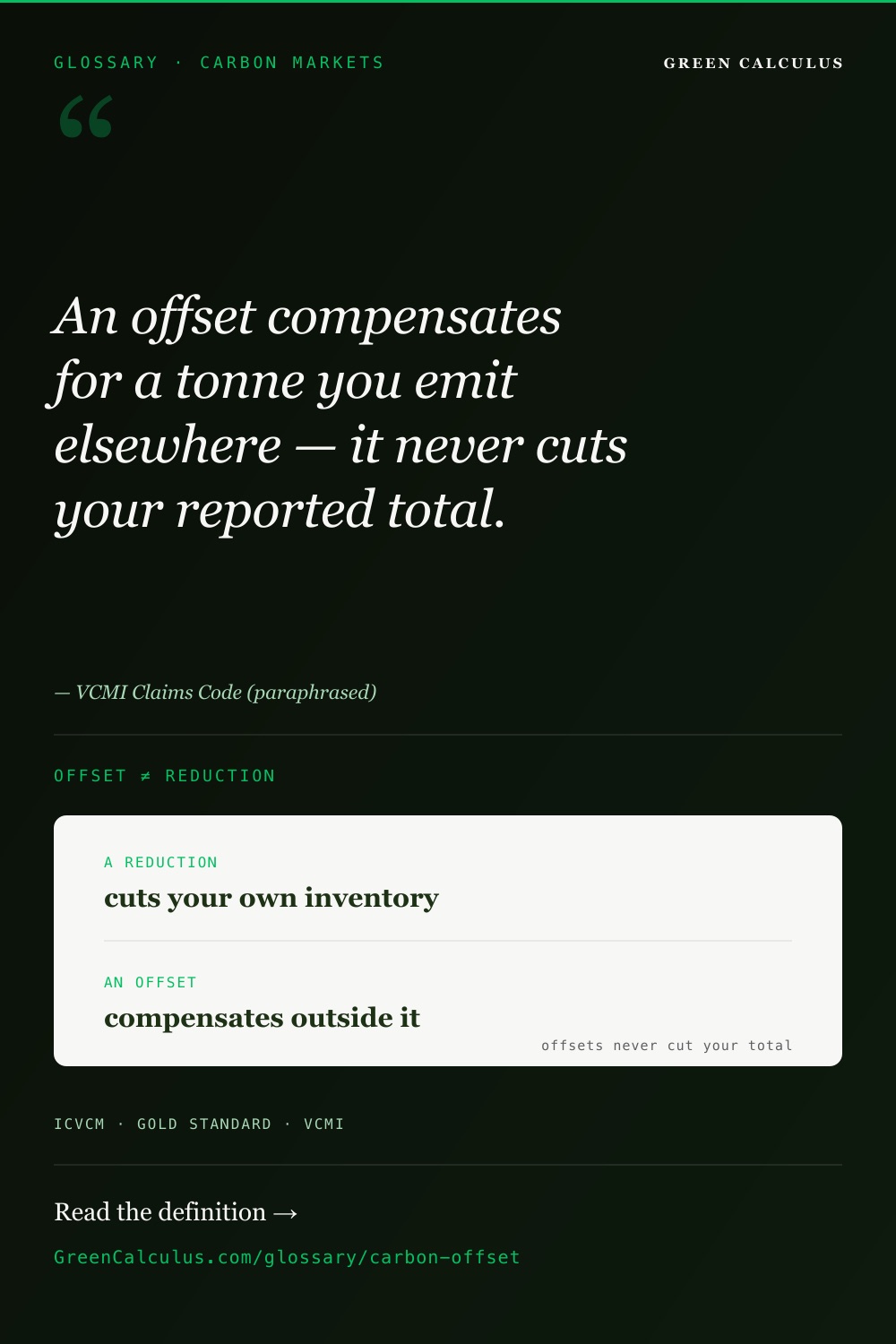
No. Your greenhouse-gas inventory still reports the tonnes you physically emitted. An offset compensates for those emissions by funding an equivalent reduction elsewhere and is disclosed as a separate action — it never lowers your reported Scope 1, 2, or 3 total. Only cutting your own emissions reduces the footprint itself.
A carbon credit is the tradable instrument — a certificate for one verified tonne of CO2e held in a registry. It becomes a carbon offset only when a buyer retires it against a specific emissions claim, permanently cancelling it so the same tonne cannot be used again. Credit is the thing; offset is the use.
Not for net-zero purposes. An avoidance credit funds an emission that would otherwise have occurred; a removal credit physically takes CO2 out of the atmosphere. Net-zero guidance such as the Oxford Principles and the SBTi standard steers buyers toward durable removals for the residual tonnes compensated at a target date, because avoidance and reversible storage do not neutralise a fossil tonne on a like-for-like basis.
Four properties: additionality (the reduction would not have happened without the credit revenue), permanence (the carbon stays stored), no double counting (the tonne is claimed once and retired), and independent verification against a sound baseline. Market-integrity initiatives such as the ICVCM Core Carbon Principles codify these thresholds, and crediting programmes such as Verra and the Gold Standard enforce them at issuance.
Prices span roughly two orders of magnitude by credit type. Nature-based avoidance credits often trade in the low single-digit-to-teens dollars per tonne, while durable engineered removals such as direct air capture sit around $500–$1,000 per tonne (2025 vintage). The gap reflects durability and integrity, not a discount — the two are not substitutes. Use the carbon offset cost calculator to budget across archetypes.