
UK Mandatory Climate Disclosures (TCFD-Aligned) — The Definitive Reference

The United Kingdom was the first G20 economy to make Task Force on Climate-related Financial Disclosures (TCFD)–aligned reporting mandatory across its regulated economy. The regime is not a single instrument but a four-layer architecture: Companies Act regulations administered by the Department for Business and Trade (DBT, formerly BEIS); FCA Listing Rules for premium-, standard-, and now UKLR-listed companies; Department for Work and Pensions (DWP) regulations for occupational pension schemes; and the FCA’s Sustainability Disclosure Requirements (SDR) for asset managers and investment products. Each layer has its own statutory instrument, threshold, scope, and first reporting year — and each shares the same TCFD four-pillar substantive content.
This page documents the UK mandatory climate disclosure regime as it stands in May 2026 with deliberate focus on the regulation-by-regulation granularity that practitioners need: which statutory instrument applies to which entity, the size thresholds that trigger obligation, the substantive disclosure requirements under each layer, the interaction with the Streamlined Energy and Carbon Reporting (SECR) regime, and the FCA’s consultation on transitioning the UK regime from TCFD to UK Sustainability Reporting Standards (UK SRS) aligned with IFRS S1 and S2. Built for sustainability officers preparing strategic report TCFD sections; for company secretaries reconciling SECR, TCFD, and SDR disclosures; for assurance providers reviewing climate disclosures under ISAE 3000; for asset managers preparing SDR entity and product disclosures; and for pension scheme trustees preparing TCFD reports under the DWP framework.
UK mandatory climate disclosures are TCFD-aligned reporting requirements imposed through four parallel regulatory layers. Layer 1 (Companies Act): The Companies (Strategic Report) (Climate-related Financial Disclosure) Regulations 2022 (SI 2022/31) require certain UK-incorporated companies and LLPs with more than 500 employees and either traded/banking/insurance status or turnover above £500m to make TCFD-aligned disclosures in their strategic report for financial years beginning on or after 6 April 2022. Layer 2 (FCA listing rules): The FCA’s PS21/23 and PS21/24 required premium- and standard-listed commercial companies to make TCFD-aligned disclosures from 2021 and 2022 respectively; these were absorbed into the UK Listing Rules (UKLR) on 29 July 2024 and DTR 7.2.8AR. Layer 3 (DWP pensions): The Occupational Pension Schemes (Climate Change Governance and Reporting) Regulations 2021 (SI 2021/839) require trustees of schemes with £1 billion or more in relevant assets to publish TCFD-aligned reports. Layer 4 (FCA SDR): The FCA’s PS23/16 introduced the Sustainability Disclosure Requirements and investment labels regime, with entity-level disclosures from large in-scope firms from 2 December 2025. Underlying the entire regime is the Streamlined Energy and Carbon Reporting (SECR) framework under SI 2018/1155, which mandates UK energy and carbon disclosure for large companies and LLPs and shares the same annual report as TCFD obligations. All quantitative GHG disclosures use the UK Government GHG conversion factors (DEFRA) as the operative emission factor source. The FCA’s 2025–2026 consultation on incorporating UK Sustainability Reporting Standards (UK SRS S1/S2, derived from IFRS S1/S2) into the UKLR is the most consequential near-term change to the regime.
Executive Summary
The UK’s mandatory climate-related financial disclosure regime is the most architecturally complex disclosure framework in the G20: not because the substantive content is unusually onerous, but because the obligation arises through four independent regulatory layers that each cover a different slice of the economy and that each have their own thresholds, effective dates, statutory instruments, and supervisory authorities. The substantive content is TCFD — the four-pillar architecture of Governance, Strategy, Risk Management, and Metrics & Targets published by the Financial Stability Board’s Task Force on Climate-related Financial Disclosures in 2017. What varies between layers is who must apply it, when they must apply it, and how it interacts with the rest of the annual report.
Four things distinguish the UK regime from adjacent disclosure frameworks. First, the UK is the operative reference jurisdiction for TCFD-mandatory reporting. The UK was the first G20 economy to publish a roadmap (November 2020) committing to mandatory TCFD-aligned reporting across the economy, and the first to deliver the implementing legislation across listed companies (FCA PS21/23, December 2021), large private companies and LLPs (SI 2022/31, January 2022), and occupational pension schemes (SI 2021/839, June 2021). Second, the regime is multi-instrument: SI 2022/31 sits in the Companies Act 2006 family; FCA TCFD requirements sit in the UKLR and DTR 7.2.8AR of the FCA Handbook; DWP pension regulations sit in the Pensions Act 2004 family; FCA SDR sits in the FCA ESG Sourcebook. Each instrument carries its own thresholds and obligations. Third, the regime is dual-stacked with SECR: large UK companies and LLPs already had mandatory energy and carbon reporting under the Streamlined Energy and Carbon Reporting regulations (SI 2018/1155) since 1 April 2019, and the SECR disclosure sits in the same strategic report as the TCFD disclosure. The interaction is the single most common source of reporting error. Fourth, the regime is in transition to UK SRS: the FCA and DBT are consulting on incorporating UK Sustainability Reporting Standards (UK SRS S1 and S2, derived from IFRS S1 and S2) into the UKLR, with mandatory application dates to be confirmed in 2026–2027. The TCFD framework, dissolved by the Financial Stability Board in October 2023 with its monitoring functions transferred to the IFRS Foundation, is the operative reference for current UK disclosure but is on a defined glide path to ISSB-aligned replacement.
For a UK-headquartered company, the operational reality is that the relevant TCFD obligation depends entirely on entity type and size. A FTSE 100 commercial company is in scope of both UKLR / DTR 7.2.8AR and SI 2022/31 and SECR — three overlapping obligations satisfied through a single, coherent strategic report section. A large private manufacturer with no listing falls within SI 2022/31 and SECR but not UKLR. A £5 billion occupational pension scheme falls within SI 2021/839 but not the Companies Act regime. An asset manager with >£5 billion AUM falls within the FCA SDR entity-level disclosures plus, if listed, the UKLR. The decision tree in §29 of this page maps the obligation set for each entity type at the level of granularity practitioners need to determine the applicable instrument before drafting any disclosure.
(1) The regime is four-layer: Companies Act (SI 2022/31), FCA listing rules (UKLR / DTR 7.2.8AR), DWP pensions (SI 2021/839), FCA SDR (ESG Sourcebook). Each layer has its own threshold, effective date, and supervisory authority. (2) The substantive content is TCFD — Governance, Strategy, Risk Management, Metrics & Targets — with the four pillars adapted into instrument-specific language in each layer. (3) The regime is dual-stacked with SECR (SI 2018/1155): SECR remains the underlying energy and carbon reporting obligation for large UK companies and LLPs, and the SECR and TCFD disclosures sit in the same strategic report. (4) All quantitative GHG disclosure uses the UK Government GHG conversion factors (DEFRA), published annually, as the operative emission factor source. (5) The regime is transitioning to UK SRS S1/S2 derived from IFRS S1/S2; the FCA consultation on incorporating UK SRS into UKLR is the most consequential near-term change, with mandatory application dates expected 2026–2027 subject to DBT endorsement of UK SRS.
Provider directory
Now it has to satisfy a regulator.
See who does this work — chosen by us, never paid placement, with the standards each one works to. Including SCS Consulting Services and ESG PRO.
Browse 3 regulatory reporting providers →Do this work? A listing is $390 a year. Get listed →
What UK Mandatory Climate Disclosures Are
UK mandatory climate disclosures are the body of statutory and regulatory rules that require certain UK-incorporated or UK-regulated entities to publish information about their exposure to, governance of, and management of climate-related risks and opportunities, in formats aligned with the recommendations of the Task Force on Climate-related Financial Disclosures (TCFD). The rules are not a single instrument: they are a coordinated regulatory regime built through four parallel legislative and supervisory channels between 2021 and 2024, with continued evolution through 2026–2027 as the UK transitions toward ISSB-aligned reporting under UK Sustainability Reporting Standards.
The substantive content underlying every layer is TCFD. The Task Force on Climate-related Financial Disclosures, established by the Financial Stability Board in December 2015 and chaired by Michael Bloomberg, published its final recommendations in June 2017. The recommendations are organised around four pillars: Governance (the organisation’s governance around climate-related risks and opportunities); Strategy (the actual and potential impacts of climate-related risks and opportunities on the organisation’s businesses, strategy, and financial planning); Risk Management (the processes used to identify, assess, and manage climate-related risks); and Metrics and Targets (the metrics and targets used to assess and manage relevant climate-related risks and opportunities). Eleven specific recommended disclosures sit beneath the four pillars. Every UK mandatory disclosure layer references these recommendations directly — either by reproducing them verbatim in the regulation, by requiring “TCFD-aligned” disclosure with specified scope, or by adapting them into regulator-specific drafting that maps cleanly back to the original recommendations.
What UK mandatory climate disclosures are not
Three distinctions matter. First, the regime is not a single instrument and there is no single “UK TCFD Act.” Practitioners frequently reference “UK TCFD requirements” as if a unified body of law existed; the reality is four parallel regulatory layers with overlapping but non-identical scopes. The applicable obligations for any given entity must be determined through the entity-type-and-size analysis set out in the decision tree in §29.
Second, the regime is not a calculation methodology. UK TCFD obligations require disclosure of Scope 1, Scope 2, and (in many cases) Scope 3 GHG emissions, but the calculation methodology comes from the GHG Protocol Corporate Standard, the GHG Protocol Scope 2 Guidance, and the GHG Protocol Scope 3 Standard. UK regulations specify what to disclose; the GHG Protocol specifies how to calculate. The DEFRA UK Government GHG conversion factors are the operative emission factor source applied within that methodology.
Third, the regime is not the same as voluntary TCFD reporting that many UK companies have undertaken since 2017. Voluntary TCFD reports follow the same four-pillar structure but are not subject to statutory enforcement, FCA supervisory review, or company law audit scope. Mandatory UK TCFD disclosures sit within the strategic report, are subject to the directors’ responsibility statement, are within the scope of audit (for consistency with the financial statements, not for substantive verification of the climate content under current rules), and are reviewable by the FCA, the FRC, and the relevant supervisory authorities.
Why the UK Moved to Mandatory TCFD
The UK’s path from voluntary TCFD reporting to mandatory TCFD-aligned disclosure ran through three phases over roughly five years. Understanding the policy logic is necessary to make sense of why the regime is structured as it is and why the transition to UK SRS is being pursued the way it is.
Phase 1 (2017–2020): voluntary adoption and the FCA “comply or explain” listing rules. Following the publication of the TCFD final recommendations in June 2017, the FCA and the FRC encouraged UK-listed companies to publish TCFD-aligned disclosures voluntarily. The FRC Financial Reporting Lab published a series of reports through 2018–2020 analysing voluntary TCFD reporting practice and identifying gaps. In December 2020, the FCA introduced Listing Rule 9.8.6R(8) (later restructured through the Listing Rules reform), requiring premium-listed commercial companies to make TCFD-consistent disclosures on a “comply or explain” basis for accounting periods beginning on or after 1 January 2021. This was the first mandatory TCFD obligation in the UK regulatory architecture, but the “comply or explain” mechanism meant non-compliant companies could opt out by stating they had done so.
Phase 2 (2020–2022): the cross-Whitehall roadmap and primary legislation. In November 2020, HM Treasury published the UK’s Interim Report and Roadmap towards mandatory climate-related disclosures, committing the UK to a fully mandatory regime across the largest UK-registered companies and financial sector firms by 2025. The roadmap was the political and procedural framework that drove SI 2021/839 (DWP pensions, June 2021), FCA PS21/23 and PS21/24 (listed companies, December 2021), and SI 2022/31 (large private companies and LLPs, January 2022). By April 2022, every major channel of the UK economy had a mandatory or near-mandatory TCFD obligation in force or imminent.
Phase 3 (2022–2026): consolidation, refinement, and the ISSB transition. With the substantive obligations in force, the post-2022 period has focused on three streams of work. The first is supervisory review and FRC thematic studies, identifying the most common failure modes in UK TCFD reporting and refining expectations through guidance rather than further primary rule-making. The second is the FCA SDR programme, which introduced the Sustainability Disclosure Requirements and investment labels (PS23/16, November 2023) and a phased rollout of entity- and product-level disclosures through 2024–2026. The third is the transition planning effort: the Transition Plan Taskforce was launched in April 2022, published its Disclosure Framework in October 2023, and was wound down in 2024 with its work transferred to the IFRS Foundation. In parallel, the FCA and DBT are consulting on incorporating UK Sustainability Reporting Standards (UK SRS S1 and S2, the UK endorsement of IFRS S1 and S2) into the UKLR, with the eventual goal of UK SRS replacing TCFD as the underlying disclosure framework across the FCA-regulated layers of the regime.
Publication History
The UK mandatory climate disclosure regime has been built through a sequence of statutory instruments and FCA policy statements between 2018 and 2024, with continued evolution through 2025–2026. The table below documents the key milestones with primary-source reference.
| Date | Event |
|---|---|
| June 2017 | TCFD final recommendations published. Four pillars (Governance, Strategy, Risk Management, Metrics & Targets) and 11 recommended disclosures established. |
| March 2018 | The Companies (Directors’ Report) and Limited Liability Partnerships (Energy and Carbon Report) Regulations 2018 (SI 2018/1155) made — the Streamlined Energy and Carbon Reporting (SECR) framework. Effective for accounting periods beginning on or after 1 April 2019. |
| July 2019 | UK Government Green Finance Strategy published; commitment to “expect all listed companies and large asset owners to disclose in line with the TCFD recommendations by 2022.” |
| November 2020 | HM Treasury publishes the Interim Report and Roadmap towards mandatory climate-related disclosures — the cross-Whitehall framework that sequences mandatory TCFD across listed companies, large private companies, asset managers, banks, insurers, and pension schemes by 2025. |
| December 2020 | FCA Policy Statement PS20/17 introduces Listing Rule 9.8.6R(8): premium-listed commercial companies make TCFD-consistent disclosures on a “comply or explain” basis from accounting periods beginning on or after 1 January 2021. |
| June 2021 | The Occupational Pension Schemes (Climate Change Governance and Reporting) Regulations 2021 (SI 2021/839) made. Trustees of schemes with £5 billion or more in relevant assets to comply from 1 October 2021; £1 billion or more from 1 October 2022. |
| October 2021 | DWP statutory guidance on the SI 2021/839 regulations published. |
| December 2021 | FCA Policy Statement PS21/23 extends mandatory TCFD-aligned disclosure to standard-listed issuers of equity shares (excluding shell companies and investment entities). FCA PS21/24 introduces TCFD-aligned disclosures for asset managers, life insurers, and FCA-regulated pension providers. Both packages effective from accounting periods beginning on or after 1 January 2022. |
| January 2022 | The Companies (Strategic Report) (Climate-related Financial Disclosure) Regulations 2022 (SI 2022/31) made. Effective for financial years beginning on or after 6 April 2022. Captures certain large UK-incorporated companies and LLPs. |
| April 2022 | Transition Plan Taskforce (TPT) launched by HM Treasury to develop a “gold standard” transition plan disclosure framework. |
| June 2023 | IFRS Foundation publishes IFRS S1 (General Requirements) and IFRS S2 (Climate-related Disclosures) — the ISSB standards that fully incorporate TCFD recommendations. |
| October 2023 | TPT publishes the TPT Disclosure Framework — the UK reference framework for corporate transition plans. Sector-specific guidance follows in subsequent months. Financial Stability Board confirms TCFD’s monitoring role complete and transfers it to the IFRS Foundation. |
| November 2023 | FCA Policy Statement PS23/16 introduces the Sustainability Disclosure Requirements (SDR) and investment labels regime. Anti-greenwashing rule effective 31 May 2024; investment labels available from 31 July 2024; product-level disclosures from 2 December 2024; entity-level disclosures from 2 December 2025 (firms with AUM > £50 billion) and 2 December 2026 (firms with AUM > £5 billion). |
| July 2024 | UK Listing Rules reform: FCA Policy Statement PS24/6 consolidates the previous Premium / Standard listing segments into a single commercial companies category effective 29 July 2024. The climate-related disclosure rule (LR 9.8.6R(8) for Premium listed) is absorbed into UKLR 6.6.6R for the unified commercial companies category and DTR 7.2.8AR continues to apply. |
| August 2024 | IFRS Foundation absorbs TPT’s intellectual property and monitoring responsibilities. The TPT Disclosure Framework continues to operate as the UK reference framework but its forward development is managed by IFRS Foundation. |
| 2024–2025 | DBT (formerly BEIS) and FCA consult on incorporating UK Sustainability Reporting Standards (UK SRS), derived from IFRS S1 and S2, into the UK disclosure regime. DBT decision on UK SRS endorsement expected to follow the consultations. |
| 2026 (expected) | UK SRS S1 and S2 endorsement decision and FCA consultation on incorporating UK SRS into UKLR replacing the TCFD-aligned regime. |
The Listing Rules reform of July 2024 is the single most consequential structural change to the UK regime since the original packages were published. The premium / standard listing segment distinction that drove the FCA’s original 2020–2021 TCFD rules (LR 9.8.6R(8) for premium listed; LR 14.3.27R-equivalent for standard listed) was collapsed into a unified commercial companies category from 29 July 2024 under UKLR 6. The substantive TCFD-aligned content requirement is preserved — commercial companies under UKLR continue to make TCFD-aligned disclosures on a “comply or explain” basis, and DTR 7.2.8AR continues to apply — but references to the legacy LR 9.8.6R(8) drafting are anachronistic in 2026. Throughout this page, “UKLR commercial companies” refers to the post-July-2024 unified category; references to “premium” and “standard” listing apply only to the pre-July-2024 architecture and to historical reports prepared under it.
Governance Architecture — FCA, DBT, DWP, TPR, FRC, PRA
The UK mandatory climate disclosure regime is administered by six government departments and regulators with overlapping but distinct responsibilities. Understanding the institutional architecture is necessary to predict how the regime will evolve and to know which authority to engage on which question.
- HM Treasury — the policy owner of the cross-Whitehall mandatory climate disclosure roadmap (November 2020) and the sponsor of the Transition Plan Taskforce (April 2022). HM Treasury also coordinates the UK’s position on the IFRS Foundation Sustainability Standards Board and the UK’s engagement with the FSB-coordinated TCFD framework.
- Department for Business and Trade (DBT, formerly BEIS) — the sponsor of the Companies Act regime, including SI 2022/31 (TCFD-aligned strategic report disclosures) and SI 2018/1155 (SECR). DBT is also the policy authority for UK Sustainability Reporting Standards (UK SRS) endorsement, the UK’s equivalent to the EU’s endorsement of ISSB standards.
- Financial Conduct Authority (FCA) — the supervisory authority for listed companies (UKLR 6, DTR 7.2.8AR), asset managers (FCA ESG Sourcebook), and the Sustainability Disclosure Requirements (FCA PS23/16). The FCA is the most active rule-maker in the UK regime and the authority most likely to drive the transition from TCFD to UK SRS.
- Department for Work and Pensions (DWP) — the policy owner of the occupational pension scheme TCFD regime (SI 2021/839) and the supervisory authority for trustee compliance. DWP guidance on the regulations was first published in October 2021 and is updated periodically.
- The Pensions Regulator (TPR) — the operational supervisor of trustee compliance with SI 2021/839. TPR publishes compliance and enforcement guidance and monitors trustee TCFD reports submitted under the regulations.
- Financial Reporting Council (FRC) — the corporate reporting and audit regulator. The FRC reviews strategic reports under SI 2022/31, publishes thematic reviews of TCFD disclosures (most recently in 2022, 2023, and 2024), and works closely with the FCA on listed company disclosure quality. The FRC is also the future host of the UK Sustainability Disclosure Standards through its proposed transformation into the Audit, Reporting and Governance Authority (ARGA).
- Prudential Regulation Authority (PRA) — the prudential supervisor of banks, building societies, insurers, and large investment firms. The PRA’s Supervisory Statement SS3/19 on managing the financial risks from climate change is the operative climate risk management framework for PRA-regulated firms and informs the climate-related risk disclosures those firms make under TCFD and the SDR.
The architecture is best understood as a coordinated multi-regulator regime rather than a single authority structure. The HM Treasury roadmap of November 2020 set the policy framework; each regulator and department then delivered its own implementing rules for its statutory remit. The result is institutional clarity within each layer (the FCA owns listed company TCFD; DWP owns pension scheme TCFD; etc.) but interaction complexity between layers, which is where the regime’s reporting complexity arises in practice.
The Four Layers of UK Mandatory Disclosure
The UK regime operates through four parallel regulatory layers, each with its own primary instrument, supervisory authority, scope, and effective date.
| Layer | Primary instrument | Supervisory authority | In-scope entities | First reporting year |
|---|---|---|---|---|
| Layer 1: Companies Act | SI 2022/31 (Companies (Strategic Report) (Climate-related Financial Disclosure) Regulations 2022) | DBT (policy); FRC (review) | UK-incorporated traded companies, banking companies, authorised insurance companies, and other companies / LLPs above size thresholds | Financial years beginning on or after 6 April 2022 |
| Layer 2: FCA Listing Rules | UKLR 6.6.6R + DTR 7.2.8AR (post-July 2024 unified regime); previously LR 9.8.6R(8) and equivalent standard-listed rule (FCA PS21/23) | FCA | UKLR commercial companies (previously premium-listed; standard-listed equity issuers excluding shell and investment entities) | Premium listed: accounting periods beginning on or after 1 January 2021; standard listed: 1 January 2022; UKLR unified: 29 July 2024 (rule reform, content requirement preserved) |
| Layer 3: DWP Pension Regulations | SI 2021/839 (Occupational Pension Schemes (Climate Change Governance and Reporting) Regulations 2021) | DWP (policy); TPR (supervision) | Occupational pension schemes with £1 billion or more in relevant assets (phased rollout from £5 billion threshold) | £5bn+ schemes: scheme years beginning on or after 1 October 2021; £1bn+ schemes: 1 October 2022 |
| Layer 4: FCA SDR | FCA ESG Sourcebook (FCA PS23/16) + extension of FCA PS21/24 entity-level TCFD requirements for asset managers, life insurers, and FCA-regulated pension providers | FCA | Asset managers, life insurers, FCA-regulated pension providers, FCA-regulated funds and portfolios; specific phasing by AUM thresholds for SDR entity disclosures | PS21/24 entity TCFD: accounting periods beginning on or after 1 January 2022 (£50bn+); 1 January 2023 (£5bn+). SDR product-level: 2 December 2024. SDR entity-level: 2 December 2025 (£50bn+); 2 December 2026 (£5bn+) |
The four layers are non-exclusive. A FTSE 100 commercial company that is a UK-incorporated traded company with over 500 employees and turnover above £500m is simultaneously in scope of Layer 1 (SI 2022/31) and Layer 2 (UKLR / DTR 7.2.8AR). A life insurer with £75bn AUM that is also UKLR-listed is in scope of Layer 2 (UKLR / DTR 7.2.8AR) and Layer 4 (FCA PS21/24 entity-level + SDR entity-level). Practitioners must work through the scope of each layer separately to determine the complete obligation set for any given entity. The decision tree in §29 sets out the analysis structure.
Layer 1: Companies Act — SI 2022/31
The Companies (Strategic Report) (Climate-related Financial Disclosure) Regulations 2022 (SI 2022/31) is the Companies Act layer of the UK regime. The regulations amend the Companies Act 2006 and the Limited Liability Partnerships (Accounts and Audit) (Application of Companies Act 2006) Regulations 2008 to insert a new requirement for climate-related financial disclosure into the strategic report (for companies) and the energy and carbon report or strategic equivalent (for LLPs).
SI 2022/31 was made on 17 January 2022 and laid before Parliament on 19 January 2022. It came into force on 6 April 2022 and applies to financial years beginning on or after that date. The regulations are administered by DBT (the policy owner) and reviewed by the FRC under its corporate reporting review remit. There is no separate supervisory authority for SI 2022/31 compliance — enforcement runs through standard Companies Act mechanisms (directors’ responsibility, audit consistency, FRC review, ultimately court action for material non-compliance).
Scope: who is in
SI 2022/31 captures four categories of UK-incorporated entity:
- UK-incorporated companies with securities admitted to trading on a UK regulated market (essentially LSE Main Market) and with more than 500 employees.
- Banking companies and authorised insurance companies with more than 500 employees, regardless of listing status.
- UK-incorporated AIM companies with more than 500 employees.
- Other UK-incorporated companies and LLPs not in the categories above with both more than 500 employees and turnover above £500 million.
The thresholds are designed to capture economically significant entities while sparing genuinely small businesses. The 500-employee floor cuts off the SME tail; the £500m turnover requirement on the residual large-private category ensures that only the truly large unlisted businesses fall within scope. Companies and LLPs that fall below the thresholds are out of scope of SI 2022/31 but may still be subject to SECR (SI 2018/1155) under that regime’s separate thresholds (see §17).
Strategic report integration
SI 2022/31’s mechanical innovation is that the climate-related financial disclosure is required to sit within the existing strategic report — not in a separate climate report. For companies, the strategic report is the narrative report required by section 414A of the Companies Act 2006; for LLPs, the equivalent is the LLP’s energy and carbon report or strategic report under the LLP Regulations. The integration with the strategic report has three operational consequences: the disclosure is part of the directors’ responsibility statement; it is within the scope of audit for consistency with the financial statements; and it is reviewable by the FRC under standard corporate reporting review procedures.
The strategic report integration also means that SI 2022/31 disclosures appear in the same document as SECR disclosures (which have sat in the directors’ report or the strategic report, at the company’s option, since 2019) and, for UKLR-listed companies, TCFD disclosures under the listing rules. The interaction of these overlapping obligations within a single document is the single largest source of reporting error in UK climate-related disclosure (see §31).
SI 2022/31 Size Thresholds
The applicability thresholds in SI 2022/31 are precise and operate on a per-financial-year basis. An entity that crosses the threshold in a financial year is in scope for that year; an entity that previously was in scope but drops below the threshold may exit scope subject to the regulations’ specific exit-and-re-entry rules.
| Entity category | Employee threshold | Turnover threshold | Listing requirement |
|---|---|---|---|
| UK-incorporated traded company (LSE Main Market or equivalent UK regulated market) | > 500 employees | None | Securities admitted to trading on a UK regulated market |
| Banking company (Companies Act definition; broadly entities authorised to accept deposits) | > 500 employees | None | None — applies regardless of listing |
| Authorised insurance company (Companies Act definition) | > 500 employees | None | None — applies regardless of listing |
| UK-incorporated AIM company (admitted to trading on AIM) | > 500 employees | None | AIM |
| Other UK-incorporated company or LLP not covered above | > 500 employees | > £500 million | None |
How thresholds are measured
The employee count is measured as the average number of persons employed by the company under contracts of service during the financial year, calculated under the existing Companies Act methodology used elsewhere in the financial reporting framework. Turnover is measured as the amount disclosed as turnover in the financial statements for the financial year, calculated under UK GAAP or IFRS as adopted by the UK as applicable.
For LLPs, the equivalent measures apply under the LLP Regulations — member count substituting for employee count is not the measure; LLPs use employee count under the same standard as companies. The £500m turnover threshold applies to LLP turnover measured under UK GAAP or IFRS as adopted by the UK.
Group consolidation
SI 2022/31 applies on a UK-incorporated-entity basis. A UK parent of a global group that meets the thresholds is in scope and must make TCFD-aligned disclosures in its consolidated strategic report covering the group. A UK subsidiary of an overseas parent that itself meets the thresholds is independently in scope and must make its own strategic report disclosures, regardless of any group-level reporting the overseas parent makes. There is no equivalence regime under SI 2022/31 that exempts UK subsidiaries on the basis of overseas parent reporting.
SI 2022/31 Substantive Requirements
SI 2022/31 inserts eight specific disclosure requirements into the strategic report. The drafting follows the TCFD four-pillar architecture but adapts the eleven TCFD recommended disclosures into eight statutory requirements for compactness.
- Governance: a description of the company’s governance arrangements in relation to assessing and managing climate-related risks and opportunities.
- Risk management process: a description of how the company identifies, assesses, and manages climate-related risks.
- Risk management integration: a description of how processes for identifying, assessing, and managing climate-related risks are integrated into the company’s overall risk management process.
- Principal climate-related risks and opportunities: a description of the principal climate-related risks and opportunities arising in connection with the company’s operations, and the time periods by reference to which those risks and opportunities are assessed.
- Impact on business model and strategy: a description of the actual and potential impacts of the principal climate-related risks and opportunities on the company’s business model and strategy.
- Resilience analysis (scenario analysis): an analysis of the resilience of the company’s business model and strategy, taking into consideration different climate-related scenarios.
- Climate-related targets: a description of the targets used by the company to manage climate-related risks and to realise climate-related opportunities, and of performance against those targets.
- Key performance indicators: a description of the key performance indicators used to assess progress against targets used to manage climate-related risks and realise climate-related opportunities, and of the calculations on which those KPIs are based.
“Comply or explain” structure
SI 2022/31 requirements (4), (5), and (6) operate on a “comply or explain” basis. The regulations require the strategic report to include the relevant disclosure or, if the company has not included that disclosure, an explanation of why not. The “or explain” carve-out is intended to accommodate companies that have determined particular disclosures are not material or that are in the early stages of building the relevant data and analytical capability.
The other requirements — Governance (1), Risk management process (2), Risk management integration (3), Climate-related targets (7), and Key performance indicators (8) — are full disclosure requirements. There is no “or explain” alternative; companies in scope must make the disclosures.
Mapping to TCFD recommendations
The eight SI 2022/31 requirements map cleanly onto the eleven TCFD recommended disclosures, but the mapping is not one-to-one. The table below sets out the correspondence:
| TCFD pillar | TCFD recommended disclosure | SI 2022/31 requirement |
|---|---|---|
| Governance | (a) Describe the board’s oversight of climate-related risks and opportunities. | (1) Governance |
| Governance | (b) Describe management’s role in assessing and managing climate-related risks and opportunities. | (1) Governance |
| Strategy | (a) Describe the climate-related risks and opportunities the organisation has identified over the short, medium, and long term. | (4) Principal climate-related risks and opportunities |
| Strategy | (b) Describe the impact of climate-related risks and opportunities on the organisation’s businesses, strategy, and financial planning. | (5) Impact on business model and strategy |
| Strategy | (c) Describe the resilience of the organisation’s strategy, taking into consideration different climate-related scenarios. | (6) Resilience analysis (scenario analysis) |
| Risk Management | (a) Describe the organisation’s processes for identifying and assessing climate-related risks. | (2) Risk management process |
| Risk Management | (b) Describe the organisation’s processes for managing climate-related risks. | (2) Risk management process |
| Risk Management | (c) Describe how processes for identifying, assessing, and managing climate-related risks are integrated into the organisation’s overall risk management. | (3) Risk management integration |
| Metrics & Targets | (a) Disclose the metrics used by the organisation to assess climate-related risks and opportunities. | (8) Key performance indicators |
| Metrics & Targets | (b) Disclose Scope 1, Scope 2, and, if appropriate, Scope 3 GHG emissions. | SECR (SI 2018/1155) plus SI 2022/31 (8) KPI requirement to the extent the metrics are GHG-based |
| Metrics & Targets | (c) Describe the targets used by the organisation to manage climate-related risks and opportunities and performance against targets. | (7) Climate-related targets |
SI 2022/31 itself does not directly require quantitative Scope 1, 2, and 3 GHG emissions disclosure — the eight requirements are framed at the level of governance, risk, strategy, targets, and KPIs without prescribing the specific metrics. The quantitative GHG disclosure obligation for in-scope entities comes from the parallel SECR regime under SI 2018/1155 (for UK energy and Scope 1 + Scope 2 + a defined slice of Scope 3) and from the FCA listing rules (which require TCFD-aligned Scope 1, 2, and 3 disclosure with proportionality for Scope 3). The result is that the GHG disclosure for any large UK company that is also listed sits at the intersection of three rules: SECR for the underlying mandatory UK reporting, SI 2022/31 for the KPI structure within the strategic report, and the UKLR for the listing-driven Scope 3 expectation. Practitioners frequently misread SI 2022/31 as a stand-alone GHG disclosure rule; it is not.
Layer 2: FCA Listing Rules — UKLR & DTR 7.2.8AR
The FCA listing rules layer of the UK regime is administered by the Financial Conduct Authority and operates through the FCA Handbook. Two structural innovations matter: the layer was the first mandatory TCFD obligation in the UK (effective for premium-listed commercial companies from 1 January 2021); and the layer was restructured by the July 2024 UK Listing Rules reform, which collapsed the premium / standard distinction into a single commercial companies category.
The pre-July 2024 architecture
From accounting periods beginning on or after 1 January 2021, FCA PS20/17 introduced Listing Rule 9.8.6R(8), which required premium-listed commercial companies to include in their annual report a statement setting out whether they had made disclosures consistent with the TCFD recommendations or, if not, an explanation of why. The “comply or explain” structure mirrored the broader UK governance approach.
FCA Policy Statement PS21/23, published December 2021, extended the obligation to standard-listed issuers of equity shares (excluding shell companies and investment entities), effective for accounting periods beginning on or after 1 January 2022. The extension was operationalised through the equivalent standard-listed rule and through DTR 7.2.8AR, which applies the TCFD-aligned disclosure expectation to all issuers required to make a corporate governance statement.
The post-July 2024 architecture
FCA Policy Statement PS24/6, effective 29 July 2024, restructured the listing regime. The previous Premium and Standard listing segments were collapsed into a unified commercial companies category under UKLR 6. The climate-related disclosure requirement is preserved in the new architecture: UKLR 6.6.6R imposes the TCFD-aligned “comply or explain” disclosure obligation on commercial companies, and DTR 7.2.8AR continues to apply across the broader population of issuers required to make a corporate governance statement.
The substantive content requirement — TCFD-aligned disclosures across the four pillars and the eleven recommended disclosures — is unchanged by the Listing Rules reform. The reform changed how the listing categories are organised, not what climate disclosure they must produce.
“Consistent with TCFD” wording
The FCA’s listing rule wording is “consistent with” the TCFD recommendations, not “in accordance with.” The choice of language is deliberate. “Consistent with” allows reasonable interpretation and judgment in applying the TCFD recommendations to the specific facts of a company’s situation; “in accordance with” would imply a more prescriptive compliance test. The FCA’s supervisory practice, as set out in successive Technical Notes, is that companies stating compliance must address all four pillars and all eleven recommended disclosures, with sufficient detail and quantitative content to be substantively informative, while accepting reasonable variation in presentation and emphasis.
FCA TCFD Requirements for Listed Companies
Beyond the headline “consistent with TCFD” obligation, the FCA’s supervisory framework imposes a number of more specific expectations on how listed companies should approach their TCFD disclosures.
Statement of consistency
Listed companies must include a clear, prominent statement in their annual report stating whether their disclosures are consistent with the TCFD recommendations. If the company has determined that the disclosures are consistent across all four pillars and all eleven recommended disclosures, the statement should say so. If the company has determined that one or more disclosures are not consistent, the statement must identify the specific recommendations involved, explain why the disclosure has not been made, and set out the company’s plan and timeline for making the disclosure in future reporting periods.
The eleven recommended disclosures
The FCA’s expectation is that listed companies address each of the eleven TCFD recommended disclosures specifically, rather than treating the four pillars as broad categories to be discussed thematically. The eleven disclosures are: Governance (a) board oversight, (b) management’s role; Strategy (a) risks and opportunities identified, (b) impact on business, (c) resilience under different scenarios; Risk Management (a) identification and assessment, (b) management, (c) integration into overall risk management; Metrics & Targets (a) metrics used, (b) Scope 1, 2, 3 GHG emissions, (c) targets and performance.
Scope 1, 2, and 3 GHG emissions
Listed companies must disclose Scope 1, Scope 2, and Scope 3 GHG emissions. The FCA’s expectation, drawn from the TCFD’s supplemental guidance, is that Scope 3 disclosure should be made if appropriate — meaning that companies for which Scope 3 is material should disclose, while companies for which Scope 3 is genuinely immaterial may omit the disclosure if they explain the assessment. In practice, virtually all FTSE 350 commercial companies have material Scope 3 exposure (purchased goods and services, use of sold products, employee commuting, business travel, capital goods), and the FCA’s supervisory expectation has hardened toward expecting Scope 3 disclosure rather than treating it as genuinely optional. The methodology comes from the GHG Protocol Scope 3 Standard.
Scenario analysis
The FCA’s expectation, drawn from the TCFD’s 2017 recommendations and its 2020 and 2021 guidance updates, is that scenario analysis should address at least two scenarios: one in which global warming is held below 2°C above pre-industrial levels, and one or more “business as usual” or higher-warming scenarios. Companies should disclose the scenarios used, the assumptions, the time horizons, and the qualitative and where possible quantitative results. The FCA does not prescribe specific scenarios but commonly referenced scenarios include those from the International Energy Agency (Net Zero Emissions by 2050, Stated Policies Scenario), the Network for Greening the Financial System (NGFS), and the Intergovernmental Panel on Climate Change.
Layer 3: DWP Pension Regulations — SI 2021/839
The Occupational Pension Schemes (Climate Change Governance and Reporting) Regulations 2021 (SI 2021/839) is the pensions layer of the UK regime. The regulations require trustees of occupational pension schemes above defined thresholds to integrate climate change considerations into scheme governance, undertake climate-related risk assessment and scenario analysis, and publish an annual TCFD-aligned report on the scheme’s website.
SI 2021/839 was made on 16 June 2021 and came into force in two stages: 1 October 2021 for schemes with £5 billion or more in relevant assets at the first scheme year-end falling on or after 1 March 2020; and 1 October 2022 for schemes with £1 billion or more in relevant assets at the first scheme year-end falling on or after 1 March 2021. The regulations are sponsored by DWP and supervised by The Pensions Regulator (TPR). Compliance enforcement runs through TPR’s standard supervisory mechanisms; non-compliance is subject to civil penalties.
Phased threshold rollout
| Scheme threshold | Effective date | First TCFD report deadline |
|---|---|---|
| £5 billion or more in relevant assets | 1 October 2021 | Within 7 months of the end of the first scheme year-end falling on or after 1 October 2021 |
| £1 billion or more in relevant assets | 1 October 2022 | Within 7 months of the end of the first scheme year-end falling on or after 1 October 2022 |
| Authorised master trusts and collective money purchase schemes | 1 October 2021 (regardless of asset size) | Within 7 months of the end of the first scheme year-end falling on or after 1 October 2021 |
Substantive trustee obligations
SI 2021/839 imposes four sets of obligations on trustees of in-scope schemes:
- Governance: establish and maintain oversight of climate-related risks and opportunities; ensure those responsible for managing the scheme have appropriate climate-related capabilities.
- Strategy: identify climate-related risks and opportunities affecting the scheme’s investment strategy and funding strategy over the short, medium, and long term; assess the resilience of investment and funding strategy under at least two climate scenarios, one of which must be aligned with global warming of 1.5°C–2°C above pre-industrial levels.
- Risk management: establish and maintain processes to identify, assess, and manage climate-related risks; integrate climate-related risk management into the scheme’s overall risk management.
- Metrics and targets: select and calculate at least four climate-related metrics covering absolute emissions (Scope 1, Scope 2, and as far as possible Scope 3), an emissions intensity metric, an additional climate change metric, and a portfolio alignment metric; set at least one non-binding target for one of the chosen metrics; review the target and metrics annually.
The trustee TCFD report must be published on a publicly accessible website within seven months of the scheme year-end. The report must be flagged to members in the scheme’s annual benefit statement or equivalent communication. The Pensions Regulator monitors compliance through trustee filings and may impose civil penalties for non-compliance.
Why the pension scheme regime matters for corporate reporters
The pensions layer is the most direct UK example of mandatory portfolio-level climate disclosure imposed on an asset owner rather than an asset manager. The methodology choices made by large pension scheme trustees on metric calculation (in particular for the portfolio alignment metric and the Scope 3 financed emissions estimation) are watched closely by the FCA in its SDR rule development and by the PRA in its prudential climate risk work, and ultimately feed back into the expectations applied to listed asset managers and to corporates whose pension fund is itself in scope of SI 2021/839.
Layer 4: FCA SDR — ESG Sourcebook
The FCA’s Sustainability Disclosure Requirements (SDR) and investment labels regime is the most recent layer of the UK regime. SDR was introduced through FCA Policy Statement PS23/16, published 28 November 2023, and is being phased in across 2024–2026. The regime sits in the FCA’s ESG Sourcebook in the FCA Handbook and applies to FCA-regulated asset managers, the products they manage, and (through the existing PS21/24 entity-level TCFD rule) life insurers and FCA-regulated pension providers.
The five SDR investment labels
The headline innovation of SDR is the investment labels regime — a set of four labels that asset managers may apply to their funds and portfolios to communicate sustainability strategy clearly to consumers:
- Sustainability Focus — for products that aim to invest mainly in assets that are environmentally and/or socially sustainable.
- Sustainability Improvers — for products that aim to invest mainly in assets that have the potential to become more environmentally and/or socially sustainable over time.
- Sustainability Impact — for products that aim to achieve a positive, measurable contribution to sustainable outcomes.
- Sustainability Mixed Goals — for products that combine the strategies of two or more of the above three labels.
The labels are voluntary but, once adopted, trigger product-level disclosure requirements. Funds that do not adopt a label can still discuss sustainability features in their marketing materials provided they comply with the FCA’s anti-greenwashing rule and the naming and marketing rules in the SDR.
SDR phased rollout
| SDR component | Effective date | Scope |
|---|---|---|
| Anti-greenwashing rule (ESG 4.3.1R) | 31 May 2024 | All FCA-authorised firms communicating sustainability claims |
| Investment labels available | 31 July 2024 | Voluntary adoption by UK-authorised funds |
| Naming and marketing rules | 2 December 2024 | UK-authorised funds using sustainability-related terms |
| Consumer-facing and pre-contractual disclosures | 2 December 2024 | UK-authorised funds using a label or sustainability terms |
| Ongoing product-level disclosures | 2 December 2025 | UK-authorised funds using a label |
| Entity-level disclosures (firms with > £50bn AUM) | 2 December 2025 | Asset managers above the £50bn threshold |
| Entity-level disclosures (firms with > £5bn AUM) | 2 December 2026 | Asset managers above the £5bn threshold |
SDR and the pre-existing PS21/24 entity TCFD rule
The SDR entity-level disclosures sit on top of the pre-existing FCA PS21/24 requirements, which from accounting periods beginning on or after 1 January 2022 (£50bn+ AUM) and 1 January 2023 (£5bn+ AUM) require asset managers, life insurers, and FCA-regulated pension providers to publish entity-level and product-level TCFD-aligned disclosures. The SDR builds on these requirements and ultimately is expected to absorb them when the FCA completes the transition to UK Sustainability Reporting Standards.
The TCFD Four-Pillar Architecture in the UK Context
Each layer of the UK regime applies the TCFD four-pillar architecture, adapted into instrument-specific language. The substantive content of each pillar is summarised below in the form most relevant to UK reporters.
Governance
Disclosure of the organisation’s governance arrangements for climate-related risks and opportunities. The two recommended disclosures are board oversight (how the board oversees climate-related risks and opportunities, including the frequency of consideration and the integration into board committees and decision-making) and management’s role (how management assesses and manages climate-related risks and opportunities, including the organisational structure, reporting lines, and integration with executive remuneration where applicable). UK reporters routinely structure this section around the role of a designated board climate committee or sustainability committee, the role of the audit committee in oversight of climate-related financial disclosures, the role of executive committees in operational management, and the linkage between climate performance and executive remuneration.
Strategy
Disclosure of the actual and potential impacts of climate-related risks and opportunities on the organisation’s businesses, strategy, and financial planning. Three recommended disclosures: risks and opportunities identified over short, medium, and long-term horizons; impact on business, strategy, and financial planning; and resilience under different climate scenarios. The scenario analysis disclosure is the most analytically demanding component of the strategy pillar, and the area where UK reporters most frequently fall short of FCA and FRC expectations (see §31).
Risk Management
Disclosure of the processes used to identify, assess, and manage climate-related risks. Three recommended disclosures: identification and assessment processes; management processes; and integration into the organisation’s overall risk management. The FCA’s expectation is that the risk management disclosure should map clearly to the organisation’s enterprise risk management framework, with climate-related risks treated as an integrated component of that framework rather than a parallel and isolated risk category.
Metrics and Targets
Disclosure of the metrics and targets used to assess and manage climate-related risks and opportunities. Three recommended disclosures: metrics used to assess climate-related risks and opportunities; Scope 1, Scope 2, and (if appropriate) Scope 3 GHG emissions; and targets and performance against targets. This is the most quantitative pillar of the four and the area where the underlying calculation methodology (GHG Protocol Corporate Standard, GHG Protocol Scope 2 Guidance, GHG Protocol Scope 3 Standard) and emission factor source (DEFRA UK Government GHG conversion factors) directly determine the reported numbers.
UK Metrics & Targets Requirements
The Metrics & Targets pillar of TCFD is the area where the four UK regulatory layers most clearly converge on shared quantitative content. Across all layers, the operative metrics expectation centres on:
- Scope 1 emissions — direct GHG emissions from sources owned or controlled by the entity, calculated under the GHG Protocol Corporate Standard with consolidation approach disclosed (equity share, financial control, or operational control). See the Scope 1 emissions glossary for the operative definition.
- Scope 2 emissions — indirect emissions from purchased electricity, heat, steam, and cooling, with dual location-based and market-based reporting under the GHG Protocol Scope 2 Guidance where market-based instruments (energy attribute certificates, power purchase agreements) are applied. See the Scope 2 emissions glossary and the Scope 2 location-based vs market-based comparison.
- Scope 3 emissions — other indirect emissions across the value chain, calculated under the GHG Protocol Scope 3 Standard across the 15 categories defined in that standard, with materiality assessment used to identify the categories that warrant detailed disclosure. See the Scope 3 emissions glossary.
- Emissions intensity metric — a ratio relating emissions to a business activity metric (revenue, production volume, floor area, full-time equivalent staff, or similar), with the choice of denominator disclosed and applied consistently across reporting cycles.
- Climate-related targets and performance — near-term, medium-term, and long-term targets including absolute emissions reduction targets and intensity-based targets, with the baseline year, target year, target boundary, and performance against the target disclosed in the strategic report or equivalent.
UK-specific quantitative requirements
The SECR layer (SI 2018/1155) imposes specific quantitative requirements that operate alongside the TCFD framework. Large UK companies and LLPs in scope of SECR must disclose: UK energy use (kWh) from electricity, gas, and transport fuels; underlying global GHG emissions from electricity, gas, and transport fuels (and other sources where relevant); the methodology used; an intensity ratio; and any energy efficiency action taken in the reporting year. SECR is the UK floor of mandatory quantitative climate disclosure for large companies and LLPs; the TCFD-aligned disclosure under SI 2022/31 and the UKLR builds on top of the SECR foundation.
The DWP regime (SI 2021/839) imposes specific quantitative requirements on pension scheme trustees: at least four climate-related metrics covering absolute emissions, an emissions intensity metric, an additional climate change metric, and a portfolio alignment metric. The portfolio alignment metric is the most analytically demanding — trustees must select a methodology (binary target measurement, benchmark divergence, or implied temperature rise) and disclose how the scheme’s portfolio aligns with global warming temperature pathways.
Scope 3 Under UK Mandatory Disclosure
Scope 3 disclosure is the most contested area of the UK mandatory climate disclosure regime — partly because the underlying methodology is the most complex (15 categories of indirect emissions, with data quality varying enormously across them), partly because the regulatory layers treat Scope 3 with subtly different language, and partly because Scope 3 is empirically much larger than Scope 1 and Scope 2 combined for most companies and therefore drives the substantive climate profile of the disclosure.
How each layer treats Scope 3
- SI 2022/31: does not specifically require Scope 3 disclosure. The KPI requirement (8) imposes a structural disclosure of climate-related metrics, which in practice includes Scope 1 and Scope 2 for most reporters and may include Scope 3 where it is material to the company’s climate strategy. The “comply or explain” structure for the strategy and resilience disclosures (requirements 4, 5, 6) accommodates companies that have not yet built Scope 3 reporting capability.
- UKLR / DTR 7.2.8AR: applies the full TCFD recommendation, which includes Scope 1, Scope 2, and Scope 3 “if appropriate.” The FCA’s supervisory practice has hardened toward expecting Scope 3 disclosure for FTSE 350 commercial companies on the basis that Scope 3 is empirically material for the overwhelming majority of large issuers.
- SI 2021/839: requires absolute emissions covering Scope 1, Scope 2, and “as far as you are able” Scope 3 for the portfolio of investments held by the scheme. The phrasing acknowledges Scope 3 data availability challenges in investment portfolios while requiring trustees to make a good-faith effort.
- FCA PS21/24 entity TCFD + SDR: requires entity-level and product-level disclosures, including financed emissions for asset managers (effectively a sectoral-Scope 3 disclosure). Financed emissions methodology typically draws on the PCAF Global GHG Accounting and Reporting Standard for the Financial Industry.
The “proportionate” carve-out
Across the UK regime, the operative test for Scope 3 disclosure is materiality. Companies and entities for which Scope 3 is genuinely immaterial may omit detailed Scope 3 disclosure if they explain the assessment. Companies for which Scope 3 is material — which in practice means substantially every company with significant value chain exposure — are expected to disclose, applying the 15-category framework of the GHG Protocol Scope 3 Standard with appropriate granularity and methodology disclosure.
UK SECR — The Energy and Carbon Reporting Layer Beneath TCFD
The Streamlined Energy and Carbon Reporting (SECR) regime, established under the Companies (Directors’ Report) and Limited Liability Partnerships (Energy and Carbon Report) Regulations 2018 (SI 2018/1155), is the underlying mandatory energy and carbon reporting obligation for large UK companies and LLPs. SECR pre-dates the UK TCFD regime by several years and sits beneath it as the quantitative GHG and energy disclosure floor.
SECR was made on 5 November 2018 and came into force for financial years beginning on or after 1 April 2019. It is administered by DBT and integrated into the Companies Act 2006 framework through amendments to the directors’ report (for unquoted large companies) and the energy and carbon report (for large LLPs). Quoted companies were already subject to mandatory GHG reporting under the Mandatory Greenhouse Gas Emissions Reporting Regulations of 2013; SECR expanded the mandatory reporting population to include unquoted large companies and LLPs.
SECR scope
SECR applies to:
- Quoted companies (companies whose equity share capital is officially listed) — subject to the more extensive 2013 mandatory GHG reporting requirements, with SECR consolidating and updating the regime.
- Large unquoted UK-incorporated companies and large LLPs — defined as those meeting two or more of: turnover > £36 million, balance sheet total > £18 million, employees > 250. (These are the Companies Act 2006 “large company” thresholds.)
The SECR thresholds are materially lower than the SI 2022/31 thresholds (which require > 500 employees and either traded/banking/insurance status or > £500m turnover). The result is a population pyramid: many more companies are in scope of SECR than of SI 2022/31, and SECR captures the broad large-company tier while SI 2022/31 captures the very largest.
SECR substantive content
For quoted companies, SECR requires disclosure of: annual UK and global GHG emissions in tonnes of CO2e covering Scope 1 (direct), Scope 2 (electricity, heat, steam, cooling), and a relevant slice of Scope 3 (business travel emissions from fuel use); UK energy consumption (kWh); an intensity ratio; the methodology used; and a description of energy efficiency action.
For large unquoted companies and LLPs, SECR requires similar disclosure but is limited to UK energy use and the associated UK GHG emissions, with the additional Scope 3 business travel component required only for quoted companies. Both populations must disclose the methodology used (typically the GHG Protocol Corporate Standard with DEFRA UK Government GHG conversion factors) and any energy efficiency action taken in the reporting period.
The SECR / TCFD interaction
The SECR disclosure and the TCFD-aligned disclosure under SI 2022/31, UKLR, or the FCA framework sit in the same annual report — usually in the strategic report. The interaction is one of the largest sources of reporting error and confusion in UK climate-related disclosure.
Purpose: SECR is a UK energy use and GHG emissions disclosure regime focused on quantitative reporting of consumption and emissions. TCFD is a climate risk and opportunity disclosure framework focused on governance, strategy, risk management, and metrics & targets across the four pillars. Scope: SECR captures large UK companies and LLPs (250+ employee, £36m+ turnover thresholds). UK TCFD obligations capture different populations across the four layers, with SI 2022/31 capturing 500+ employee large companies/LLPs and the FCA listing rules capturing UKLR-listed commercial companies. Substantive content: SECR is quantitative GHG and energy data plus methodology disclosure and intensity ratio. UK TCFD is the full four-pillar architecture including governance, strategy, risk management, and metrics & targets. In the strategic report: SECR disclosure historically sat in the directors’ report; many companies now place SECR within the strategic report for consolidation. TCFD-aligned disclosure under SI 2022/31 sits in the strategic report. UKLR companies place TCFD disclosure in the annual report, typically in a dedicated strategic report section. Methodology: SECR explicitly references the UK Government Environmental Reporting Guidelines and the DEFRA UK Government GHG conversion factors. TCFD-aligned disclosure references the GHG Protocol Corporate Standard, Scope 2 Guidance, and Scope 3 Standard, with DEFRA factors applied at the UK operational level. The reconciliation rule: the SECR-disclosed Scope 1 and Scope 2 emissions must be the same numbers as the TCFD-aligned Scope 1 and Scope 2 disclosures in the same annual report. Discrepancies between the two are an FRC-identified common error and a basic consistency review trigger.
The DEFRA Emission Factors Connection
Every quantitative GHG emissions disclosure under the UK mandatory climate disclosure regime — under SI 2022/31, UKLR, DWP, SDR, and SECR — sits on top of the UK Government GHG conversion factors published annually by the Department for Environment, Food and Rural Affairs (DEFRA) jointly with the Department for Energy Security and Net Zero (DESNZ). The DEFRA factors are the operative UK emission factor source for fuel combustion, fugitive emissions, transport, electricity (for UK location-based Scope 2), and a wide range of other emissions categories.
The DEFRA factors are updated annually, with each year’s factors published in mid-year and applicable to subsequent reporting cycles. The current operative factor set in 2026 is the DEFRA 2025 conversion factors published in summer 2025. The full factor set is documented in the GreenCalculus DEFRA emission factors reference page.
The disclosure-to-data chain
The data chain from disclosure obligation to underlying emission factor runs as follows:
- The disclosure obligation: arising from SI 2022/31, UKLR, SI 2021/839, FCA SDR, or SECR, requiring quantitative Scope 1 / Scope 2 / Scope 3 GHG disclosure.
- The calculation methodology: GHG Protocol Corporate Standard for Scope 1 and Scope 2 framework; GHG Protocol Scope 2 Guidance for dual location-based and market-based reporting; GHG Protocol Scope 3 Standard for value chain categories; ISO 14064-1 as the parallel quantification standard.
- The activity data: fuel consumption (litres of diesel, cubic metres of natural gas, kWh of electricity), distance travelled, weight or volume of inputs, supplier-specific data where available.
- The emission factor: DEFRA UK Government GHG conversion factors (the operative factor for UK-located activities); IEA Grid Emission Factors (the operative source for non-UK location-based Scope 2); supplier-specific factors and residual mix factors where market-based Scope 2 is calculated.
- The GWP basis: IPCC AR6 GWP-100 values for converting non-CO2 gases to CO2e, as documented in the GreenCalculus IPCC AR6 GWP values reference page.
- The reported number: tonnes of CO2e by scope, presented in the strategic report or trustee TCFD report.
The chain is operative across every layer of the UK regime. A FTSE 100 commercial company reporting Scope 1 emissions under SECR and under SI 2022/31 KPI (8) and under UKLR / DTR 7.2.8AR uses the same DEFRA-anchored calculation for all three disclosures — producing a single Scope 1 number that satisfies all three rules simultaneously. The GreenCalculus Scope 1 Combustion Calculator implements this calculation for fuel combustion sources using the current DEFRA 2025 factor set.
Scenario Analysis Under UK TCFD
Scenario analysis is the most analytically demanding component of the TCFD framework and the area where UK reporters most frequently fall short of FCA and FRC expectations. The requirement appears in SI 2022/31 (requirement 6, resilience analysis, on a “comply or explain” basis), in the UKLR / DTR 7.2.8AR (full TCFD Strategy pillar disclosure (c)), and in SI 2021/839 (mandatory scenario analysis for occupational pension scheme trustees with at least one scenario aligned with 1.5–2°C global warming).
Scenario selection
The FCA, FRC, and TPR have not prescribed specific scenarios for use in UK climate disclosure. The expectation is that reporters select scenarios appropriate to their business model, sector, and time horizon, with at least one transition-aligned scenario (typically aligned with global warming of 1.5–2°C above pre-industrial levels) and at least one physical-risk-relevant scenario (typically a higher-warming scenario consistent with current policies). Commonly applied scenario sets include:
- IEA scenarios: the Net Zero Emissions by 2050 (NZE) Scenario, Announced Pledges Scenario (APS), and Stated Policies Scenario (STEPS) from the annual World Energy Outlook.
- NGFS scenarios: the Network for Greening the Financial System publishes climate scenarios specifically designed for financial sector use, covering orderly and disorderly transition pathways and high-warming “hot house world” scenarios.
- IPCC scenarios: the Shared Socioeconomic Pathways (SSPs) and Representative Concentration Pathways (RCPs) used in the IPCC AR6 reports.
FRC expectations
The FRC’s thematic reviews of TCFD disclosures, most recently in 2024, have identified scenario analysis as the area most in need of improvement across UK reporters. The recurring themes in FRC findings: scenarios chosen without clear linkage to the company’s specific risks; quantitative analysis substituted by qualitative narrative; assumptions not disclosed; time horizons not specified; the impact on financial planning not articulated; the resilience conclusion stated without supporting analysis. The FRC’s 2024 thematic review on climate-related and metrics-related disclosures restated these expectations and provided examples of better practice.
Transition Plans — The TPT Framework
Transition plans are a distinct disclosure object within the UK regime: forward-looking statements of how an entity intends to align its strategy and operations with the transition to a low-carbon economy. The UK approach to transition plan disclosure has developed in parallel with the broader TCFD-aligned reporting regime and is anchored on the Transition Plan Taskforce (TPT) framework.
The TPT was established by HM Treasury in April 2022, chaired by Aviva CEO Amanda Blanc and former Bank of England Deputy Governor Sir Jon Cunliffe. The TPT’s mandate was to develop a “gold standard” framework for corporate transition plans that would serve as the UK reference framework. The TPT published its Disclosure Framework in October 2023, followed by sector-specific guidance for asset managers, asset owners, banks, electric utilities, food and beverage, metals and mining, oil and gas, and the public sector in subsequent months.
In August 2024, the IFRS Foundation announced that it had assumed responsibility for the TPT’s intellectual property and forward development. The TPT itself was wound down, but the TPT Disclosure Framework continues to operate as the UK reference framework for transition plan disclosure, with the IFRS Foundation responsible for its forward development in coordination with the development of IFRS S2 climate disclosure guidance.
The TPT Disclosure Framework in Detail
The TPT Disclosure Framework is organised around five disclosure pillars:
- Foundations — the strategic ambition, business model and value chain, key assumptions, and external factors underpinning the transition plan.
- Implementation Strategy — the business planning and operations changes, products and services adjustments, policies and conditions, financial planning, and capital allocation that operationalise the transition plan.
- Engagement Strategy — engagement with the value chain, industry, government, public sector, and civil society to support transition.
- Metrics and Targets — the GHG emissions, financial, carbon credits, and governance metrics and targets used to track progress.
- Governance — the governance, business and operational metrics, incentives, skills and competencies, and culture change embedded in the entity’s governance arrangements.
Sector-specific guidance
The TPT published sector-specific guidance documents elaborating the Disclosure Framework for specific industries:
- Asset Managers
- Asset Owners
- Banks
- Electric Utilities and Power Generators
- Food and Beverage
- Metals and Mining
- Oil and Gas
- Public Sector
The sector guidance documents adapt the five-pillar Disclosure Framework into the specific transition challenges and opportunities of each sector, with sector-relevant metrics and the most relevant decarbonisation levers identified.
Linkage to TCFD and UK SRS
The TPT Disclosure Framework is designed to be integrated with TCFD-aligned reporting under the UK regime. The Foundations and Implementation Strategy pillars map to the Strategy pillar of TCFD; the Metrics and Targets pillar maps to the corresponding TCFD pillar; the Governance pillar maps to the TCFD Governance pillar. Companies preparing both a transition plan and a TCFD-aligned strategic report section can structure the two as integrated outputs from a shared analytical framework.
The integration with UK SRS is even more direct. IFRS S2, on which UK SRS S2 will be based, includes specific requirements for transition plan disclosure that draw on the TPT framework. The TPT’s transfer to the IFRS Foundation in August 2024 was structured precisely to enable this integration: the TPT Disclosure Framework becomes the practitioner-level operationalisation of IFRS S2 transition plan disclosure requirements.
UK TCFD vs ISSB IFRS S2 / UK SRS Transition
The transition from TCFD-aligned disclosure to ISSB-aligned disclosure under UK Sustainability Reporting Standards (UK SRS S1 and S2) is the single most consequential near-term change to the UK regime. Understanding the trajectory requires distinguishing between three things: the international ISSB standards (IFRS S1 and IFRS S2), the UK endorsement of those standards (UK SRS S1 and UK SRS S2), and the incorporation of UK SRS into the UK regulatory regime (via FCA UKLR amendments and possibly DBT amendments to the Companies Act regime).
The international layer: IFRS S1 and S2
The International Sustainability Standards Board, established by the IFRS Foundation in November 2021, published its first two standards in June 2023: IFRS S1 General Requirements for Disclosure of Sustainability-related Financial Information, and IFRS S2 Climate-related Disclosures. IFRS S2 fully incorporates the TCFD recommendations and extends them with additional requirements on industry-based metrics, financed emissions for financial institutions, and several other areas. The TCFD framework itself was retired by the Financial Stability Board in October 2023, with its monitoring functions transferred to the IFRS Foundation. For substantive coverage of IFRS S2 see the IFRS S2 reference page.
The UK endorsement layer: UK SRS
The UK Government’s UK Sustainability Disclosure Standards endorsement framework, announced as part of the November 2020 roadmap, is the process by which IFRS S1 and IFRS S2 will be endorsed for UK use as UK SRS S1 and UK SRS S2. DBT is the policy authority for endorsement; the FCA is the supervisory authority for incorporation into the listing rules; the FRC (or its successor body ARGA) is expected to host the UK SRS over the long term. DBT consultations on UK SRS endorsement have been ongoing through 2024–2025, with an endorsement decision expected to follow the consultations. UK SRS, when endorsed, may include UK-specific modifications to IFRS S1 and IFRS S2, but the substantive content is expected to remain materially aligned with the international standards.
The regulatory incorporation layer: UKLR amendments
The FCA’s consultations on incorporating UK SRS into the UKLR are the operational mechanism by which UK SRS would replace TCFD as the underlying disclosure framework for UKLR-listed commercial companies. The FCA’s working position, set out in successive policy statements and discussion papers, is that UKLR commercial companies would be required to make disclosures “consistent with” UK SRS S1 and S2 rather than the existing “consistent with TCFD” requirement, with the substantive content scope effectively unchanged but updated to reflect the more granular IFRS S2 expectations on industry-based metrics, financed emissions, transition plans, and climate-related risk and opportunity disclosure. Mandatory application dates are expected to be set after DBT endorsement of UK SRS, with phased implementation through 2026–2028.
The UK regime will not switch from TCFD to UK SRS on a single date. The transition is staged across multiple regulatory channels with different effective dates: the FCA UKLR layer is likely to transition first; the SI 2022/31 Companies Act layer may transition through subsequent DBT amendments; the DWP pension scheme regime under SI 2021/839 will require its own DWP-led update; the SDR layer will integrate UK SRS as the underlying entity-level disclosure framework. Practitioners should expect the period 2026–2028 to be characterised by parallel application of TCFD-aligned reporting under existing rules and early adoption of UK SRS-aligned reporting where companies have chosen to lead, with full mandatory UK SRS application emerging through this period.
UK TCFD vs EU CSRD
For UK companies with EU operations, the parallel application of the UK TCFD regime and the EU Corporate Sustainability Reporting Directive (CSRD) is one of the most operationally complex challenges in 2026 reporting. The two regimes share substantial overlapping content but differ in their materiality framing, scope, granularity, and assurance requirements.
Materiality framing
UK TCFD operates on a financial materiality lens — climate-related disclosures are scoped to information material to enterprise value, mirroring the IFRS S2 / TCFD approach. CSRD operates on a double materiality lens — disclosures must cover both information material from a financial perspective and information material from an impact perspective. The double-materiality scope of CSRD captures impact-on-environment disclosures that UK TCFD does not require, and the resulting disclosure profile under CSRD is typically broader than under UK TCFD alone.
Substantive content alignment
ESRS E1 Climate Change under CSRD covers materially the same substantive ground as the UK TCFD regime: governance, strategy (including transition plans), risk and opportunity management, and metrics and targets including Scope 1, 2, and 3 GHG emissions. The methodology anchors are the same — GHG Protocol for the calculation framework, IPCC GWP values for the conversion to CO2e, dual location-based and market-based Scope 2 reporting where market-based instruments are used. For substantive coverage of ESRS E1 see the CSRD / ESRS E1 reference page.
The dual-reporter operational challenge
A UK company with an EU subsidiary that itself triggers CSRD obligations, or a UK company with EU operations of sufficient scale to bring the parent into CSRD’s third-country scope (turnover > €150m in the EU plus an EU branch or subsidiary), must report under both regimes simultaneously. The operational reality for dual reporters is that the underlying GHG inventory and methodology base does double duty — the same Scope 1 / Scope 2 / Scope 3 numbers feed both UK TCFD disclosures and ESRS E1 disclosures — but the disclosure presentation and the additional content (CSRD’s impact-materiality disclosures, the digital tagging requirements, the assurance requirements) impose meaningful incremental work. The methodology alignment is the operational saving; the framework-specific disclosure architecture is the incremental cost.
UK TCFD vs GRI
The interaction between mandatory UK TCFD disclosure and voluntary GRI reporting is the third major framework-level relationship UK reporters need to navigate. GRI is voluntary; UK TCFD obligations are mandatory; the substantive overlap is significant but the architectural framing is different. For substantive coverage of the GRI Standards see the GRI Standards (Environmental) reference page.
The key distinctions: GRI operates on impact materiality (impacts of the company on the environment and people); UK TCFD operates on financial materiality (climate-related impacts on the company). GRI applies the GHG Protocol calculation methodology under GRI 305 (transitioning to GRI 102 Climate Change 2025 on 1 January 2027); UK TCFD applies the GHG Protocol calculation methodology under its FCA / SI 2022/31 / DWP layers. The underlying GHG inventory is the same under both frameworks; the disclosure presentation differs.
For UK companies producing both a GRI report and a UK TCFD-aligned strategic report section, the operational architecture is to build a single underlying GHG inventory and methodology base, then present it through the two framework-specific disclosure structures. The GRI content index can be extended to cross-reference UK TCFD requirements, producing a single integrated disclosure architecture covering both frameworks.
Assurance of UK TCFD Disclosures
Assurance of UK TCFD disclosures is in transition. The current default position is that mandatory TCFD-aligned disclosures in the strategic report are within the scope of audit only for consistency with the financial statements, not for substantive verification of the climate content. Substantive third-party assurance of climate disclosures is not mandated by the UK regime as currently structured — with the exception of specific PRA-supervised firms where prudential reasons drive assurance expectations, and with the exception of TPT-aligned transition plan disclosures where assurance is increasingly being voluntarily obtained.
The current assurance landscape
The standard assurance framework for substantive sustainability assurance is ISAE 3000 (Assurance Engagements Other Than Audits or Reviews of Historical Financial Information), with ISAE 3410 specifically for greenhouse gas statements. UK reporters that obtain substantive assurance of their TCFD disclosures typically engage their auditor or a separate assurance provider to perform a limited assurance engagement under ISAE 3000, covering the quantitative GHG disclosures and (in higher-effort engagements) elements of the qualitative TCFD-aligned content.
FRC and FCA expectations
The FRC has, in successive thematic reviews, urged stronger internal controls and external assurance practice for climate disclosures. The FCA has, in successive Technical Notes and Dear CEO letters, similarly emphasised the importance of internal control over climate disclosures and noted the increasing market expectation of external assurance. Neither regulator has, as of May 2026, mandated substantive third-party assurance of climate disclosures under the existing rules, but the trajectory toward mandatory limited assurance and eventual reasonable assurance is widely anticipated — particularly under the UK SRS regime when it is incorporated into UKLR.
The CSRD comparison
The contrast with CSRD is instructive. CSRD mandates limited assurance of sustainability reporting from initial implementation (financial years beginning on or after 1 January 2024 for the first wave of in-scope companies), with a transition to reasonable assurance later in the decade. The UK regime has not yet adopted this trajectory in primary legislation but the trajectory in the FRC’s and FCA’s supervisory practice points toward similar expectations emerging through the late 2020s.
Annual Report Integration
The mechanical integration of UK TCFD disclosures within the annual report is a small but operationally important topic. The strategic report (for companies) and equivalent reporting documents (for LLPs and pension schemes) are the documents where the disclosures sit; the placement, structure, and cross-referencing within those documents determines the practical readability and the compliance position of the disclosure.
Strategic report placement
For UK-incorporated companies in scope of SI 2022/31, the climate-related financial disclosure must be included in the strategic report. The common practice is to include a dedicated TCFD-aligned section within the strategic report, organised around the four pillars (Governance, Strategy, Risk Management, Metrics & Targets) and cross-referenced to other relevant sections of the annual report (Risk Management section, financial statements, remuneration report). The dedicated TCFD section is then identified as the location of the SI 2022/31 disclosures and, for UKLR-listed companies, the UKLR / DTR 7.2.8AR disclosures.
SECR placement
SECR disclosures historically sat in the directors’ report rather than the strategic report. Recent practice has converged on placing SECR within the strategic report for consolidation with the TCFD disclosures, on the basis that the underlying GHG numbers are the same and the consolidation aids readability. Companies that retain SECR in the directors’ report must ensure that the SECR-disclosed Scope 1 and Scope 2 numbers are consistent with the TCFD-disclosed Scope 1 and Scope 2 numbers elsewhere in the annual report.
Pension scheme TCFD report placement
The DWP regime under SI 2021/839 requires the trustee TCFD report to be a stand-alone document published on a publicly accessible website. The report is not integrated into the scheme’s annual report or the sponsoring employer’s annual report; it is a stand-alone deliverable published within seven months of the scheme year-end.
Worked Example — FTSE 250 Manufacturer
The following worked example illustrates how a FTSE 250 manufacturer with operations in the UK and the EU navigates the overlapping UK mandatory climate disclosure obligations. The company in this example: is UK-incorporated; is listed on the LSE Main Market (UKLR commercial companies category, post-July 2024); has 2,800 employees globally including 1,200 in the UK; has annual turnover of £1.4 billion; has manufacturing operations in the UK, Germany, and Poland; and has voluntarily aligned with the TPT Disclosure Framework for its transition plan. Numbers are illustrative.
Step 1: Determine the obligation set
The company is in scope of:
- SECR (SI 2018/1155): quoted company; full SECR disclosure (UK and global GHG, UK energy use, intensity ratio, methodology, energy efficiency action).
- SI 2022/31: UK-incorporated company listed on a UK regulated market with > 500 employees; full eight-requirement disclosure within the strategic report.
- UKLR / DTR 7.2.8AR: UKLR commercial company; “consistent with TCFD” statement and four-pillar / eleven-disclosure compliance.
- TPT Disclosure Framework: voluntary alignment with the five-pillar transition plan disclosure structure.
- CSRD ESRS E1: depending on EU turnover and EU subsidiary scope, potentially in scope of CSRD third-country provisions or via the German / Polish subsidiaries if they themselves meet the CSRD thresholds.
Step 2: Build the underlying GHG inventory
The company builds a single underlying GHG inventory under the GHG Protocol Corporate Standard with operational control consolidation and AR6 GWP-100. Illustrative numbers:
- Scope 1 (UK): 18,500 t CO2e (natural gas combustion in UK manufacturing sites, fleet diesel, refrigerant fugitive emissions; calculated using DEFRA 2025 conversion factors).
- Scope 1 (Germany + Poland): 12,800 t CO2e (natural gas, fleet diesel; calculated using DEFRA factors as the operational source with country-specific factor checks).
- Scope 1 total: 31,300 t CO2e.
- Scope 2 location-based (UK): 14,200 t CO2e (purchased electricity; UK grid factor from DEFRA 2025).
- Scope 2 location-based (Germany): 9,800 t CO2e (purchased electricity; IEA 2026 grid factor for Germany).
- Scope 2 location-based (Poland): 11,400 t CO2e (purchased electricity; IEA 2026 grid factor for Poland).
- Scope 2 location-based total: 35,400 t CO2e.
- Scope 2 market-based total: 18,200 t CO2e (after applying 32,000 MWh of renewable energy certificates and PPAs across UK and German operations).
- Scope 3: 685,000 t CO2e across Categories 1 (Purchased goods and services, 510,000 t), 4 (Upstream transportation, 48,000 t), and 11 (Use of sold products, 127,000 t).
Step 3: Disclose under each layer
- SECR disclosure: UK Scope 1 (18,500 t), UK Scope 2 location-based (14,200 t), UK energy use (148,000 MWh), intensity ratio (e.g., 6.5 t CO2e per £1m UK revenue), DEFRA 2025 methodology disclosed, energy efficiency action (LED retrofits across two UK sites).
- SI 2022/31 disclosure within the strategic report: full eight-requirement disclosure including governance, risk management process and integration, principal climate-related risks and opportunities (carbon pricing exposure, physical risk to coastal manufacturing site, customer transition demand), impact on business model and strategy, scenario analysis under IEA NZE and STEPS, transition plan aligned with TPT framework, KPIs including the Scope 1 + Scope 2 + Scope 3 GHG inventory above.
- UKLR / DTR 7.2.8AR statement of consistency: included in the annual report stating that disclosures are consistent with the TCFD recommendations across all four pillars and eleven recommended disclosures.
- TPT-aligned transition plan: stand-alone transition plan section structured under the TPT five-pillar architecture, with near-term (2030) and long-term (2050) targets aligned with SBTi 1.5°C pathway, financial planning and capital allocation implications disclosed.
What this demonstrates
The same underlying GHG inventory (31,300 t Scope 1; 35,400 t Scope 2 location-based; 18,200 t Scope 2 market-based; 685,000 t Scope 3) feeds the SECR disclosure, the SI 2022/31 KPI disclosure, the UKLR / DTR 7.2.8AR disclosure, and (where applicable) the CSRD ESRS E1 disclosure. The DEFRA 2025 conversion factors are the operative emission factor for UK operations; the IEA 2026 grid factors are the operative source for non-UK Scope 2; the GHG Protocol Corporate Standard is the calculation framework; the AR6 GWP-100 values are the basis for the CO2e conversion. The strategic report integration consolidates the disclosures across the four UK regulatory layers into a single coherent narrative.
Run the Scope 1 combustion calculation that anchors UK TCFD GHG disclosure
The GreenCalculus Scope 1 Combustion Calculator implements the DEFRA 2025 conversion factor architecture used in UK SECR and TCFD-aligned disclosures, with AR6 GWP-100 values and the GHG Protocol Corporate Standard consolidation framework. Useful for verifying that the Scope 1 number disclosed in your strategic report reconciles cell-by-cell to the underlying fuel consumption data.
Open the Scope 1 calculatorFinancial Sector Specifics
The financial sector occupies a distinctive position in the UK mandatory climate disclosure regime. Three regulatory architectures interact: the FCA conduct regime for asset managers, life insurers, and FCA-regulated pension providers under PS21/24 and SDR; the PRA prudential regime for banks, insurers, and PRA-regulated investment firms under SS3/19; and the DWP regime for occupational pension scheme trustees under SI 2021/839.
Asset managers
Asset managers in scope of FCA PS21/24 (currently £5bn+ AUM threshold) must publish entity-level and product-level TCFD-aligned disclosures. From 2 December 2025 (£50bn+ AUM) and 2 December 2026 (£5bn+ AUM), SDR entity-level disclosures replace and extend the PS21/24 entity-level requirements. Asset managers using the SDR investment labels must additionally provide consumer-facing, pre-contractual, and ongoing product-level disclosures for labelled funds. The most analytically demanding component for asset managers is financed emissions disclosure — the Scope 3 Category 15 emissions associated with the investment portfolio, typically calculated under the PCAF Global GHG Accounting and Reporting Standard for the Financial Industry.
Banks
UK-incorporated banks are subject to multiple overlapping disclosure expectations: SI 2022/31 (as UK-incorporated companies above the size thresholds, regardless of listing); UKLR / DTR 7.2.8AR (if listed); PRA SS3/19 (climate risk management and the Climate Biennial Exploratory Scenario follow-on supervisory engagement); and Pillar 3 climate-related disclosures under the prudential framework. The result is a coordinated disclosure profile that covers the conduct regime climate disclosures, the corporate reporting layer, and the prudential climate risk disclosures. Financed emissions (Scope 3 Category 15) is the substantively largest disclosure area for banks, typically calculated under the PCAF Standard.
Insurers
Insurers are subject to similar overlapping disclosure expectations: SI 2022/31 (as UK-incorporated companies; authorised insurance companies face the 500-employee threshold regardless of turnover); UKLR / DTR 7.2.8AR (if listed); PRA SS3/19 (climate risk management); the Climate Biennial Exploratory Scenario follow-on supervisory engagement; and the FCA PS21/24 entity-level requirements for life insurers specifically. The Solvency II Own Risk and Solvency Assessment (ORSA) is the prudential framework within which climate risk is integrated into insurer risk management.
Occupational pension schemes
The DWP regime under SI 2021/839 is the dominant disclosure obligation for occupational pension scheme trustees. The regime applies regardless of the listing status of the sponsoring employer and imposes a separate trustee-level TCFD disclosure obligation distinct from the corporate disclosure obligations applied to the sponsoring employer. Trustees must select and calculate at least four climate-related metrics including a portfolio alignment metric — the most analytically demanding component of the regime.
Decision Tree — Which Regime Applies?
The decision tree below maps the applicable UK mandatory climate disclosure regime for the most common entity types. Practitioners should work through the entity-by-entity analysis in this order: SECR first (as the underlying floor for large UK companies and LLPs); then SI 2022/31 (the Companies Act TCFD layer); then UKLR / DTR 7.2.8AR (the FCA listing rules layer); then the DWP layer if a pension scheme; then the FCA conduct / SDR layer if an FCA-regulated firm.
| Entity type | SECR? | SI 2022/31? | UKLR / DTR 7.2.8AR? | DWP SI 2021/839? | FCA PS21/24 / SDR? |
|---|---|---|---|---|---|
| UKLR-listed commercial company, > 500 employees, UK-incorporated | Yes (quoted) | Yes | Yes | No | No |
| UK-incorporated AIM company, > 500 employees | Yes (if meets large-company thresholds) | Yes | No (AIM is not a UK regulated market for UKLR purposes) | No | No |
| Large UK-incorporated private manufacturer, > 500 employees, > £500m turnover | Yes (if meets large-company thresholds) | Yes | No | No | No |
| UK-incorporated banking company, > 500 employees | Yes | Yes | Yes (if listed) | No (typically) | No (entity TCFD applies via PRA, not PS21/24) |
| UK-incorporated authorised insurance company, > 500 employees | Yes | Yes | Yes (if listed) | No (typically) | Yes (life insurers under PS21/24) |
| Asset manager, £5bn+ AUM, UK-incorporated | Yes (if meets large-company thresholds) | Yes (if meets the other 500-employee threshold) | Yes (if listed) | No | Yes |
| Occupational pension scheme, £1bn+ relevant assets | No (not a Companies Act entity) | No | No | Yes | No |
| UK subsidiary of overseas parent, > 500 employees, > £500m UK turnover | Yes (if meets large-company thresholds) | Yes (no equivalence carve-out for overseas parent reporting) | No (not directly listed) | No | No |
Common Misinterpretations
Six high-frequency misreadings of the UK regime that surface in corporate annual reports, consultancy decks, and practitioner discussion.
It is not. The UK mandatory climate disclosure regime is four parallel regulatory layers, each with its own statutory instrument, supervisory authority, and threshold. SI 2022/31 (Companies Act), UKLR / DTR 7.2.8AR (FCA listing), SI 2021/839 (DWP pensions), and FCA SDR / PS21/24 (FCA conduct) operate independently. A reference to “the UK TCFD obligation” is ambiguous unless the specific instrument is identified.
It does not. SI 2022/31’s eight requirements are framed at the level of governance, risk, strategy, targets, and KPIs without prescribing specific GHG metrics. The quantitative GHG disclosure obligation for large UK companies comes from the parallel SECR regime under SI 2018/1155 and, for listed companies, from the TCFD-aligned UKLR requirements. Practitioners frequently misread SI 2022/31 as a stand-alone GHG disclosure rule.
They cannot, in a single annual report. The SECR-disclosed Scope 1 and Scope 2 emissions must reconcile to the TCFD-disclosed Scope 1 and Scope 2 emissions elsewhere in the same annual report. Discrepancies between the two are an FRC-identified common error and a basic consistency review failure. The underlying GHG inventory feeds both disclosures; the presentation differs but the numbers must be the same.
The “comply or explain” framing means companies must address each of the eleven TCFD recommended disclosures; if they have determined that a disclosure is not consistent with TCFD they must explain why and set out their plan to make the disclosure in future periods. It does not mean the disclosure is optional in any substantive sense. The FCA’s supervisory practice has hardened toward expecting substantively complete TCFD-aligned disclosure from UKLR commercial companies, with “explain” used only for genuinely incomplete disclosures with a credible improvement plan.
It will not. The transition is layered across multiple regulatory channels with different effective dates — the FCA UKLR layer is likely to transition first; SI 2022/31 may transition through subsequent DBT amendments; the DWP and SDR layers will each integrate UK SRS through their own implementation paths. Practitioners should expect the period 2026–2028 to be characterised by parallel application of TCFD-aligned reporting under existing rules and early adoption of UK SRS where companies choose to lead.
It is not, as of May 2026. UK TCFD-aligned disclosures in the strategic report are within the scope of audit only for consistency with the financial statements, not for substantive verification of the climate content. Substantive third-party assurance of climate disclosures is voluntarily obtained by many UK reporters but is not mandated by the current regime. The trajectory toward mandatory limited assurance is widely anticipated, particularly under the UK SRS regime when it is incorporated into UKLR, but the mandate is not in force today.
Common Reporting Errors (FRC-Identified)
The FRC’s successive thematic reviews of UK climate-related financial disclosures — published in 2022, 2023, and 2024 — have identified a recurring set of failure modes in UK TCFD reporting. The errors below draw on those reviews and on common findings during ISAE 3000 assurance engagements on UK climate disclosures.
- SECR / TCFD GHG number inconsistency. The most basic and most frequent error: the SECR-disclosed Scope 1 and Scope 2 emissions do not reconcile to the TCFD-disclosed Scope 1 and Scope 2 emissions elsewhere in the same annual report. The underlying inventory is the same but the presentation differs and rounding, scoping, or methodology choices have been applied inconsistently. The fix is a single inventory feeding both disclosures with a single methodology footnote.
- Scenario analysis with no quantitative content. Scenarios are named (IEA NZE, STEPS, NGFS Net Zero 2050) but the assessment is purely qualitative; no quantitative financial or operational impact estimates are disclosed; the time horizon is not specified; the resilience conclusion is stated without supporting analysis. The FRC has repeatedly flagged this as the single largest area for improvement in UK TCFD reporting.
- Scope 3 disclosure marked “comply” but limited to one or two categories. The company states consistency with TCFD recommendation 4(b) (Scope 1, 2, 3 GHG emissions) but the Scope 3 disclosure covers only business travel and employee commuting (the smallest categories for most reporters), with the materially larger categories (purchased goods and services, use of sold products, capital goods) omitted without a documented materiality assessment.
- Targets disclosed without baseline year or methodology. Climate targets are disclosed (typically a net-zero-by-2050 ambition) but the baseline year is not specified, the methodology for measuring progress is not disclosed, the target boundary (does it cover Scope 3?) is unclear, and performance against the target is not quantitatively reported. The fix is to apply SBTi or equivalent target architecture with a documented baseline year, target year, target boundary, and trajectory.
- Governance disclosure that lists committees without describing oversight. The Governance pillar disclosure lists the board committees and management forums responsible for climate-related matters but does not describe what those committees actually do, how often climate matters are considered, how decisions are escalated, or how climate considerations are integrated into broader corporate governance. The disclosure is structural but not substantive.
- Methodology disclosed in general terms only. The methodology footnote states that the GHG inventory has been calculated “in accordance with the GHG Protocol Corporate Standard” without identifying the consolidation approach (equity share / financial control / operational control), the base year, the recalculation triggers, the emission factor source (DEFRA 2025? IEA 2026?), the GWP basis (AR5? AR6?), or the Scope 2 reporting method (location-based / market-based / dual).
- “Statement of consistency” omitted from listed company annual reports. UKLR commercial companies are required to include a clear statement of whether their disclosures are consistent with TCFD; companies frequently embed the equivalent content within the strategic report without an explicit identifiable statement. The FCA’s supervisory practice expects a prominent, identifiable statement covering all four pillars and all eleven recommended disclosures.
- Transition plan claimed but no TPT alignment disclosed. A transition plan is referenced in the strategic report but the plan does not address the five TPT Disclosure Framework pillars (Foundations, Implementation Strategy, Engagement Strategy, Metrics and Targets, Governance). The plan is more accurately characterised as a high-level commitment than a structured transition plan disclosure, and the FRC’s supervisory expectation is that companies claiming transition plan disclosure align with the TPT framework.
Implementation Workflow
For a UK-incorporated company preparing its first or next strategic report containing TCFD-aligned disclosures under SI 2022/31, UKLR, and the parallel SECR regime, the implementation workflow runs as follows.
- Determine the obligation set. Work through the decision tree in §29 to identify which of the four UK regulatory layers apply: SECR, SI 2022/31, UKLR / DTR 7.2.8AR, DWP SI 2021/839, FCA PS21/24 / SDR. Document the in-scope status for each layer and the applicable thresholds at the financial year end.
- Confirm the methodology floor. Apply the GHG Protocol Corporate Standard with operational control consolidation (or equity share / financial control where appropriate); apply AR6 GWP-100 values; apply the GHG Protocol Scope 2 Guidance dual location-based and market-based reporting where market-based instruments are used; apply the GHG Protocol Scope 3 Standard for the 15 Scope 3 categories with materiality assessment to identify the categories warranting detailed disclosure.
- Confirm the emission factor sources. DEFRA 2025 UK Government GHG conversion factors for UK operations; IEA 2026 grid emission factors for non-UK location-based Scope 2; supplier-specific factors and residual mix factors for market-based Scope 2; published industry factors for Scope 3 categories where supplier-specific data is unavailable.
- Build the consolidated GHG inventory. A single inventory covering Scope 1, Scope 2 (location-based and market-based where applicable), and material Scope 3 categories, with the consolidation approach disclosed and consistent across all layers of the disclosure.
- Reconcile to SECR. Confirm that the SECR-disclosed UK Scope 1 and Scope 2 emissions are derived from the same underlying inventory and reconcile cell-by-cell to the TCFD-aligned disclosure elsewhere in the strategic report.
- Address the eight SI 2022/31 requirements. Draft the strategic report TCFD section to cover all eight statutory requirements (Governance, Risk management process, Risk management integration, Principal climate-related risks and opportunities, Impact on business model and strategy, Resilience analysis, Climate-related targets, Key performance indicators). For requirements 4, 5, and 6 (comply or explain), either provide the substantive disclosure or document the explanation for omission.
- Address the eleven TCFD recommended disclosures (UKLR companies). For UKLR commercial companies, structure the strategic report TCFD section to cover all eleven recommended disclosures across the four pillars. Include the prominent statement of consistency required by the FCA’s supervisory practice.
- Address scenario analysis quantitatively. Select at least two scenarios (typically one transition-aligned at 1.5°C–2°C and one higher-warming scenario), disclose the assumptions and time horizons, and provide quantitative or semi-quantitative analysis of the implications for business model, strategy, and financial planning. Avoid purely qualitative scenario narratives.
- Align the transition plan with the TPT Disclosure Framework. If the company has a transition plan, structure the disclosure under the five TPT pillars (Foundations, Implementation Strategy, Engagement Strategy, Metrics and Targets, Governance). If sector-specific TPT guidance is available, apply it.
- Set targets under SBTi or equivalent architecture. Document near-term and long-term targets with baseline year, target year, target boundary, methodology for measuring progress, and quantitative performance against the targets. See the GreenCalculus SBTi Near-Term Target Calculator for target architecture support.
- Internal control and assurance preparation. Document the internal controls over climate-related disclosures, including data collection, methodology application, review, and approval. If voluntary external assurance is sought, scope the engagement to cover the quantitative GHG disclosures and as much of the qualitative TCFD content as the engagement budget supports.
- Consider UK SRS readiness. Map the existing TCFD-aligned disclosure infrastructure to the anticipated UK SRS S1 / S2 requirements; identify gaps and incremental data and analytical work; plan for the transition timeline as DBT endorsement of UK SRS and FCA incorporation into UKLR progress.
Pressure-test your near-term targets against SBTi compliance criteria
The GreenCalculus SBTi Near-Term Target Calculator implements the SBTi absolute contraction approach and sector-specific decarbonisation pathways, with the target architecture (baseline year, target year, target boundary, trajectory) that UK TCFD-aligned reporting and UK SRS-aligned reporting both require. Useful for verifying that your climate targets meet the SBTi 1.5°C criterion and align with the TPT Disclosure Framework’s metrics and targets pillar.
Open the SBTi target calculatorFuture Evolution
Five trajectories will shape the UK mandatory climate disclosure regime over the next several years.
The ISSB / UK SRS transition. The single most consequential near-term change is the FCA’s incorporation of UK Sustainability Reporting Standards into the UKLR, replacing the TCFD-aligned regime with a UK SRS S1 / S2-aligned regime derived from IFRS S1 / S2. DBT endorsement of UK SRS is expected in 2026 subject to the ongoing consultations; the FCA’s mandatory application date for UK SRS in UKLR is expected to be phased through 2026–2028. The substantive content scope is broadly preserved, but the disclosure granularity (industry-based metrics, financed emissions, transition plans, climate-related risk and opportunity disclosure) is expected to increase under UK SRS.
Mandatory assurance. The trajectory toward mandatory limited assurance of UK climate-related financial disclosures is widely anticipated. The CSRD has set the European reference position (mandatory limited assurance from initial implementation; reasonable assurance trajectory through the late 2020s), and UK supervisory practice is increasingly aligned with this trajectory. Mandatory assurance under UK SRS, when incorporated into UKLR, is the most likely near-term mechanism.
TPT mainstreaming. The TPT Disclosure Framework, transferred to the IFRS Foundation in August 2024, is expected to become the practitioner-level operationalisation of IFRS S2 / UK SRS S2 transition plan disclosure requirements. The framework’s structure (five pillars; sector-specific guidance) is likely to be embedded into UK SRS S2 implementation guidance, with mandatory application driven through the UKLR.
Nature-related disclosures (TNFD). The Taskforce on Nature-related Financial Disclosures published its final recommendations in September 2023. The UK has not yet imposed mandatory TNFD-aligned disclosure, but the trajectory toward mandatory nature-related disclosure mirrors the trajectory of mandatory climate-related disclosure five years earlier. Expect the late 2020s to bring UK consultations on mandatory TNFD-aligned reporting for large UK companies, financial institutions, and pension scheme trustees.
SECR consolidation. The SECR regime, established in 2018 and operating in parallel with the more recent TCFD-aligned regime, is increasingly seen as a candidate for consolidation into the broader sustainability disclosure framework. The trajectory toward consolidation — whether through DBT amendments to SI 2018/1155 to align with UK SRS, or through formal repeal and replacement by an updated regime — is one of the more uncertain elements of the UK regime’s near-term evolution.
Stay current with every UK climate disclosure rule change
GreenCalculus publishes a quarterly tracking update on UK mandatory climate disclosure: the FCA’s UK SRS consultations and policy statements, DBT endorsement decisions on UK SRS, FRC thematic reviews of TCFD reporting, TPR enforcement findings on the DWP regime, and TPT framework developments under IFRS Foundation stewardship. Subscribe to the next issue.
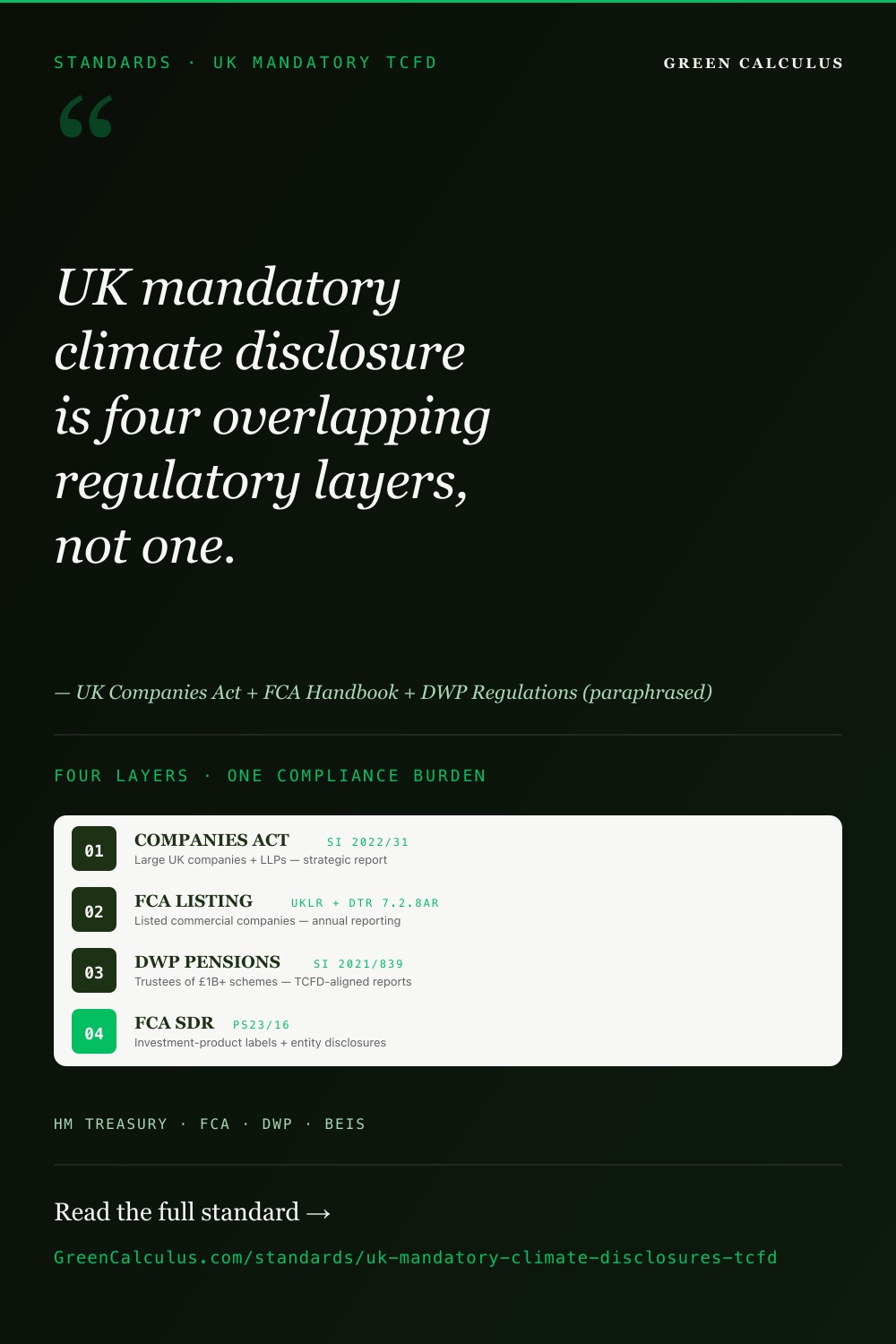
Frequently Asked Questions
The UK mandatory climate disclosure regime applies through four parallel regulatory layers. Under SI 2022/31, UK-incorporated traded companies, banking companies, and authorised insurance companies with more than 500 employees, UK-incorporated AIM companies with more than 500 employees, and other UK-incorporated companies and LLPs with more than 500 employees and turnover above £500 million must make TCFD-aligned disclosures in their strategic report. Under the FCA UKLR / DTR 7.2.8AR, UKLR commercial companies must additionally make a “consistent with TCFD” statement. Under SI 2021/839, occupational pension scheme trustees with £1 billion or more in relevant assets must publish a TCFD-aligned trustee report. Under FCA PS21/24 and SDR, asset managers, life insurers, and FCA-regulated pension providers above defined AUM thresholds must make entity-level and product-level disclosures.
SI 2022/31 is the Companies (Strategic Report) (Climate-related Financial Disclosure) Regulations 2022, made on 17 January 2022, in force from 6 April 2022. The regulations require certain large UK-incorporated companies and LLPs to include climate-related financial disclosures in their strategic report. The disclosures cover eight specific requirements aligned with the TCFD four-pillar framework: governance, risk management process, risk management integration, principal climate-related risks and opportunities, impact on business model and strategy, resilience (scenario) analysis, climate-related targets, and key performance indicators. The regulations apply to financial years beginning on or after 6 April 2022.
SECR (Streamlined Energy and Carbon Reporting, under SI 2018/1155) is the UK mandatory energy and carbon disclosure regime for large companies and LLPs, in force since accounting periods beginning on or after 1 April 2019. SECR is quantitative and structured: it requires disclosure of Scope 1 and Scope 2 GHG emissions (and a defined slice of Scope 3 for quoted companies), UK energy use in kWh, an intensity ratio, methodology, and energy efficiency action. UK TCFD-aligned disclosures (under SI 2022/31, UKLR, and other layers) are the broader climate-related financial disclosure framework structured around the TCFD four pillars: governance, strategy, risk management, and metrics & targets. The two regimes operate in parallel and share the same annual report: the SECR-disclosed Scope 1 and Scope 2 must reconcile to the TCFD-disclosed Scope 1 and Scope 2 in the same report.
The FCA’s Policy Statement PS24/6, effective 29 July 2024, restructured the UK listing regime by collapsing the previous Premium and Standard listing segments into a single commercial companies category under the UK Listing Rules (UKLR). The climate-related disclosure requirement that previously applied to premium-listed companies under LR 9.8.6R(8) is preserved in the new architecture under UKLR 6.6.6R, and DTR 7.2.8AR continues to apply. The substantive TCFD-aligned content requirement is unchanged — commercial companies make “consistent with TCFD” statements across the four pillars and eleven recommended disclosures. What changed is the listing category structure, not the climate disclosure content. References to the legacy “premium” and “standard” listing segments are anachronistic for current reports but remain relevant for historical reports prepared under the pre-July-2024 architecture.
The DEFRA emission factors (formally the UK Government GHG conversion factors) are the annually updated emission factor dataset published by the Department for Environment, Food and Rural Affairs jointly with the Department for Energy Security and Net Zero. They are the operative UK emission factor source for fuel combustion, fugitive emissions, transport, location-based UK electricity, water, waste, and a wide range of other emissions categories. Every UK quantitative GHG disclosure under SECR, SI 2022/31, the UKLR / DTR 7.2.8AR, SI 2021/839, and the FCA SDR is built on top of the DEFRA factors for UK-located activities. The current operative factor set in 2026 is the DEFRA 2025 conversion factors published in summer 2025.
The Transition Plan Taskforce was established by HM Treasury in April 2022 to develop a UK reference framework for corporate transition plans. The TPT published its Disclosure Framework in October 2023, organised around five pillars (Foundations, Implementation Strategy, Engagement Strategy, Metrics and Targets, Governance), followed by sector-specific guidance for asset managers, asset owners, banks, electric utilities, food and beverage, metals and mining, oil and gas, and the public sector. In August 2024, the IFRS Foundation assumed responsibility for the TPT’s intellectual property and forward development. The TPT Disclosure Framework continues to operate as the UK reference framework for transition plan disclosure, with the IFRS Foundation responsible for forward development in coordination with IFRS S2 climate disclosure guidance.
Scope 3 treatment varies by regulatory layer. SI 2022/31 does not directly require Scope 3 disclosure but accommodates it through the KPI requirement and the comply-or-explain structure. The UKLR / DTR 7.2.8AR applies the full TCFD recommendation including Scope 1, 2, and 3 “if appropriate” — the FCA’s supervisory practice has hardened toward expecting Scope 3 disclosure for FTSE 350 commercial companies on the basis that Scope 3 is empirically material for the overwhelming majority of large issuers. SI 2021/839 requires pension scheme trustees to disclose Scope 1, 2, and “as far as you are able” Scope 3 for the investment portfolio. The FCA SDR + PS21/24 framework for asset managers requires financed emissions disclosure (effectively a sectoral-Scope 3 disclosure) typically calculated under the PCAF Standard. The operative test across the regime is materiality, with the GHG Protocol Scope 3 Standard providing the calculation framework.
No, as of May 2026. UK TCFD-aligned disclosures in the strategic report are within the scope of audit only for consistency with the financial statements, not for substantive verification of the climate content. Substantive third-party assurance of climate disclosures is voluntarily obtained by many UK reporters under ISAE 3000 (general) or ISAE 3410 (GHG-specific) but is not mandated by the current UK regime. The CSRD has set the European reference position with mandatory limited assurance from initial implementation, and UK supervisory practice is increasingly aligned with this trajectory. Mandatory limited assurance under the UK regime is widely anticipated, most likely through incorporation of UK SRS into UKLR, but is not in force today.
UK Sustainability Reporting Standards (UK SRS) are the UK Government’s endorsement of the ISSB’s IFRS S1 (General Requirements) and IFRS S2 (Climate-related Disclosures), published by the IFRS Foundation in June 2023. UK SRS S1 and UK SRS S2, when endorsed by DBT and incorporated into the FCA UKLR, will replace the existing TCFD-aligned regime for UKLR commercial companies. IFRS S2 fully incorporates the TCFD recommendations and extends them with additional requirements on industry-based metrics, financed emissions for financial institutions, and transition plans. The TCFD framework itself was retired by the Financial Stability Board in October 2023, with monitoring functions transferred to the IFRS Foundation. The UK transition from TCFD to UK SRS is expected to be phased through 2026–2028 across the four regulatory layers, with mandatory application dates set by DBT and the FCA following the ongoing consultations.
The Occupational Pension Schemes (Climate Change Governance and Reporting) Regulations 2021 (SI 2021/839) apply in two phases. Trustees of schemes with £5 billion or more in relevant assets at the first scheme year-end falling on or after 1 March 2020 came into scope from 1 October 2021. Trustees of schemes with £1 billion or more in relevant assets at the first scheme year-end falling on or after 1 March 2021 came into scope from 1 October 2022. Authorised master trusts and collective money purchase schemes came into scope from 1 October 2021 regardless of asset size. The trustee TCFD report must be published on a publicly accessible website within seven months of the scheme year-end, with the scheme year-end date determining the reporting deadline.
The two regimes share substantial overlapping content but differ in materiality framing, scope, granularity, and assurance requirements. UK TCFD operates on financial materiality; CSRD operates on double materiality, capturing both financial materiality and impact materiality. ESRS E1 covers materially the same governance, strategy (including transition plans), risk and opportunity management, and metrics and targets ground as the UK TCFD regime. The underlying GHG inventory and methodology base does double duty across both regimes — the same Scope 1 / Scope 2 / Scope 3 numbers feed both UK TCFD and ESRS E1 disclosures, with DEFRA factors for UK operations and IEA grid factors for non-UK Scope 2. The framework-specific architecture (CSRD’s impact-materiality content, the digital tagging requirements, the assurance requirements) imposes incremental work on dual reporters but the methodology alignment is substantial.
The FRC’s thematic reviews of climate-related financial disclosures (2022, 2023, 2024) have identified a recurring set of failure modes: scenario analysis with no quantitative content; SECR / TCFD Scope 1 / Scope 2 inconsistency in the same annual report; Scope 3 disclosure limited to the smallest categories without a documented materiality assessment; climate targets disclosed without baseline year or methodology; Governance disclosure that lists committees without describing oversight; methodology disclosed in general terms only without identifying consolidation approach, base year, emission factor source, or GWP basis; statement of consistency omitted or embedded without a clear identifiable statement; and transition plan claimed but not aligned with the TPT Disclosure Framework. The FRC’s 2024 thematic review on climate-related and metrics-related disclosures provides specific examples of better practice and is the operative supervisory expectation document for FY2025 strategic reports.
The FCA Sustainability Disclosure Requirements (SDR) and investment labels regime was introduced through FCA Policy Statement PS23/16, published 28 November 2023. The regime defines four investment labels — Sustainability Focus, Sustainability Improvers, Sustainability Impact, and Sustainability Mixed Goals — that UK-authorised funds may voluntarily adopt to communicate sustainability strategy clearly to consumers. The phased rollout: anti-greenwashing rule effective 31 May 2024; investment labels available from 31 July 2024; naming and marketing rules and consumer-facing/pre-contractual disclosures from 2 December 2024; ongoing product-level disclosures from 2 December 2025; entity-level disclosures from 2 December 2025 (firms with > £50bn AUM) and 2 December 2026 (firms with > £5bn AUM).
Transition plan disclosure under the UK regime is currently anchored on the TPT Disclosure Framework published in October 2023, which serves as the UK reference framework but is not itself a mandatory regulation. Mandatory transition plan disclosure flows through the existing TCFD-aligned regime: SI 2022/31’s strategy and targets requirements, the UKLR / DTR 7.2.8AR TCFD-aligned framework, and the DWP regime’s strategy and metrics requirements all incorporate transition-plan-relevant content without a dedicated standalone obligation. The FCA’s PS24/X and the upcoming UK SRS S2 incorporation are expected to embed more granular transition plan disclosure requirements aligned with IFRS S2. The TPT framework, transferred to the IFRS Foundation in August 2024, is expected to become the practitioner-level operationalisation of IFRS S2 / UK SRS S2 transition plan disclosure.
Sources and References
Every claim and methodological statement in this article reconciles to the primary sources below. Where the UK government or a UK regulator has published a definitive document on a topic, the primary source is cited directly; secondary commentary is used only for interpretation.
Primary UK statutory instruments
- The Companies (Strategic Report) (Climate-related Financial Disclosure) Regulations 2022, SI 2022/31, made 17 January 2022, in force 6 April 2022.
- The Companies (Directors’ Report) and Limited Liability Partnerships (Energy and Carbon Report) Regulations 2018, SI 2018/1155, made 5 November 2018, in force 1 April 2019 (the SECR regime).
- The Occupational Pension Schemes (Climate Change Governance and Reporting) Regulations 2021, SI 2021/839, made 16 June 2021, in force in phases from 1 October 2021.
- The Limited Liability Partnerships (Climate-related Financial Disclosure) Regulations 2022, SI 2022/46 (the LLP equivalent to SI 2022/31).
FCA policy statements and Handbook references
- FCA Policy Statement PS20/17 Proposals to enhance climate-related disclosures by listed issuers, December 2020 (introducing LR 9.8.6R(8)).
- FCA Policy Statement PS21/23 Enhancing climate-related disclosures by standard listed companies, December 2021.
- FCA Policy Statement PS21/24 Enhancing climate-related disclosures by asset managers, life insurers and FCA-regulated pension providers, December 2021.
- FCA Policy Statement PS22/20 Sustainability Disclosure Requirements (SDR) and investment labels: feedback, December 2022.
- FCA Policy Statement PS23/16 Sustainability Disclosure Requirements (SDR) and investment labels, November 2023.
- FCA Policy Statement PS24/6 UK Listing Rules, July 2024.
- FCA Handbook: UKLR 6.6.6R (commercial company climate-related financial disclosure); DTR 7.2.8AR (corporate governance statement climate-related financial information); ESG Sourcebook (SDR rules).
- FCA Technical Notes on TCFD-aligned reporting (successive editions).
DWP and TPR documents
- DWP, Climate and Investment Reporting: Setting Expectations and Empowering Savers — statutory guidance on SI 2021/839, October 2021 (updated periodically).
- The Pensions Regulator, climate change guidance and supervisory communications.
FRC thematic reviews
- FRC, Thematic Review: TCFD Disclosures and Climate in the Financial Statements, 2022.
- FRC, FRC CRR Thematic Review: Climate-related Reporting, 2023.
- FRC, Thematic Review on Climate-related Metrics and Targets, 2024.
- FRC Financial Reporting Lab, Climate-related Corporate Reporting series.
HM Treasury and cross-Whitehall documents
- HM Treasury, A Roadmap towards Mandatory Climate-related Disclosures, November 2020.
- HM Treasury, Mobilising Green Investment: 2023 Green Finance Strategy, March 2023.
- DBT (formerly BEIS), UK Sustainability Disclosure Standards: endorsement consultation, 2024–2025.
TCFD and TPT documents
- Task Force on Climate-related Financial Disclosures, Final Report: Recommendations of the Task Force on Climate-related Financial Disclosures, June 2017.
- Task Force on Climate-related Financial Disclosures, Implementing the Recommendations of the Task Force on Climate-related Financial Disclosures, October 2021 (and successive annexes).
- Financial Stability Board, statement on TCFD monitoring transfer to IFRS Foundation, October 2023.
- Transition Plan Taskforce, The TPT Disclosure Framework, October 2023.
- Transition Plan Taskforce, sector-specific guidance documents (Asset Managers, Asset Owners, Banks, Electric Utilities, Food and Beverage, Metals and Mining, Oil and Gas, Public Sector).
- IFRS Foundation, announcement of TPT intellectual property transfer, August 2024.
ISSB and adjacent international standards
- International Sustainability Standards Board, IFRS S1 General Requirements for Disclosure of Sustainability-related Financial Information, June 2023.
- International Sustainability Standards Board, IFRS S2 Climate-related Disclosures, June 2023.
- European Sustainability Reporting Standards, ESRS E1 Climate Change, EFRAG / EU Delegated Act, 2023.
- Global Reporting Initiative, GRI 305 Emissions 2016 (transitioning to GRI 102 Climate Change 2025).
- Taskforce on Nature-related Financial Disclosures, Recommendations, September 2023.
Methodology and data sources
- WRI & WBCSD, The Greenhouse Gas Protocol: A Corporate Accounting and Reporting Standard, revised edition.
- WRI & WBCSD, GHG Protocol Scope 2 Guidance, January 2015.
- WRI & WBCSD, Corporate Value Chain (Scope 3) Accounting and Reporting Standard, 2011.
- Department for Environment, Food and Rural Affairs & Department for Energy Security and Net Zero, UK Government GHG Conversion Factors for Company Reporting, 2025 edition.
- Department for Business, Energy & Industrial Strategy (now DBT), Environmental Reporting Guidelines: Including Streamlined Energy and Carbon Reporting Guidance, 2019 (with subsequent updates).
- International Energy Agency, Global Energy Review 2026 and grid emission factor dataset.
- Intergovernmental Panel on Climate Change, Sixth Assessment Report (AR6) Working Group I, 2021. Table 7.SM.7 GWP-100 values.
- Partnership for Carbon Accounting Financials, The Global GHG Accounting and Reporting Standard for the Financial Industry, Part A (Financed Emissions).
Prudential and assurance frameworks
- Prudential Regulation Authority, Supervisory Statement SS3/19 Enhancing banks’ and insurers’ approaches to managing the financial risks from climate change, April 2019.
- PRA, Climate Biennial Exploratory Scenario, follow-on supervisory engagement.
- ISAE 3000 (Revised), Assurance Engagements Other Than Audits or Reviews of Historical Financial Information.
- ISAE 3410, Assurance Engagements on Greenhouse Gas Statements.
- ISO 14064-3, GHG statement validation and verification.
Related GreenCalculus reference pages
- GHG Protocol Corporate Standard
- GHG Protocol Scope 2 Guidance
- GHG Protocol Scope 3 Standard
- GHG Protocol Land Sector and Removals Standard 2026
- ISO 14064-1
- IPCC AR6
- IFRS S2 Climate-related Disclosures
- CSRD / ESRS E1
- TCFD Recommendations
- GRI Standards (Environmental)
- SBTi Corporate Net-Zero Standard
- RE100 Technical Criteria
- UK DEFRA Emission Factors
- Scope 1 emissions
- Scope 2 emissions
- Scope 3 emissions
- Scope 2 location-based
- Scope 2 market-based
- Global Warming Potential
- CO2e (carbon dioxide equivalent)
- Energy Attribute Certificates
- Residual mix
- Electricity emission factor
- Scope 2 location-based vs market-based
- Scope 1 Combustion Calculator
- Scope 2 Electricity Calculator
- SBTi Near-Term Target Calculator
- IPCC AR6 GWP values
- IEA Grid Emission Factors 2026
- DEFRA Emission Factors
- Scope 2 Electricity Methodology
- Scope 2 Market-Based Methodology
- Natural Gas Combustion Methodology
- Diesel Combustion Methodology
- SBTi Readiness Checklist
What changed in this revision
Updated 11 May 2026. Initial publication. Documents the UK mandatory climate disclosure regime as it stands in May 2026: the four-layer architecture (SI 2022/31 Companies Act; UKLR / DTR 7.2.8AR FCA listing rules following the July 2024 Listing Rules reform; SI 2021/839 DWP pensions; FCA SDR / PS21/24 conduct); the SECR underlying floor under SI 2018/1155; the TPT Disclosure Framework (October 2023) and its IFRS Foundation transfer (August 2024); the ISSB / UK SRS transition pathway following the June 2023 publication of IFRS S1 and IFRS S2 and the October 2023 retirement of the TCFD framework; FRC thematic reviews from 2022, 2023, and 2024; the FCA SDR phased rollout through December 2024, December 2025, and December 2026; and cross-references to the GHG Protocol Corporate Standard, GHG Protocol Scope 2 Guidance, GHG Protocol Scope 3 Standard, ISO 14064-1, IPCC AR6, IFRS S2, CSRD/ESRS E1, GRI Standards (Environmental), TCFD Recommendations, SBTi, RE100, and UK DEFRA emission factors.