
PAS 2080

Most carbon standards tell you how to count emissions. PAS 2080 does something different: it tells you how to manage them out of a project before the concrete is poured. It contains no emission factors, no life-cycle-assessment maths, and no conversion tables — and that is the point most readers miss.
PAS 2080 is the governance layer that turns a pile of carbon numbers into decisions, contracts, and accountability across the entire built-environment value chain.
PAS 2080:2023 is the UK specification for managing whole-life carbon in buildings and infrastructure. It defines a value-chain process built on an Avoid–Switch–Improve hierarchy. It is a management standard, not a calculation method.
PAS 2080 in one view — what it is and is not
PAS 2080 is a Publicly Available Specification published by BSI. The current edition, PAS 2080:2023, came into effect on 31 March 2023 and superseded the original PAS 2080:2016, which is withdrawn. It was sponsored by the Institution of Civil Engineers (ICE) and the Green Construction Board, and it is supplemented by a separate ICE Guidance Document that carries worked examples and case studies. It is a voluntary standard — it carries no statutory force on its own — but it is increasingly written into construction contracts and procurement requirements, which is where its teeth come from.
The defining characteristic of PAS 2080 is what it deliberately leaves out. It does not tell you the carbon factor of a tonne of cement, the embodied carbon of structural steel, or the global warming potential of refrigerant leakage. For those numbers it points outward to established quantification standards. PAS 2080 is concerned with the discipline that wraps around the numbers: who is accountable, when carbon decisions are made, how baselines and targets are set, how performance is verified, and how procurement locks reductions into contracts.
- A carbon management specification for the built environment
- A common process shared across the whole value chain
- A governance and accountability framework
- A target-setting, baseline and continual-improvement discipline
- A procurement and contracting mechanism for carbon
- Verifiable by independent third-party certification
- A carbon quantification or LCA methodology
- A source of emission factors or GWP values
- A product carbon footprint standard
- A carbon-neutrality or offsetting claim standard
- A statutory or mandatory regulation
- A substitute for BS EN 15978 / 15804 calculation work
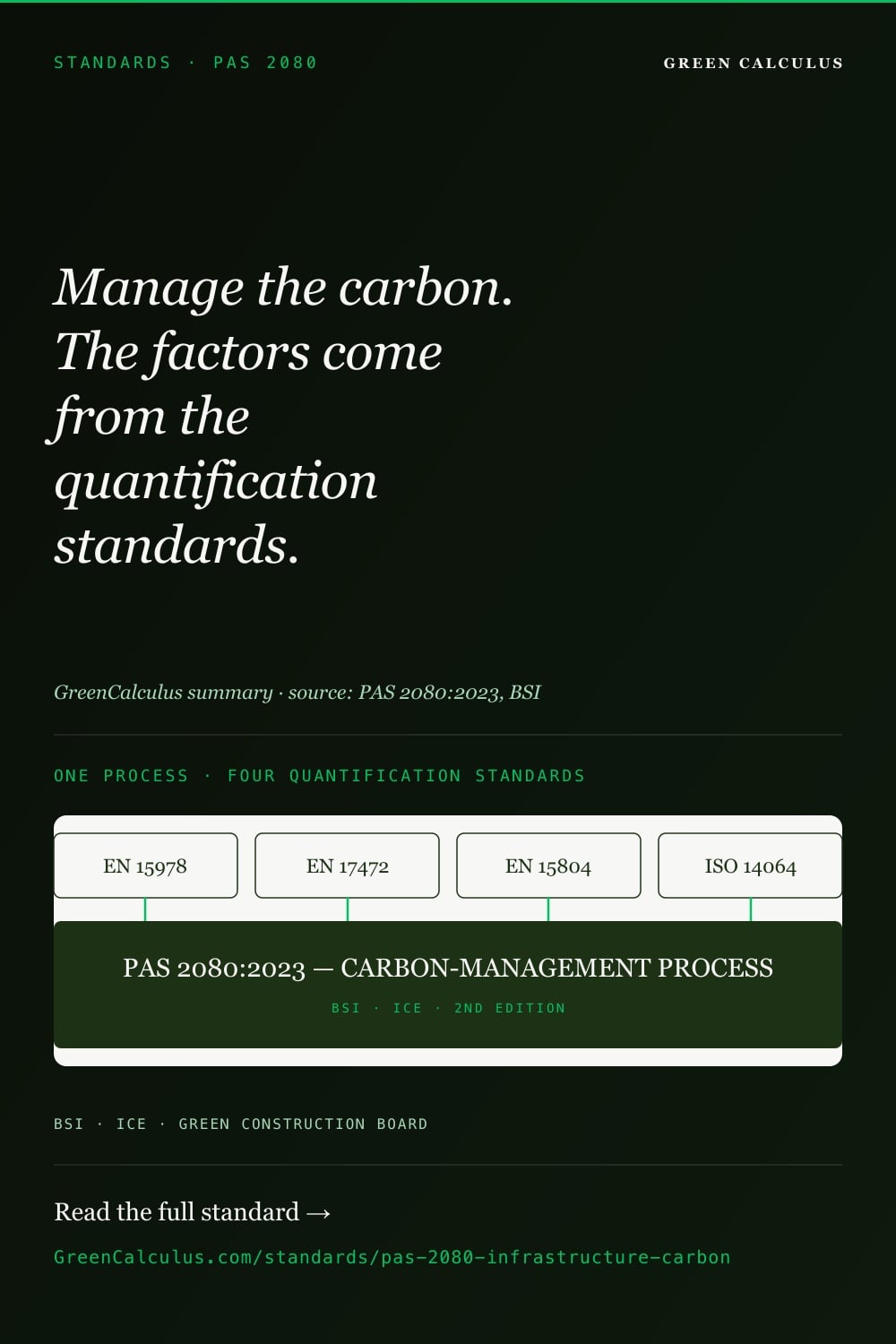
Teams that treat PAS 2080 as a calculation standard look for factors that are not there and conclude the document is vague. Teams that treat it correctly — as the management layer — use it to decide which calculations matter, when they must be done in the project timeline, and who is accountable for acting on them. The quantification itself is performed under BS EN 15978 and the EPD rules of BS EN 15804, with factor data from sources such as the ICE embodied carbon database.
Provider directory
Need help keeping this up all year?
See who does this work. Every listing names the standards it works to, and paid placements are labelled. Including Pangolin Associates and Small World Consulting.
Browse 6 carbon accounting & inventory providers →Do this work? A listing is US$390 a year. Get listed →
PAS 2080 as the governance layer over quantification
The most useful mental model places PAS 2080 above the quantification stack rather than inside it. The calculation standards generate carbon figures; PAS 2080 governs the behaviours, decisions and contracts that determine whether those figures actually fall. An organisation can have impeccable embodied-carbon numbers and still emit far more than necessary if no one is accountable for acting on them early enough. PAS 2080 exists to close that gap.
A whole-life carbon assessment produces a number. PAS 2080 adds the apparatus that makes the number consequential: a baseline against which reduction is measured, a target that is set early and tightened over time, named accountability across asset owners, designers, constructors and suppliers, and procurement clauses that convert intent into contractual obligation. The assessment tells you where you are; PAS 2080 governs how you get lower.
Scope and the 2016 → 2023 expansion
The single most significant change in the 2023 revision was scope. The 2016 edition was an infrastructure specification — roads, rail, water, energy networks. The 2023 edition widened the scope to the whole built environment, explicitly including buildings, on the basis that buildings and infrastructure are part of a single interconnected system and benefit from a common carbon management process. This is why the standard is now titled “carbon management in buildings and infrastructure” and why a buildings-focused team can adopt it without contortion.
| Dimension | PAS 2080:2016 | PAS 2080:2023 (current) |
|---|---|---|
| Scope | Infrastructure only | Whole built environment — buildings and infrastructure |
| Central concept | Capital and operational carbon | Whole-life carbon, including user carbon and the control/influence distinction |
| Value chain | Asset owner, designer, constructor, supplier | Same four, plus explicit guidance for influencing parties (government, regulators, financiers) in the annexes |
| Climate framing | Carbon and cost reduction | Explicit 1.5°C alignment, circular economy, climate resilience and locked-in emissions |
| Procurement | Referenced | Strengthened as a core enforcement mechanism for carbon reduction |
| Status | Withdrawn | In force from 31 March 2023 |
The 2023 framing also leans hard on a hard truth: most of the built environment that will exist in 2050 has already been built, which locks in substantial emissions through assets already in operation. The standard therefore applies not only to new projects but to the management, operation, use and retrofit of existing assets and networks — a deliberate move to keep retrofit and asset operation inside the carbon-management discipline rather than treating PAS 2080 as a new-build-only document.
The whole-life carbon model — capital, operational, user
PAS 2080 organises emissions into three categories that map onto the asset lifecycle. Understanding these categories is a prerequisite for setting a defensible baseline, because the baseline must declare which categories it covers.
GHG emissions associated with the creation and end-of-life treatment of an asset, network or system — materials, manufacturing, transport to site, construction, and eventual demolition or disposal. This is where embodied-carbon assessment and material choice dominate, and where the earliest design decisions have the largest leverage.
GHG emissions from operating and maintaining the asset over its in-use life — energy for heating, cooling, lighting, pumping, traction, and the maintenance and replacement cycles required to keep the asset functioning. Driven by design efficiency and the carbon intensity of the energy supply.
GHG emissions arising from how end users interact with the asset — for example, the vehicle emissions enabled by a road, or the travel patterns shaped by a transport network. Often outside direct control but within influence, and a distinctive feature of the PAS 2080 model relative to narrower building-only frameworks.
These categories align with the lifecycle modules used in whole-life carbon assessment under RICS whole-life carbon methodology and BS EN 15978. The mapping is the bridge between PAS 2080’s management language and the quantification standards that produce the figures.
| Lifecycle stage (BS EN 15978) | Modules | PAS 2080 category |
|---|---|---|
| Product and construction | A1–A5 | Capital carbon |
| Use — operational energy and water | B6–B7 | Operational carbon |
| Use — maintenance, repair, replacement | B1–B5 | Capital / operational (boundary-dependent) |
| End of life | C1–C4 | Capital carbon |
| Benefits and loads beyond the system boundary | D | Reported separately (reuse, recovery, exported energy) |
| Emissions enabled by asset use | (outside A–D) | User carbon |
The carbon reduction hierarchy — Avoid, Switch, Improve
At the centre of PAS 2080 sits a decision hierarchy that prioritises the highest-leverage interventions first. It is most memorably expressed as a sequence of questions — build nothing, build less, build clever, build efficiently — and it deliberately orders interventions by impact, not by ease. The biggest reductions come from the decisions made earliest, when the question is still whether to build at all.
Challenge the root need. Can the outcome be delivered without a new asset — through demand management, maximising existing assets, or repurposing? Where construction is unavoidable, reduce scope and quantity. This is the highest-leverage stage and the cheapest carbon to remove, because it is never built.
Where building is necessary, switch to lower-carbon materials, methods and energy sources. Specify low-carbon concrete and steel, reuse components, choose construction methods with lower embodied carbon, and design for a low-carbon operational energy supply. Decisions here are made in design and procurement.
Optimise the delivery of what is being built — efficient construction logistics, reduced waste, plant and site energy efficiency, and lean processes. Valuable, but constrained: by this stage the major design decisions are fixed, so the available reductions are smaller than at the Avoid and Switch stages.
The common failure is to jump straight to Improve — squeezing efficiency out of a design whose fundamental scope was never challenged. PAS 2080 requires the questions to be asked in order, because a 5% efficiency gain on an asset that should never have been built is a rounding error against the carbon of not building it. The hierarchy front-loads the decisions to the earliest project stages, where influence is greatest and cost of change is lowest.
Value chain members and control versus influence
PAS 2080 assigns requirements to four value-chain member types and provides guidance for a fifth group that shapes outcomes without being directly bound by the specification. The framework rests on a precise distinction between carbon a member controls and carbon a member can only influence — the boundary that determines accountability.
Hold the greatest control. They define the need, set carbon baselines and reduction targets, establish governance, and embed carbon requirements into procurement. Accountable for meeting reduction targets at asset, programme and portfolio level.
Convert reduction targets into design decisions, apply the Avoid–Switch–Improve hierarchy, and quantify options. Encouraged to actively challenge the targets and brief rather than accept them passively.
Responsible for construction-stage carbon, logistics, waste and plant efficiency, and for proposing buildability-led reductions. Often the party whose tendered carbon baseline becomes a contractual KPI.
Provide low-carbon products and the EPD-backed carbon data the value chain depends on. Their environmental product declarations under BS EN 15804 are the factual basis for material switching decisions.
Not bound by the requirements but addressed in the annexes. They shape behaviour through policy, regulation and finance conditions, and PAS 2080 explicitly recognises their leverage over the net-zero transition.
A member is accountable for carbon within its control and responsible for actively influencing carbon beyond it. A designer cannot control the carbon intensity of the national grid, but can influence operational carbon by designing for lower energy demand. An asset owner cannot control how every user behaves, but can influence user carbon through the design brief. PAS 2080 requires each member to identify, document and communicate the whole-life carbon implications within both their control and their influence at the network and system level — which is what stops the standard from collapsing into “not my emissions”.
The PAS 2080 carbon management process
The requirements clauses define a repeating management cycle. Each value-chain member implements the cycle within its role, and the cycle is designed to feed forward across project stages so that reductions achieved at one stage are protected and built upon at the next.
Embed decarbonisation into organisational strategy, establish governance systems that reward challenge and innovation, and make named individuals accountable for carbon outcomes. Without leadership, the rest of the cycle has no authority behind it.
Apply the Avoid–Switch–Improve hierarchy at every decision point, integrating climate resilience, circular-economy thinking and whole-life cost. Carbon becomes an input to design decisions rather than a report produced after them.
Quantify a carbon baseline against a defined functional unit, then set reduction targets relative to it — early, and tightened over time through continual improvement. Targets can be set per asset or programme and aggregated to organisational level.
Calculate carbon using an external, consistent methodology — BS EN 15978, BS EN 17472 or ISO 14064 — with industry-standard coefficients. PAS 2080 specifies that quantification must be consistent and transparent; it does not supply the method itself.
Establish metrics and KPIs, monitor performance against targets, and report transparently. For nature-based interventions this extends to tracking avoided emissions and sequestered carbon over time.
Embed carbon requirements, baselines and targets into contracts and tender criteria so that reductions become contractual obligations rather than aspirations. This is the mechanism that carries reductions across the gaps between value-chain members.
Feed performance data back into governance, tighten targets, and update baselines as evidence and technology improve. The cycle is explicitly progressive — each iteration is expected to be more ambitious than the last.
Baselines and target setting
The baseline is the foundation that makes every reduction claim meaningful, and PAS 2080 is specific about how it must be constructed. A baseline must reference the functional unit of the asset or programme being delivered — the unit of useful output, such as a kilometre of road, a square metre of floor area, or a unit of service capacity — so that reductions are normalised against what the asset actually delivers rather than against an arbitrary design.
| Baseline level | Functional unit reference | Typical owner |
|---|---|---|
| Single asset | The functional unit of that asset (e.g. per km, per m²) | Designer / constructor, built up from materials and activities |
| Programme of works | Aggregated functional units across the programme | Asset owner / manager |
| Service provision | Carbon per unit of service delivered | Asset owner / manager, tied to an investment period |
Targets are then set as a proportion of the baseline and tightened through the continual-improvement cycle. The most consequential targets are set early, when design freedom is greatest. A widely cited application of this discipline runs procurement around a specimen design: tendering contractors are required to demonstrate a minimum reduction against that design — in documented cases a threshold of at least 30% — and on award, the winning contractor’s tendered baseline replaces the client’s specimen baseline and the tendered savings become a contractual KPI with penalties for non-delivery.
| Step | What happens |
|---|---|
| 1 — Client specimen baseline | Client publishes a reference design and its quantified carbon baseline using a predefined methodology and standard coefficients. |
| 2 — Tender requirement | Bidders must propose a design demonstrating a minimum saving (e.g. ≥30%) against the specimen baseline. |
| 3 — Award | The winning bidder’s tendered baseline and reduction proposals replace the client’s specimen baseline. |
| 4 — Contractual KPI | The tendered savings become a measured KPI; emissions are reported throughout delivery; failure to meet the target triggers a penalty. |
This is how PAS 2080 converts a target from an aspiration into an enforceable obligation — the baseline migrates from client to contractor, and the saving becomes a term of the contract.
Measurement, reporting and verification (Clause 9)
Clause 9 governs how carbon performance is measured, reported and verified — the discipline that keeps a PAS 2080 programme honest. It requires credible metrics and KPIs, monitoring against the targets set at baseline, and transparent reporting that allows performance to be challenged. The standard’s emphasis on transparency is deliberate: a reduction that cannot be evidenced and traced is not a reduction PAS 2080 recognises.
For nature-based solutions and removals the MRV requirement is more demanding, because the quantity being claimed changes over time. Tracking both avoided emissions and sequestered carbon may require geospatial data, vegetation inventories or soil sampling to verify removals as they accrue, with methodologies refined as evidence improves. The ICE guidance is pointed on this: emissions and removals through land-use change and nature-based solutions are treated as the proven route to the “net” part of the net-zero equation, which is why their measurement is held to a higher evidentiary standard than a one-off material switch.
The metrics and reporting required under Clause 9 are precisely the traceability that an organisation-level inventory under ISO 14064-1 already provides — emission factor citations, consistent methodology, and documented assumptions. A team with a mature inventory has most of the MRV evidence base already; the PAS 2080 gap is usually the project-stage target tracking and the procurement linkage, not the underlying measurement.
Procurement as the enforcement mechanism
Procurement is the clause that gives a voluntary standard contractual force. PAS 2080 strengthened its procurement requirements in 2023 because carbon reductions are repeatedly lost at the boundaries between value-chain members — a designer specifies a low-carbon solution that a constructor, under cost pressure and with no contractual carbon obligation, quietly substitutes. Embedding carbon baselines and targets into contracts closes that gap.
Procurement also functions as the corrective where “reduce carbon, reduce cost” does not hold. Many low-carbon choices do save money, but some do not, and in those cases a procurement requirement is what prevents the lower-carbon option from being value-engineered out. Writing the carbon target into the tender and the contract converts it from a preference into a deliverable, with the tendered saving becoming a key performance indicator that is monitored and, where the contract provides, penalised on shortfall.
The quantification standards PAS 2080 relies on
Because PAS 2080 contains no calculation method, implementation depends on selecting the right quantification standards and applying them consistently. The standard expects a predefined, transparent methodology with industry-standard coefficients — which in practice means the established whole-life and embodied carbon standards below.
| Standard | Supplies | Role under PAS 2080 |
|---|---|---|
| BS EN 15978 | Whole-life carbon assessment method for buildings, lifecycle modules A–D | Primary quantification method for the baseline and option assessments |
| BS EN 17472 | Whole-life carbon assessment method for civil engineering works | The infrastructure counterpart to EN 15978 for the civils side of the built environment |
| BS EN 15804 | Core product category rules for construction-product EPDs | Standardises the product-level carbon data that feeds the assessment |
| RICS WLCA | Professional-statement methodology for whole-life carbon assessment | Practical UK application layer over EN 15978 for projects |
| ICE database | Embodied carbon coefficients for materials | A common coefficient source where product-specific EPDs are unavailable |
| ISO 14064-1 | Organisation-level GHG inventory and quantification | Underpins organisational baselines and the MRV evidence base |
The practical consequence is that a PAS 2080 implementation is only as credible as the quantification beneath it. Tools that produce consistent, EN 15978–aligned figures — such as a whole-building life-cycle assessment calculator or material-specific embodied-carbon calculators for concrete and cement — supply the baseline and option figures that the PAS 2080 process then governs.
PAS 2080 versus RICS WLCA, ISO 14064 and SBTi
PAS 2080 is frequently confused with the standards it sits alongside. The distinction is consistent: PAS 2080 governs the management process, while the others either quantify carbon or set the destination. They are complementary, not alternatives.
| Dimension | PAS 2080 | RICS WLCA / BS EN 15978 | ISO 14064-1 | SBTi Net-Zero |
|---|---|---|---|---|
| Primary function | Carbon management process | Whole-life carbon quantification | Organisational GHG inventory | Target ambition and validation |
| Supplies factors? | No | Method only; factors from EPDs/databases | Method only | No |
| Unit of focus | Project / programme / asset | Asset / building | Organisation | Organisation |
| Sector | Built environment | Built environment | All sectors | All sectors |
| Verification | Third-party certification against the standard | Professional assurance of the assessment | Third-party inventory verification | SBTi validation of targets |
| Status | Voluntary, often contractual | Voluntary / professional | Voluntary | Voluntary |
A typical mature programme runs all four: SBTi sets the organisation-level destination, ISO 14064-1 structures the corporate inventory, BS EN 15978 / RICS WLCA quantify each project’s whole-life carbon, and PAS 2080 governs the value-chain process that drives the project figures down toward the corporate target. For real-estate portfolios, CRREM stranding pathways add the asset-level decarbonisation trajectory that PAS 2080 retrofit management then delivers against.
Verification and claims of conformity
PAS 2080 conformity is assessed at the organisational level: a certification body verifies that an organisation has implemented the carbon management process required for its value-chain role, not that a single project achieved a particular number. This is an important distinction — PAS 2080 certification attests to the management system, while the carbon reductions themselves are evidenced through the MRV and reporting the system produces.
| Verification focus | What the assessor looks for |
|---|---|
| Leadership and governance | Documented strategy, named accountability, governance that rewards carbon challenge |
| Decarbonisation principles | Evidence the Avoid–Switch–Improve hierarchy is applied at decision points, not retrofitted to justify decisions |
| Baselines and targets | Quantified baselines against functional units; targets set early and tightened over time |
| Quantification consistency | A defined, transparent methodology with industry-standard coefficients, applied consistently |
| MRV | Credible metrics, monitoring against target, transparent and challengeable reporting |
| Procurement integration | Carbon requirements embedded in contracts and tender criteria |
| Continual improvement | Performance data fed back into progressively more ambitious targets |
Adoption is often driven down the supply chain by major asset owners. Where a verified asset owner requires its contractors and their subcontractors to operate their own PAS 2080-aligned carbon management systems, certification becomes a practical condition of working in that supply chain — the same procurement-cascade dynamic that turns a voluntary standard into a market requirement.
Mapping an existing carbon programme to PAS 2080
An organisation with an established whole-life carbon assessment capability typically already holds a substantial part of what PAS 2080 requires on the quantification side. The gaps are usually in governance, target discipline and procurement integration rather than in measurement.
| Existing capability | PAS 2080 requirement satisfied | Remaining gap |
|---|---|---|
| BS EN 15978 / RICS whole-life carbon assessments | Quantification method and baseline figures | Tie assessments to functional-unit baselines and early targets, not just end-of-design reporting |
| EPD-backed material data | Factor data for switching decisions | Embed the data into design decision points under the Avoid–Switch–Improve hierarchy |
| Organisational GHG inventory (ISO 14064-1) | MRV evidence base and reporting | Add project-stage target tracking and KPI monitoring |
| — (typically absent) | Leadership and governance | New work: named accountability, strategy, governance that rewards carbon challenge |
| — (typically absent) | Early target setting and continual improvement | New work: targets set at the brief stage and tightened each cycle, not fixed at design freeze |
| — (typically absent) | Procurement integration | New work: carbon baselines and targets written into tenders and contracts as KPIs |
Implementation readiness checklist
This checklist separates the two tracks where PAS 2080 readiness tends to diverge — the technical / quantification track, which mature carbon teams usually lead on, and the governance / process track, which is typically the real gap. Tick what is in place to see where the work remains.
Common implementation errors
Frequently asked questions
PAS 2080 is a Publicly Available Specification, published by BSI and sponsored by the Institution of Civil Engineers and the Green Construction Board, for managing whole-life carbon in the built environment. The current edition, PAS 2080:2023, came into effect on 31 March 2023, superseding PAS 2080:2016. It covers leadership and governance, decarbonisation decision-making, baselines and targets, quantification (by reference to external standards), measurement and verification, procurement, and continual improvement, across both buildings and infrastructure.
No. PAS 2080 is a carbon management specification and deliberately contains no quantification method, emission factors or GWP values. It refers to external standards for the calculations — BS EN 15978 and BS EN 17472 for whole-life carbon assessment, BS EN 15804 for construction-product EPDs, and ISO 14064 for organisational inventories. PAS 2080 governs how those figures are baselined, targeted, verified and contracted, not how they are computed.
The 2023 revision widened the scope from infrastructure only to the whole built environment, explicitly including buildings. It clarified the roles of value-chain members around control of and influence on whole-life carbon, increased the emphasis on whole-life carbon aligned with a 1.5°C scenario and circular-economy principles, integrated climate resilience and locked-in emissions, and strengthened procurement as an enforcement mechanism. PAS 2080:2023 superseded and withdrew the 2016 edition on 31 March 2023.
It is PAS 2080’s carbon reduction decision hierarchy, ordering interventions by leverage. Avoid (build nothing, build less) challenges the root need and reduces scope — the highest-leverage stage. Switch (build clever) moves to lower-carbon materials, methods and energy where building is necessary. Improve (build efficiently) optimises delivery of what is being built. The order matters: the largest reductions come from the earliest questions, so Avoid and Switch must be exhausted before relying on Improve.
Capital carbon is the emissions from creating and ending the life of an asset — materials, manufacturing, construction and end-of-life. Operational carbon is the emissions from operating and maintaining the asset in use, principally energy and maintenance. User carbon is the emissions arising from how end users interact with the asset, such as vehicle emissions enabled by a road. Together they make up whole-life carbon, and a PAS 2080 baseline must declare which of these categories it includes.
PAS 2080 is a voluntary standard with no statutory force of its own. In practice it is increasingly required contractually: major asset owners write PAS 2080-aligned carbon management into procurement and ask their contractors and subcontractors to operate their own conforming systems. This procurement cascade turns a voluntary standard into a practical condition of working in certain supply chains, even though no law mandates it.
Verification is organisation-level third-party certification against the standard. A certification body assesses whether the organisation has implemented the carbon management process required for its value-chain role — leadership and governance, baselines and targets, consistent quantification, MRV, procurement integration, and continual improvement. The certification attests to the management system; the carbon reductions themselves are evidenced through the MRV and reporting that system produces.
PAS 2080 sets requirements for four member types — asset owners/managers, designers, constructors, and product/material suppliers — and provides guidance in its annexes for influencing parties such as government, regulators and financiers who shape outcomes without being directly bound. Each member implements the carbon management process within its role, accountable for carbon within its control and responsible for actively influencing carbon beyond it.
They are complementary. BS EN 15978 provides the whole-life carbon assessment method and the RICS professional statement applies it in UK practice; both produce the carbon figures. PAS 2080 sits above them, governing how those figures are turned into baselines, targets, contracts and verified reductions across the value chain. A credible PAS 2080 implementation depends on consistent quantification from EN 15978 / RICS WLCA beneath it.
It applies to both. The 2023 edition explicitly covers the provision, operation, use and end of life of new projects as well as the management and retrofit of existing assets and networks. This reflects the reality that most of the built environment expected to exist in 2050 is already built and carries high locked-in emissions, so operation and retrofit are central to the carbon-management task rather than peripheral to it.
Quantify the whole-life carbon that a PAS 2080 process governs — with the EN 15978 lifecycle modules, functional-unit baselines, and material-switching figures the standard depends on.