
Anode Effect

Aluminium is made by passing a huge electric current through molten rock. Almost all of its carbon footprint comes from that electricity and from the carbon anodes it consumes — but there is a third, stranger source, produced only when the process briefly goes wrong. When it does, the smelter emits gases thousands of times more warming than CO₂, molecule for molecule.
The upset that produces them is called the anode effect. The anode effect is a process fault in aluminium smelting that releases perfluorocarbons — the extremely potent greenhouse gases CF₄ and C₂F₆.
The anode effect is a process upset in aluminium smelting that releases perfluorocarbons — CF₄ and C₂F₆ — when dissolved alumina runs too low in the Hall-Héroult cell. These gases are extraordinarily potent and long-lived; aluminium is the largest source of PFC emissions.
Definition — When the Smelter Runs Out of Alumina
Primary aluminium is produced by the Hall-Héroult process: alumina (aluminium oxide, Al₂O₃) is dissolved in a bath of molten cryolite and split by a large electric current into aluminium metal and oxygen, with carbon anodes dipping into the bath. Normally the oxygen released reacts with the carbon anode to form CO₂. But if the dissolved alumina concentration falls too low, the reaction runs short of oxygen and the anode instead reacts with the fluoride in the electrolyte. This fault is the anode effect, and it produces perfluorocarbons — chiefly tetrafluoromethane (CF₄) and hexafluoroethane (C₂F₆).
An anode effect announces itself with a sudden, sharp rise in the cell’s operating voltage, which is how smelters detect and measure it. The more frequent and the longer these events, the more PFCs a smelter emits. Because PFCs are essentially only produced this way at industrial scale, primary aluminium smelting is the single largest source of PFC emissions worldwide.
Definition at a glance
| What it is | A process fault in aluminium smelting that releases perfluorocarbons |
|---|---|
| Where | The Hall-Héroult electrolysis cell, when dissolved alumina runs too low |
| Gases produced | CF₄ (tetrafluoromethane) and C₂F₆ (hexafluoroethane) — PFCs |
| Signal | A sharp spike in cell voltage |
| Significance | Aluminium is the largest source of PFC emissions; CF₄ GWP ≈ 7380 |
| In accounting | Scope 1 process emission, separate from the anode CO₂ |
The Gases and Why They Matter
The anode effect releases two perfluorocarbons. They are emitted in small quantities by mass, but their global warming potential is so high, and their atmospheric lifetimes so long, that they carry a heavy climate weight:
| Gas | Name | GWP-100 AR6 · live |
|---|---|---|
| CF₄ | Tetrafluoromethane | 7380 |
| C₂F₆ | Hexafluoroethane | 12400 |
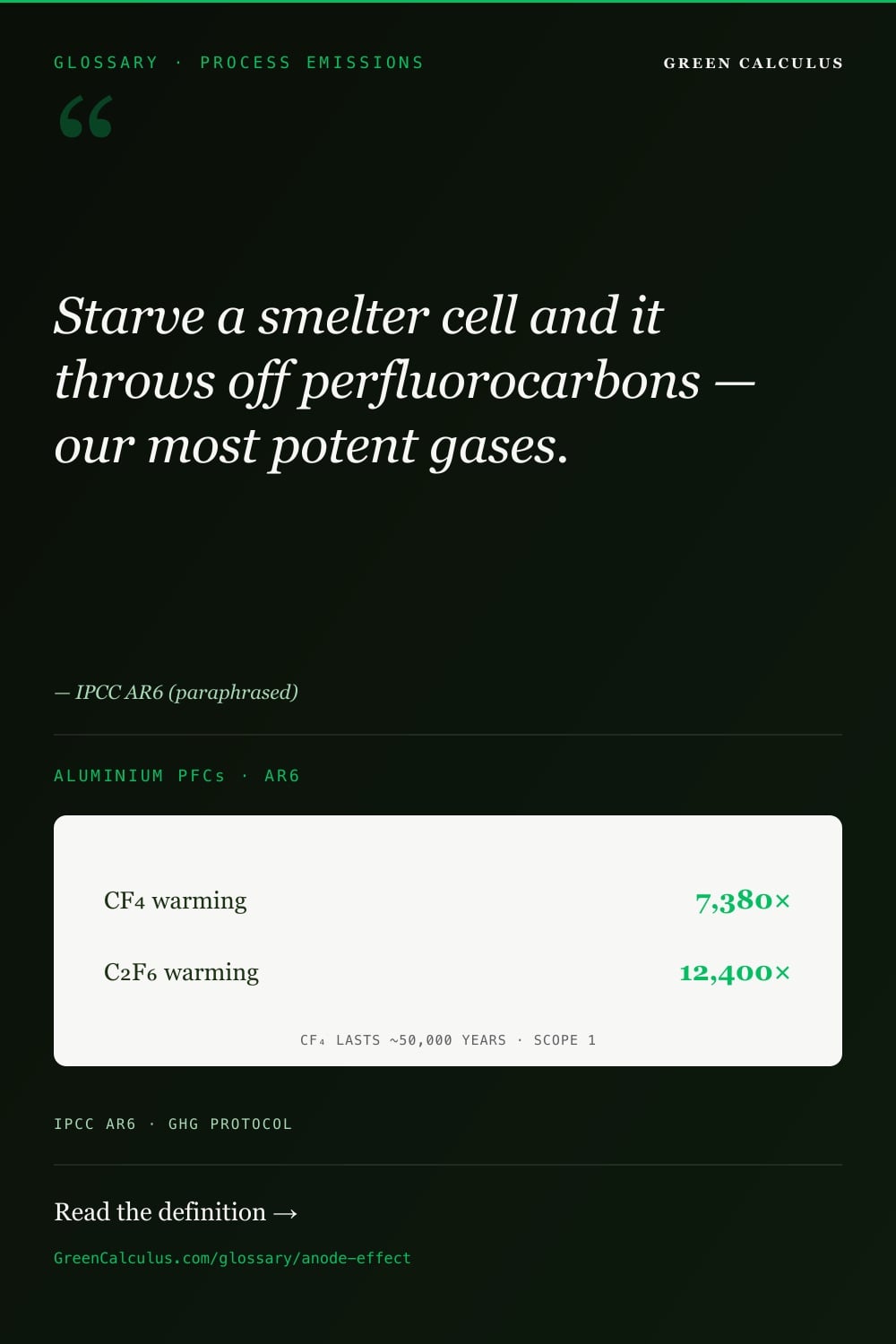
A single tonne of CF₄ warms the climate about as much as 7380 tonnes of CO₂ [GreenCalculus gwp.PFC_CF4.ar6_100 · IPCC AR6 WGI Ch 7 Table 7.SM.7 (2021) — AR6 GWP-100 · v2026.203] over a century, and C₂F₆ about 12400 tonnes [GreenCalculus gwp.PFC_C2F6.ar6_100 · IPCC AR6 WGI Ch 7 Table 7.SM.7 (2021) — AR6 GWP-100]. Worse, these molecules are almost inert: CF₄ has an atmospheric lifetime on the order of 50,000 years, so what is emitted today is effectively permanent. This combination of high potency and near-permanence is why even the small PFC emissions from anode effects are taken seriously in an aluminium smelter’s inventory, and why they are one of the fluorinated gases singled out for control.
Cell Technology and Cutting the Anode Effect
How many PFCs a smelter emits depends heavily on its cell technology and how well the alumina feed is controlled. The IPCC Tier 1 default CF₄ factors below show how the older designs compare — the emission per tonne of aluminium varies several-fold with technology:
| Cell technology | CF₄ factor kg CF₄ / t aluminium · live, IPCC Tier 1 |
|---|---|
| Side-worked prebake (SWPB) | 1.6 |
| Vertical-stud Søderberg (VSS) | 0.8 |
| Centre-worked prebake (CWPB) | 0.4 |
| Horizontal-stud Søderberg (HSS) | 0.4 |
The real advance has come from point-fed prebake (PFPB) cells with computerised alumina feeding and anode-effect suppression, which keep the alumina topped up and intervene the instant a voltage spike begins. These modern smelters have driven anode-effect frequency and duration far below the older defaults above, cutting PFC emissions per tonne of aluminium by an order of magnitude. It is one of the clearest industrial-emissions success stories — the same output of metal, with a fraction of the perfluorocarbons — and it is why the anode effect is both a serious emission and a largely solved one at best-practice plants.
Anode-Effect PFCs in GHG Accounting
Anode-effect PFCs are a process emission from primary aluminium production, and Scope 1 for the smelter. They are reported separately from the CO₂ produced by the carbon anode being consumed — two different emissions from the same cell. The PFCs are usually estimated from measured anode-effect data (frequency and duration, or overvoltage) multiplied by a technology-specific factor, then converted to CO₂-equivalent using each gas’s GWP. The aluminium process PFC calculator applies this, and the method follows the IPCC IPPU guidelines for metal production.
Worked micro-example
Take a centre-worked prebake (CWPB) cell at the IPCC Tier 1 default factors. Per tonne of aluminium it emits about 0.4 kg CF₄ and 0.04 kg C₂F₆. Converting to CO₂-equivalent with the live GWPs:
- 0.4 kg CF₄ × 7380 [GreenCalculus gwp.PFC_CF4.ar6_100] = ≈ 2,952 kg CO₂e
- 0.04 kg C₂F₆ × 12400 [GreenCalculus gwp.PFC_C2F6.ar6_100] = ≈ 496 kg CO₂e
- Total ≈ 3.4 t CO₂e per tonne of aluminium, from anode-effect PFCs alone
Snapshot using the live CF₄/C₂F₆ GWPs and the IPCC Tier 1 CWPB factors. This is a deliberately high, older-technology default to show the mechanism — a modern point-fed prebake smelter with anode-effect suppression emits a small fraction of this. It is also separate from the anode CO₂ and the (usually much larger) electricity emissions of the smelter.
Common Confusions
- Confusing anode-effect PFCs with the anode’s CO₂. The consumed carbon anode releases CO₂ (a process emission); the anode effect releases PFCs. They are separate emissions from the same cell, reported separately.
- Dismissing PFCs because the mass is tiny. A few tenths of a kilogram of CF₄ per tonne of aluminium becomes thousands of kilograms of CO₂e, because CF₄’s GWP is about 7380 [GreenCalculus gwp.PFC_CF4.ar6_100].
- Assuming all smelters emit the same. PFC emissions vary several-fold by cell technology and control; modern point-fed prebake cells emit far less than older Søderberg or side-worked designs.
- Treating PFCs as short-lived. CF₄ persists for roughly 50,000 years — emissions today are effectively permanent, which is part of why they matter so much.
- Thinking it only occurs in aluminium. PFCs are also used in semiconductor manufacturing, but the anode effect specifically is an aluminium-smelting phenomenon.
Frequently Asked Questions
The anode effect is a process fault in the smelting of primary aluminium. Aluminium is made in a Hall-Héroult cell, where alumina dissolved in molten cryolite is split by electricity into aluminium and oxygen. When the dissolved alumina concentration drops too low, the carbon anode reacts with the fluoride electrolyte instead of with oxygen, producing perfluorocarbons — mainly tetrafluoromethane (CF₄) and hexafluoroethane (C₂F₆). The event is marked by a sharp rise in the cell’s voltage. Because these gases are only produced industrially in this way, aluminium smelting is the largest single source of PFC emissions worldwide.
Because the gases are extraordinarily potent and long-lived. Tetrafluoromethane (CF₄) has a 100-year global warming potential of about 7380 [GreenCalculus gwp.PFC_CF4.ar6_100], and hexafluoroethane (C₂F₆) about 12400 [GreenCalculus gwp.PFC_C2F6.ar6_100] — meaning one tonne warms the climate as much as thousands of tonnes of CO₂. On top of that, CF₄ survives in the atmosphere for roughly 50,000 years, so emissions are effectively permanent. A smelter might emit only a fraction of a kilogram of CF₄ per tonne of aluminium, but multiplied by its GWP that becomes thousands of kilograms of CO₂-equivalent, which is why even these small quantities are a real part of aluminium’s carbon footprint.
By preventing the alumina in the cell from running low, which is what triggers the effect. Modern smelters use point-fed prebake (PFPB) technology, which meters small amounts of alumina into the bath continuously, together with computerised control that detects the voltage rise of an incipient anode effect and intervenes immediately. This has reduced both how often anode effects occur and how long they last, cutting PFC emissions per tonne of aluminium dramatically compared with older Søderberg or side-worked prebake cells. It is one of the clearest success stories in industrial emissions control: the same aluminium output with a small fraction of the perfluorocarbons. Remaining emissions are then measured from anode-effect data and reported.
No — they are two different emissions from the same cell. In normal operation, the oxygen released by splitting alumina reacts with the carbon anode to form carbon dioxide; this steady consumption of the anode is a process emission of CO₂. The anode effect is the fault condition, occurring when alumina runs low, in which the anode reacts with the fluoride electrolyte to form perfluorocarbons instead. Both are Scope 1 process emissions from aluminium smelting, but they are chemically distinct and are reported separately: the anode CO₂ from routine operation, and the CF₄ and C₂F₆ from anode effects.
They are Scope 1 — direct emissions from the smelter’s own process. Anode-effect PFCs are classed as a process emission from primary aluminium production, alongside the CO₂ from the consumed carbon anode. They are estimated from the smelter’s measured anode-effect performance and a technology-specific factor, then converted to CO₂-equivalent using the gases’ GWP values and reported in the industrial-processes part of the Scope 1 inventory. The large electricity use of a smelter is separate: if the power is bought from the grid, those emissions are Scope 2, not Scope 1.
Need someone who does this? 6 carbon accounting & inventory providers in our directory →