
Permanence (Carbon Storage) — Definition and GHG Accounting Context

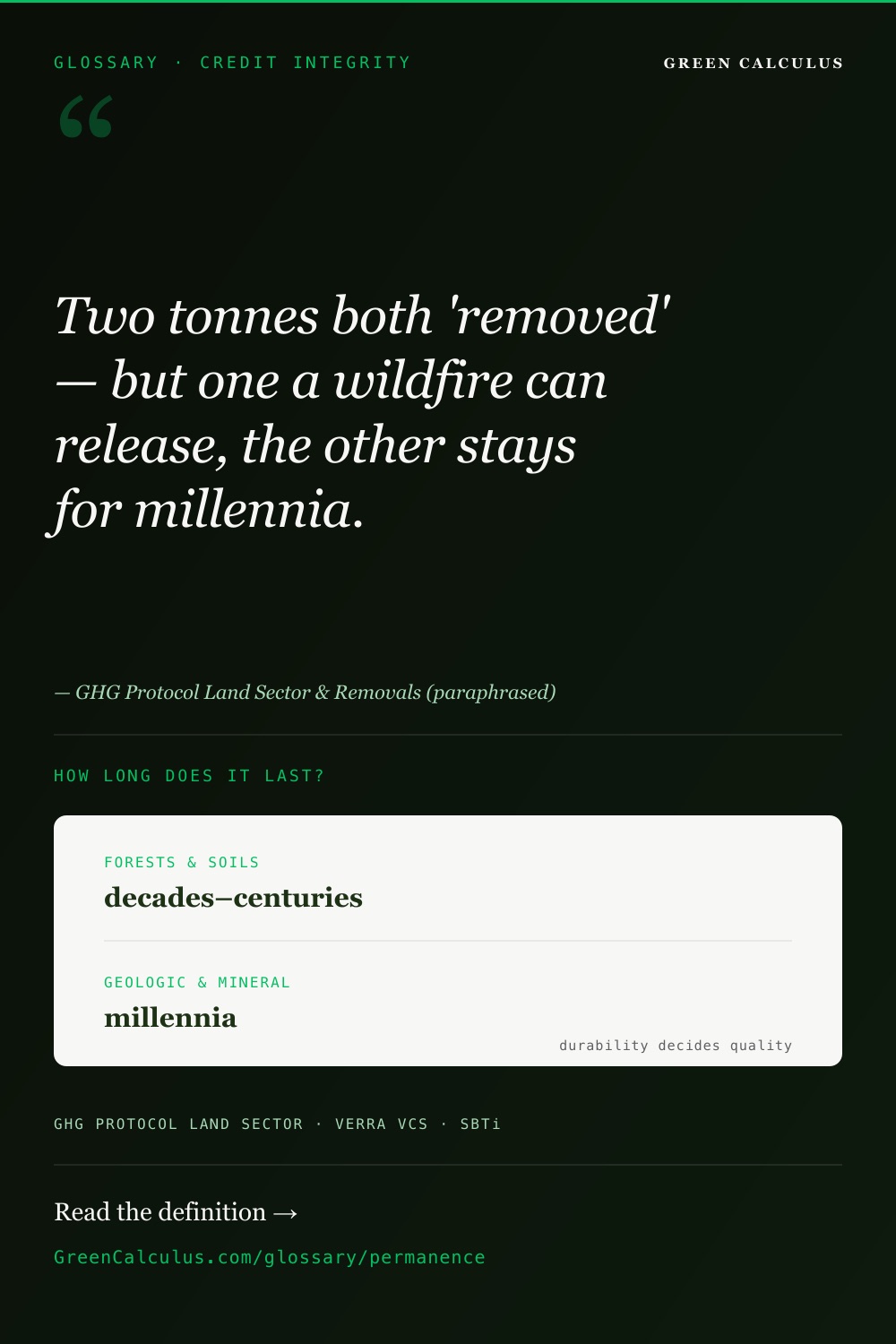
A tonne of carbon dioxide removed from the air and locked into a forest, and a tonne captured and injected deep underground, are both counted as “one tonne removed”. But one can be released again by a single summer wildfire, while the other stays put for longer than recorded history. Treating them as equal is one of the most consequential mistakes in carbon accounting — because a removal is only worth as much as the length of time the carbon actually stays away.
Permanence is how long stored carbon stays out of the atmosphere before it risks coming back — the attribute that separates a lasting removal from a temporary one.
Permanence — increasingly called durability — is how long carbon that has been removed or stored stays out of the atmosphere before it risks returning. It is the quality attribute that decides whether a carbon removal genuinely lasts, and it ranges from decades (forests, soils) to millennia (geological storage). Because a CO₂ emission’s climate effect lasts centuries, durable removals should ideally match that timescale.
Definition — How Long the Carbon Stays Stored
Permanence is the length of time that carbon removed from or kept out of the atmosphere remains stored before it risks being released again. Equivalently, it is the resistance of a carbon store to reversal. The concept applies wherever carbon is being stored to benefit the climate — in trees, soils, rock, products, or deep geological formations — and it is the single most important measure of a store’s quality.
The field increasingly prefers the term durability over “permanence”, and the shift is deliberate. “Permanence” suggests a binary — carbon is either stored forever or it is not — whereas real storage sits on a continuous spectrum from a few decades to many millennia. “Durability” captures that spectrum honestly: the question is not simply whether carbon is permanent, but how long it will stay, and how likely it is to leak back in the meantime.
Why Permanence Matters
Permanence matters because of a mismatch of timescales. Carbon dioxide, once emitted, perturbs the climate for a very long time — a large share of an emission remains in the atmosphere for centuries, and a meaningful fraction for over a thousand years. To genuinely offset such an emission, the carbon removed to compensate for it should stay stored on a comparable timescale. Storing a tonne for thirty years against an emission that warms the planet for a millennium merely defers the problem; it does not neutralise it.
The climate effect of emissions is itself measured over a time horizon: CO₂e values each gas by its global warming potential over 100 years — methane at 29.8 and nitrous oxide at 273 times CO₂ — a convention that already bakes a durability judgment into the accounting of emissions. Permanence applies the same logic to the other side of the ledger, on the storage. This is the basis of durability matching: the growing expectation, reflected in net-zero guidance, that residual fossil emissions be neutralised with removals durable enough to match them.
The Durability Spectrum
Storage methods differ in durability by orders of magnitude, and this is what makes “one tonne removed” so misleading without context.
| Storage type | Examples | Typical durability | Reversal risk |
|---|---|---|---|
| Biological | Forests, soil carbon | Decades | High — fire, drought, land-use change |
| Pyrogenic | Biochar in soil | Centuries | Low to moderate |
| Mineral / ocean | Enhanced weathering, ocean bicarbonate | Millennia | Very low |
| Geological | DACCS, BECCS, CCS storage | Millennia and beyond | Very low — monitored |
A tonne of biochar carbon and a tonne of geologically stored CO₂ are not interchangeable with a tonne held in a forest, even though each is “one tonne removed”. Comparing removals on cost alone, without durability, is how low-durability tonnes end up standing in for high-durability needs. Weigh cost against durability across methods in the Carbon Removal (CDR) Calculator.
Reversals — What Sends Carbon Back
A reversal is the event that undoes a removal: stored carbon returns to the atmosphere, cancelling some or all of the original benefit. Reversals are what durability is really about, and their causes vary by store:
- Biological stores reverse through wildfire, disease, drought, pests, or clearing — and through ordinary land-use change when a protected forest is later felled.
- Soil stores reverse when land is tilled, drained, or converted, releasing carbon that had built up.
- Geological stores can, in principle, leak, though well-chosen and monitored sites have very low leakage — which is why monitoring is part of the method.
Reversals are often split into intentional (a landowner clears a forest) and unintentional (a fire), but the atmosphere does not care about intent: the carbon is back either way, and the accounting has to account for it.
Managing the Risk: Buffers, Monitoring, Ton-Year
Because reversal risk cannot be eliminated for lower-durability stores, credible programmes manage it explicitly rather than ignore it. Several mechanisms do this work:
| Mechanism | How it works |
|---|---|
| Buffer pools | A risk-based share of credits is withheld into a shared reserve that replaces any that later reverse — a form of self-insurance |
| Monitoring & liability | Ongoing measurement over a defined period, with a named party responsible for making good a reversal |
| Durability rating | Storage is labelled by its expected horizon (for example 100-year or 1,000-year) so like is compared with like |
| Ton-year accounting | Temporary storage is credited in proportion to how long it lasts — one tonne for a set number of years counts as a fraction of a permanent tonne |
These mechanisms differ in rigour and are themselves debated. Buffer pools depend on being sized correctly for the risk, and can be strained if reversals cluster. Ton-year accounting is contested precisely because it can make short-term storage look equivalent to durable storage. The direction of travel in serious accounting is toward transparent durability ratings and durability matching rather than treating all tonnes alike.
Permanence vs Additionality
Permanence is one of several quality tests a removal or credit must pass, and it is easy to confuse with the others — especially additionality. The two are independent, and both are required.
Permanence asks: will the carbon stay stored? Additionality asks: would the removal have happened anyway without the carbon finance? A store can be perfectly durable but non-additional (it would have existed regardless), which makes its credits worthless; or genuinely additional but impermanent, which means it only defers emissions. A credible removal needs to clear both bars — and neither should be confused with leakage, the separate problem of a project simply pushing emissions somewhere else.
Common Confusions
- Treating permanence as binary. Storage sits on a durability spectrum from decades to millennia; even “permanent” geological storage is monitored, not assumed.
- Treating all removals as equal. A decades-durable forest tonne is not interchangeable with a millennia-durable geological tonne.
- Confusing permanence with additionality. One asks whether the carbon stays stored; the other whether the removal would have happened anyway. Both are needed.
- Assuming buffer pools make impermanence costless. They insure against reversals but do not make short-term storage equal to durable storage, and can be strained.
- Believing temporary storage fully offsets a fossil emission. It defers rather than neutralises; durable removals should match the emission’s timescale.
- Excusing a reversal because it was unintentional. The carbon returns regardless of intent, and the accounting must reflect it.
Frequently Asked Questions
Permanence is how long carbon that has been removed from or kept out of the atmosphere stays stored before it risks returning — equivalently, a store’s resistance to reversal. It is the key quality measure of any carbon store, whether in trees, soils, rock, products, or deep geological formations. The field increasingly calls it durability, to emphasise that storage is a spectrum from decades to millennia rather than a simple “permanent or not”. A removal is only as valuable as the length of time its carbon actually stays away.
Because of a timescale mismatch. A tonne of CO₂ perturbs the climate for a very long time — much of an emission stays airborne for centuries, and a significant fraction for over a thousand years. To genuinely offset such an emission, the carbon stored to compensate should last on a comparable timescale. Storing carbon for a few decades against a millennia-long emission only defers the problem. This is the basis of “durability matching”, the growing expectation that residual fossil emissions be neutralised with removals durable enough to match them, rather than with short-lived storage.
A reversal is when stored carbon returns to the atmosphere, cancelling some or all of a removal’s benefit. The causes depend on the store: biological stores such as forests reverse through wildfire, disease, drought, or clearing; soil stores reverse when land is tilled or converted; and geological stores can in principle leak, though well-chosen, monitored sites have very low risk. Reversals are described as intentional (deliberate land-use change) or unintentional (a fire), but the climate outcome is the same — the carbon is back, and the accounting must reflect it.
Through several mechanisms. Buffer pools withhold a risk-based share of credits into a shared reserve that replaces any that later reverse — a form of self-insurance. Monitoring and liability arrangements track the store over time and name a party responsible for making good a reversal. Durability ratings label storage by its expected horizon so like is compared with like. And ton-year accounting credits temporary storage in proportion to how long it lasts. These vary in rigour and are debated — buffer pools must be sized correctly, and ton-year accounting is criticised for making short-term storage look equivalent to durable storage.
They are separate quality tests, and both are required. Permanence asks whether the stored carbon will stay stored. Additionality asks whether the removal would have happened anyway without the carbon finance. A store can be durable but non-additional — it would have existed regardless — which makes its credits worthless; or additional but impermanent, which means it only defers emissions rather than neutralising them. A credible removal or credit must pass both tests. Neither should be confused with leakage, which is the separate problem of a project displacing emissions elsewhere rather than avoiding them.