
Additionality — Definition and GHG Accounting Context

Buying a carbon credit is meant to fund a tonne of emissions cut or removed somewhere else — a tonne that would not otherwise have happened. But what if it would have happened anyway? A wind farm that was already the cheapest option, a forest that was never going to be cut, an efficiency upgrade a factory would have made regardless: pay for these and you have bought a certificate, not a climate benefit. The tonne was always coming; your money changed nothing.
Additionality is the test of exactly that — whether the reduction would not have happened without the carbon finance, and so whether the credit represents a real, extra tonne.
Additionality is the requirement that the reductions or removals behind a carbon credit would not have occurred without the carbon finance that pays for them. If the activity would have happened anyway — already profitable, legally required, or common practice — the credits are non-additional and deliver no real benefit, so using them as offsets can raise net emissions. It is the make-or-break test of offset integrity, and it is distinct from permanence.
Definition — Would It Have Happened Anyway?
Additionality is the requirement that the emission reductions or removals a carbon credit represents are additional to what would have happened without it — that the carbon finance is the reason, or a decisive reason, the activity takes place. It is the counterfactual heart of a credit: not “did emissions fall?”, but “did they fall because of this project, beyond what would have occurred anyway?”.
The logic is unforgiving. If a project would have gone ahead regardless — because it was already profitable, already required by law, or already standard practice — then the credits it issues correspond to no extra climate action. Selling them lets a buyer claim to have offset emissions against a reduction that was always going to happen, so the buyer’s own emissions continue with nothing genuinely compensating for them. Additionality is what separates a credit that funds real, extra mitigation from one that simply monetises the status quo.
Why Additionality Is Make-or-Break
A non-additional offset is worse than useless — it increases net emissions. The buyer keeps emitting, believing a tonne has been cut elsewhere to compensate; but if that cut would have happened anyway, no compensating reduction exists. The atmosphere ends up with the buyer’s ongoing emissions and none of the offsetting benefit that was claimed. This is why additionality, not price or volume, is the first question to ask of any credit, and why failures of additionality are the root of most carbon-market scandals.
The Baseline and the Counterfactual
Additionality is judged against a baseline — a constructed scenario of what would have happened in the project’s absence, also called the counterfactual. The credited reduction is the gap between that baseline and the project’s actual emissions:
Credited reduction = baseline emissions − project emissions
Both are measured in tonnes of CO₂e, aggregating each gas by its global warming potential (methane at 29.8 and nitrous oxide at 273 times CO₂ over 100 years) into CO₂e. The baseline is where additionality is won or lost: set it too high — assume more emissions would have occurred than realistically would — and the project looks more additional and earns more credits than it deserves. Much of what looks like an additionality failure is really an inflated, over-generous baseline.
How Additionality Is Tested
Because it cannot be measured directly, additionality is assessed through a set of complementary tests, and a credible project is expected to pass the relevant ones.
| Test | Question it asks | Not additional if… |
|---|---|---|
| Regulatory / legal | Is the activity already required by law? | It is legally mandated anyway |
| Financial | Is it viable without the carbon revenue? | It is already profitable on its own |
| Barrier analysis | Do real non-financial barriers block it that the finance overcomes? | No genuine barriers exist |
| Common practice | Is it already widespread in the sector or region? | It is already standard practice |
These tests are complementary, not alternatives: a project can be financially marginal yet still be common practice, or face barriers yet already be required by regulation. The strongest additionality cases clear all the relevant hurdles; the weakest lean on a single, contestable argument.
Why It’s So Hard to Prove
Additionality is the hardest quality criterion precisely because it rests on a counterfactual that can never be observed. Nobody can rerun history without the project to see what “would have happened”, so every additionality claim is a judgment, open to optimism and to gaming. The problem is sharpest for avoidance credits — avoided deforestation, for instance, where the whole claim hinges on asserting a forest would otherwise have been cleared — and somewhat easier, though not automatic, for engineered removals, which plainly would not exist without the finance but must still pass the financial test.
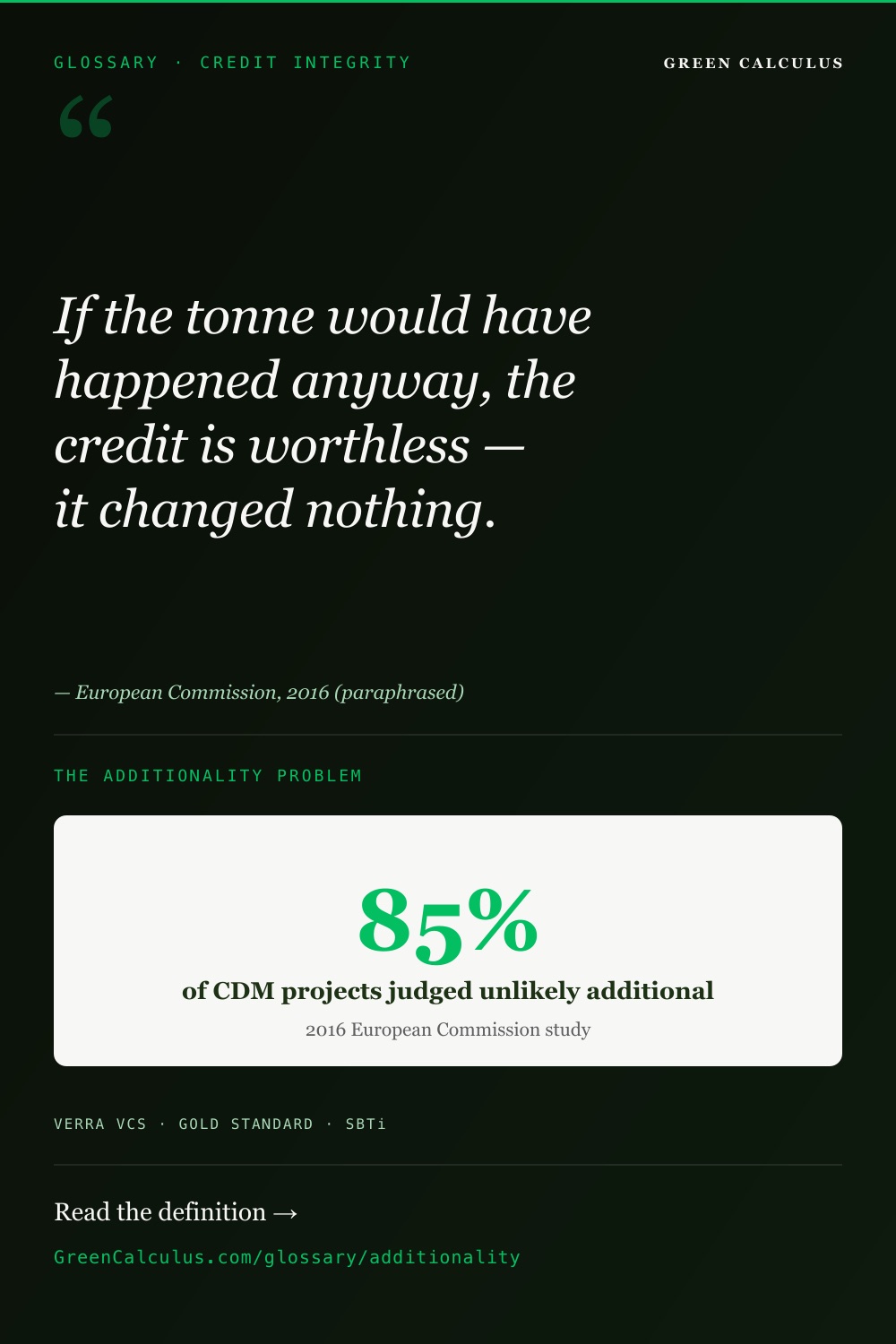
Independent assessments have repeatedly found large shares of credits to be non-additional or over-credited. A 2016 analysis for the European Commission judged 85% of Clean Development Mechanism projects unlikely to ensure that reductions were additional and not over-estimated, with only 2% highly likely. A 2023 investigation concluded that more than 90% of one leading certifier’s rainforest credits were essentially worthless. These findings are not proof that offsetting cannot work, but they are a strong warning to treat additionality claims sceptically and to favour credit types where the counterfactual is most defensible.
Additionality and Its Siblings
Additionality is one of a small set of quality criteria that a credit must satisfy together; passing one does not excuse failing another.
| Criterion | The question it asks |
|---|---|
| Additionality | Would the reduction have happened anyway, without the finance? |
| Permanence | Will the stored carbon stay out of the atmosphere? |
| No leakage | Does the project simply push emissions somewhere else? |
| Accurate baseline | Is the counterfactual realistic, avoiding over-crediting? |
A credit that is genuinely additional but impermanent only defers emissions; one that is durable but non-additional funds nothing extra; and one built on an inflated baseline over-credits even if the project is real. A credible credit has to clear all of these — which is why additionality, though foundational, is necessary rather than sufficient on its own.
Common Confusions
- Confusing additionality with permanence. Additionality asks whether the reduction would have happened anyway; permanence asks whether stored carbon stays put. Both are required.
- Assuming a certified credit is automatically additional. Certification helps but does not guarantee it, as the market’s track record shows.
- Confusing additionality with the baseline. The baseline is the counterfactual scenario; additionality is the test that the finance actually drove the change against it.
- Thinking removals are always additional. Engineered removals still have to pass the financial test — they are not additional by definition.
- Equating non-additional with fraudulent. Many non-additional credits come from honest but over-optimistic baselines, not deliberate deception.
- Reading the bare word “additional”. Additionality is a specific counterfactual test, not just “extra” in a loose sense.
Frequently Asked Questions
Additionality is the requirement that the emission reductions or removals behind a carbon credit would not have happened without the carbon finance that pays for them. It is the counterfactual test at the core of a credit: the reduction must be additional to what would have occurred anyway. If a project would have gone ahead regardless — because it was already profitable, legally required, or standard practice — its credits are non-additional and represent no genuine extra climate action. Additionality is judged against a baseline of what would otherwise have happened, and it is the single most important test of a credit’s integrity.
Because a non-additional offset increases net emissions rather than neutralising them. When you offset, you keep emitting on the assumption that an equal reduction is being funded elsewhere. If that reduction would have happened anyway, there is no compensating cut — the atmosphere is left with your ongoing emissions and none of the offsetting benefit claimed. So additionality, not price or volume, is the first thing to check about any credit. Failures of additionality are the root cause of most carbon-market controversies, where credits turned out to fund activities that were always going to occur.
Through several complementary tests, since it cannot be measured directly. A regulatory or legal test checks that the activity is not already required by law. A financial test checks that it would not be viable without the carbon revenue. A barrier analysis looks for genuine non-financial obstacles — technological or institutional — that the finance helps overcome. And a common-practice test checks that the activity is not already widespread in the sector or region. A strong project passes the relevant tests together; a weak one leans on a single, contestable argument. All of this is assessed against a baseline of what would otherwise have happened.
Because it depends on a counterfactual that can never be observed. History cannot be rerun without the project to see what would otherwise have happened, so every additionality claim is a judgment, vulnerable to optimism and to gaming the baseline. The difficulty is greatest for avoidance credits, such as avoided deforestation, where the claim rests entirely on asserting emissions that would have occurred; it is somewhat easier for engineered removals, which clearly would not exist without the finance but still must pass a financial test. Independent studies have found large shares of credits to be non-additional — including 85% of Clean Development Mechanism projects in one 2016 analysis — which is why additionality claims deserve scepticism.
They are separate quality tests, and both are required. Additionality asks whether the reduction or removal would have happened anyway without the carbon finance. Permanence asks whether stored carbon will stay out of the atmosphere or risks reversing. A credit can be genuinely additional but impermanent — funding a real activity whose carbon later returns — which only defers emissions; or durable but non-additional, storing carbon reliably from an activity that needed no finance, which funds nothing extra. Neither should be confused with leakage, the separate problem of a project displacing emissions elsewhere. A credible credit has to satisfy all of these.