
Direct Air Capture (DAC)

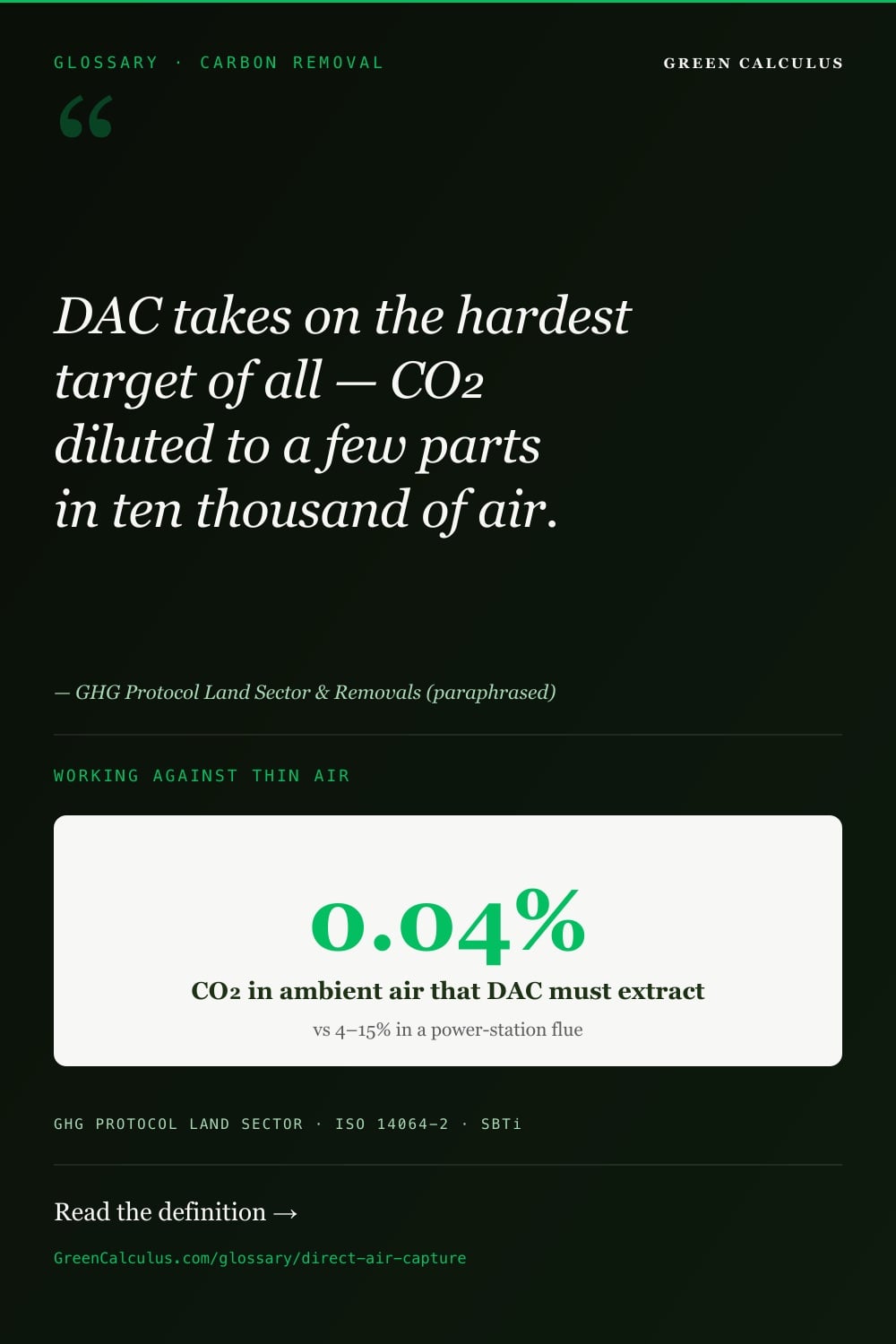
Most carbon capture starts with a concentrated stream — the exhaust of a power station or cement kiln, where CO₂ makes up a large share of the gas. Direct air capture takes on a far harder target: the open atmosphere, where carbon dioxide is diluted to a few molecules in every ten thousand. Pulling it out there is what makes the technology powerful — it can remove emissions that were released anywhere, at any time — and also what makes it slow, energy-hungry, and expensive.
Direct air capture is a technology that chemically extracts CO₂ straight from ambient air — but capture alone is not removal until the carbon is durably stored.
Direct air capture (DAC) chemically pulls CO₂ out of ambient air rather than a concentrated exhaust. On its own it is only capture; paired with durable storage (DACCS) it becomes carbon removal. CO₂ in air is so dilute (~0.04%) that DAC is energy-intensive.
Definition — Pulling CO₂ Straight From the Air
Direct air capture is a group of technologies that separate carbon dioxide directly from the ambient atmosphere. Air is drawn across a chemical that selectively binds CO₂; the CO₂ is then released from that chemical in a concentrated, pure stream, and the sorbent is reused. The result is a supply of captured CO₂ that came out of the open air — not from a smokestack, and not from any single emitter.
That “from the open air” quality is what gives DAC its distinctive role. Because the carbon it captures was already in the atmosphere, DAC can address emissions regardless of where or when they were released — including the diffuse, historic, and hard-to-abate emissions that no point-source capture can reach. It is one of the engineered methods within carbon dioxide removal, and the one most often held up for its permanence and measurability.
Direct air capture is a capture technology, not by itself a removal. Capturing CO₂ from the air only becomes carbon removal once that CO₂ is stored durably. What happens to the captured carbon — permanent storage, or use and re-release — decides whether DAC removes anything at all.
DAC, DACCS, and DAC-U: Capture Is Not Removal
The most important distinction on this page is between capturing CO₂ and removing it. Direct air capture produces a stream of CO₂; its climate value depends entirely on where that stream goes.
| Term | What happens to the captured CO₂ | Is it carbon removal? |
|---|---|---|
| DAC (capture only) | CO₂ is captured; fate not yet specified | Not yet — capture alone removes nothing |
| DACCS (capture + storage) | Injected into geological formations for the long term | Yes — atmospheric source + durable storage |
| DAC-U (capture + utilisation) | Used to make fuels, chemicals, or carbonated drinks | Usually not — the CO₂ is soon re-released |
Only DACCS — direct air carbon capture and storage — is reliably a removal, because it satisfies both halves of the removal test: the carbon comes from the atmosphere and it stays out. DAC used to synthesise fuels can cut fossil use, but the CO₂ returns to the air when the fuel is burned, so it is not removal. When people call DAC a “negative emissions technology”, they mean DACCS.
How It Works: Liquid Solvent vs Solid Sorbent
Two engineering approaches dominate, distinguished by the chemical that grabs the CO₂ and the heat needed to release it again.
| Liquid solvent (l-DAC) | Solid sorbent (s-DAC) | |
|---|---|---|
| Capture medium | Aqueous alkaline (hydroxide) solution | Amine-functionalised solid filter |
| Release step | High-temperature calcination (~900°C) | Lower-temperature vacuum/temperature swing (~80–120°C) |
| Energy character | Large high-grade heat demand | Lower-grade heat, modular, batch cycles |
| Scale style | Large centralised plants | Many small stackable units |
Both are commercial but early. The lower-temperature heat of solid-sorbent systems can be met by heat pumps or waste heat; the high-temperature heat of liquid systems has historically been supplied by burning natural gas, which — unless that CO₂ is also captured — eats into the net removal. The choice of technology and, above all, the energy source drive both the cost and the real climate benefit.
The Dilution Problem — Why DAC Is Energy-Hungry
The central challenge of DAC is thermodynamic. Carbon dioxide is only about 0.04% of the air, roughly a hundred times more dilute than in a power-station flue gas. Separating a dilute substance from a mixture takes intrinsically more energy than separating a concentrated one, so DAC needs a large energy input per tonne — commonly several gigajoules of heat plus electricity for every tonne of CO₂ captured.
Because DAC consumes so much energy, its climate value stands or falls on where that energy comes from. Powered by low-carbon heat and electricity, DACCS delivers a genuine net removal. Powered by unabated fossil energy, the emissions from running it can cancel out much — or in the worst case all — of the CO₂ it captures. This is why DAC plants are sited next to clean power and geological storage, and why any DAC figure must be assessed on a full lifecycle basis, not on the gross tonnes pulled from the air.
Durability, Cost, and Footprint
DAC’s profile is almost the mirror image of nature-based removal, which is why it is discussed as a complement to — not a replacement for — forests and soils.
- Durability: very high. CO₂ stored geologically through DACCS stays put for millennia and does not face the fire, drought, or land-use reversal risks of biological storage. This permanence is DAC’s headline advantage.
- Measurability: high. The captured tonnes are metered directly and the storage is monitored, making DACCS one of the easier removals to verify — an important quality signal for credits.
- Footprint: small land, large energy. DAC uses little land and does not compete with food or ecosystems, but it demands a great deal of low-carbon energy.
- Cost: high today. Capture costs are still several hundred dollars per tonne — the IEA’s 2024 figures put liquid systems around US$340 and solid systems up to about US$540 per tonne — far above the roughly US$100 long-term aspiration, which remains contested.
- Scale: very small. The largest plant operating, Climeworks’ Mammoth in Iceland, is designed for on the order of 36,000 tonnes a year — a rounding error against the gigatonnes of removal that mid-century pathways call for.
Gross vs Net Removal, and Units
DAC removals are counted in tonnes of CO₂, but the figure that matters is the net removal: the CO₂ durably stored minus the lifecycle emissions of capturing and storing it. Given how energy-intensive DAC is, that subtraction can be large, and it is dominated by the emissions of the energy supply.
Those lifecycle emissions include gases beyond CO₂ — methane leaking from a natural-gas heat supply, for instance, and nitrous oxide from upstream processes — so they are put on a common footing by global warming potential (methane at 29.8 [GreenCalculus gwp.CH4_fossil.ar6_100 · IPCC AR6 WGI Ch 7 Table 7.SM.7 (2021) — AR6 GWP-100 · v2026.203] and nitrous oxide at 273 [GreenCalculus gwp.N2O.ar6_100 · IPCC AR6 WGI Ch 7 Table 7.SM.7 (2021) — AR6 GWP-100] times CO₂ over 100 years) and expressed in CO₂e before being netted off. A credible DACCS removal figure is always net of this full lifecycle, which is exactly why the carbon intensity of the energy source is decisive.
Where DAC Fits in Net Zero
DAC is one method inside the broader toolkit of carbon dioxide removal, and it plays the same bounded role removals play everywhere: neutralising the residual, hard-to-abate emissions that survive deep decarbonisation, and — later — drawing the atmospheric stock back down. Because its storage is so durable and so measurable, DACCS is often favoured for the portion of a net-zero claim that demands permanence, under frameworks such as the SBTi Corporate Net-Zero Standard.
DAC is not a reason to keep emitting. It is expensive, energy-hungry, and — today — operating at a tiny fraction of the scale required, so using it to justify avoidable emissions is both costly and counter-productive. Its value is in permanently removing the emissions that genuinely cannot be cut, and it counts as removal only when it is DACCS: captured from the air and durably stored, contrast this with avoided emissions, which take nothing out of the atmosphere at all.
Common Confusions
- Treating capture as removal. DAC on its own removes nothing; only DACCS — capture plus durable storage — is carbon removal.
- Confusing DAC with point-source capture. DAC works on 0.04% ambient air; power-plant capture works on a concentrated flue and is an emission reduction, not removal.
- Assuming DAC is always carbon-negative. On fossil energy, the emissions of running it can cancel much of what it captures. Net removal depends on low-carbon power.
- Counting DAC-U as removal. CO₂ used for fuels or drinks is soon re-released; utilisation is generally not removal.
- Quoting gross tonnes. Report the net, lifecycle removal, not the raw CO₂ captured.
- Assuming today’s cost is ~$100/t. Current capture costs are several hundred dollars per tonne; $100 is a long-term, contested aspiration.
Frequently Asked Questions
Direct air capture is a technology that chemically separates carbon dioxide directly from ambient air. Air is passed over a chemical that binds CO₂; the CO₂ is then released as a concentrated, pure stream and the chemical is reused. Unlike capture on a power-station flue, DAC works on the open atmosphere, so it can address emissions released anywhere and at any time. On its own DAC is only capture — it becomes a carbon removal method (DACCS) when the captured CO₂ is stored durably underground.
DAC is the capture step — pulling CO₂ out of the air. DACCS (direct air carbon capture and storage) is DAC plus durable geological storage of that CO₂, and it is the version that counts as carbon removal, because the carbon both comes from the atmosphere and stays out of it. If the captured CO₂ is instead used to make fuels, chemicals, or carbonated drinks (DAC utilisation, or DAC-U), it is usually re-released and is not removal. So “DAC” describes the machine; “DACCS” describes the removal.
The difference is the concentration of the CO₂ and the source of the carbon. Point-source capture at a power plant or factory treats a flue gas that is 4–15% CO₂ and stops fossil carbon before it is emitted — an emission reduction. DAC treats ambient air that is only about 0.04% CO₂ and takes carbon out of the atmosphere — a removal, once stored. The dilution makes DAC far more energy-intensive and costly per tonne, but it also lets DAC address emissions from any source, past or present, rather than only the single stack it is bolted to.
Because CO₂ is extremely dilute in air — about 420 parts per million, or 0.04%. Separating a dilute substance from a mixture takes intrinsically more energy than separating a concentrated one, so DAC needs a large energy input per tonne, typically several gigajoules of heat plus electricity. That energy demand drives the cost, which today runs to several hundred dollars per tonne (the IEA’s 2024 figures put liquid-solvent systems around US$340 and solid-sorbent systems up to about US$540). It also means the technology only delivers a real net removal when it runs on low-carbon energy.
Only when it is DACCS run on low-carbon energy. The net removal is the CO₂ durably stored minus the lifecycle emissions of capturing and storing it, and because DAC is so energy-hungry, those emissions are dominated by the energy supply. Powered by clean heat and electricity, DACCS is genuinely carbon-negative; powered by unabated fossil energy, its own emissions can cancel much or all of what it captures. Capture used for fuels or drinks (DAC-U) is not carbon-negative at all, because the CO₂ is soon released again.
Need someone who does this? 6 carbon accounting & inventory providers in our directory →