
SBTi FLAG Guidance

The FLAG Guidance is the part of the science-based-target architecture that decides whether a food, agriculture, or forestry company’s climate commitment is credible. For a beverage multinational, a paper producer, a quick-service restaurant chain, or any company where land-sector emissions dominate the footprint, the FLAG target is not a supplementary disclosure — it is the target that governs the majority of the corporate’s emissions and the one most likely to be scrutinised by investors, regulators, and supply-chain customers. And yet FLAG is the least-understood pillar of the SBTi framework, routinely confused with the accounting standard it sits on top of, with the IPCC methodology that feeds its emission factors, and with the broader Corporate Net-Zero Standard it forms one component of.
This page documents the SBTi FLAG Guidance as it stands in May 2026: the operational stack that connects the IPCC emission-factor chain, the GHG Protocol Land Sector and Removals Standard, the FLAG target-setting methodology, SBTi validation, and downstream CSRD and IFRS S2 disclosure; the sector-scope rules that decide who must set a FLAG target; the choice between a commodity-intensity pathway and an absolute-reduction pathway; the no-deforestation requirement and its 2025 target date; the no-offsets rule that distinguishes FLAG from carbon-credit-based claims; and the mandatory-jurisdiction implications now converging on land-sector emissions. Built for sustainability and net-zero target teams, agricultural supply-chain leads, food and forestry sector compliance functions, ESG analysts, and any decision-maker whose corporate footprint is dominated by land.
SBTi FLAG Guidance is the method for setting science-based targets on forest, land and agriculture emissions and removals. Companies with significant land-sector emissions set a FLAG target alongside their standard energy and industry target. It covers agriculture, land-use change, and removals, requires a no-deforestation commitment, and does not permit offsets to substitute for reductions.
Executive Summary
The SBTi FLAG Guidance is the forest, land and agriculture component of the Science Based Targets initiative’s corporate target-setting architecture. Published in 2022 as the Forest, Land and Agriculture Science Based Target-Setting Guidance, it was the first methodology to allow companies in land-intensive sectors to set science-based targets that account for the emissions and removals associated with agricultural production, land-use change, and land-sector carbon sinks. Before FLAG, land-sector emissions sat outside the SBTi framework, which meant that the companies with the largest land footprints — food producers, agricultural traders, forestry and paper companies — could set SBTi-validated targets that excluded the majority of their actual emissions.
FLAG closes that gap. It is not a standalone net-zero framework and it is not an accounting standard. It is a target-setting methodology that operates on top of an accounting standard (the GHG Protocol, and increasingly the Land Sector and Removals Standard) and inside a broader framework (the SBTi Corporate Net-Zero Standard). A company subject to FLAG sets a FLAG target covering its land-sector emissions and removals in addition to a standard energy-and-industry target covering its fossil and process emissions. The two targets are set on different methodologies, validated together, and tracked separately.
The architecture is modular and the division of labour is clean. The IPCC Guidelines provide the Tier 1, 2, and 3 emission factors and methodologies that quantify agricultural and land-use-change emissions at the activity level. The GHG Protocol — the Corporate Standard, the Scope 3 Standard, and the Land Sector and Removals Standard — specifies how those activity-level emissions are compiled into a corporate inventory. FLAG specifies how the resulting land-sector inventory is converted into a science-based target. The SBTi validation team confirms the target conforms to FLAG. CSRD, IFRS S2, and voluntary disclosure regimes then carry the validated target into mandatory and voluntary reporting. Each layer is examined in this reference.
Three features distinguish FLAG from a conventional energy-and-industry target. First, removals: land is both a source and a sink, so FLAG targets account for carbon sequestration in soils and biomass alongside emissions — the only SBTi target type that treats removals as integral rather than supplementary. Second, the no-deforestation requirement: companies setting FLAG targets are expected to commit to ending deforestation, with a target date of 2025 across their land-sector supply chains. Third, the no-offsets rule: emission reductions counted toward a FLAG target must come from the company’s own value chain, not from purchased carbon credits — the same principle that governs the rest of the SBTi framework, applied to the land sector where the temptation to substitute offsets is highest.
Every FLAG target: (1) covers land-sector emissions and removals — agriculture, land-use change, and land-based carbon sinks — separately from the company’s energy-and-industry target; (2) is set on one of two pathway types — a commodity-specific intensity pathway or an absolute-reduction pathway — both anchored to the FLAG sector science-based decarbonisation modelling; (3) is paired with a no-deforestation commitment expected to take effect from a 2025 target date; (4) counts only value-chain reductions and removals toward the target, with no substitution by purchased offsets; (5) is validated by SBTi against the published FLAG criteria and tracked alongside the company’s energy-and-industry target through the same validation and progress-reporting cycle.
Provider directory
Now you have to defend it.
See who does this work. Every listing names the standards it works to, and paid placements are labelled. Including LRQA and First Environment.
Browse 4 assurance & verification providers →Do this work? A listing is US$390 a year. Get listed →
Chain of Custody — From Farm Gate to Corporate Target
Every validated FLAG target that an investor relies on, a customer audits in a supplier scorecard, or a regulator examines under a disclosure regime rides a specific chain that connects the upstream emission science to the consumer of the commitment. Most practitioners in food, agriculture, and forestry companies can describe parts of the chain but not the chain in full. The mapping below is the one any sustainability lead, supply-chain director, or ESG analyst should be able to draw before the next target-setting or disclosure cycle begins. No competitor reference draws it end to end.
| Step | Layer | What happens | Who governs it |
|---|---|---|---|
| 1 | Emission-factor science | Activity-level emissions and removals are quantified using IPCC Tier 1, 2, or 3 methodologies — enteric fermentation, manure management, fertiliser nitrogen, land-use change carbon stock loss, biomass and soil removals | IPCC (2006 Guidelines + 2019 Refinement) |
| 2 | Inventory accounting | Activity-level emissions are compiled into a corporate land-sector inventory under the GHG Protocol Corporate Standard, the Scope 3 Standard, and the Land Sector and Removals Standard — boundary, scope mapping, removals accounting | GHG Protocol (WRI / WBCSD) |
| 3 | Target methodology | The land-sector inventory is converted into a science-based target — commodity-intensity or absolute pathway, base year, target year, no-deforestation commitment | SBTi FLAG Guidance |
| 4 | Net-zero framework | The FLAG target is set inside the company’s overall net-zero commitment, paired with the energy-and-industry target, under the long-term and near-term target architecture | SBTi Corporate Net-Zero Standard |
| 5 | Validation | SBTi reviews the submitted FLAG and energy-and-industry targets against the published criteria and validates or returns them for revision | SBTi target validation team |
| 6 | Disclosure | The validated targets are published in the company’s sustainability report, CSRD ESRS E1 disclosure, IFRS S2 disclosure, and CDP submission, with annual progress tracking | Company + applicable disclosure framework |
| 7 | Assurance and reliance | Where assurance is required, the land-sector inventory underlying the target is verified; investors, customers, and regulators rely on the validated target and assured inventory | Assurance provider + market and regulator |
The chain reads bottom-up for credibility: the investor’s reliance at step 7 is only as strong as the weakest link from step 1 onward. A FLAG target built on a land-sector inventory with unsupported activity data, an inconsistent removals boundary, or a non-conservative land-use-change assumption is a target that does not hold up when the inventory beneath it is assured under ISO 14064-3 verification. It reads top-down for accountability: when a land-sector climate claim is challenged — the recurring scrutiny of agricultural-sector net-zero commitments and deforestation-linked supply chains — the challenge typically targets a specific link rather than the chain as a whole. Knowing which link is being challenged is the difference between targeted remediation and broad reputational exposure.
A FLAG target that holds up under investor, customer, or regulator challenge requires every link in the chain to be defensible. IPCC-consistent emission factors are necessary; a GHG Protocol-conformant inventory is necessary; FLAG-conformant target methodology is necessary; SBTi validation is necessary; a no-deforestation commitment is necessary; consistency between the FLAG target and the energy-and-industry target is necessary; assurance of the underlying inventory is increasingly necessary as land-sector emissions enter mandatory disclosure scope. The discipline is to build the chain link by link from the activity data up, not to set the headline target first and reconcile the inventory afterward.
What FLAG Guidance Is — and What It Is Not
FLAG Guidance is a target-setting methodology. It specifies how a company with material land-sector emissions converts its forest, land and agriculture inventory into a science-based target consistent with limiting warming to 1.5°C. It defines the eligible target types, the sector-specific decarbonisation pathways, the treatment of removals, the no-deforestation expectation, and the rules for how a FLAG target interacts with a company’s energy-and-industry target. A target is FLAG-conformant when it is set on an eligible pathway, anchored to the published sector modelling, accompanied by the required no-deforestation commitment, and validated by SBTi against the FLAG criteria.
What FLAG is not is equally important, because each confusion is a common one. FLAG is not an accounting standard. It does not specify how to compile the inventory — how to set the organisational boundary, how to map emissions to scopes, how to account for removals at the inventory level. That is the role of the GHG Protocol, and specifically of the Land Sector and Removals Standard for the land-specific accounting. FLAG consumes the inventory the accounting standard produces; it does not produce the inventory itself.
FLAG is not an IPCC methodology. The emission factors and quantification methods that turn head-of-cattle, kilograms-of-nitrogen, and hectares-of-land-converted into tonnes of CO2e come from the IPCC 2006 Guidelines and 2019 Refinement. FLAG sits downstream of that science; it does not redefine the emission factors. A FLAG target’s environmental integrity depends on the IPCC-consistent quantification beneath it, but FLAG itself is silent on the tier methodology — that is the inventory preparer’s choice, governed by the accounting standard and the IPCC tiers.
FLAG is not the full SBTi Corporate Net-Zero Standard. It is one component. The Corporate Net-Zero Standard sets the overall architecture — near-term and long-term targets, the requirement to reach net-zero, the beyond-value-chain-mitigation expectation. FLAG plugs into that architecture as the land-sector target type for companies that need one. A company subject to FLAG still sets an energy-and-industry target under the standard’s general methodology; FLAG governs only the land-sector portion. The two are validated together but they are distinct targets on distinct methodologies.
And FLAG is not a carbon-credit or offsetting framework. It does not certify carbon credits, it does not permit purchased offsets to count toward the target, and it does not adjudicate credit quality. Reductions and removals counted toward a FLAG target must occur within the company’s own value chain. The role of carbon credits in a company’s broader climate strategy is addressed by the beyond-value-chain-mitigation concept in the Corporate Net-Zero Standard, not by FLAG.
Why FLAG Guidance Exists
The reason FLAG exists is that, until 2022, the SBTi framework could not accommodate the emissions that matter most for the food and land sectors. The original SBTi methodology was built around energy and industrial emissions — fossil fuel combustion, electricity, industrial processes. It had no method for setting a target on the biological emissions of agriculture (enteric fermentation, manure, fertiliser nitrous oxide, rice cultivation) or on the carbon-stock changes of land-use change (deforestation, conversion of grassland and wetland). It also had no method for the removals side of the ledger — the carbon that forests, soils, and biomass sequester.
This was not a minor gap. Forest, land and agriculture activity is one of the largest contributors to global greenhouse gas emissions, and for companies in the food, beverage, agricultural-commodity, and forestry sectors, land-sector emissions routinely dominate the corporate footprint — frequently exceeding the company’s entire energy-and-industry emissions by a wide margin. A food company that set an SBTi-validated energy-and-industry target before FLAG could legitimately claim a science-based target while leaving the majority of its actual climate impact outside the target boundary. The credibility problem was structural: the framework’s most prominent participants in the highest-impact sectors were setting targets that excluded their highest-impact emissions.
What the institutional gap looked like in practice was a beverage or food multinational in 2019–2021 facing investor and customer pressure to set a science-based target, able to do so under the existing methodology, but unable to bring its agricultural supply-chain emissions — typically the bulk of its Scope 3 — into the target in a methodologically rigorous way. The emissions were quantifiable using IPCC methods and reportable under the GHG Protocol Scope 3 Standard, but there was no science-based pathway against which to set a reduction target for them.
FLAG was developed to fill that gap. The Science Based Targets initiative, working with World Resources Institute and WWF and drawing on land-sector decarbonisation modelling, produced sector-specific pathways and a target-setting methodology that allowed land-sector emissions and removals to be brought inside the SBTi framework on the same scientific footing as energy and industry. The 2022 publication of the FLAG Guidance and its accompanying target-setting tool made it operational, and the SBTi began requiring FLAG targets from companies meeting the sector-scope thresholds.
What FLAG fixes, structurally, is the absence of a science-based target methodology for the land sector inside the dominant corporate target framework. It does not replace the IPCC science or the GHG Protocol accounting; it builds the missing target layer on top of them, so that a company whose footprint is dominated by land can set a target that actually covers that footprint.
Governance and Publication History
The Science Based Targets initiative is a partnership of CDP, the United Nations Global Compact, World Resources Institute, and WWF. It develops the standards and criteria against which corporate climate targets are assessed, operates the target validation service, and maintains the sector-specific guidance documents of which FLAG is one. FLAG was developed under this partnership structure, with World Resources Institute and WWF leading the land-sector technical work and drawing on external scientific modelling of land-sector decarbonisation pathways.
The publication history relevant to FLAG:
| Date | Event |
|---|---|
| 2015 | Science Based Targets initiative launched. Early methodology covers energy and industrial emissions; land-sector emissions and removals are outside scope. |
| 2021 | SBTi Corporate Net-Zero Standard published — the overarching framework into which FLAG subsequently plugs as the land-sector target type. |
| 2022 | SBTi Forest, Land and Agriculture Science Based Target-Setting Guidance (FLAG Guidance) published, together with the FLAG target-setting tool and sector pathways. First methodology allowing land-sector emissions and removals inside the SBTi framework. |
| 2023 onward | FLAG targets progressively required of in-scope companies setting or renewing SBTi targets. Companies meeting the sector-scope thresholds must set a FLAG target alongside their energy-and-industry target. |
| 2025 | No-deforestation target date expected of FLAG companies across their land-sector supply chains. |
| 2026 | GHG Protocol Land Sector and Removals Standard published — the accounting standard that the FLAG target methodology increasingly sits on top of for land-sector inventory compilation. |
FLAG is a living methodology. The SBTi maintains and revises its standards and sector guidance on an ongoing basis as the underlying science, the accounting standards beneath it, and implementation experience evolve. The arrival of the GHG Protocol Land Sector and Removals Standard in 2026 is the most significant recent development in the accounting layer beneath FLAG, and the interaction between the two is examined in detail later on this page.
FLAG Guidance and its companion documents are revised periodically by the SBTi. The dates and threshold values on this page reflect the FLAG Guidance as published and operative at the date in the meta header above. Any company setting or renewing a FLAG target should confirm the current criteria version against the SBTi’s published FLAG resources, because the sector-scope thresholds, pathway parameters, and target dates are the parameters most likely to be refined in a future revision.
The AFOLU Emissions Architecture
FLAG operates on the agriculture, forestry and other land use (AFOLU) emissions architecture — the structure the IPCC uses to organise land-sector emissions and removals. Understanding the architecture is a prerequisite to understanding what a FLAG inventory contains and where the methodological risk concentrates. AFOLU emissions divide into three families, and removals form a fourth dimension that cuts across them.
Agriculture emissions
Agricultural emissions are predominantly non-CO2 — methane and nitrous oxide — which is why a FLAG inventory looks very different from a fossil-fuel inventory. The principal sources, with illustrative IPCC Tier 1 global-aggregate emission factors:
| Source | Principal gas | Illustrative IPCC Tier 1 factor | Note |
|---|---|---|---|
| Enteric fermentation — dairy cattle | CH4 | 3,850.2 kg CO2e / head / yr | Tier 1 high-productivity systems, AR6 GWP-100 |
| Enteric fermentation — beef cattle | CH4 | 1,785.6 kg CO2e / head / yr | Tier 1 non-dairy cattle, AR6 GWP-100 |
| Enteric fermentation — sheep | CH4 | 223.2 kg CO2e / head / yr | Tier 1, AR6 GWP-100 |
| Manure management — dairy cattle (CH4) | CH4 | 864.9 kg CO2e / head / yr | Tier 1 weighted-average manure system; Tier 2 strongly recommended given >10× variation across systems and climates |
| Fertiliser nitrogen (synthetic) | N2O | 5.765 kg CO2e / kg N applied | Combined direct + indirect (IPCC Tier 1 sum); AR5 GWP-100 per DEFRA convention |
| Rice cultivation | CH4 | 1,210.0 kg CO2e / ha (illustrative) | Highly variable with water management and organic amendment; site-specific quantification preferred |
The dominance of methane and nitrous oxide in agricultural emissions makes the choice of global warming potential basis consequential. A FLAG inventory built on IPCC AR6 GWP-100 values produces materially different totals from one built on AR5, and the inconsistent application of GWP basis across livestock, fertiliser, and land-use-change sources is one of the most common inventory errors at the FLAG interface.
Land-use change emissions
Land-use change emissions arise from the loss of carbon stock when land is converted — most consequentially the conversion of forest to agriculture (deforestation), but also the conversion of grassland, wetland, and the drainage of peatland. These are large, often one-time emissions:
| Land-use change type | Illustrative IPCC factor | Character |
|---|---|---|
| Tropical deforestation | 165,000 kg CO2e / ha | One-time stock loss; high uncertainty; CO2e aggregate |
| Temperate deforestation | 90,000 kg CO2e / ha | One-time stock loss |
| Peatland drainage | 27,000 kg CO2e / ha / yr | Ongoing annual emission — not one-time, unlike deforestation |
The magnitude of land-use-change emission factors — a single hectare of tropical deforestation carries an emission on the order of a large fleet of vehicles for a year — is why the no-deforestation requirement is central to FLAG rather than peripheral. Deforestation in a land-sector supply chain can dwarf every other emission source in the inventory, which is the structural reason FLAG pairs the target with a deforestation commitment.
Forestry, removals, and the source-and-sink duality
The defining structural feature of the land sector — and the feature that makes FLAG targets differ from industrial targets — is that land is simultaneously a source of emissions and a sink for carbon. Forests, soils, and biomass sequester carbon; the same land base that emits methane from livestock and nitrous oxide from fertiliser also removes CO2 through growth and soil carbon accumulation. A FLAG target therefore accounts for removals as an integral part of the target, not as a supplementary offset. This duality is examined in its own section below, because it is the single most distinctive and most-misunderstood aspect of FLAG accounting.
FLAG Sector Scope — Who Must Apply It
Not every company sets a FLAG target. The guidance defines a sector scope — the set of companies for which land-sector emissions are material enough that a FLAG target is required. The scope is defined two ways: by sector classification, and by an emissions-share threshold that catches companies in any sector whose land-sector emissions are large enough to matter.
The designated FLAG sectors
Companies in a defined set of land-intensive sectors are expected to set a FLAG target by virtue of their sector classification. These are the sectors where land-sector emissions are inherent to the business model:
- Forest and paper products — production (including rubber and timber).
- Food production — agricultural production (the farming and primary production of agricultural commodities).
- Food production — animal source (livestock, dairy, and animal products).
- Food and beverage processing.
- Food and staples retailing.
- Tobacco.
A company classified in one of these sectors sets a FLAG target as a matter of course, because its land-sector emissions are intrinsic to its activity.
The emissions-share threshold
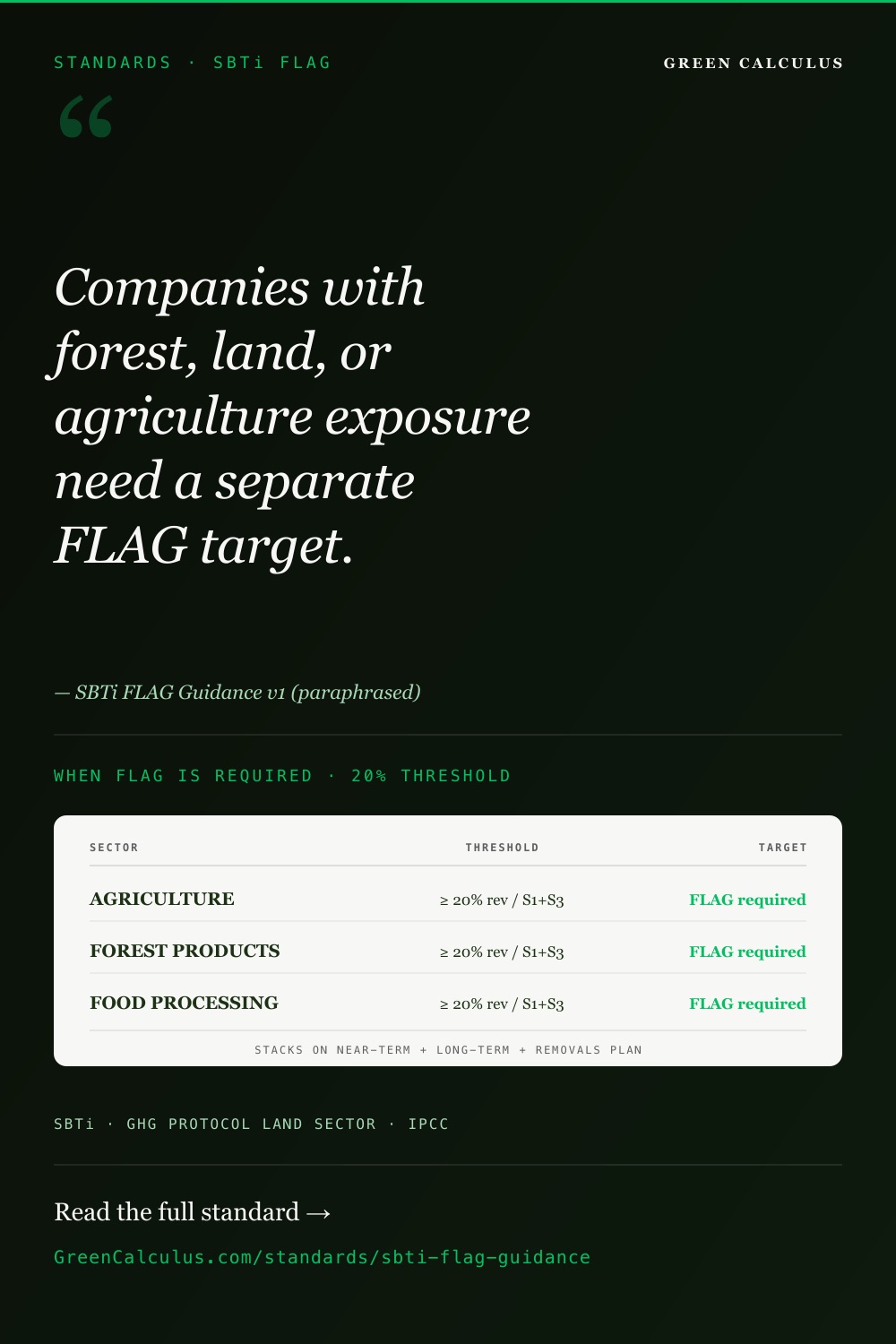
The sector classification alone would miss companies that are not classified as food or forestry companies but nonetheless have large land-sector footprints — for example a diversified consumer-goods company with a significant agricultural-commodity supply chain. To catch these, FLAG applies an emissions-share threshold: a company whose FLAG-related emissions constitute a sufficiently large share of its total emissions is expected to set a FLAG target regardless of its primary sector classification. The threshold is set so that any company for which land-sector emissions are material — broadly, where land-sector emissions reach around 20 percent of the total inventory — falls into FLAG scope.
The specific percentage threshold, the exact sector list, and the way the share is calculated are FLAG criteria parameters that the SBTi revises. The 20 percent figure and the sector list above reflect the FLAG Guidance as operative at this page’s review date. Any company near the threshold should determine its scope status against the current published FLAG criteria and the SBTi target-setting tool rather than relying on a reference page, because a company just below the threshold today can cross it after a single acquisition or supply-chain change.
Interaction with the energy-and-industry target
A company in FLAG scope does not replace its energy-and-industry target with a FLAG target — it sets both. The land-sector emissions go into the FLAG target; the fossil and process emissions go into the energy-and-industry target. The two targets are set on different methodologies, submitted together, and validated together. A company’s Scope 1, 2, and 3 emissions are therefore split between the two targets: the land-sector portion of Scope 3 (and any land-sector Scope 1, such as a company’s own farming operations) sits in the FLAG target, while the energy and industrial portion sits in the energy-and-industry target. Getting this split right — ensuring every tonne is in exactly one target and no tonne is double-counted or omitted — is the first methodological task in FLAG target-setting, and it is demonstrated in the worked example below. The split itself is performed against the company’s inventory, which is compiled under the GHG Protocol Scope 3 Standard for the value-chain emissions.
A company that needs to quantify the land-sector emissions that determine its FLAG scope and target can model the agricultural, land-use-change, and removals components through the GreenCalculus FLAG emissions calculator at the FLAG emissions calculator, with the underlying calculation rules documented in our FLAG emissions methodology and a dedicated Fertiliser & Soil N₂O calculator for the synthetic-nitrogen sub-component — all of which apply the IPCC Tier 1 factors documented in the AFOLU architecture section above.
Target Types — Commodity-Intensity vs Absolute
FLAG offers two target pathways, and the choice between them is the central target-setting decision. The two pathways lead to structurally different targets, suit different business models, and impose different measurement and tracking obligations.
FLAG sector pathway (absolute)
An absolute-reduction target on total land-sector emissions, anchored to the FLAG sector science-based decarbonisation pathway. The company commits to reducing its absolute land-sector emissions by a defined percentage by the target year, against a base year. Suits companies whose land-sector activity is not cleanly attributable to a single commodity, or that prefer an absolute commitment.
FLAG commodity pathway (intensity)
A commodity-specific intensity target, expressed as emissions per unit of commodity produced or sourced, anchored to commodity-level decarbonisation pathways. The company commits to reducing the emission intensity of specific commodities — beef, dairy, soy, palm, paper, and so on — by a defined amount by the target year. Suits companies whose footprint is concentrated in a small number of identifiable commodities.
The two pathways are anchored to modelled reference scenarios for land-sector decarbonisation. The absolute pathway uses a sector-wide trajectory; the commodity pathway uses commodity-specific trajectories that reflect the different abatement potential of different agricultural products. A company choosing the commodity pathway must be able to attribute its emissions to specific commodities and track intensity per unit of those commodities over time — a heavier measurement obligation than the absolute pathway, but one that produces a target more closely matched to the company’s actual production decisions.
| Dimension | FLAG sector pathway (absolute) | FLAG commodity pathway (intensity) |
|---|---|---|
| Target metric | Absolute tCO2e of land-sector emissions | tCO2e per unit of commodity |
| Anchored to | FLAG sector-wide decarbonisation pathway | Commodity-specific decarbonisation pathways |
| Best suited to | Diversified or hard-to-attribute land footprints | Footprints concentrated in identifiable commodities |
| Measurement obligation | Total land-sector emissions inventory | Emissions plus production volume per commodity |
| Growth sensitivity | Target tightens absolute emissions regardless of growth — business growth increases the abatement challenge | Intensity target permits absolute growth if intensity falls — decouples emissions from production volume |
| Deforestation requirement | Applies — no-deforestation commitment required alongside | Applies — no-deforestation commitment required alongside |
The growth-sensitivity row is the one that drives most pathway-selection decisions. An intensity target lets a growing company reconcile expansion with decarbonisation by improving the emissions efficiency of each unit produced, while an absolute target holds the line on total emissions regardless of growth. A company expecting significant production growth and choosing an absolute pathway is committing to a harder challenge than the headline percentage suggests, because growth works against the absolute target. Neither pathway, however, relaxes the no-deforestation requirement — it applies to both.
The No-Deforestation and DCF Requirement
FLAG is distinctive among science-based target types in requiring not just an emissions reduction but a specific commodity-supply-chain commitment: the elimination of deforestation. Companies setting FLAG targets are expected to commit to a no-deforestation target, with a target date of 2025, across their land-sector supply chains. The requirement reflects the AFOLU architecture: as the land-use-change emission factors in the architecture section show, deforestation is the single largest discrete emission source in many land-sector supply chains, and a credible land-sector target cannot leave it unaddressed.
The deforestation commitment in FLAG aligns with the broader concept of deforestation- and conversion-free (DCF) supply chains. A DCF commitment covers not only forest loss but the conversion of other natural ecosystems — grasslands, wetlands, savannahs — recognising that converting any high-carbon, high-biodiversity natural ecosystem to agricultural use produces the same kind of one-time carbon-stock loss that deforestation does. The cutoff date concept central to DCF — the date after which any conversion in a supply chain disqualifies the resulting commodity from being counted as conversion-free — interacts with the FLAG base year and target year, and companies must align their DCF cutoff with their FLAG accounting to avoid counting emissions from post-cutoff conversion as part of a target they claim to be meeting.
The specific cutoff date that applies to a given commodity depends on the framework and the commodity. Different deforestation-free frameworks and regulations set different cutoff dates, and the EU Deforestation Regulation uses its own cutoff. A company aligning its FLAG no-deforestation commitment with its DCF supply-chain commitments and with the EU Deforestation Regulation must reconcile the relevant cutoff dates rather than assuming a single date applies across all of them. The cutoff dates and the precise scope of the FLAG no-deforestation expectation are parameters to confirm against the current SBTi FLAG criteria and the relevant DCF framework — they are not values this reference can fix for every commodity.
The practical consequence is that a FLAG target and a deforestation commitment are inseparable. A company cannot set a FLAG emissions target and treat deforestation as a separate, later workstream; the no-deforestation commitment is part of what makes the FLAG target valid. This is the structural mechanism by which FLAG forces the largest land-sector emission source into the target rather than allowing it to be deferred.
The No-Offsets Rule in FLAG
One of the most consequential and most-searched aspects of FLAG is the rule that purchased carbon offsets cannot substitute for the reductions and removals counted toward a FLAG target. This is not a FLAG-specific invention — it is the application to the land sector of a principle that runs through the entire SBTi framework: a science-based target is met by reducing emissions within the company’s own value chain, not by purchasing credits to compensate for emissions that continue.
The rule matters more in the land sector than anywhere else, because the land sector is where the temptation to substitute offsets is strongest and where the line between a value-chain removal and a purchased offset is easiest to blur. A company can plant trees, restore soil carbon, or change agricultural practices within its own supply chain — these are value-chain removals and they can count toward a FLAG target. The same company can also buy forestry or soil-carbon credits on the voluntary market — these are offsets and they cannot count toward a FLAG target. The distinction is whether the removal occurs inside the company’s accounted value chain or is purchased from outside it.
The test is location and accounting, not activity type. A soil-carbon sequestration project on a farm inside the company’s sourcing footprint, accounted in the company’s land-sector inventory, is a value-chain removal eligible for the FLAG target. A purchased carbon credit retired against the company’s emissions — even a credit from an identical-looking soil-carbon project — is an offset, outside the value chain, and ineligible for the FLAG target. The company may still use purchased credits in its broader climate strategy as beyond-value-chain mitigation under the Corporate Net-Zero Standard, but those credits sit outside the FLAG target and cannot be presented as progress against it.
This rule is what gives a FLAG target its integrity as a measure of the company’s own decarbonisation. It forces the abatement effort into the company’s actual operations and supply chain — changing how cattle are raised, how fertiliser is applied, how land is managed, how forests are protected — rather than allowing the company to pay a third party to reduce emissions elsewhere while its own land-sector emissions continue. For a company evaluating its options, the practical implication is that FLAG progress requires real change in agricultural and forestry practice within the value chain, and that any carbon-credit purchasing strategy is a separate workstream that does not count toward the FLAG target.
Removals — The Source-and-Sink Duality
The feature that most distinguishes FLAG accounting from every other SBTi target type is the integral treatment of removals. In an energy-and-industry target, emissions only go up — there is no mechanism by which burning fossil fuel removes carbon from the atmosphere. In the land sector, the same land base that emits also sequesters: a managed forest grows and accumulates carbon; agricultural soils under improved management gain organic carbon; biomass on agricultural land stores carbon. FLAG is the SBTi target type that brings this removals dimension inside the target.
Removals in a FLAG inventory come from several sources: forest growth and afforestation or reforestation within the value chain; soil carbon sequestration from improved agricultural practices such as cover cropping, reduced tillage, and improved grazing management; and biomass carbon accumulation. These removals are accounted under the GHG Protocol Land Sector and Removals Standard, which is the accounting standard that specifies how a removal is recognised, quantified, and reported — including the durability and reversal-risk considerations that distinguish a permanent removal from a temporary one.
The source-and-sink duality has two structural consequences for FLAG targets. First, a FLAG target nets emissions against removals within the land-sector boundary, which means a company can make progress on its FLAG target by increasing removals as well as by reducing emissions — though the no-offsets rule confines eligible removals to the value chain. Second, the accounting for removals is materially harder than the accounting for emissions, because removals raise questions of permanence, reversal risk, and additionality that emissions do not. A tonne of carbon sequestered in soil can be released again if management practices change; a forest can burn. The Land Sector and Removals Standard addresses these questions, and a FLAG inventory that counts removals must satisfy the standard’s requirements for durability and reversal accounting.
This is the structural reason FLAG targets differ from industrial targets, and it is the reason the interaction between FLAG and the Land Sector and Removals Standard is so consequential. The target methodology assumes a removals accounting framework beneath it; the 2026 publication of that framework is what gives FLAG removals accounting a firm standard to rest on.
Worked Example — FLAG Target-Setting Walkthrough
An illustrative worked example demonstrating how a company in FLAG scope sets its targets, from inventory split through pathway selection to the paired target structure. The company and the numbers are hypothetical and hardcoded for instructional purposes; they are not the operational values for any specific real-world company and they apply illustrative IPCC Tier 1 factors rather than the company-specific factors a real target would use.
Company profile
“Northwind Foods plc” — a hypothetical food and beverage company with a dairy and beef supply chain, an own-farming operation, and a packaging footprint. Reported base-year inventory: energy-and-industry emissions (Scope 1 fossil combustion, Scope 2 electricity, and the non-land portion of Scope 3 such as packaging and logistics) of 400,000 tCO2e; land-sector emissions (enteric fermentation, manure, fertiliser, and land-use change in the agricultural supply chain) of 1,600,000 tCO2e; land-sector removals (soil carbon and on-farm biomass within the value chain) of 120,000 tCO2e. Total gross inventory: 2,000,000 tCO2e.
Step 1: Determine FLAG scope
Land-sector emissions of 1,600,000 tCO2e are 80 percent of the 2,000,000 tCO2e total — far above the materiality threshold. Northwind is in FLAG scope both by sector classification (food and beverage) and by emissions share. It must set a FLAG target alongside its energy-and-industry target.
Step 2: Split the inventory
Every tonne is allocated to exactly one target. The energy-and-industry target covers the 400,000 tCO2e of fossil, electricity, and non-land value-chain emissions. The FLAG target covers the 1,600,000 tCO2e of land-sector emissions, net of the 120,000 tCO2e of value-chain removals.
Energy-and-industry target boundary = 400,000 tCO2e
FLAG target boundary (gross emissions) = 1,600,000 tCO2e
FLAG value-chain removals = 120,000 tCO2e
FLAG net land-sector position = 1,600,000 − 120,000 = 1,480,000 tCO2e
Check: 400,000 + 1,600,000 = 2,000,000 tCO2e gross — every tonne allocated once
Step 3: Select the FLAG pathway
Northwind’s footprint is concentrated in two identifiable commodities — dairy and beef — and it can attribute emissions and production volume to each. It selects the commodity-intensity pathway, committing to reduce the emission intensity of its dairy (tCO2e per tonne of milk) and beef (tCO2e per tonne of product) against the commodity-specific FLAG decarbonisation pathways. A diversified company unable to make this attribution cleanly would instead select the absolute sector pathway on the 1,600,000 tCO2e total.
Step 4: Attach the no-deforestation commitment
Because Northwind’s beef supply chain carries land-use-change risk, it commits to a no-deforestation target across its land-sector supply chains, aligned to a DCF cutoff date reconciled with the EU Deforestation Regulation for its EU-market products. The land-use-change emissions in the base-year inventory are the emissions the deforestation commitment is designed to drive to zero in new sourcing.
Step 5: Pair and submit the targets
Northwind submits two targets to SBTi together: the energy-and-industry target on the 400,000 tCO2e boundary, set on the standard methodology, and the FLAG commodity-intensity target on the 1,600,000 tCO2e land-sector boundary with the 120,000 tCO2e removals accounted, set on the FLAG commodity pathway, with the no-deforestation commitment attached. SBTi validates the two together against the energy-and-industry criteria and the FLAG criteria respectively.
The FLAG target-setting workflow is structured: determine scope, split the inventory so every tonne sits in exactly one target, select the pathway that matches the business model, attach the no-deforestation commitment, and submit the paired targets for joint validation. The hardest and most error-prone step is the inventory split — the discipline that ensures land-sector emissions go into the FLAG target, energy and industrial emissions go into the energy-and-industry target, removals are confined to the value chain, and no tonne is double-counted or omitted. The removals treatment (netting 120,000 tCO2e of value-chain removals against gross land-sector emissions) is what makes this a FLAG target rather than a conventional Scope 3 reduction target.
Interaction with the GHG Protocol Land Sector and Removals Standard 2026
The GHG Protocol Land Sector and Removals Standard, published in 2026, is the accounting standard that the FLAG target methodology increasingly sits on top of. The relationship is the same as the relationship between any SBTi target and the accounting standard beneath it: the accounting standard specifies how the inventory is compiled; the target methodology specifies how the inventory is converted into a target. FLAG consumes the land-sector inventory the Land Sector and Removals Standard produces.
The Land Sector and Removals Standard does for land-sector accounting what the Corporate Standard and Scope 3 Standard did for energy and value-chain accounting: it specifies the boundary, the categorisation of emissions and removals, the treatment of land-use change, and — most consequentially — the accounting rules for removals, including durability, reversal risk, and the distinction between different removal types. Before the standard, land-sector inventory accounting drew on a patchwork of IPCC methods, programme-specific rules, and emerging guidance; the standard consolidates this into a single accounting framework.
For FLAG, the most important contribution of the Land Sector and Removals Standard is the removals accounting framework. As the removals section above explains, the source-and-sink duality is the defining feature of FLAG accounting, and removals raise questions — permanence, reversal, additionality — that the target methodology assumes are resolved by the accounting standard beneath it. The 2026 standard provides that resolution. A FLAG inventory compiled under the Land Sector and Removals Standard has a firm basis for how it recognises and quantifies the removals that the FLAG target nets against gross emissions.
The GHG Protocol Land Sector and Removals Standard is registered in the GreenCalculus source registry but its detailed accounting rows are not yet populated in the data layer. The interaction described here reflects the standard’s published structure and its role relative to FLAG; specific row-level accounting parameters from the standard should be confirmed against the GHG Protocol’s published Land Sector and Removals Standard directly as the data layer is populated.
Interaction with IPCC 2006 Guidelines and 2019 Refinement
The IPCC Guidelines are the scientific foundation beneath the entire FLAG chain. The 2006 IPCC Guidelines for National Greenhouse Gas Inventories and their 2019 Refinement provide the emission factors and quantification methodologies that turn agricultural and land-use-change activity into tonnes of CO2e. Every number in the AFOLU architecture section above — the enteric fermentation factors, the manure factors, the fertiliser nitrogen factor, the land-use-change stock losses — traces to the IPCC AFOLU volume.
The IPCC organises land-sector quantification into three tiers of increasing specificity and accuracy:
- Tier 1 uses default emission factors and simple activity data — for example, a single global or regional emission factor per head of cattle multiplied by the number of head. The illustrative factors in the AFOLU architecture section are Tier 1 factors. Tier 1 is the most accessible but the least accurate, and it cannot reflect company-specific abatement.
- Tier 2 uses country- or region-specific emission factors and more detailed activity data — for example, emission factors that reflect the specific feed, productivity, and manure-management systems of the herd. Tier 2 is strongly recommended for sources with high variability, such as manure management, where the IPCC notes more than tenfold variation across systems and climates.
- Tier 3 uses the most detailed, often model-based or measurement-based methods, reflecting the specific characteristics of the operation. Tier 3 is the most accurate and the most data-intensive.
The tier choice matters for FLAG because a target can only credit abatement that the inventory methodology can detect. A company using Tier 1 factors cannot show the emissions benefit of improved manure management or feed changes, because the Tier 1 factor is fixed regardless of practice. A company seeking to demonstrate genuine intensity reductions under a FLAG commodity pathway typically needs Tier 2 or Tier 3 methods that respond to the actual changes the company makes in its operations. The choice of tier is governed by the accounting standard and the IPCC tiers, not by FLAG itself — FLAG consumes the inventory at whatever tier it was compiled — but the practical reality is that meaningful FLAG progress usually requires moving up the tiers.
The GWP basis is the other IPCC-derived choice that runs through a FLAG inventory. Because agricultural emissions are dominated by methane and nitrous oxide, the choice between AR5 and AR6 global warming potentials has a larger effect on a FLAG inventory than on a fossil-fuel inventory. Corporate reporting defaults to AR6; some DEFRA-sourced factors carry AR5 internally by convention. A FLAG inventory must apply the GWP basis consistently across all its non-CO2 sources, and inconsistency here is a common finding.
Interaction with the SBTi Corporate Net-Zero Standard
FLAG is a component of the SBTi Corporate Net-Zero Standard, not a standalone framework. The Corporate Net-Zero Standard sets the overall target architecture; FLAG is the land-sector target type that plugs into it. Understanding how the two relate is essential to setting a compliant set of targets.
The Corporate Net-Zero Standard requires companies to set near-term targets (typically over a five-to-ten-year horizon) and long-term targets (to a net-zero target year), and to reach a state of net-zero emissions in which residual emissions are neutralised by permanent removals. A company in FLAG scope satisfies these requirements across two parallel target tracks: the energy-and-industry track, set on the standard’s general methodology, and the FLAG track, set on the FLAG methodology. Both tracks have near-term and long-term targets; both contribute to the company’s overall net-zero commitment.
The interaction creates several rules that a company must observe. The FLAG target and the energy-and-industry target cannot overlap — the inventory split described in the sector-scope and worked-example sections ensures every tonne sits in exactly one track. The two targets are validated together, not separately, so a company cannot obtain validation of its energy-and-industry target while deferring its FLAG target if it is in FLAG scope. And the net-zero end state requires both tracks to reach their long-term targets, with FLAG residual emissions neutralised by removals accounted under the land-sector removals framework.
The removals treatment is where FLAG and the Corporate Net-Zero Standard interlock most tightly. The standard’s net-zero concept requires neutralising residual emissions with permanent removals; FLAG’s integral removals accounting is the mechanism by which land-sector residuals are addressed. The beyond-value-chain mitigation concept in the standard — the recommendation that companies invest in mitigation outside their value chain in addition to meeting their targets — is where purchased carbon credits sit, explicitly outside both the FLAG target and the energy-and-industry target.
Interaction with the GHG Protocol Scope 3 Standard
For most companies in FLAG scope, the land-sector emissions that go into the FLAG target sit predominantly in Scope 3 — the value-chain emissions of purchased agricultural commodities. A food company does not usually own the farms that produce its raw materials; the enteric fermentation, manure, fertiliser, and land-use-change emissions of those farms are the company’s upstream Scope 3 emissions under the GHG Protocol Scope 3 Standard, principally Category 1 (purchased goods and services).
This is why FLAG and the Scope 3 Standard interact so directly. The Scope 3 Standard specifies how the value-chain inventory is compiled — which categories are included, how upstream agricultural emissions are quantified, what data quality is expected. FLAG then takes the land-sector portion of that Scope 3 inventory and converts it into a target. The land-sector emissions do not form a separate scope; they are a subset of the company’s Scope 1, 2, and 3 emissions, identified by their land-sector character and routed into the FLAG target rather than the energy-and-industry target.
The practical consequence is that a company’s Scope 3 inventory must be granular enough to identify and isolate its land-sector emissions. A company that quantifies its purchased agricultural goods using a coarse spend-based method may be unable to separate the land-sector emissions from the rest of Category 1 with the precision a FLAG target requires, and may be unable to demonstrate intensity reductions under a commodity pathway. Moving from spend-based to activity-based or supplier-specific data for agricultural commodities is therefore often a prerequisite to a credible FLAG target — the same data-quality progression that the tier discussion in the IPCC interaction section describes, viewed from the inventory-accounting side.
Interaction with CSRD / ESRS E1
The EU Corporate Sustainability Reporting Directive and its climate standard, ESRS E1, are the disclosure regime into which a validated FLAG target flows for companies in CSRD scope. ESRS E1 requires disclosure of a company’s greenhouse gas emissions across Scope 1, Scope 2, and material Scope 3, and disclosure of the company’s climate transition plan and targets. For a company in FLAG scope, the land-sector emissions and the FLAG target are material elements of that disclosure.
The interaction works in both directions. ESRS E1 requires the company to disclose its targets, including the FLAG target where one exists, and to report progress against them — so the FLAG target becomes a disclosed, audited commitment rather than a voluntary claim. And ESRS E1’s emissions-disclosure requirements drive the inventory granularity that FLAG also depends on: a company compiling its Scope 3 inventory to ESRS E1 standard is compiling much of the data its FLAG target requires. The land-sector emissions disclosed under ESRS E1 and the land-sector emissions targeted under FLAG are the same emissions, viewed through the disclosure lens and the target lens respectively.
Crucially, ESRS E1 brings the land-sector inventory into the scope of mandatory assurance. CSRD requires assurance of sustainability disclosures, which means the land-sector inventory underlying a FLAG target — historically one of the least-assured parts of a corporate footprint — is increasingly subject to third-party verification. The verification of that inventory is the subject of the verification section below.
Interaction with IFRS S2
IFRS S2 Climate-Related Disclosures is the ISSB’s global climate-disclosure standard, adopted progressively across jurisdictions. Like ESRS E1, it requires disclosure of Scope 1, Scope 2, and Scope 3 emissions and of the company’s climate targets, and like ESRS E1 it carries the FLAG target and the land-sector inventory into mandatory disclosure for companies in adopting jurisdictions.
IFRS S2 requires disclosure of greenhouse gas emissions measured under the GHG Protocol Corporate Standard, and disclosure of the targets the company has set, including the methodology and the validation status. A FLAG target validated by SBTi is the kind of target IFRS S2 expects a land-sector company to disclose, with its commodity-intensity or absolute pathway, its base and target years, and its progress. As IFRS S2 adoption spreads across the jurisdictions implementing it — and as those jurisdictions progressively introduce assurance requirements — the land-sector inventory underlying a FLAG target enters the same mandatory-assurance trajectory under IFRS S2 that it enters under CSRD.
The convergence of CSRD and IFRS S2 on land-sector emissions is the development that most changes the stakes of FLAG. A FLAG target was, at its 2022 introduction, a voluntary commitment validated by a voluntary initiative. By 2026, the land-sector emissions it targets are entering mandatory disclosure and mandatory assurance under two major disclosure regimes. The methodological rigour of the inventory beneath the target — the IPCC-consistent factors, the GHG Protocol-conformant compilation, the defensible removals accounting — is no longer only a matter of SBTi validation; it is a matter of regulatory disclosure and audit.
Verification and Assurance of FLAG Inventories
As land-sector emissions enter mandatory disclosure under CSRD and IFRS S2, the inventory underlying a FLAG target increasingly requires third-party assurance. The assurance methodology is ISO 14064-3 verification, the international standard for the validation and verification of greenhouse gas statements, applied to the land-sector inventory the same way it is applied to any other corporate GHG statement.
Land-sector inventories present verification challenges that energy-and-industry inventories do not. The activity data is often upstream in the supply chain, held by farmers and intermediaries rather than by the reporting company, which makes it harder to trace to primary records. The emission factors are tier-dependent and the choice of tier materially affects the result. The removals accounting raises permanence and reversal questions that emissions accounting does not. And the land-use-change emissions depend on supply-chain traceability that is difficult to establish for commodities sourced through long, opaque supply chains.
The common verification findings in land-sector inventories therefore cluster around these difficulties: unsupported upstream activity data where the company cannot trace the figure to a primary record; inconsistent tier application across sources or across the base and reporting years; GWP-basis inconsistency across the methane- and nitrous-oxide-dominated source mix; removals counted without adequate durability or reversal accounting; and land-use-change emissions omitted or understated because supply-chain traceability is incomplete. A FLAG inventory prepared with these findings in mind — traceable activity data, consistent tier and GWP application, defensible removals accounting, and credible land-use-change traceability — produces a cleaner assurance engagement and a more defensible target. The full verification methodology, the limited-versus-reasonable assurance distinction, and the mandatory-jurisdiction assurance trajectory are documented on the dedicated ISO 14064-3 reference page.
Mandatory Jurisdiction Implications
FLAG itself is voluntary — it is a target-setting methodology of a voluntary initiative, not a regulation. But the land-sector emissions it targets, and the deforestation commitments it requires, are increasingly the subject of mandatory regulation. The convergence of voluntary FLAG target-setting and mandatory land-sector regulation is the development that most changes the operational stakes for companies in FLAG scope. The mapping below covers the regimes where land-sector emissions or deforestation are entering mandatory scope.
| Jurisdiction / Regime | What it requires | Relevance to FLAG |
|---|---|---|
| EU CSRD / ESRS E1 | Mandatory disclosure of Scope 1, 2, and material Scope 3 emissions and of climate targets, with assurance, for in-scope undertakings | Brings the land-sector inventory and the FLAG target into mandatory, assured disclosure |
| EU Deforestation Regulation | Prohibits placing on the EU market commodities (cattle, soy, palm, wood, cocoa, coffee, rubber and derived products) linked to deforestation after a defined cutoff date, with due-diligence and geolocation requirements | Makes deforestation-free supply chains a legal requirement, not just a FLAG expectation; companies must reconcile the FLAG no-deforestation commitment with the regulation’s cutoff and due-diligence rules |
| IFRS S2 adopting jurisdictions | Mandatory climate disclosure including Scope 1, 2, and 3 emissions and targets, progressively with assurance, across adopting jurisdictions | Carries the land-sector inventory and FLAG target into mandatory disclosure wherever IFRS S2 is adopted |
| Singapore | Climate disclosure for listed and large companies aligned with IFRS S2, with assurance phasing in | Brings land-sector emissions of in-scope food and agriculture companies into mandatory disclosure |
| Australia | Mandatory climate-related financial disclosure aligned with IFRS S2, phased by entity size, with assurance | Brings the land-sector inventory of large agricultural and food companies into mandatory, assured disclosure |
The EU Deforestation Regulation is the regime that interacts most directly with FLAG’s distinctive content. Where FLAG expects a no-deforestation commitment as a condition of target validity, the EU Deforestation Regulation requires deforestation-free supply chains as a condition of market access, backed by due-diligence and geolocation obligations and its own cutoff date. A company in FLAG scope selling into the EU market must satisfy both: the FLAG no-deforestation commitment for target validity, and the regulation’s due-diligence regime for market access. Reconciling the two — aligning cutoff dates, sharing the underlying supply-chain traceability data — is a practical task that the largest land-sector companies are working through now. The relationship between land-sector carbon costs and the EU’s broader carbon-border regime is addressed on the EU CBAM reference page, though CBAM does not currently cover the agricultural commodities most central to FLAG.
Common Inventory and Target-Setting Findings
Seven categories of issue that surface routinely when FLAG inventories and targets are prepared and reviewed, and that companies should anticipate before submitting a FLAG target for validation or an inventory for assurance:
- Inventory-split errors. Land-sector emissions left in the energy-and-industry target, or energy emissions pulled into the FLAG target; tonnes double-counted across both targets or omitted from both. The split must allocate every tonne to exactly one target.
- GWP-basis inconsistency. AR5 applied to some non-CO2 sources and AR6 to others, or biogenic and fossil methane treated inconsistently — a larger error in a methane- and nitrous-oxide-dominated FLAG inventory than in a fossil inventory.
- Tier mismatch. Tier 1 default factors used where the company claims practice-based abatement that only Tier 2 or Tier 3 methods can detect, so the claimed reduction cannot be substantiated by the inventory methodology.
- Unsupported upstream activity data. Agricultural activity data — head of livestock, kilograms of nitrogen, hectares sourced — that cannot be traced to a primary record because it sits upstream with farmers and intermediaries.
- Land-use-change omission. Land-use-change emissions understated or omitted because supply-chain traceability is incomplete, despite land-use change often being the single largest emission source in the inventory.
- Removals over-counted or under-evidenced. Removals counted toward the FLAG target without adequate durability and reversal accounting, or removals from outside the value chain (purchased offsets) misclassified as value-chain removals.
- Deforestation commitment misaligned. A FLAG no-deforestation commitment whose cutoff date is not reconciled with the company’s DCF supply-chain commitments or the EU Deforestation Regulation, so the same supply chain carries inconsistent deforestation cutoffs.
Each of these is correctable before submission or assurance. The company that anticipates them in inventory and target preparation produces a cleaner validation and a more defensible disclosure.
Common Misinterpretations
Six high-frequency misreadings of FLAG that surface in target-setting discussions, sustainability-team training, and external scrutiny of land-sector climate claims:
It does not. For most companies in FLAG scope, the land-sector emissions are predominantly Scope 3 — the upstream emissions of purchased agricultural commodities. FLAG covers land-sector emissions wherever they sit in the inventory, and for a food company that does not own its farms, that means the FLAG target is dominated by Scope 3 Category 1 emissions, not Scope 1.
They cannot. Only removals occurring within the company’s own value chain, accounted in its land-sector inventory, count toward a FLAG target. A purchased carbon credit — even from an identical-looking removal project — is an offset, sits outside the value chain, and cannot count toward the FLAG target. It may be used as beyond-value-chain mitigation under the Corporate Net-Zero Standard, but that is separate from the FLAG target.
They are neither. They are two distinct targets on two distinct methodologies, covering two non-overlapping portions of the inventory. A company in FLAG scope sets both; it does not pick one, and it does not add them into a single headline number. Every tonne sits in exactly one target, and the two are validated together but tracked separately.
The reverse is true. A FLAG target requires a no-deforestation commitment as a condition of its validity — the two are inseparable. A company cannot set a FLAG emissions target and defer deforestation to a later workstream; the no-deforestation commitment, expected from a 2025 target date, is part of what makes the FLAG target valid.
It is not. FLAG is a target-setting methodology that consumes an inventory built under the GHG Protocol (and the Land Sector and Removals Standard) using IPCC emission factors. FLAG specifies how to convert a land-sector inventory into a target; it does not specify how to compile the inventory. Companies that look to FLAG for inventory-compilation rules are looking in the wrong document.
It does not. An intensity pathway permits absolute emissions to rise only if emission intensity per unit of commodity falls fast enough along the commodity decarbonisation pathway — and it still requires the no-deforestation commitment and is still validated against a 1.5°C-aligned trajectory. Intensity decoupling is not a licence for unconstrained growth; it is a different, sometimes harder, route to the same destination.
What FLAG Guidance Does Not Cover
The dimensions FLAG does not address — and that other layers in the stack, the accounting standard, or separate frameworks address — are as important to understand as the dimensions it does.
- Inventory compilation. FLAG does not specify how to build the land-sector inventory — boundary, scope mapping, removals recognition. That is the GHG Protocol’s role, principally the Land Sector and Removals Standard.
- Emission-factor science. FLAG does not define the emission factors or the tier methodologies. Those come from the IPCC Guidelines and Refinement.
- Carbon-credit certification or quality. FLAG does not certify carbon credits, rank their quality, or adjudicate offset integrity. Credit quality frameworks and the carbon-credit standards address that, and credits sit outside the FLAG target entirely.
- The legal due-diligence of deforestation regulation. FLAG expects a no-deforestation commitment but does not implement the legal due-diligence, geolocation, and traceability obligations of the EU Deforestation Regulation. Those are a separate legal compliance workstream.
- Biodiversity, water, and other land-related impacts. FLAG is greenhouse-gas-specific. The broader environmental impacts of land use — biodiversity loss, water use, soil health beyond carbon — are addressed by other frameworks, including emerging nature-related disclosure frameworks.
- The energy-and-industry target. FLAG governs only the land-sector target. The fossil and process emissions are governed by the SBTi general methodology under the Corporate Net-Zero Standard.
- Assurance methodology. FLAG does not specify how the land-sector inventory is verified. That is ISO 14064-3, applied to the inventory the same way as to any GHG statement.
Future Evolution
Four trajectories will shape FLAG and its operational context through the late 2020s.
The Land Sector and Removals Standard implementation. The 2026 publication of the GHG Protocol Land Sector and Removals Standard gives FLAG a firm accounting foundation for the first time, particularly for removals. The implementation phase will surface practical questions about how the standard’s removals, durability, and reversal rules interact with FLAG target accounting — questions likely to drive refinement of the FLAG methodology as the accounting standard beneath it beds in.
FLAG methodology revision. FLAG is a living methodology, and the SBTi revises its standards and sector guidance as the science and the accounting standards evolve. The arrival of the Land Sector and Removals Standard, accumulated implementation experience since 2022, and the broader evolution of the SBTi Corporate Net-Zero Standard all point toward future FLAG revisions. The sector-scope thresholds, the pathway parameters, and the no-deforestation date are the elements most likely to be refined.
The mandatory-disclosure convergence. The movement of land-sector emissions into mandatory disclosure and assurance under CSRD, IFRS S2 adopting jurisdictions, and the EU Deforestation Regulation will continue to raise the stakes of FLAG. A target that was voluntary at its 2022 introduction increasingly governs emissions that are mandatorily disclosed and assured, which raises the rigour expected of the inventory beneath it and brings FLAG progress into the scope of regulatory and audit scrutiny.
The traceability and data-quality frontier. The binding constraint on credible FLAG targets is supply-chain data quality — the ability to trace agricultural activity data to primary records, to apply higher-tier emission factors that detect practice-based abatement, and to establish the land-use-change traceability that the no-deforestation commitment requires. The investment companies are making in supply-chain traceability, increasingly driven by the EU Deforestation Regulation as much as by FLAG, will determine how far FLAG targets can move from estimated to evidenced over the rest of the decade.
Stay current with every land-sector development
GreenCalculus tracks the FLAG methodology, the GHG Protocol Land Sector and Removals Standard implementation, the EU Deforestation Regulation timeline, and the mandatory-disclosure trajectory for land-sector emissions. Subscribe to the next update and stay ahead of every revision.
Frequently Asked Questions
SBTi FLAG Guidance is the Forest, Land and Agriculture Science Based Target-Setting Guidance, published by the Science Based Targets initiative in 2022. It is the methodology that lets companies with material land-sector emissions set science-based targets covering agriculture, land-use change, and land-sector removals. A company in FLAG scope sets a FLAG target alongside its standard energy-and-industry target, on a commodity-intensity or absolute pathway, accompanied by a no-deforestation commitment, with only value-chain reductions and removals counting toward the target. FLAG is not an accounting standard and not an IPCC methodology — it sits on top of the GHG Protocol accounting and the IPCC emission factors as the target layer.
Two groups of companies. First, companies classified in the designated FLAG sectors — forest and paper products, agricultural production, animal-source food, food and beverage processing, food and staples retailing, and tobacco — set a FLAG target by virtue of their sector. Second, companies in any sector whose land-sector emissions are a material share of their total inventory — broadly around 20 percent or more — fall into FLAG scope on the emissions-share threshold regardless of their primary sector. The exact threshold and sector list are FLAG criteria that the SBTi revises, so a company near the threshold should confirm its status against the current published FLAG criteria.
An absolute FLAG target commits the company to reducing its total land-sector emissions by a defined percentage by the target year, anchored to the FLAG sector-wide decarbonisation pathway. A commodity-intensity target commits the company to reducing the emission intensity — emissions per unit of commodity produced or sourced — of specific commodities such as beef, dairy, soy, or palm, anchored to commodity-specific pathways. The absolute pathway suits diversified or hard-to-attribute footprints; the intensity pathway suits footprints concentrated in identifiable commodities and decouples emissions from production volume. The intensity pathway carries a heavier measurement obligation because it requires tracking production volume per commodity. Both require the no-deforestation commitment.
No. Purchased carbon offsets cannot substitute for the reductions and removals counted toward a FLAG target. Only reductions and removals occurring within the company’s own value chain, accounted in its land-sector inventory, count toward the target. A soil-carbon or forestry project inside the company’s sourcing footprint is a value-chain removal and is eligible; a purchased credit retired against the company’s emissions — even from an identical project type — is an offset, sits outside the value chain, and is ineligible. The company may still use purchased credits as beyond-value-chain mitigation under the SBTi Corporate Net-Zero Standard, but those credits are separate from the FLAG target and cannot be presented as progress against it.
FLAG is the only SBTi target type that treats removals as integral rather than supplementary, because the land sector is both a source of emissions and a sink for carbon. Removals from forest growth, soil carbon sequestration through improved practices, and biomass accumulation within the value chain are netted against gross land-sector emissions in the FLAG target. These removals are accounted under the GHG Protocol Land Sector and Removals Standard, which specifies the durability and reversal-risk rules that distinguish a permanent removal from a temporary one. The no-offsets rule confines eligible removals to the value chain — purchased removal credits do not qualify.
Companies setting FLAG targets are expected to commit to ending deforestation across their land-sector supply chains, with a target date of 2025. The requirement reflects the fact that deforestation is the single largest discrete emission source in many land-sector supply chains — a hectare of tropical deforestation carries an emission on the order of 165,000 kg CO2e of one-time stock loss. The commitment aligns with the broader concept of deforestation- and conversion-free supply chains, which also covers conversion of other natural ecosystems such as grasslands and wetlands. A FLAG target and its no-deforestation commitment are inseparable; the commitment is part of what makes the target valid.
Yes, and for most companies in FLAG scope the land-sector emissions are predominantly Scope 3. A food company that does not own its farms has its agricultural emissions — enteric fermentation, manure, fertiliser, land-use change — as upstream Scope 3, principally Category 1 (purchased goods and services) under the GHG Protocol Scope 3 Standard. FLAG covers land-sector emissions wherever they sit in the inventory, so the FLAG target is typically dominated by Scope 3. This is why a company’s Scope 3 inventory must be granular enough to isolate its land-sector emissions, often requiring a move from spend-based to activity-based or supplier-specific data for agricultural commodities.
FLAG is a component of the Corporate Net-Zero Standard, not a standalone framework. The Corporate Net-Zero Standard sets the overall target architecture — near-term and long-term targets, the net-zero end state, beyond-value-chain mitigation. FLAG is the land-sector target type that plugs into that architecture for companies in FLAG scope. Such a company sets two parallel target tracks: an energy-and-industry track on the standard’s general methodology and a FLAG track on the FLAG methodology, validated together. The inventory split ensures the two tracks do not overlap, and the net-zero end state requires both tracks to reach their long-term targets, with FLAG residuals neutralised by value-chain removals.
The Land Sector and Removals Standard, published in 2026, is the accounting standard that the FLAG target methodology sits on top of for land-sector inventory compilation. The accounting standard specifies how the land-sector inventory is built — boundary, categorisation, land-use-change treatment, and most consequentially the removals accounting rules including durability and reversal risk. FLAG then converts that inventory into a target. The standard’s most important contribution to FLAG is the removals accounting framework, because the source-and-sink duality is FLAG’s defining feature and removals raise permanence and reversal questions that the target methodology assumes the accounting standard resolves.
FLAG itself does not mandate a tier — it consumes the inventory at whatever tier it was compiled, with the tier choice governed by the accounting standard and the IPCC Guidelines. But the practical reality is that meaningful FLAG progress usually requires moving up the tiers. Tier 1 uses fixed default emission factors that cannot reflect company-specific abatement, so a company using Tier 1 cannot demonstrate the emissions benefit of improved manure management, feed changes, or fertiliser practices. A company seeking to show genuine intensity reductions under a commodity pathway typically needs Tier 2 or Tier 3 methods that respond to the actual changes it makes in its operations.
The two address deforestation from different directions. FLAG expects a no-deforestation commitment as a condition of target validity; the EU Deforestation Regulation requires deforestation-free supply chains as a condition of placing covered commodities on the EU market, backed by due-diligence, geolocation, and traceability obligations and its own cutoff date. A company in FLAG scope selling into the EU must satisfy both. The practical task is reconciliation — aligning the cutoff dates and sharing the underlying supply-chain traceability data so that the same supply chain does not carry inconsistent deforestation cutoffs across the voluntary FLAG commitment and the mandatory regulation.
The FLAG target itself is validated by SBTi, but the land-sector inventory underlying it increasingly requires third-party assurance as land-sector emissions enter mandatory disclosure under CSRD and IFRS S2 adopting jurisdictions. The assurance methodology is ISO 14064-3, applied to the land-sector inventory the same way as to any GHG statement. Land-sector inventories present particular verification challenges — upstream activity data that is hard to trace, tier-dependent factors, removals permanence questions, and land-use-change traceability — so a FLAG inventory prepared with traceable data, consistent tier and GWP application, and defensible removals accounting produces a cleaner assurance engagement.
Sources and References
Every claim and methodological statement on this page reconciles to the primary sources below. Where the SBTi, the GHG Protocol, or the IPCC has published a definitive document on a topic, the primary source is cited directly; secondary commentary is used only for interpretation.
Primary SBTi documents
- Science Based Targets initiative, Forest, Land and Agriculture Science Based Target-Setting Guidance (FLAG Guidance), 2022, with the accompanying FLAG target-setting tool and sector pathways. Operative version as referenced as of May 2026.
- Science Based Targets initiative, SBTi Corporate Net-Zero Standard, 2021, and accompanying criteria and target-validation protocol.
- Science Based Targets initiative, target-setting criteria and FLAG sector classification and threshold documentation, current versions.
Accounting standards
- World Resources Institute & World Business Council for Sustainable Development, GHG Protocol Land Sector and Removals Standard, First Edition, 2026.
- World Resources Institute & World Business Council for Sustainable Development, The Greenhouse Gas Protocol: A Corporate Accounting and Reporting Standard, revised edition 2004.
- World Resources Institute & World Business Council for Sustainable Development, Corporate Value Chain (Scope 3) Accounting and Reporting Standard, 2011.
Emission-factor science
- Intergovernmental Panel on Climate Change, 2006 IPCC Guidelines for National Greenhouse Gas Inventories, Volume 4 (Agriculture, Forestry and Other Land Use).
- Intergovernmental Panel on Climate Change, 2019 Refinement to the 2006 IPCC Guidelines for National Greenhouse Gas Inventories.
- Intergovernmental Panel on Climate Change, Sixth Assessment Report (AR6), Working Group I, 2021. GWP-100 values applied to non-CO2 sources.
Disclosure and regulatory regimes
- European Financial Reporting Advisory Group, European Sustainability Reporting Standards, ESRS E1 (Climate change), under the EU Corporate Sustainability Reporting Directive.
- International Sustainability Standards Board, IFRS S2 Climate-Related Disclosures, 2023, as amended.
- European Union, Regulation on deforestation-free products (EU Deforestation Regulation), with its due-diligence, geolocation, and cutoff-date provisions.
Related GreenCalculus reference pages
- GHG Protocol Land Sector and Removals Standard — the land-sector accounting standard beneath FLAG
- SBTi Corporate Net-Zero Standard — the framework FLAG is a component of
- IPCC 2019 Refinement — the emission-factor science
- GHG Protocol Scope 3 Standard — where most FLAG emissions sit
- ISO 14064-3 Verification — assurance of the land-sector inventory
- CSRD / ESRS E1 — the EU disclosure regime
- IFRS S2 Climate-Related Disclosures — the global disclosure standard
- FLAG Emissions Calculator — model the land-sector inventory components
What changed in this revision
Updated 25 May 2026. Initial publication. Reflects the operative state of SBTi FLAG Guidance as of May 2026, incorporating: the 2022 FLAG Guidance and target-setting tool; the FLAG sector scope and emissions-share threshold; the commodity-intensity and absolute pathway types; the no-deforestation commitment and its 2025 target date; the no-offsets rule and value-chain removals distinction; the source-and-sink removals duality; the 2026 GHG Protocol Land Sector and Removals Standard as the accounting foundation; the IPCC 2006 Guidelines and 2019 Refinement tier methodology; the SBTi Corporate Net-Zero Standard framework relationship; and the CSRD, IFRS S2, and EU Deforestation Regulation mandatory-disclosure convergence on land-sector emissions.