
Gross vs Net Emissions — Definition and GHG Accounting Context
Two companies both announce “20,000 tonnes net”. The first genuinely emits 30,000 tonnes and removes 10,000 with permanent carbon capture. The second emits 100,000 tonnes and buys 80,000 tonnes of cheap offsets. Their net figures are identical; their impact on the atmosphere is not remotely so. The single number that tells them apart is the one they would both rather not lead with — the gross.
Gross and net emissions are the two sides of that number — gross is everything a company actually emits; net is what is left after removals and offsets are subtracted — and only the gross tells you what reached the sky.
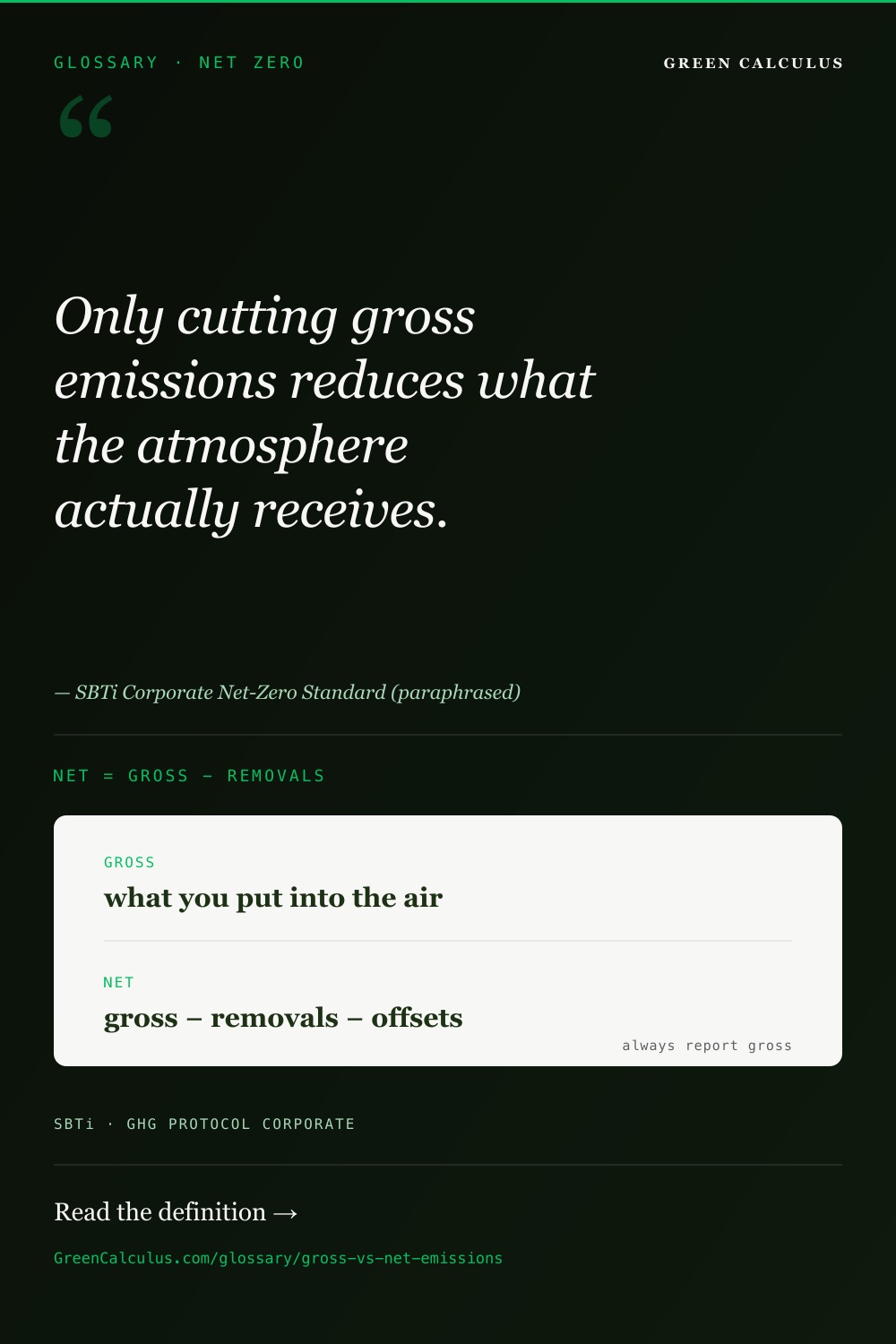
Gross emissions are the total greenhouse gases an organisation produces, before any subtraction. Net emissions are gross emissions minus carbon removals (and sometimes purchased offsets): net = gross − removals − offsets. Only cutting gross reduces what the atmosphere actually receives — which is why gross emissions must always be reported, not just the net figure.
Definition — Total Emitted vs What Remains
Gross emissions are the total greenhouse gas emissions an organisation produces over a reporting period — the full inventory across Scopes 1, 2, and 3, before anything is subtracted. It is the honest measure of a company’s contribution to the atmosphere: the sum of everything it actually emits.
Net emissions are gross emissions after carbon removals — and, in some accounting, purchased offsets — have been subtracted. Net is always less than or equal to gross, and the gap between them is exactly the quantity of emissions a company claims to have balanced elsewhere rather than avoided emitting in the first place.
The distinction matters because the two numbers answer different questions. Gross asks “how much did you emit?”; net asks “how much is left after you paid to balance some of it?”. A falling gross figure is a real reduction in emissions; a falling net figure might be a real reduction, or it might just be more removals and offsets layered on top of an unchanged gross. That ambiguity is why the distinction sits at the heart of every credible — and every questionable — net-zero claim.
Definition at a glance
| The two terms | Gross emissions · net emissions |
|---|---|
| Gross | Total GHG emissions produced, before any subtraction |
| Net | Gross minus carbon removals (and sometimes offsets) |
| Formula | Net = gross − removals − offsets |
| Reported | Gross always reported; removals and offsets shown separately, not deducted |
| Not to be confused with | Net zero — a state where residual gross emissions are balanced by removals |
The GHG Protocol Corporate Standard requires companies to report their gross emissions across the scopes, and to report any offsets or reductions from purchased credits separately — they are never deducted from the inventory total. The gross figure is the primary number.
The SBTi Corporate Net-Zero Standard is stricter still: it does not allow offsets to be netted against a reduction target, and permits permanent removals only to neutralise a small residual after deep absolute cuts of around 90% across Scopes 1, 2, and 3.
The Formula: What Can Be Netted Off
Net emissions are gross minus what a company subtracts — but not everything a company might like to subtract is legitimate, and the standards are increasingly strict about what may be netted off and when:
| Item | Reduces net? | Notes |
|---|---|---|
| Carbon removals (DAC, afforestation, BECCS) | Yes — the credible route | Permanent removals neutralise residual gross emissions |
| Purchased offsets / credits | Contested | The SBTi does not allow them to be netted against reduction targets |
| Avoided emissions | No | A separate claim about emissions prevented elsewhere — never subtracted from your own inventory |
The cleanest case is a permanent removal, which physically takes CO₂ back out of the atmosphere and so genuinely offsets a residual gross emission. Purchased offsets are contested because their quality and permanence vary, and because they can substitute for real reductions. Avoided emissions are a common error — they describe emissions a product helped prevent elsewhere and can never be deducted from a company’s own gross total.
Gross, Net, and Net-Zero Integrity
The gross/net distinction is what separates a credible net-zero claim from greenwashing. A genuine net-zero pathway drives gross emissions down as far as possible, then uses removals only to neutralise the small residual that cannot yet be eliminated. A weak one leaves gross emissions high and simply buys enough offsets to make the net number small.
Gross vs net for one company (illustrative)
Net emissions are gross minus removals and offsets — here 100,000 t gross becomes 80,000 t net after 20,000 t is balanced elsewhere. The amber gross bar is what the atmosphere actually received; the 20,000 t gap is not a reduction in what the company emitted. Two companies can report the same net figure with completely different gross emissions, which is why gross must always be shown alongside net. Illustrative figures.
This is why frameworks insist on the gross figure. Judged on net alone, a company that cut its gross emissions in half looks identical to one that cut nothing and offset the difference — yet only the first has changed what reaches the atmosphere. The SBTi encodes this by requiring deep gross reductions before any neutralisation counts.
How Gross and Net Are Reported
Under the GHG Protocol, the gross figure is the headline: a company reports its Scope 1, 2, and 3 emissions in full, and reports any purchased offsets or credits separately, so a reader can always see both the true emissions and whatever has been done to balance them. Offsets are never quietly deducted from the scope totals to produce a smaller inventory.
Net figures are legitimate and useful — a company pursuing net zero needs to show its residual after removals — but only when presented alongside the gross. Best-practice disclosure states gross emissions, the reductions achieved against them, the removals applied, and the resulting net, as separate lines rather than a single netted number. The moment net appears without gross, the most important information has been hidden.
Common Confusions
- Reading net as the real emissions. Net is gross minus what was balanced elsewhere; the atmosphere received the gross amount.
- Confusing net emissions with net zero. Net emissions is a number; net zero is a state in which residual gross emissions are fully neutralised by removals.
- Netting offsets off a reduction target. The SBTi does not allow it — a reduction target must be met by cutting gross, not by buying credits.
- Subtracting avoided emissions. Emissions prevented elsewhere are a separate claim and can never be deducted from a company’s own gross total.
- Presenting net without gross. A net figure alone is uninterpretable — two companies with identical nets can have wildly different gross emissions.
- Treating all removals and offsets as equal. A permanent physical removal is not the same as a cheap, impermanent offset, even if both reduce the net figure by the same amount on paper.
Frequently Asked Questions
Gross emissions are the total greenhouse gases an organisation produces over a reporting period — its full inventory across Scopes 1, 2, and 3, before any subtraction. Net emissions are gross emissions after carbon removals, and sometimes purchased offsets, have been subtracted: net = gross − removals − offsets. Gross measures what a company actually emits; net measures what is left after some of it is balanced elsewhere. Only reducing gross emissions changes what the atmosphere receives, which is why gross must always be reported, not just the net figure.
Because net alone can hide a company’s true impact. Two companies can report the same net figure while emitting wildly different amounts — one by cutting gross emissions deeply and removing a small residual, the other by leaving gross high and buying offsets to match. Judged on net, they look identical; judged on gross, only the first has reduced what reaches the atmosphere. The GHG Protocol therefore requires gross emissions as the headline figure, with offsets and credits reported separately rather than deducted, so the real emissions are always visible.
Legitimately, carbon removals — such as direct air capture, afforestation, or BECCS — which physically take CO₂ back out of the atmosphere and neutralise a residual gross emission. Purchased offsets are contested: their quality and permanence vary, and the SBTi does not allow them to be netted against a reduction target. Avoided emissions — emissions prevented elsewhere by a company’s product — can never be subtracted from its own gross total; they are a separate claim entirely. The credible route to a lower net is deep gross reduction first, removals only for what remains.
No. Net emissions is a number — gross emissions minus removals and offsets in a given year. Net zero is a state, reached when a company has cut its gross emissions as far as possible and permanently neutralises the small remaining residual with removals, so its net emissions are effectively zero. Under the SBTi Corporate Net-Zero Standard, that means roughly a 90% absolute reduction in gross emissions before removals are used for the residual. A low net figure is not the same as net zero, and net zero is not achieved by offsetting a high gross.
Not under credible standards. Buying enough offsets to drive the net figure to zero while leaving gross emissions high is precisely the practice net-zero standards are designed to prevent. The SBTi requires deep absolute cuts in gross emissions — around 90% across all scopes — and permits only permanent removals to neutralise the residual, not offsets to substitute for reduction. Offsetting a large gross may support climate action beyond a company’s value chain, but it does not constitute net zero, because the company is still emitting at scale.