
PCAF Insurance-Associated Emissions Standard — The Definitive Reference

For most re/insurers, the emissions associated with their underwriting portfolios dwarf the emissions of their own buildings, vehicles, and purchased energy combined — yet for years there was no standardised way to measure them. A bank can trace its climate impact by following its money. An insurer holds no equity, extends no loan, and exerts no operational control, so following the money leads nowhere.
The PCAF Insurance-Associated Emissions Standard answers a different question — not “where did the money go?” but “whose risk are you carrying?”
The PCAF Insurance-Associated Emissions Standard (Part C) is the global method for measuring GHG emissions tied to re/insurance underwriting. Emissions = an attribution factor × the insured’s absolute emissions, reported separately under Scope 3 Category 15.
1. What the PCAF Insurance-Associated Emissions Standard Is
The Partnership for Carbon Accounting Financials (PCAF) is a financial-industry-led initiative, created in 2015 by Dutch financial institutions, extended to North America in 2018, and scaled globally in 2019. By November 2025 it counted more than 670 participating financial institutions. PCAF exists to harmonise greenhouse-gas accounting and disclosure across the financial sector, so that emissions tied to lending, investment, and underwriting are measured the same way by everyone who reports them.
The Global GHG Accounting and Reporting Standard for the Financial Industry is built in three parts. Part A covers financed emissions — the emissions of loans and investments. Part B covers facilitated emissions — emissions tied to capital-markets activities. Part C, the subject of this page, covers insurance-associated emissions: the GHG emissions linked to re/insurance underwriting portfolios. Part C supplements, and does not replace, the GHG Protocol Corporate Value Chain (Scope 3) Accounting and Reporting Standard.
Insurance-associated emissions are a distinct sub-set of an insurer’s Scope 3 emissions. Under the GHG Protocol, accounting for underwriting emissions is optional and falls within Scope 3 Category 15 (Investments). PCAF’s working group resolved this placement by requiring that insurance-associated emissions be reported as a supplementary accounting note within Category 15 — measured, but kept separate from financed emissions and never aggregated with them.
1.1 The Two Editions — 2022 and December 2025
The Standard exists in two versions. The First Version, published in November 2022 as a collaboration between PCAF and the UN-convened Net-Zero Insurance Alliance (NZIA), introduced methodologies for two segments: commercial lines and personal motor. The Second Edition, published in December 2025 after a public consultation held between December 2024 and March 2025, expands the scope to four segments by adding project insurance and treaty reinsurance.
Two new segment methodologies were added — project insurance (covering construction all-risk, erection all-risk, and inherent-defect insurance) and treaty reinsurance — taking the Standard from two segments to four. PCAF notes that the methodologies and guidance introduced in the December 2025 edition have not yet been reviewed by the GHG Protocol. The 2022 commercial-lines and personal-motor methods carry forward substantially intact.
2. Where It Sits in the Standards Stack
The Insurance-Associated Emissions Standard does not stand alone. It is an attribution methodology layered on top of the GHG Protocol’s accounting rules and beneath the disclosure regimes that consume its output. Understanding the three layers clarifies what PCAF does — and, equally important, what it deliberately leaves to other standards.
A re/insurer is uniquely positioned: it carries underwriting risk and manages an investment balance sheet at the same time. Its investments are measured with the PCAF Financed Emissions Standard (Part A); its underwriting portfolio is measured with Part C. Because both are “virtual accounting” views of the same real-economy emissions, they must be reported separately to avoid conflating two fundamentally different relationships with the client.
3. “Follow the Risk” — Why Insurance Needs Its Own Standard
Financed-emissions accounting rests on the “follow the money” principle: trace capital from the financial institution to the real-economy activity it funds, and allocate a proportional share of that activity’s emissions back to the financier. The allocation base is clean — the total capital of a company is visible on the liability side of its balance sheet, so a lender’s or investor’s proportional stake is straightforward to compute.
Underwriting breaks that logic. A re/insurer extends no loan and holds no equity. It carries risk in exchange for a premium, and the payout — if it ever occurs — is contingent on an insured event and is intended for recovery, not expansion. There is no ownership, no capital interest, and no direct operational control over the insured’s activity. Following the money leads nowhere, because no money flows in the financing sense.
PCAF therefore substitutes the “follow the risk” principle. Instead of tracing capital, it traces the risk transfer: the entity whose risk has been transferred to the re/insurance industry — typically the insured — is the entity whose emissions are in focus. Insurance is treated as an enabler of economic activity: a business that cannot obtain cover cannot operate, so a defensible fraction of that business’s emissions is associated with the insurer that makes the activity possible.
| Dimension | Financed emissions (Part A) | Insurance-associated emissions (Part C) |
|---|---|---|
| Guiding principle | Follow the money | Follow the risk |
| Relationship with client | Ownership / creditor — capital interest and influence | Risk carrier — no ownership, no operational control |
| Allocation base | Share of lending or investment vs. total client capital | Attribution factor specific to the line of business |
| Contract length | Multi-year (loan or holding period) | Typically one year for most P&C lines |
| GHG Protocol placement | Scope 3 Category 15 (Investments) | Scope 3 Category 15 — supplementary note, reported separately |
| Aggregation | Reported as financed emissions | Never aggregated with financed emissions |
Insurance-associated emissions and financed emissions are not comparable and must never be summed. They are two different views of real-economy emissions arising from two different relationships. PCAF requires insurance-associated emissions to be reported as a supplementary accounting note under Scope 3 Category 15, separately from financed emissions, with any limitations disclosed. Aggregating the two figures into a single “Category 15 total” is a conformance failure.
4. The Five PCAF Requirements
PCAF derives five additional requirements for insurance-associated emissions from the GHG Protocol’s five core principles. The principles describe the qualities a good inventory must have; the requirements translate those qualities into obligations specific to re/insurers.
| GHG Protocol principle | PCAF requirement | What it obliges the re/insurer to do |
|---|---|---|
| Completeness | Recognition | Account for insurance-associated emissions separately under Scope 3 Category 15. Disclose any limitations or exclusions. |
| Relevance | Measurement | Measure and report emissions for specific products and segments by “following the risk”, using the PCAF segment methodologies. Cover the seven Kyoto Protocol gases. |
| Accuracy | Attribution | Make the insurer’s share proportional to the absolute emissions of the insured customer or asset, via a line-of-business-specific attribution factor. |
| Consistency | Data quality | Use the highest-quality data reasonably available for each line of business, score it 1–5, and improve it over time. |
| Transparency | Disclosure | Publicly disclose aggregated absolute insurance-associated emissions with methodology, timeframes, and data-quality scores, on a clear audit trail. |
The seven gases referenced under Measurement are those mandated by the Kyoto Protocol: carbon dioxide (CO2), methane (CH4), nitrous oxide (N2O), hydrofluorocarbons (HFCs), perfluorocarbons (PFCs), sulfur hexafluoride (SF6), and nitrogen trifluoride (NF3), expressed as carbon dioxide equivalent (CO2e). The GHG accounting period must align with the financial accounting period, with the attribution factor struck at a fixed point in time — for example, the last day of the fiscal year.
5. The General Attribution Equation
Every segment in the Standard applies the same two-part logic: take the absolute emissions of the insured, then multiply by an attribution factor that captures the insurer’s proportional share. The attribution factor is what changes between lines of business; the structure does not.
The attribution factor answers a single question for each segment: how central is insurance to enabling the insured activity? The more essential the cover, the larger the defensible share of emissions. The Working Group set five guiding principles for an adequate attribution factor — robustness and independence, proportionality, comparability, feasibility and reasonableness, and materiality — and tested each segment’s factor against them.
An important consequence of this structure is that the absolute figures from different segments are not comparable to one another. The commercial-lines factor is built from a premium-to-revenue ratio; the personal-motor factor from a premium-to-cost-of-ownership ratio. They measure different things on different bases, which is why each segment is reported separately rather than rolled into one underwriting total.
6. The Four Segments — Methodology by Line of Business
The Second Edition covers four segments. Each has its own attribution factor, its own data requirements, and its own limitations. Commercial lines and personal motor carry forward from the 2022 First Version; project insurance and treaty reinsurance are new in December 2025.
6.1 Commercial lines
All types of insurance purchased by companies — property, liability/casualty, commercial motor, marine, aviation, agriculture, financial lines, and most engineering and special lines. Attribution is the ratio of the re/insurance premium to the customer’s revenue. The same approach applies to facultative (single-risk) reinsurance covers.
6.2 Project insurance new in 2nd ed.
Construction all-risk (CAR), erection all-risk (EAR), and inherent-defect insurance (IDI). Covers the emissions associated with insured construction and engineering projects rather than an operating company’s ongoing revenue, requiring a project-specific attribution approach.
6.3 Personal motor
Vehicles insured by private individuals and households. Attribution is the share of insurance premium in the total cost of vehicle ownership. Insurers may use a PCAF-provided industry attribution factor or compute a portfolio-specific individual factor.
6.4 Treaty reinsurance new in 2nd ed.
Reinsurance written on a treaty basis (and treaty-like facultative structures) across the lines in scope of the primary-insurance methodology. Allows reinsurers to associate emissions with the portfolios they reinsure, with net-premium treatment to manage double counting along the risk-sharing chain.
6.1 Commercial Lines — Premium ÷ Revenue
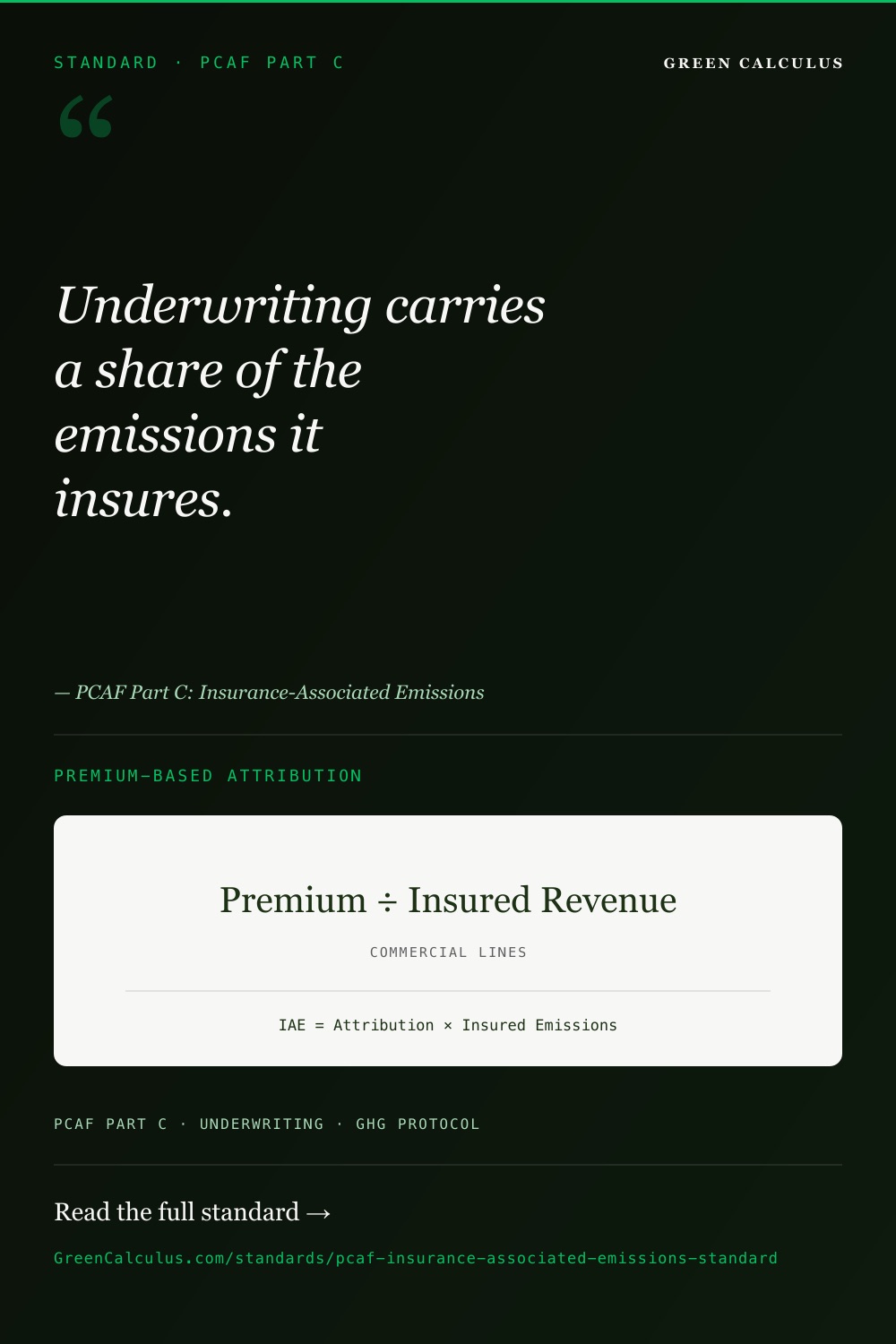
For a commercial policy, the attribution factor is the ratio of the re/insurance premium to the insured company’s revenue. Multiplying that factor by the company’s absolute emissions yields the share associated with the cover.
Because the attribution factor divides by customer revenue, reported emissions can move from one year to the next even when nothing about the underwriting changes — a fall in a client’s revenue raises the attribution factor and therefore the associated emissions. Practitioners analysing trends over time must separate this revenue effect from genuine changes in the underlying portfolio, and disclose it where material under the consistency principle.
6.3 Personal Motor — Premium ÷ Total Cost of Ownership
For personal motor, insurance is a far larger share of the total cost of running a vehicle than commercial premiums are of corporate revenue, so the attribution factor is correspondingly higher. PCAF offers two routes.
Premium here is defined as gross written premium — the total payable by the insured for the policy written in the period — net of external acquisition costs. Total cost of ownership aggregates the recurring and one-off costs of running the vehicle, of which insurance is one component alongside fuel, registration, maintenance, parking and tolls.
6.5 What Is In and Out of Scope
The Second Edition draws explicit boundaries. Several lines remain out of scope pending further methodological work, and these exclusions must be disclosed by any re/insurer claiming conformance.
| Line of business | Treatment in the Second Edition |
|---|---|
| Commercial property, liability/casualty, commercial motor, marine, aviation, agriculture | In scope — commercial lines (§5.2) |
| Trade credit and political risk (primary insurance only) | In scope — commercial lines |
| Financial lines (professional indemnity, D&O), workers compensation, statutory lines | In scope — commercial lines |
| Engineering — construction projects (CAR / EAR / IDI) | In scope — project insurance (§5.3) |
| Personal motor (all lines) | In scope — personal motor (§5.4) |
| Treaty reinsurance and treaty-like facultative structures | In scope — treaty reinsurance (§5.5) |
| Structured trade credit, surety | Out of scope — link to financed-emissions products |
| Corporate life and pensions, personal accident | Out of scope this version |
| Personal lines other than motor (home, travel, legal, pet, personal liability/property) | Out of scope this version |
| Life and health insurance | Out of scope this version |
| Insurance purchased by public entities (government agencies, municipalities) | Out of scope — boundary work pending |
7. Data Quality Scoring (1–5)
PCAF’s defining discipline is that it never asks for a number without asking how good that number is. Every emissions figure carries a data-quality score from 1 (highest) to 5 (lowest), describing how the insured’s emissions were obtained. The same 1–5 logic that governs financed emissions applies to insurance-associated emissions, scored per line of business and disclosed as a portfolio weighted average.
| Score | Basis of the insured’s emissions | Quality |
|---|---|---|
| 1 | Verified reported emissions from the insured client or asset | Highest |
| 2 | Unverified reported emissions from the insured client or asset | High |
| 3 | Physical-activity-based emissions using primary physical activity data | Medium |
| 4 | Economic-activity-based emissions using average sector data (e.g. revenue × sector intensity) | Low |
| 5 | Economic-activity-based emissions estimated with limited data and broad proxies | Lowest |
PCAF explicitly encourages re/insurers to begin with sector averages where client emissions data is unavailable — an initial footprint at score 4 or 5 still reveals the carbon-intensive hotspots in a portfolio. The expectation is that the weighted-average score improves over time as client engagement yields verified data. The score is disclosed precisely so that stakeholders can read the confidence behind the headline number. Where an insurer holds a joint-venture stake below 50% and cannot access the data needed to compute an attribution factor, it is not required to report those emissions.
8. Double Counting
Double counting — the same real-economy emissions appearing more than once — is inherent to financial-sector GHG accounting, and PCAF treats it as something to minimise and disclose rather than eliminate. The Standard identifies three distinct mechanisms by which it arises in underwriting portfolios.
Across insurance and investment
An insurer that both insures and invests in the same company counts that company’s emissions twice — once as financed emissions, once as insurance-associated. PCAF resolves this by requiring the two to be reported separately, never aggregated, so the overlap is visible rather than hidden.
Across emission scopes
Insuring several companies along one value chain can double-count the same emissions through the insureds’ Scope 3. Reporting each insured’s Scope 3 separately from its Scope 1 and 2 limits the effect, though residual overlap remains when both a power generator and its customers are insured.
Across the risk-sharing chain
Large risks are spread across primary insurers, reinsurers, and retrocessionaires. Each could count the same emissions. Reporting net insurance-associated emissions — calculated on net (re)insurance premium — addresses overlap between the layers of the chain.
PCAF does not aim to eradicate double counting or to build a single global balance sheet of absolute emissions. Its objective is to minimise double counting where it would interfere with stated decarbonisation goals, and to require that methodologies and limitations be stated transparently in the disclosure. Every re/insurer using the Standard is exposed to the same double-counting characteristics, so comparability across reporters is preserved even where absolute totals overlap.
9. Reporting Requirements and Metrics
Conformance turns on disclosure, not just calculation. A re/insurer that intends to conform to the Standard must, as a minimum, measure and report aggregated absolute insurance-associated emissions for the reporting year, as a supplementary accounting note under Scope 3 Category 15, with accompanying methodology, timeframe, and data-quality information.
- Absolute emissions — the headline required metric, in tonnes CO2e, aggregated across the portfolio and disclosed separately from financed emissions.
- Emissions intensity — optional ratios (for example, emissions per unit of premium) that let a re/insurer compare sectors and clients and identify high-exposure segments. Useful for the risk-management and product-development business goals.
- Data-quality score — the portfolio weighted-average 1–5 score, disclosed so stakeholders can judge confidence.
- Removals and avoided emissions — may be reported, but always separately from the Scope 1, 2, and 3 inventories, with the calculation method disclosed. The Standard does not yet provide a method for insurance-associated removals or avoided emissions; re/insurers disclose their own formula where they choose to report these.
Beyond the Category 15 supplementary note covered here, re/insurers are also expected to measure and report their own Scope 1 and Scope 2 emissions and any other material Scope 3 categories in line with the GHG Protocol. The output of this Standard feeds directly into the financial-sector disclosures expected under IFRS S2 and, in the EU, the quantification requirements of CSRD ESRS E1.
10. Worked Example — A Commercial Property Policy
A single commercial-lines policy demonstrates the full chain from inputs to a scored, disclosable figure. The values below are illustrative inputs chosen to show the mechanics, not factors drawn from any real portfolio.
11. Common Implementation Errors
12. Frequently Asked Questions
Insurance-associated emissions are the greenhouse-gas emissions linked to a re/insurer’s underwriting portfolio — the share of an insured client’s or asset’s emissions associated with the cover provided. They are calculated by multiplying an attribution factor by the insured’s absolute emissions, and reported as a supplementary note under Scope 3 Category 15. They are distinct from financed emissions, which arise from loans and investments, and the two must not be aggregated.
“Follow the money” is the principle behind financed emissions: trace capital from a lender or investor to the activity it funds, and allocate a proportional share of that activity’s emissions back. It works because a company’s total capital is visible on its balance sheet. Underwriting has no equivalent money flow — the insurer holds no equity and extends no loan — so PCAF uses “follow the risk” instead: it traces the risk transferred to the re/insurance industry and treats insurance as an enabler of the insured’s activity, allocating a defensible fraction of the insured’s emissions accordingly.
The Second Edition (December 2025) covers four segments: commercial lines, project insurance, personal motor, and treaty reinsurance. The First Version (November 2022) covered only commercial lines and personal motor. The December 2025 update added project insurance — covering construction all-risk, erection all-risk, and inherent-defect insurance — and treaty reinsurance as new methodologies. PCAF notes that the 2025 additions have not yet been reviewed by the GHG Protocol.
For a commercial policy the attribution factor is the re/insurance premium divided by the insured company’s revenue. That factor is then multiplied by the company’s absolute emissions — Scope 1 and 2 as a minimum, with Scope 3 reported separately where significant and available. Because the factor divides by revenue, reported emissions can move year to year purely because a client’s revenue changed, so trend analysis must account for this volatility.
It is a 1-to-5 score describing how the insured’s emissions were obtained: 1 is verified reported emissions (highest quality), 2 is unverified reported emissions, 3 is physical-activity-based data, 4 is economic-activity-based average sector data, and 5 is estimated data with broad proxies (lowest quality). Re/insurers disclose a portfolio weighted-average score and are expected to improve it over time. PCAF encourages starting with low-quality estimates rather than not reporting at all, because even a score-5 footprint reveals portfolio hotspots.
No. Adoption of the Standard is voluntary and must be determined independently by each company, subject to applicable law. Under the GHG Protocol, reporting underwriting emissions is optional within Scope 3 Category 15. However, the figures the Standard produces feed the financial-sector disclosures expected under frameworks such as IFRS S2 and, in the EU, CSRD ESRS E1 — so for many re/insurers it is effectively the method of choice for a disclosure that downstream regimes increasingly expect.
Measure the emissions behind the disclosures
Insurance-associated emissions feed the same financial-sector reporting pipeline as financed emissions. Start with the sibling standards that anchor the Category 15 picture.
Related GreenCalculus References
PCAF and financial-sector accounting: PCAF Financed Emissions Standard (Part A) · GHG Protocol Scope 3 Standard · GHG Protocol Corporate Standard
Disclosure regimes: IFRS S2 Climate Disclosures · CDP Climate Change Questionnaire · CSRD ESRS E1
Glossary: Scope 3 emissions · CO2e · Scope 1 · Scope 2