
EPA GHGRP Subpart W — The Definitive Reference

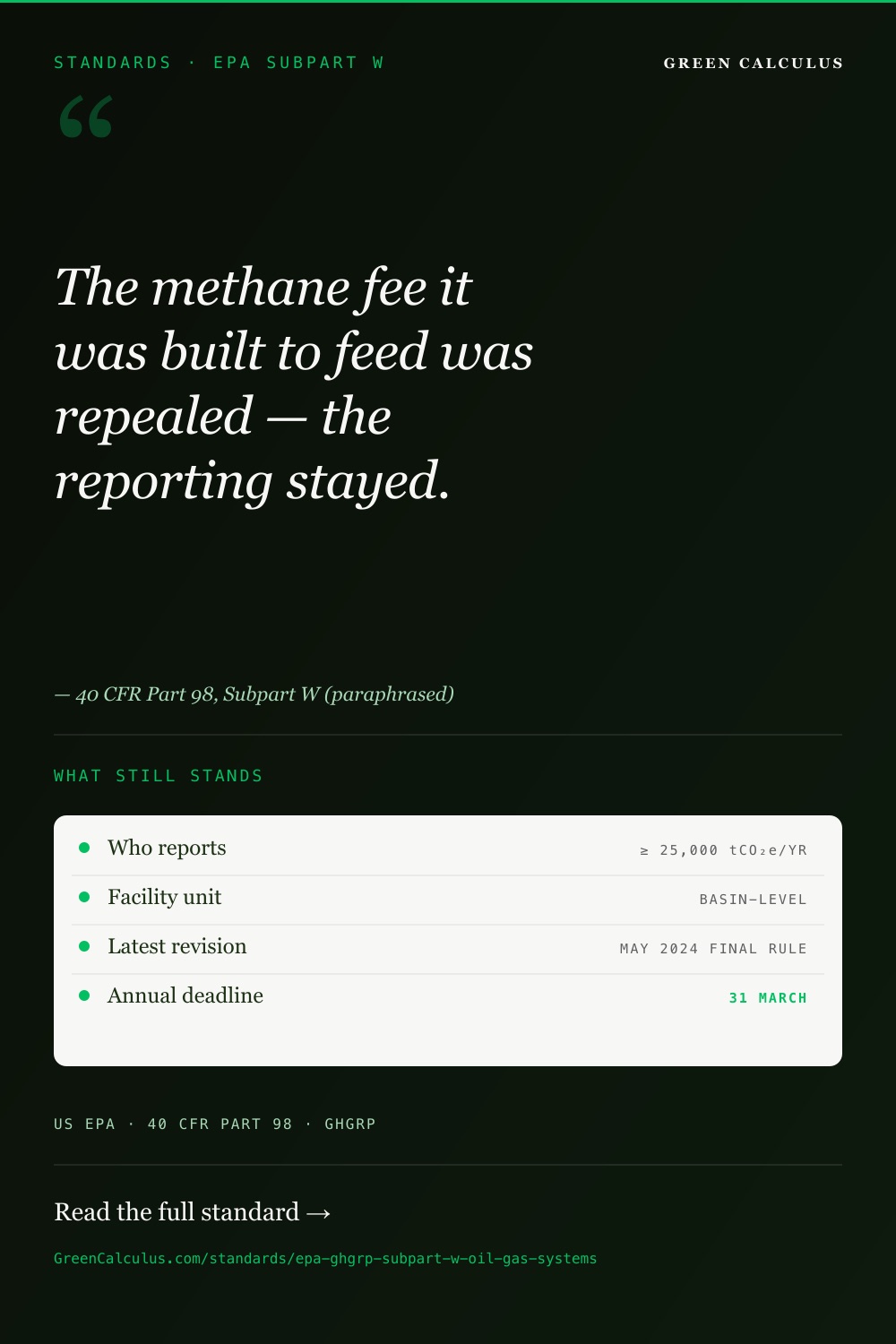
Subpart W reporting remains in effect as law, and covered facilities continue to file annual reports. However, two 2025 actions changed the landscape: the Waste Emissions Charge (the methane fee that Subpart W data was to feed) was nullified by a Congressional Review Act resolution signed 14 March 2025 and formally revoked effective 19 May 2025, and in September 2025 EPA proposed to delay Subpart W applicability to reporting year 2034. The proposed delay is not final. This page documents the May 2024 Final Rule as written and flags where its future is contested.
Subpart W is the rulebook that decides how every large oil and gas facility in the United States counts its greenhouse gases — and for methane specifically, it is the most consequential emissions-accounting instrument the sector has. For fifteen years it quietly standardised how producers, processors, pipelines, and LNG terminals report to the EPA. Then the Inflation Reduction Act tied a per-tonne methane fee to those same numbers, and overnight the accuracy of a Subpart W report stopped being a compliance formality and became a line item with a dollar sign attached.
Subpart W is where methane accounting in the United States stopped being paperwork and started carrying a price.
Subpart W of the EPA Greenhouse Gas Reporting Program sets mandatory GHG reporting rules for US petroleum and natural gas systems emitting 25,000+ metric tons CO₂e per year. The May 2024 Final Rule expanded methane methods and added large-release reporting; reports are due 31 March.
What Subpart W is
Subpart W is the petroleum and natural gas systems source category of the US EPA’s Greenhouse Gas Reporting Program (GHGRP), codified at 40 CFR Part 98. The GHGRP was established under a 2008 Congressional appropriations mandate and has collected annual greenhouse gas data from the largest US emitters since 2010. Subpart W is the part of that program that prescribes exactly how oil and gas facilities calculate and report their emissions — the equations, emission factors, monitoring methods, and data elements that turn field operations into a filed number.
The rule matters far beyond its length because of what attached to it in 2022. The Inflation Reduction Act added Clean Air Act section 136, the Methane Emissions Reduction Program, which directed EPA to revise Subpart W so that reported emissions are based on empirical data and reflect total methane emissions from covered facilities, and which established a Waste Emissions Charge keyed to those same Subpart W figures. EPA delivered the revision in the May 2024 Final Rule. The charge itself was later nullified — but the reporting rule it was built on remains, and its data continues to shape how US methane is measured.
Subpart W is a reporting rule, not an emissions limit. It does not cap methane or require abatement — it dictates how emissions are measured and disclosed. The performance standards that actually limit oil and gas methane are separate instruments (NSPS OOOOb and EG OOOOc under Clean Air Act section 111). Subpart W’s role is to produce the authoritative emissions number; other rules decide what that number obligates. Keeping this distinction straight is essential to reading the 2025 developments correctly.
Where Subpart W sits in the reporting stack
Like any disclosure regime, Subpart W consumes the outputs of the scientific and methodological layers beneath it and produces a regulated number at the top. For a practitioner, the useful mental model is that Subpart W is the US mandatory-reporting counterpart to voluntary corporate GHG accounting — same underlying gas science, different legal force and a prescriptive, equation-by-equation methodology.
Applicability — who reports
A facility must report under Subpart W if its total emissions across the source category meet or exceed 25,000 metric tons of CO₂e per year. The threshold is assessed at the facility level using the aggregation and basin-level definitions specific to each industry segment — for onshore production, a “facility” is defined at the basin level, which bundles many wells and sites under a single reporter, a structure unique to this source category.
| Element | Rule |
|---|---|
| Reporting threshold | 25,000 metric tons CO₂e per year across the Subpart W source category |
| Gases reported | Methane (CH₄), carbon dioxide (CO₂), and nitrous oxide (N₂O), reported by source type and aggregated as CO₂e |
| Reporting entity | Facility owner or operator. For onshore production, the facility is defined at the basin level. |
| Annual deadline | 31 March, for the prior calendar reporting year, submitted through EPA’s electronic reporting tool (e-GGRT) |
| Data disclosure | Most reported data is published; the May 2024 rule also finalised confidentiality determinations for new and revised data elements |
Industry segments and emission sources
Subpart W covers the full oil and gas value chain, split into industry segments, each with its own set of reportable emission sources. The segment structure matters because the applicable calculation methodologies, emission factors, and monitoring requirements differ by segment and source type.
| Segment | Scope | Characteristic methane sources |
|---|---|---|
| Onshore production | Wells and associated equipment, defined at basin level | Pneumatic devices, liquids unloading, associated gas venting/flaring, equipment leaks, storage tanks |
| Offshore production | Offshore platforms | Platform venting, fugitive equipment leaks, flaring |
| Gathering & boosting | Gathering pipelines and compressor stations | Compressor venting and leaks, pneumatic devices, blowdowns |
| Processing | Gas processing plants | Compressor seals, dehydrator vents, flares, equipment leaks, acid-gas removal vents |
| Transmission & storage | Transmission pipelines, compressor stations, underground storage | Compressor venting, pneumatic devices, blowdowns, storage-well leaks |
| Distribution | Local distribution networks | Pipeline and meter/regulator-station leaks, mains and services |
| LNG storage & import/export | LNG terminals and storage | Compressor and equipment leaks, venting |
Methane is reported as a direct Scope 1 emission for each source, separately from combustion CO₂. Because the rule categorises by how emissions physically arise — venting, flaring, equipment leaks, and combustion — its source taxonomy maps closely onto the fugitive and process-emission structure used in broader industrial and fugitive-emissions accounting.
The May 2024 Final Rule — what changed
The May 2024 Final Rule (published 14 May 2024 at 89 FR 42062) was EPA’s response to the Clean Air Act section 136(h) directive that Subpart W reporting be based on empirical data and reflect total methane emissions. EPA structured the amendments in four parts, phasing implementation over reporting years 2024 and 2025, with most provisions effective 1 January 2025.
1. Close reporting gaps by sector
Revisions to emission-data reporting for specific segments so that the total captures methane sources previously omitted or under-counted — the core “total methane emissions” mandate.
2. New and improved calculation methods
New and refined calculation methodologies that let reporters use empirical, measurement-based data rather than defaulting to generic factors — including provisions for large-release detection.
3. Stronger reporting requirements
Additional data elements and structure to improve verification and transparency of the collected data.
4. Technical corrections
Clarifications and corrections, plus conforming changes to the general provisions (subpart A) and stationary combustion (subpart C) as they apply to oil and gas facilities.
The single most important change is the move toward empirical data. Legacy Subpart W leaned heavily on generic emission factors multiplied by equipment counts — the same estimation approach that systematically under-counts real methane. Section 136(h) required reporting to reflect measured reality, so the 2024 rule adds pathways for facilities to substitute direct measurement, and requires reporting of large release events that factor-based inventories miss entirely. This is the same accuracy problem that measurement-based frameworks were built to solve, now written into a US federal reporting rule.
Calculation methodologies and the empirical-data mandate
Subpart W does not prescribe a single method per source. For most source types it offers a hierarchy of options, and the 2024 rule widened that hierarchy toward measurement. The general principle is that a reporter may use a more accurate, data-driven method where it has the data, and falls back to default factors where it does not.
| Tier | Basis | Typical use |
|---|---|---|
| Default emission factors | Generic population-count × factor | Baseline where no measurement exists; the legacy approach the 2024 rule reduces reliance on |
| Engineering calculation | Site-specific parameters and equations | Where operating data supports a physics- or engineering-based estimate |
| Direct measurement | Metered, sampled, or monitored emissions | The empirical-data pathway strengthened by the 2024 rule |
| Large-release / remote detection | Site-level or aerial detection of large events | Other Large Release Events — measured or detected releases above the threshold |
The 2024 rule was written to let a facility use a single consistent method to satisfy multiple EPA programs at once. Where a Subpart W source is also subject to the NSPS OOOOb / EG OOOOc performance standards, data generated for those standards can, in defined cases, feed the Subpart W calculation — reducing the duplicate measurement burden of complying with reporting and performance rules in parallel. This alignment is one of the more operationally valuable features of the revision.
Other Large Release Events
The most significant conceptual addition in the 2024 rule is the requirement to report Other Large Release Events (OLRE) — abnormal emission events exceeding 100 kg of methane per hour that are not otherwise captured by the standard source-category calculations. These are the intermittent super-emitter events — a stuck vent, a tank thief-hatch left open, an unplanned blowdown — that dominate real methane totals but are invisible to factor-based inventories built on normal operating assumptions.
OLRE reporting can draw on detection from site monitoring, aircraft, satellites, or other remote-sensing methods. Its inclusion is what pushes Subpart W from a purely bottom-up inventory toward a hybrid that also accounts for the heavy tail of the emissions distribution. Notably, even after the Waste Emissions Charge was nullified, OLRE reporting remains a live obligation under the reporting rule — the events must still be reported to EPA regardless of whether any fee attaches to them.
GWP basis — AR-era values and the CO₂e conversion
Subpart W reports each gas by source and then aggregates to CO₂e using the global warming potential values specified in the rule’s own tables (40 CFR Part 98, Subpart A, Table A-1). Historically the GHGRP has used AR4-era GWP values for aggregation — a point of divergence from corporate reporting, which has moved to the latest IPCC assessment. Any comparison between a Subpart W total and a corporate inventory must reconcile the GWP basis before the numbers can be compared.
| Basis | Methane GWP-100 | Where used |
|---|---|---|
| IPCC AR4 (2007) | 25 | The GHGRP aggregation table basis, historically |
| IPCC AR5 (2013) | 28 | Some legacy corporate and DEFRA-convention reporting |
| IPCC AR6 (2021), fossil | 29.8 | Current corporate default — GHG Protocol, CSRD, most voluntary reporting |
A methane tonnage reported under Subpart W and the same methane converted to CO₂e in a corporate inventory can differ purely because of the GWP set used, before any real emissions difference. The GHGRP has historically aggregated on AR4 values (methane = 25) while corporate reporting uses AR6 (fossil methane = 29.8). Always confirm which assessment basis a given total uses. The full AR6 factor set, including biogenic methane and feedback variants, is maintained on the AR6 GWP-100 dataset; the conceptual background is covered under global warming potential.
The Waste Emissions Charge and its repeal
The Waste Emissions Charge (WEC) is the reason Subpart W briefly carried a direct financial stake. Clean Air Act section 136, added by the Inflation Reduction Act, directed EPA to impose a per-tonne charge on methane emissions above specified intensity thresholds from facilities that report more than 25,000 metric tons CO₂e under Subpart W. EPA finalised the implementing rule at 40 CFR Part 99 in late 2024, with a charge schedule rising over time.
| Emissions year | Charge per metric ton of excess methane (as finalised) |
|---|---|
| 2024 | $900 |
| 2025 | $1,200 |
| 2026 and beyond | $1,500 |
That schedule no longer applies. On 14 March 2025 the President signed a Congressional Review Act joint resolution disapproving EPA’s WEC implementing rule, and EPA formally revoked the 40 CFR Part 99 rule effective 19 May 2025, removing it from the Code of Federal Regulations. A CRA disapproval has a durable effect: it also constrains EPA from issuing a substantially similar rule without new legislative authority.
An important nuance for anyone tracking future liability: the CRA resolution nullified the implementing rule, not the underlying statutory charge in Clean Air Act section 136. The charge remains on the books as law, but there is no operative rule to calculate or collect it, and Congress separately acted to prohibit collection until 2034. In practical terms, facilities are not required to make WEC filings or payments today. Whether the charge is ever revived depends on future legislation — which is precisely why the reporting rule that would feed it is now itself under reconsideration.
Regulatory timeline
The 2025 reconsideration
In September 2025, EPA published a proposed reconsideration of the GHGRP that would, for Subpart W, delay applicability to reporting year 2034 — effectively suspending the source category for roughly a decade — and takes comment on limiting the application of the general stationary-combustion subpart (subpart C) to Subpart W facilities over the same period, with an exception carved out for the natural gas distribution industry.
A proposed rule has no legal force until finalised. As matters stand, the May 2024 Final Rule remains the operative reporting requirement, and reporting-year obligations continue on the existing schedule. A facility planning its compliance cannot rely on the proposed delay taking effect, nor on its taking effect in the form proposed — proposals change through comment, and are subject to legal challenge. The prudent posture is to continue reporting to the current rule while tracking the reconsideration docket. This page will be updated when the reconsideration is finalised, withdrawn, or litigated to a conclusion.
Subpart W versus OGMP 2.0
Practitioners frequently work with both Subpart W and the UNEP-administered Oil & Gas Methane Partnership 2.0, and the two are often confused because both push oil and gas methane reporting toward measurement. They are different instruments with different force and structure.
| Dimension | EPA Subpart W | OGMP 2.0 |
|---|---|---|
| Nature | Mandatory US federal reporting rule | Voluntary international framework |
| Administered by | US EPA | UNEP — International Methane Emissions Observatory |
| Geography | United States | Global, member-based |
| Scope of assets | Operated facilities above threshold | Operated and non-operated assets, including joint ventures |
| Structure | Prescriptive equations and factors, with an empirical-data pathway | Five-level data-quality ladder toward site-reconciled measurement |
| Consequence | Public data; formerly fed the Waste Emissions Charge (now nullified) | Reputational and market signal; feeds IMEO’s public dataset |
Legacy Subpart W (default factors, detailed source) sits at roughly the same measurement maturity as a mid-tier methodology on a voluntary measurement ladder; the 2024 rule’s empirical-data pathway and OLRE reporting push it toward the measurement tiers that measurement-based frameworks target. A US operator building empirical Subpart W data is building much of the same measurement infrastructure a voluntary measurement framework would ask for — the artefacts largely transfer, even though the legal drivers differ.
Subpart W and corporate GHG accounting
For a sustainability or inventory team, the integration question is how Subpart W numbers relate to the corporate carbon inventory. They overlap heavily but are not interchangeable, mainly because of boundary and GWP-basis differences.
| Corporate framework | Relationship to Subpart W |
|---|---|
| GHG Protocol Corporate Standard | Subpart W methane is Scope 1. But Subpart W’s basin-level facility definition and AR4 aggregation differ from the corporate organisational boundary and AR6 basis — reconcile both before mapping. |
| Scope 1 stationary combustion | Combustion CO₂ overlaps, but Subpart W’s value is its treatment of venting, flaring, and fugitive methane — sources a combustion inventory does not capture. |
| CSRD / ESRS E1 | For US operations of CSRD-scoped groups, Subpart W provides measurement-grade methane data that strengthens the E1-6 gross Scope 1 disclosure under limited assurance. |
| OGMP 2.0 (voluntary framework) | Complementary: empirical Subpart W data supports the measurement tiers of a voluntary methane framework, and vice versa. |
The practical workflow is to treat Subpart W as the authoritative US methane number for regulatory purposes and to reconcile it — on boundary and GWP basis — before folding it into a corporate inventory or a voluntary oil and gas methane inventory. A dedicated oil and gas methane calculator can help translate source-level activity into the CO₂e figure a corporate report needs, on the AR6 basis rather than the AR4 basis the GHGRP aggregates on.
Reporting readiness checklist
Check every item that is true for your facility today. The tool flags the gaps between a legacy factor-based Subpart W report and one built to the May 2024 empirical-data standard.
Common reporting errors
Frequently asked questions
Subpart W is the petroleum and natural gas systems source category of the US EPA’s Greenhouse Gas Reporting Program, codified at 40 CFR Part 98. It prescribes how oil and gas facilities calculate and report their greenhouse gas emissions — methane, carbon dioxide, and nitrous oxide — to the EPA each year. Facilities emitting 25,000 or more metric tons of CO₂e per year across the source category must report. The May 2024 Final Rule substantially revised the methodology to require empirical, total-methane reporting.
Yes. The Congressional Review Act resolution signed in March 2025 nullified the Waste Emissions Charge implementing rule (40 CFR Part 99) — the methane fee — not Subpart W reporting. Subpart W remains in effect as law, and covered facilities continue to file annual reports. Separately, in September 2025 EPA proposed to delay Subpart W applicability to reporting year 2034, but that proposal is not final and has no legal force until finalised. Reporting obligations continue on the current schedule.
Owners and operators of petroleum and natural gas facilities whose emissions across the Subpart W source category meet or exceed 25,000 metric tons of CO₂e per year. This covers onshore and offshore production, gathering and boosting, gas processing, transmission and storage, distribution, and LNG storage and import/export. For onshore production, the facility is defined at the basin level, so a single report can cover many wells and sites. Reports are filed annually through EPA’s e-GGRT electronic reporting tool.
The May 2024 Final Rule (89 FR 42062) revised Subpart W in four parts: closing reporting gaps by sector so the total reflects all methane; adding and improving calculation methodologies to enable empirical, measurement-based reporting; strengthening reporting requirements for verification and transparency; and technical corrections. It was required by Clean Air Act section 136(h), added by the Inflation Reduction Act, which directed that reporting be based on empirical data and reflect total methane emissions. Most provisions took effect 1 January 2025, phased over reporting years 2024 and 2025.
An Other Large Release Event is an abnormal emission event exceeding 100 kilograms of methane per hour that is not otherwise captured by the standard source-category calculations. The May 2024 rule requires these events to be reported, drawing on site monitoring, aircraft, satellite, or other detection. OLRE reporting captures the intermittent super-emitter events that dominate real methane totals but are invisible to factor-based inventories. The obligation to report OLRE remains in effect independent of the repealed Waste Emissions Charge.
The Waste Emissions Charge (WEC) was a per-tonne fee on methane emissions above intensity thresholds from facilities reporting more than 25,000 metric tons CO₂e under Subpart W, created by Clean Air Act section 136 in the Inflation Reduction Act. EPA finalised the implementing rule at 40 CFR Part 99 with a schedule of $900 per tonne of excess methane for 2024, $1,200 for 2025, and $1,500 for 2026 onward. A Congressional Review Act resolution signed 14 March 2025 disapproved that rule, and EPA revoked it effective 19 May 2025. The fee does not apply today. The underlying statutory charge remains on the books, but there is no operative rule to calculate or collect it, and Congress prohibited collection until 2034.
Subpart W aggregates gases to CO₂e using the GWP values in the GHGRP’s own tables (40 CFR Part 98, Subpart A, Table A-1), which have historically been AR4-era values — methane at 25. This differs from current corporate reporting, which uses IPCC AR6 (fossil methane 29.8). Because the aggregation basis differs, a Subpart W CO₂e total and a corporate-inventory CO₂e total are not directly comparable until the GWP basis is reconciled. Always confirm which assessment basis a given figure uses before comparing.
The annual GHG report is due 31 March each year, covering the prior calendar reporting year, submitted through EPA’s electronic reporting tool (e-GGRT). For example, reporting-year 2025 data is due 31 March 2026 under the current rule. This deadline continues to apply unless and until a finalised reconsideration changes it — the September 2025 proposed delay does not alter the deadline while it remains a proposal.
Subpart W is a mandatory US federal reporting rule administered by EPA; OGMP 2.0 is a voluntary international framework administered by UNEP’s International Methane Emissions Observatory. Subpart W covers operated facilities above a threshold with prescriptive equations and an empirical-data pathway; OGMP 2.0 covers operated and non-operated assets on a five-level data-quality ladder toward site-reconciled measurement. Both push oil and gas methane reporting toward measurement, and a US operator building empirical Subpart W data is building much of the infrastructure a voluntary measurement framework would ask for.
They are different types of rule. Subpart W is a reporting rule — it dictates how emissions are measured and disclosed. NSPS OOOOb and EG OOOOc are performance standards under Clean Air Act section 111 that actually limit methane and require controls. The May 2024 Subpart W rule was written so that, where a source is subject to both, a single consistent measurement method can serve multiple programs, reducing duplicate monitoring. Subpart W produces the emissions number; the performance standards decide what must be controlled.