
Global Methane Pledge — The Definitive Reference

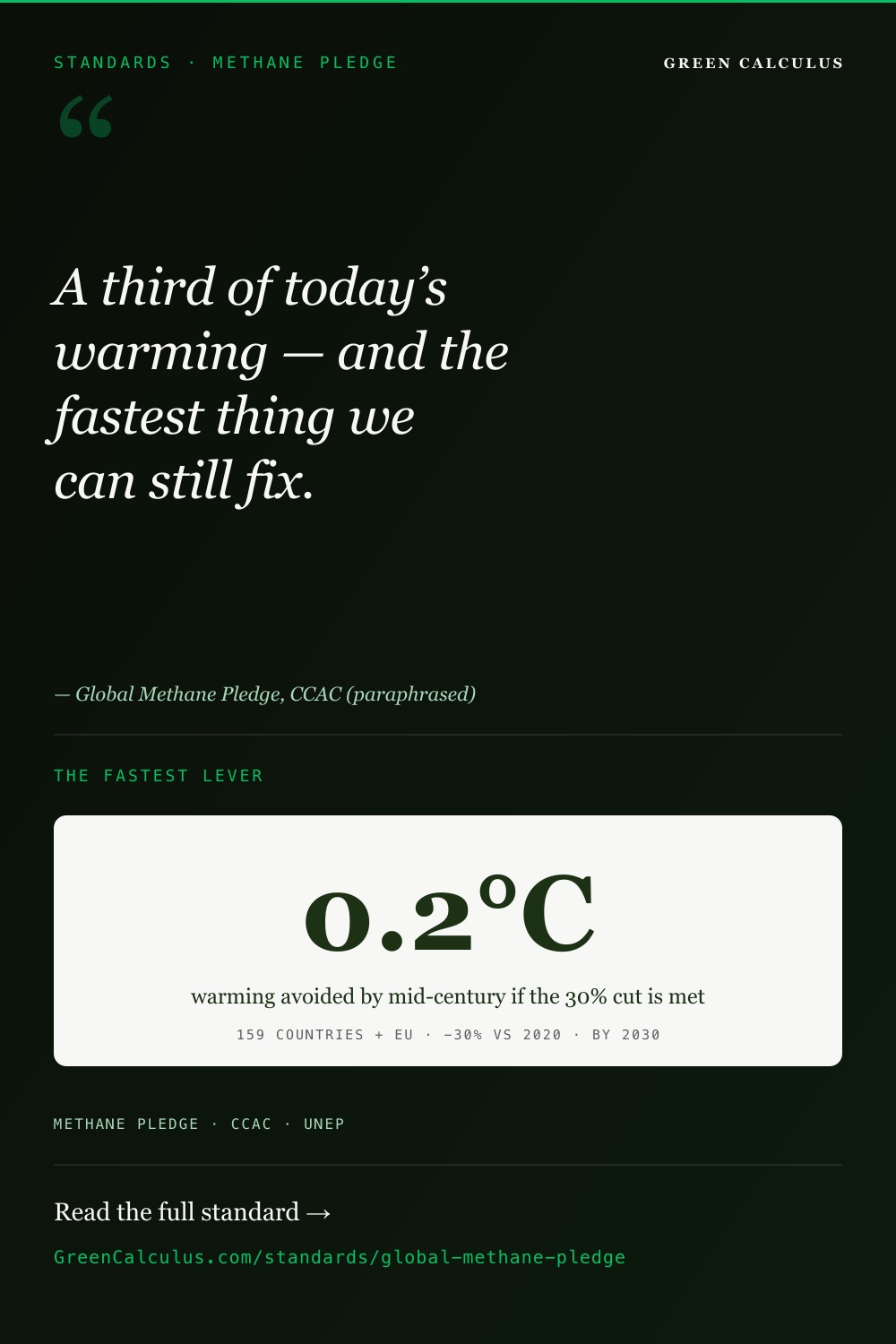
The Global Methane Pledge is not a reporting standard, a factor set, or a disclosure regime. It is a collective political commitment by 159 countries and the European Union to cut anthropogenic methane emissions at least 30% below 2020 levels by 2030 — a target that, if met, removes an estimated 0.2°C of warming by mid-century from the fastest lever available in climate policy.
For a corporate GHG team it is the policy signal behind almost every methane line in your inventory — and it lands on the one gas your GWP basis is most likely to get wrong.
The Global Methane Pledge is a voluntary, non-binding commitment launched at COP26 in 2021 by the US and EU. Signatories — now 159 countries plus the EU — collectively aim to cut methane 30% below 2020 levels by 2030 across energy, agriculture and waste.
What the Global Methane Pledge is
The Global Methane Pledge (GMP) was launched on 2 November 2021 on the sidelines of the COP26 climate conference in Glasgow by the United States and the European Commission. More than 100 countries signed at launch; participation has since grown to 159 countries plus the European Union. Participants agree to a single collective goal: reduce global anthropogenic methane emissions by at least 30% below 2020 levels by 2030, across all human-caused sources rather than any single sector.
Three properties define what the pledge is — and, more importantly for a compliance team, what it is not.
Voluntary and non-binding
The GMP is a political commitment, not a treaty. There are no legal penalties, no enforcement mechanism, and no allocated national quota. Each signatory determines its own methane strategy, timelines, and reporting.
Collective, not per-country
The 30% target is a global aggregate. No individual country is committed to cutting its own methane by 30% — the pledge asks each participant to contribute to the collective outcome.
A catalyst, not a methodology
The GMP does not define how to calculate methane. It points participants toward the highest-tier IPCC inventory methods and improved UNFCCC reporting, but the calculation rules live in other standards.
Because the pledge is collective and voluntary, it functions as a demand signal that flows downward into national regulation and, from there, into corporate obligations. A company does not “comply with” the GMP directly. It complies with the national policies — the EU Methane Regulation, national oil-and-gas rules, landfill and agriculture measures — that signatory governments adopt to move the collective number. Understanding the pledge is understanding the policy pressure behind those rules.
The GMP remains active and continues to add participants; the 5th Ministerial convened at COP30 in Belém in November 2025, chaired by Canada and the EU. The United States — a co-founder in 2021 — withdrew from the Paris Agreement effective 27 January 2026 and announced its intent to withdraw from the UN Framework Convention on Climate Change in January 2026. This does not dissolve the pledge, which is administered independently through the CCAC, but it removes the largest single co-founder’s federal backing and repealed the US oil-and-gas Waste Emissions Charge (enacted disapproval, March 2025). Non-participants continue to include China, India and Russia.
Why methane — the science case and the GWP problem
Methane (CH₄) is the second-largest contributor to anthropogenic warming after carbon dioxide, responsible for roughly a third of the warming experienced since pre-industrial times. Its power as a policy lever comes from a physical property that also makes it the trickiest gas to account for: it is short-lived. Atmospheric methane has a perturbation lifetime of roughly 11.8 years, against centuries-to-millennia for a pulse of CO₂. Cut methane emissions and atmospheric concentrations fall within a decade — which is precisely why a 2030 target on methane can deliver a near-term temperature benefit that a comparable CO₂ target cannot.
The same short lifetime creates the central measurement problem. Global Warming Potential compresses a gas’s time-varying radiative effect into a single multiplier over a chosen horizon. For a short-lived gas, the horizon choice changes the answer dramatically. Over 20 years methane’s warming effect is far larger than over 100 years, because most of its impact is concentrated early. Corporate inventories almost universally use GWP-100, which understates methane’s near-term punch — the exact effect the pledge is designed to counter.
AR6 GWP-100 values without climate-carbon cycle feedbacks are 29.8 for fossil methane and 27.9 for biogenic methane; the corresponding GWP-20 value for methane is 82.5 (source: IPCC AR6 WGI Table 7.SM.7). The AR5 GWP-100 value still embedded in older factor sets is 28. GreenCalculus corporate inventories use the AR6 GWP-100 basis by default; the full set is documented on the AR6 GWP dataset page. The GMP does not mandate a GWP horizon — national inventories reported under the UNFCCC use GWP-100 — but the pledge’s rationale rests on the GWP-20 view of methane’s importance, which is worth stating explicitly whenever GMP framing appears next to a GWP-100 corporate number.
There is no “correct” GWP horizon — 20-year and 100-year values answer different questions. GWP-100 is the reporting convention for corporate inventories, CSRD/ESRS E1 and the GHG Protocol; GWP-20 better reflects the near-term temperature stakes that motivate the pledge. When a document mixes the two, it is usually comparing a corporate footprint (GWP-100) against a policy narrative (GWP-20) without saying so. Always disclose the horizon and the assessment report (AR5 vs AR6) alongside any methane figure.
Where the pledge sits in the accounting stack
The GMP is a Layer-5 initiative in the GreenCalculus stack. It sits above the scientific and calculation layers — it consumes their outputs — but below the binding national and corporate disclosure regimes that translate its collective ambition into obligations. It is a political anchor that pulls the layers below it toward faster methane action; it does not itself specify how a tonne of methane is counted.
Layer 4 is intentionally absent from the GreenCalculus stack. The value of placing the GMP at Layer 5 is that it clarifies the direction of causation: the pledge does not change your factors or your calculation method, but it changes the regulatory environment that determines which methane sources you will soon be required to measure, report, and reduce.
Signatories, coverage and the non-participant gap
Participation has grown steadily since launch, but the headline count understates one structural weakness: three of the largest methane emitters have not joined. Coverage of global emissions is therefore lower than the participant count alone suggests.
| Metric | Value | Note |
|---|---|---|
| Participating countries | 159 + European Union | Grew from 100+ at COP26 launch; Azerbaijan, Tajikistan, Guatemala and Madagascar joined in 2024. |
| Share of global anthropogenic methane | More than 50% | Coverage crossed 50% as membership grew; the balance sits largely with non-participants. |
| Share of global GDP represented | Nearly three-quarters | Signatories concentrate in higher-income and mid-income economies. |
| Major non-participants | China, India, Russia | Three of the world’s largest methane emitters (coal, agriculture, and oil & gas respectively) remain outside the pledge. |
| Collective target | −30% vs 2020, by 2030 | Aggregate across all anthropogenic sources; not allocated per country. |
The non-participant gap matters for interpreting progress. Because China’s coal-sector methane, India’s agricultural methane, and Russia’s oil-and-gas methane sit outside the pledge, even full delivery by every signatory would not by itself hit a 30% cut in global methane. The pledge’s leverage is partly indirect: it builds measurement capacity, finance, and satellite monitoring that increasingly detect large emission events regardless of whether the source country has signed.
The three sectoral pathways
Rather than a single implementation track, the GMP organises action through sectoral “pathways” — coalitions of countries and partners targeting the largest methane-emitting sectors. Three pathways were established, in the order the abatement economics favour them.
| Pathway | Energy | Waste | Food & Agriculture |
|---|---|---|---|
| Launched | June 2022 (Major Economies Forum) | COP27, November 2022 | COP27, November 2022 |
| Primary sources | Oil & gas venting/flaring/leaks; coal-mine methane | Landfill and organic-waste decomposition | Enteric fermentation, manure, rice cultivation |
| Abatement cost | Lowest — much is net-negative (captured gas has value) | Moderate — capture and diversion infrastructure | Highest — behavioural, dietary and biological complexity |
| Speed of impact | Fastest — leak detection and repair is immediate | Medium — infrastructure lead times | Slowest — structural change to food systems |
| Relevance to a corporate inventory | Scope 1 fugitive/process methane for energy operators | Scope 3 Cat 5 (waste generated in operations) and Scope 1 for waste operators | Scope 1 AFOLU for producers; Scope 3 for food buyers |
The fossil-energy sector holds the largest, fastest, and cheapest methane-reduction potential. The IEA estimates that deploying all available oil-and-gas abatement technologies could avoid nearly 0.1°C of warming by mid-century — because captured methane is saleable gas, a large share of the abatement pays for itself. Existing high-level pledges imply roughly a 55% cut in oil-and-gas methane by 2030, though policies actually on the books would deliver closer to 25%. This is why energy-sector super-emitter detection — satellites, optical gas imaging, the UNEP Methane Alert and Response System — dominates GMP implementation activity.
For operators, the pathway that matters depends on the source profile. Energy operators focus on fugitive and process methane and coal-mine methane; agricultural producers on AFOLU sources — enteric fermentation, manure management, and rice; waste operators and any organisation with significant landfill exposure on the waste stream. GreenCalculus provides dedicated calculators for each: coal-mine methane, enteric fermentation, manure management, rice cultivation, and waste by disposal route.
Baseline, target and measurement mechanics
The pledge’s numeric commitment is precise even though the implementation is discretionary. Getting the baseline year, the target basis, and the measurement expectation right is essential for anyone mapping corporate methane targets onto GMP framing.
| Element | Specification |
|---|---|
| Baseline year | 2020 |
| Target year | 2030 |
| Reduction | At least 30%, collective across all participants |
| Gas scope | Anthropogenic methane from all human-caused sources (energy, agriculture, waste), not energy alone |
| Inventory expectation | Move toward the highest-tier IPCC good-practice methodologies; improve accuracy, transparency, consistency, comparability and completeness of national reporting under the UNFCCC and Paris Agreement |
| Reporting vehicle | National greenhouse gas inventories under the UNFCCC; no separate GMP reporting obligation |
| Review cadence | Annual Ministerial alongside COP; progress tracked via the UNEP-CCAC Global Methane Status Report and the IEA Global Methane Tracker |
The measurement expectation is the part most relevant to a technical audience. “Highest-tier IPCC methodologies” means moving from Tier 1 (default emission factors applied to activity data) toward Tier 2 and Tier 3 (country- or facility-specific factors, and direct or model-based measurement). For methane specifically, the pledge has accelerated a shift from bottom-up inventory estimates to empirical, measurement-based approaches — satellite detection, aircraft campaigns, and continuous monitoring — because bottom-up methods have historically underestimated real-world methane, particularly from super-emitting oil-and-gas facilities.
Satellite and atmospheric measurement campaigns repeatedly find more methane than national bottom-up inventories report, especially in the energy sector. For a corporate inventory this is a live risk: a facility using Tier 1 default factors may be materially understating fugitive methane relative to what a measurement-based approach would find. Where the pledge and its monitoring infrastructure (IMEO, the Methane Alert and Response System, Carbon Mapper) push toward measurement, expect factor sets and reporting expectations to tighten. Build the audit trail now so a later shift to Tier 3 does not read as an unexplained restatement.
Governance and the pathway architecture
The GMP has no treaty body and no secretariat of its own in the legal sense. Since September 2023 the Climate and Clean Air Coalition (CCAC), convened by the UN Environment Programme, provides secretariat services. Governance runs through annual Ministerials and a network of implementing partners rather than through binding institutions.
Implementation is delivered by a network of partners rather than by the pledge itself: the Global Methane Initiative, the Global Methane Hub, the IEA, UNECE, the World Bank, and — for detection — the UNEP International Methane Emissions Observatory (IMEO) and its Methane Alert and Response System. This distributed model is a strength (fast mobilisation, private-sector and philanthropic finance) and a weakness (no enforcement, uneven national follow-through).
What the pledge means for corporate GHG accounting
A company does not report to the GMP. But the pledge shapes the corporate accounting environment in three concrete ways, each of which touches a specific part of the inventory.
Fugitive and process methane — venting, flaring, leaks, coal-mine methane, and refrigeration-adjacent losses — sits in Scope 1. The pledge and its monitoring infrastructure make under-reported Scope 1 methane increasingly visible and increasingly regulated. Energy, waste, and heavy-industry operators should expect the measurement bar to rise from default factors toward direct measurement. The fugitive-emissions topic hub collects the relevant calculators.
The pledge’s real teeth are the national rules signatories adopt to hit the collective number: the EU Methane Regulation, national oil-and-gas methane rules, landfill diversion mandates, and livestock-emissions assessments. Compliance obligations flow from those instruments, not from the pledge. A methane inventory built to a defensible standard today is the foundation for whichever national rule lands in your jurisdiction.
Because methane’s near-term warming is the pledge’s whole rationale, using an outdated GWP basis materially misstates a methane-heavy footprint. Report methane on the AR6 GWP-100 basis (29.8 fossil, 27.9 biogenic) and disclose the horizon and assessment report explicitly. Under CSRD/ESRS E1 and SBTi, methane reductions must be gross — abatement, not offsets — which aligns directly with the pledge’s emphasis on real emission cuts. Express the result in CO₂e with the basis stated.
The GMP’s 2020 baseline and 2030 target are a convenient reference frame for corporate methane goals, but they are not a corporate obligation. If you set a methane-specific reduction target, a 2020 baseline aligns your narrative with the pledge and with most national policy; an SBTi-aligned pathway will typically demand a steeper trajectory on fossil methane than the collective 30%. Keep the corporate target gross, methodology-consistent year on year, and separate from any CO₂ target so the methane trajectory is legible on its own terms.
GMP versus binding methane regimes
The pledge is frequently confused with the binding instruments that implement it. The distinction is the difference between a political aspiration and an enforceable obligation — and only the latter creates compliance risk.
| Instrument | Type | Binding? | What it does |
|---|---|---|---|
| Global Methane Pledge | Voluntary political commitment | No | Sets the collective 30%-by-2030 ambition; catalyses national action. No penalties. |
| EU Methane Regulation (2024) | EU law | Yes | Mandatory measurement, reporting and verification plus leak detection and repair for oil, gas and coal; import rules phasing in. |
| US oil & gas Waste Emissions Charge | US federal fee (IRA) | Repealed 2025 | A per-tonne methane fee on oil-and-gas facilities; the implementing rule was disapproved under the Congressional Review Act in March 2025. |
| Kigali Amendment | Treaty (HFC phase-down) | Yes | Not methane — governs HFCs. Included here because it is the binding counterpart people conflate with the voluntary GMP. |
| EU F-gas Regulation (2024) | EU law | Yes | Also not methane — fluorinated gases. Listed to mark the boundary of what the pledge does and does not cover. |
“We meet the Global Methane Pledge” is not a compliance statement a company can make — there is nothing to comply with. What a company complies with is the EU Methane Regulation, a national oil-and-gas rule, or a landfill mandate. Treating the pledge as though it imposes direct corporate obligations is the most common category error in methane reporting. Cite the binding instrument, not the pledge, in any compliance claim.
Progress against the 2030 gap
Membership has grown every year, but delivery has not kept pace. The defining tension of the pledge is the gap between what participants have pledged and what their policies-on-the-books will actually deliver.
| Point | participating countries |
|---|---|
| 2021 | 100.0 participating countries |
| 2022 | 150.0 participating countries |
| 2024 | 159.0 participating countries |
Against that growth in membership, the abatement picture is sobering. In the oil-and-gas sector — the pledge’s flagship — existing high-level pledges imply roughly a 55% reduction by 2030, but detailed policies and regulations actually in force would cut emissions by only around 25%. Coal-sector commitments are more limited still, with an even larger implementation gap. As of the 2025 NDC round, only about 30 Nationally Determined Contributions mentioned specific energy-methane measures, and just nine included quantitative targets. The pledge has succeeded in raising ambition and building monitoring capacity; it has not yet closed the gap to its own target.
Pledged intent
High-level commitments imply ≈55% cut in oil-and-gas methane by 2030 — consistent with the pledge’s ambition if fully implemented.
Policy-backed reality
Detailed regulations on the books deliver ≈25% by 2030 — less than half the pledged intent. The delta is the implementation gap.
The capacity dividend
Even where cuts lag, the pledge has built satellite detection, national action plans, and finance that lower the cost of future action.
Common misconceptions
Corporate alignment checklist
This checklist is not a GMP compliance test — the pledge has no corporate compliance mechanism. It is a readiness check for any organisation operating in a signatory jurisdiction, where national methane regulation is tightening in the pledge’s wake. Tick what your inventory already does.
Frequently asked questions
The Global Methane Pledge is a voluntary, non-binding political commitment launched at COP26 in November 2021 by the United States and the European Commission. Participants — now 159 countries plus the European Union — agree to a collective goal of cutting anthropogenic methane emissions at least 30% below 2020 levels by 2030, across energy, agriculture and waste. It sets ambition and catalyses national action; it does not define calculation methods or impose penalties.
No. The pledge is a political commitment, not a treaty. There are no legal penalties, no enforcement mechanism, and no allocated per-country quota — the 30% target is a global aggregate. Legal obligations arise only from the national laws that signatories adopt to move the collective number, such as the EU Methane Regulation. A company complies with those instruments, not with the pledge itself.
The baseline is 2020 and the target year is 2030. The commitment is to reduce collective anthropogenic methane emissions by at least 30% below the 2020 level by 2030. The reduction spans all human-caused methane sources — energy, agriculture and waste — not the energy sector alone.
Three of the largest methane emitters remain outside the pledge as of 2025: China (a major coal-sector emitter), India (agricultural methane), and Russia (oil-and-gas methane). Their absence means the pledge covers more than 50% of global anthropogenic methane but not the full picture — even complete delivery by every signatory would not by itself achieve a 30% cut in global methane.
The pledge does not mandate a GWP horizon; national inventories reported under the UNFCCC use GWP-100. However, the pledge’s rationale rests on methane’s near-term impact, which is best captured by GWP-20 (methane ≈ 82.5 on the AR6 20-year basis) rather than GWP-100 (≈29.8 fossil, ≈27.9 biogenic). Corporate inventories should report methane on AR6 GWP-100 and disclose the horizon explicitly, keeping any GWP-20 policy framing clearly separate.
Three sectoral pathways organise implementation. The Energy Pathway (launched June 2022) targets oil, gas and coal methane — the largest, fastest and cheapest abatement opportunity. The Food & Agriculture Pathway and the Waste Pathway (both launched at COP27 in November 2022) target enteric fermentation, manure and rice, and landfill and organic-waste methane respectively. Energy leads because captured methane is saleable gas, making much of the abatement net-negative.
The United States — a co-founder — withdrew from the Paris Agreement effective 27 January 2026 and announced its intent to withdraw from the UN Framework Convention on Climate Change in January 2026, and it repealed the domestic oil-and-gas Waste Emissions Charge in March 2025. These actions remove the largest co-founder’s federal backing but do not dissolve the pledge, which is administered independently through the CCAC. The remaining 158 participants plus the EU continue, with the EU and Canada chairing the Ministerial.
Indirectly but concretely. The pledge does not create a corporate reporting obligation, but it sharpens scrutiny of Scope 1 fugitive and process methane, drives the national regulations companies must comply with, and reinforces the AR6 GWP basis and gross-reduction discipline that CSRD/ESRS E1 and SBTi already require. Practically, it raises the measurement bar — pushing material methane sources from Tier 1 default factors toward measurement-based Tier 3.
Not on current policies. Membership has grown to 159 countries plus the EU, but implementation lags: in oil and gas, high-level pledges imply roughly a 55% cut by 2030 while policies actually in force would deliver closer to 25%. Coal-sector commitments lag further. The pledge has succeeded in raising ambition and building satellite monitoring and national action plans, but the gap between pledged intent and policy-backed delivery remains the central challenge.
Build a defensible methane inventory before national regulation tightens in the pledge’s wake — AR6 GWP-100 basis, source-level provenance, and a clear path from default factors to measurement.