
ISO 14001 Environmental Management Systems

ISO 14001:2026 was published on 15 April 2026 and is the current edition. It replaces ISO 14001:2015 — now withdrawn — and absorbs the February 2024 climate-change amendment (ISO 14001:2015/Amd 1:2024). Organizations certified to the 2015 edition are in a three-year transition period: existing certificates remain valid until approximately May 2029, after which only the 2026 edition is recognised. The changes are evolutionary — the Plan-Do-Check-Act cycle and ten-clause structure are unchanged — so most certified organizations can treat this as a structured update, not a rebuild.
Most environmental standards tell an organization what to measure. ISO 14001 tells it how to run — it is not a carbon factor, a disclosure template, or a reporting rule, but a management system: a structured way to set environmental policy, identify what matters, control operations, and improve year after year. With more than 670,000 certified organizations across 171 countries, it is the most widely adopted environmental management standard in the world, and it is the scaffolding on which a great deal of corporate climate and sustainability work is actually hung.
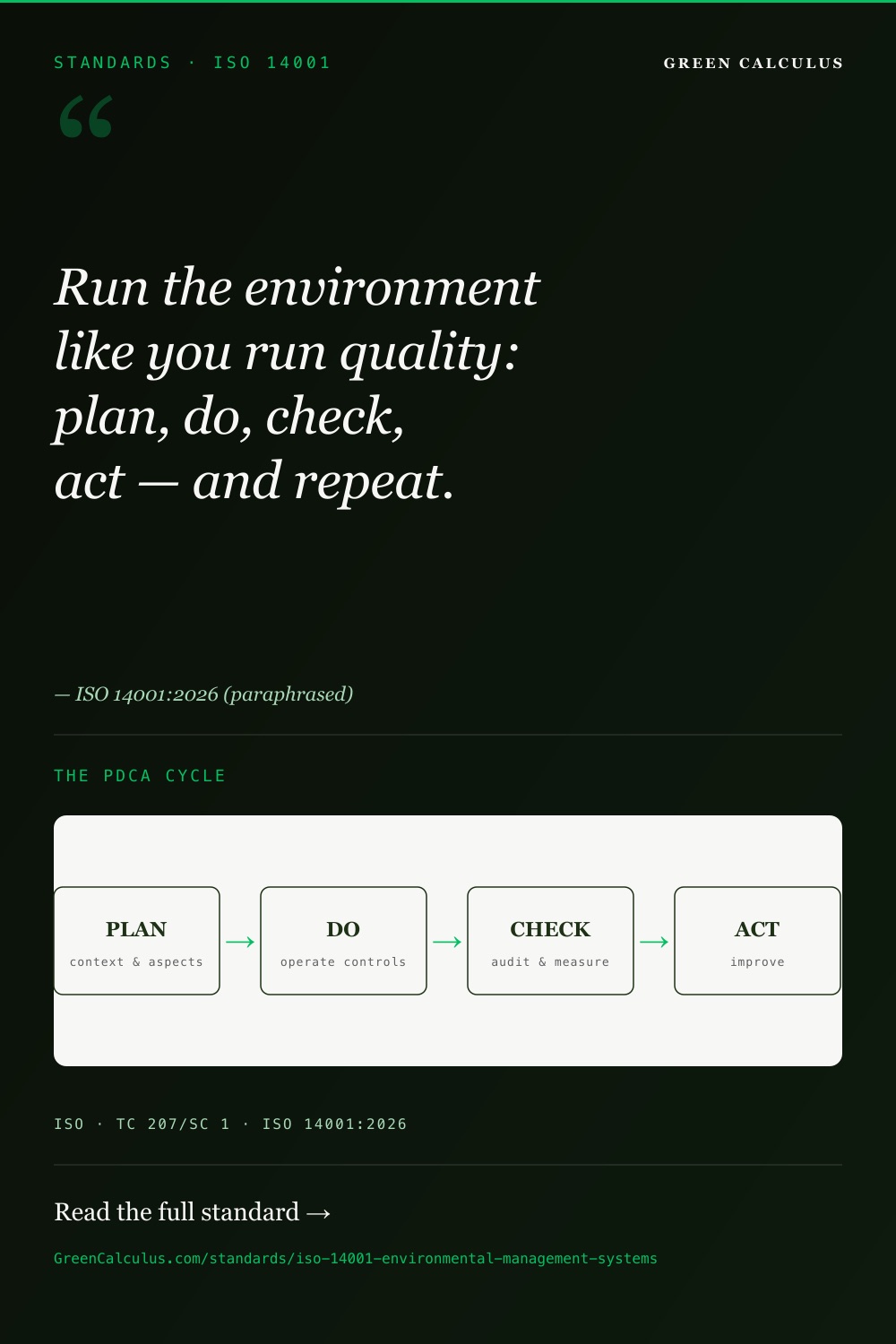
ISO 14001 is the operating system for environmental management — everything else runs on top of it.
ISO 14001 is the international standard for environmental management systems (EMS). It sets requirements for managing environmental aspects, meeting compliance obligations, and improving performance through a Plan-Do-Check-Act cycle. The current edition, ISO 14001:2026, replaces ISO 14001:2015.
What ISO 14001 is
ISO 14001 specifies the requirements for an environmental management system (EMS) that an organization can use to enhance its environmental performance. In the standard’s own terms, an EMS is the part of the overall management system used to manage environmental aspects, meet compliance obligations, and address risks and opportunities. It is a framework, not a checklist of environmental targets: two organizations doing similar work can hold different policies, obligations, and performance goals and both conform to ISO 14001, because the standard governs the system that manages the environment, not the specific environmental outcomes.
It is deliberately universal. ISO 14001:2026 applies to any organization regardless of size, sector, location, or industry — a global manufacturer and a single-site services firm use the same clause structure, scaled to their context. Conformity can be demonstrated in four ways: self-determination and self-declaration; confirmation by an interested party such as a customer; confirmation of the self-declaration by an external party; or full certification by an accredited external certification body. The last of these — third-party certification — is what most people mean when they say a company “has ISO 14001.”
ISO 14001 does not set an emissions limit or a pass/fail environmental score. It requires an organization to define its own environmental policy and objectives and then build a disciplined system to pursue and improve them. This is why it complements — rather than competes with — measurement standards like the GHG Protocol and disclosure regimes like CSRD: those supply the numbers and the reporting obligations, while ISO 14001 supplies the management machinery that produces and governs them.
Provider directory
Now it has to hold up all year.
See who does this work. Every listing names the standards it works to, and paid placements are labelled. Including Anthesis Group and Attain Zero.
Browse 6 carbon accounting & inventory providers →Do this work? A listing is US$390 a year. Get listed →
The PDCA cycle and Harmonized Structure
The engine of ISO 14001 is the Plan-Do-Check-Act (PDCA) cycle — the continual-improvement loop that runs through every clause. Plan: establish the objectives and processes needed to deliver results in line with the environmental policy. Do: implement the processes. Check: monitor and measure against policy, objectives, and obligations, and report the results. Act: take actions to continually improve. The cycle is not a one-time project; it is a permanent rhythm the EMS repeats.
ISO 14001 is built on the Harmonized Structure (formerly Annex SL) — the common high-level clause framework, shared terminology, and identical core text that ISO applies across its management-system standards. This is why ISO 14001 slots so cleanly alongside ISO 9001 (quality), ISO 45001 (occupational health and safety), and ISO 50001 (energy management): they share the same skeleton, so an organization running one can integrate the others with far less duplication.
The ten clauses, clause by clause
ISO 14001 has ten clauses. The first three are introductory (scope, normative references, terms and definitions); the requirements an organization is audited against live in Clauses 4 through 10. The table below walks the requirement clauses and their key sub-clauses, with the 2026 additions marked.
| Clause | Title | What it requires |
|---|---|---|
| 4 | Context of the organization | Determine internal and external issues, interested parties, and the EMS scope. 2026: environmental conditions — climate change, biodiversity, resource availability, pollution — must be explicitly considered. |
| 5 | Leadership | Top-management commitment, an environmental policy, and assigned roles and responsibilities. 2026: stronger, more distributed leadership accountability. |
| 6 | Planning | Environmental aspects, compliance obligations, objectives and planning to achieve them. 2026: new Clause 6.1.4 (risks and opportunities as a standalone requirement) and new Clause 6.3 (planning of changes). |
| 7 | Support | Resources, competence, awareness, communication, and documented information. |
| 8 | Operation | Operational planning and control, and emergency preparedness and response. 2026: broader life-cycle and supply-chain/outsourcing scope; expanded emergency preparedness. |
| 9 | Performance evaluation | Monitoring, measurement, analysis and evaluation; internal audit; management review. 2026: Clause 9.2.2 requires documented internal-audit objectives; management review restructured as inputs → process → results. |
| 10 | Improvement | Nonconformity and corrective action, and continual improvement of the EMS. |
Environmental aspects and impacts
The conceptual core of ISO 14001 is the distinction between an environmental aspect and an environmental impact. An aspect is an element of an organization’s activities, products, or services that interacts with the environment — fuel combustion, water abstraction, waste generation, refrigerant use. An impact is the resulting change to the environment — climate change, water depletion, land contamination. The EMS requires an organization to identify its aspects, determine which are significant, and manage those significant aspects through objectives and operational controls.
Aspect → Impact
Natural gas combustion in a boiler (aspect) → greenhouse gas emissions and climate change (impact). Solvent use in a process (aspect) → air pollution (impact). The aspect is what the organization does; the impact is what happens to the environment as a result.
Significance and life-cycle perspective
Not every aspect is significant. The organization sets criteria to rank them, and ISO 14001:2026 strengthens the requirement to apply a life-cycle perspective — considering aspects from raw materials and suppliers through use and end-of-life, not only at the factory gate.
Under ISO 14001:2026, greenhouse gas emissions are squarely within the aspects-and-impacts framework, and climate change is now explicitly named as an environmental condition in Clause 4. In practice this means an organization’s Scope 1 direct emissions and its purchased-energy emissions belong in the aspects register, ranked for significance, and managed through EMS objectives — the same discipline the standard applies to waste, water, and air pollution.
Compliance obligations and risks and opportunities
Two further planning pillars sit alongside aspects. Compliance obligations are the legal requirements and other commitments an organization must fulfil — environmental permits, discharge consents, waste regulations, plus voluntary commitments it has adopted. ISO 14001 requires the organization to determine these obligations, have access to them, and evaluate its compliance periodically. Risks and opportunities are the uncertainties that could affect the EMS’s ability to achieve its intended outcomes — and, in the 2026 edition, this logic gets its own dedicated sub-clause.
| Planning pillar | What it captures | Clause |
|---|---|---|
| Environmental aspects | How the organization’s activities interact with the environment, and which interactions are significant | 6.1.2 |
| Compliance obligations | Legal requirements and other commitments the organization must meet | 6.1.3 |
| Risks and opportunities | Uncertainties affecting EMS outcomes — now a standalone requirement aligned with ISO 9001 logic | 6.1.4 (new in 2026) |
What changed in ISO 14001:2026
ISO 14001:2026 is an evolution of the 2015 edition, not a replacement of its architecture. The PDCA cycle and the ten-clause Harmonized Structure are unchanged. What the revision does is remove ambiguity: topics the 2015 edition allowed organizations to treat as optional — climate, biodiversity, change management — are now explicit, named, and auditable. Most additions live in the normative requirements around context, planning, and operation, with expanded guidance in Annex A.
Almost every 2026 change follows one pattern — taking something the 2015 edition implied and making it explicit and auditable. Climate change was always a possible significant aspect; now it is named. Change management was always good practice; now it is Clause 6.3. Risk was always part of planning; now it is Clause 6.1.4. For an organization that already ran a mature EMS, much of this is documentation and evidence work rather than new capability — but for one that treated the softer requirements as optional, the revision removes that latitude.
The transition timeline
Publication of a new edition starts a formal transition window governed by the IAF (International Accreditation Forum). Certified organizations move to the 2026 edition through their normal audit cycle, and certification bodies stop issuing new 2015 certificates partway through the window.
Most organizations do not commission a standalone transition audit. They fold the transition into their next scheduled surveillance or recertification audit, assessed against the 2026 edition — the route most certification bodies favour to keep cost and disruption down. The practical advice from across the certification industry is consistent: start with a gap analysis against the published 2026 text now, focus documentation effort on Clauses 4.1, 6.1.4, 6.3, and 8.1, and transition methodically through the normal audit cycle rather than rushing in 2028.
Certification — how it works
Third-party certification is the most recognised route to demonstrating conformity. It follows a defined sequence, and it is issued by a certification body accredited under a national accreditation member of the IAF — the accreditation is what gives the certificate its credibility, because it confirms the certifier itself is competent and impartial.
Integration with other management systems
Because ISO 14001 shares the Harmonized Structure with ISO’s other management-system standards, organizations frequently run an integrated management system (IMS) rather than parallel silos. The shared clause numbering and common text mean context, leadership, planning, support, operation, evaluation, and improvement can be governed once and applied across environment, quality, safety, and energy.
| Standard | Domain | Relationship to ISO 14001 |
|---|---|---|
| ISO 9001 | Quality management | Same Harmonized Structure; the 2026 edition deliberately tightens ISO 14001’s risk logic toward ISO 9001. |
| ISO 45001 | Occupational health & safety | Same structure; commonly integrated with ISO 14001 as a combined EHS system. |
| ISO 50001 | Energy management | Same structure; directly complementary — energy performance is a major environmental aspect, so ISO 50001 deepens the energy side of an ISO 14001 EMS. |
ISO 14001 and GHG accounting
ISO 14001 is the management frame; GHG accounting standards are the measurement content that sits inside it. An organization’s greenhouse gas inventory is not produced by ISO 14001 — it is produced by the GHG Protocol or ISO 14064-1 — but ISO 14001 is what makes that inventory a governed, improving, audited part of the business rather than an annual spreadsheet exercise.
| GHG framework | How it fits inside ISO 14001 |
|---|---|
| GHG Protocol Corporate Standard | Supplies the Scope 1/2/3 accounting method; the resulting emissions become significant environmental aspects managed by the EMS. |
| ISO 14064-1 | The ISO-family GHG inventory standard — a natural pairing, sharing ISO’s terminology and structure with ISO 14001. |
| IPCC AR6 | Supplies the GWP values that convert gases to CO₂e when quantifying the climate impact of aspects. |
| ISO 14064-3 | GHG verification — the assurance layer that can validate the emissions data an EMS manages. |
In practice, an organization building a defensible climate program uses ISO 14001 to hold the whole thing together: the GHG inventory (via the ISO 14064-1 inventory methodology, supported by an inventory calculator) becomes an aspect the EMS tracks and improves, emissions-reduction objectives sit in Clause 6, operational controls in Clause 8, and performance is checked and reviewed in Clause 9. The standard turns a static footprint into a managed one.
ISO 14001 as the backbone for CSRD and ESRS
A well-run ISO 14001 EMS is quietly one of the most useful assets a company can bring to European sustainability reporting. The environmental topical standards under the CSRD’s ESRS map closely onto the aspects an EMS already manages, which means much of the data-collection, governance, and control infrastructure a reporter needs is already in place.
| ESRS environmental topic | Corresponding ISO 14001 aspect area |
|---|---|
| ESRS E1 — Climate change | GHG emissions aspects; energy; climate as a named environmental condition (Clause 4) |
| ESRS E2 — Pollution | Air, water, and soil pollution aspects; operational controls |
| ESRS E3 — Water & marine resources | Water abstraction and discharge aspects |
| ESRS E4 — Biodiversity & ecosystems | Biodiversity as a named environmental condition (Clause 4, 2026) |
| ESRS E5 — Resource use & circular economy | Waste and material-flow aspects; life-cycle perspective |
ISO 14001 does not produce a CSRD disclosure — it does not require double materiality, intensity ratios, or the specific ESRS datapoints. What it provides is the operational backbone that generates governed, audited environmental data across exactly the topics ESRS covers. Organizations moving into mandatory climate and environmental disclosure generally find their EMS is the fastest route to the underlying evidence, even though the disclosure standard sits a layer above it.
Transition readiness checklist
For an organization already certified to ISO 14001:2015, this checklist covers the gaps that the 2026 edition most commonly opens. Check every item already in place; the tool flags where transition work remains.
Common implementation errors
Frequently asked questions
ISO 14001 is the international standard for environmental management systems (EMS), published by the International Organization for Standardization. It specifies the requirements for a system an organization can use to manage its environmental aspects, meet its compliance obligations, address risks and opportunities, and continually improve its environmental performance through a Plan-Do-Check-Act cycle. It is a management-system standard, not an emissions limit or a reporting template — it governs how environmental performance is managed, not the specific outcomes. More than 670,000 organizations across 171 countries are certified to it.
The current edition is ISO 14001:2026, published on 15 April 2026. It replaces ISO 14001:2015, which is now withdrawn, and absorbs the February 2024 climate-change amendment (ISO 14001:2015/Amd 1:2024). Organizations certified to the 2015 edition are in a three-year transition period and must move to the 2026 edition by approximately May 2029 for their certificates to remain valid. The 2026 edition keeps the same Plan-Do-Check-Act cycle and ten-clause Harmonized Structure, so it is an evolutionary update rather than a structural overhaul.
The main changes are: Clause 4 now explicitly names climate change, biodiversity, resource availability, and pollution as environmental conditions to consider; a new Clause 6.3 introduces formal change-management planning; a new Clause 6.1.4 separates risks and opportunities into a standalone requirement; the life-cycle perspective and supply-chain scope in operational controls are strengthened; Clause 9.2.2 requires documented internal-audit objectives; and the management-review clause is restructured around inputs, process, and results. The PDCA cycle and Harmonized Structure are unchanged, so most existing documentation carries over with targeted updates.
The transition period is three years from publication. ISO 14001:2026 was published on 15 April 2026, so organizations certified to ISO 14001:2015 have until approximately May 2029 (April/May 2029 per the IAF mandatory transition document) to transition. Around 18 months after publication — roughly October 2027 — certification bodies can no longer issue new certificates against the 2015 edition. Most organizations fold the transition into their next scheduled surveillance or recertification audit rather than commissioning a separate transition audit. Starting with a gap analysis early is the recommended approach.
An environmental aspect is an element of an organization’s activities, products, or services that interacts with the environment — for example, fuel combustion, water abstraction, or waste generation. An environmental impact is the resulting change to the environment — for example, climate change, water depletion, or land contamination. The aspect is the cause (what the organization does); the impact is the effect (what happens to the environment). ISO 14001 requires organizations to identify their aspects, determine which are significant, and manage the significant ones through objectives and operational controls. Greenhouse gas emissions are an aspect whose impact is climate change.
No. ISO 14001 is a voluntary standard — no law requires certification. Organizations pursue it for market access, customer and supply-chain requirements, regulatory goodwill, and internal discipline. Conformity can be demonstrated in several ways: self-declaration, confirmation by an interested party, external confirmation of a self-declaration, or full third-party certification by an accredited certification body. Third-party certification is the most widely recognised route and is what customers and tender processes usually mean when they require “ISO 14001”.
They operate at different layers. ISO 14001 is the management system — it governs how environmental performance is planned, controlled, evaluated, and improved. The GHG Protocol and ISO 14064-1 are measurement standards — they tell an organization how to calculate its greenhouse gas inventory. In practice, the GHG inventory becomes a significant environmental aspect that the ISO 14001 EMS manages: emissions objectives sit in the planning clause, operational controls in the operation clause, and performance is checked in the evaluation clause. ISO 14001 turns a static carbon footprint into a governed, improving one.
Yes, and it is common. ISO 14001, ISO 9001 (quality), ISO 45001 (health and safety), and ISO 50001 (energy) all share the Harmonized Structure — the same high-level clause framework and common core text. This shared skeleton lets organizations run an integrated management system where context, leadership, planning, support, operation, performance evaluation, and improvement are governed once and applied across all domains, rather than maintaining separate parallel systems. The 2026 edition deliberately tightens ISO 14001’s risk logic toward ISO 9001, making integration cleaner.
Indirectly but substantially. ISO 14001 does not produce a CSRD disclosure — it does not require double materiality, intensity ratios, or the specific ESRS datapoints. What it provides is the operational backbone that generates governed, audited environmental data across the topics the ESRS environmental standards cover: climate (E1), pollution (E2), water (E3), biodiversity (E4), and circular economy (E5). An organization with a well-run EMS already manages exactly these aspects, so it typically finds the EMS is the fastest route to the underlying evidence a disclosure requires, even though the disclosure standard sits a layer above the management system.
PDCA — Plan-Do-Check-Act — is the continual-improvement cycle at the heart of ISO 14001. Plan: establish environmental objectives and the processes to deliver them, in line with the environmental policy (Clauses 4–6). Do: implement the processes (Clauses 7–8). Check: monitor and measure against policy, objectives, and obligations, through internal audit and management review (Clause 9). Act: take action to continually improve (Clause 10). The cycle repeats permanently — the EMS is never “finished,” it is continually improved, which is what makes ISO 14001 a living system rather than a one-time certification.