
OGMP 2.0 — The Definitive Reference

For three decades the oil and gas sector reported its methane emissions the way it reported almost everything else — with generic emission factors multiplied by activity data, producing an inventory that looked precise on paper and diverged from reality by a factor of two or more whenever anyone measured it directly. OGMP 2.0 exists to end that gap. It is the only comprehensive, measurement-based methane reporting framework for the sector, and its core premise is blunt: an estimate you cannot reconcile against a measurement is not good enough.
OGMP 2.0 is where methane reporting stops being an accounting exercise and becomes a measurement discipline.
OGMP 2.0 is UNEP’s voluntary, measurement-based methane reporting framework for oil and gas. Members report Scope 1 methane across operated and non-operated assets on a five-level scale, targeting Level 4–5 “Gold Standard” reporting that reconciles source inventories against site measurements.
What OGMP 2.0 is — and who runs it
The Oil & Gas Methane Partnership 2.0 is the United Nations Environment Programme’s flagship methane reporting and mitigation programme for the oil and gas industry. It is voluntary, principles-based, and — uniquely among methane frameworks — built around direct measurement rather than generic estimation. Companies that join commit to reporting their Scope 1 methane emissions annually, across both operated and non-operated assets, using the most accurate methods and science-based measurement available, and to improving the granularity of that reporting year on year until source-level inventories can be reconciled against site-level measurements.
The partnership has a specific lineage. The original Oil and Gas Methane Partnership (OGMP) was launched by the Climate and Clean Air Coalition (CCAC) at the UN Secretary-General’s Climate Summit in 2014. In November 2020, UNEP, CCAC, the European Commission, the Environmental Defense Fund, and an initial cohort of 62 oil and gas companies re-launched it as OGMP 2.0 — a substantially more ambitious framework that connects reporting directly to mitigation. The programme is now administered by UNEP’s International Methane Emissions Observatory (IMEO), the body that collects, reconciles, and publishes the reported data.
Human-caused methane emissions drive roughly one-third of current global warming, and the oil and gas value chain is one of the largest and most abatable sources. The problem OGMP 2.0 addresses is not that the sector under-reports on purpose — it is that generic emission factors systematically miss the intermittent, heavy-tailed nature of real methane releases, where a small number of “super-emitter” events dominate the total. Direct measurement catches what factors miss. See the GreenCalculus reference on methane (CH₄) as a greenhouse gas for the underlying atmospheric science.
The measurement layer over methane reporting
OGMP 2.0 is best understood not as a competitor to corporate GHG accounting standards but as the measurement discipline that sits underneath them for one specific gas in one specific sector. A GHG Protocol inventory tells a company how to classify and total its emissions; OGMP 2.0 tells it how good the underlying methane numbers have to be. The two are complementary layers, not alternatives.
A company can be fully GHG Protocol-compliant and still be reporting methane at OGMP 2.0 Level 1 — a single consolidated estimate built from industry-average factors. Compliance with the accounting standard says nothing about the empirical quality of the methane figure inside it. OGMP 2.0 is the framework that grades that quality and drives it upward. This is why regulators and disclosure regimes increasingly point at OGMP 2.0 levels rather than re-inventing a measurement scale of their own.
Scope — operated, non-operated, and the value chain
OGMP 2.0’s scope is deliberately broader than the operational-control boundary most companies default to for Scope 1 reporting. Members commit to report methane from both operated and non-operated assets, including joint ventures in which they hold an interest but do not run day-to-day operations. This is the single most operationally demanding feature of membership: it forces companies to obtain credible methane data from partners they do not control, which is why the framework allows a longer runway for non-operated assets than for operated ones.
| Asset class | In OGMP 2.0 scope? | Notes |
|---|---|---|
| Operated assets | Yes — full reporting | Company controls operations and data. Gold Standard timeline: 3 years to Level 4/5 for material assets. |
| Non-operated assets and joint ventures | Yes — full reporting | Company holds an interest but does not operate. Gold Standard timeline: 5 years, reflecting the difficulty of obtaining partner data. |
| Upstream (exploration & production) | Yes | Reports against the IOGP upstream source categories (venting, fugitives, flaring, energy/combustion, other). |
| Midstream (transmission, storage, LNG) | Yes | Pipelines, gas storage, and LNG terminals report against the midstream/downstream categories (fugitives, venting, incomplete combustion). |
| Downstream (distribution) | Yes | Distribution networks report against the same midstream/downstream category set. |
| Refineries, chemical plants, biogas/biomethane, end users | Generally out of scope | Product manufacturing and end use fall outside the current asset-type definitions — check the reporting templates for the definitive asset-type list. |
The gas of interest is methane specifically, reported as a Scope 1 direct emission and separately from the carbon dioxide that combustion produces. Because the framework is measurement-led, it categorises emissions by how they physically occur — venting, fugitive leakage, flaring, and incomplete combustion — rather than by the equipment-centric taxonomies used in bottom-up factor inventories. That physical framing is what makes site-level reconciliation possible at Level 5.
The five reporting levels
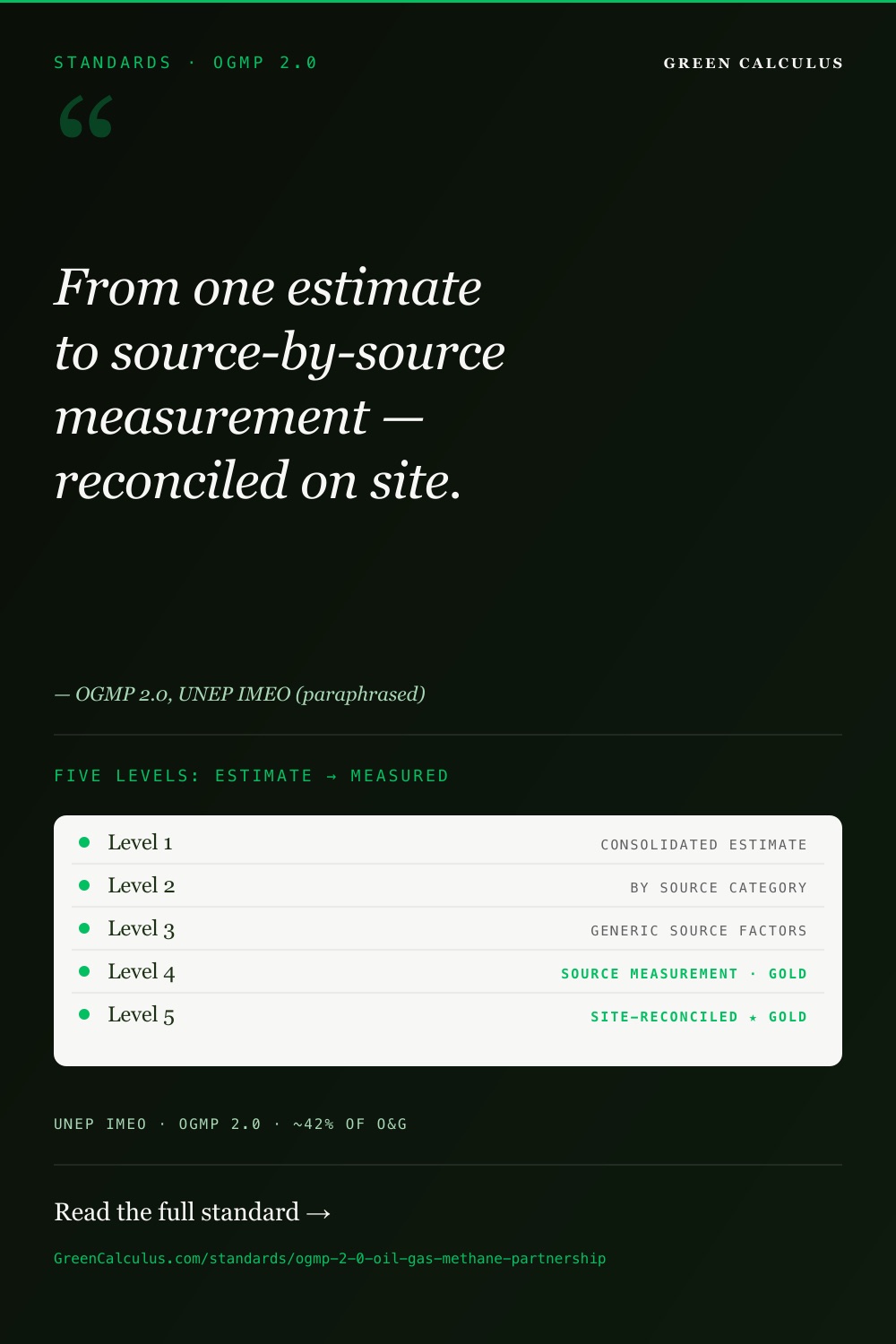
The five-level scale is the heart of OGMP 2.0. It is a data-quality ladder: each rung demands more granular, more empirical, and more defensible methane data than the one below. Levels 1–3 are estimation tiers; Levels 4–5 are measurement tiers. The framework’s entire design intent is to move companies up the ladder over time, not to reward staying put at a level that looks complete but rests on generic factors.
A single emissions figure at the asset, venture, or country level, built from industry-average emission factors or comparison with similar facilities. The starting point for a newly joined member or for immaterial assets. No source breakdown.
Estimation — bottom-upEmissions split across the simplified IOGP source categories — venting, fugitives, flaring, energy/combustion, and other for upstream; fugitives, venting, and incomplete combustion for midstream and downstream. Still generic factors, but now attributable to a category.
Estimation — bottom-upReporting by detailed individual source (compressors, valves, tanks, pneumatic devices) using generic, source-level emission factors. This is the level most operators are already familiar with — it is broadly comparable to US EPA Subpart W inventory reporting.
Estimation — detailed sourceReporting by detailed source using source-specific emission factors and activity factors derived from direct measurement or detailed engineering models — typically developed through statistical sampling with calibrated bagging, high-flow sampling, or continuous monitoring, plus improved activity tracking (blowdown counts, event logs). Still a bottom-up inventory, but empirically grounded.
Measurement — source levelEverything in Level 4, plus independent site-level measurement of total emissions across a statistically representative population of sites — and the reconciliation of that top-down measured total against the bottom-up source-level inventory. Site measurement complements rather than replaces the source inventory; the act of reconciling the two is what closes the gap between estimate and reality.
Measurement — site level + reconciliationLevel 3 is where reporting quality most often stalls. It looks rigorous — every source is itemised — but it still multiplies equipment counts by generic factors, so it inherits exactly the estimation error OGMP 2.0 was created to eliminate. A company reporting entirely at Level 3 has a detailed inventory that can still be off by a large multiple. The framework treats Level 3 as a waypoint, not a destination: material assets are expected to reach Level 4 with a credible path to Level 5.
Source categories and the Level 3–5 mapping
Because OGMP 2.0 categorises methane by how it physically escapes, the same category vocabulary runs through every reporting level — what changes up the ladder is the quality of the number attached to each category. The categories derive from the International Association of Oil & Gas Producers (IOGP) taxonomy: five for upstream operations, three for midstream and downstream.
| Segment | Source categories | Typical dominant source |
|---|---|---|
| Upstream (exploration & production) | Venting · Fugitive losses · Flaring · Energy / combustion · Other | Venting and fugitives usually dominate; flaring efficiency is a frequent hidden contributor. |
| Midstream (transmission, storage, LNG) | Fugitive losses · Venting · Incomplete combustion | Compressor seals and pipeline fugitives; incomplete combustion at turbines and engines. |
| Downstream (distribution) | Fugitive losses · Venting · Incomplete combustion | Distribution-network leakage and metering/regulating station venting. |
How the levels map onto measurement practice
| Level | Granularity | Factor basis | Measurement input | Nearest regulatory analogue |
|---|---|---|---|---|
| Level 1 | Asset / venture / country | Industry average | None | High-level national inventory estimate |
| Level 2 | Source category | Generic | None | Simplified category reporting |
| Level 3 | Detailed source | Generic source-level | None | US EPA Subpart W (generic-factor mode) |
| Level 4 | Detailed source | Source-specific | Direct source measurement / sampling | EU Methane Regulation source-level measurement |
| Level 5 | Site + source, reconciled | Source-specific, reconciled | Site-level top-down measurement | Emerging site-level regulatory MRV |
Reconciliation — Level 4 versus Level 5
The single conceptual leap in OGMP 2.0 is the move from Level 4 to Level 5, and it is worth stating precisely because it is the feature most often misunderstood. Level 4 is a bottom-up inventory: you measure or sample individual sources and sum them. Level 5 adds a top-down measurement — an independent read of a whole site’s emissions, taken from a vantage that sees everything at once (aircraft, drone, tower, or satellite) — and then reconciles the two.
Level 4 — source level (bottom-up)
Quantify each source with source-specific factors and activity data, then sum. Strength: attributes emissions to specific equipment, so it directly informs repair and mitigation priorities. Weakness: it can only count sources you know to look for — undetected leaks and intermittent super-emitters are invisible.
Level 5 — site level + reconciliation
Independently measure the site’s total emissions top-down, then compare against the summed source inventory. A persistent gap signals missing sources, under-counted activity, or intermittent releases the bottom-up count missed. Reconciling the two is what makes the reported total credible.
A common error is to treat a satellite or flyover reading as “Level 5.” It is not. Site-level measurement is a necessary input, but Level 5 is defined by the reconciliation of source-level and site-level datasets across a statistically representative population of sites. The reconciliation process — investigating and explaining the discrepancy, then improving the inventory — is where accuracy, thoroughness, and confidence are actually gained. Site measurement complements the source inventory; it does not replace it.
Materiality — the 5% rule
Not every asset must reach Level 5. OGMP 2.0 uses a materiality threshold to focus measurement effort where the emissions actually are. Assets whose methane emissions represent less than 5% of a company’s total portfolio emissions are treated as immaterial and are not required to reach Level 5 reporting. This concentrates the expensive, measurement-intensive work on the assets that dominate the footprint, consistent with the heavy-tailed distribution of methane emissions across a portfolio.
Materiality is assessed at the portfolio level, which means it is dynamic: as a company drives down emissions from its largest assets, previously immaterial assets can cross the 5% line and pull new assets into the Level 4/5 requirement. The framework’s logic is self-tightening by design — mitigation success at the top of the portfolio raises the bar for everything below it.
The Gold Standard and the Gold Standard Pathway
“Gold Standard” is OGMP 2.0’s designation for the target state of reporting: all material assets reported at Level 4 and Level 5, backed by a defined methane reduction target. It is not a badge a company claims on day one — it is the destination of a phased implementation plan with hard deadlines that start ticking the moment a company formally joins.
A company can be recognised as being on the Gold Standard Pathway before it actually reaches Level 4/5 across the portfolio. This requires submitting an OGMP 2.0-compliant Level 1 (or higher) report for all in-scope assets in line with the reporting cycle, plus a credible, granular per-asset implementation plan showing how each material asset reaches Level 4/5 within the required period. The Pathway designation rewards a serious, timebound plan — it is not a substitute for eventually delivering the measurement.
Member commitments and the annual reporting cycle
Membership carries three standing commitments and one fixed annual rhythm. The commitments are simple to state and demanding to deliver.
The annual emissions report and the updated implementation plan are both due on 31 May each year, covering the prior calendar year’s emissions. The two documents are submitted together — the report shows where the company is, the implementation plan shows where each asset is going and by when. Missing or incomplete submissions are visible to the Steering Group and undermine the Pathway/Gold Standard status the company is working toward.
IMEO, MARS and the assurance process
Reported data does not simply go into a filing cabinet. UNEP’s International Methane Emissions Observatory (IMEO) runs reported OGMP 2.0 data through a structured assurance process and integrates it with independent data streams — satellites, scientific measurement studies, and national inventories — to build an open, empirically verified dataset of oil and gas methane emissions. IMEO is a core implementing partner of the Global Methane Pledge, the effort by more than 150 countries to cut global methane emissions 30% by 2030.
Sitting alongside the annual reporting cycle is IMEO’s Methane Alert and Response System (MARS) — a satellite-based detection system that identifies large methane plumes and super-emitter events and notifies the relevant operators and governments so they can act. MARS is the near-real-time complement to OGMP 2.0’s annual inventory: the inventory characterises the baseline, MARS catches the large intermittent events between reporting cycles.
Methane reduction targets — intensity or absolute
OGMP 2.0 requires a methane reduction target but does not dictate its form. Companies choose between an intensity target and an absolute target, and the choice has real consequences for how growth interacts with the commitment.
| Dimension | Intensity target | Absolute target |
|---|---|---|
| Metric | Methane emissions per unit of throughput (e.g. % of gas marketed, or tonnes CH₄ per unit produced) | Total tonnes of methane, portfolio-wide |
| Behaviour under growth | Absolute emissions can rise while intensity falls, if production grows faster than leakage | Emissions must fall in absolute terms regardless of production |
| Common benchmark | Near-zero methane intensity — leading OGMP 2.0 members report intensities an order of magnitude below the global industry average | Aligned with the Global Methane Pledge’s 30%-by-2030 ambition where adopted |
| Best suited to | Growing portfolios demonstrating efficiency improvement | Stable or declining portfolios, and alignment with net-zero methane claims |
A methane reduction target is only as credible as the inventory it is measured against. A target set on a Level 1 estimate can appear to be met simply because the estimate never captured the emissions in the first place — and can appear to be missed the moment measurement reveals what was always there. This is the deeper reason OGMP 2.0 couples targets to the level ladder: the framework will not let a company claim a reduction it cannot measure. Moving up the levels can temporarily increase reported emissions as hidden sources surface, which is a sign the framework is working, not failing.
GWP basis — why the methane time horizon matters
Methane is a short-lived but potent greenhouse gas, and converting a mass of methane into carbon-dioxide-equivalent depends heavily on the chosen time horizon. This choice is more consequential for methane than for any other common gas, and any credible methane report must state which basis it uses. The operative reference for corporate reporting is IPCC AR6 (2021).
| Basis | Fossil methane GWP | What it emphasises |
|---|---|---|
| AR6 GWP-100 (100-year) | 29.8 | Long-run warming. The default for corporate GHG inventories, GHG Protocol, and CSRD. |
| AR6 GWP-20 (20-year) | 82.5 | Near-term warming. Highlights the urgency of methane action within the critical next two decades. |
The values above are hardcoded historical references to the IPCC AR6 assessment as it reads today; the full set of AR6 factors, including biogenic methane and the climate-carbon-cycle-feedback variants, is maintained on the AR6 GWP-100 dataset. For the conceptual background on why the time horizon dominates methane’s CO₂e, see the reference on global warming potential. OGMP 2.0 reporting is expressed in methane mass; the CO₂e conversion is applied downstream when the number enters a corporate GHG inventory or disclosure.
The regulatory cascade
OGMP 2.0 was designed as a voluntary initiative, but its measurement architecture has become the reference point for a wave of binding methane regulation. The framework’s levels and reconciliation logic increasingly appear, explicitly or implicitly, in the MRV requirements that regulators are writing.
| Instrument | Jurisdiction | Relationship to OGMP 2.0 |
|---|---|---|
| EU Methane Regulation (Regulation (EU) 2024/1787) | European Union | Mandates source-level measurement and, for imports, methane-intensity transparency. OGMP 2.0 Level 4/5 reporting maps directly onto its MRV expectations; membership is a strong readiness signal. |
| Global Methane Pledge | 150+ countries | Cut global methane 30% by 2030. IMEO — which administers OGMP 2.0 — is a core implementing partner; OGMP 2.0 data underpins progress tracking. |
| US methane rules & EPA Subpart W | United States | Subpart W inventory reporting is broadly comparable to OGMP 2.0 Level 3; empirical-data provisions push toward Level 4-grade measurement. |
| World Bank Zero Routine Flaring | Global | Targets routine flaring, a major methane and CO₂ source; complements OGMP 2.0’s flaring source category and combustion-efficiency scrutiny. |
The practical takeaway for operators is that Level 4/5 capability is no longer purely voluntary infrastructure. A company that builds measurement-grade methane MRV to satisfy OGMP 2.0 is simultaneously building the evidence base that the EU Methane Regulation and comparable regimes require. The reverse is not true: an operator waiting for regulation to compel measurement will find the required infrastructure — sampling programmes, site-level campaigns, reconciliation workflows — takes years to stand up, which is precisely why the framework’s three-and-five-year runways start at the join date.
OGMP 2.0 and corporate GHG accounting
For a sustainability or inventory team, the key integration question is how OGMP 2.0 methane numbers flow into the broader corporate carbon inventory. The answer is clean, because the two frameworks operate at different layers.
| Corporate framework | How OGMP 2.0 methane enters |
|---|---|
| GHG Protocol Corporate Standard | Methane is a Scope 1 direct emission. OGMP 2.0 improves the quality of the methane line; the classification and CO₂e conversion follow GHG Protocol. |
| ISO 14064-1 | OGMP 2.0’s measurement discipline and reconciliation strengthen the data-quality tiering and Inventory Management Plan that ISO 14064-1 assurance depends on. |
| CSRD / ESRS E1 | E1-6 gross Scope 1 includes methane. Measurement-grade OGMP 2.0 data materially raises the credibility of the disclosed figure under limited assurance. |
| US EPA Subpart W | Roughly aligns with Level 3; OGMP 2.0 pushes beyond it to source-specific and site-reconciled data. |
The practical workflow is to treat OGMP 2.0 as the methane data-quality engine and the corporate standard as the accounting frame. Companies running a fugitive and process-emissions programme will find that OGMP 2.0 Level 4/5 work produces exactly the source-attributed, measurement-backed methane data that a defensible Scope 1 inventory needs — and that a stationary-combustion inventory alone never captures, because combustion factors say nothing about venting and fugitive losses.
Level locator — self-assessment
Use this to place your current methane reporting against the OGMP 2.0 ladder. Check every statement that is true for your material assets today. The tool identifies the highest level you can defensibly claim and the gap to Gold Standard.
Common implementation errors
Frequently asked questions
OGMP 2.0 — the Oil & Gas Methane Partnership 2.0 — is the United Nations Environment Programme’s flagship methane reporting and mitigation framework for the oil and gas sector. It is the only comprehensive, measurement-based international reporting framework for the industry. Launched in November 2020 as a more ambitious successor to the 2014 OGMP, it is administered by UNEP’s International Methane Emissions Observatory (IMEO), with the Climate and Clean Air Coalition, the European Commission, and the Environmental Defense Fund as founding partners. Members commit to reporting Scope 1 methane annually across operated and non-operated assets using measurement rather than generic emission factors.
Level 1 is a consolidated estimate at asset, venture, or country level using industry-average factors. Level 2 splits emissions across the IOGP source categories. Level 3 reports by detailed individual source using generic source-level factors. Level 4 reports by detailed source using source-specific emission factors and activity data derived from direct measurement or sampling. Level 5 adds independent site-level measurement and reconciles it against the source-level inventory across a statistically representative population of sites. Levels 1–3 are estimation tiers; Levels 4–5 are measurement tiers, and reaching Level 4/5 for all material assets is the “Gold Standard”.
Level 4 is a bottom-up inventory: individual sources are measured or sampled with source-specific factors and summed. Level 5 adds a top-down, independent measurement of a whole site’s emissions and reconciles that measured total against the summed source inventory. The reconciliation is the defining feature — it surfaces missing sources, under-counted activity, and intermittent super-emitter events that a bottom-up count cannot see. Site-level measurement complements rather than replaces the source inventory; a top-down reading with nothing to reconcile against is not Level 5.
Gold Standard Reporting means all material assets are reported at Level 4 and Level 5, backed by a defined methane reduction target. Companies have three years to bring material operated assets to Level 4/5 and five years for material non-operated assets, with both clocks starting at the date the company formally joins. A company can be recognised as being on the “Gold Standard Pathway” earlier by submitting a compliant Level 1 (or higher) report for all in-scope assets plus a credible, granular per-asset implementation plan showing how each material asset reaches Level 4/5 within the required period.
Yes. Members report methane from both operated and non-operated assets, including joint ventures in which they hold an interest but do not operate. This is one of the framework’s most demanding features because it requires obtaining measurement-grade data from partners the member does not control. To acknowledge that difficulty, the Gold Standard timeline gives non-operated assets five years to reach Level 4/5, versus three years for operated assets. Reporting only operated assets does not satisfy OGMP 2.0.
Assets whose methane emissions represent less than 5% of a company’s total portfolio emissions are treated as immaterial and are not required to reach Level 5 reporting. This focuses measurement-intensive work on the assets that dominate the footprint. Materiality is assessed at the portfolio level, so it is dynamic: as a company reduces emissions from its largest assets, previously immaterial assets can cross the 5% line and become subject to the Level 4/5 requirement. The threshold is self-tightening — mitigation success raises the bar for the rest of the portfolio.
OGMP 2.0 is a voluntary, principles-based initiative — companies choose to join. However, its measurement architecture has become the de facto reference for binding methane regulation. The EU Methane Regulation (Regulation (EU) 2024/1787) requires source-level measurement and import-side methane transparency that maps closely onto OGMP 2.0 Level 4/5, and IMEO — which administers OGMP 2.0 — is a core implementing partner of the Global Methane Pledge. In practice, building OGMP 2.0-grade measurement infrastructure is increasingly the same infrastructure regulators require, so the voluntary framework and mandatory regimes are converging.
OGMP 2.0 reporting is expressed in methane mass; the CO₂e conversion is applied downstream when the number enters a corporate inventory or disclosure. The corporate default is IPCC AR6 GWP-100, which gives fossil methane a value of 29.8. On the 20-year basis (AR6 GWP-20), fossil methane is 82.5 — the higher figure reflects methane’s intense near-term warming. Because the value nearly triples between the two horizons, any methane figure reported as CO₂e must state its basis. AR6 GWP-100 is the convention for GHG Protocol and CSRD reporting.
They operate at different layers. GHG Protocol tells a company how to classify and total its emissions — methane is a Scope 1 direct emission. OGMP 2.0 tells it how good the underlying methane number has to be. A company can be fully GHG Protocol-compliant while reporting methane at Level 1, because the accounting standard says nothing about the empirical quality of the figure. OGMP 2.0 grades and improves that quality. Under CSRD/ESRS E1, gross Scope 1 includes methane, so measurement-grade OGMP 2.0 data materially raises the credibility of the disclosed figure under limited assurance.
The annual emissions report and the updated implementation plan are both due on 31 May each year, covering the prior calendar year’s emissions. The two are submitted together: the report shows where each asset currently sits on the level ladder, and the implementation plan shows the timebound pathway to Level 4/5. Members also nominate technical, steering-group, and MARS focal points, and report progress against their methane reduction target through the OGMP web application.