
45Z Tax Credit Calculator: Clean Fuel Production Credit per Gallon

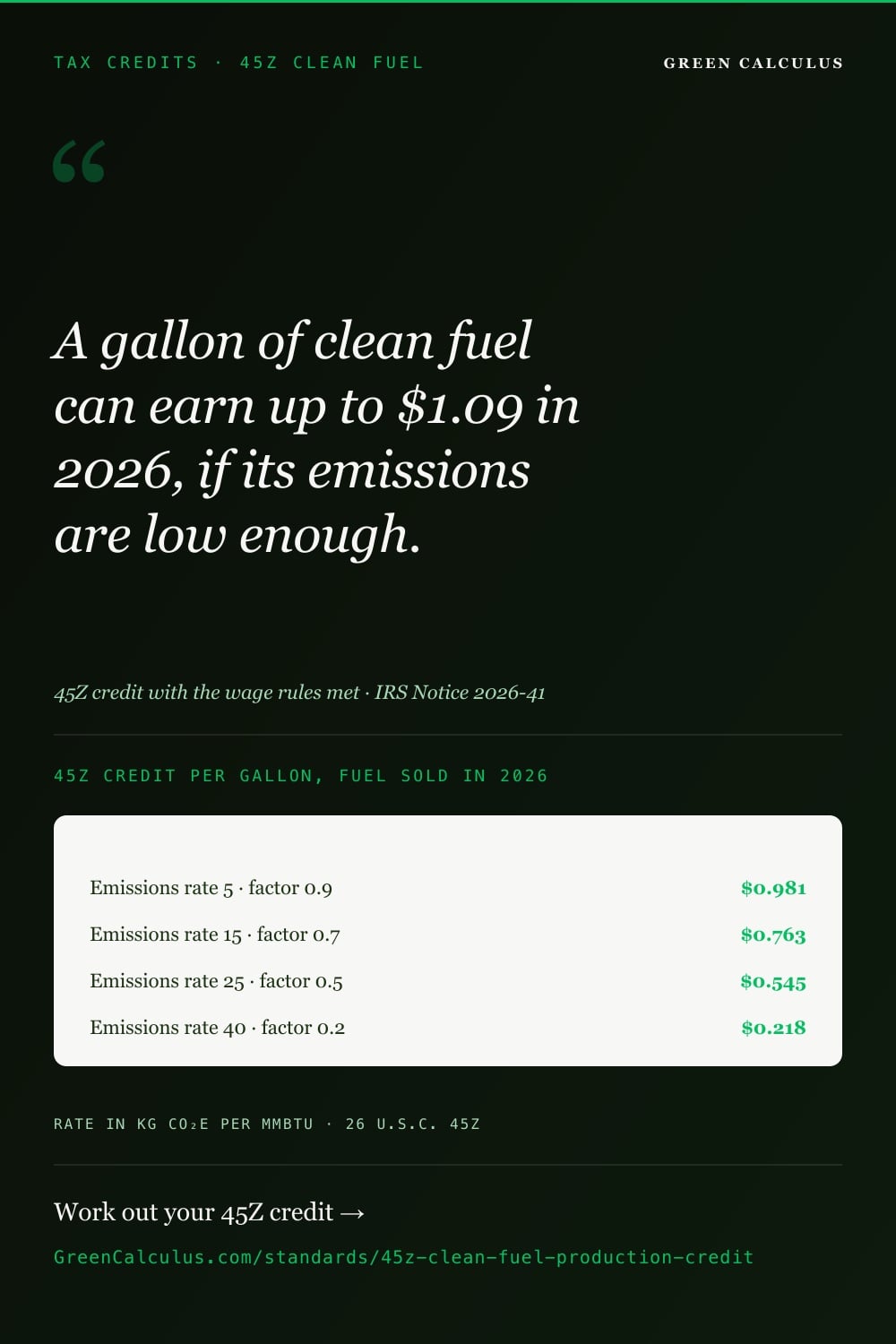
The 45Z clean fuel production credit is a US federal tax credit for each gallon of low-emission transportation fuel a registered producer makes in the United States and sells. For fuel sold in 2026, the 45Z credit is $1.09 a gallon times the fuel's emissions factor if the plant meets the prevailing wage and apprenticeship rules (22 cents otherwise), where the factor is (50 minus the fuel's emissions rate in kg CO2e per MMBtu) divided by 50, rounded to the nearest 0.1. Fuel must be sold by 31 December 2029.
45Z credit calculator
Enter your fuel’s emissions rate from the IRS emissions rate table, from your own 45ZCF-GREET run, or from a provisional emissions rate. The calculator rounds the emissions factor the way the law does, picks the right amount for the year the fuel was made and sold, and shows how far your rate is from the next step up.
Worked example: a fuel with an emissions rate of 21.25 kg CO2e per MMBtu has an emissions factor of (50 − 21.25) ÷ 50 = 0.575, rounded to 0.6. Sold in 2026 from a plant that meets the wage and apprenticeship rules, it earns $1.09 × 0.6 = $0.654 a gallon, or $654,000 on 1 million gallons.
Amounts from the IRS inflation notices, checked 2 November 2026. This is an estimate for planning, not tax advice: the credit you can claim depends on your facility’s registration, records and the final regulations. GreenCalculus has no affiliate links on this page and does not sell credit transfers.
What changed recently
- 8 Sep 2026: IRS Notice 2026-53 published the 2026 emissions rate table. It lists fuel pathways and points to the most recent version of DOE’s 45ZCF-GREET model for the rates themselves, and adds dairy and swine manure as separate feedstocks.
- 13 Jul 2026: Notice 2026-41 set the 2026 amounts: $1.09 a gallon if the wage and apprenticeship rules are met, 22 cents if not.
- 29 Jun 2026: USDA published final technical guidelines for low-carbon (regenerative) biofuel feedstocks and an updated Feedstock Carbon Intensity Calculator.
- 4 Feb 2026: Treasury and the IRS published proposed 45Z regulations. They are not final yet.
- 4 Jul 2025: the 2025 budget law (Pub. L. 119-21) extended 45Z to fuel sold by 31 December 2029 and changed several rules for fuel made from 2026.
Provider directory
Need help keeping this up all year?
See who does this work. Every listing names the standards it works to, and paid placements are labelled. Including Anthesis Group and The Carbon Trust.
Browse 6 carbon accounting & inventory providers →Do this work? A listing is US$390 a year. Get listed →
How the 45Z credit is calculated
The credit for each gallon is the applicable amount times the fuel’s emissions factor. The applicable amount is set by the IRS each year; the emissions factor measures how far the fuel’s lifecycle emissions are below a baseline of 50 kg CO₂e per MMBtu.
- Find the emissions rate. This is the fuel’s lifecycle greenhouse gas emissions in kg CO₂e per million Btu (MMBtu), taken from the IRS emissions rate table, which relies on DOE’s 45ZCF-GREET model for most fuels, or from a provisional emissions rate the IRS has granted.
- Work out the emissions factor: (50 − emissions rate) ÷ 50, then round to the nearest 0.1. A fuel at 50 or above gets nothing; a fuel at zero gets the full amount.
- Pick the applicable amount for the year the fuel is sold: $1.09 a gallon in 2026 if the facility meets the prevailing wage and apprenticeship rules, 22 cents if it does not.
- Multiply: applicable amount × emissions factor × gallons sold (or gallon equivalents for gas fuels). The law rounds the credit to the nearest cent.
The rounding matters more than it looks. The proposed regulations give two examples: a rate of 21.25 gives (50 − 21.25) ÷ 50 = 0.575, which rounds up to 0.6; a rate of 23 gives 0.54, which rounds down to 0.5. Each step of 0.1 is a band 5 kg wide, so cutting a rate from 23 to 22.5 moves the fuel up a full step. The calculator shows the rate you would need for the next step.
Credit per gallon at every emissions rate
Every possible emissions factor, the range of rates that rounds to it, and the credit per gallon for fuel sold this year. Rates below zero only count for fuel made from animal manure from 2026, so the table stops at a factor of 1.0.
| Emissions rate (kg CO₂e/MMBtu) | Emissions factor | Wage rules met ($1.09) | Not met ($0.22) |
|---|---|---|---|
| 0 to 2.5 | 1.0 | $1.090 | $0.220 |
| Over 2.5 to 7.5 | 0.9 | $0.981 | $0.198 |
| Over 7.5 to 12.5 | 0.8 | $0.872 | $0.176 |
| Over 12.5 to 17.5 | 0.7 | $0.763 | $0.154 |
| Over 17.5 to 22.5 | 0.6 | $0.654 | $0.132 |
| Over 22.5 to 27.5 | 0.5 | $0.545 | $0.110 |
| Over 27.5 to 32.5 | 0.4 | $0.436 | $0.088 |
| Over 32.5 to 37.5 | 0.3 | $0.327 | $0.066 |
| Over 37.5 to 42.5 | 0.2 | $0.218 | $0.044 |
| Over 42.5 to 47.5 | 0.1 | $0.109 | $0.022 |
| Over 47.5 to 50 | 0.0 | $0.000 | $0.000 |
Factor = (50 − rate) ÷ 50, rounded to the nearest 0.1, rounding up from 0.05: 26 U.S.C. 45Z(b)(1)(A) and (b)(2); rounding direction from proposed §1.45Z-2(c)(2). Amounts: IRS Notice 2026-41, Internal Revenue Bulletin 2026-29 (13 July 2026), section 3.03: GDP implicit price deflator 2025 (128.986) / 2022 (118.023). A rate above 50 earns nothing. Fuel from animal manure can have a rate below zero and a factor above 1.0.
45Z amounts by year
The law sets the base amounts at 20 cents a gallon, or $1.00 with the wage and apprenticeship rules, and the IRS raises them each year for inflation from a 2022 base. The adjusted amounts usually come out in July for that calendar year. Sustainable aviation fuel had higher amounts, but only for SAF made in 2025.
| Year sold | Inflation factor | Wage rules met | Not met | SAF made in 2025 (met / not met) |
|---|---|---|---|---|
| 2025 | 1.0611 | $1.06 | $0.21 | $1.86 / $0.37 |
| 2026 | 1.0929 | $1.09 | $0.22 | $1.91 / $0.38 |
The SAF amounts apply only to SAF produced in 2025. Pub. L. 119-21 §70521 removed the higher SAF amount for fuel produced after 31 December 2025, so SAF produced from 2026 earns the same amount as other fuels. The IRS publishes each year's factor in the Internal Revenue Bulletin, usually in July. Sources: 2025: IRS Notice 2025-37 (2025-30 I.R.B.), as restated in the Instructions for Form 7218 (12/2025); 2026: IRS Notice 2026-41, Internal Revenue Bulletin 2026-29 (13 July 2026), section 3.03: GDP implicit price deflator 2025 (128.986) / 2022 (118.023).
The year that counts is the year the fuel is sold, not the year it was made. A gallon of ethanol made in December 2025 and sold in January 2026 uses the 2026 amount. The exception is SAF: the higher SAF amount applies only to SAF produced in 2025, whenever it is sold.
What the 2025 law changed
The 2025 budget law, Pub. L. 119-21, kept 45Z but changed who benefits. Most of the changes apply to fuel produced after 31 December 2025.
| Rule | Fuel produced in 2025 | Fuel produced from 2026 |
|---|---|---|
| Last day of sales | 31 December 2027 (Inflation Reduction Act) | 31 December 2029 |
| Sustainable aviation fuel | Higher amount: $1.75 a gallon ($0.35 without wage rules), before inflation | Same amount as any other fuel |
| Indirect land use change | Counted in the emissions rate | Left out of the emissions rate |
| Emissions rate below zero | Allowed | Not allowed, except for fuel from animal manure |
| Feedstock | Any origin | Grown or produced in the United States, Mexico or Canada only |
| Animal manure | One generic rate | Separate rates by manure type (dairy and swine in the 2026 table) |
26 U.S.C. 45Z as amended by Pub. L. 119-21 §70521 (4 July 2025); IRS Notice 2026-53 sections 2.03-2.04 and 4.02 (8 Sep 2026).
The two changes with the most effect on the numbers are the end of the SAF premium and the removal of indirect land use change from the emissions rate. Leaving out land use change lowers the emissions rate of crop-based fuels such as corn ethanol and soybean biodiesel, which can move them up one or more steps on the ladder. The new feedstock rule means a fuel made from, say, imported used cooking oil from outside North America earns no credit from 2026.
Emissions rates and the 45ZCF-GREET model
The emissions rate is the number that decides the credit, and for most fuels it comes from a model rather than a published list. Notice 2026-53’s 2026 emissions rate table lists fuel types and feedstocks and tells producers to use the most recent version of DOE’s 45ZCF-GREET model for the rate itself. For SAF, the law also allows rates from the ICAO CORSIA methodology.
45ZCF-GREET is a version of Argonne National Laboratory’s GREET lifecycle model set up for 45Z. DOE’s September 2026 package is a 32 MB download holding three Excel workbooks: the 45ZCF-GREET model itself, a 45ZCF Feedstock Carbon Intensity Calculator for farm practices, and the full GREET1 2025 model it depends on. You enter your plant’s energy use, feedstock and co-products, and it returns an emissions rate.
Why this page asks for your own rate
DOE’s FAQ says 45ZCF-GREET “was developed for use exclusively with Excel 365 on Windows operating systems” and will not run properly on a Mac or older Excel. The values saved in the downloaded workbook are one sample run, not a table of defaults. Rather than print rates that could be wrong for your plant, the calculator takes the rate from your own model run, the IRS table or your provisional emissions rate.
No rate for your fuel? A producer whose fuel type is not in the table can petition the IRS for a provisional emissions rate (PER). Under the proposed regulations, a rate first set for a type of fuel, in a table or by a PER, relates back to 1 January 2025.
Farmers and low-carbon feedstocks
Corn, soybean and other crop growers do not claim 45Z themselves; the fuel producer does. But farm practices can lower a fuel’s emissions rate, and so raise the producer’s credit and what the producer may pay for low-carbon crops.
On 29 June 2026 USDA published final technical guidelines for producing regenerative agricultural biofuel feedstocks (91 FR 39334, now 7 CFR part 2100) and an updated USDA Feedstock Carbon Intensity Calculator. Notice 2026-53 lets producers use the 2026 version of the 45ZCF calculator for fuel made in 2025 if the farm practices meet those guidelines, including the chain of custody and audit rules. Because the 2025 and 2026 crops were mostly planted before the guidelines were final, the IRS treats the pre-planting nutrient budget requirement as met for those years, but the nutrient applications themselves still have to be documented.
Renewable natural gas from manure
Fuel made from animal manure, mostly renewable natural gas from dairy and hog farms, is the one case where the emissions rate can stay below zero from 2026, because capturing the methane avoids emissions that would otherwise happen. A negative rate gives an emissions factor above 1.0, so the credit per gallon equivalent can be more than the applicable amount.
The 2025 law also requires separate rates for each type of manure. The 2026 table includes dairy and swine manure as distinct feedstocks. The IRS expects a 45ZCF-GREET update later in 2026 to add poultry and beef manure, and asks producers of those fuels to wait for it rather than file for a provisional rate. In the calculator, tick “Made from animal manure” to keep a negative rate.
Gas fuels: gallon equivalents
Gas fuels such as renewable natural gas and hydrogen earn the credit per gallon equivalent rather than per gallon. The proposed regulations define a gallon equivalent as the fuel’s lower heating value divided by that of a gallon of gasoline, 116,090 Btu, rounded to five decimal places. One pound of compressed natural gas (CANG) is 20,267 ÷ 116,090 = 0.17458 gallon equivalents.
| Fuel | Btu per pound (lower heating value) | Gallon equivalents per pound | Per 1,000 pounds |
|---|---|---|---|
| Compressed natural gas or RNG (CANG) | 20,267 | 0.17458 | 174.58 |
| Liquefied natural gas or RNG (liquefied CANG) | 20,908 | 0.18010 | 180.10 |
| Hydrogen | 51,585 | 0.44435 | 444.35 |
| Liquefied petroleum gas (other than propane from HEFA) | 19,873 | 0.17119 | 171.19 |
| Propane from HEFA | 18,568 | 0.15994 | 159.94 |
| Dimethyl ether | 12,417 | 0.10696 | 106.96 |
Proposed §1.45Z-1(b)(20), 91 FR 5160 (4 Feb 2026): gallon equivalent = the fuel's lower heating value in Btu / 116,090 Btu (a gallon of gasoline), rounded to 5 decimal places; lower heating values in Btu per pound. These are proposed rules, not yet final.
Choose the gas fuel in the calculator and enter pounds sold; it converts to gallon equivalents before applying the credit.
Who can claim 45Z
The proposed regulations sum up the conditions. To claim 45Z, a producer must:
- make a transportation fuel that is suitable for use as a fuel and has an emissions rate no higher than 50 kg CO₂e per MMBtu;
- make it at a qualified facility in the United States or a US territory;
- be registered with the IRS as a clean fuel producer (under section 4101) when the fuel is made; and
- sell it to an unrelated person in the same tax year.
From 2026 the feedstock must also come from the United States, Mexico or Canada. A specified foreign entity cannot claim the credit for tax years beginning after 4 July 2025, and a foreign-influenced entity cannot for tax years beginning after 4 July 2027.
45Z and 45Q do not stack at one facility. A plant where a 45Q carbon capture credit is allowed for the year is not a qualified facility for 45Z. An ethanol plant that captures and stores its fermentation CO₂ has to compare the two: carbon capture lowers the fuel’s emissions rate, which raises 45Z, but the plant can only take one credit. Our 45Q calculator works out the other side.
Claiming, transferring or getting it paid
Producers claim the credit on IRS Form 7218, Clean Fuel Production Credit, filing a separate form for each facility, and carry it to Form 3800 with their other business credits. A facility claiming the higher amount for meeting the wage and apprenticeship rules also files Form 7220 to back it up. Two other routes exist, and both need an IRS pre-filing registration first:
- Transfer: a producer can sell the credit to an unrelated taxpayer for cash under section 6418. The 2025 law kept transfers but bars selling them to a specified foreign entity.
- Elective pay: tax-exempt organizations, state and local governments, tribes and rural electric cooperatives can have the credit paid out as if it were a tax overpayment under section 6417.
Where the guidance stands
- The 2025 budget law (Pub. L. 119-21) extends 45Z to fuel sold by 31 December 2029 and makes the changes in the table above for fuel produced from 2026.
- Proposed 45Z regulations published (91 FR 5160). Comments closed 6 April 2026; not yet final.
- USDA publishes final technical guidelines for regenerative biofuel feedstocks (91 FR 39334) and an updated Feedstock Carbon Intensity Calculator.
- Notice 2026-41: the 2026 inflation adjustment, $1.09 a gallon with the wage rules, 22 cents without.
- Notice 2026-53: the 2026 emissions rate table, with DOE's September 2026 45ZCF-GREET model.
Federal Register 2026-02246; IRS news release IR-2026-108 (8 Sep 2026); IRS Notice 2026-41; IRS Notice 2026-53.
The proposed regulations closed for comments on 6 April 2026 and had a public hearing on 28 May 2026. Until they are final, the statute and the IRS notices are the binding rules, and the proposed text shows how Treasury reads them.
Frequently asked questions
For fuel sold in 2026, up to $1.09 a gallon if the plant meets the prevailing wage and apprenticeship rules and up to 22 cents if not. The full amount needs an emissions rate of 2.5 kg CO₂e per MMBtu or less; a fuel at 25 gets half of it.
Subtract the fuel’s emissions rate from 50, divide by 50 and round to the nearest 0.1. A rate of 21.25 kg CO₂e per MMBtu gives 0.575, which rounds to 0.6.
It applies to fuel produced after 31 December 2024 and sold by 31 December 2029. The 2025 budget law moved the end date from 2027 to 2029.
Only SAF produced in 2025. The 2025 budget law removed the higher SAF amount for fuel produced after 31 December 2025, so SAF made from 2026 earns the same amount per gallon as other fuels.
In the IRS emissions rate table for the year (Notice 2026-53 for 2026), which for most fuels refers you to DOE’s 45ZCF-GREET model. The model runs in Excel 365 on Windows. If your fuel is not covered, you can petition the IRS for a provisional emissions rate.
Not directly: the registered fuel producer claims it. Farm practices that meet USDA’s 2026 technical guidelines can lower the fuel’s emissions rate through the Feedstock Carbon Intensity Calculator, which raises the producer’s credit.
Not at the same facility in the same year. A facility where a 45Q carbon capture credit is allowed is not a qualified facility for 45Z.
Yes. Under section 6418 a producer can transfer the credit to an unrelated taxpayer for cash, though not to a specified foreign entity. Tax-exempt bodies and governments can instead elect direct payment under section 6417.
No. Proposed regulations were published on 4 February 2026, comments closed on 6 April and a hearing was held on 28 May 2026. Final regulations had not been published when this page was checked on 2 November 2026.
Sources and how we keep this page current
Every amount in the calculator and tables comes from one data file, read from the official documents below on 2 November 2026 and re-checked on a fixed timetable.
- 26 U.S.C. 45Z, Clean fuel production credit (Cornell LII), as amended by Pub. L. 119-21, section 70521 (4 July 2025).
- IRS, Notice 2026-41, Internal Revenue Bulletin 2026-29 (13 July 2026): the 2026 inflation adjustment factor and amounts.
- IRS, Instructions for Form 7218: the 2025 amounts (Notice 2025-37) and how to claim.
- IRS, Notice 2026-53 and news release IR-2026-108 (8 September 2026): the 2026 emissions rate table, manure feedstocks, USDA practices.
- Treasury and IRS, Section 45Z Clean Fuel Production Credit, proposed regulations, 91 FR 5160 (4 February 2026): conditions, rounding, gallon equivalents.
- US Department of Energy, 45ZCF-GREET 2026 (September 2026) and 45ZCF-GREET FAQ.
- USDA, USDA Feedstock Carbon Intensity Calculator and the technical guidelines at 91 FR 39334 (29 June 2026).
- IRS, Prevailing wage and apprenticeship FAQs.
We re-check the amounts when the IRS publishes each year’s inflation notice, usually in July, and the emissions rate rules when a new table or the final regulations come out. The dates are on our update schedule and every change is logged on the changelog. This page explains the credit for general information; it is not legal or tax advice.