
45Q Tax Credit Calculator: Carbon Capture Credit per Metric Ton

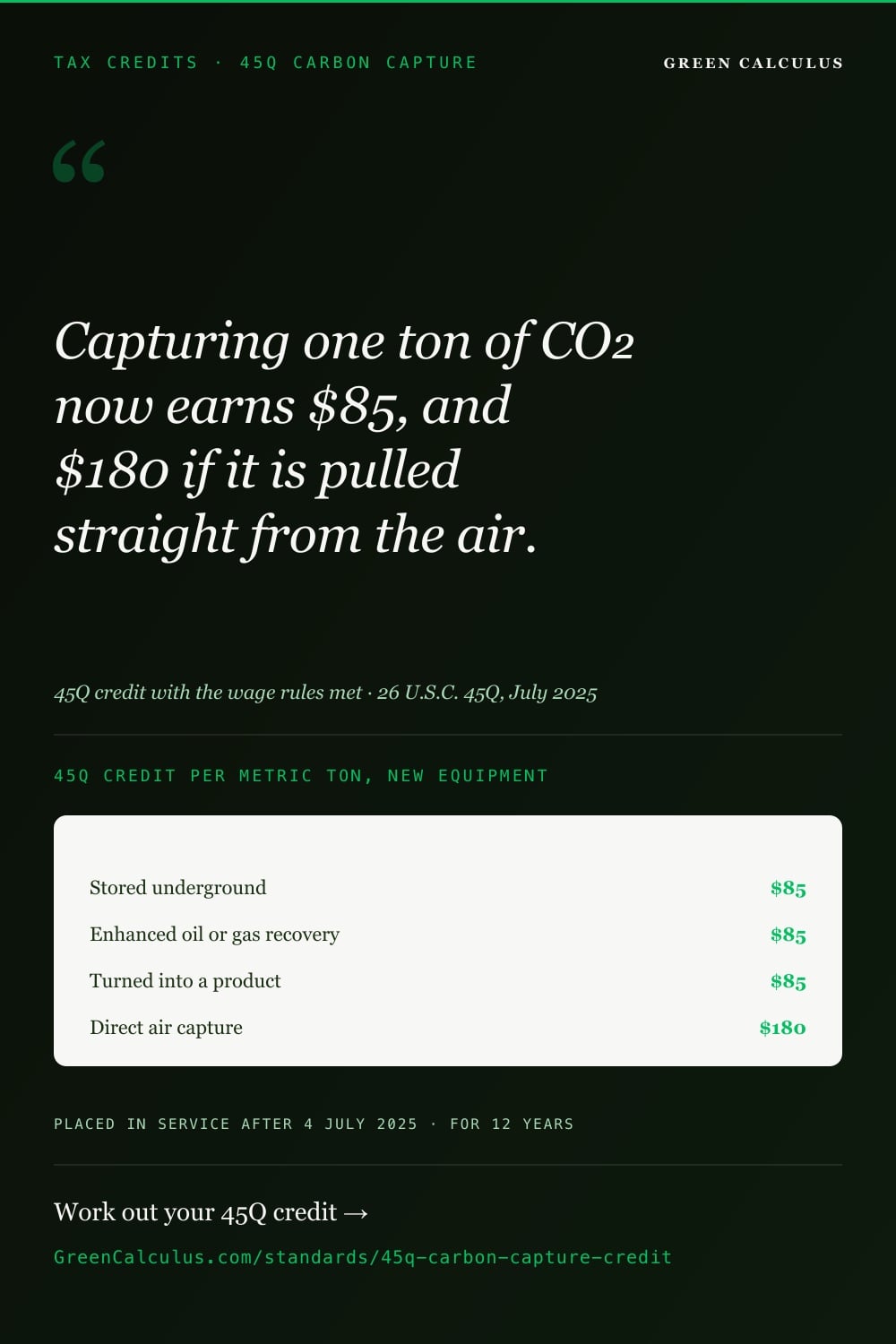
The 45Q tax credit pays the owner of carbon capture equipment for each metric ton of carbon dioxide (or other carbon oxide) it captures and stores underground, uses for oil or gas recovery, or turns into a product in the United States. For carbon capture equipment placed in service after 4 July 2025, 45Q pays $85 per metric ton of CO2 that is stored, used for enhanced oil recovery or turned into a product, and $180 per ton from direct air capture, if the prevailing wage and apprenticeship rules are met ($17 and $36 if not), for 12 years, rising with inflation from 2027.
45Q credit calculator
Choose the type of facility, what happens to the CO₂ and when the capture equipment was placed in service. The calculator gives the credit per ton, the credit for a year and the 12-year total, and warns if the plant captures too little to qualify.
Worked example: an ethanol plant placed in service in 2026 that captures and stores 300,000 metric tons of CO2 a year, meeting the wage and apprenticeship rules, earns $85 × 300,000 = $25,500,000 a year at 2026 amounts, or $306,000,000 over 12 years before inflation adjustments.
Amounts from the statute, checked 2 November 2026. From 2027 the IRS adjusts them for inflation each year, so the year-by-year table uses your own inflation assumption, set to zero by default. This is an estimate for planning, not tax advice. GreenCalculus has no affiliate links on this page and does not sell credit transfers.
What changed in 2025
- Equal amounts for every use: for equipment placed in service after 4 July 2025, CO₂ used for enhanced oil recovery or turned into products earns the same as CO₂ stored underground: $85 a ton with the wage rules, up from $60 for earlier equipment.
- Foreign entity bar: no credit for tax years beginning after 4 July 2025 if the taxpayer is a specified foreign entity or a foreign-influenced entity.
- Kept: the credit amounts for storage and direct air capture, the 12-year credit period, the 1 January 2033 construction deadline, transfers and direct pay.
Provider directory
Need help keeping this up all year?
See who does this work. Every listing names the standards it works to, and paid placements are labelled. Including Small World Consulting and Anthesis Group.
Browse 6 carbon accounting & inventory providers →Do this work? A listing is US$390 a year. Get listed →
45Q credit amounts per ton
The amount depends on three things: when the capture equipment was placed in service, whether the CO₂ comes from a plant’s exhaust (point source) or straight from the air, and whether the project meets the prevailing wage and apprenticeship rules.
| Capture equipment placed in service | Use of the CO₂ | Point source | Direct air capture |
|---|---|---|---|
| Placed in service after 4 July 2025 | Stored underground | $85 ($17) | $180 ($36) |
| Enhanced oil or gas recovery | $85 ($17) | $180 ($36) | |
| Utilization (products) | $85 ($17) | $180 ($36) | |
| Placed in service from 1 January 2023 to 4 July 2025 | Stored underground | $85 ($17) | $180 ($36) |
| Enhanced oil or gas recovery | $60 ($12) | $130 ($26) | |
| Utilization (products) | $60 ($12) | $130 ($26) |
26 U.S.C. 45Q(a)(3), (b)(1)(A)-(B) and (h); parity for storage, enhanced oil recovery and utilization added by Pub. L. 119-21 §70522(b) for facilities or equipment placed in service after 4 July 2025 (§70522(d)(2)); earlier post-2022 amounts from the Inflation Reduction Act (Pub. L. 117-169 §13104). Base amounts stay at these figures for taxable years beginning in 2025 and 2026. From 2027 they are multiplied by an inflation adjustment factor with 2025 as the base year (45Q(b)(1)(A)(ii)), which the IRS publishes each year. The five times amount needs the prevailing wage and apprenticeship rules, unless construction of the facility and the capture equipment began before 29 January 2023 (60 days after IRS Notice 2022-61).
The five times amount is the one almost every project is planned around. It needs prevailing wages for the workers who build the project and for those who later alter or repair it during the credit period, plus apprenticeship hours during construction, unless construction began before 29 January 2023. A project that misses them gets only the base amount, one fifth as much.
How the 45Q credit works
- Capture CO₂ with carbon capture equipment at a qualified facility, or from the air at a direct air capture facility, in the United States or a US possession.
- Measure it at the point of capture and verify it at the point of storage, injection or use.
- Store or use it: inject it into secure geological storage, use it to recover oil or gas and store it there, or turn it into a product.
- Claim the amount per metric ton for each year of the 12-year period that starts when the capture equipment is placed in service.
Construction of the facility or the capture equipment must begin before 1 January 2033. The calculator covers equipment placed in service from 2023; older equipment has different, inflation-indexed amounts under earlier versions of the law.
Minimum capture to qualify
A facility must capture at least a minimum amount of carbon oxide each year. A year below the line earns no credit at all, not a smaller one, which is why the calculator warns when the amount you enter is too low.
| Facility | Metric tons a year | Also |
|---|---|---|
| Direct air capture facility | 1,000 | |
| Electricity generating facility | 18,750 | And capture equipment designed to capture at least 75% of the unit's baseline carbon oxide |
| Any other facility (ethanol, gas processing, cement, hydrogen, steel and so on) | 12,500 |
26 U.S.C. 45Q(d)(1)-(2): construction must begin before 1 January 2033; minimum metric tons of qualified carbon oxide captured in the taxable year.
Storage, oil recovery and utilization
- Secure geological storage: injecting CO₂ into deep saline formations, oil and gas reservoirs or unminable coal seams under IRS rules written with EPA, DOE and the Interior Department so that it does not escape.
- Enhanced oil or gas recovery: injecting CO₂ to push out more oil or gas, with the CO₂ then kept in the reservoir. Only the first injection counts; CO₂ that comes back up and is re-injected does not.
- Utilization: turning CO₂ into a product, growing algae or bacteria with it, or another use with a commercial market. The credit is based on a lifecycle analysis of how much CO₂ the process keeps out of the air, not simply the tons delivered.
If stored CO₂ later leaks or is no longer stored as the law requires, the IRS can take back the credit already claimed for it.
Inflation from 2027
The amounts in the table apply to tax years beginning in 2025 and 2026. From 2027 the IRS multiplies them by an inflation adjustment factor with 2025 as the base year and publishes the new figures each year. Nobody knows those future factors yet, so the calculator’s 12-year table uses the inflation rate you choose. Leave it at zero to see the credit in 2026 dollars.
Who claims the credit
For equipment placed in service since 2018, the credit belongs to the person that owns the carbon capture equipment and physically or contractually ensures the CO₂ is captured and then stored, used or injected. The owner can elect to give the credit to the company that stores or uses the CO₂ instead.
From tax years beginning after 4 July 2025, a specified foreign entity or a foreign-influenced entity cannot claim it.
Claiming, transferring or direct pay
- Claim: on IRS Form 8933, Carbon Oxide Sequestration Credit, carried to Form 3800.
- Transfer: the credit can be sold for cash to an unrelated taxpayer under section 6418, but not to a specified foreign entity.
- Direct pay: unusually, 45Q direct pay under section 6417 is not limited to tax-exempt bodies and governments. Any taxpayer that placed carbon capture equipment in service after 2022 can elect it, for a limited run of years set in the law.
45Q or 45Z at an ethanol plant
An ethanol plant that captures its fermentation CO₂ can qualify for 45Q, and the capture also lowers the emissions rate of its ethanol under the 45Z clean fuel production credit. It cannot take both: a facility for which a 45Q credit is allowed in a year is not a qualified facility for 45Z in that year. Run both calculators on the same plant to see which pays more. A typical comparison sets the 45Q credit for the tons captured against the 45Z credit for the gallons sold at the lower emissions rate.
For background on the technologies, see carbon capture and storage, direct air capture and BECCS.
Frequently asked questions
For equipment placed in service after 4 July 2025, $85 a metric ton of CO₂ captured at a plant and $180 from direct air capture if the prevailing wage and apprenticeship rules are met, or $17 and $36 if not. These amounts apply in 2025 and 2026 and rise with inflation from 2027.
Yes, in two ways. For equipment placed in service after 4 July 2025, CO₂ used for enhanced oil recovery or turned into products now earns the same amount as CO₂ stored underground. And specified foreign entities and foreign-influenced entities can no longer claim it. The storage and direct air capture amounts did not change.
For 12 years from the date the carbon capture equipment is placed in service. Construction must begin before 1 January 2033.
1,000 metric tons a year for a direct air capture facility, 18,750 tons for a power plant (whose capture equipment must also be designed to capture at least 75% of the unit’s baseline carbon oxide), and 12,500 tons for any other facility.
Yes, if the CO₂ is used as a tertiary injectant in a qualified oil or gas recovery project and stays in secure geological storage. For equipment placed in service after 4 July 2025 it earns the same amount as dedicated storage.
Yes. They can be transferred for cash to an unrelated taxpayer under section 6418, though not to a specified foreign entity. Any taxpayer that placed carbon capture equipment in service after 2022 can instead elect direct payment for a limited number of years.
No. A facility for which a 45Q credit is allowed for the year is not a qualified facility for the 45Z clean fuel production credit, so a plant has to choose one each year.
IRS Form 8933, Carbon Oxide Sequestration Credit, which carries to Form 3800, General Business Credit.
Sources and how we keep this page current
Every amount in the calculator and tables comes from one data file, read from the official documents below on 2 November 2026 and re-checked on a fixed timetable.
- 26 U.S.C. 45Q, Credit for carbon oxide sequestration (Cornell LII): amounts, credit period, thresholds, uses, who claims, recapture.
- Pub. L. 119-21, section 70522 (4 July 2025): parity for every use, the foreign entity bar, effective dates.
- 26 U.S.C. 6417 (direct pay) and 6418 (transfers).
- IRS, About Form 8933, Carbon Oxide Sequestration Credit.
- IRS, Prevailing wage and apprenticeship FAQs: the 29 January 2023 construction date.
- 26 U.S.C. 45Z: the qualified facility rule that keeps 45Q and 45Z apart.
We re-check the amounts when the IRS publishes each year’s inflation factor, from 2027, and whenever the law or the regulations change. The dates are on our update schedule and every change is logged on the changelog. This page explains the credit for general information; it is not legal or tax advice.